

Urosurgery and Reconstructive Urology for Ethiopian Patients in India
Five gates every urethral stricture case should pass before accepting the same quick fix again — starting with why a treatment that works well in the short term is, by Ethiopia's own published data, failing roughly a third of the time within a year.
Aurethral stricture, a scarred narrowing that makes urination progressively difficult, is one of urology's oldest problems, and also one where the difference between a temporary fix and a permanent one is unusually well documented. In 24 years of arranging surgical care in India for patients across Africa and Asia, this is a field where a patient can genuinely be treated again and again without anyone being at fault — the treatment being repeated is real and legitimate, it simply isn't the one most likely to actually solve the problem. Ethiopia's own published research makes the pattern specific and clear. The great majority of urethral strictures here trace back to a prior infection, not age or unrelated illness. Optical urethrotomy, a scope procedure that cuts the scarred narrowing open, is simple, safe, and understandably popular — and a study from a major Addis Ababa tertiary hospital found that roughly a third of strictures treated this way returned within a single year. Urethroplasty, the reconstructive operation that removes the scarred segment entirely and rebuilds the urethra using the patient's own tissue, is described in the same Ethiopian research as the actual gold-standard treatment, with published international series achieving initial success above 95 percent. India's reconstructive urology centres perform this definitive procedure as high-volume, routine practice. These five gates walk through what's actually causing a specific stricture, why the treatment already tried may not be the one that lasts, and why India is where the definitive fix is reliably available.
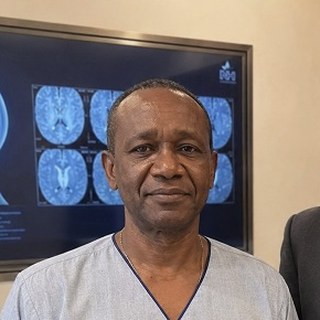
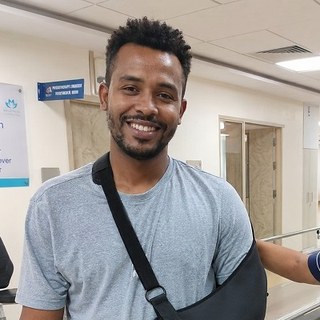
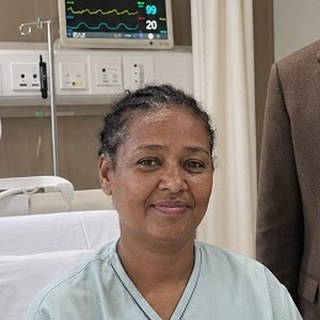
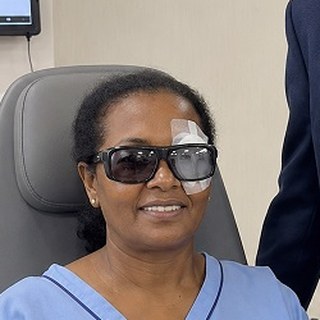
Healing Journeys of Ethiopian Patients



Key Takeaways
- The guide focuses on urethral stricture, a scar-related narrowing that can cause a weak urinary stream, difficulty starting urination and incomplete bladder emptying. It recommends confirming the diagnosis with a retrograde urethrogram and identifying the exact location and length of the stricture before selecting treatment.
- Published Ethiopian data cited in the guide shows that 82% of urethral strictures were linked to prior infection, with trauma and catheter-related causes accounting for smaller proportions. The page 3 chart highlights how important earlier infection is both for understanding the condition and for prevention.
- The page 4 chart compares 35% recurrence within one year after optical urethrotomy at an Ethiopian tertiary centre with a 97.8% initial success rate for modern substitution urethroplasty in published international series. The guide explains that optical urethrotomy remains useful, particularly for short first-time strictures, but recurrence should prompt discussion of definitive reconstruction.
- Urethroplasty is not a single technique. Short strictures may be treated with excision and primary anastomosis, while longer or more complex strictures may require buccal mucosal graft urethroplasty. The guide stresses that patients should ask about the surgeon's annual urethroplasty volume and experience with the specific technique.
- The page 5 chart shows published Ethiopian paediatric data with 58% successful primary surgery and 82% successful redo surgery after recurrence. The guide uses this to demonstrate that even when reconstruction requires another attempt, a well-executed second procedure can still achieve a successful outcome.
- The page 6 cost chart gives indicative Indian planning ranges from US$800–1,500 for optical urethrotomy, US$1,800–3,000 for short-stricture anastomotic repair, US$3,000–5,000 for buccal mucosal graft urethroplasty, US$4,500–8,000 for complex/staged urethroplasty and US$4,000–7,000 for revision urethroplasty.
Quick Facts
- Treatment
- Urethroplasty
- Country
- India
- Patients
- Ethiopian Patients
- Condition
- Urethral Stricture
- Key Specialist
- Reconstructive Urologist
- Main Options
- Urethrotomy & Urethroplasty
- Main Technique
- Buccal Mucosal Graft
- Key Cause
- Prior Infection
- Recurrence
- 35% After Urethrotomy
- Urethroplasty Success
- 97.8% Published Series
- Urethroplasty Cost
- US$3,000–5,000
- Complex Surgery
- US$4,500–8,000
- Hospital Stay
- 3–5 Days
- Catheter
- 2–3 Weeks
- India Stay
- 1–2 Weeks
- Follow-Up
- Ethiopian Urologist
- Author
- Dr. Dheeraj Bojwani
- Experience
- 24+ Years
In Brief
For Ethiopian patients with recurrent or complex urethral strictures, the guide recommends reviewing the actual urethrogram or imaging before deciding on treatment. Patients should ask whether the surgeon performs urethroplasty regularly, which technique is recommended for their stricture length and whether a buccal mucosal graft or staged reconstruction is required. Quotations should clearly include imaging, hospital stay, catheter management and possible revision costs. After surgery, the catheter may remain for two to three weeks, so a clear plan for removal and follow-up in Ethiopia should be arranged before travelling.
1 Gate One
A slowed stream, or something more?
Difficulty starting urination, a weaker stream, or straining to empty the bladder fully is what usually starts this conversation, and these symptoms have several possible causes besides a urethral stricture, including prostate enlargement and bladder dysfunction. A retrograde urethrogram, an imaging study that outlines the urethra directly, is what actually confirms a stricture, its location, and its length — details that shape everything about the right treatment.
Ask specifically whether this imaging has been done, and if a stricture is confirmed, what its exact length and location are. This is not a detail to skip; it is the single piece of information that determines which treatment genuinely fits the case.
2 Gate Two
Why the same fix keeps failing
This condition has a specific, well-documented cause in Ethiopian and regional data.
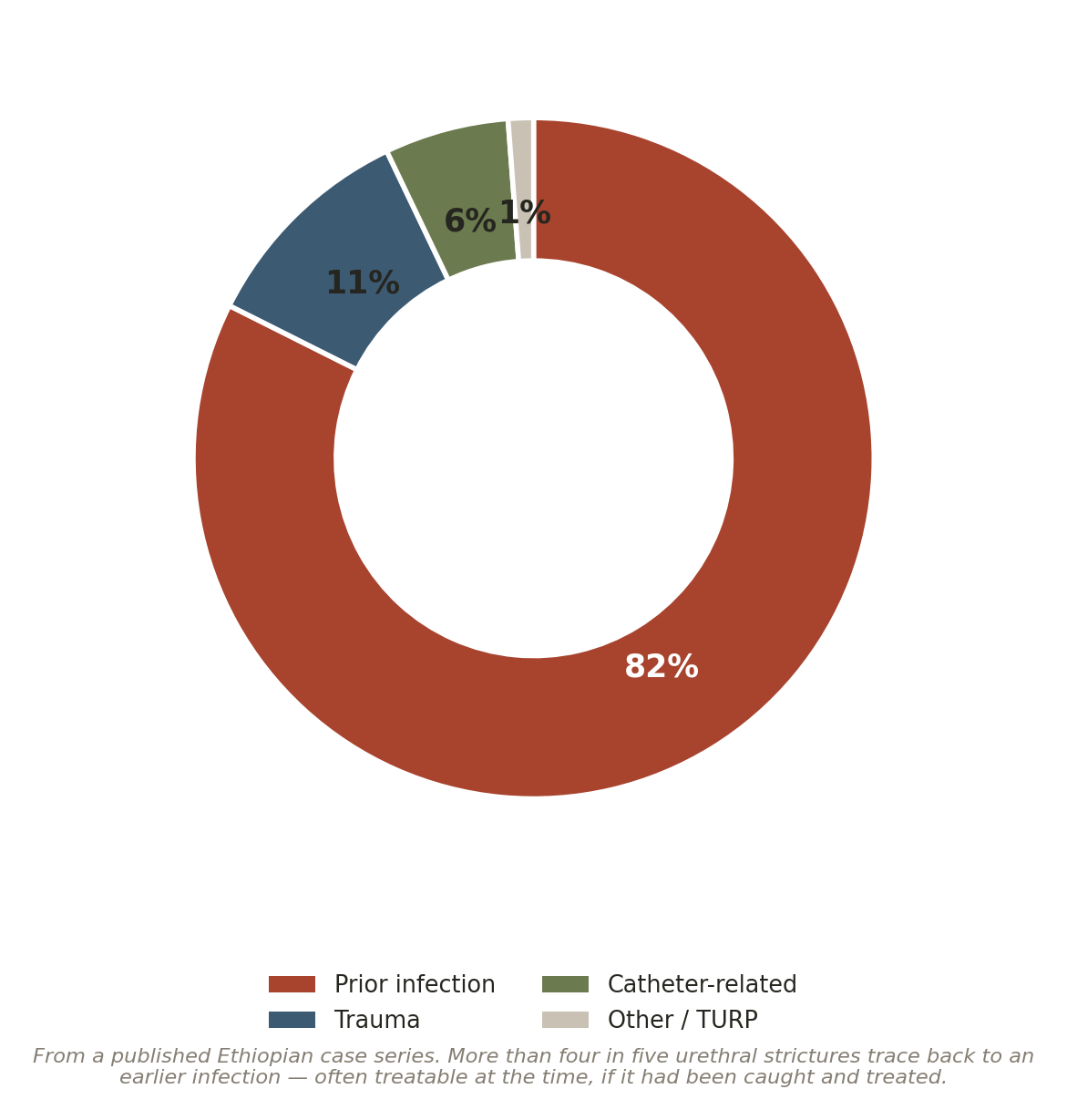
An earlier infection, not age or chance, explains most cases — a pattern worth knowing for prevention as much as treatment.
Once a stricture is present, the treatment chosen matters enormously for whether it actually resolves.
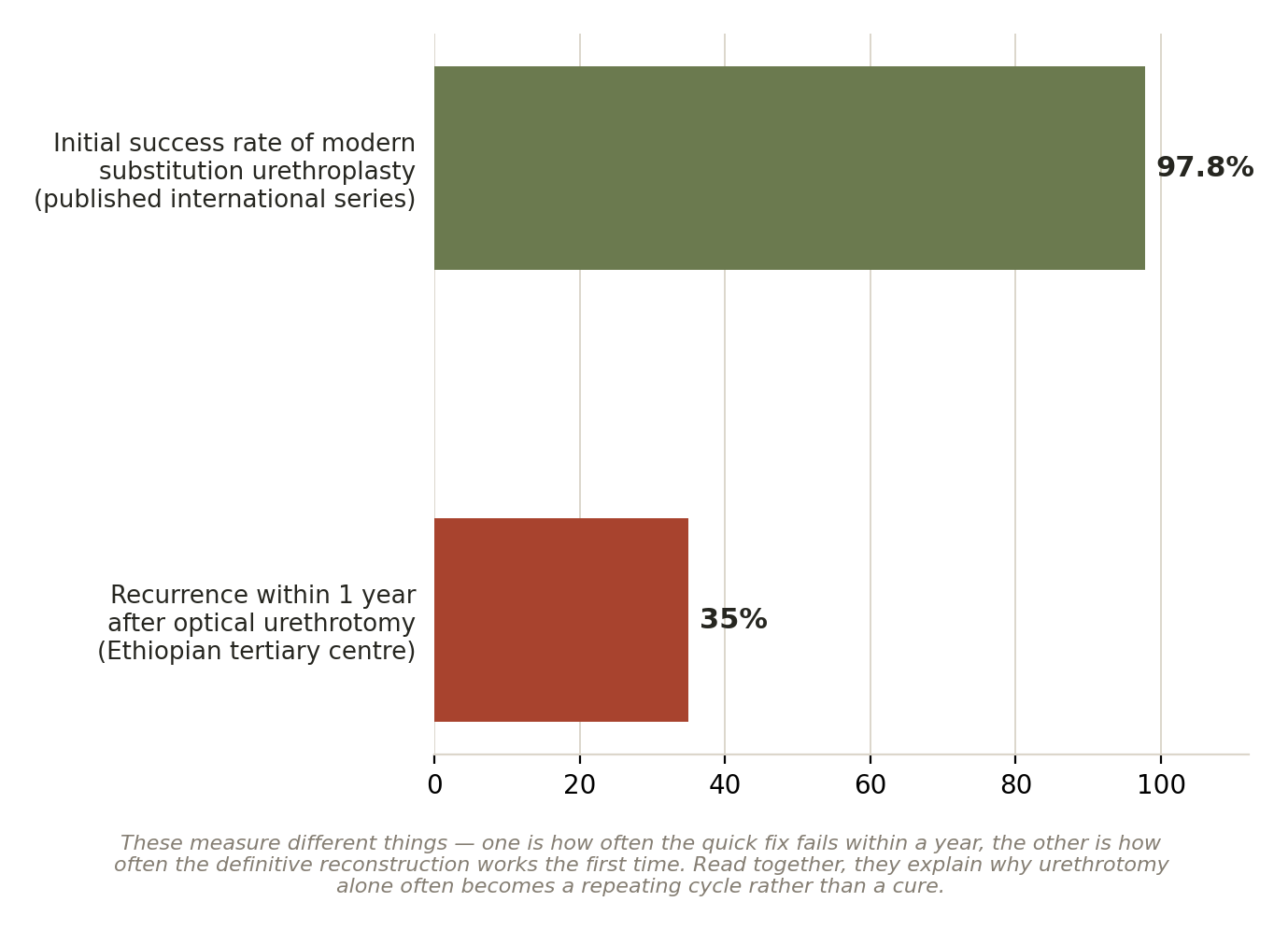
Two different measures, read together: how often the quick fix fails, against how often the definitive repair works.
Why this isn't a criticism of anyone's care so far: optical urethrotomy is genuinely useful, particularly for short, first-time strictures, and it is simpler, safer, and more widely available than reconstructive surgery. The issue is not that it was used, but that recurrence after it is common enough that it deserves to be named clearly, so a returning stricture is met with a conversation about definitive treatment rather than another routine repeat of the same procedure.
3 Gate Three
Which reconstruction, and how experienced?
Urethroplasty is not one single operation. For short strictures, excision and primary anastomosis removes the scarred segment and rejoins healthy tissue directly. For longer strictures, substitution techniques, most commonly using a graft of buccal mucosa from inside the cheek, are used to widen or replace the affected segment, since buccal tissue tolerates the urinary environment well and leaves no visible scar.
Outcomes are strongly tied to surgeon experience with this specific technique, not general urological training alone. Even specialist care can occasionally need a second attempt: a published Ethiopian case series in children found a real difference between first and repeat surgery.
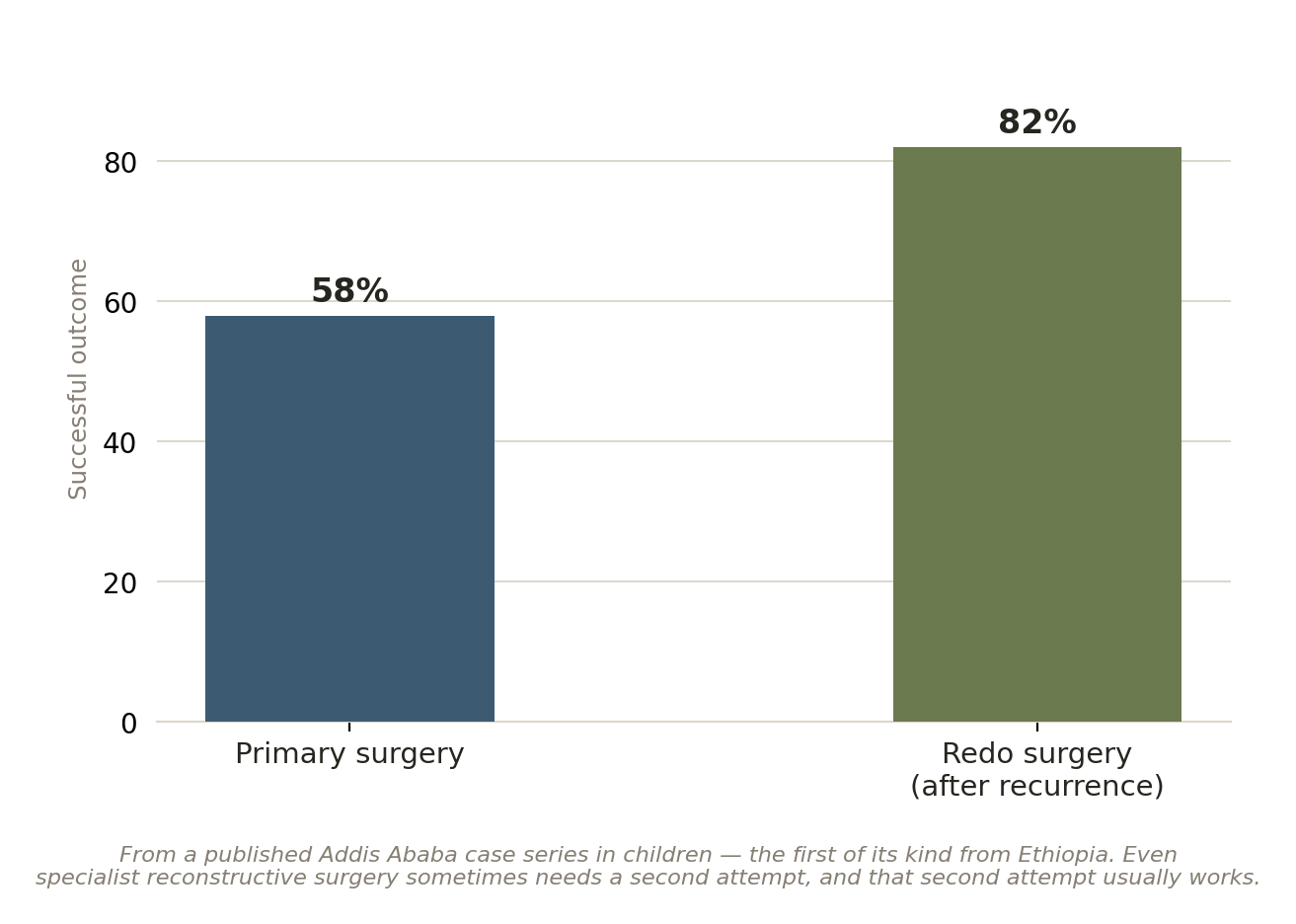
Even when a first repair doesn't fully succeed, a well-executed second attempt usually does.
Ask any surgeon specifically how many urethroplasty procedures, and which techniques, they perform annually — not how many years they have practised urology overall.
4 Gate Four
Could this be done in Ethiopia?
For the initial procedure, yes: optical urethrotomy is well established and commonly performed at Ethiopian tertiary hospitals, as the published data in gate two itself demonstrates. Definitive substitution urethroplasty, the reconstructive technique most likely to actually resolve a recurrent or complex stricture, is newer and less consistently available domestically; the paediatric case series referenced above describes itself explicitly as the first study of its kind from Ethiopia, a sign of how recently this specific subspecialty has begun to be documented.
This is precisely where India's reconstructive urology centres add genuine, comparative depth: surgeons who perform urethroplasty, including complex buccal mucosal graft cases, as a defined high-volume subspecialty, and outcomes consistent with the strong published international results cited in gate two. For a stricture where the difference between a repeat procedure and a lasting cure often comes down to technique and experience, that specialisation is not a convenience — it is what actually determines whether this is the last operation needed. Ask any centre how many urethroplasty cases their surgeon performs each year.
5 Gate Five
Is the money arranged?
Ethiopia's health financing does not follow a patient abroad. Community-Based Health Insurance covers contracted facilities inside the country, and the formal-sector scheme still isn't settling claims. Since February 2026 a bank may release up to US$20,000 per case against a letter from the treating hospital, without a visa or ticket in hand.
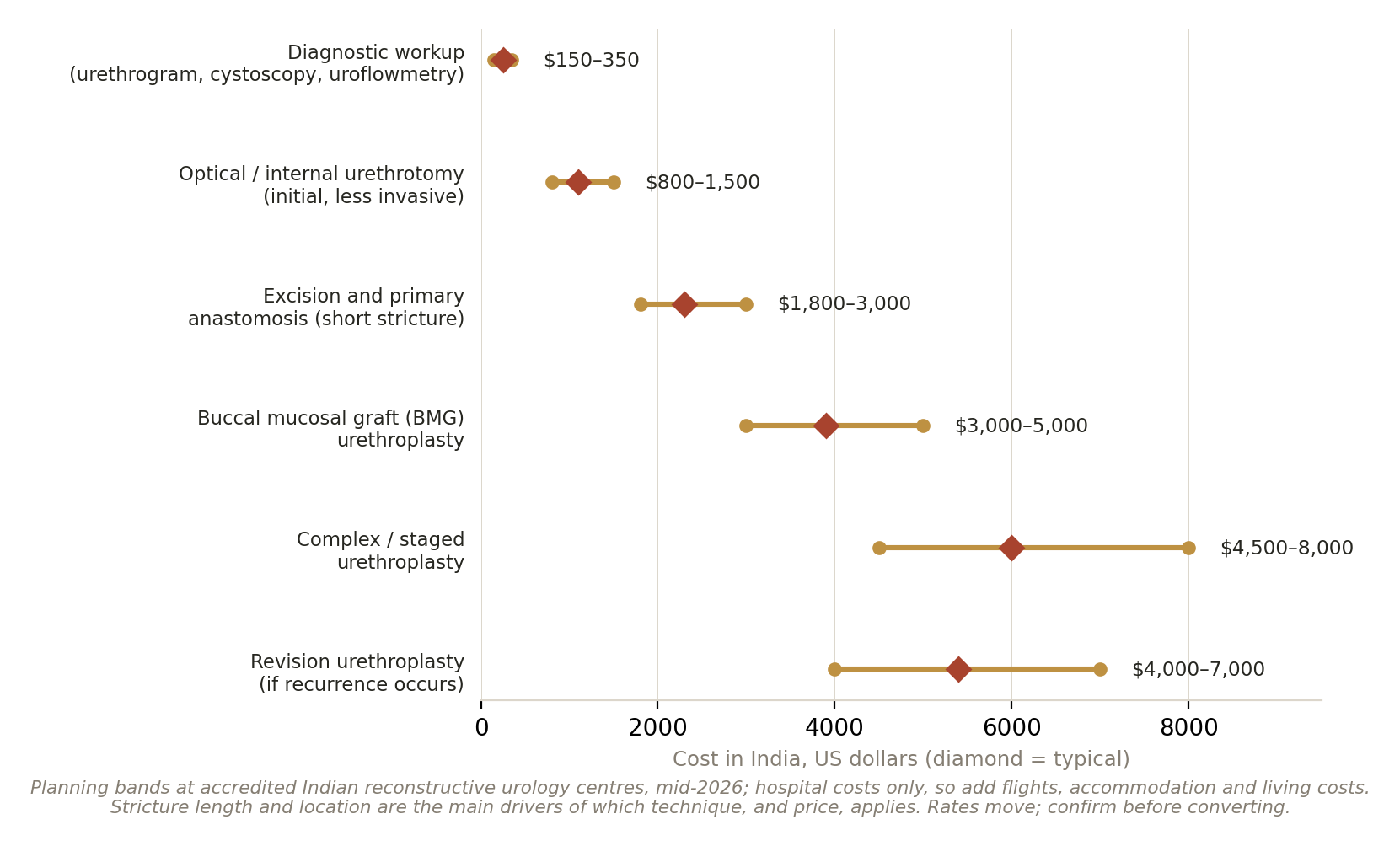
Budget for the definitive procedure your stricture's length and location actually require.
The figures differ substantially by technique and complexity: optical urethrotomy sits well below urethroplasty, and within urethroplasty, a short anastomotic repair costs less than a complex staged reconstruction. Even at the top of these ranges, treatment at an accredited Indian reconstructive urology centre remains a fraction of an equivalent case in the Gulf, Europe, or the United States. Confirm the stricture length and recommended technique before assuming any single number applies to your case.
| A quotation, annotatedA composite of the urosurgery quotes that reach me, with the questions I send back. | |
| Urethroplasty — USD 3,900 | Which technique, and for what stricture length? This determines whether the price actually fits. |
| Includes: retrograde urethrogram and planning | Good sign. Confirm the surgeon reviewed your actual imaging, not just a written report. |
| Technique: buccal mucosal graft | Ask the surgeon's annual case volume with this specific technique. |
| Includes: 4 days admission | Reasonable for this procedure. Ask about catheter duration and the follow-up plan. |
| Excludes: catheter removal and check | Ask whether this needs a return visit or can be coordinated with a provider in Ethiopia. |
| Excludes: revision if recurrence occurs | Ask what the published recurrence rate is for this specific technique and surgeon. |
In 24 years the urosurgery patients most satisfied with their outcome were the ones who asked for the definitive procedure by name, rather than accepting another round of the treatment that had already failed once.
The Ethiopian practicalities
Ethiopian Airlines flies non-stop from Bole to Delhi, Mumbai, Bengaluru, Chennai, and Hyderabad. A urinary catheter typically stays in place for two to three weeks after urethroplasty, so plan for either an extended stay or a clear plan for catheter care and removal once home; ask the treating centre which they recommend for your specific case. Yellow fever certification is required at least ten days before arrival, oral polio vaccination roughly four weeks before. The medical visa follows the hospital's invitation letter through the Embassy of India, Addis Ababa. Where treatment spans the Orthodox fasting calendar, this rarely affects urological recovery directly, but confirm any dietary considerations with the hospital. Confirm current rules with the Embassy, since they change, and ask for an Amharic-speaking coordinator to carry a written follow-up and catheter-care plan back to a named urologist in Ethiopia.
Straight Answers for Ethiopian Patients about Urosurgery and Reconstructive Urology in India
I've had my urethral stricture dilated or "cut" before and it came back. Why?
Optical urethrotomy is simple and often effective short-term, but Ethiopian data shows roughly one in three strictures return within a year. Urethroplasty, which rebuilds the urethra, is the gold-standard treatment with much higher long- term success.
What actually causes a urethral stricture?
In published Ethiopian and regional data, the leading cause by far is a prior infection. Trauma, particularly pelvic fractures from road accidents, and prior catheter use are the other common causes.
Is reconstructive urethral surgery available in Ethiopia?
The initial, less invasive procedure is well established. Definitive substitution urethroplasty, the specialised technique with much better long-term results, is a newer and less consistently available specialty domestically.
How long does urethroplasty in India take?
The procedure takes two to four hours with a three-to-five-day hospital stay and a catheter for two to three weeks after. Most patients plan one to two weeks in India, with follow-up once the catheter is removed.
Who pays for this in Ethiopia?
You do. Neither Community-Based Health Insurance nor the pending formal-sector scheme funds treatment abroad, though a bank may now advance up to US$20,000 against the treating hospital's letter.
A closing word
Send any urethrogram or imaging, details of any prior treatment including how many times it's been repeated, and how long symptoms have been present. I will tell you honestly whether this looks like a case for definitive reconstruction, and why India's reconstructive urology centres are where that specific expertise is reliably available to an Ethiopian patient today.
Sources
- 🌐 Short-term recurrence rate of male urethral stricture and its predictors after treatment with optical internal urethrotomy
- 🌐 The endoscopic treatment of urethral strictures in Mekelle, Ethiopia. PubMed. 2009
- 🌐 Outcome of delayed perineal anastomotic urethroplasty in children with post-traumatic urethral stricture in a tertiary center, Addis Ababa
- 🌐 Long-term outcome of non-transecting anastomotic bulbar urethroplasty for urethral strictures: an 8-year experience. PMC. 2021
- 🌐 National Medical Commission of India — Indian Medical Register, for verifying a treating urologist's qualification and registration
- 🌐 National Bank of Ethiopia Directive FXD/04/2026 (foreign exchange, advance payments for treatment abroad); Embassy of India, Addis Ababa
Frequently Asked Questions by Ethiopians about Urosurgery and Reconstructive Urology in India
What symptoms can indicate a urethral stricture?
A weak urinary stream, difficulty starting urination or trouble emptying the bladder can occur. These symptoms can also have other causes, so proper evaluation is important.
Which test confirms a urethral stricture?
A retrograde urethrogram directly outlines the urethra and helps determine the stricture's exact location and length, which are important for treatment planning.
What is the main cause of urethral stricture in the guide?
Prior infection is the leading documented cause, accounting for 82% in the Ethiopian case series presented on page 3. Trauma and catheter-related causes were smaller categories.
Why can a urethral stricture return after urethrotomy?
Optical urethrotomy opens the scarred area but does not remove and reconstruct the affected segment. The guide cites a 35% recurrence rate within one year in an Ethiopian tertiary-centre study.
What is urethroplasty?
Urethroplasty is reconstructive surgery that removes or bypasses the scarred segment and rebuilds the urethra. Buccal mucosal grafts may be used for longer strictures.
How much does buccal mucosal graft urethroplasty cost in India?
The guide gives an indicative planning range of US$3,000–5,000 at accredited Indian reconstructive urology centres.
How much does complex or staged urethroplasty cost?
The indicative range shown on page 6 is US$4,500–8,000, depending on the complexity and treatment plan.
How long does urethroplasty take?
The guide states that the procedure generally takes two to four hours, with a hospital stay of approximately three to five days.
How long does the catheter remain after urethroplasty?
A urinary catheter typically remains in place for two to three weeks. Patients should arrange in advance whether removal and follow-up will happen in India or Ethiopia.
How long should Ethiopian patients stay in India?
The guide suggests planning approximately one to two weeks in India, with follow-up after the catheter is removed according to the treating centre's plan.
Page Summary
This eight-page guide helps Ethiopian patients understand urethral stricture and evaluate reconstructive urology treatment in India. It explains why a retrograde urethrogram is important for confirming the stricture's location and length and highlights prior infection as the leading documented cause. The guide compares optical urethrotomy with definitive urethroplasty and stresses the importance of surgeon-specific experience with the required technique. The page 4 chart compares recurrence after urethrotomy with published urethroplasty success, while page 6 provides indicative costs for different procedures. It also covers catheter care, travel planning, hospital stay and follow-up after returning to Ethiopia.
Citation Block
| Topic | Information |
|---|---|
| Topic | Urosurgery & Reconstructive Urology |
| Treatment | Urethroplasty |
| Country | India |
| Patients | Ethiopian Patients |
| Condition | Urethral Stricture |
| Key Specialist | Reconstructive Urologist |
| Main Options | Urethrotomy & Urethroplasty |
| Main Technique | Buccal Mucosal Graft |
| Key Cause | Prior Infection |
| Recurrence After Urethrotomy | 35% Within 1 Year |
| Published Urethroplasty Success | 97.8% |
| BMG Cost | US$3,000–5,000 |
| Complex Cost | US$4,500–8,000 |
| Hospital Stay | 3–5 Days |
| Catheter Duration | 2–3 Weeks |
| India Stay | 1–2 Weeks |
| Key Check | Surgeon Technique & Case Volume |
| Key Records | Urethrogram & Previous Treatment |
| Follow-Up | Ethiopian Urologist |
| Visa | Indian Medical Visa |
| Key Questions | Technique, Cost, Catheter & Recurrence |
| Warning Sign | Repeated Treatment Without Definitive Review |

Our Mission Statement
Our mission is to place patients at the centre of every healthcare decision by providing trustworthy, evidence-based, and unbiased medical information. We believe that informed patients make better decisions. Backed by personalised guidance from our experienced advisory team, we help patients understand their treatment options, compare them objectively, and confidently choose the path that best suits their medical needs and personal circumstances.
Patient Testimonials from Ethiopia

Ready to Take the First Step?
Share your Medical Reports with our Healthcare Managers Today and Get a FREE CONSULTATION, a Personalized Treatment Plan, and Complete Support from Arrival to Recovery.
Get Your Free ConsultationAreas We Serve
This resource has been thoughtfully prepared for patients from Ethiopia who are considering medical treatment in India. We also welcome patients from the wider region in the countries mentioned below-
We assist patients from:
- Eritrea
- Djibouti
- Somalia
- Kenya
- Sudan
- Burundi
- Comoros
- Ethiopia
- Madagascar
- Malawi
- Mauritius
- Mozambique
- Rwanda
- South Sudan
Many of the insights, treatment pathways, hospital recommendations, travel guidance, and patient support services described here are equally relevant and may be used as a reference when planning treatment in India.
From Ethiopia to India: Your Complete Patient Support Guide
- Brain Tumour Surgery in India for Ethiopians
- Cancer Treatment in India for Ethiopians
- Cardiac Surgery in India for Ethiopian Patients
- Cervical and Disc Replacement Surgery in India for Ethiopians
- Cosmetic and Plastic Surgery in India for Ethiopians
- CyberKnife Treatment in India for Ethiopians
- Eye Surgery in India for Ethiopians
- Gamma Knife Treatment in India for Ethiopians
- Heart Valve Replacement Surgery in India for Ethiopians
- Hip Surgery in India for Ethiopian Patients
- Knee Surgery in India for Ethiopian Patients
- Laparoscopic and Robotic Myomectomy Surgery in India for Ethiopians
- Neurosurgery in India for Ethiopians
- Paediatric Cardiac Surgery in India for Ethiopians
- Paediatric Neurosurgery in India for Ethiopians
- Prostate Cancer Treatment and Surgery in India for Ethiopians
- Robotic Cancer Surgery in India for Ethiopians
- Scoliosis Surgery in India for Ethiopians