

Cosmetic and Plastic Surgery in India for Ethiopians
Five gates every case should pass before booking a flight — beginning with the single distinction that shapes everything else: are you restoring something, or choosing to change it?
Plastic surgery is really two different fields sharing one name. One restores something a person has lost — movement after a burn, a normal face after a cleft lip, a shape after cancer or trauma. The other changes something a person was born with or has developed, by choice, with no underlying medical need. Both are legitimate. They are not, however, the same conversation, and treating them as one is where I see families make the most avoidable mistakes. Ethiopia carries a heavier burden of the first kind than most guides acknowledge. Burn injury is common, disproportionately affects children, and is the second leading cause of accidental death among young Ethiopian children, most often from open cooking fires and scalds at home. Every burn that heals across a joint carries the risk of a contracture — a scar tight enough to limit movement for life if it is never released. In 24 years of arranging surgical care in India for patients across Africa and Asia, the plastic surgery cases I most regret not seeing earlier are almost always reconstructive ones in children, where a straightforward operation became a harder one simply because time passed. These five gates are built to catch that early.
Healing Journeys of Ethiopian Patients
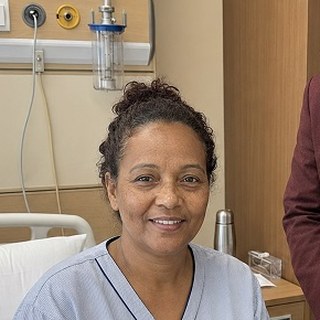
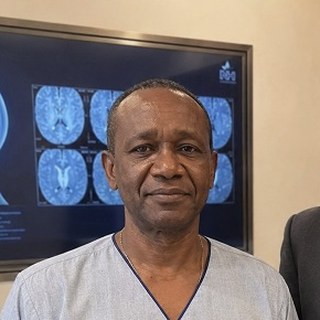
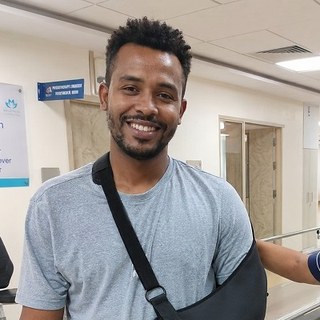
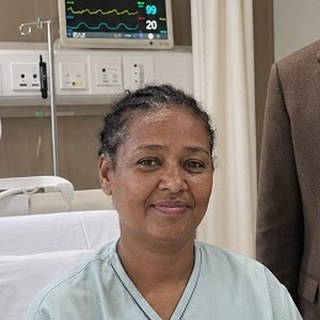

Key Takeaways
- Plastic surgery for Ethiopian patients falls into two fundamentally different categories: reconstructive surgery and aesthetic surgery. Reconstructive procedures restore function or anatomy affected by burns, congenital conditions, cancer or trauma, while aesthetic procedures change appearance by choice.
- The distinction matters because reconstructive cases can sometimes be time-sensitive, whereas elective aesthetic surgery generally does not carry the same medical urgency.
- Burn contractures deserve particular attention in Ethiopian children. As the illustration on page 3 explains, a healed scar band does not grow as the child's bones grow, so a relatively mild restriction at age five can become considerably more disabling by age twelve.
- A burn scar crossing the elbow, hand, neck, armpit or another joint in a growing child should therefore be assessed by a qualified plastic surgeon even when movement remains reasonably good.
- Ethiopian patients considering surgery in India should verify that their doctor is genuinely trained in Plastic and Reconstructive Surgery. The guide identifies MCh or DNB in Plastic and Reconstructive Surgery as common specialist postgraduate qualifications and recommends independently verifying registration.
- Skin type should form part of surgical planning. The page 4 chart highlights a substantially higher relative risk of keloid or hypertrophic scarring in darker skin, meaning incision placement, closure technique and postoperative scar management should be discussed before surgery.
- Scar-management measures discussed include silicone sheeting, pressure therapy and, in selected cases, steroid injections. A previous history of keloids should be disclosed to the surgeon before any reconstructive or aesthetic procedure.
- Indicative mid-2026 costs shown in the page 5 chart include cleft lip repair at approximately USD 1,400–2,800, cleft palate repair at USD 2,000–3,800, burn contracture release with grafting at USD 1,800–3,800, rhinoplasty at USD 1,800–3,800, liposuction at USD 1,500–3,800 per area, and breast augmentation/reconstruction at USD 2,500–5,200.
- Combining several aesthetic procedures into one trip can reduce travel inconvenience, but the guide warns that this is a medical trade-off rather than merely a scheduling decision. Patients should ask how combining their proposed procedures changes the complication risk.
- Before travelling, patients should clarify the exact procedure, surgeon qualification, scar-management plan, hospital costs, potential revision costs and whether treatment is best completed in one operation or staged across separate visits.
Quick Facts
- Conditions/Treatment Areas Covered
- Burn contractures, cleft lip, cleft palate, post-traumatic defects, post-cancer reconstruction, aesthetic facial concerns and body-contouring concerns
- Procedures Mentioned
- Burn contracture release and grafting, cleft lip repair, cleft palate repair, rhinoplasty, liposuction, body contouring, facial rejuvenation, breast augmentation and breast reconstruction
- Target Audience
- Ethiopian patients and families considering reconstructive or aesthetic plastic surgery in India
- Reconstructive Surgery
- Restores anatomy or function affected by burns, congenital conditions, trauma or cancer.
- Aesthetic Surgery
- Electively changes appearance without an underlying medical need.
- Childhood Burn Contractures
- A scar crossing a joint can become increasingly restrictive as a child grows because the scar itself does not lengthen with the underlying bone.
- Surgeon Qualification
- Patients should ask specifically for formal qualifications such as MCh or DNB in Plastic and Reconstructive Surgery and independently verify registration.
- Scarring Consideration
- Darker skin carries a higher relative risk of keloid and hypertrophic scar formation.
- Cleft Lip Repair Cost
- Approximately USD 1,400–2,800
- Cleft Palate Repair Cost
- Approximately USD 2,000–3,800
- Burn Contracture Release + Graft Cost
- Approximately USD 1,800–3,800 per site
- Breast Augmentation/Reconstruction Cost
- Approximately USD 2,500–5,200
- Combined Procedures
- The guide states that published data show combined plastic surgery procedures carry a higher 30-day complication rate than a single procedure performed alone.
- Author/Advisor
- Dr. Dheeraj Bojwani, Independent Medical Travel Advisor, 24 years arranging surgical care for international patients
In Brief
Cosmetic and plastic surgery in India for Ethiopian patients should begin by distinguishing reconstructive treatment from elective aesthetic surgery. Reconstructive procedures include burn contracture release, cleft lip or palate repair and reconstruction following trauma or cancer, while aesthetic procedures include rhinoplasty, liposuction and body contouring. For Ethiopian patients, the guide gives particular attention to childhood burn contractures and the higher risk of keloid or hypertrophic scarring in darker skin. Patients should verify that their surgeon holds formal plastic and reconstructive surgery qualifications and should discuss incision planning, scar prevention, procedure staging and revision costs before travelling.
1 Gate One
Reconstructive, or aesthetic?
Say plainly which one you need, because the answer changes the urgency, the financing, and often the surgeon you should be seeing.
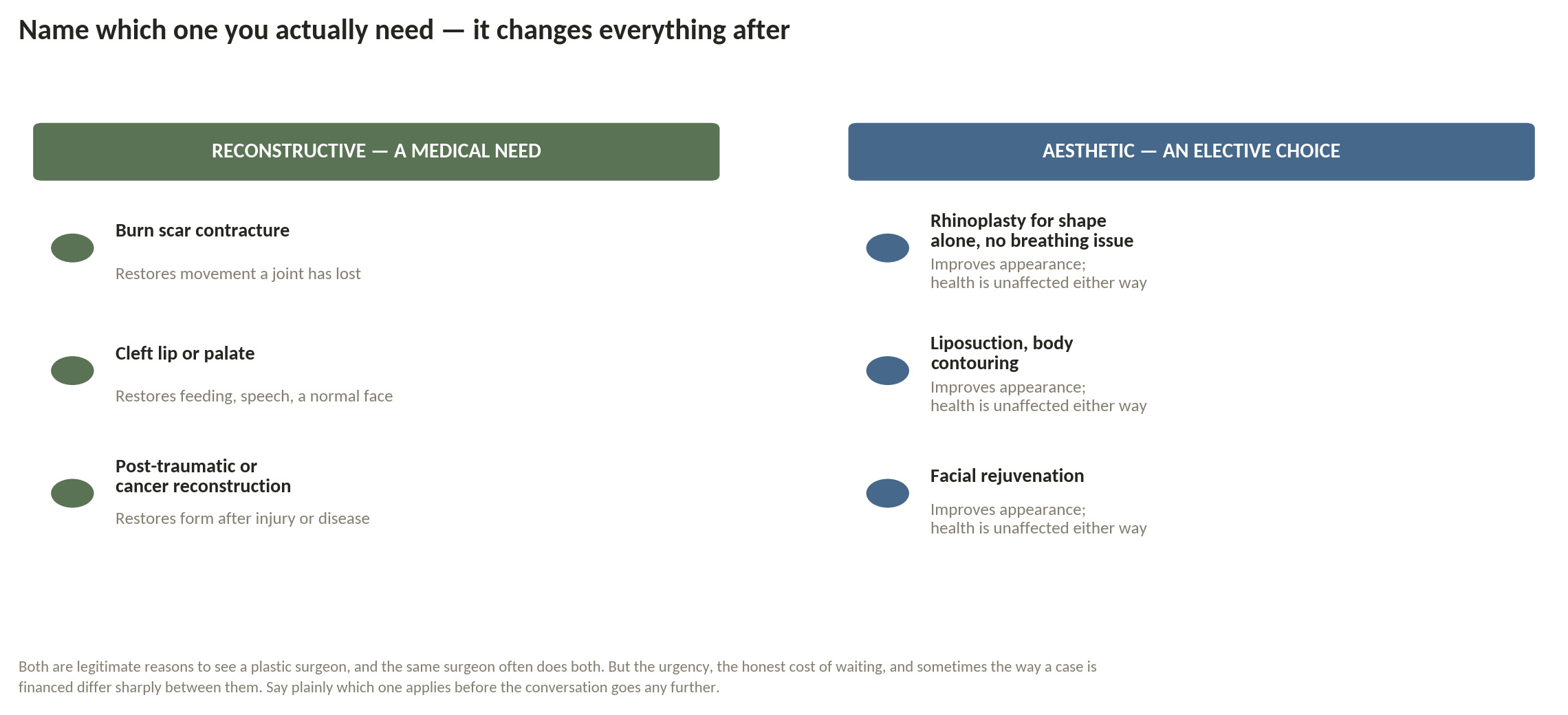
Two fields, one name, very different rules.
Reconstructive surgery restores something that was lost or never formed correctly — a burn contracture, a cleft lip or palate, reconstruction after cancer or trauma. There is a genuine medical argument for timely treatment, sometimes an urgent one. Aesthetic surgery changes an appearance the person was not otherwise troubled by medically. It is entirely legitimate to want it, but there is no clock running: your health is the same the week before as the week after, whenever that surgery happens. Confusing the two categories leads reconstructive patients to wait far too long, and aesthetic patients to feel a false urgency that serves nobody but a hurried surgeon.
The same surgeon can honestly do both kinds of work in the same week. What should not happen is the same conversation applied to both — a reconstructive case discussed as though it were a lifestyle choice, or an aesthetic one sold with a manufactured deadline.
2 Gate Two
If it is a child's burn scar, is the clock running?
This is the gate most likely to be missed, because a healed burn does not look urgent. It is, if it crosses a joint in a growing child.
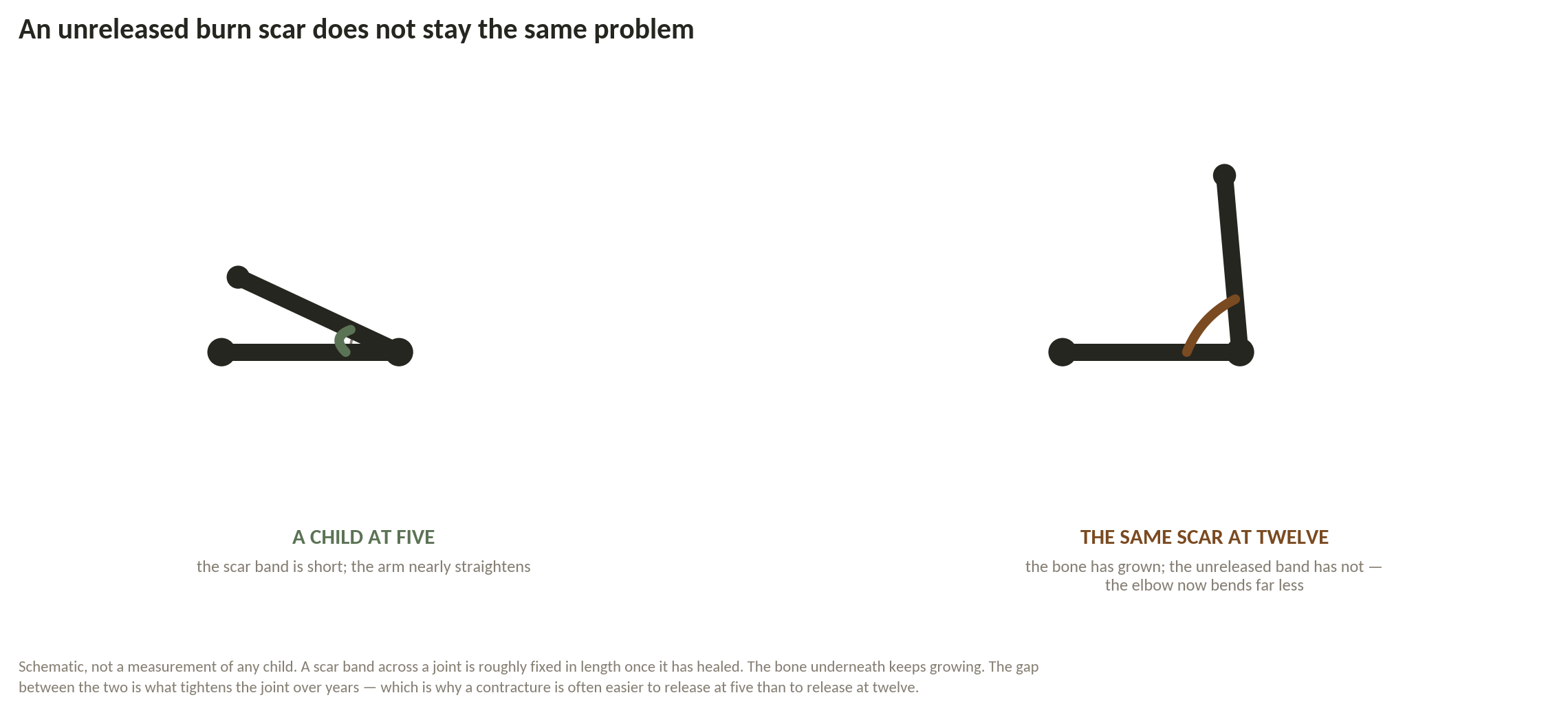
The scar does not grow. The child does.
A scar band across a joint is fixed in length once it heals. The bone underneath keeps growing. The gap between the two is what steadily tightens the joint over years, turning a mild limitation at five into a genuinely disabling one by twelve. This is why a contracture is generally easier to release earlier than later, and why a burn scar over an elbow, a hand, the neck, or the armpit in a child deserves an assessment now rather than being left until it visibly interferes with daily life.
If your child has a burn scar crossing a joint , have it assessed by a plastic surgeon even if movement still looks reasonably normal today. The question worth asking is not whether it needs releasing, but when it will stop being straightforward to release.
3 Gate Three
Is this actually a plastic surgeon?
The word cosmetic surgeon is not a protected medical title in the way plastic surgeon is. In India, and in many countries, someone can describe themselves as a cosmetic surgeon after training that never included formal plastic surgery at all — sometimes a general medical or dental qualification with a short course added on. This matters most for aesthetic procedures, since reconstructive cases are usually already routed to genuine specialists through the nature of the referral.
A genuine plastic surgeon in India holds a specific postgraduate qualification, most often an MCh or DNB in Plastic and Reconstructive Surgery, built on an MBBS and general surgical training. Ask for that qualification by name, and verify the surgeon's registration independently rather than relying on a clinic's own website. For any procedure, ask to see genuine before-and-after results from patients with a similar skin type and concern to your own, not a generic gallery.
This verification matters more, not less, when a hospital is unfamiliar to you and thousands of kilometres away. A few minutes checking a registration number before you travel is a far better use of time than discovering a problem afterwards, when correcting it means a second operation, a second trip, and a second bill.
4 Gate Four
What does your skin need the surgeon to plan for?
This applies equally to reconstructive and aesthetic surgery, and it is specific to skin like most Ethiopian patients have.
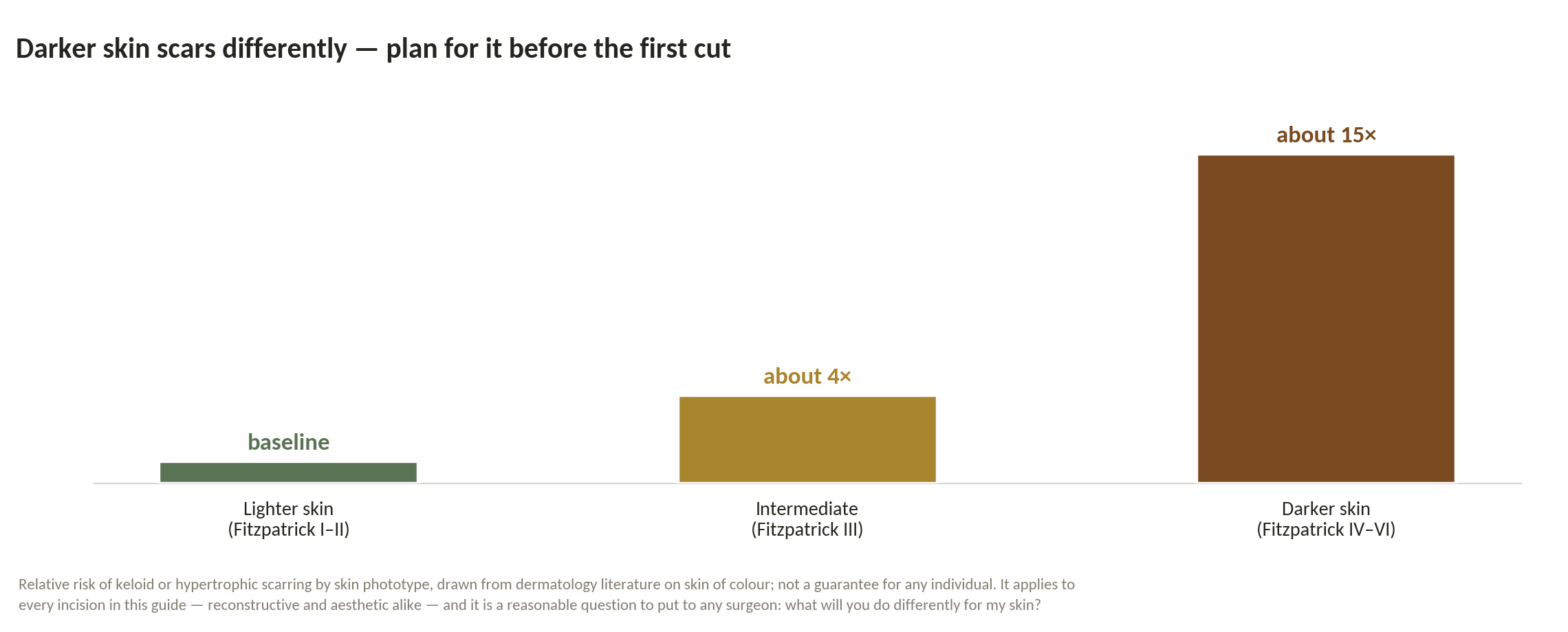
The same incision, a different scarring risk.
Darker skin carries a substantially higher risk of keloid or hypertrophic scarring — a scar that grows raised, itchy, and sometimes larger than the original wound. It does not rule out surgery, and most operations proceed normally. It does change the plan: some surgeons choose incision placement and closure technique with this in mind, and many recommend a period of scar management afterwards — silicone sheeting, pressure, sometimes a steroid injection — specifically to reduce the chance of a problem scar forming. Ask directly whether this is part of your plan, or an extra you will discover the need for later.
5 Gate Five
Is the money arranged, and how much in one trip?
Ethiopia's health financing does not follow a patient abroad, and for purely aesthetic surgery no financing scheme is likely to apply at all — it is family money, in full. For reconstructive surgery the position is sometimes different depending on the facility, but do not assume coverage without confirming it directly. Since February 2026 a bank may release up to twenty thousand US dollars per case against a letter from the treating hospital, without a visa or ticket in hand.
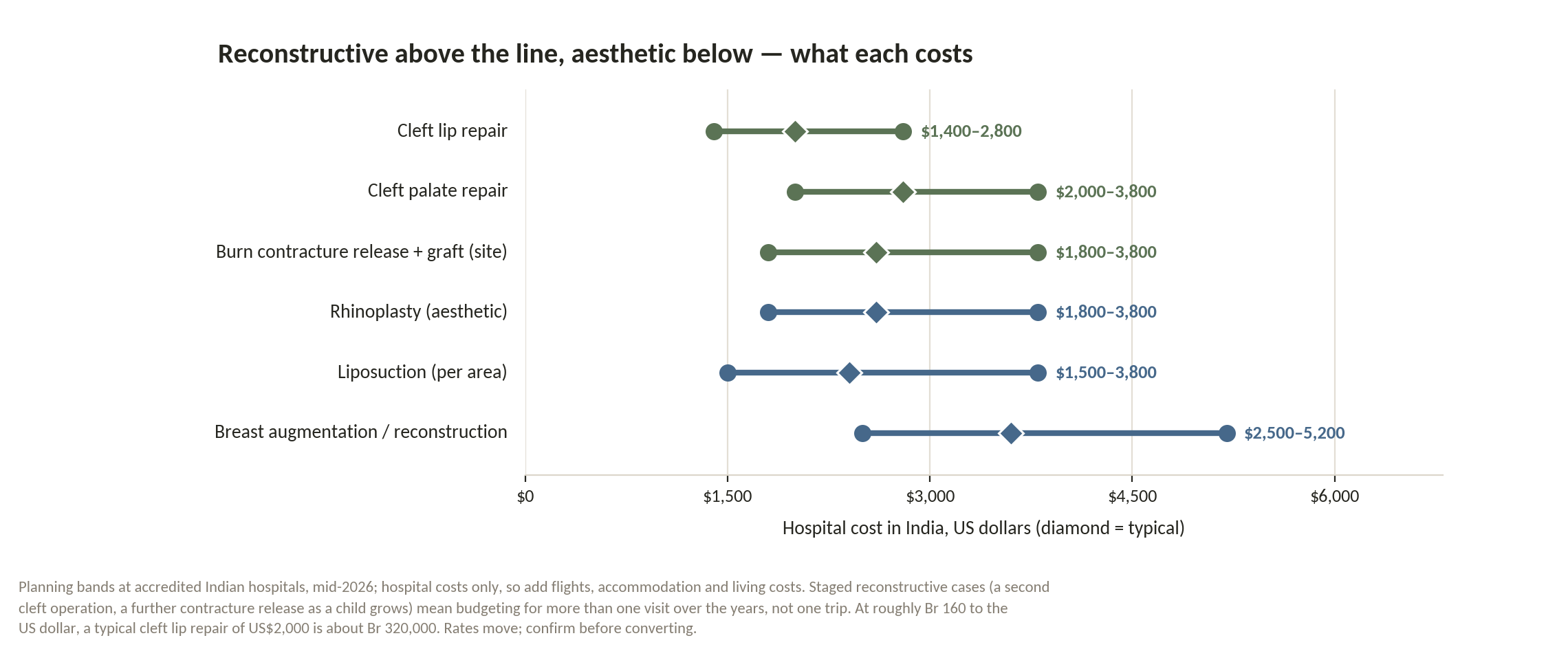
Reconstructive procedures above the line, aesthetic below.
The temptation to combine several aesthetic procedures into a single trip is understandable, since it saves a second set of flights. But it is a genuine medical trade-off, not only a scheduling one: a large registry study of plastic surgery outcomes found combined procedures carried a materially higher thirty-day complication rate than a single procedure done alone. That does not mean never combine — many combinations are done safely every day — but it means asking your surgeon directly what the complication difference is for your specific combination before agreeing to it.
In 24 years the plastic surgery patients most satisfied with their outcome were rarely the ones who did the most in one trip. They were the ones who understood exactly which gate their case belonged to before agreeing to anything.
| A quotation, annotatedA composite of the plastic surgery quotes that reach me, with the questions I send back. | |
| Plastic surgery — USD 2,400 | For which procedure? Reconstructive and aesthetic prices differ sharply. |
| Surgeon: board-certified plastic surgeon | Ask for the qualification by name and verify it, not just the title. |
| Includes: 2 days admission | Reasonable for most. Ask what a staged second visit would add. |
| Anti-scarring protocol: not included | For darker skin this should not be an afterthought. Price it in. |
| Combining procedures: available on request | Ask for the complication-rate difference before agreeing to this. |
| Excludes: revision if scarring recurs | Ask the price of a revision now, especially if you scar easily. |
Pay the hospital and never an individual, and never settle a balance before you arrive.
The Ethiopian practicalities
Ethiopian Airlines flies non ‐ stop from Bole to Delhi, Mumbai, Bengaluru, Chennai and Hyderabad. Ask the surgeon in writing when it is safe to fly, since swelling, healing incisions and compression garments all interact differently with a long flight depending on the procedure — this is especially relevant after body-contouring surgery, where the clearance is individual.
Yellow fever certification is required at least ten days before arrival and oral polio vaccination roughly four weeks before; for a young child having contracture surgery, coordinate this with the paediatrician alongside the routine vaccination schedule. The medical visa follows the hospital's invitation letter through the Embassy of India in Addis Ababa, and an attendant is worth arranging for any procedure requiring more than a day or two of recovery. Confirm current rules with the Embassy, since they change, and ask for an Amharic ‐ speaking coordinator to walk through wound care and scar management before you fly home — this is where gate four's plan actually gets carried out.
A closing word
Send photographs from several angles, in good light, along with a short account of what you want changed or restored and, for a reconstructive case, how the original injury happened and when. I will tell you which gate you are standing at, whether a child's contracture is a case that should move sooner rather than later, and for aesthetic requests, what a realistic, honestly staged plan looks like.
Sources
- 🌐 Adane MM, et al. Prevalence and risk factors of cooking-related burn injury among under-five children, Northwest Ethiopia
- 🌐 Alemayehu S, et al. Management outcome of burn injury and associated factors among hospitalised children, Tigray, Ethiopia. 2020
- 🌐 Rios-Diaz AJ, et al. Risk of complications in combined plastic surgery procedures. Aesthetic Surgery Journal, 2023
- 🌐 Kwiecien GJ, et al. Surgical scar management and outcomes in racial/ethnic minorities: a systematic review
- 🌐 National Medical Commission of India — Indian Medical Register, for verifying a treating surgeon's qualification and registration
- 🌐 National Accreditation Board for Hospitals & Healthcare Providers (NABH), Quality Council of India
Frequently Asked Questions by Ethiopians about Cosmetic and Plastic Surgery in India
What is the difference between reconstructive and cosmetic surgery for Ethiopian patients travelling to India?
The guide separates plastic surgery into two categories. Reconstructive surgery restores function or anatomy affected by conditions such as burn contractures, cleft lip or palate, trauma or cancer. Aesthetic surgery changes appearance by choice and includes procedures such as rhinoplasty, liposuction and facial rejuvenation. This distinction matters because reconstructive treatment may sometimes be time-sensitive, whereas aesthetic surgery generally has no medical urgency.
Why should Ethiopian children with burn contractures be assessed early?
The guide explains that a healed scar does not grow, but the child does. A scar band crossing a joint can therefore become progressively tighter as the underlying bones grow. The illustration on page 3 shows how a relatively mild restriction at age five can become much more limiting by age twelve. Burn scars crossing the elbow, hand, neck, armpit or another joint should therefore be assessed by a plastic surgeon even if movement currently appears reasonable.
How can Ethiopian patients verify a plastic surgeon in India?
Patients should not rely only on the title "cosmetic surgeon." The guide recommends asking for the doctor's actual specialist qualification, commonly an MCh or DNB in Plastic and Reconstructive Surgery, and independently verifying the surgeon's registration. Patients should also request genuine before-and-after examples involving people with a similar skin type and concern.
How much does burn contracture surgery in India cost for Ethiopian patients?
According to the cost chart on page 5, burn contracture release with grafting costs approximately USD 1,800–3,800 per site at accredited Indian hospitals. The figures represent indicative mid-2026 hospital planning ranges and exclude flights, accommodation and living expenses. Some children may require staged procedures or another operation as they grow.
How much do cosmetic procedures in India cost for Ethiopian patients?
The page 5 chart gives indicative costs of approximately USD 1,800–3,800 for aesthetic rhinoplasty, USD 1,500–3,800 per area for liposuction and USD 2,500–5,200 for breast augmentation/reconstruction. Cleft lip repair is approximately USD 1,400–2,800 and cleft palate repair USD 2,000–3,800. These figures cover hospital costs and exclude travel and accommodation.
Does darker Ethiopian skin require special scar planning after plastic surgery?
The guide says yes. The chart on page 4 highlights a substantially higher relative risk of keloid or hypertrophic scarring in darker skin. This does not rule out surgery, but patients should discuss incision placement, closure technique and postoperative scar management before the operation. Measures discussed include silicone sheeting, pressure therapy and, in some cases, steroid injections.
Can Ethiopian patients have several cosmetic procedures during one trip to India?
They can, but the guide advises treating this as a medical decision rather than simply a way to save on flights. It states that published data show combined procedures carry a materially higher 30-day complication rate than a single procedure. Patients should therefore ask their surgeon how the proposed combination changes their individual complication risk before agreeing to multiple procedures.
What should Ethiopian patients check in a plastic surgery quotation from India?
The annotated quotation on page 5 recommends checking exactly which procedure the price covers, the surgeon's verified qualification, number of admission days, whether an anti-scarring protocol is included, the implications of combining procedures and the cost of revision if problematic scarring returns. The guide also advises paying the hospital rather than an individual and not settling the full balance before arrival.
What travel arrangements should Ethiopian patients make for plastic surgery in India?
The guide notes direct Ethiopian Airlines connections from Bole to several Indian cities and advises obtaining written fit-to-fly guidance from the surgeon, especially after body-contouring procedures. It also discusses yellow fever certification, oral polio vaccination, the hospital invitation letter, Indian medical visa and arranging an attendant for procedures involving more than a day or two of recovery.
What should Ethiopian patients send before requesting a plastic surgery opinion from India?
The guide recommends sending clear photographs from several angles in good lighting, together with a short explanation of what the patient wants changed or restored. For reconstructive cases, patients should also explain how the original injury occurred and when it happened. This helps determine whether the case is reconstructive or aesthetic, whether treatment is time-sensitive and whether a staged surgical plan may be more appropriate.
My child has a burn scar that limits movement. Is that plastic surgery?
Yes, and specifically reconstructive plastic surgery, not a cosmetic choice. Releasing a contracture restores function a child needs for ordinary life, and it is worth acting on earlier rather than later while the child is still growing.
Is a 'cosmetic surgeon' the same as a plastic surgeon?
Not necessarily, and this is worth checking directly. In many places, including India, the title cosmetic surgeon is not protected the way plastic surgeon is. Ask for the surgeon's actual qualification and verify it.
Can I have several aesthetic procedures done in one trip to save on travel?
You can, but understand the trade-off first: published data shows combining procedures nearly doubles the 30-day complication rate compared with a single procedure. That is a genuine medical decision, not only a convenience.
I have kept keloids from small cuts before. Does that change my options?
It should be raised with the surgeon before any procedure, reconstructive or aesthetic. It does not rule out surgery, but it usually changes the plan — the technique used, and often additional treatment afterwards to reduce the chance of the scar returning.
Who pays for this in Ethiopia?
For aesthetic procedures, you do, in full. For reconstructive surgery there may be some difference depending on the facility, but neither community-based insurance nor the pending formal-sector scheme funds treatment abroad; a bank may advance up to US$20,000 against the hospital's letter.
Page Summary
This guide takes Ethiopian patients through five gates. Gate one separates reconstructive surgery — burns, cleft, trauma and cancer reconstruction — from elective aesthetic procedures, because only the first can be time-sensitive. Gate two explains why a burn scar crossing a joint in a growing child becomes more restrictive with age, and should be assessed even when movement still looks reasonable. Gate three is about credentials: look for a formal MCh or DNB in Plastic and Reconstructive Surgery rather than the label "cosmetic surgeon". Gate four covers scar planning in darker skin, where keloid risk is higher. Gate five sets out indicative costs, from USD 1,400–2,800 for cleft lip repair to USD 2,500–5,200 for breast surgery, and warns against combining procedures merely to save a second journey.
Citation Block
| Topic | Information |
|---|---|
| Topic Information | Cosmetic and Plastic Surgery in India for Ethiopian Patients |
| Procedure | Reconstructive & Aesthetic Plastic Surgery |
| Country | India |
| Intended Audience | Ethiopian Patients and Families |
| Conditions Covered | Burn Contractures, Cleft Lip/Palate, Post-Traumatic Defects, Post-Cancer Reconstruction and Aesthetic Concerns |
| Procedures | Burn Contracture Release, Skin Grafting, Cleft Repair, Rhinoplasty, Liposuction, Body Contouring, Breast Augmentation and Reconstruction |
| Typical Stay | Procedure-Dependent; No Single Overall Duration Specified |
| Hospital Stay | Procedure-Dependent; Around 2 Days Described as Reasonable for Many Procedures in the Example Quotation |
| Cleft Lip Repair Cost | Approximately USD 1,400–2,800 |
| Burn Contracture Release + Graft Cost | Approximately USD 1,800–3,800 Per Site |
| Rhinoplasty Cost | Approximately USD 1,800–3,800 |
| Breast Augmentation/Reconstruction Cost | Approximately USD 2,500–5,200 |

Our Mission Statement
Our mission is to place patients at the centre of every healthcare decision by providing trustworthy, evidence-based, and unbiased medical information. We believe that informed patients make better decisions. Backed by personalised guidance from our experienced advisory team, we help patients understand their treatment options, compare them objectively, and confidently choose the path that best suits their medical needs and personal circumstances.
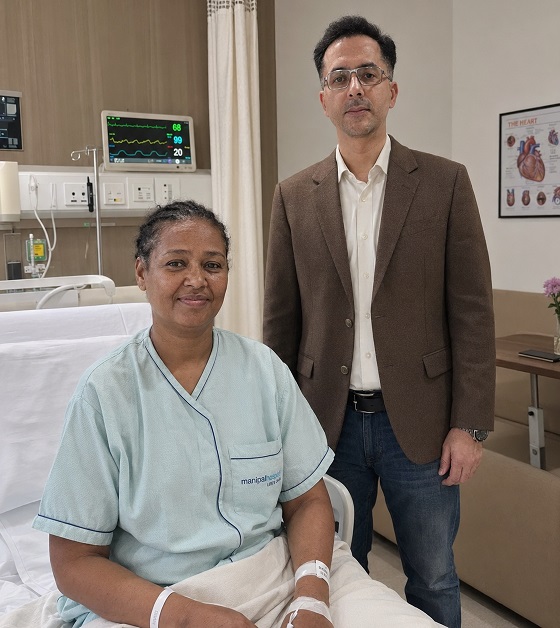
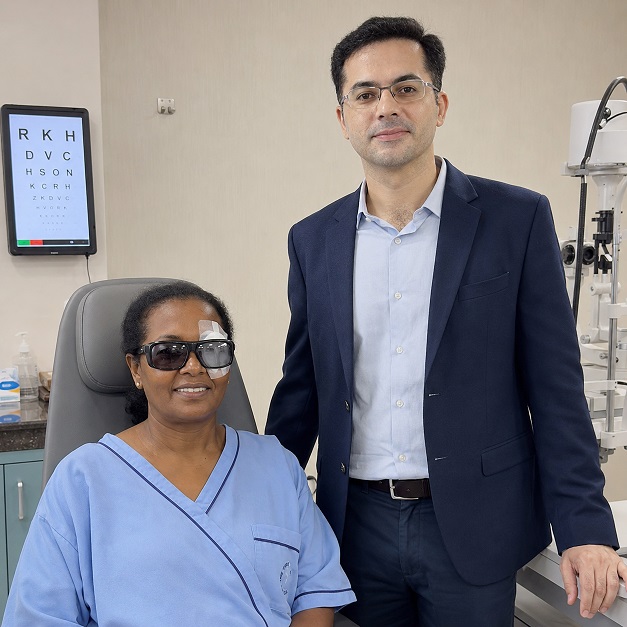
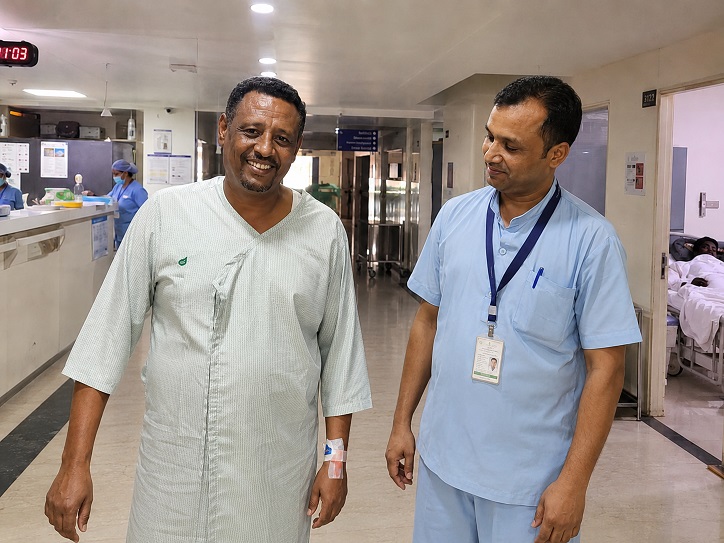
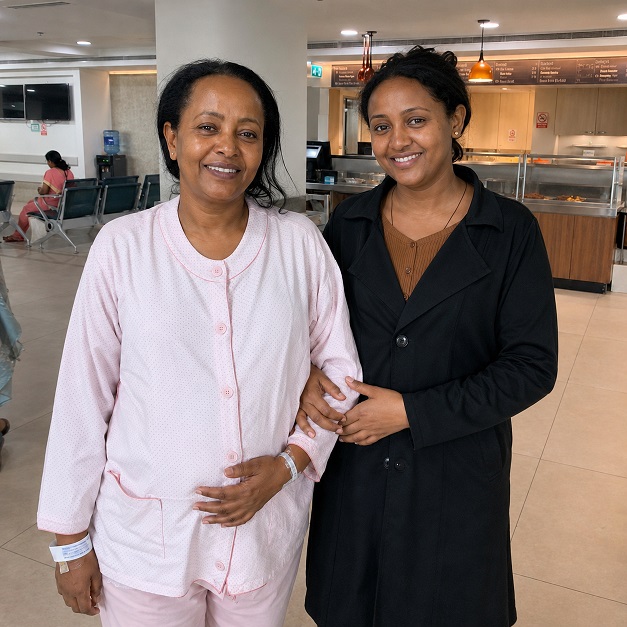
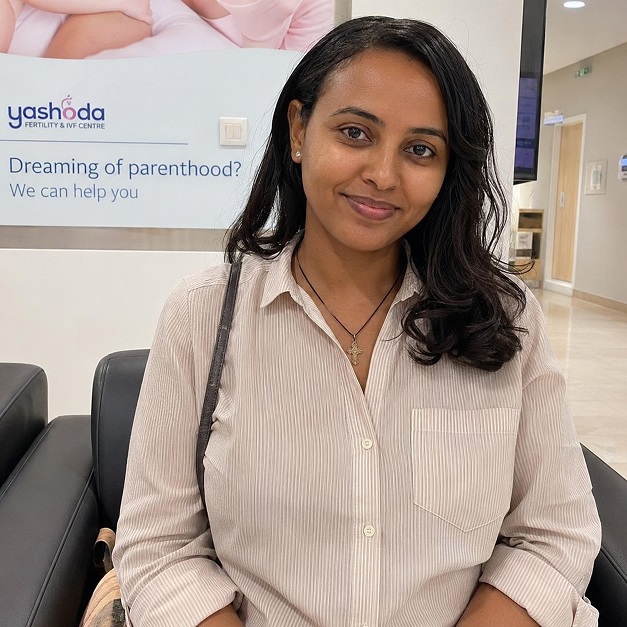
Patient Testimonials from Ethiopia
Ready to Take the First Step?
Share your Medical Reports with our Healthcare Managers Today and Get a FREE CONSULTATION, a Personalized Treatment Plan, and Complete Support from Arrival to Recovery.
Get Your Free ConsultationAreas We Serve
This resource has been thoughtfully prepared for patients from Ethiopia who are considering medical treatment in India. We also welcome patients from the wider region in the countries mentioned below-
We assist patients from:
- Eritrea
- Djibouti
- Somalia
- Kenya
- South Sudan
- Sudan
- Burundi
- Comoros
- Ethiopia
- Madagascar
- Malawi
- Mauritius
- Mozambique
- Rwanda
Many of the insights, treatment pathways, hospital recommendations, travel guidance, and patient support services described here are equally relevant and may be used as a reference when planning treatment in India.
From Ethiopia to India: Your Complete Patient Support Guide
- Brain Tumour Surgery in India for Ethiopians
- Cancer Treatment in India for Ethiopians
- Cardiac Surgery in India for Ethiopian Patients
- Cervical and Disc Replacement Surgery in India for Ethiopians
- Cosmetic and Plastic Surgery in India for Ethiopians
- CyberKnife Treatment in India for Ethiopians
- Eye Surgery in India for Ethiopians
- Gamma Knife Treatment in India for Ethiopians
- Heart Valve Replacement Surgery in India for Ethiopians
- Hip Surgery in India for Ethiopian Patients
- Knee Surgery in India for Ethiopian Patients
- Laparoscopic and Robotic Myomectomy Surgery in India for Ethiopians
- Neurosurgery in India for Ethiopians
- Paediatric Cardiac Surgery in India for Ethiopians
- Paediatric Neurosurgery in India for Ethiopians
- Prostate Cancer Treatment and Surgery in India for Ethiopians
- Robotic Cancer Surgery in India for Ethiopians
- Scoliosis Surgery in India for Ethiopians