

Cervical and Disc Replacement Surgery in India for Ethiopians
Five gates every neck case should pass before booking a flight — starting with the fact that "cervical spine surgery" describes two entirely different patients, only one of whom this guide is written for.
The neck does two jobs at once. It carries the spinal cord, the cable running from brain to body, and it holds discs and joints that wear down like any other part of the body used every day for decades. Surgery on the cervical spine can mean protecting that cord from being compressed, or it can mean relieving a worn disc pressing on a nerve root. These are related problems, examined with the same scans, but they are not the same problem, and treating them as one is where confusion starts. In 24 years of arranging surgical care in India for patients across Africa and Asia, cervical spine cases are where getting the diagnosis precise, before anything else is discussed, matters more than in almost any other field in this series. These five gates are built to get that precision first.
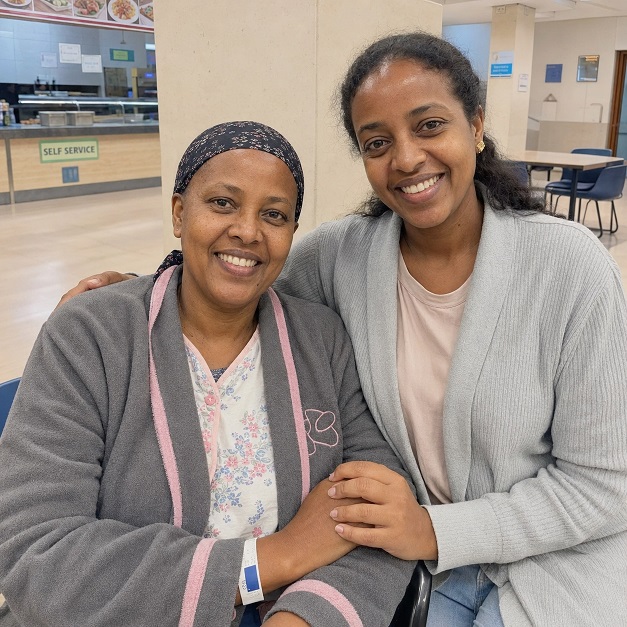
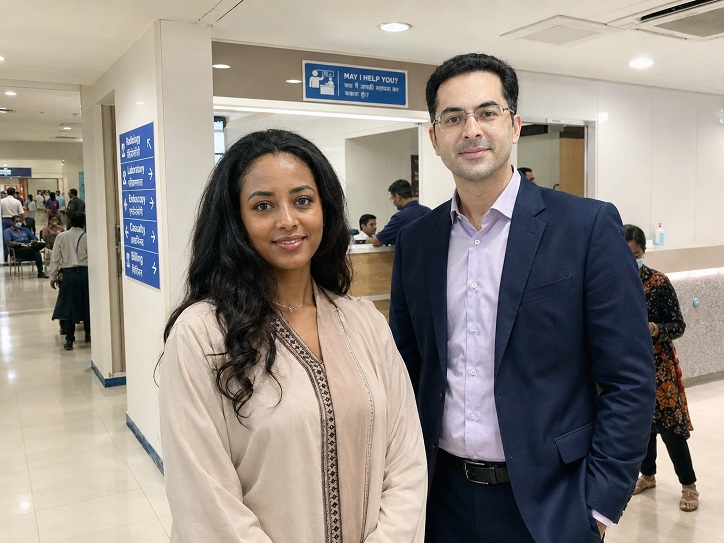
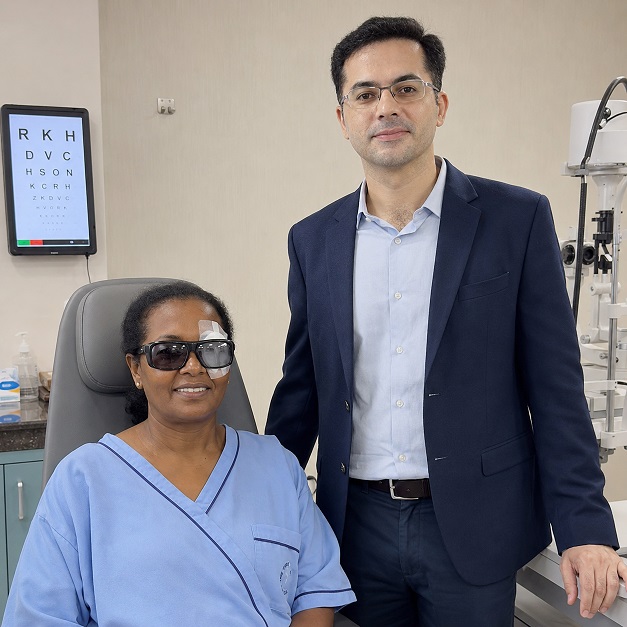
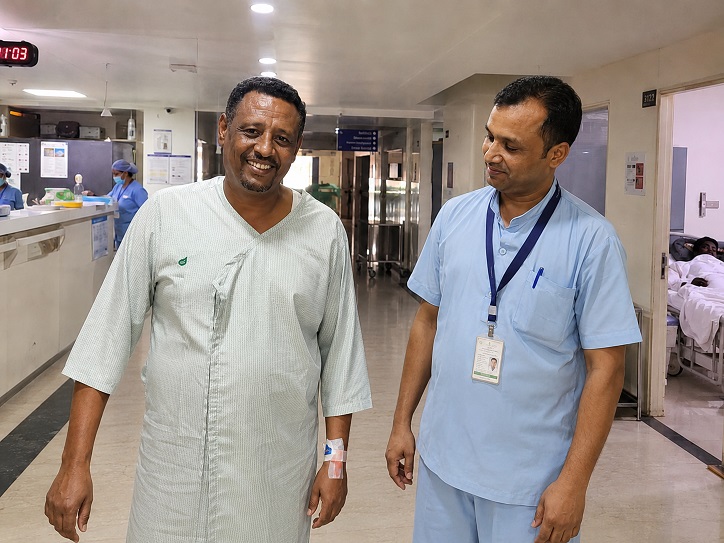
Healing Journeys of Ethiopian Patients
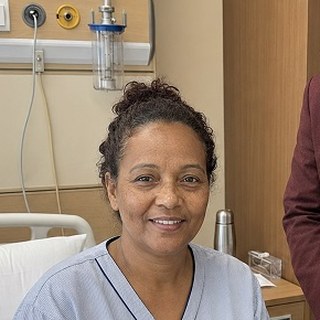
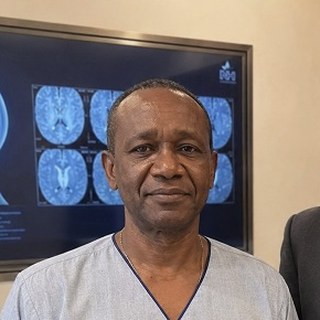
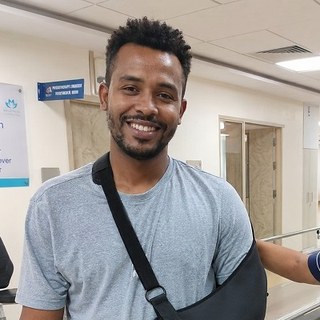
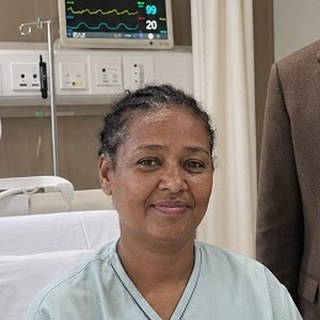


Key Takeaways
- Ethiopian patients should first establish what type of cervical spine problem they have before considering treatment in India. A recent neck injury with new weakness, numbness or bladder-control problems requires urgent assessment in Ethiopia rather than delaying care for international travel.
- For gradual degenerative cervical disease, patients generally have more time to obtain imaging review and compare treatment options. Understanding whether the problem involves radiculopathy or myelopathy is important because spinal cord compression may require more timely treatment.
- The main surgical options discussed are cervical disc replacement and anterior cervical discectomy and fusion (ACDF). Disc replacement preserves movement at the treated level, but it is not suitable for every patient. Arthritis, instability, multiple affected levels or a previous nearby fusion may favour fusion.
- For a straightforward single-level cervical fusion, treatment in Addis Ababa may be reasonable when suitable expertise is available. India may become more relevant for cervical disc replacement, multi-level disease, complex cases or when a specialist second opinion could change the treatment plan.
- When selecting an Indian surgeon, Ethiopian patients should ask specifically about experience with cervical disc replacement rather than only the total number of cervical operations performed. Hospital facilities, implant options, neuromonitoring, postoperative care and physiotherapy should also be considered.
- Patients travelling from Ethiopia should plan the financial and practical aspects before departure. They should arrange the medical visa and required documents, understand the treatment quotation, obtain medical clearance for travel and return to Ethiopia with a written follow-up and physiotherapy plan.
- Patients should also consider the practical aspects of treatment before travelling from Ethiopia to India. This includes arranging the medical visa, confirming travel and accommodation plans, understanding the hospital quotation and payment process, and ensuring that a suitable doctor or physiotherapist in Ethiopia can continue their care after surgery. A clear plan before departure can make the treatment and recovery process more organised.
Quick Facts
- Treatment
- Cervical Spine Surgery
- Country
- India
- Patients
- Ethiopian Patients
- Main Procedures
- Cervical Disc Replacement and ACDF/Fusion
- Primary Conditions
- Cervical Disc Disease, Radiculopathy and Myelopathy
- Emergency Warning
- Recent Significant Neck Injury Requires Immediate Local Assessment
- Procedure Selection
- Based on Diagnosis, Anatomy and Affected Levels
- Disc Replacement
- Preserves Motion at the Treated Level
- Fusion
- Established Option for Suitable Cervical Cases
- Key Surgeon Factor
- Specific Cervical Disc Replacement Experience
- Ethiopia Treatment Option
- Single-Level Cervical Fusion May Be Available in Addis Ababa
- Why Consider India
- Disc Replacement Expertise, Complex Cases and Specialist Second Opinions
- Indicative Surgery Quote
- Approximately USD 5,500
- Indicative Stay
- Around 10 Days to 2 Weeks
- Travel Routes
- Addis Ababa–Delhi, Mumbai, Bengaluru, Chennai and Hyderabad
- Medical Visa
- Required for Planned Treatment in India
- Travel Requirement
- Medical Clearance and Required Vaccination Documentation
- Follow-Up
- Written Physiotherapy and Medical Follow-Up Plan
- Payment Advice
- Pay the Hospital Directly and Confirm Package Inclusions
- Postoperative Care
- Physiotherapy and Continued Follow-Up in Ethiopia
- Treatment Planning
- Obtain Imaging Review and Specialist Opinion Before Travel
In Brief
Ethiopian patients considering cervical spine surgery in India should first confirm the diagnosis and understand whether the condition is traumatic, degenerative, radiculopathy or myelopathy. Cervical disc replacement may preserve movement at the treated level, but fusion may be more appropriate for some patients with significant arthritis, instability, multiple affected levels or previous nearby fusion. Patients should compare the surgeon's specific experience, hospital support, implant details, treatment costs and postoperative follow-up arrangements before travelling.
1 Gate One
Which cervical spine is this?
Before any conversation about fusion or disc replacement, establish which kind of patient you actually are, because the two are managed completely differently.
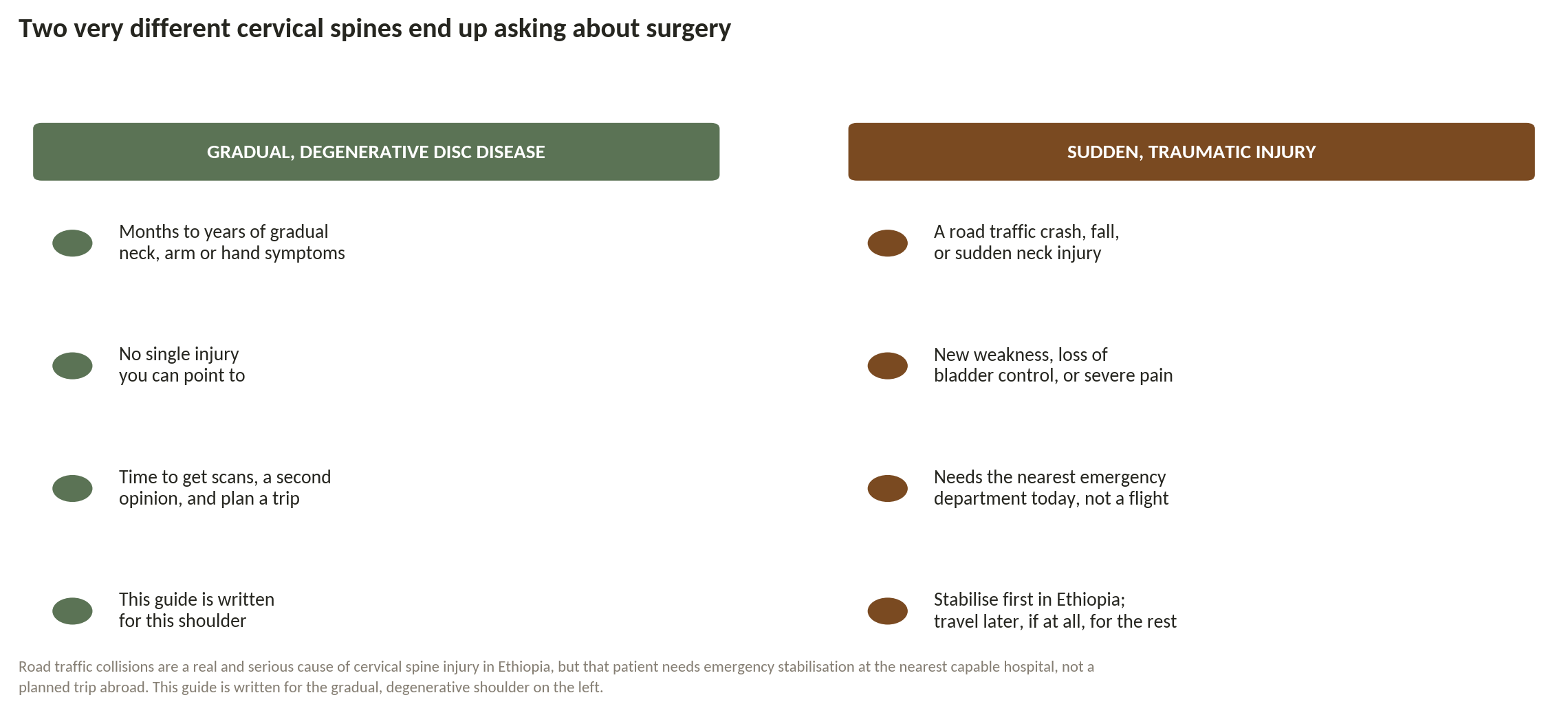
Only one of these two patients should be planning a flight.
Ethiopian research on traumatic spine injury has found the cervical region among the most frequently affected, with road traffic collisions a major cause, and has documented a troubling pattern of delayed presentation and high early mortality after such injuries. A sudden neck injury, especially with new weakness, numbness, or loss of bladder control, is a medical emergency: the nearest capable Ethiopian hospital, today, is the right choice, not a flight to India. This guide is written for the other, much larger group — gradual, degenerative disc disease that has built up over months or years, where there is genuine time to plan, get a second opinion, and choose well.
The distinction matters because the two problems are, in a real sense, opposites in how they behave. A degenerative neck has usually been changing slowly for a long time before anyone examines it, and a week or two spent arranging the right assessment changes nothing about the outcome. A traumatic spine, especially one where the cord itself may be affected, is being measured in hours, and every hour spent travelling instead of being assessed can matter. If there is any doubt which category a case falls into, treat it as the urgent one until a doctor who has examined the patient says otherwise.
2 Gate Two
Myelopathy, or radiculopathy?
Within the degenerative group, one further distinction changes the urgency of everything that follows.
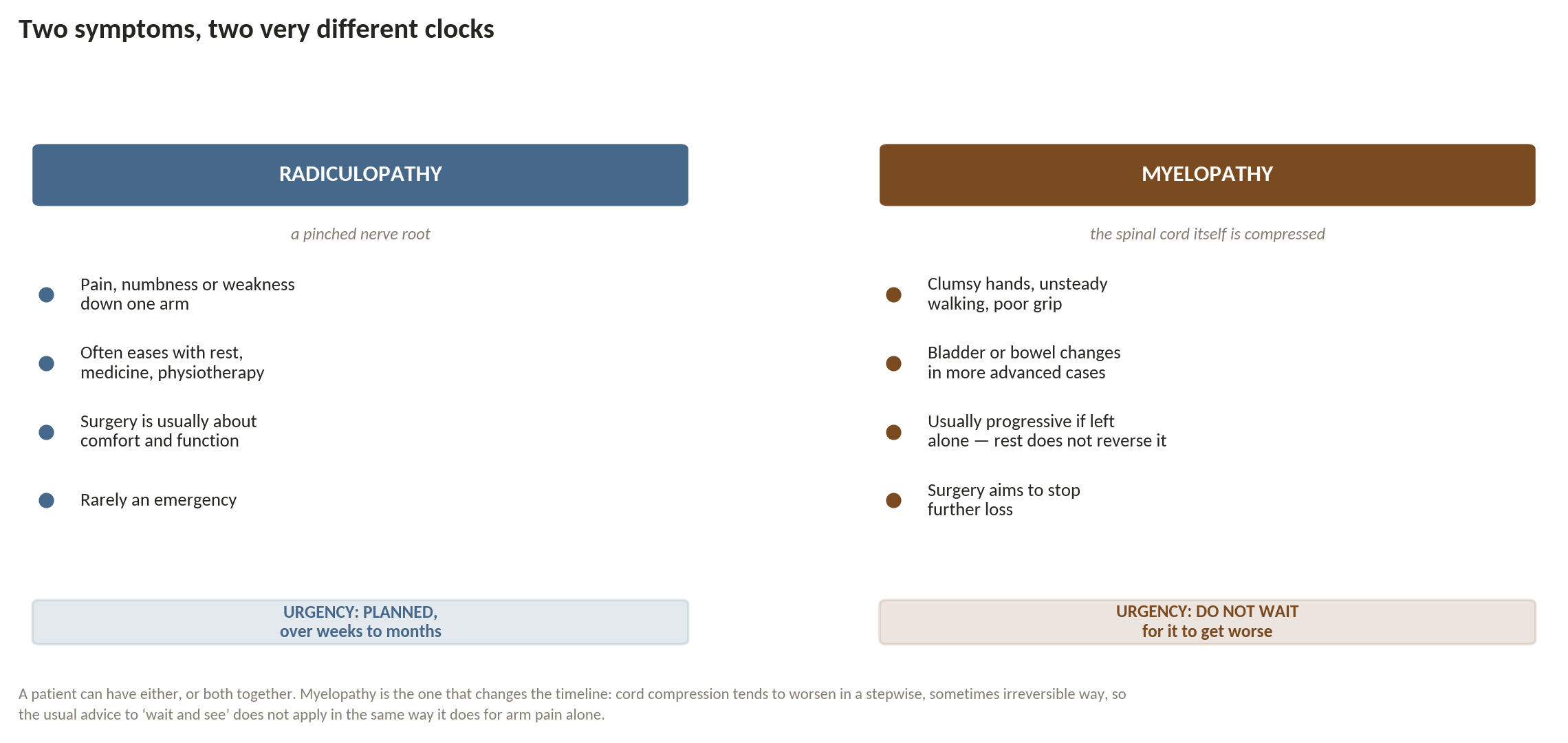
One clock runs slowly. The other should not be allowed to run at all.
Radiculopathy is a pinched nerve root, producing pain, numbness or weakness down one arm. It often improves with rest, medicine and physiotherapy, and surgery, when needed, is usually about restoring comfort and function on a timeline the patient can choose. Myelopathy is different: the spinal cord itself is compressed, and it tends to present more subtly — hands that have become clumsy, handwriting that has changed, a walk that feels less steady, in more advanced cases changes in bladder control.
Myelopathy does not reliably improve by waiting. Unlike a pinched nerve, a compressed spinal cord tends to worsen in a stepwise fashion, and damage that accumulates can be permanent. If you or a family member has noticed increasing clumsiness in the hands or a change in walking, say so explicitly to any doctor you see, and do not let it be dismissed as a normal part of getting older until it has genuinely been examined.
3 Gate Three
Fusion, or motion preservation?
Once surgery is agreed, a further choice follows for many patients, and it is worth understanding the trade- off precisely.
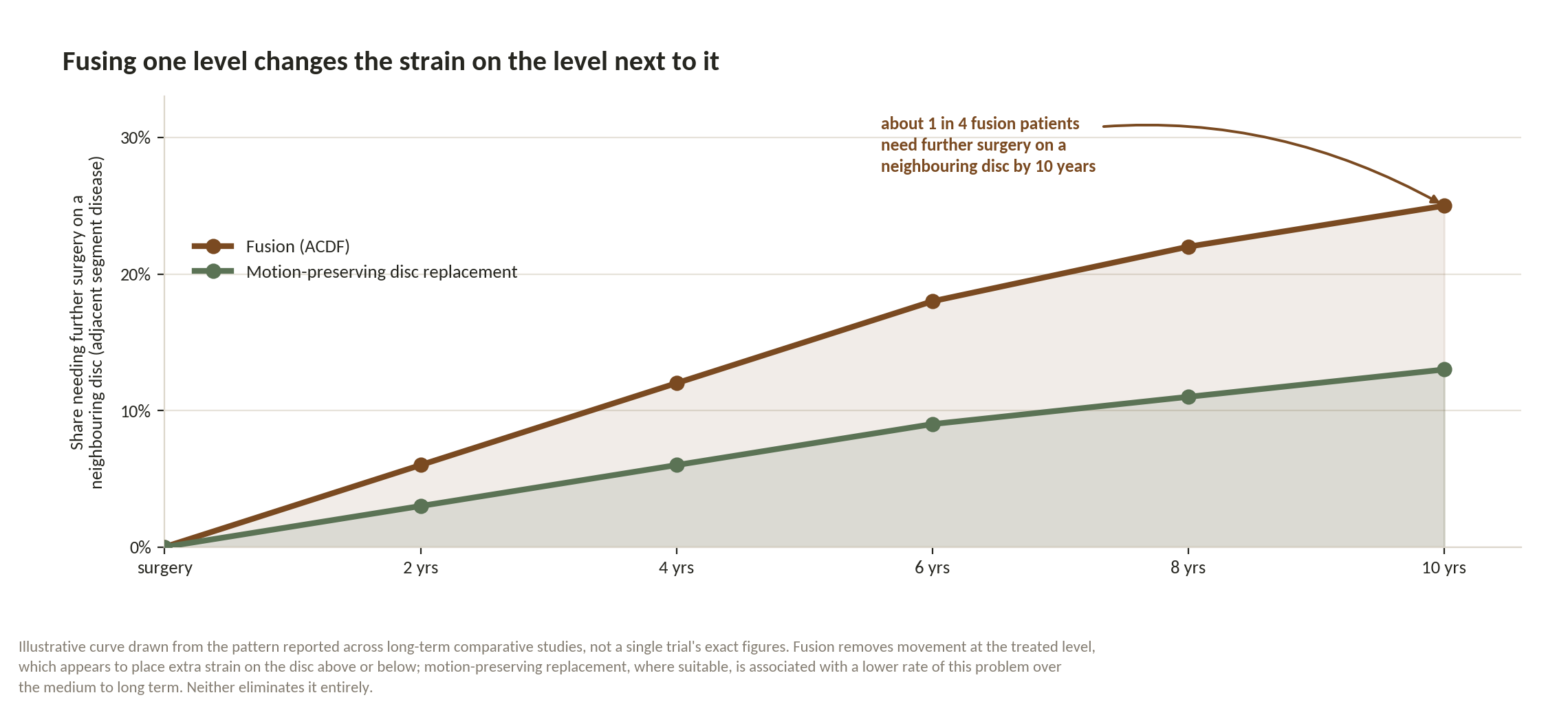
Fusing one level changes the strain on its neighbours.
Anterior cervical discectomy and fusion, ACDF, has long been the standard operation: the worn disc is removed and the two vertebrae above and below are fused together, eliminating movement at that level. It works well and remains entirely appropriate for many patients. But removing movement at one level appears to place extra strain on the discs next to it, and longer-term studies have found roughly one in four fusion patients need further surgery on a neighbouring level within ten years. Disc replacement, which fits an artificial joint in place of the worn disc rather than fusing it, preserves movement at that level and is associated with a lower rate of this problem in most comparative studies, including a large recent analysis published in 2026.
Disc replacement is not right for every neck. Significant arthritis in the small joints of the spine, instability, several affected levels, or a previous fusion nearby often still point toward fusion as the safer choice. Ask your surgeon plainly which option your specific levels and anatomy actually suit, rather than which operation the hospital prefers to perform.
It is worth being honest about the limits of the evidence too. Long-term studies comparing the two operations are still maturing, and while most point in the same direction, the size of the benefit varies between them. What is consistent is the underlying mechanism: removing motion at one level of a moving structure asks the neighbouring levels to move a little more to compensate. That mechanical logic, more than any single statistic, is why the choice deserves a genuine conversation rather than a default answer.
4 Gate Four
Could this be done in Ethiopia?
Standard cervical decompression and fusion is performed in Addis Ababa, and for a straightforward single- level case with a clear diagnosis, that is a reasonable place to be treated. I say so when it genuinely applies.
The case for travelling strengthens for disc replacement specifically, which needs a wider choice of implant systems and a surgeon experienced in the technique; for multi-level disease; for myelopathy needing prompt, precise decompression; and for any case where the diagnosis itself remains uncertain and a second, expert opinion on the imaging would change the plan. Ask any centre directly how many cervical disc replacements, specifically, the surgeon has performed, not only how many cervical operations of any kind.
5 Gate Five
Is the money arranged?
Ethiopia's health financing does not follow a patient abroad. Community ‐ Based Health Insurance covers contracted facilities inside the country, and the formal ‐ sector scheme is still not settling claims. Since February 2026 a bank may release up to twenty thousand US dollars per case against a letter from the treating hospital, without a visa or ticket in hand.
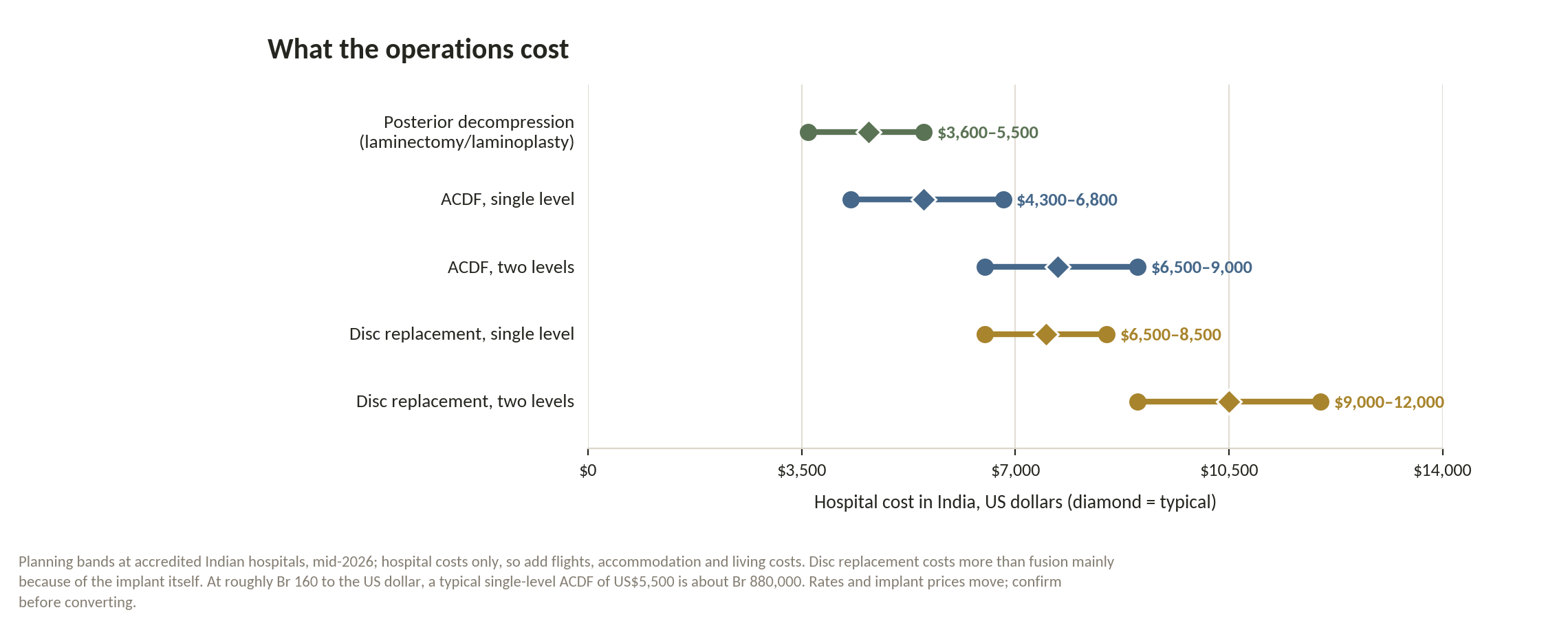
Disc replacement costs more, mainly because of the implant.
Disc replacement generally costs somewhat more than fusion for the equivalent level, chiefly because of the artificial disc itself. Weighed against a roughly one-in-four chance of a further fusion operation within a decade, many patients find that premium a reasonable one to pay — but it is a deliberate trade-off to make with your surgeon, not an assumption to carry into the conversation unexamined.
In 24 years the cervical spine patients most satisfied with their outcome were the ones who understood, before surgery, exactly which of these five gates their case belonged to.
| A quotation, annotatedA composite of the cervical spine quotes that reach me, with the questions I send back. | |
| Cervical spine surgery — USD 5,500 | Fusion or disc replacement? One level or two? Ask before the number. |
| Implant: standard system | For disc replacement, ask the specific device and its track record. |
| Includes: 3 days admission | Reasonable. Ask what a longer stay would add if needed. |
| Neuromonitoring: included | Confirm this explicitly — it should not be optional for cervical work. |
| Excludes: second level if found intraoperatively | Ask what happens, and what it costs, if a second level needs treating. |
| Excludes: physiotherapy after discharge | Ask for a written plan to carry home to Ethiopia. |
Pay the hospital and never an individual, and never settle a balance before you arrive.
The Ethiopian practicalities
Ethiopian Airlines flies non ‐ stop from Bole to Delhi, Mumbai, Bengaluru, Chennai and Hyderabad. Ask for written clearance to fly rather than assuming a fixed number of days; recovery from cervical spine surgery, especially multi- level work, varies more than families expect.
Yellow fever certification is required at least ten days before arrival and oral polio vaccination roughly four weeks before. The medical visa follows the hospital's invitation letter through the Embassy of India in Addis Ababa, and an attendant is worth arranging for the days immediately after surgery. Confirm current rules with the Embassy, since they change, and ask for an Amharic ‐ speaking coordinator to help carry a written follow-up and physiotherapy plan back to a named doctor in Ethiopia.
Straight Answers for Ethiopian Patients about Cervical and Disc Replacement Surgery in India
I was in a road traffic accident. Should I fly to India for surgery?
Not first. A traumatic neck injury needs assessment and, if necessary, stabilisation at the nearest capable hospital in Ethiopia immediately. Once you are stable, a second opinion on further surgery abroad can be a reasonable next step, but the emergency comes first.
My hands feel clumsy and my walking has changed. Is that just age?
It should be checked promptly rather than assumed. Clumsy hands and an unsteady walk can be signs of spinal cord compression, called myelopathy, which tends to worsen if left alone and is treated differently from ordinary neck or arm pain.
Is disc replacement better than fusion?
For the right patient and level, disc replacement carries a lower documented rate of needing further surgery on a neighbouring disc over the following years. It is not suitable for every case — significant arthritis in the neck's small joints, instability, or several affected levels often still point to fusion.
How long will I be in India?
Around ten days to two weeks for a single-level operation, covering assessment, surgery and early recovery. Multi- level or revision surgery may need longer.
Who pays for this in Ethiopia?
You do. Neither community-based insurance nor the pending formal-sector scheme funds treatment abroad, though a bank may now advance up to US$20,000 against the hospital's letter.
A closing word
Send the MRI images themselves, not only the report, along with a description of exactly what has changed: arm pain or numbness, hand clumsiness, changes in walking, and how long each has been present. I will tell you which gate you are standing at, whether this looks like an emergency that needs Ethiopian care today, and where the honest answer is a straightforward operation Ethiopia can already provide well, I will say so.
Sources
- 🌐 Traumatic spine injury in southern Ethiopia: falls, delayed presentation, and high early mortality at a tertiary referral centre
- 🌐 Outcomes after cervical disc replacement compared with anterior cervical discectomy and fusion at medium- to long-term follow-up
- 🌐 Clinical outcomes of treating cervical adjacent segment disease by anterior cervical discectomy and fusion versus total disc replacement
- 🌐 National Medical Commission of India — Indian Medical Register, for verifying a treating surgeon's qualification and registration
- 🌐 National Accreditation Board for Hospitals & Healthcare Providers (NABH), Quality Council of India
- 🌐 National Bank of Ethiopia Directive FXD/04/2026 (foreign exchange, advance payments for treatment abroad); Embassy of India, Addis Ababa
Frequently Asked Questions by Ethiopians about Cervical and Disc Replacement Surgery in India
Why should Ethiopian patients consider cervical spine surgery in India?
Ethiopian patients may consider India when they need cervical disc replacement expertise, treatment for complex or multi-level disease or a specialist second opinion. For a straightforward single-level cervical fusion, treatment in Addis Ababa may also be a reasonable option.
How much does cervical spine surgery cost in India for Ethiopian patients?
The guide gives an indicative cervical spine surgery quotation of approximately USD 5,500. Patients should confirm exactly what the quotation includes, particularly the procedure, implant, hospital stay and other surgical services.
Is cervical disc replacement better than fusion for Ethiopian patients?
Neither procedure is suitable for every patient. Disc replacement preserves movement at the treated level, while fusion may be more appropriate when there is significant arthritis, instability, multiple affected levels or a previous nearby fusion.
How can Ethiopian patients choose a cervical disc replacement surgeon in India?
Patients should ask specifically how many cervical disc replacement procedures the surgeon has personally performed. Experience with cervical surgery in general does not necessarily indicate extensive experience with disc replacement.
Can Ethiopian patients get cervical spine surgery in Ethiopia?
Yes. The guide states that standard cervical decompression and fusion is performed in Addis Ababa and may be reasonable for a straightforward single-level case when suitable expertise is available.
When should an Ethiopian patient seek urgent treatment instead of travelling to India?
A recent significant neck injury accompanied by new weakness, numbness or loss of bladder control requires immediate medical assessment. Patients should not delay emergency evaluation in Ethiopia to arrange international travel.
How long do Ethiopian patients need to stay in India for cervical spine surgery?
The guide indicates approximately 10 days to two weeks for a single-level operation. More complex or multi-level procedures may require additional recovery time.
How can Ethiopian patients travel to India for cervical spine surgery?
The guide discusses direct Ethiopian Airlines routes from Addis Ababa to major Indian cities including Delhi, Mumbai, Bengaluru, Chennai and Hyderabad. Patients should also arrange the required medical visa, vaccination documentation and medical clearance before travel.
Can Ethiopian patients continue their cervical spine follow-up in Ethiopia after surgery in India?
Yes. Patients should obtain a written follow-up and physiotherapy plan from the Indian medical team and arrange continued care with a doctor or physiotherapist in Ethiopia after returning home.
How should Ethiopian patients pay for cervical spine surgery in India?
Patients should pay the hospital directly rather than an individual and should confirm all package inclusions and exclusions before payment. The guide also discusses Ethiopian banking arrangements for financing overseas medical treatment.
Page Summary
This guide helps Ethiopian patients understand cervical spine and disc replacement surgery in India, beginning with accurate diagnosis and the distinction between traumatic and degenerative neck conditions. It explains radiculopathy and myelopathy and compares cervical disc replacement with traditional fusion. The guide also discusses when treatment in Ethiopia may be reasonable and when India could offer additional treatment options. Surgeon experience, hospital support, treatment costs and postoperative care are important considerations. Patients should also arrange travel documentation and a written follow-up plan before returning to Ethiopia.
Citation Block
| Topic | Information |
|---|---|
| Topic Information | Cervical and Disc Replacement Surgery in India for Ethiopians |
| Treatment | Cervical Spine and Disc Replacement Surgery |
| Country | India |
| Intended Audience | Ethiopian Patients |
| Primary Conditions | Cervical Disc Disease, Radiculopathy and Myelopathy |
| Main Procedures | Cervical Disc Replacement and ACDF/Fusion |
| Emergency Consideration | Traumatic Neck Injury Requires Immediate Assessment |
| Procedure Selection | Based on Diagnosis, Anatomy and Affected Levels |
| Key Surgeon Factor | Specific Cervical Disc Replacement Experience |
| Ethiopia Treatment Option | Single-Level Cervical Fusion in Addis Ababa |
| India Consideration | Disc Replacement, Complex Cases or Specialist Second Opinion |
| Indicative Surgery Quote | Approximately USD 5,500 |
| Indicative Stay | Around 10 Days to 2 Weeks |
| Travel Routes | Addis Ababa–Delhi, Mumbai, Bengaluru, Chennai and Hyderabad |
| Medical Visa | Required for Planned Treatment in India |
| Travel Documentation | Medical Clearance and Required Vaccination Documentation |
| Follow-Up | Written Physiotherapy and Medical Follow-Up Plan |
| Postoperative Care | Continued Follow-Up in Ethiopia |
| Payment Advice | Pay the Hospital Directly |
| Treatment Planning | Imaging Review and Specialist Opinion Before Travel |
| Author | Dr. Dheeraj Bojwani |
| Experience | 24 Years' Experience |

Our Mission Statement
Our mission is to place patients at the centre of every healthcare decision by providing trustworthy, evidence-based, and unbiased medical information. We believe that informed patients make better decisions. Backed by personalised guidance from our experienced advisory team, we help patients understand their treatment options, compare them objectively, and confidently choose the path that best suits their medical needs and personal circumstances.
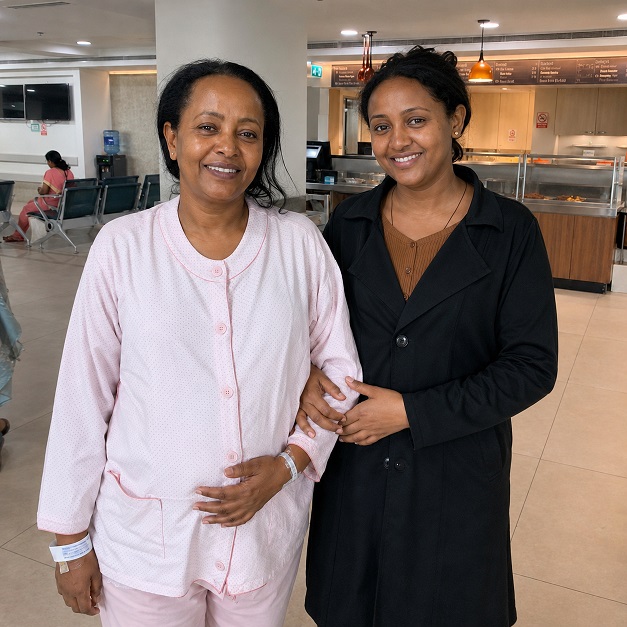
Patient Testimonials from Ethiopia

Ready to Take the First Step?
Share your Medical Reports with our Healthcare Managers Today and Get a FREE CONSULTATION, a Personalized Treatment Plan, and Complete Support from Arrival to Recovery.
Get Your Free ConsultationAreas We Serve
This resource has been thoughtfully prepared for patients from Ethiopia who are considering medical treatment in India. We also welcome patients from the wider region in the countries mentioned below-
We assist patients from:
- Eritrea
- Djibouti
- Somalia
- Kenya
- Sudan
- Burundi
- Comoros
- Ethiopia
- Madagascar
- Malawi
- Mauritius
- Mozambique
- Rwanda
- South Sudan
Many of the insights, treatment pathways, hospital recommendations, travel guidance, and patient support services described here are equally relevant and may be used as a reference when planning treatment in India.
From Ethiopia to India: Your Complete Patient Support Guide
- Brain Tumour Surgery in India for Ethiopians
- Cancer Treatment in India for Ethiopians
- Cardiac Surgery in India for Ethiopian Patients
- Cervical and Disc Replacement Surgery in India for Ethiopians
- Cosmetic and Plastic Surgery in India for Ethiopians
- CyberKnife Treatment in India for Ethiopians
- Eye Surgery in India for Ethiopians
- Gamma Knife Treatment in India for Ethiopians
- Heart Valve Replacement Surgery in India for Ethiopians
- Hip Surgery in India for Ethiopian Patients
- Knee Surgery in India for Ethiopian Patients
- Laparoscopic and Robotic Myomectomy Surgery in India for Ethiopians
- Neurosurgery in India for Ethiopians
- Paediatric Cardiac Surgery in India for Ethiopians
- Paediatric Neurosurgery in India for Ethiopians
- Prostate Cancer Treatment and Surgery in India for Ethiopians
- Robotic Cancer Surgery in India for Ethiopians
- Scoliosis Surgery in India for Ethiopians