

Paediatric Neurosurgery in India for Ethiopians
Five gates every family should pass before booking a flight for a child's brain or spine condition — starting with the single most misunderstood fact in this field: a second operation is usually normal, not a failure.
Most paediatric neurosurgery, in Ethiopia and everywhere else, is not about tumours. It is about hydrocephalus — a build-up of fluid inside a baby's skull, usually treated with a shunt that drains it away. Worldwide it is the single most common condition a children's neurosurgeon treats, and it is what most Ethiopian families in this field are actually dealing with. The hardest part for a parent to accept is not the first operation. It is the possibility of a second one. A shunt is a mechanical device in a growing child, and devices in growing children sometimes block, infect, or are outgrown. When that happens it can feel like something went wrong. Most of the time, nothing did. In 24 years of arranging surgical care in India for patients across Africa and Asia, the families who coped best with a child's shunt were the ones told from the outset that a revision was a real possibility, not a remote one. These five gates are built to give you that same preparation.
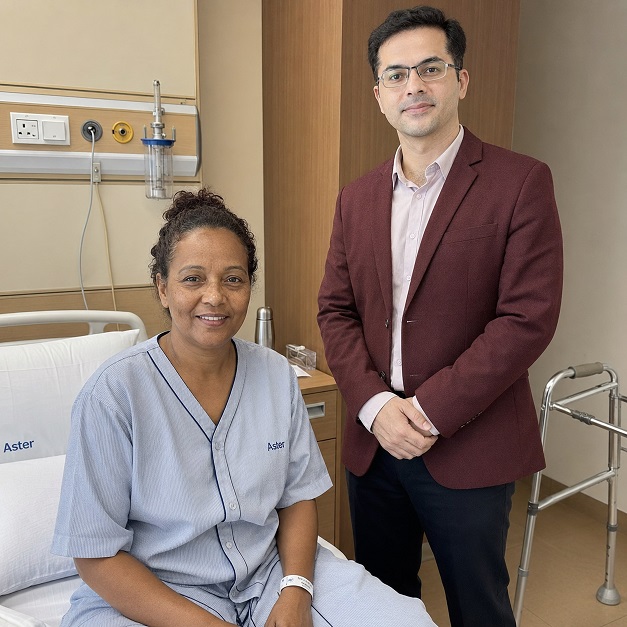
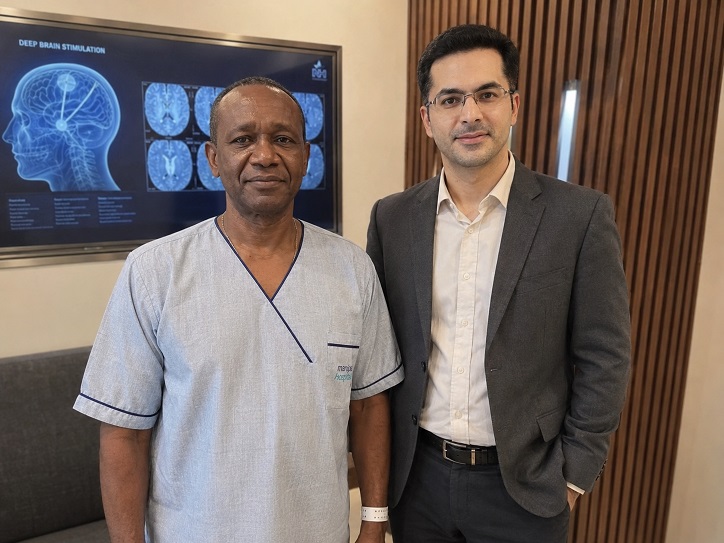
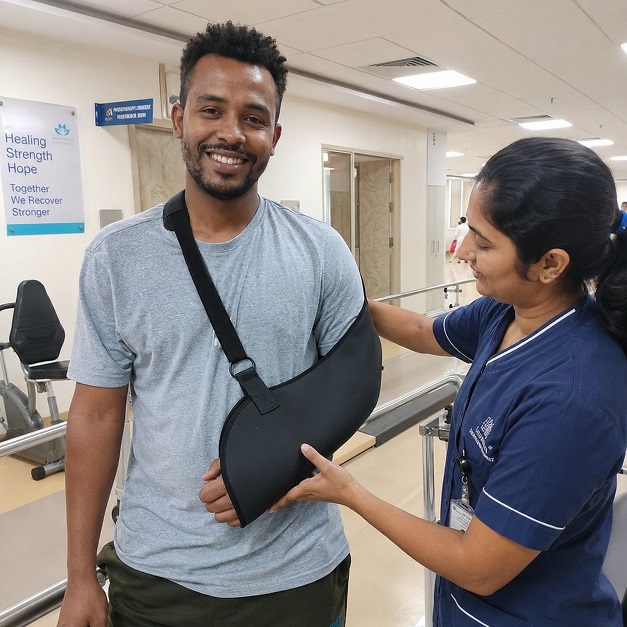
Healing Journeys of Ethiopian Patients

Key Takeaways
- Paediatric neurosurgery for Ethiopian children is most commonly associated with hydrocephalus, rather than brain tumours. Hydrocephalus is a build-up of fluid inside a child's skull and is frequently treated with a shunt that drains the excess fluid.
- The guide's central message for parents is that a second shunt operation is common and does not automatically mean the first surgery failed. A shunt is a mechanical device placed in a growing child and may later block, become infected or require revision.
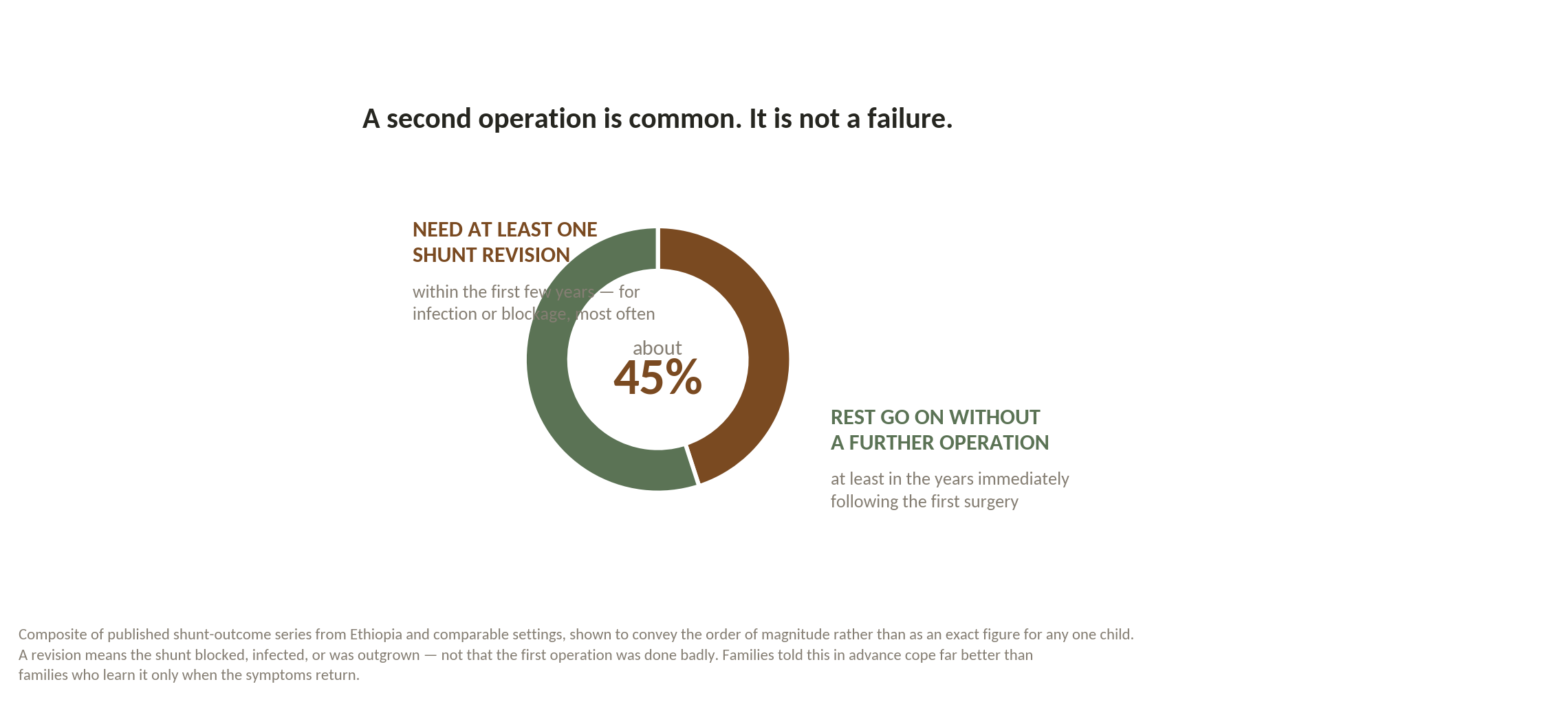
- The page 2 chart illustrates this point with an approximate figure of 45% of children requiring at least one shunt revision within the first few years. The document describes this as a composite estimate intended to show the order of magnitude rather than predict the outcome for an individual child.
- Hydrocephalus in children may be associated with spina bifida, infection around birth or congenital abnormalities. Because infection can itself require treatment, families should ask whether an infectious cause has been considered rather than assuming that fluid accumulation is the entire problem.
- A rapidly increasing head size may be an early sign of hydrocephalus. Assessment should include MRI or CT imaging reviewed by someone experienced with children's scans, together with examination by a paediatric neurosurgeon.
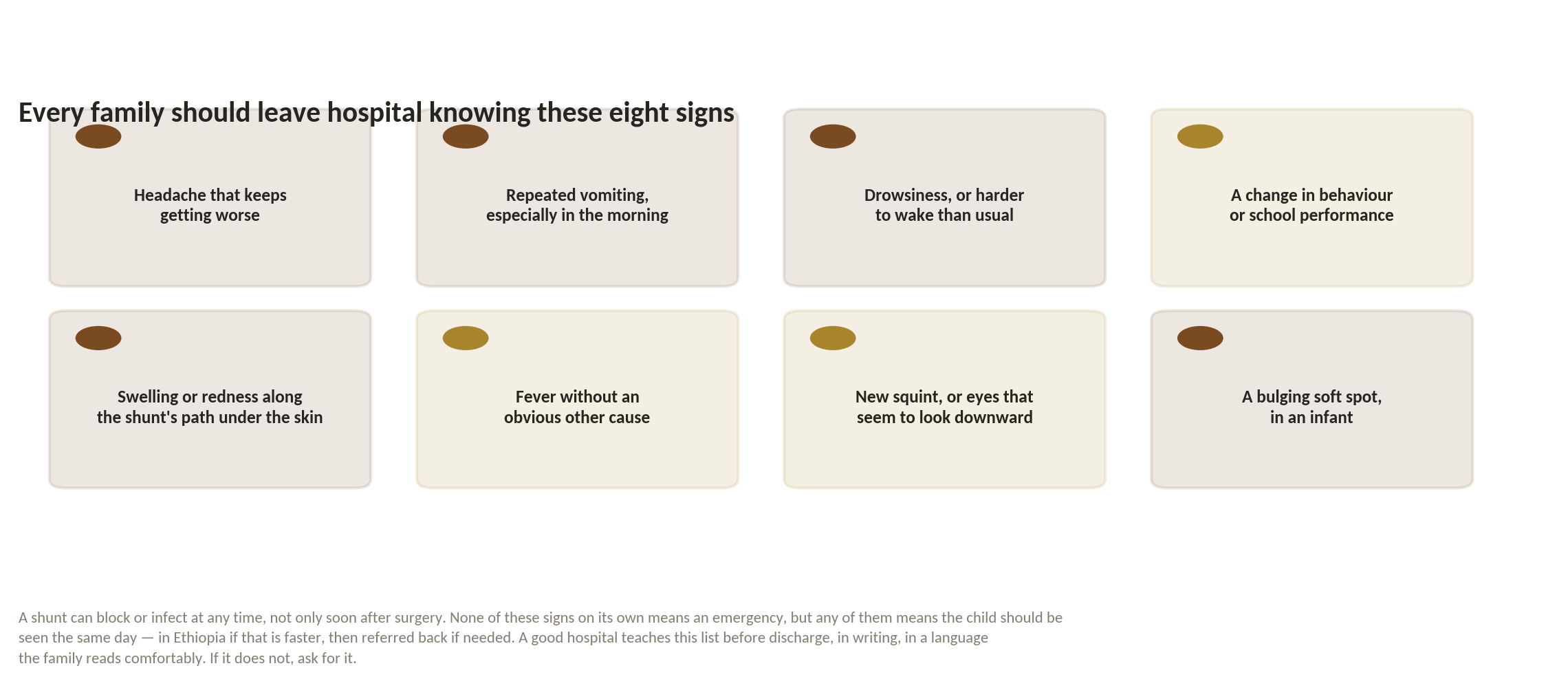
- Families of children with a shunt should know the warning signs of possible blockage or infection. The page 3 infographic identifies eight signs: worsening headache, repeated vomiting, unusual drowsiness, behavioural change, swelling or redness along the shunt pathway, unexplained fever, new eye changes such as squint or downward-looking eyes, and a bulging soft spot in an infant. Any of these requires same-day medical assessment.
- Choosing a treatment centre should involve determining whether it is a genuinely paediatric neurosurgical unit, rather than an adult unit that occasionally treats children.
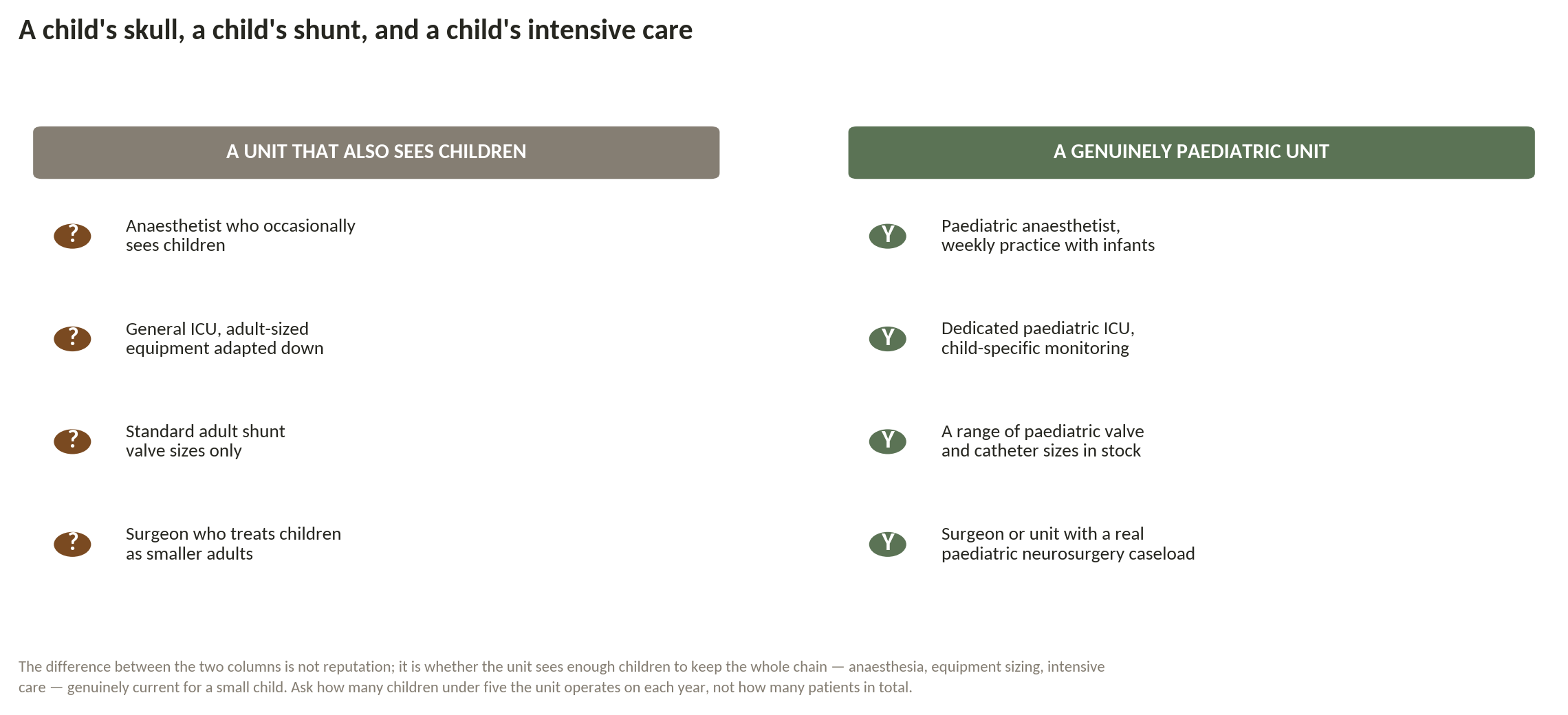
- The page 3 comparison graphic highlights the difference: a genuinely paediatric unit should have a paediatric anaesthetist who regularly manages infants, a dedicated paediatric ICU with child-specific monitoring, paediatric shunt valves and catheter sizes in stock, and a surgeon or unit with a genuine paediatric neurosurgical caseload.
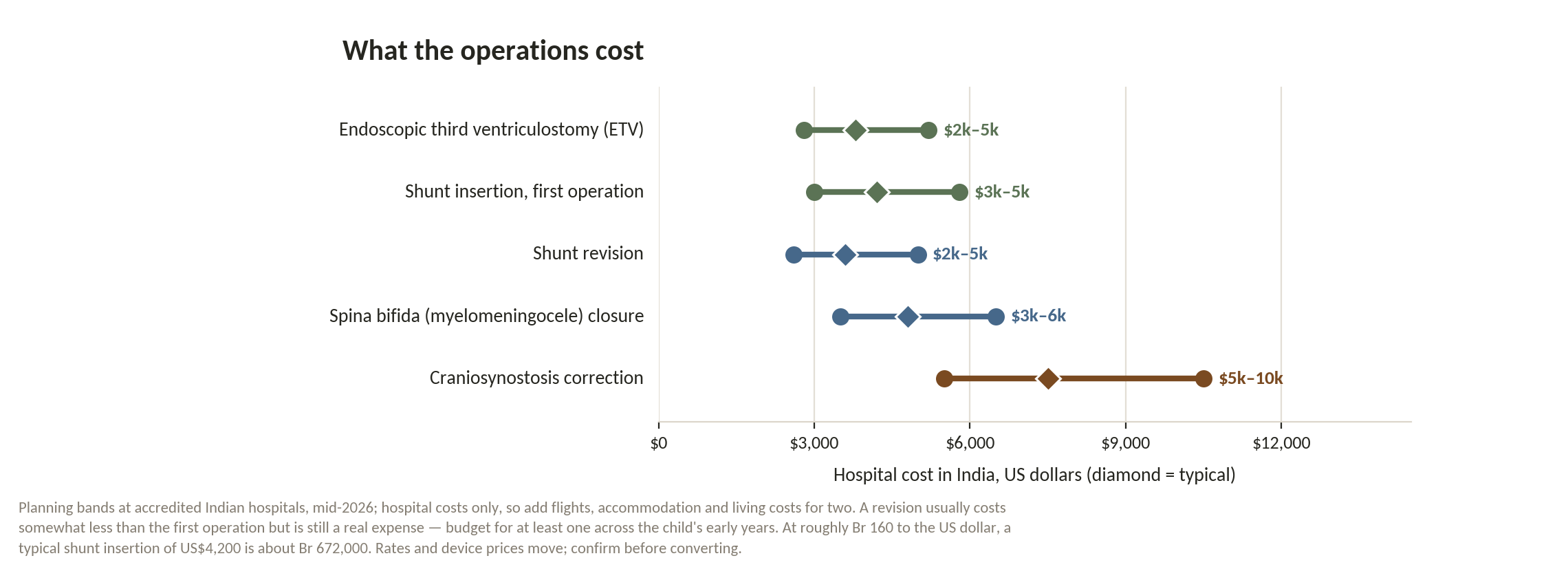
- According to the cost chart on page 4, indicative Indian hospital costs are approximately USD 2,000–5,000 for ETV, USD 3,000–5,000 for first shunt insertion, USD 2,000–5,000 for shunt revision, USD 3,000–6,000 for spina bifida closure and USD 5,000–10,000 for craniosynostosis correction.
- For a straightforward shunt or ETV, the guide suggests approximately 2–3 weeks in India. Spina bifida closure or craniosynostosis surgery may require longer because recovery and wound healing determine when the child is ready to travel.
Quick Facts
- Country
- India
- Intended Audience
- Ethiopian children and their families
- Procedures Covered
- Shunt insertion, shunt revision, endoscopic third ventriculostomy (ETV), spina bifida closure and craniosynostosis correction
- Treatment in Ethiopia
- Hydrocephalus surgery is performed at several hospitals in Addis Ababa, and ETV is increasingly available locally.
- ETV Cost
- Approximately USD 2,000–5,000
- First Shunt Insertion Cost
- Approximately USD 3,000–5,000
- Shunt Revision Cost
- Approximately USD 2,000–5,000
- Spina Bifida Closure Cost
- Approximately USD 3,000–6,000
- Craniosynostosis Correction Cost
- Approximately USD 5,000–10,000
- Typical Stay – Shunt/ETV
- Approximately 2–3 weeks
- Typical Stay – Complex Procedures
- Longer for spina bifida closure or craniosynostosis correction
- Hospital Stay
- Procedure-dependent; the sample quotation includes 2 PICU days.
- Long-Term Follow-Up
- A named doctor in Ethiopia should ideally receive the child's records and imaging before the family leaves India.
- Financial Planning
- The guide states that Ethiopian health financing does not fund overseas treatment and that a bank may release up to USD 20,000 per case against a treating hospital's letter.
In Brief
Paediatric neurosurgery in India for Ethiopian children commonly involves hydrocephalus, shunt surgery, endoscopic third ventriculostomy (ETV), spina bifida and craniosynostosis. A central point for families is that a shunt is a lifelong mechanical device and revision may be required if it blocks or becomes infected; the guide's page 2 graphic uses an approximate figure of 45% needing at least one revision within the first few years. Families should therefore choose a genuinely paediatric neurosurgical unit, learn the warning signs of shunt problems before discharge and arrange long-term follow-up with a named doctor in Ethiopia. Indicative Indian hospital costs range from approximately USD 2,000–5,000 for ETV to USD 5,000–10,000 for craniosynostosis correction.
1 Gate One
What is actually wrong?
Paediatric neurosurgery covers several distinct conditions, and it matters which one your child has. Hydrocephalus, most often linked to spina bifida or to an infection around birth, is by far the most common. Spina bifida itself, an opening in the developing spine, often needs its own closure operation, sometimes together with a shunt. Craniosynostosis, where the skull's growth joints fuse too early and distort its shape, is a different problem again, corrected on its own timetable. Tumours and head injuries occur in children too, and are covered in more depth in this series' reports on brain tumours and general neurosurgery.
An MRI or CT read by someone experienced with children's scans, alongside a paediatric neurosurgeon's examination, is what establishes which of these your child has. Send the images themselves, not only the written report, and include the child's birth history and growth chart if you have one — for hydrocephalus in particular, a rapidly enlarging head is often the clearest early sign, sometimes noticed before any other symptom appears.
Worldwide, hydrocephalus in children is caused about as often by infection or complications around birth as by a purely congenital malformation, and that mix is reflected in Ethiopia's own published experience. This matters practically: an infective cause sometimes needs treating in its own right before or alongside the shunt, so ask directly whether that has been considered, rather than assuming the fluid build ‐ up is the whole story.
2 Gate Two
What signs mean go back today?
If your child needs a shunt, understand this before the operation, not after: it is a lifelong device, and living with it means learning to watch for trouble.
A second operation is common. It is not a failure.
Across published series, including from Ethiopia itself, a substantial share of children with a new shunt need at least one revision within the first few years, usually because the shunt has blocked or become infected rather than because anything was done wrong at surgery. Knowing this in advance changes how a family experiences it: a manageable, expected event rather than a crisis.
Eight signs every family should be taught before leaving hospital.
Ask for this list in writing before you leave the hospital , ideally translated. A worsening headache, repeated vomiting, unusual drowsiness, a behaviour change, swelling along the shunt's path under the skin, unexplained fever, new eye changes, or a bulging soft spot in an infant — any one of these means same-day assessment, wherever you are. A hospital that teaches this properly is protecting your child for years after you have left.
3 Gate Three
Is this a genuinely paediatric unit?
A children's brain and spine are not small versions of an adult's, and the team around the operation needs to reflect that in practice, not only in a brochure.
The gap that matters is practice, not reputation.
A paediatric anaesthetist who manages small children weekly, an intensive-care unit built around children rather than adapted for them, a genuine stock of paediatric shunt valves and catheters in the sizes infants actually need, and a surgeon with a real paediatric caseload — these are the things that separate a unit that also sees children from one that is built for them. Ask directly how many children under five the unit operates on each year, and how many of those are shunt or hydrocephalus cases specifically. A confident, specific answer is worth more than any hospital ranking.
4 Gate Four
Where does each part belong?
Ethiopian paediatric neurosurgical capacity has grown substantially. Hydrocephalus surgery is now performed at several hospitals in Addis Ababa, and endoscopic third ventriculostomy — an alternative to a shunt that avoids implanting a permanent device in some children — is increasingly available locally. Where it works, ETV is genuinely attractive: no foreign body, nothing to block or infect years later, and no lifelong device to monitor. It does not suit every child, and a paediatric neurosurgeon will tell you whether your child's anatomy and age make it a realistic option rather than a shunt. Where a straightforward case can be seen and treated promptly at home, that is often the right choice.
The case for travelling is strongest for complex hydrocephalus, craniosynostosis, or spina bifida needing a genuinely paediatric surgical and intensive-care team not yet consistently available at every centre. But because gate two established that a shunt is a lifelong relationship rather than a single event, where the operation happens matters less than where the follow ‐ up happens. Before you leave India, arrange a named doctor in Ethiopia who will follow the child, receives the operation records and imaging, and can manage straightforward revisions locally — referring back only when something is genuinely complex. Ask the operating hospital to set this connection up directly rather than leaving the family to arrange it alone.
5 Gate Five
Is the money arranged — for a lifetime device?
Ethiopia's health financing does not follow a child abroad. Community ‐ Based Health Insurance covers contracted facilities inside the country, and the formal ‐ sector scheme is still not settling claims. Since February 2026 a bank may release up to twenty thousand US dollars per case against a letter from the treating hospital, without a visa or ticket in hand.
Budget for more than one operation across the early years.
The figure that most needs to be in a family's plan is not on any single quotation: the likely cost of a revision, years after the first operation is forgotten. Given roughly how common revision is, treat it as an expected future cost, not a remote risk, and ask both the Indian hospital and any Ethiopian follow ‐ up centre what a straightforward revision would cost in each place.
In 24 years the paediatric shunt families who struggled financially were almost always the ones who had budgeted for one operation only.
| A quotation, annotatedA composite of the paediatric neurosurgery quotes that reach me, with the questions I send back. | |
| Paediatric neurosurgery — USD 4,600 | For which condition? Hydrocephalus, spina bifida, craniosynostosis differ. |
| Shunt: standard paediatric valve | Which size range does the unit actually stock? Ask before surgery. |
| PICU: 2 days included | Ask the daily rate beyond it, and whether it is genuinely paediatric. |
| Includes: follow-up scan before discharge | Good. Ask who reads it, and how the report reaches Ethiopia. |
| Excludes: revision if needed later | Expect this. Ask the price of a revision now, not when it happens. |
| Excludes: written warning-signs discharge sheet | Ask for one anyway, in Amharic if possible. It is the cheapest safeguard. |
Pay the hospital and never an individual, and never settle a balance before you arrive.
The Ethiopian practicalities
Ethiopian Airlines flies non ‐ stop from Bole to Delhi, Mumbai, Bengaluru, Chennai and Hyderabad. Ask the hospital for written clearance before flying home rather than assuming a fixed number of days; for a young child after cranial or spinal surgery, that clearance depends on wound healing and how the child is feeding and settling, not a calendar.
Yellow fever certification is required at least ten days before arrival and oral polio vaccination roughly four weeks before; for an infant, coordinate this with the paediatrician alongside the routine vaccination schedule rather than treating it as a separate errand. The medical visa follows the hospital's invitation letter through the Embassy of India in Addis Ababa; apply for both parents where you can, since a small child in hospital needs a familiar face nearby at all times. Confirm current rules with the Embassy, since they change, and ask for an Amharic ‐ speaking coordinator to help through discharge teaching — this is precisely where the warning-signs list from gate two needs to be understood, not merely handed over.
A closing word
Send the scan images, the child's birth history, growth chart, and a note on head size, feeding, alertness and any vomiting. I will tell you which gate you are standing at, whether this looks like a single operation or the start of an ongoing relationship with a shunt, and where the honest answer is that Addis Ababa can see your child as well as India can, I will say so.
Sources
- 🌐 Asfaw ZK, et al. Defining pediatric neurosurgery in low-income countries: a cross-sectional study in Ethiopia
- 🌐 Laeke T, et al. Paediatric hydrocephalus in Ethiopia: treatment failures and infections. World Neurosurgery, 2017
- 🌐 Surgical outcomes and complications in children undergoing ventriculoperitoneal shunt at a tertiary care hospital in Eastern India
- 🌐 National Medical Commission of India — Indian Medical Register, for verifying a treating doctor's registration and qualifications
- 🌐 National Accreditation Board for Hospitals & Healthcare Providers (NABH), a constituent board of the Quality Council of India
- 🌐 National Bank of Ethiopia Directive FXD/04/2026 (foreign exchange, advance payments for treatment abroad); Embassy of India, Addis Ababa
Frequently Asked Questions by Ethiopians about Paediatric Neurosurgery in India
What are the most common conditions treated by paediatric neurosurgeons?
The guide identifies hydrocephalus as the most common condition in paediatric neurosurgery, particularly among the Ethiopian families discussed. Other conditions include spina bifida and craniosynostosis, while brain tumours and head injuries are also treated by paediatric neurosurgeons but are not the main focus of this guide.
If a child needs a second shunt operation, does it mean the first surgery failed?
Usually not. The guide's page 2 chart uses an approximate figure of 45% of children requiring at least one shunt revision within the first few years. Revisions most commonly occur because the shunt becomes blocked or infected rather than because the original operation was performed incorrectly. The document's central message is: a second operation is common; it is not a failure.
What warning signs of shunt blockage or infection should Ethiopian parents know?
The page 3 infographic identifies eight warning signs: a worsening headache, repeated vomiting, unusual drowsiness, behaviour or school-performance changes, swelling or redness along the shunt pathway, unexplained fever, new eye changes such as squinting or downward-looking eyes, and a bulging soft spot in an infant. According to the guide, any of these signs warrants same-day medical assessment.
Is ETV better than a shunt for a child with hydrocephalus?
Not for every child. Endoscopic third ventriculostomy (ETV) can be attractive because it avoids implanting a permanent foreign device, meaning there is no shunt to block or become infected years later. However, the guide states that ETV suitability depends on the child's age and anatomy. A paediatric neurosurgeon should determine whether ETV is a realistic alternative to shunt surgery.
How much does paediatric neurosurgery in India cost for Ethiopian children?
According to the cost chart on page 4, indicative Indian hospital costs are approximately USD 2,000–5,000 for ETV, USD 3,000–5,000 for first shunt insertion, USD 2,000–5,000 for shunt revision, USD 3,000–6,000 for spina bifida closure, and USD 5,000–10,000 for craniosynostosis correction. These are hospital planning ranges rather than guaranteed quotations.
How can Ethiopian parents tell whether an Indian hospital has a genuinely paediatric neurosurgical unit?
The comparison graphic on page 3 recommends looking beyond hospital reputation. A genuinely paediatric unit should have a paediatric anaesthetist who regularly treats infants, a dedicated paediatric ICU with child-specific monitoring, appropriate paediatric shunt valves and catheter sizes in stock, and a surgeon or team with a genuine paediatric neurosurgical caseload. Parents should ask how many children under five the unit operates on each year and how many are hydrocephalus or shunt cases.
Can hydrocephalus and shunt problems be treated in Ethiopia?
Increasingly, yes. The guide states that hydrocephalus surgery is performed at several hospitals in Addis Ababa, and ETV is increasingly available locally. Straightforward shunt revisions may also often be managed in Ethiopia once the child has an established follow-up system. The case for travelling is described as stronger for complex hydrocephalus, craniosynostosis or spina bifida requiring specialised paediatric surgical and intensive-care expertise.
How long should an Ethiopian family stay in India after paediatric neurosurgery?
The guide suggests approximately 2–3 weeks for a straightforward shunt operation or ETV. Children undergoing spina bifida closure or craniosynostosis correction may need longer because wound healing and overall recovery determine when travel is safe. Families should obtain written clearance from the hospital before flying home rather than relying on a predetermined return date.
What long-term follow-up should be arranged after shunt surgery in India?
Before returning home, the guide recommends establishing a named doctor in Ethiopia who will follow the child, receive the operative records and imaging, recognise shunt problems and manage straightforward revisions locally where appropriate. The Indian hospital should ideally help establish this connection directly. This is important because a shunt should be viewed as a lifelong relationship rather than a one-time operation.
What should Ethiopian parents send before requesting a paediatric neurosurgery opinion from India?
The guide recommends sending the child's actual MRI or CT images rather than only the written report, along with the birth history and growth chart where available. For suspected hydrocephalus, parents should also provide information about the child's head size, feeding, alertness and any vomiting. These details help the paediatric neurosurgical team understand the condition and determine whether the child may need shunt surgery, ETV or another form of treatment.
Our child needs a second shunt operation. Did the first surgeon make a mistake?
Almost certainly not. Roughly half of shunted children need at least one revision in the early years, most often because the shunt blocked or infected, not because it was placed badly. A second operation is common, not a failure.
How do we know a shunt has blocked?
By the warning signs your discharge team should have taught you: worsening headache, repeated vomiting, drowsiness, behaviour change, swelling along the shunt's path, fever, or a bulging soft spot in an infant. Any of these needs same-day assessment.
Can shunt problems be managed in Ethiopia, or must we return to India each time?
Increasingly, yes, in Ethiopia. Straightforward revisions can often be done locally once a child is established in a follow-up system. Ask the operating hospital to set that system up with a named doctor before you leave India.
How long will we be in India for the first operation?
Around two to three weeks for a straightforward shunt or ETV, longer for spina bifida closure or craniosynostosis correction, because recovery and wound healing set the pace.
Who pays for this in Ethiopia?
You do. Neither community-based insurance nor the pending formal-sector scheme funds treatment abroad, though a bank may now advance up to US$20,000 against the hospital's letter.
Page Summary
This guide takes Ethiopian families through five gates. Gate one establishes what the child actually has, hydrocephalus being the most common. Gate two prepares families for life with a shunt: roughly 45% of children need at least one revision in the first few years, and eight warning signs should prompt same-day assessment. Gate three asks whether the hospital is genuinely built for children — paediatric anaesthesia, a dedicated PICU, child-sized equipment and a real paediatric caseload — rather than an adult unit that occasionally treats them. Gate four argues that where the long-term follow-up happens may matter more than where the first shunt goes in. Gate five costs the whole treatment, from USD 2,000–5,000 for ETV to USD 5,000–10,000 for craniosynostosis correction, treating future revision as a realistic cost.
Citation Block
| Topic | Information |
|---|---|
| Topic Information | Paediatric Neurosurgery in India for Ethiopians |
| Specialty | Paediatric Neurosurgery |
| Country | India |
| Intended Audience | Ethiopian Children and Their Families |
| Conditions Covered | Hydrocephalus, Spina Bifida and Craniosynostosis |
| Procedures | Shunt Insertion, Shunt Revision, ETV, Spina Bifida Closure and Craniosynostosis Correction |
| Typical Stay – Shunt/ETV | Approximately 2–3 Weeks |
| Typical Stay – Complex Surgery | Longer; Procedure and Recovery Dependent |
| Hospital/PICU Stay | Procedure-Dependent; Sample Quotation Includes 2 PICU Days |
| Recovery | Based on Wound Healing, Feeding and Overall Clinical Recovery |
| ETV Cost | Approximately USD 2,000–5,000 |
| Follow-Up | Long-Term Follow-Up Should Ideally Be Established in Ethiopia |

Our Mission Statement
Our mission is to place patients at the centre of every healthcare decision by providing trustworthy, evidence-based, and unbiased medical information. We believe that informed patients make better decisions. Backed by personalised guidance from our experienced advisory team, we help patients understand their treatment options, compare them objectively, and confidently choose the path that best suits their medical needs and personal circumstances.
Patient Testimonials from Ethiopia
Ready to Take the First Step?
Share your Medical Reports with our Healthcare Managers Today and Get a FREE CONSULTATION, a Personalized Treatment Plan, and Complete Support from Arrival to Recovery.
Get Your Free ConsultationAreas We Serve
This resource has been thoughtfully prepared for patients from Ethiopia who are considering medical treatment in India. We also welcome patients from the wider region in the countries mentioned below-
We assist patients from:
- Eritrea
- Djibouti
- Somalia
- Kenya
- South Sudan
- Sudan
- Burundi
- Comoros
- Ethiopia
- Madagascar
- Malawi
- Mauritius
- Mozambique
- Rwanda
Many of the insights, treatment pathways, hospital recommendations, travel guidance, and patient support services described here are equally relevant and may be used as a reference when planning treatment in India.
From Ethiopia to India: Your Complete Patient Support Guide
- Brain Tumour Surgery in India for Ethiopians
- Cancer Treatment in India for Ethiopians
- Cardiac Surgery in India for Ethiopian Patients
- Cervical and Disc Replacement Surgery in India for Ethiopians
- Cosmetic and Plastic Surgery in India for Ethiopians
- CyberKnife Treatment in India for Ethiopians
- Eye Surgery in India for Ethiopians
- Gamma Knife Treatment in India for Ethiopians
- Heart Valve Replacement Surgery in India for Ethiopians
- Hip Surgery in India for Ethiopian Patients
- Knee Surgery in India for Ethiopian Patients
- Laparoscopic and Robotic Myomectomy Surgery in India for Ethiopians
- Neurosurgery in India for Ethiopians
- Paediatric Cardiac Surgery in India for Ethiopians
- Paediatric Neurosurgery in India for Ethiopians
- Prostate Cancer Treatment and Surgery in India for Ethiopians
- Robotic Cancer Surgery in India for Ethiopians
- Scoliosis Surgery in India for Ethiopians