

Heart Valve Replacement Surgery in India for Ethiopians
Five gates every valve patient should pass before booking a flight — and the reason the right valve for an Ethiopian patient is often not the one a Western guide would recommend.
Most of the valve patients I am sent from Ethiopia are young. They are not seventy ‐ year ‐ olds with worn ‐ out hearts, but people in their twenties and thirties whose valves were scarred years earlier by rheumatic fever, the late shadow of a childhood throat infection. That single fact changes everything, and it is why a valve guide written for London or Toronto can quietly give an Ethiopian patient the wrong answer. In 24 years of arranging surgical care in India for patients across Africa and Asia, the valve decision is the one where the standard advice most needs adjusting for where the patient actually lives. These five gates are built around that. The middle one — which valve, and can you monitor it — is the heart of the whole thing, and the reason to read carefully before anyone quotes you a price.
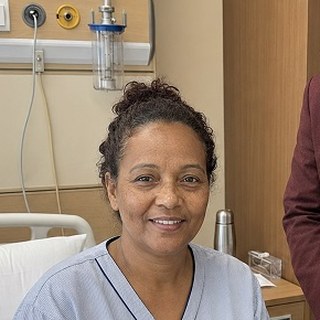
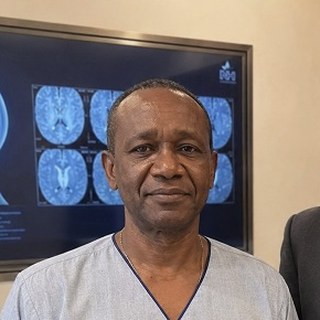
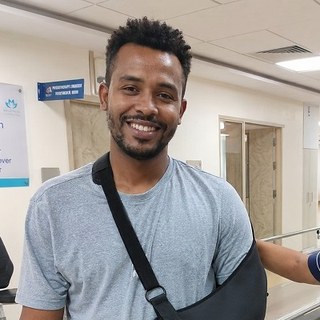
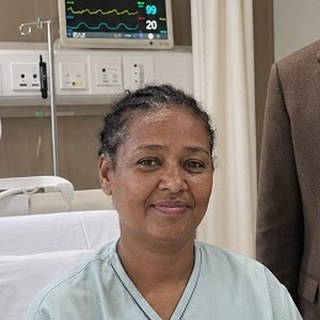
Healing Journeys of Ethiopian Patients


Key Takeaways
- Heart valve replacement decisions for Ethiopian patients should begin with a more basic question: can the patient's own valve be repaired instead of replaced? This is particularly relevant for a leaking mitral valve, where repair may preserve the natural valve and avoid the mechanical-versus-tissue valve decision altogether.
- The guide emphasises that many Ethiopian valve patients are relatively young because rheumatic heart disease remains an important cause of valvular damage. This makes treatment decisions different from those commonly described in guides written mainly for older Western patients.
- If replacement is necessary, the choice between a mechanical valve and a tissue valve should not be based on age alone. The patient's ability to obtain reliable lifelong blood-thinner monitoring after returning to Ethiopia is central to the decision.
- A mechanical valve can last a lifetime but requires a daily blood thinner and regular blood testing for life. Too little anticoagulation can allow the valve to clot, while excessive anticoagulation increases bleeding risk.
- The monitoring chart on page 3 illustrates why location matters. It shows indicative time within the safe blood-thinner range of 72% for a well-run clinic in a high-income country, 55% for a good centre in a capital city, and only 32% for someone living rurally or far from a testing centre.
- For a young Ethiopian patient who cannot reliably access monitoring, the guide argues that a tissue valve may sometimes be the safer practical choice, despite the likelihood that it will wear out in approximately 10–20 years and require another intervention.
- Open-heart valve surgery is available in Addis Ababa, and the guide does not suggest that every Ethiopian patient should travel abroad. The principal reason to consider India is often the waiting time: if the valve is deteriorating faster than the local surgical queue is moving, travelling may become reasonable.
- The cost chart on page 4 gives indicative Indian hospital ranges of approximately USD 5,000–8,000 for valve repair, USD 6,000–9,000 for a single tissue valve, USD 6,000–11,000 for a single mechanical valve, USD 8,000–13,000 for double valve replacement and USD 11,000–18,000 for TAVI.
- Patients should generally plan around 3–4 weeks in India for a single-valve operation, including assessment, surgery, recovery and clearance to fly. Double-valve surgery or a difficult repair may require longer.
- Long-term valve protection continues after returning to Ethiopia. The guide highlights anticoagulation monitoring where applicable, benzathine penicillin for prevention of recurrent rheumatic disease, dental care, pregnancy planning for young women, and ongoing cardiac follow-up.
Quick Facts
- Conditions Covered
- Rheumatic heart disease, mitral valve disease and other heart valve disorders requiring repair or replacement
- Procedures Mentioned
- Heart valve repair, single valve replacement, double valve replacement and TAVI
- Target Audience
- Ethiopian patients and families considering heart valve surgery in India
- First Treatment Question
- Whether the damaged valve can be repaired instead of replaced
- Key Ethiopian Consideration
- A mechanical valve is only as safe as the monitoring available after the patient returns home.
- Treatment in Ethiopia
- Open-heart valve surgery is performed in Addis Ababa by local teams.
- Valve Repair Cost
- Approximately USD 5,000–8,000
- Single Tissue Valve Cost
- Approximately USD 6,000–9,000
- Single Mechanical Valve Cost
- Approximately USD 6,000–11,000
- Double Valve Replacement Cost
- Approximately USD 8,000–13,000
- TAVI Cost
- Approximately USD 11,000–18,000
- Typical Stay in India
- Approximately 3–4 weeks for a single valve
- Pre-Travel Records
- The guide recommends sending the echocardiogram images and report, the patient's age, exercise tolerance/breathlessness and distance from a laboratory capable of anticoagulation monitoring.
- Author/Advisor
- Dr. Dheeraj Bojwani, Independent Medical Travel Advisor, 24 years arranging surgical care in India
In Brief
Heart valve surgery in India for Ethiopian patients requires more than choosing between a mechanical and tissue valve. The first question is whether the patient's own valve—particularly a leaking mitral valve—can be repaired. If replacement is necessary, the guide emphasises that reliable lifelong anticoagulation monitoring in Ethiopia should influence valve selection alongside age. Mechanical valves offer durability but require daily blood-thinning medication and regular testing, while tissue valves generally avoid lifelong anticoagulation but may wear out within 10–20 years. Indicative Indian hospital costs range from approximately USD 5,000–8,000 for valve repair to USD 8,000–13,000 for double valve replacement, with a typical single-valve medical trip lasting around 3–4 weeks.
1 Gate One
Repair, or replace?
Before choosing between kinds of new valve, ask whether you need a new one at all. It is the question most quotations skip, because a replacement is simpler to price and to perform.
For a leaking mitral valve in particular, repairing the patient's own valve often gives better long ‐ term survival than replacing it, and it removes the entire mechanical ‐ versus ‐ tissue question along with the lifelong medication that can come with it. The mitral valve is by far the one most often damaged by rheumatic disease, so this is not a rare situation — it is the common one. Repair is technically harder, so not every unit offers it, and a unit that only ever replaces will find that replacement is what you need.
So the first question to put to any surgeon is simply this: is my valve repairable, and if you cannot repair it, can you tell me who could? A surgeon who repairs as well as replaces is telling you something reassuring about the unit.
2 Gate Two
Which valve — and can you monitor it at home?
If the valve must be replaced, a second choice follows, and this is the gate that matters most for an Ethiopian patient.
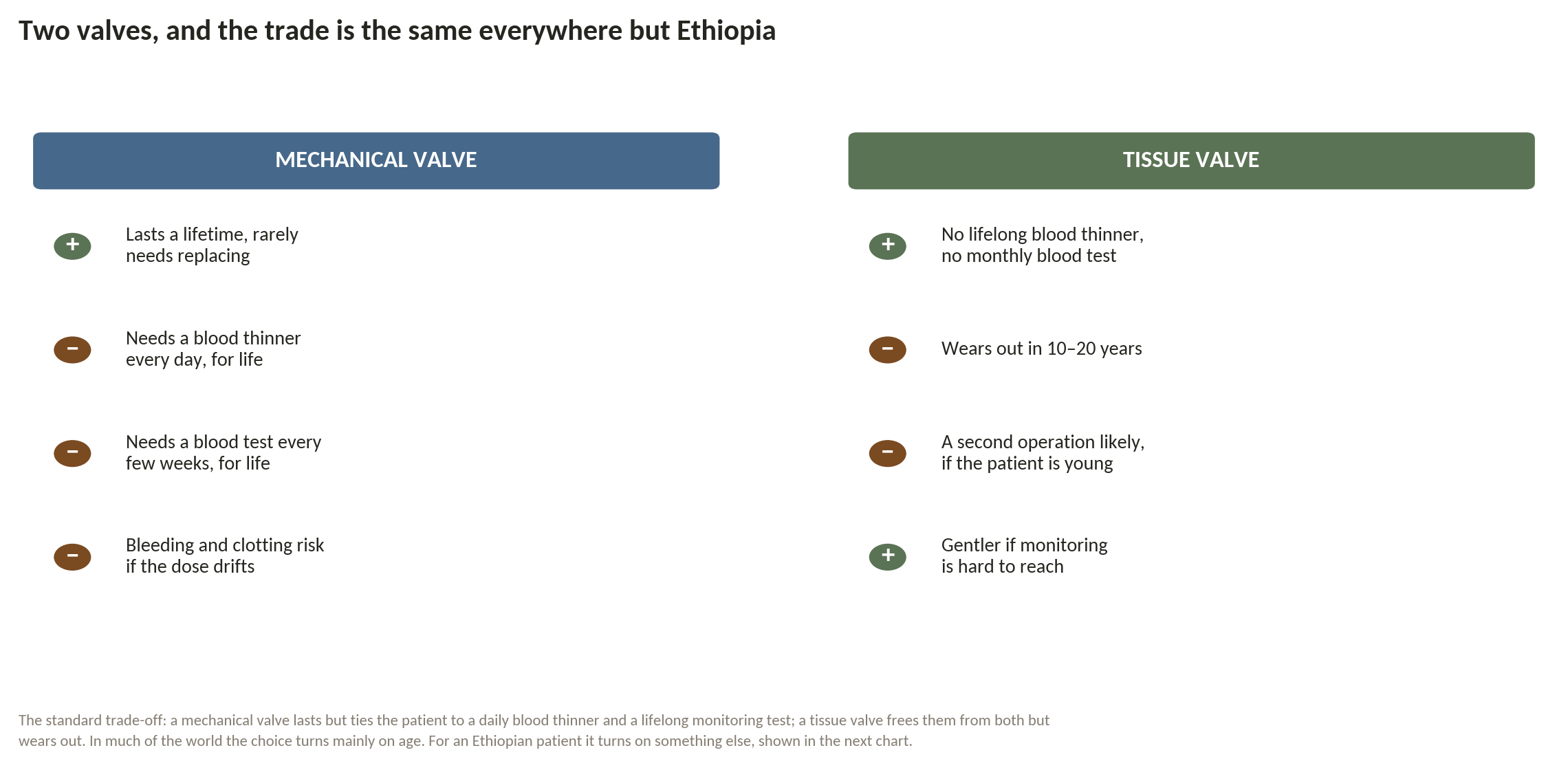
The standard trade-off — before Ethiopia changes it.
A mechanical valve lasts a lifetime but demands a blood thinner every single day and a blood test every few weeks, for ever, to keep that thinner in a narrow safe range. Too little and the valve can clot; too much and the patient can bleed. A tissue valve asks for neither, but wears out in ten to twenty years and, in a young patient, will need replacing again.
In most of the world that choice turns mainly on age: younger patients take the durable mechanical valve and accept the medication. But the medication is only safe if the monitoring behind it is reliable, and that is exactly what cannot be assumed for a patient living far from a testing centre.
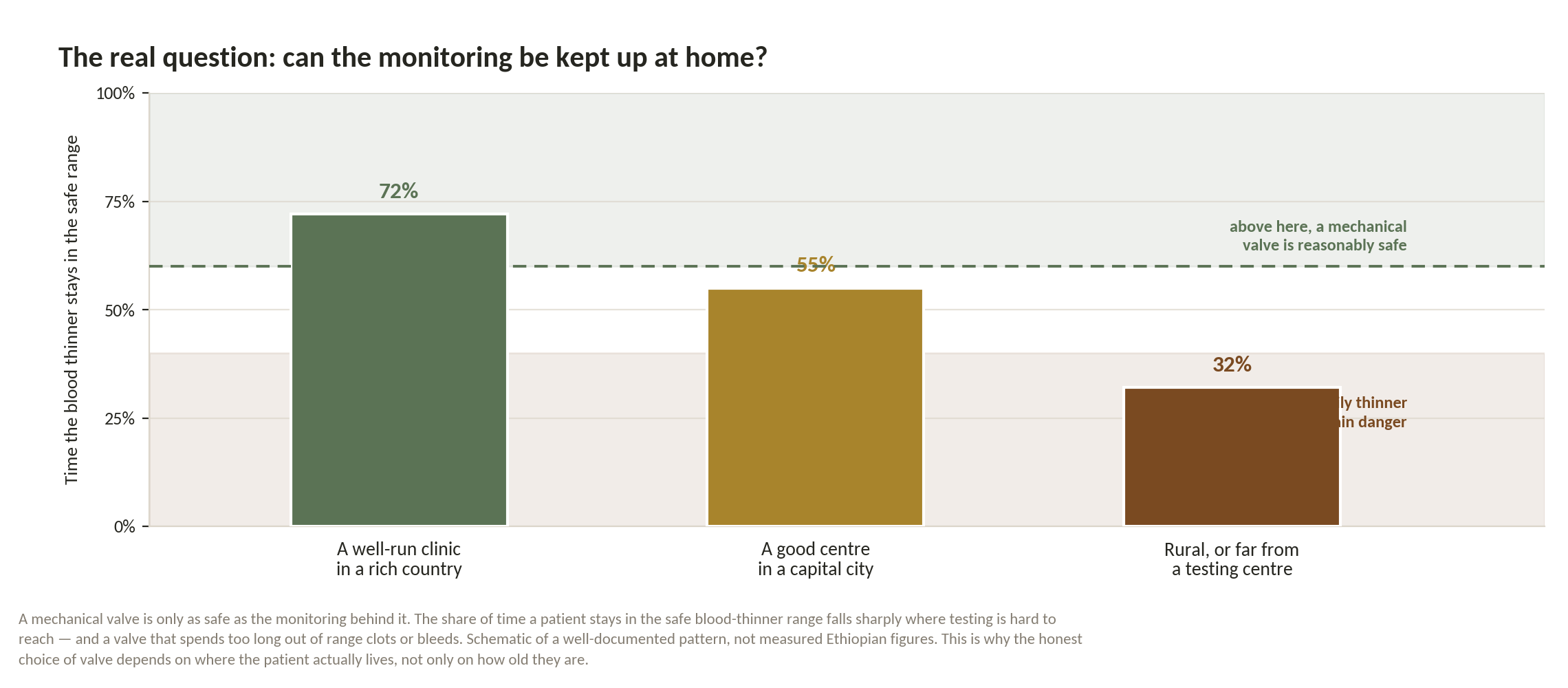
A mechanical valve is only as safe as the monitoring behind it.
This is the honest heart of the decision. A mechanical valve in a patient who cannot reliably reach monitoring is not the durable safe choice it looks like on paper — it is a daily hazard. For many young Ethiopian patients who live far from a reliable laboratory, a tissue valve, accepting a likely second operation later, is the more honest choice. Raise this directly with your surgeon, and be wary of anyone who chooses the valve without asking where you live.
3 Gate Three
Could this be done in Ethiopia?
Open ‐ heart valve surgery is performed in Addis Ababa by local teams, and the largest centre is a charity where the operation itself is free. If you can secure a place there in reasonable time, it is a genuinely good option, and I have told families so.
The difficulty, as with all cardiac surgery in Ethiopia, is the queue rather than the quality. A small number of centres and surgeons face a waiting list far longer than the capacity to clear it, and a scarred valve does not pause while a patient waits. The argument for travelling is therefore about time: if your valve is deteriorating faster than the queue moves, that is the reason to go, and it is the only one that matters. If it is stable and a place is within reach, staying is reasonable.
Wherever the operation is done, the point from gate two follows the patient home. The monitoring burden of a mechanical valve lands in Ethiopia, not in India, so it belongs in the decision no matter where the surgery happens.
4 Gate Four
Is the money arranged?
Ethiopia's health financing does not follow a patient abroad. Community ‐ Based Health Insurance covers contracted facilities inside the country, and the formal ‐ sector scheme is still not settling claims. Since
February 2026 a bank may release up to twenty thousand US dollars per case against a letter from the treating hospital, without a visa or ticket in hand — which for most valve patients covers the operation.
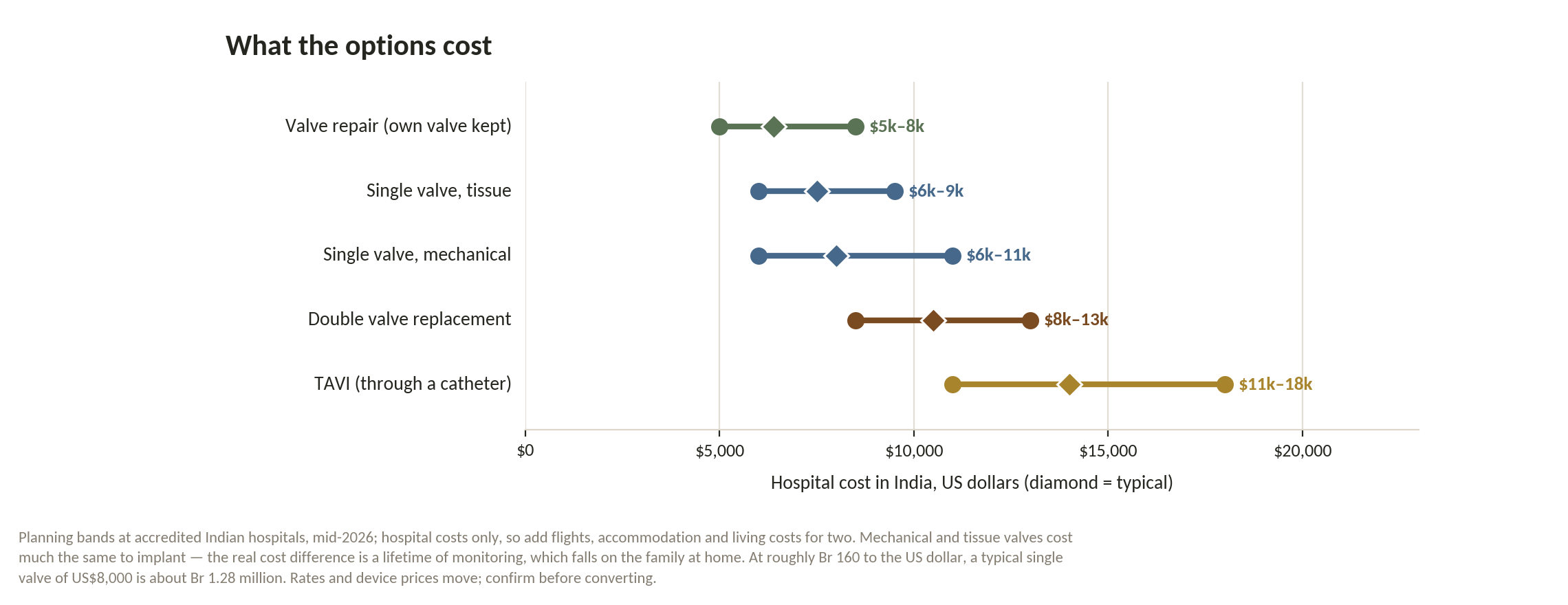
What the options cost — and the real difference is not here.
One point on the chart is worth pausing on: a mechanical and a tissue valve cost much the same to implant. The real difference in cost is not the valve but the lifetime of monitoring a mechanical one demands, and that cost falls on the family at home rather than on the hospital bill. It is a genuine expense, and it belongs in the decision.
In 24 years the valve bills that caused distress were rarely the quoted operation. They were the intensive ‐ care days nobody had costed. Ask the daily ICU rate in writing before you travel.
| A quotation, annotatedA composite of the valve quotes that reach me, with the questions I send back. | |
| Valve replacement — USD 7,600 | One valve or two? And repair or replace? Ask before the number. |
| Valve: mechanical or tissue as decided | Decided by whom? This is your decision to make with the surgeon. |
| ICU: 2 days included | The item that moves most. Get the daily rate beyond day two. |
| Excludes: pre-operative work-up | For a heart, the work-up is the foundation. Price it separately. |
| Blood: 1 unit included | Ask the per ‐ unit rate, and have your haemoglobin checked now. |
| Excludes: anticoagulation follow-up | Of course it does — that happens in Ethiopia. Plan it there. |
Pay the hospital and never an individual, and never settle a balance before you arrive.
5 Gate Five
Who protects the valve for the rest of your life?
A replaced valve is a treated condition, not a cured one, and two things protect it for the decades that follow. Both are arranged in Ethiopia, and both are too often left out of the travel plan.
The first, for a mechanical valve, is the monitoring already described: know before you fly who will do the blood test, where, and how often. The second applies to every valve patient. Because most Ethiopian valve disease begins with rheumatic fever, the same process can attack a new valve, and regular benzathine penicillin injections continued for years are what prevent it. Securing that supply at home is part of the surgery, not a footnote to it.
Two more things belong in that plan. Dental care matters more than it sounds, because mouth infections can settle on a prosthetic valve, so a check ‐ up before surgery and good dental care afterwards genuinely protect the heart. And for the many young women who have valve surgery, any thought of pregnancy should be discussed with the surgeon before conception, because the choice of valve and its medication bear directly on it. Leave hospital with the operation note, the exact valve details, the discharge echocardiogram and a written follow ‐ up plan, and hand a copy to a named doctor in Ethiopia while the case is still fresh.
The Ethiopian practicalities
Ethiopian Airlines flies non ‐ stop from Bole to Delhi, Mumbai, Bengaluru, Chennai and Hyderabad, and for a patient recovering from open ‐ heart surgery a single sector home rather than a long Gulf transit is a real clinical advantage. Ask the hospital when it is safe to fly rather than assuming a fixed number of days; for the heart, that clearance is individual.
Yellow fever certification is required at least ten days before arrival and oral polio vaccination roughly four weeks before, so begin the polio requirement at once. The medical visa follows the hospital's invitation letter through the Embassy of India in Addis Ababa, and the attendant visa should be lodged in the same batch. Confirm current rules with the Embassy, since they change, and ask for an Amharic ‐ speaking coordinator — and mention the fasting calendar before admission, since recovery from heart surgery is no time to be short of protein.
A closing word
Send the echocardiogram — the images and the report, not the report alone — with the patient's age, how far they can walk before breathlessness, and, importantly, how far they live from a laboratory that could monitor a blood thinner. That last detail sounds mundane and is central. I will tell you which gate you are standing at, whether repair may be possible, and where the honest answer is a tissue valve rather than a mechanical one because of where you live, I will say so.
Sources
- 🌐 Yadeta D, et al. Prevalence of rheumatic heart disease among school children in Ethiopia: a multisite echocardiography-based screening
- 🌐 Asfaw T. Prevalence of rheumatic heart disease in Ethiopia: a systematic review and meta-analysis. SAGE Open Medicine, 2023
- 🌐 Rheumatic heart disease at the Tikur Anbessa Referral Cardiac Clinic, Addis Ababa (2015–2018), PLOS One , 2021
- 🌐 Fenta TG, et al. Quality of anticoagulation management with warfarin among outpatients in a tertiary hospital in Addis Ababa, Ethiopia
- 🌐 Anticoagulation control among patients on vitamin K antagonists in nine countries in sub-Saharan Africa , 2024
- 🌐 Anticoagulation quality through time in therapeutic range in sub-Saharan Africa: a systematic review and meta-analysis , 2025
Frequently Asked Questions by Ethiopians about Heart Valve Replacement Surgery in India
Can Ethiopian patients have their heart valve repaired instead of replaced?
Sometimes, yes. The guide recommends asking about valve repair before discussing replacement, particularly for a leaking mitral valve. Repair keeps the patient's own valve, avoids a prosthetic valve and can remove the mechanical-versus-tissue decision and associated lifelong anticoagulation issue. Because not every cardiac unit offers valve repair, patients should specifically ask whether their valve is repairable and whether the surgeon regularly performs repairs.
Should Ethiopian patients choose a mechanical or tissue heart valve?
The guide argues that the decision should depend on more than the patient's age. A mechanical valve is durable but requires daily blood-thinning medication and regular blood testing for life. A tissue valve generally avoids lifelong anticoagulation but typically wears out within 10–20 years. For an Ethiopian patient living far from reliable blood-testing facilities, the guide suggests that a tissue valve may sometimes be the safer practical choice despite the possibility of another operation later.
Why is blood-thinner monitoring so important after a mechanical valve?
A mechanical valve requires anticoagulation to remain within a narrow therapeutic range. Too little can lead to valve clotting, while too much increases bleeding risk. The chart on page 3 illustrates safe-range time at 72% in a well-run high-income-country clinic, 55% at a good centre in a capital city and 32% for someone rural or far from a testing centre. The guide therefore describes reliable monitoring as central to valve selection.
How much does heart valve replacement in India cost for Ethiopian patients?
According to the cost chart on page 4, indicative Indian hospital costs are approximately USD 5,000–8,000 for valve repair, USD 6,000–9,000 for a single tissue valve, USD 6,000–11,000 for a single mechanical valve, and USD 8,000–13,000 for double valve replacement. TAVI is shown at approximately USD 11,000–18,000. These figures exclude flights, accommodation and living expenses.
Is heart valve surgery available in Ethiopia, or is travelling to India necessary?
The guide states that open-heart valve surgery is performed in Addis Ababa by local teams, and that staying in Ethiopia can be a reasonable option when a surgical place is available within an appropriate timeframe. It identifies waiting-list capacity rather than quality as the main difficulty. If the valve is deteriorating faster than the patient can obtain surgery locally, travelling to India may become a practical option.
How long should Ethiopian patients stay in India after heart valve surgery?
The guide recommends planning approximately 3–4 weeks in India for a single-valve procedure, covering preoperative assessment, surgery, recovery and clearance to fly. Double-valve replacement or a difficult valve repair may require a longer stay. Patients should ask their treating hospital when they are individually safe to fly rather than relying on a fixed postoperative day.
What extra costs should Ethiopian patients check in a heart valve surgery quotation?
The annotated quotation on page 4 highlights several items that can change the final bill. Patients should clarify whether the quotation is for one or two valves, whether repair or replacement is planned, how many ICU days are included, the daily ICU rate beyond those days, the cost of the preoperative work-up, blood-unit charges and what anticoagulation follow-up is excluded.
What follow-up must Ethiopian patients arrange after receiving a mechanical valve?
Before leaving India, a mechanical-valve patient should know who will perform their blood tests in Ethiopia, where testing will take place and how often it will be required. The guide describes this as part of the operation rather than an afterthought because the long-term safety of a mechanical valve depends on reliable anticoagulation management after the patient returns home.
Why are rheumatic fever prevention and dental care important after valve surgery?
The guide notes that much Ethiopian valve disease originates from rheumatic fever. It therefore highlights continued benzathine penicillin injections for years as an important part of preventing recurrent rheumatic disease. Dental health also matters because infections originating in the mouth can affect a prosthetic valve, so the guide recommends a dental check before surgery and good dental care afterwards.
What should Ethiopian patients send before requesting a heart valve surgery opinion from India?
The guide recommends sending the echocardiogram images together with the written report, rather than the report alone. Patients should also provide their age, explain how far they can walk before becoming breathless and state how far they live from a laboratory capable of monitoring blood-thinning medication. That last detail is particularly important when deciding between a mechanical and tissue valve.
Which valve should I choose, mechanical or tissue?
It depends less on age than on where you live. A mechanical valve lasts but needs a daily blood thinner and a regular blood test for life; if that testing is hard to reach from your home, a tissue valve is often the safer honest choice even in a younger patient.
Can my valve be repaired instead of replaced?
Sometimes, especially a leaking mitral valve, and it is worth asking before anything else. Repair keeps your own valve, avoids a prosthesis and removes the whole blood-thinner question. Not every unit offers it.
How long will I be in India?
Around three to four weeks for a single valve, covering assessment, surgery and the clearance to fly. A double valve or a difficult repair may need longer.
What is the one thing to arrange before I fly home?
If you have a mechanical valve, the blood-thinner monitoring. Know who will do the test in Ethiopia, where, and how often, before you leave India. It is part of the operation, not an afterthought.
Who pays for this in Ethiopia?
You do. Neither community-based insurance nor the pending formal-sector scheme funds treatment abroad, though a bank may now advance up to US$20,000 against the hospital's letter.
Page Summary
This guide takes Ethiopian patients through five gates. Gate one asks whether the valve can be repaired at all before replacement is discussed. Gate two is the decision that matters most in Ethiopia: a mechanical valve lasts but demands lifelong blood thinners and regular INR testing, while a tissue valve avoids that and may wear out in 10–20 years, so reliable access to blood testing can settle the choice. Gate three acknowledges that open-heart valve surgery is established in Addis Ababa, and that waiting-list capacity is the usual reason to travel. Gate four prices it, from USD 5,000–8,000 for repair to USD 11,000–18,000 for TAVI, and flags ICU days and blood costs. Gate five treats anticoagulation monitoring, penicillin prophylaxis, dental care and pregnancy planning as part of the operation rather than an afterthought.
Citation Block
| Topic | Information |
|---|---|
| Topic Information | Heart Valve Replacement Surgery in India for Ethiopians |
| Procedure | Heart Valve Repair & Replacement |
| Country | India |
| Intended Audience | Ethiopian Patients and Families |
| Conditions Covered | Rheumatic Heart Disease, Mitral Valve Disease and Other Heart Valve Disorders |
| Procedures | Valve Repair, Mechanical Valve Replacement, Tissue Valve Replacement, Double Valve Replacement and TAVI |
| Typical Stay | Approximately 3–4 Weeks for a Single Valve |
| Hospital Stay | Exact Duration Not Specified; Quotation Example Includes 2 ICU Days |
| Recovery | Individualised; Fit-to-Fly Clearance Required Before Returning to Ethiopia |
| Valve Repair Cost | Approximately USD 5,000–8,000 |
| Single Tissue Valve Cost | Approximately USD 6,000–9,000 |
| Long-Term Care | Anticoagulation Monitoring Where Applicable, Rheumatic Fever Prevention, Dental Care and Cardiac Follow-Up |

Our Mission Statement
Our mission is to place patients at the centre of every healthcare decision by providing trustworthy, evidence-based, and unbiased medical information. We believe that informed patients make better decisions. Backed by personalised guidance from our experienced advisory team, we help patients understand their treatment options, compare them objectively, and confidently choose the path that best suits their medical needs and personal circumstances.
Patient Testimonials from Ethiopia

Ready to Take the First Step?
Share your Medical Reports with our Healthcare Managers Today and Get a FREE CONSULTATION, a Personalized Treatment Plan, and Complete Support from Arrival to Recovery.
Get Your Free ConsultationAreas We Serve
This resource has been thoughtfully prepared for patients from Ethiopia who are considering medical treatment in India. We also welcome patients from the wider region in the countries mentioned below-
We assist patients from:
- Eritrea
- Djibouti
- Somalia
- Kenya
- South Sudan
- Sudan
- Burundi
- Comoros
- Ethiopia
- Madagascar
- Malawi
- Mauritius
- Mozambique
- Rwanda
Many of the insights, treatment pathways, hospital recommendations, travel guidance, and patient support services described here are equally relevant and may be used as a reference when planning treatment in India.
From Ethiopia to India: Your Complete Patient Support Guide
- Brain Tumour Surgery in India for Ethiopians
- Cancer Treatment in India for Ethiopians
- Cardiac Surgery in India for Ethiopian Patients
- Cervical and Disc Replacement Surgery in India for Ethiopians
- Cosmetic and Plastic Surgery in India for Ethiopians
- CyberKnife Treatment in India for Ethiopians
- Eye Surgery in India for Ethiopians
- Gamma Knife Treatment in India for Ethiopians
- Heart Valve Replacement Surgery in India for Ethiopians
- Hip Surgery in India for Ethiopian Patients
- Knee Surgery in India for Ethiopian Patients
- Laparoscopic and Robotic Myomectomy Surgery in India for Ethiopians
- Neurosurgery in India for Ethiopians
- Paediatric Cardiac Surgery in India for Ethiopians
- Paediatric Neurosurgery in India for Ethiopians
- Prostate Cancer Treatment and Surgery in India for Ethiopians
- Robotic Cancer Surgery in India for Ethiopians
- Scoliosis Surgery in India for Ethiopians