

Gamma Knife Treatment in India for Ethiopians
Five gates every Gamma Knife case should pass before booking a flight — starting with the one fact this machine cannot escape: it treats one organ, and one organ only.
Gamma Knife is, by design, the most specialised machine in this entire series. It does not treat the spine, the lung, the liver, or the prostate. It does one thing: it aims roughly two hundred low-energy gamma-ray beams from different angles so that they converge, with sub-millimetre accuracy, on a single point inside the skull. That narrowness is not a limitation to apologise for. It is the entire source of its precision, and the reason it has been called the gold standard for certain brain conditions since long before newer competing technologies existed. Families sometimes arrive asking for Gamma Knife having confused it with CyberKnife, or with radiotherapy generally. In 24 years of arranging surgical and oncological care in India for patients across Africa and Asia, sorting out exactly which technology a case actually needs — before any conversation about hospitals or cost — has saved more confusion in this field than in almost any other. These five gates start with that clarity and end with the fact that, as things stand, nobody in Ethiopia or the wider Horn of Africa can offer this treatment at all.
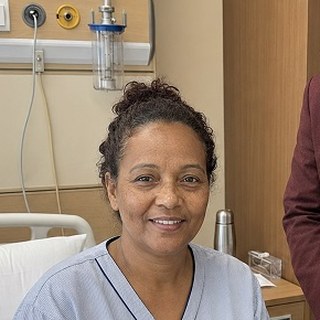
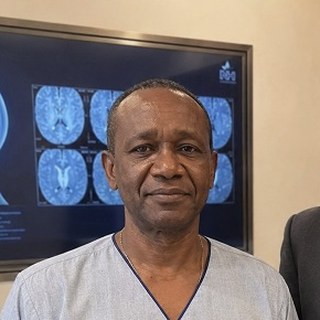
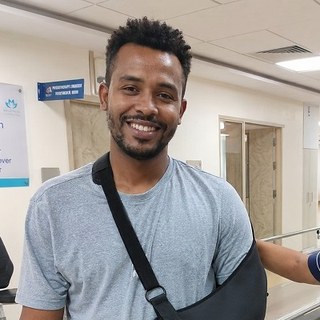
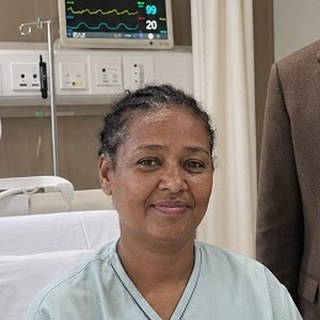
Healing Journeys of Ethiopian Patients


Key Takeaways
- Gamma Knife is a highly specialised radiosurgery technology designed only for targets inside the skull. Unlike CyberKnife, it is not used for tumours in the spine, lung, liver or prostate.
- Gamma Knife can be used for selected meningiomas, acoustic neuromas, pituitary tumours, brain metastases, arteriovenous malformations (AVMs), trigeminal neuralgia and certain tremor disorders.
- The technology works by directing roughly 200 low-energy gamma-ray beams from different angles toward a precisely defined intracranial target. Each individual beam carries relatively little energy, but their convergence produces the therapeutic radiation dose.
- The diagram on page 2 makes the treatment boundary particularly clear: Gamma Knife treats the brain/skull region only, while lesions in the spine, lung, liver and prostate require another treatment technology.
- Patients may be treated using either a frame-based or frameless system. The traditional approach uses a lightweight metal frame attached to the skull with small pins under local anaesthetic, while newer frameless systems use a mask or net with continuous imaging to verify head position.
- The comparison graphic on page 3 shows that frame-based treatment provides rigid fixation and has the longest evidence base, whereas frameless treatment avoids pins, is more comfortable and may allow treatment to be divided across several days when clinically suitable.
- One of Gamma Knife's major strengths is the ability to treat several small brain metastases during the same sitting. The illustration on page 4 demonstrates six separate metastases being targeted during one treatment day.
- The guide states that Gamma Knife is not currently available in Ethiopia or elsewhere in the Horn of Africa. It describes South Africa's system as the closest established centre on the continent while noting that Indian centres have decades of Gamma Knife experience.
- According to the cost chart on page 5, indicative Indian treatment costs are approximately USD 5,000–7,000 for trigeminal neuralgia, USD 5,500–7,500 for a single small brain lesion, USD 6,000–8,500 for acoustic neuroma or AVM, and USD 6,500–9,500 for several metastases treated in one sitting.
- The guide recommends arranging a follow-up scan approximately 3–6 months after treatment because the full effect of Gamma Knife develops gradually and is not necessarily visible immediately after the treatment session.
Quick Facts
- Conditions Covered
- Meningioma, acoustic neuroma, pituitary tumour, brain metastases, arteriovenous malformation, trigeminal neuralgia and certain tremors
- Procedure
- Gamma Knife stereotactic radiosurgery
- Target Audience
- Ethiopian patients and families considering Gamma Knife treatment in India
- Treatment Area
- Intracranial conditions only
- Trigeminal Neuralgia Cost
- Approximately USD 5,000–7,000
- Single Small Brain Lesion Cost
- Approximately USD 5,500–7,500
- Acoustic Neuroma Cost
- Approximately USD 6,000–8,500
- AVM Treatment Cost
- Approximately USD 6,000–8,500
- Several Metastases in One Sitting
- Approximately USD 6,500–9,500
- Typical Stay in India
- The guide does not provide a fixed number of days but describes it as a short trip involving a few days of accommodation, with patients potentially arriving 1–2 days early for imaging and planning.
- Hospital Stay
- Overnight admission is generally not presented as routine; the sample quotation lists an overnight stay only "if needed."
- Follow-Up
- Approximately 3–6 months after treatment
- Financial Planning
- The guide states that Ethiopian insurance schemes do not fund overseas treatment and that, since February 2026, a bank may release up to USD 20,000 per case against the treating hospital's letter.
- Author/Advisor
- Dr. Dheeraj Bojwani, Independent Medical Travel Advisor, 24 years arranging surgical and oncological care in India
In Brief
Gamma Knife treatment in India is a specialised form of stereotactic radiosurgery for conditions located inside the skull, including selected meningiomas, acoustic neuromas, pituitary tumours, brain metastases, AVMs and trigeminal neuralgia. Approximately 200 gamma-ray beams converge with sub-millimetre precision on the treatment target. Patients may undergo traditional frame-based treatment or, where suitable and available, frameless mask-based treatment. One particular strength is the ability to treat several small brain metastases during a single sitting. Most treatment is completed in one day, with indicative Indian costs ranging from approximately USD 5,000–9,500 depending on the condition and number of targets.
1 Gate One
Is your problem inside the skull?
This sounds obvious, but it is worth stating plainly because the name Gamma Knife gets used loosely in conversation for almost any advanced radiation treatment.
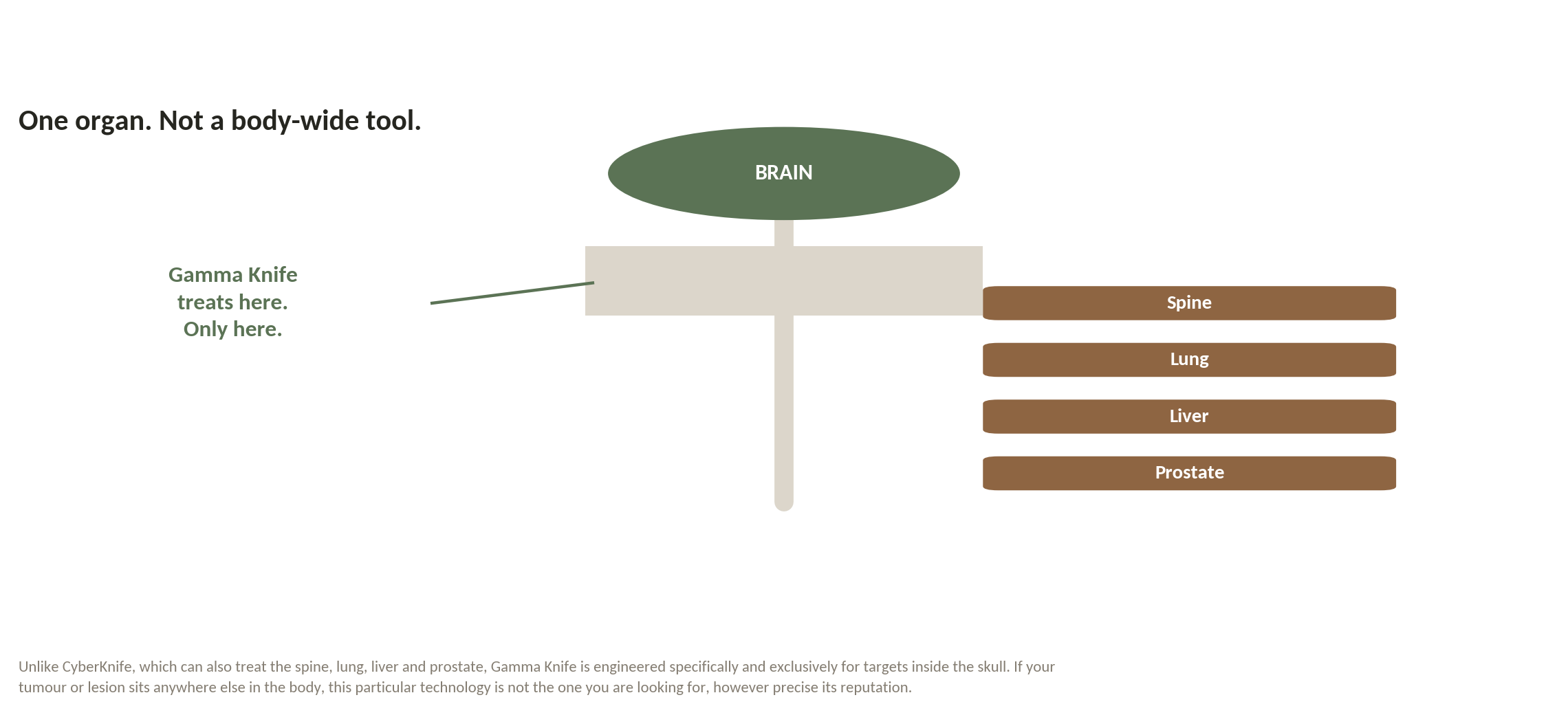
One organ. Not a body-wide tool.
Gamma Knife treats meningiomas, acoustic neuromas, pituitary tumours, brain metastases, arteriovenous malformations, and functional conditions such as trigeminal neuralgia and certain tremors — all of them inside the skull. If your tumour sits in the spine, lung, liver, or prostate, this specific technology is not built to reach it; CyberKnife and other body-capable radiosurgery systems exist for exactly that purpose. Confirming this at the outset avoids a wasted conversation with a hospital about a treatment that was never going to apply to your case.
The mechanism is worth understanding briefly, because it explains why the boundary is so firm. Each of the roughly two hundred beams individually carries too little energy to damage tissue on its own. Only where they all converge, at a single fixed point, does the combined dose become therapeutic. That convergence depends on the head being held in an exact, unmoving position relative to the machine — a requirement that simply does not translate to organs that move with breathing or a beating heart, which is a large part of why this technology has stayed confined to the skull for decades.
2 Gate Two
Frame, or frameless mask?
Once Gamma Knife is confirmed as the right tool, a genuine practical choice follows, and it is worth understanding before the day of treatment rather than discovering it on arrival.
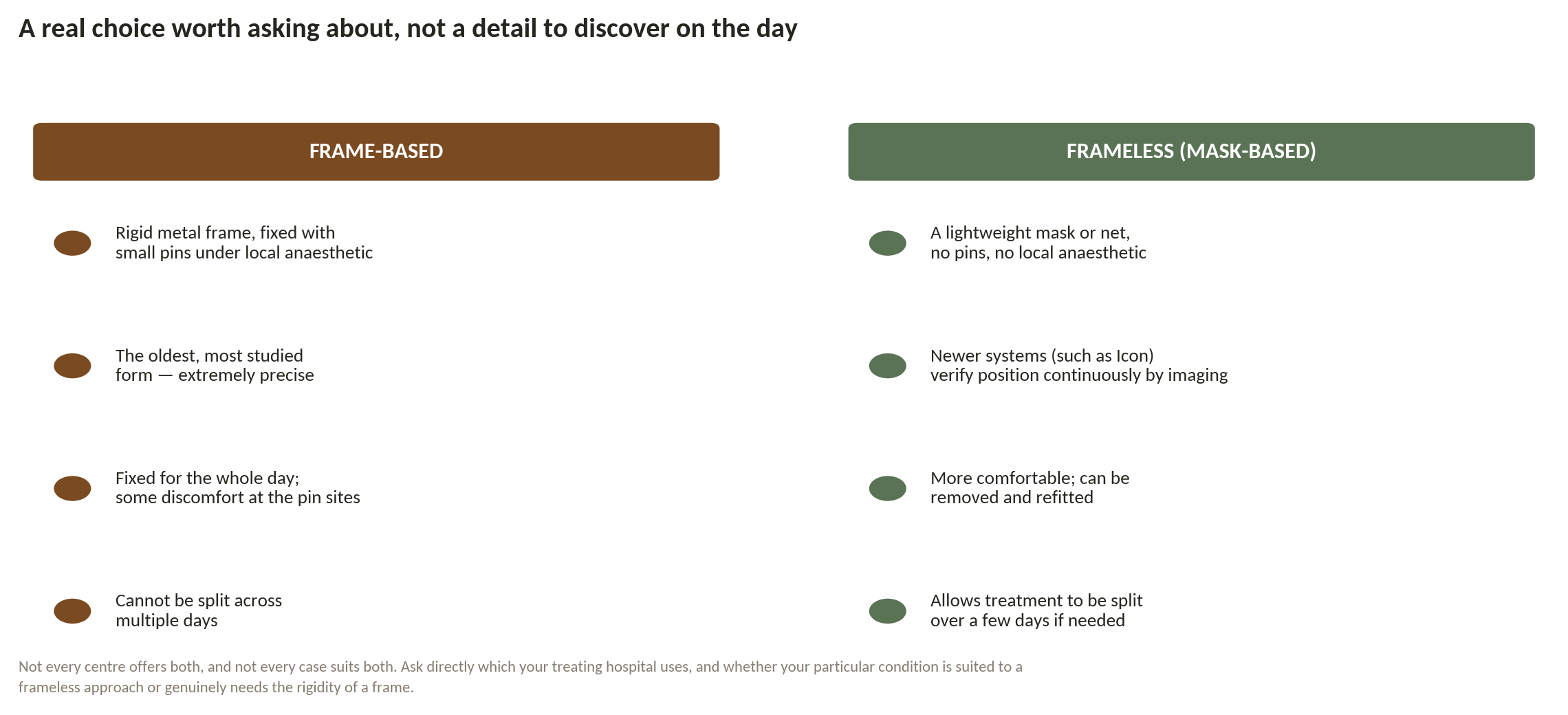
Both hold the head still. They do it very differently.
The original and most studied approach uses a lightweight metal frame, fixed to the skull with small pins under local anaesthetic, holding the head absolutely rigid for the entire session. It remains extremely precise and is still preferred for many cases. Newer systems offer a frameless alternative: a soft mask or net, with the machine continuously verifying position by imaging rather than relying on rigid fixation. It is more comfortable and can, where suitable, be split across a few days rather than completed in one sitting.
Not every hospital offers both, and not every condition suits both equally well. Ask directly which your treating centre uses, and whether a frameless option is genuinely appropriate for your specific lesion rather than simply what happens to be installed.
If the idea of pins fixed to the skull under local anaesthetic causes real anxiety, say so plainly when you first speak to the hospital. A frameless option may be entirely reasonable for many conditions, and a good team will discuss the trade-off honestly rather than defaulting to whichever system happens to be in the room that day.
3 Gate Three
One sitting, several targets at once?
This is where Gamma Knife's narrowness turns into a genuine strength, and it is worth asking about directly if you have more than one brain lesion.
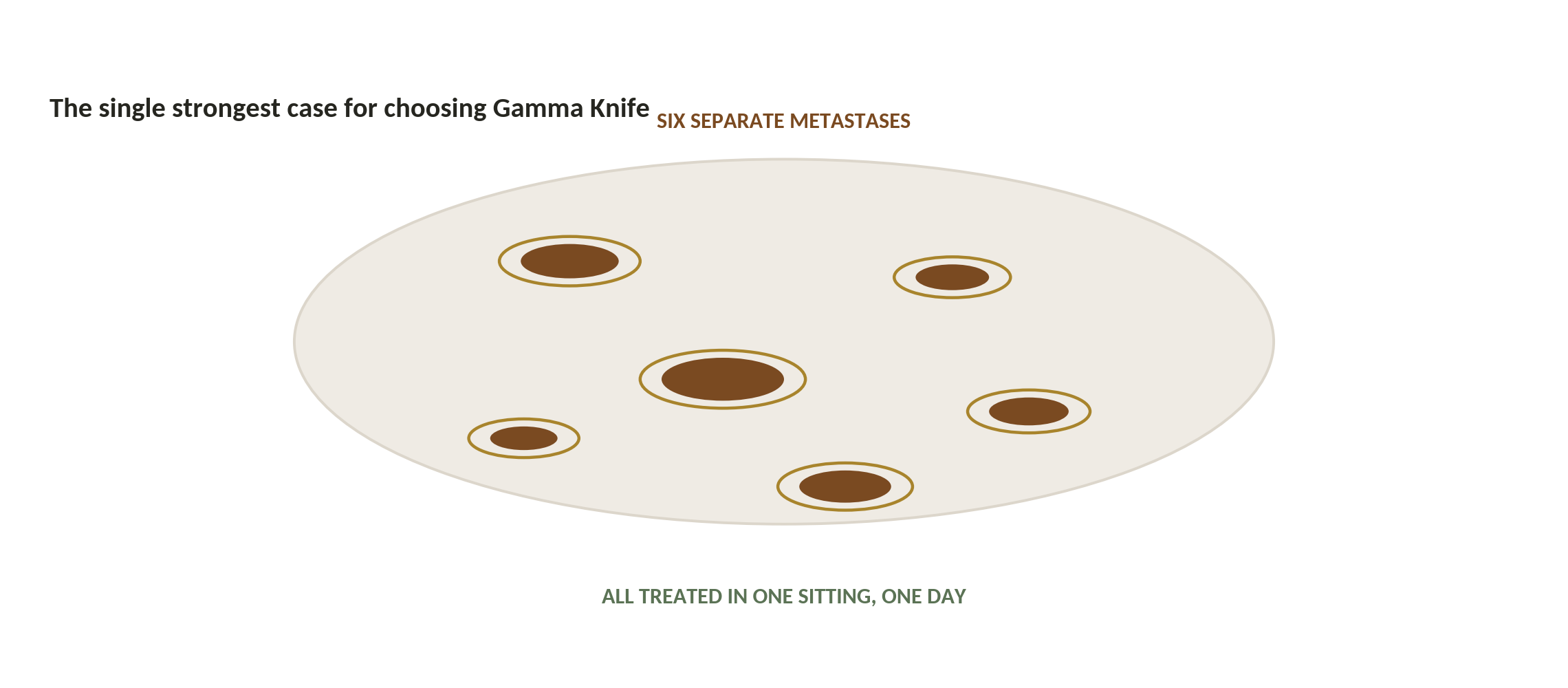
Several problems, addressed together, on one day.
Because the machine's geometry is fixed and does not need to be reset between targets the way a moving robotic arm does, treating several small metastases in a single sitting is one of Gamma Knife's most established uses — often the strongest single reason to choose it over an alternative. If your scan shows more than one lesion, ask specifically whether all of them can realistically be treated on the same day, and if not, why not.
4 Gate Four
Nowhere in the region
As things stand, there is no Gamma Knife system in Ethiopia, and none anywhere in the Horn of Africa. A continent-wide survey found only two Gamma Knife systems across the whole of Africa, with South Africa's unit — running since 2017, having treated over a thousand patients — the closest established centre on the continent, still a long journey from Addis Ababa and still a fully self-funded trip for a foreign patient.
A 2025 systematic review of Gamma Knife research from lower-and-middle-income countries found the overwhelming majority of published work came from a small number of centres, with Africa contributing a small fraction of the global total — a fair reflection of how little access exists across most of the continent. India's centres, by contrast, have treated Gamma Knife patients for decades, with published cost and outcome data from some of the country's largest neurosurgical units.
This is worth naming plainly rather than treating as a footnote: for a condition like trigeminal neuralgia or a small acoustic neuroma, where Gamma Knife has decades of outcome data behind it, travelling to a centre with genuine experience is not an indulgence. It is the difference between a treatment planned by a team that has done this hundreds of times and one attempting it for the first handful of cases.
5 Gate Five
Is the money arranged for a single treatment day?
Ethiopia's health financing does not follow a patient abroad. Community ‐ Based Health Insurance covers contracted facilities inside the country, and the formal ‐ sector scheme is still not settling claims. Since
February 2026 a bank may release up to twenty thousand US dollars per case against a letter from the treating hospital, without a visa or ticket in hand — a ceiling that comfortably covers a Gamma Knife session.
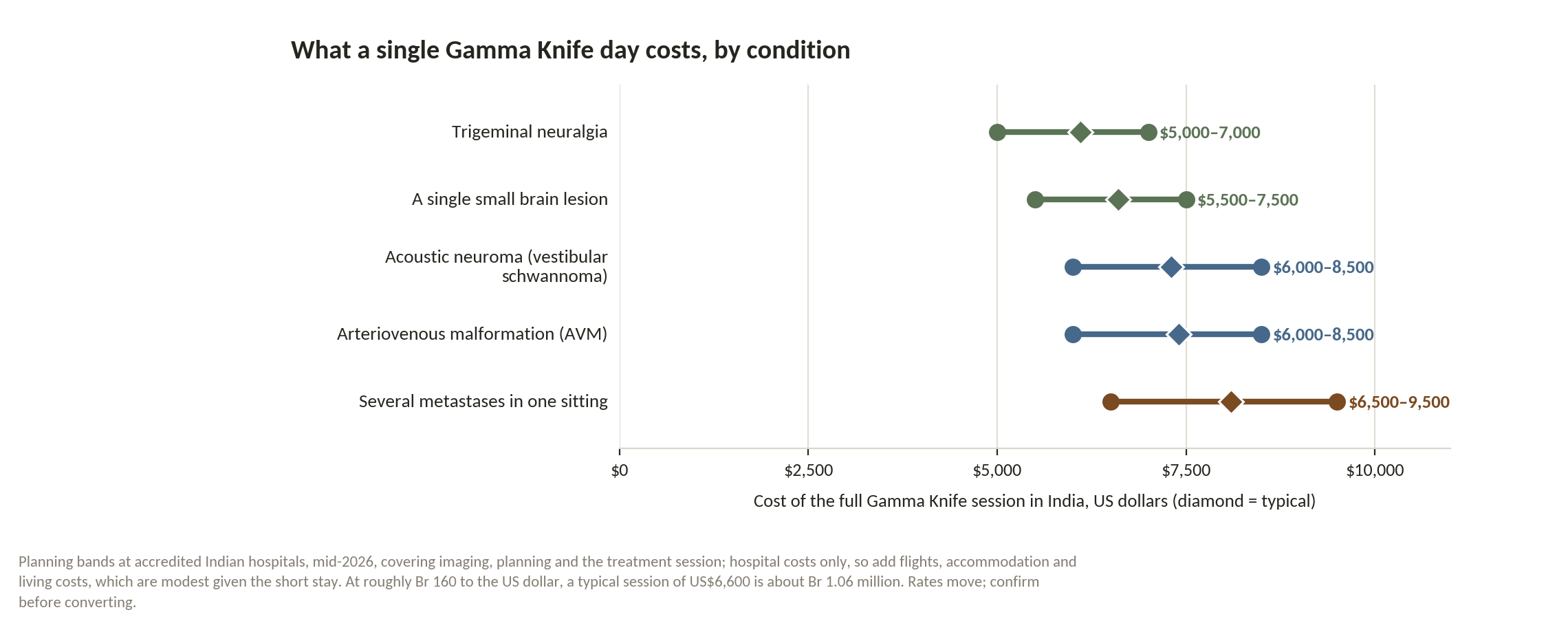
One day of treatment, and a correspondingly short, affordable trip.
Because most Gamma Knife treatment is complete in a single day, this is one of the shortest and least expensive trips in the whole series once travel is added — flights and a few days of accommodation, rather than weeks. Published cost analyses from major Indian centres confirm that treating several lesions on the same day does not multiply the price the way separate procedures would, which is worth confirming directly with your chosen hospital.
In 24 years the Gamma Knife patients most satisfied with their trip were the ones who arrived already certain their condition was genuinely suited to this specific technology, rather than discovering only in India that a different treatment was needed after all.
| A quotation, annotatedA composite of the Gamma Knife quotes that reach me, with the questions I send back. | |
| Gamma Knife treatment — USD 6,600 | For which condition, and frame-based or frameless? Ask. |
| Includes: planning MRI, one session | Good. Confirm whether more than one lesion is included at this price. |
| Frame fitting: local anaesthetic | Ask what happens if a frameless option would suit you better. |
| Neurosurgeon: named on request | Ask for the medical physicist's name too, not only the doctor's. |
| Excludes: overnight stay if needed | Rare, but ask the added cost in case observation is recommended. |
| Follow-up scan: at 3–6 months, not included | Results take months to appear. Arrange this scan before flying home. |
Pay the hospital and never an individual, and never settle a balance before you arrive.
The Ethiopian practicalities
Ethiopian Airlines flies non ‐ stop from Bole to Delhi, Mumbai, Bengaluru, Chennai and Hyderabad, and the single-day nature of most Gamma Knife treatment means a short, well-defined trip is realistic for many patients. Confirm your treatment date is fixed before booking flights, and ask whether you should arrive a day or two early for imaging and planning.
Yellow fever certification is required at least ten days before arrival and oral polio vaccination roughly four weeks before. The medical visa follows the hospital's invitation letter through the Embassy of India in Addis Ababa. Confirm current rules with the Embassy, since they change, and ask for an Amharic ‐ speaking coordinator to help arrange the follow-up scan, usually at three to six months, since the full effect of Gamma Knife treatment takes time to appear and that scan should be planned before you leave India.
A closing word
Send the MRI itself — the images, not only the report — with a note on how many lesions are visible and whether any other treatment, including CyberKnife or open surgery, has already been discussed. I will tell you honestly whether this looks like a genuine Gamma Knife case, and where a different technology or approach would serve you better, I will say so.
Sources
- 🌐 Optimizing costs and sustainability for Gamma Knife radiosurgery: a cost and breakeven analysis at India's largest neurosurgery centre
- 🌐 Significance, applications, and contributions of Gamma Knife radiosurgery in advancing neurosurgical care in lower-middle-income countries
- 🌐 Radiotherapy infrastructure for brain metastasis treatment in Africa: practical guidelines for a stereotactic radiosurgery programme
- 🌐 National Medical Commission of India — Indian Medical Register, for verifying a treating doctor's registration
- 🌐 National Accreditation Board for Hospitals & Healthcare Providers (NABH), Quality Council of India
- 🌐 National Bank of Ethiopia Directive FXD/04/2026 (foreign exchange, advance payments for treatment abroad); Embassy of India, Addis Ababa
Frequently Asked Questions by Ethiopians about Gamma Knife Treatment in India
What conditions can Gamma Knife treat for Ethiopian patients travelling to India?
The guide states that Gamma Knife is designed specifically for conditions inside the skull. These include selected meningiomas, acoustic neuromas, pituitary tumours, brain metastases, arteriovenous malformations (AVMs), trigeminal neuralgia and certain tremor disorders. It does not treat tumours in the spine, lung, liver or prostate.
Is Gamma Knife the same as CyberKnife?
No. Gamma Knife is specifically designed for intracranial targets and is usually completed in a single sitting. CyberKnife can also treat areas outside the skull, including the spine, lung, liver and prostate, and typically delivers treatment over one to five sessions. The guide recommends confirming which technology actually suits the patient's condition before travelling.
How much does Gamma Knife treatment in India cost for Ethiopian patients?
According to the cost chart on page 5, indicative Indian costs are approximately USD 5,000–7,000 for trigeminal neuralgia, USD 5,500–7,500 for a single small brain lesion, USD 6,000–8,500 for acoustic neuroma, USD 6,000–8,500 for AVM, and USD 6,500–9,500 for several metastases treated in one sitting.
What is the difference between frame-based and frameless Gamma Knife?
The comparison graphic on page 3 shows that traditional frame-based Gamma Knife uses a lightweight metal frame fixed to the skull with small pins under local anaesthetic. Frameless treatment uses a mask or net and continuously checks head position using imaging. The frameless option avoids pins and may allow treatment to be divided over several days, but not every condition or treatment centre is suitable for both approaches.
Does the Gamma Knife head frame hurt?
According to the guide, the pins are inserted under local anaesthetic, so fitting itself is not described as painful, although patients may experience pressure and soreness for a day or two afterwards. Patients who are particularly anxious about frame fixation should ask whether a frameless option is clinically appropriate for their case.
Can several brain metastases be treated during one Gamma Knife session?
Often, yes. Treating several small brain metastases during a single sitting is identified as one of Gamma Knife's major strengths. The illustration on page 4 demonstrates six separate metastases treated during the same sitting on one treatment day. Patients with multiple lesions should ask whether all of their targets can realistically be treated together.
Is Gamma Knife treatment available in Ethiopia?
The guide states that there is currently no Gamma Knife system in Ethiopia or elsewhere in the Horn of Africa. It identifies South Africa's system, operating since 2017, as the closest established centre on the African continent while noting that Indian centres have treated Gamma Knife patients for decades.
How long do Ethiopian patients need to stay in India for Gamma Knife treatment?
Most Gamma Knife treatment is completed in a single treatment day, so patients generally do not need to remain in India for weeks. The guide recommends asking whether arrival one or two days before treatment is necessary for imaging and planning. A fixed total number of days in India is not specified in the document.
What should Ethiopian patients check before accepting a Gamma Knife quotation?
The annotated quotation on page 6 recommends confirming the condition being treated, whether the procedure will be frame-based or frameless, whether multiple lesions are included in the quoted price, and whether the planning MRI is included. Patients should also ask for the medical physicist's name, clarify the cost of an overnight stay if observation becomes necessary, and confirm arrangements for follow-up imaging.
What follow-up is required after Gamma Knife treatment?
The guide recommends planning a follow-up scan approximately 3–6 months after treatment because the full effect of Gamma Knife takes time to appear. Ethiopian patients should arrange this scan before leaving India rather than expecting an immediate result. Before travelling for treatment, the guide also recommends sending the actual MRI images—not only the written report—and explaining how many lesions are present and whether CyberKnife or open surgery has already been discussed.
Does the frame hurt?
The pins are placed under local anaesthetic, so the fitting itself is not painful, though many patients describe pressure and some soreness for a day or two afterwards. A frameless mask avoids this entirely, where it is available and suitable for your case.
How many brain lesions can be treated in one session?
Often several. Treating multiple small metastases in a single sitting is one of Gamma Knife's genuine strengths, and it is worth asking specifically whether your case is suited to this if you have more than one lesion.
Will I need to stay in India for weeks?
Usually not. Most Gamma Knife treatment is completed in a single day, with a short period of assessment before and monitoring afterwards, making it one of the shortest trips in this whole series.
Who pays for this in Ethiopia?
You do. Neither community-based insurance nor the pending formal-sector scheme funds treatment abroad, though a bank may now advance up to US$20,000 against the hospital's letter.
Page Summary
This guide takes Ethiopian patients through five gates, starting with the technology's defining limit: Gamma Knife treats what is inside the skull, and nothing else. Gate one checks that the condition suits it — meningioma, acoustic neuroma, pituitary tumour, brain metastases, AVM or trigeminal neuralgia. Gate two compares the pinned frame with the newer mask: one offers rigid fixation and a long evidence base, the other avoids pins and allows treatment across several days. Gate three covers treating several brain metastases in one sitting. Gate four notes that there is no Gamma Knife system in Ethiopia or anywhere in the Horn of Africa. Gate five gives indicative Indian costs of roughly USD 5,000–9,500, and because most treatment finishes in a day, this is one of the shortest trips in the series.
Citation Block
| Topic | Information |
|---|---|
| Topic Information | Gamma Knife Treatment in India for Ethiopian Patients |
| Procedure | Gamma Knife Stereotactic Radiosurgery |
| Country | India |
| Intended Audience | Ethiopian Patients and Families |
| Conditions Covered | Meningioma, Acoustic Neuroma, Pituitary Tumour, Brain Metastases, AVM, Trigeminal Neuralgia and Certain Tremors |
| Treatment Area | Inside the Skull Only |
| Treatment Options | Frame-Based Gamma Knife and Frameless Mask-Based Gamma Knife |
| Typical Treatment Duration | Usually One Treatment Day |
| Typical Stay | Short Trip; Fixed Number of Days Not Specified |
| Hospital Stay | Overnight Stay Only if Required; Not Routinely Specified |
| Follow-Up | Approximately 3–6 Months |
| Several Brain Metastases Cost | Approximately USD 6,500–9,500 |


Our Mission Statement
Our mission is to place patients at the centre of every healthcare decision by providing trustworthy, evidence-based, and unbiased medical information. We believe that informed patients make better decisions. Backed by personalised guidance from our experienced advisory team, we help patients understand their treatment options, compare them objectively, and confidently choose the path that best suits their medical needs and personal circumstances.
Patient Testimonials from Ethiopia

Ready to Take the First Step?
Share your Medical Reports with our Healthcare Managers Today and Get a FREE CONSULTATION, a Personalized Treatment Plan, and Complete Support from Arrival to Recovery.
Get Your Free ConsultationAreas We Serve
This resource has been thoughtfully prepared for patients from Ethiopia who are considering medical treatment in India. We also welcome patients from the wider region in the countries mentioned below-
We assist patients from:
- Eritrea
- Djibouti
- Somalia
- Kenya
- South Sudan
- Sudan
- Burundi
- Comoros
- Ethiopia
- Madagascar
- Malawi
- Mauritius
- Mozambique
- Rwanda
Many of the insights, treatment pathways, hospital recommendations, travel guidance, and patient support services described here are equally relevant and may be used as a reference when planning treatment in India.
From Ethiopia to India: Your Complete Patient Support Guide
- Brain Tumour Surgery in India for Ethiopians
- Cancer Treatment in India for Ethiopians
- Cardiac Surgery in India for Ethiopian Patients
- Cervical and Disc Replacement Surgery in India for Ethiopians
- Cosmetic and Plastic Surgery in India for Ethiopians
- CyberKnife Treatment in India for Ethiopians
- Eye Surgery in India for Ethiopians
- Gamma Knife Treatment in India for Ethiopians
- Heart Valve Replacement Surgery in India for Ethiopians
- Hip Surgery in India for Ethiopian Patients
- Knee Surgery in India for Ethiopian Patients
- Laparoscopic and Robotic Myomectomy Surgery in India for Ethiopians
- Neurosurgery in India for Ethiopians
- Paediatric Cardiac Surgery in India for Ethiopians
- Paediatric Neurosurgery in India for Ethiopians
- Prostate Cancer Treatment and Surgery in India for Ethiopians
- Robotic Cancer Surgery in India for Ethiopians
- Scoliosis Surgery in India for Ethiopians