

Neurosurgery in India for Ethiopians
Five gates every neurosurgical case should pass before anyone books a flight — beginning with the one that decides whether you should be booking a flight at all.
Neurosurgery is the widest word in this whole series. It covers a burst blood vessel that will kill within hours, a benign tumour that has been growing quietly for a decade, a trapped spinal nerve, a child's blocked fluid drainage and a tremor treated with fine electrodes. These are not variations of one operation. They are different specialties that happen to share a corridor. That breadth is the source of the two commonest mistakes Ethiopian families make. The first is treating an emergency as though there were time to shop for a hospital abroad. The second is treating a planned operation as though any neurosurgeon would do, when the field has divided into sub-specialties as distinct from one another as they are from cardiology. In 24 years of arranging surgical care in India for patients across Africa and Asia, the neurosurgical referrals that have gone well are the ones that sorted these two questions out first. So the five gates below begin there, and the very first one may send you to a hospital in Addis Ababa tonight rather than to an aeroplane next month.
Healing Journeys of Ethiopian Patients


Key Takeaways
- Neurosurgery covers very different conditions, from life-threatening emergencies to slowly progressing problems that allow weeks for planning. For Ethiopian patients, the first decision is therefore not which Indian hospital to choose, but whether travelling abroad is medically safe at all.
- The page 2 emergency-versus-planned diagram makes this distinction clear. A ruptured aneurysm, serious head injury with bleeding, acute hydrocephalus, rapidly developing spinal cord compression, or a brain abscess with falling consciousness requires treatment at the nearest capable hospital. These cases should not be delayed for international travel.
- Planned conditions are different. An unruptured aneurysm discovered incidentally, a benign tumour producing slowly worsening symptoms, trigeminal neuralgia, a stable spinal condition, or chronic slow fluid build-up may provide time to obtain specialist opinions and choose a treatment centre.
- A central message of the guide is that "a neurosurgeon is not one job." Modern neurosurgery includes vascular/endovascular, neuro-oncology, skull-base, spine, functional and paediatric subspecialties.
- The subspecialist grid on page 3 matches different problems to different expertise. Aneurysms and AVMs are primarily vascular/endovascular cases; gliomas belong with neuro-oncology; complex or revision spine surgery with a spine specialist; Parkinson's, tremor and epilepsy with functional neurosurgery; and childhood hydrocephalus or tumours with paediatric neurosurgery.
- Patients should therefore ask how many operations of their exact type the individual surgeon performs each year, rather than relying only on a famous hospital name or a general claim that the surgeon is experienced.
- The hospital's capabilities matter as much as the surgeon. For an aneurysm, for example, a suitable unit should genuinely be able to offer both clipping and coiling so that treatment is selected according to the aneurysm rather than according to whichever procedure the hospital happens to provide.
- The decision tree on page 4 illustrates this principle. Coiling treats an aneurysm from inside the blood vessel without open surgery, while clipping involves open surgical repair. Neither is universally superior; the appropriate option depends on characteristics such as the aneurysm's shape, depth, neck and whether it has bled.
- For planned neurosurgery, the guide gives a typical stay of approximately 2–3 weeks in India, with several days potentially spent in ICU or a high-dependency unit. Endovascular procedures may require less time than open surgery.
- Long-term rehabilitation—such as physiotherapy, speech therapy and relearning function—is often better continued in Ethiopia, close to family and in the patient's own language, provided the Indian surgical team supplies a clear rehabilitation plan, scans and medical records.
Quick Facts
- Country
- India
- Intended Audience
- Ethiopian patients and families considering planned neurosurgical treatment abroad
- Key Aneurysm Principle
- Neither clipping nor coiling is universally better; the unit should offer both and recommend according to the individual aneurysm.
- Treatment in Ethiopia
- Many shunts, spinal operations and some tumour procedures can reasonably be performed locally.
- Hydrocephalus Shunt Cost
- Approximately USD 3,000–5,000
- Microdiscectomy/Simple Spine Cost
- Approximately USD 3,000–6,000
- Standard Tumour Craniotomy Cost
- Approximately USD 4,800–7,500
- Aneurysm Clipping Cost
- Approximately USD 6,000–11,000
- Aneurysm Coiling/Flow Diverter Cost
- Approximately USD 7,500–14,000
- Complex Skull-Base Tumour Cost
- Approximately USD 7,000–13,000
- Deep Brain Stimulation Cost
- Approximately USD 9,000–18,000
- Typical Stay in India
- Approximately 2–3 weeks for planned neurosurgery
- Major Budget Variable
- Additional ICU days
- Financial Planning
- The guide states that Ethiopian health financing does not fund overseas treatment and that a bank may release up to USD 20,000 per case against an institutional treatment letter.
In Brief
Neurosurgery in India for Ethiopian patients should begin with determining whether the condition is an emergency or a planned case. Ruptured aneurysms, serious head injuries, acute hydrocephalus, rapidly progressing spinal cord compression and declining consciousness require immediate treatment at the nearest capable hospital rather than international travel. For planned cases, the next priority is matching the condition to the correct neurosurgical subspecialist and choosing a hospital that offers the full range of appropriate treatments. For aneurysms, this means access to both clipping and endovascular coiling rather than a unit offering only one approach. Indicative Indian hospital costs vary widely, from approximately USD 3,000–5,000 for hydrocephalus shunt surgery to USD 9,000–18,000 for deep brain stimulation, with ICU duration representing an important variable expense.
1 Gate One
Is this an emergency, or is there time to plan?
Everything else in this guide assumes you have time. The first gate exists to check that you do, because a good deal of neurosurgery cannot wait for a passport.
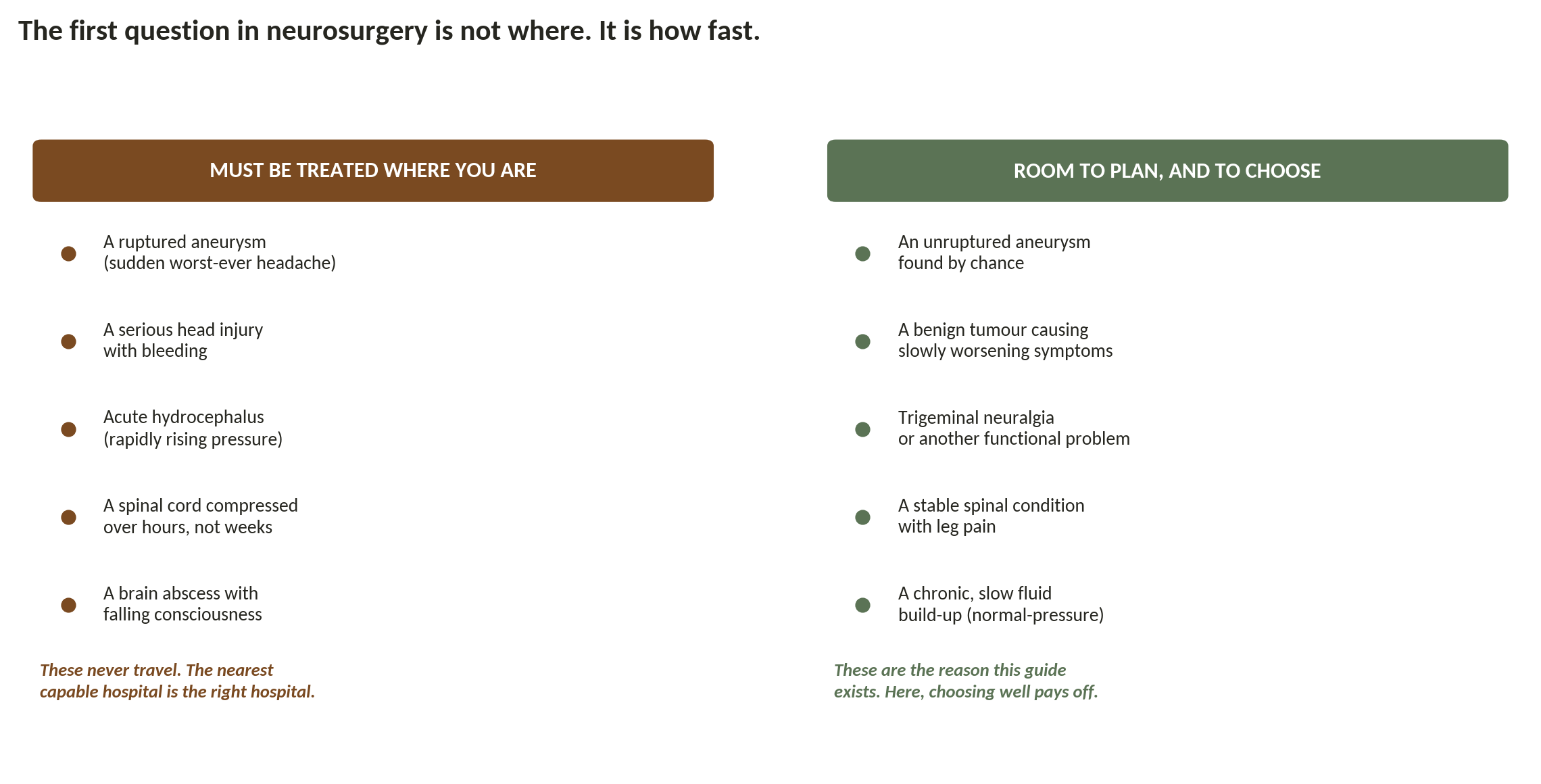
The divide that has to be settled before anything else is discussed.
A ruptured aneurysm announces itself as the worst headache of a person's life, arriving in an instant. A serious head injury, a rapidly rising pressure in the skull, a spinal cord being crushed over hours, a brain abscess dimming someone's consciousness — these are measured in hours, and the nearest capable hospital is by definition the right one. No saving is worth the flight, because the patient may not survive the wait for it.
If this is the emergency column, stop reading and go. Ethiopia has neurosurgical services that handle exactly these situations, and using them is not a compromise. It is the correct decision. This guide is for the other column, and there is no shame in discovering your case belongs on the left.
The right-hand column is different in kind. An unruptured aneurysm found by chance on a scan done for something else, a benign tumour causing symptoms that have crept up over months, a stable spinal problem, a slow fluid build-up in an older adult — these allow weeks to think, and weeks spent choosing the right team are repaid many times over. If your case is here, the remaining four gates are written for you.
2 Gate Two
Which kind of neurosurgeon do you actually need?
Here is the single most valuable idea in this guide, and the one most likely to change where you end up: a neurosurgeon is not one job.
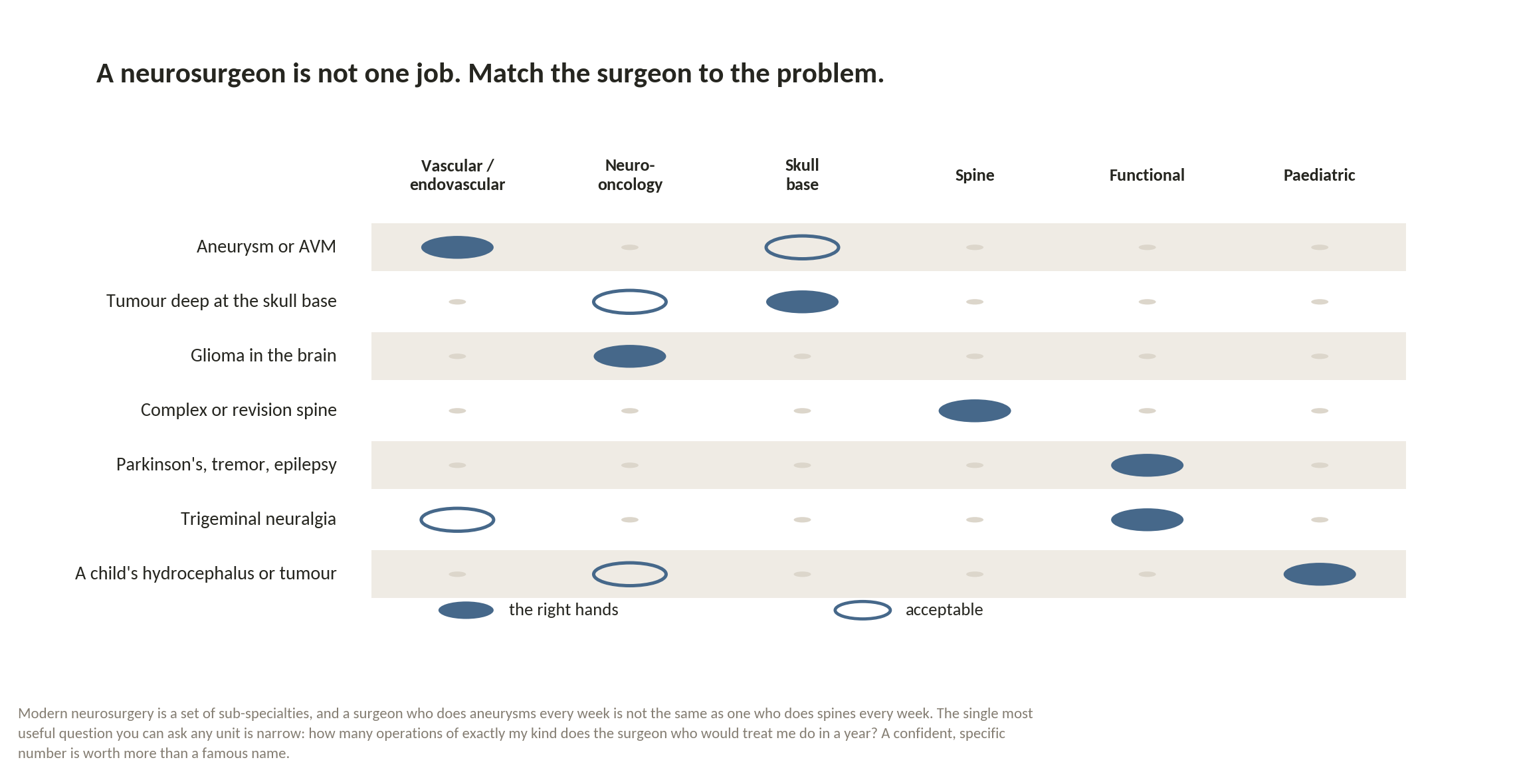
Match the surgeon to the problem, not to the reputation.
The field long ago divided into sub-specialties. A vascular neurosurgeon who treats aneurysms and malformations every week is a different practitioner from a spine surgeon, who is different again from a neuro-oncologist, a skull-base surgeon, a functional neurosurgeon who implants electrodes for Parkinson's, or a paediatric neurosurgeon. Their training overlaps at the root and diverges completely at the tip, and the surgeon who is brilliant at one may seldom perform another.
This matters more when travelling than at home, because a famous hospital name tells you nothing about who will actually hold the instruments. So the question to ask is exact and unembarrassing: not how good is your hospital, but how many operations of precisely my kind does the individual surgeon who would treat me perform in a year? A specific, confident number — forty aneurysms, sixty spines — tells you more than any brochure. Vagueness in answer to that question is itself an answer.
3 Gate Three
Does the unit have the whole toolkit for your problem?
Having found the right surgeon, the next question is whether the hospital around them can offer every reasonable option for your condition rather than only the one it prefers.
The clearest example is the aneurysm, and it is worth walking through because the principle generalises.
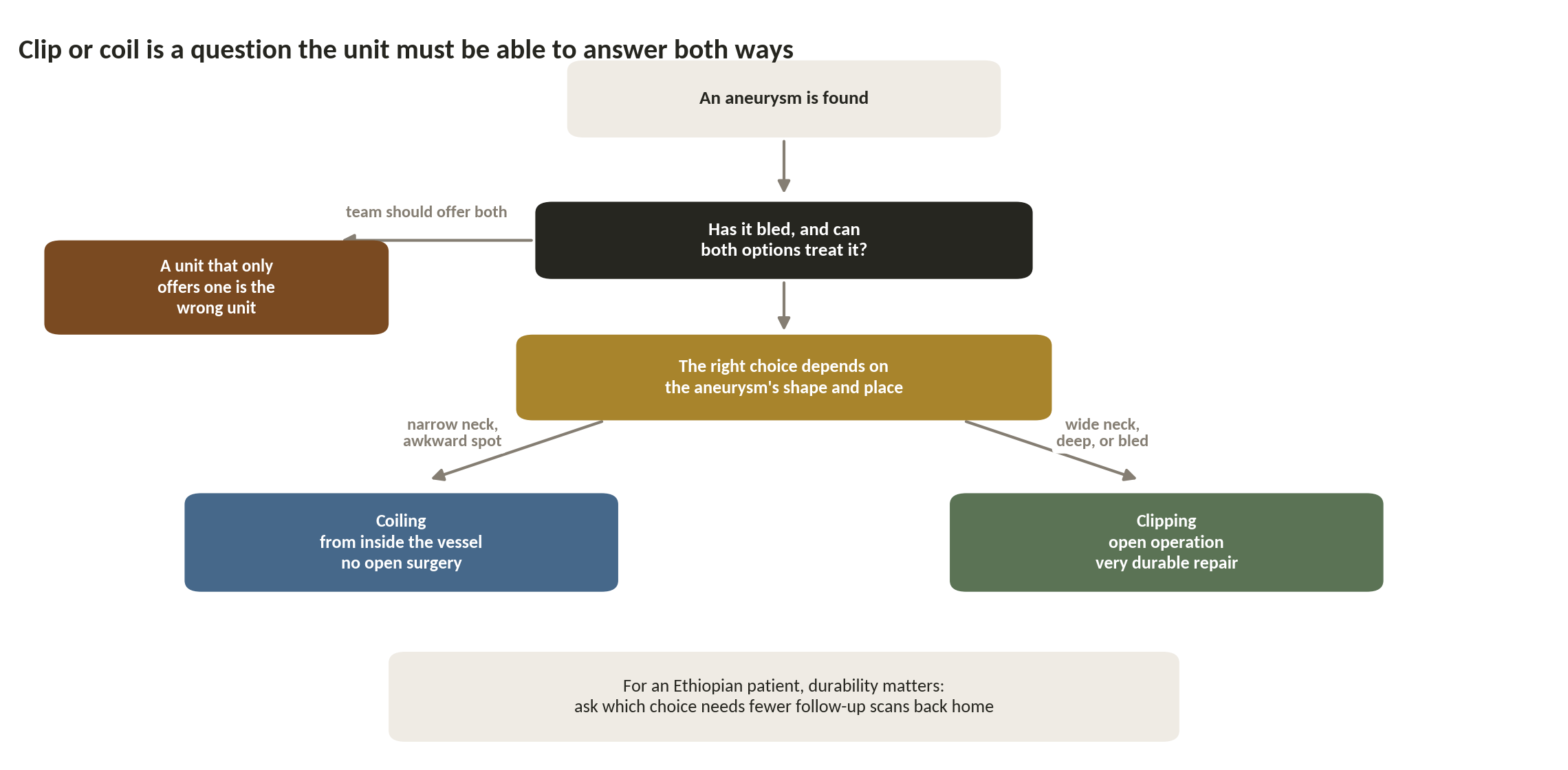
A unit that can only offer one answer is the wrong unit.
An aneurysm can be sealed in two quite different ways: clipped in an open operation, or coiled from inside the blood vessel with no open surgery at all. Neither is universally better. A wide-necked or deep aneurysm, or one that has already bled, may suit one approach; a narrow-necked one in an awkward spot may suit the other. What you need is a unit that genuinely offers both and a team — surgeon and interventional radiologist together — that will recommend the one suited to your aneurysm rather than the one they happen to do. A hospital that performs only clipping will find that clipping is what you need. That is not dishonesty; it is human nature, and it is why the toolkit matters.
The same logic runs through the rest of neurosurgery. For a functional case, ask whether they do the mapping the operation depends on. For a spinal one, ask about intraoperative monitoring. The question is always the same: can this unit offer the whole menu, or only its favourite dish?
4 Gate Four
Where does each part belong?
Ethiopia's neurosurgical capacity has grown at a remarkable pace, and a good deal of planned neurosurgery is now done in Addis Ababa and in several regional centres. Straightforward operations — many shunts, much spinal work, some tumours — are reasonable to have done at home, near family and follow-up, and I say so whenever it is true.
The case for travelling narrows to the operations where sub-specialty experience and specific equipment change the result: aneurysm and vascular work needing a full endovascular suite, complex skull-base tumours, functional surgery with its electrode mapping, difficult revision spine. These are the procedures where doing dozens a year, and having the exact kit, genuinely alters the outcome.
What tends to travel home well is what comes afterwards. Rehabilitation following neurosurgery — physiotherapy, speech therapy, the slow relearning of function — is long, and it is far better done in your own language among your own family than in a hotel near a foreign hospital. So the shape I most often recommend is to travel for the operation and the immediate recovery, then come home with a clear rehabilitation plan and the scans and records that the doctors in Ethiopia will need to continue your care. Arrange that follow-up before you fly, not after you land.
5 Gate Five
Is the money arranged, and have you counted intensive care?
Ethiopia's health financing does not follow a patient abroad. Community ‐ Based Health Insurance covers contracted facilities inside the country, and the formal ‐ sector scheme is still not settling claims. Since February 2026 a bank may release up to twenty thousand US dollars per case against a letter from the treating hospital, without a visa or ticket in hand.
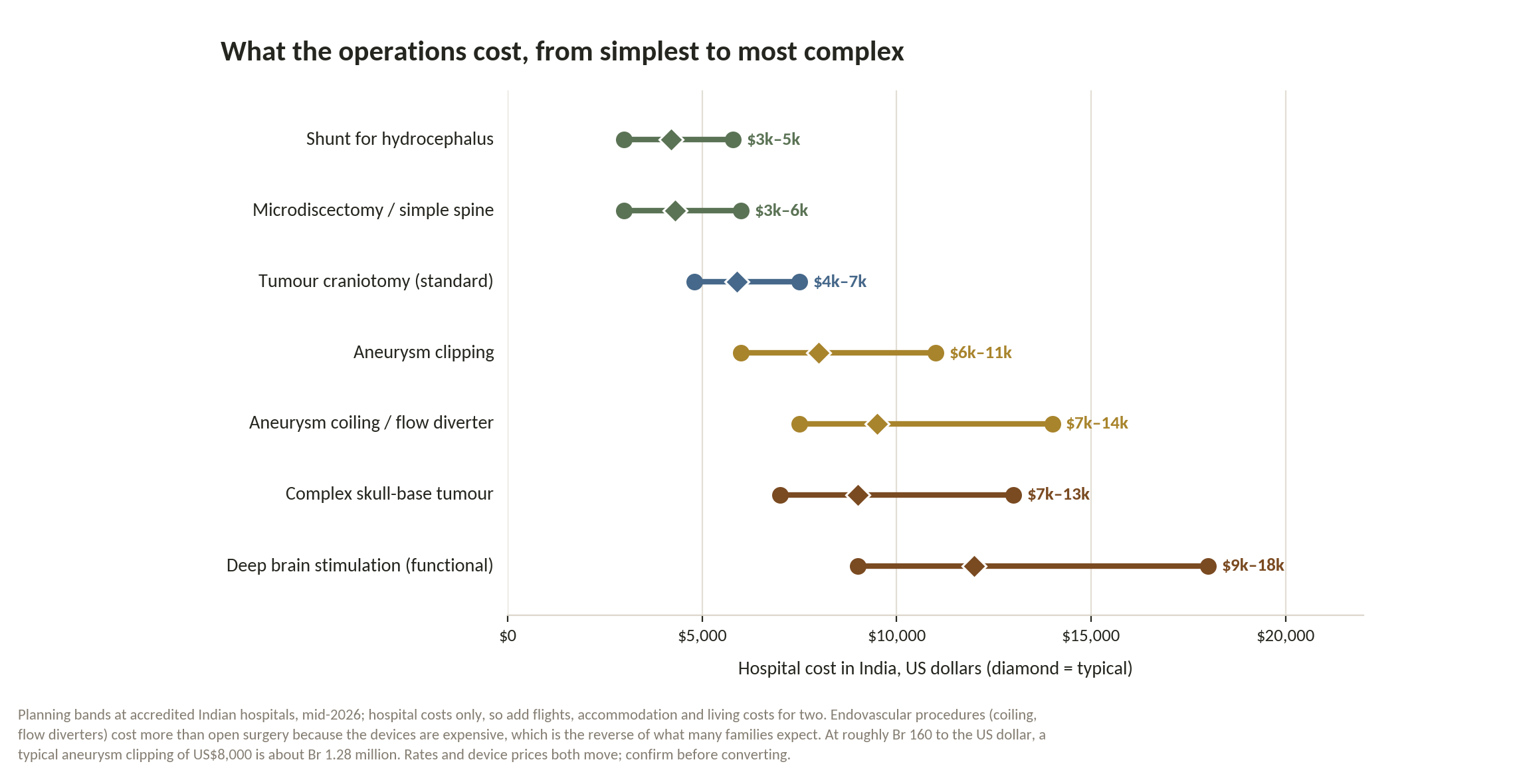
Seven operations, seven very different bills.
Two features of neurosurgical costing catch families out. The first is that the range is enormous: a shunt and a deep brain stimulation are both neurosurgery, and one costs several times the other. Use the chart to find your own operation rather than a headline average, because the average describes nobody.
The second is counter-intuitive. The keyhole option is often the expensive one. Coiling an aneurysm from inside the vessel, with no open surgery, usually costs more than clipping it open, because the coils and flow- diverting devices are costly. Families expect the less invasive route to be cheaper and are caught out when it is not. And across all of neurosurgery, the single most variable line on the bill is intensive care. A planned two ‐ day stay that becomes six is what turns a manageable budget into a crisis, so ask the daily ICU rate in writing before you travel and keep a contingency against it.
In 24 years the neurosurgical budgets that have broken did so on the days in intensive care that nobody had priced.
| A quotation, annotatedA composite of the neurosurgery quotes that reach me, with the questions I send back. | |
| Neurosurgery package — USD 6,400 | For which operation? Neurosurgery is a dozen different prices. |
| ICU: 2 days included | The item that moves most. Get the daily rate beyond day two. |
| Implants / devices: as required | For coiling this is most of the bill. Name the devices and count. |
| Neuromonitoring: if needed | Needed for which part? Ask whether it is in the figure or on top. |
| Pre-operative angiogram: not included | For vascular work this is essential, not optional. Price it. |
| Excludes: rehabilitation | Ask what physiotherapy or speech therapy costs per week. |
Pay the hospital and never an individual, and never settle a balance ahead of treatment given.
The Ethiopian practicalities
Ethiopian Airlines flies non ‐ stop from Bole to Delhi, Mumbai, Bengaluru, Chennai and Hyderabad. After any operation on the brain or spine, ask for written clearance to fly rather than assuming a fixed number of days; the safe interval depends on what was done and on the pressure inside the skull, and for some procedures it is longer than families expect. If seizures have been part of the picture, confirm the medication is stable before a long flight.
Yellow fever certification is required at least ten days before arrival and oral polio vaccination roughly four weeks before. Start the polio requirement at once, since for a planned neurosurgical case four weeks is time you would rather spend arranging the surgery.
The medical visa follows the hospital's invitation letter through the Embassy of India in Addis Ababa, and the attendant visa should be lodged in the same batch. That companion matters here more than in most fields: a patient recovering from neurosurgery may be confused, weak or unable to manage alone for some time. Confirm current rules with the Embassy, since they change, and ask the hospital for an Amharic ‐ speaking coordinator to help through the assessment and consent conversations, which in neurosurgery are detailed and important to understand fully.
A closing word
Send the scan itself — the MRI or CT images, not the report — with a short account of what has happened and how quickly: the headache, the weakness, the seizure, the loss of balance, and over what period. The first thing I will tell you is which column of the first chart you are in, because nothing else matters until that is settled. Where this is an emergency, I will say so plainly and tell you to go to the nearest hospital now. Where there is time, I will tell you which kind of neurosurgeon you need and where the operation can honestly be done — sometimes in India, sometimes in Addis Ababa.
Frequently Asked Questions by Ethiopians about Neurosurgery in India
Which neurosurgical conditions should Ethiopian patients not travel to India for?
The guide says that neurosurgical emergencies should be treated at the nearest capable hospital immediately, rather than delayed for international travel. The page 2 emergency diagram includes a ruptured aneurysm with a sudden severe headache, serious head injury with bleeding, acute hydrocephalus with rapidly rising pressure, spinal cord compression progressing over hours, and a brain abscess with falling consciousness.
When can an Ethiopian patient consider travelling to India for neurosurgery?
Planned travel may be considered when the condition is sufficiently stable to allow time for specialist selection. The guide gives examples such as an unruptured aneurysm found incidentally, a benign tumour with slowly worsening symptoms, trigeminal neuralgia, a stable spinal condition and chronic slow fluid build-up. These cases may allow weeks for evaluation and treatment planning.
How should Ethiopian patients choose the right neurosurgeon in India?
The guide emphasises choosing by subspecialty rather than general reputation. The page 3 grid matches aneurysms and AVMs with vascular/endovascular expertise, gliomas with neuro-oncology, complex spine problems with spine specialists, Parkinson's/tremor/epilepsy with functional neurosurgery, and childhood hydrocephalus or tumours with paediatric neurosurgery. Patients are advised to ask how many operations of their exact type the individual surgeon performs each year.
Is aneurysm coiling better than clipping?
Neither approach is universally better. The page 4 decision tree explains that clipping involves open surgical repair, whereas coiling treats the aneurysm from inside the blood vessel. The appropriate choice depends on features such as the aneurysm's shape, location, neck and whether it has bled. The guide recommends choosing a unit capable of genuinely offering both clipping and coiling.
How much does neurosurgery in India cost for Ethiopian patients?
According to the page 5 cost chart, indicative hospital costs are approximately USD 3,000–5,000 for a hydrocephalus shunt, USD 3,000–6,000 for microdiscectomy/simple spine surgery, USD 4,800–7,500 for standard tumour craniotomy, USD 6,000–11,000 for aneurysm clipping, USD 7,500–14,000 for coiling/flow diversion, USD 7,000–13,000 for complex skull-base surgery, and USD 9,000–18,000 for deep brain stimulation.
Why can aneurysm coiling cost more than open clipping in India?
Although coiling is less invasive, the guide explains that it can be more expensive because of the cost of coils and flow-diverting devices. This is one of the counter-intuitive aspects of neurosurgical pricing highlighted in the document. Patients considering endovascular treatment should therefore ask which devices will be required and whether their costs are included in the quotation.
How long should Ethiopian patients expect to stay in India after planned neurosurgery?
The guide gives a general estimate of approximately 2–3 weeks in India for planned neurosurgery, with several days potentially spent in intensive care or a high-dependency unit. Endovascular procedures may require a shorter stay than open surgery. After brain or spine surgery, patients should obtain written fit-to-fly clearance because the safe timing depends on the procedure and the patient's condition.
Why should Ethiopian patients budget separately for ICU care after neurosurgery?
The guide identifies additional ICU days as one of the most unpredictable neurosurgical expenses. A package might include two ICU days, but if the patient requires six, the final bill can increase substantially. The annotated quotation on page 6 therefore recommends obtaining the daily ICU rate beyond the included days in writing and keeping a financial contingency for extended intensive care.
Can rehabilitation after neurosurgery be continued in Ethiopia?
Yes. The guide explains that longer-term physiotherapy, speech therapy and neurological rehabilitation can often be better continued in Ethiopia, where the patient has family support and can communicate in their own language. Before leaving India, patients should obtain a clear rehabilitation plan together with scans and medical records needed by the doctors and therapists continuing their care in Ethiopia.
What should Ethiopian patients send before requesting a neurosurgery opinion from India?
The guide recommends sending the actual MRI or CT scan images, not only the written radiology report, together with a short account of the symptoms and how quickly they developed. Important details include headache, weakness, seizures, loss of balance and the timeframe over which these symptoms appeared. This information helps establish the most important first question: whether the case is an emergency requiring immediate local treatment or a planned condition for which international treatment can safely be considered.
My scan found an aneurysm that has not burst. Do I have time to travel?
Usually yes, and that is exactly the situation this guide is written for. An unruptured aneurysm found by chance can normally be planned over weeks. A sudden, worst-ever headache is the opposite: that is an emergency now, not a reason to book a flight.
How do I know which kind of neurosurgeon I need?
By the condition, not the reputation. Aneurysms need a vascular neurosurgeon, gliomas a neuro-oncology one, complex spine a spine specialist. Ask how many operations of your exact kind the surgeon does each year.
How long will I be in India?
Roughly two to three weeks for planned surgery, of which several days are spent in intensive care and a high dependency unit. Endovascular procedures often need a shorter stay than open surgery.
Is coiling better than clipping?
Neither is better in general; they suit different aneurysms. What matters is that the unit can genuinely offer both and recommends the one that fits yours, rather than the one it happens to do.
Who pays for this in Ethiopia?
You do. Neither community-based insurance nor the pending formal-sector scheme funds treatment abroad, though a bank may now advance up to US$20,000 against the hospital's letter.
Page Summary
This guide takes Ethiopian patients through five gates, beginning with the only question that comes first: is there time to consider travelling at all? A ruptured aneurysm, serious head injury or acute hydrocephalus must be treated where the patient already is. Gate two shows that aneurysms, gliomas, skull-base tumours, complex spine and functional cases need different subspecialists, so match the surgeon to the condition, not the hospital's name. Gate three asks whether the centre offers every reasonable option — clipping and coiling both — or only the one it routinely performs. Gate four accepts Ethiopia's growing capacity and points to vascular, skull-base and revision-spine work as the real reasons to travel. Gate five runs from USD 3,000–5,000 for a shunt to USD 9,000–18,000 for deep brain stimulation, with extra ICU days the cost to budget for.
Citation Block
| Topic | Information |
|---|---|
| Topic Information | Neurosurgery in India for Ethiopians |
| Specialty | Neurosurgery |
| Country | India |
| Intended Audience | Ethiopian Patients and Families |
| Conditions Covered | Aneurysm, AVM, Brain Tumours, Hydrocephalus, Spinal Conditions, Trigeminal Neuralgia, Parkinson's, Tremor, Epilepsy and Paediatric Neurosurgical Conditions |
| Procedures | Shunt Surgery, Spine Surgery, Craniotomy, Aneurysm Clipping, Coiling/Flow Diversion, Skull-Base Surgery and Deep Brain Stimulation |
| Typical Stay | Approximately 2–3 Weeks for Planned Surgery |
| Hospital Stay | Procedure-Dependent; Several Days May Be Required in ICU/HDU |
| Recovery | Immediate Recovery in India; Longer Rehabilitation May Continue in Ethiopia |
| Hydrocephalus Shunt Cost | Approximately USD 3,000–5,000 |
| Simple Spine Cost | Approximately USD 3,000–6,000 |
| Key Safety Principle | Neurosurgical Emergencies Should Not Be Delayed for International Travel |

Our Mission Statement
Our mission is to place patients at the centre of every healthcare decision by providing trustworthy, evidence-based, and unbiased medical information. We believe that informed patients make better decisions. Backed by personalised guidance from our experienced advisory team, we help patients understand their treatment options, compare them objectively, and confidently choose the path that best suits their medical needs and personal circumstances.
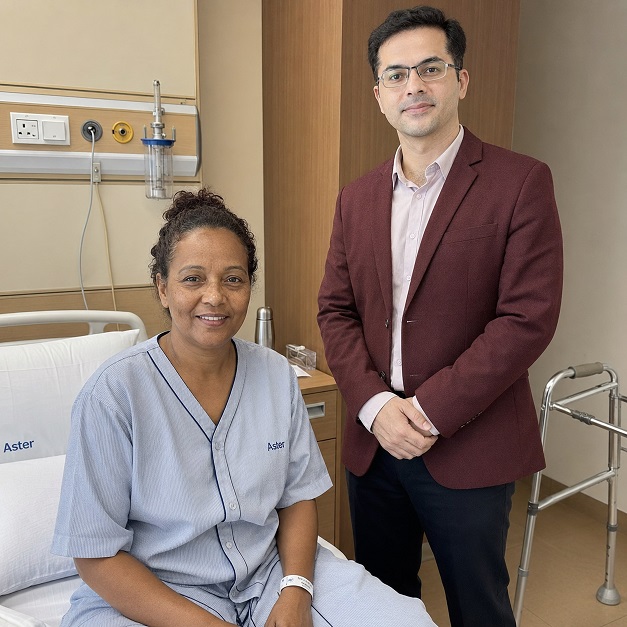
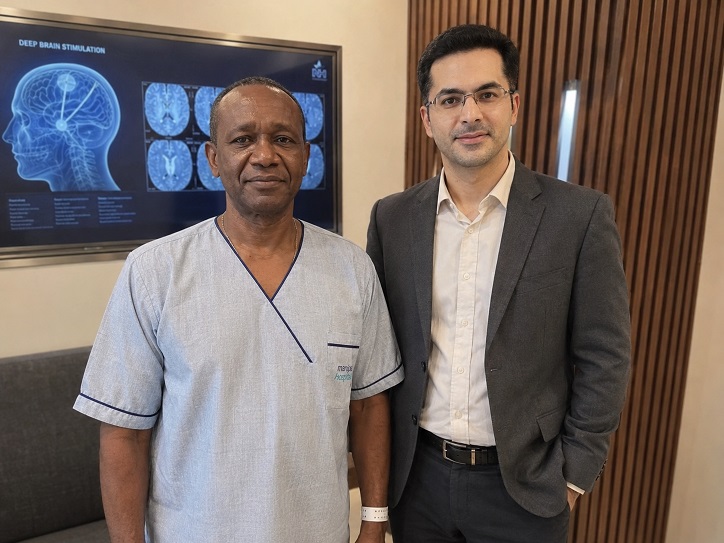
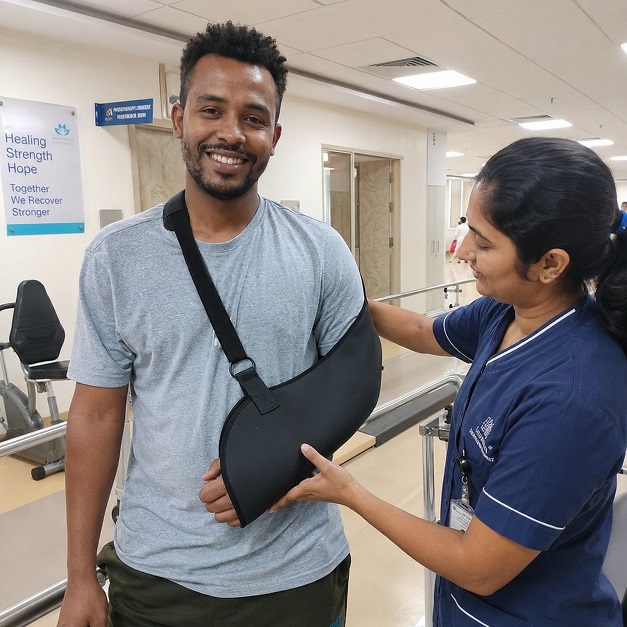
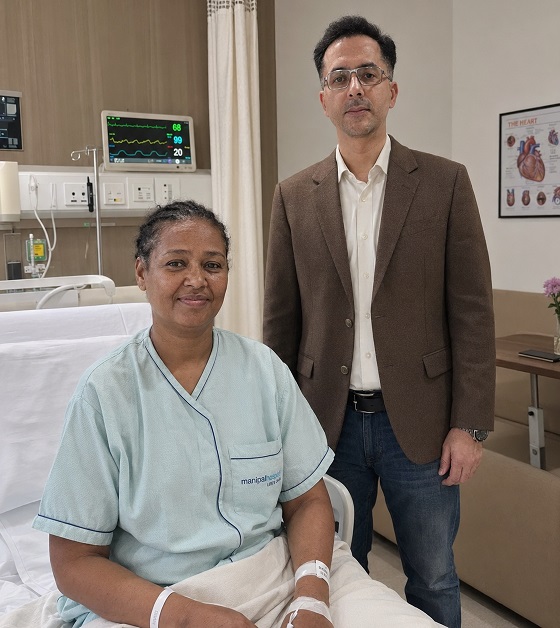
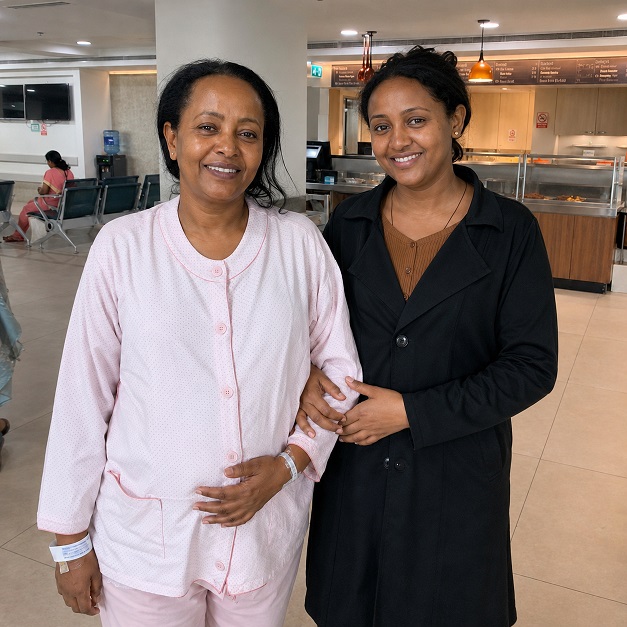
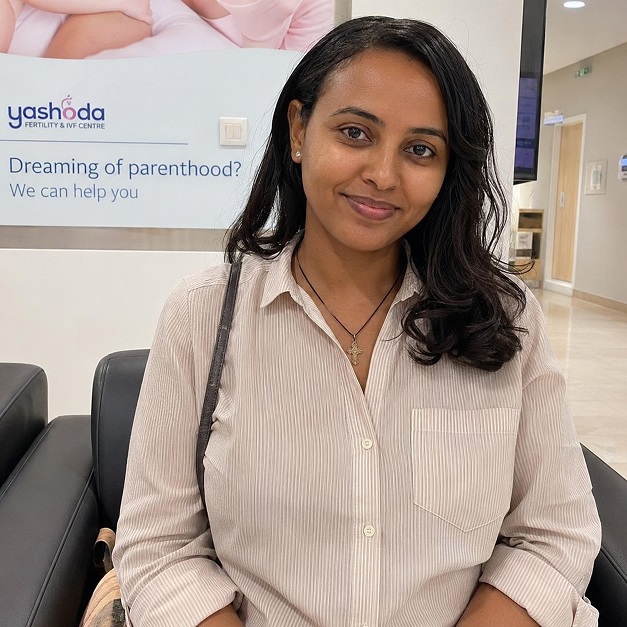
Patient Testimonials from Ethiopia
Ready to Take the First Step?
Share your Medical Reports with our Healthcare Managers Today and Get a FREE CONSULTATION, a Personalized Treatment Plan, and Complete Support from Arrival to Recovery.
Get Your Free ConsultationAreas We Serve
This resource has been thoughtfully prepared for patients from Ethiopia who are considering medical treatment in India. We also welcome patients from the wider region in the countries mentioned below-
We assist patients from:
- Eritrea
- Djibouti
- Somalia
- Kenya
- South Sudan
- Sudan
- Burundi
- Comoros
- Ethiopia
- Madagascar
- Malawi
- Mauritius
- Mozambique
- Rwanda
Many of the insights, treatment pathways, hospital recommendations, travel guidance, and patient support services described here are equally relevant and may be used as a reference when planning treatment in India.
From Ethiopia to India: Your Complete Patient Support Guide
- Brain Tumour Surgery in India for Ethiopians
- Cancer Treatment in India for Ethiopians
- Cardiac Surgery in India for Ethiopian Patients
- Cervical and Disc Replacement Surgery in India for Ethiopians
- Cosmetic and Plastic Surgery in India for Ethiopians
- CyberKnife Treatment in India for Ethiopians
- Eye Surgery in India for Ethiopians
- Gamma Knife Treatment in India for Ethiopians
- Heart Valve Replacement Surgery in India for Ethiopians
- Hip Surgery in India for Ethiopian Patients
- Knee Surgery in India for Ethiopian Patients
- Laparoscopic and Robotic Myomectomy Surgery in India for Ethiopians
- Neurosurgery in India for Ethiopians
- Paediatric Cardiac Surgery in India for Ethiopians
- Paediatric Neurosurgery in India for Ethiopians
- Prostate Cancer Treatment and Surgery in India for Ethiopians
- Robotic Cancer Surgery in India for Ethiopians
- Scoliosis Surgery in India for Ethiopians