

Knee Surgery in India for Ethiopian Patients
Five gates every knee should pass before anyone books a flight — starting with the one measurement that decides both the operation and the bill.
Aknee quotation is the easiest document in medical travel to write, and the easiest to get wrong. It says total knee replacement, gives a number, and quietly assumes a knee that still bends, whose ligaments still work, and which has only recently gone crooked. Many of the knees I am sent from Ethiopia are not that knee. They have been walked on for years longer than a knee in London or Toronto would have been — because the operation was not available, or not affordable, or simply never offered. By the time the X ‐ ray reaches me the leg carries a fixed bow, the knee will not straighten, and the operation being priced is not the operation the patient needs. In 24 years of arranging surgical care in India for patients across Africa and Asia, the knee is the joint where the distance between the quotation and the reality is widest. What follows is a route map with five gates. The purpose of each is to close that distance before anybody buys a ticket.
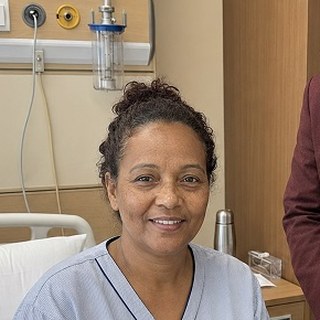
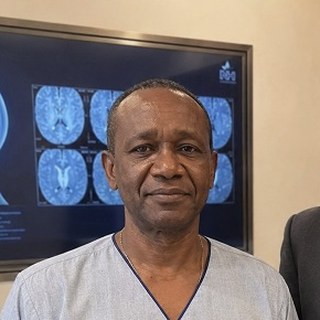
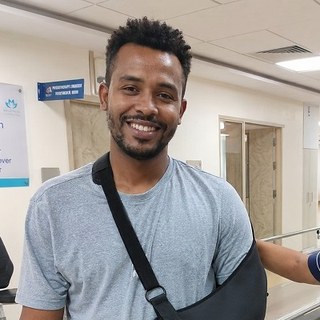
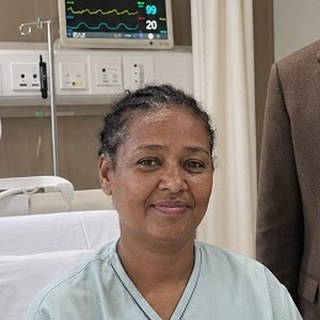
Healing Journeys of Ethiopian Patients


Key Takeaways
- Ethiopian patients should first obtain standing, weight-bearing knee X-rays, ideally extending from the hip to the ankle, because the degree of deformity determines both the surgical plan and the implant required.
- Knee replacement quotations should specify the implant tier. A standard implant, constrained implant and rotating hinge implant are designed for different levels of deformity and have significantly different costs.
- Younger Ethiopian patients should ask whether a joint-preserving procedure, such as osteotomy or partial knee replacement, may delay the need for a total knee replacement.
- Routine knee replacement can often be performed in Ethiopia, while severe deformities, complex revisions and knees requiring specialised implants may benefit from treatment at high-volume centres in India.
- Patients should compare quotations carefully to confirm the implant manufacturer, implant model, hospital stay, physiotherapy sessions and possible additional costs before committing to treatment.
- Most payment disputes arise from implant upgrades, additional physiotherapy sessions and extended hospital stays rather than the original package price.
- Most unilateral knee replacement procedures in accredited Indian hospitals generally cost USD 3,500–6,500, although implant choice and complexity influence the final cost.
- Ethiopian patients usually remain in India for 2–3 weeks after a single knee replacement and 3–4 weeks when both knees are treated during the same trip.
- Rehabilitation is essential after knee replacement. Achieving approximately 90 degrees of knee flexion within six weeks is an important milestone for long-term mobility.
- Before returning home, patients should obtain their operation note, implant card, discharge X-rays and written rehabilitation protocol to support continued physiotherapy in Ethiopia.
Quick Facts
- Conditions Covered
- Osteoarthritis, Severe Knee Deformity, Post-Traumatic Arthritis, Inflammatory Arthritis, Previous Knee Infection, Fixed Knee Deformity, Ligament Instability
- Procedures Mentioned
- Total Knee Replacement, Partial Knee Replacement, Osteotomy, Bilateral Knee Replacement, Constrained Knee Replacement, Rotating Hinge Knee Replacement
- Target Audience
- Ethiopian patients considering knee surgery or knee replacement in India
- Unilateral Total Knee Replacement
- USD 3,500–6,500
- Bilateral Knee Replacement
- USD 6,000–10,500
- Robotic Knee Replacement
- USD 5,000–8,500
- Typical Stay in India
- Approximately 2–3 Weeks for one knee and 3–4 Weeks for bilateral surgery
- Hospital Stay
- Approximately 5–7 Days, depending on recovery and physiotherapy progress
- Supervised Physiotherapy
- Continues throughout the stay in India and should continue for approximately three months after returning home
- Important Implant Details
- Manufacturer, implant model, implant constraint level, implant sizes and implant card
- Important Pre-Travel Records
- Standing weight-bearing X-rays of both knees, full-length hip-to-ankle X-rays if available, previous imaging, blood investigations and current medication list
- Medical Travel Requirements
- Hospital invitation letter, Indian Medical Visa, Medical Attendant Visa, yellow fever vaccination certificate, oral polio vaccination certificate and changeable return ticket
- Author/Advisor
- Dr. Dheeraj Bojwani
- Experience
- 24+ Years in Medical Travel
In Brief
Choosing knee surgery in India requires Ethiopian patients to evaluate more than the quoted package price. The severity of knee deformity, implant type, patient age and rehabilitation plan all influence treatment success. While straightforward arthritis may be managed with a standard knee replacement, severe deformities, ligament instability or previous infection often require more specialised implants and experienced reconstructive surgeons. Patients should request a detailed quotation identifying the implant tier, physiotherapy programme and expected rehabilitation schedule, while also discussing whether a joint-preserving procedure remains possible before proceeding with total knee replacement.
1 Gate One
How bad is the deformity, and who measured it?
Begin with the right picture. A knee X ‐ ray taken lying down tells a surgeon very little about how the leg behaves when you stand on it. What is needed is a weight ‐ bearing film, and ideally a full ‐ length one from hip to ankle, because only that shows the true angle of the limb and how much of the bend is coming from the knee itself rather than from an old fracture higher up.
That angle is not a technical detail. It decides which implant you need, and the implant is the largest single variable in a knee bill.
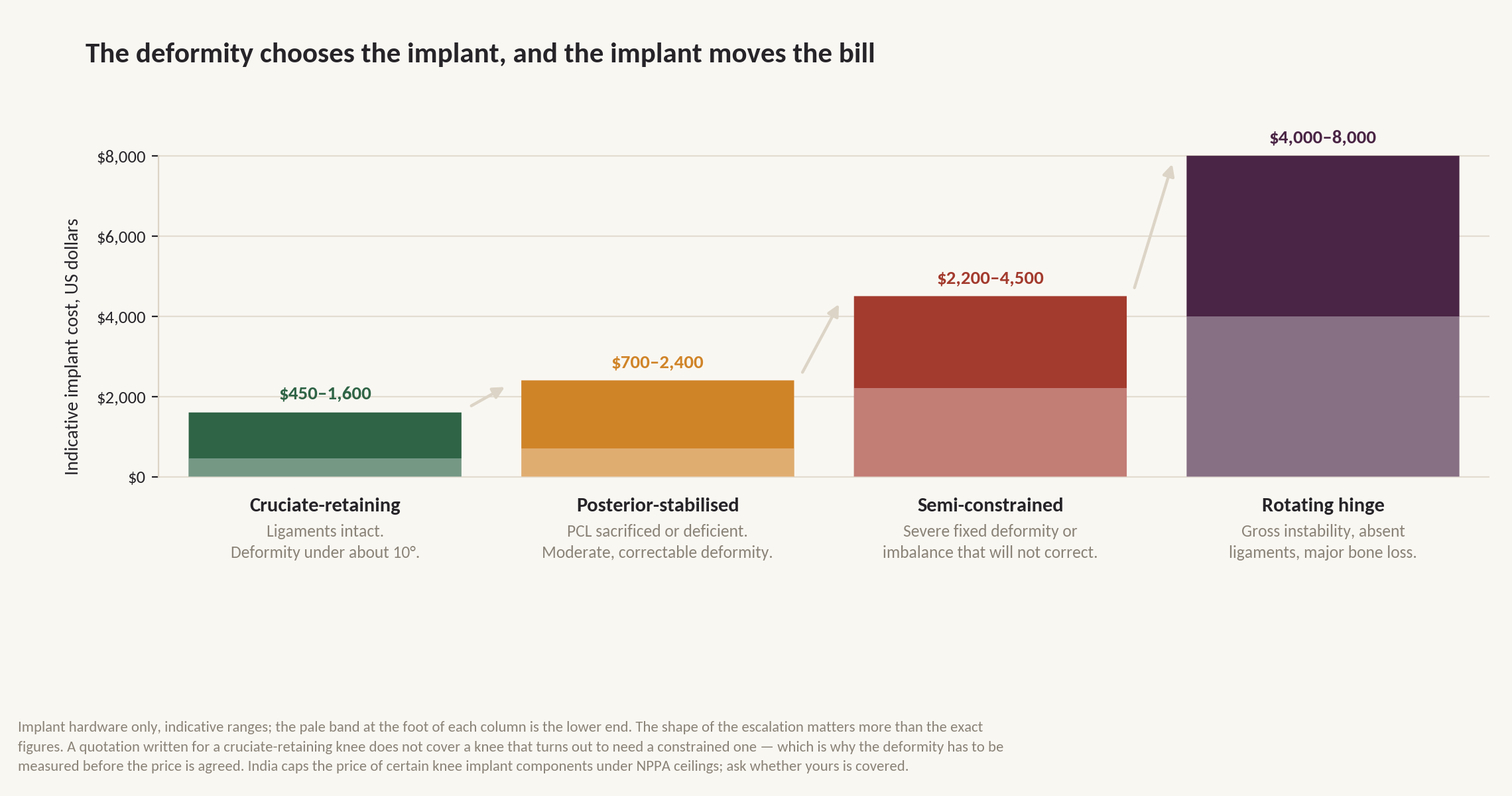
Four tiers of implant, four different bills, decided by a measurement.
A straightforward arthritic knee with working ligaments takes a standard primary implant. A knee with a large fixed bow that will not correct on the table, or with ligaments stretched past use on one side, needs a constrained implant with stems — heavier hardware, more of it, and several times the price. A knee wrecked by old infection or injury may need a hinge.
So the question to ask before accepting any figure is narrow and answerable: what is my deformity in degrees, does it correct when you examine me, and which implant tier has this quotation been written for? A hospital that answers all three is worth continuing with.
2 Gate Two
Is a replacement the right operation for your age?
Ethiopian knee patients are, on the whole, younger than the patients these operations were designed around. Much of the disease here is not the slow wear of a seventy ‐ year ‐ old but the consequence of a road traffic injury, an old septic knee or an inflammatory arthritis, arriving in someone in their forties or fifties. Published African arthroplasty series report both a lower average age and heavier use of constrained implants than Western registries. The two findings are connected, and both follow from presenting late.
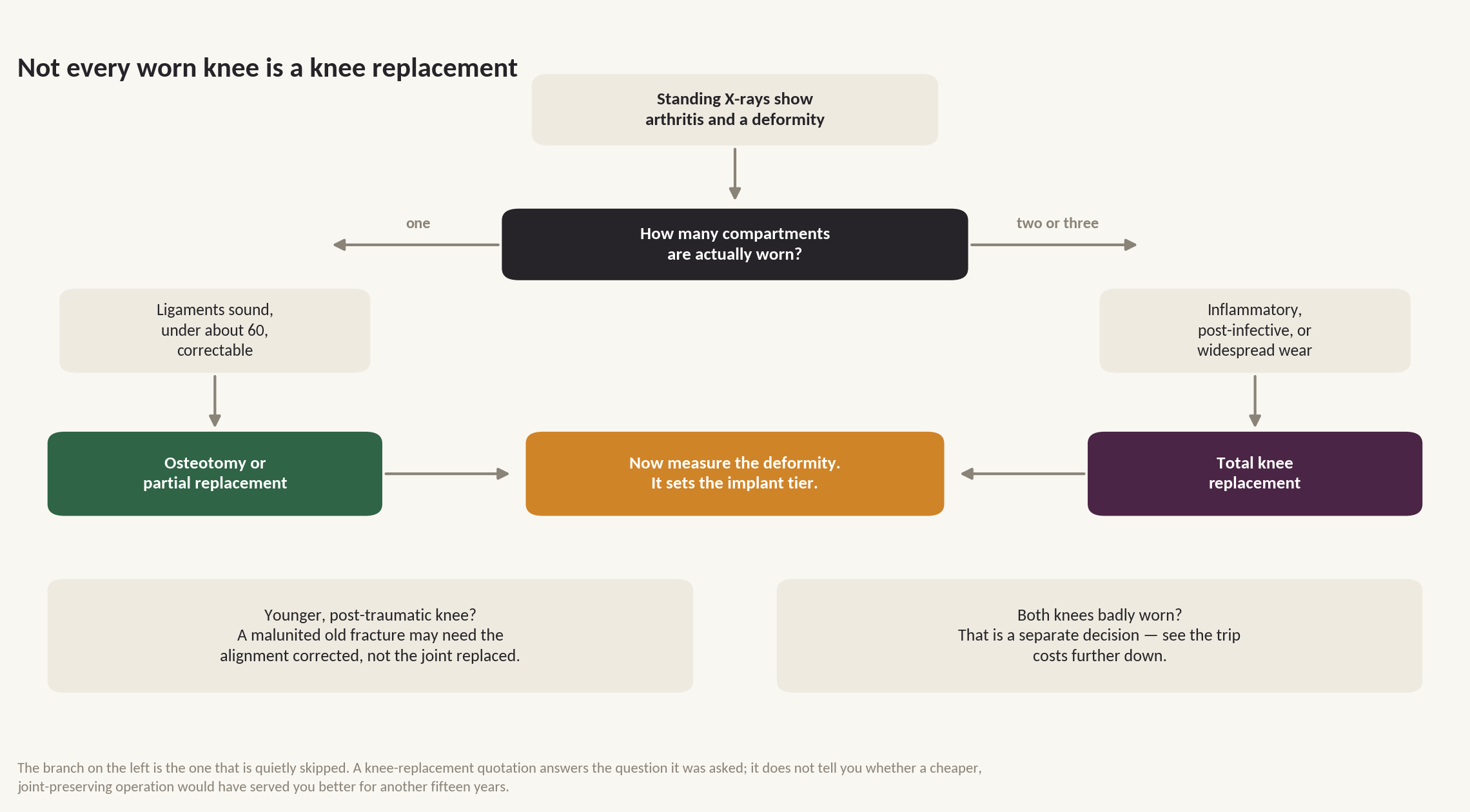
The left-hand branch is the one that quietly gets skipped.
Age matters because a knee replacement is not permanent. It is a very good operation with a finite life, and one put into a forty ‐ five ‐ year ‐ old will almost certainly need revising — in a country where revision is considerably harder to arrange than the first operation was. That is a serious argument for asking whether something smaller would do.
If the wear sits on one side of the knee only, the ligaments are sound and the deformity corrects, then an osteotomy — realigning the bone so the load shifts off the worn half — or a partial replacement may buy a decade or more before a total replacement is needed. Both are cheaper. Neither will be raised by anyone selling knee replacements. Ask about them by name.
3 Gate Three
Could this be done in Ethiopia?
Joint replacement is being done in Addis Ababa, and being honest about that matters more than any sales pitch.
CURE Ethiopia has published the country's first substantial arthroplasty series; Tikur Anbessa, St Paul's and the AaBET trauma hospital carry the public orthopaedic load; and several private hospitals — Landmark, MCM and Kadisco among them — run joint replacement services, some through regular visiting arrangements with Indian orthopaedic teams. That last point deserves your attention rather than my silence: it may be possible to have your operation in Addis Ababa, from the same calibre of surgeon you were preparing to fly to meet.
The argument for travelling is about what happens when a knee is not straightforward. It rests on three things: whether the unit does enough of these operations to hold its results, whether the full range of implant sizes and constraint levels is physically on the shelf on the day, and what is done if the knee becomes infected or stiff afterwards.
Ask both sides the same two questions — how many knees like mine did you do last year, and what do you keep in stock. A visiting team operating one week a month is a different proposition from a unit operating every week, and both differ from a camp that will not return for a year.
4 Gate Four
Is the money arranged, and does the quote name the implant?
No part of Ethiopia's health financing reaches this. Community ‐ Based Health Insurance buys care at contracted facilities inside the country and nothing beyond them, and the formal ‐ sector scheme promised for years has still not begun paying claims. A knee replacement abroad is paid for by the family, and it is kinder to say so at the start than to let anyone discover it later.
Moving the money, at least, has become the easy part, which was not true two years ago. Since February 2026 the National Bank's revised foreign exchange rules allow a bank to advance up to twenty thousand US dollars per case against a letter from the treating hospital, before any visa or ticket exists. Ask the hospital for that letter early; it is the document the bank actually wants.
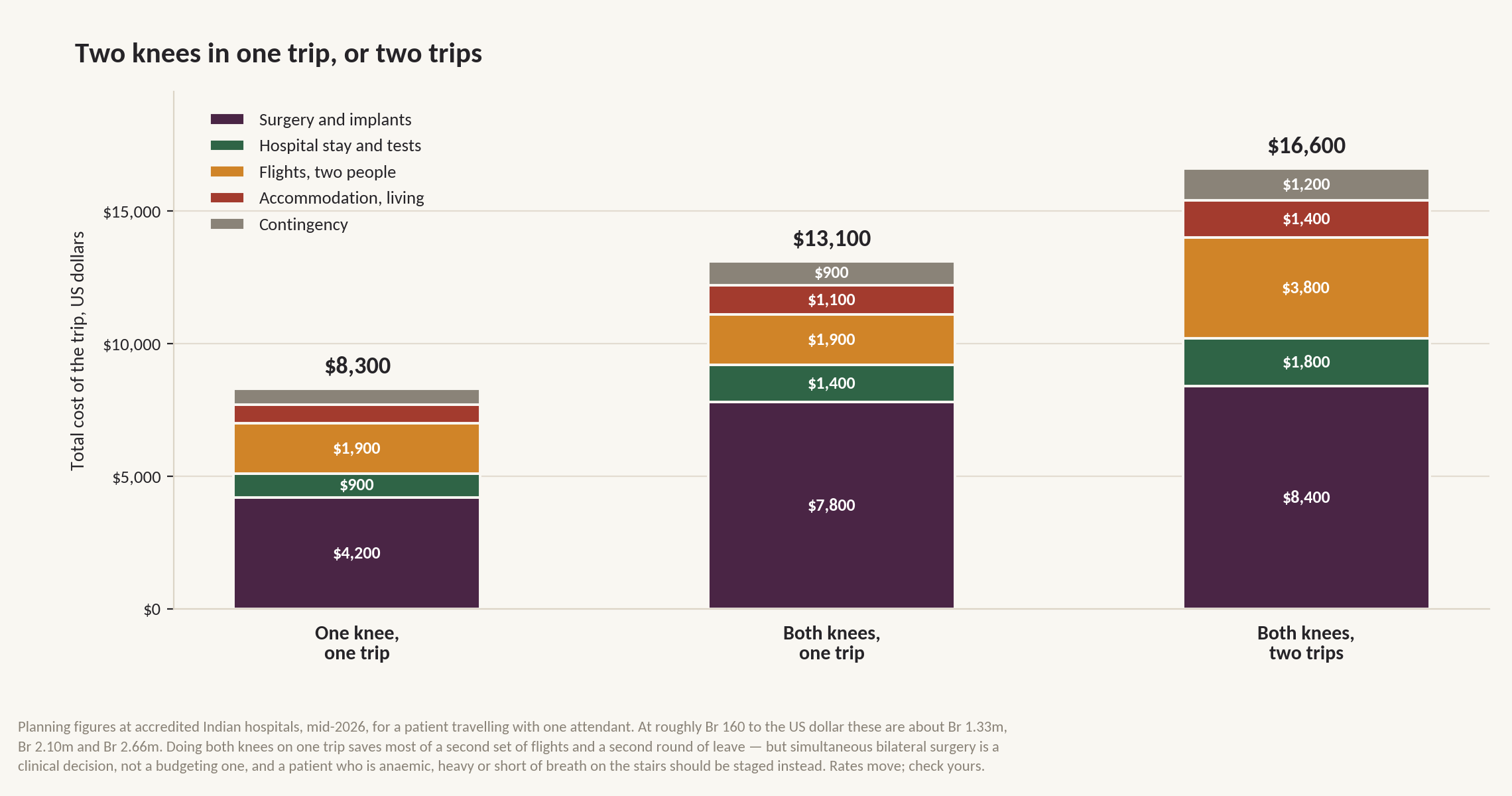
Where a second trip costs you, and where it does not.
In 24 years the arguments I have had to settle over knee bills have almost never concerned the headline figure. They have concerned the implant line, the physiotherapy that turned out to be extra, and the hospital days beyond the package.
| A quotation, annotatedA composite of the knee quotes that reach me, with the questions I send back. | |
| Total knee replacement — USD 4,400 | One knee or two? And which implant tier is this written for? |
| Implant: imported, as per requirement | Not a specification. Manufacturer, model, and constrained or not. |
| Includes: 5 days hospital, 5 physio sessions | Five sessions is a start, not a course. What does the sixth cost? |
| Deformity correction: as applicable | The whole question, answered with two words. Ask for degrees. |
| Not included: blood transfusion | Ask for the per ‐ unit price, and check your haemoglobin now. |
| Second knee: 60% of above | Only if done on the same admission. Confirm that in writing. |
Pay the deposit to the hospital and never to an individual, and never settle the balance before you arrive.
5 Gate Five
Who is going to do the rehabilitation?
This is the gate that decides whether the operation was worth having, and the one nobody budgets for.
A knee is not a hip. A hip largely rehabilitates itself; a knee has to be bent, deliberately and uncomfortably, every day for months. A knee allowed to stiffen in the first six weeks may never bend properly again.
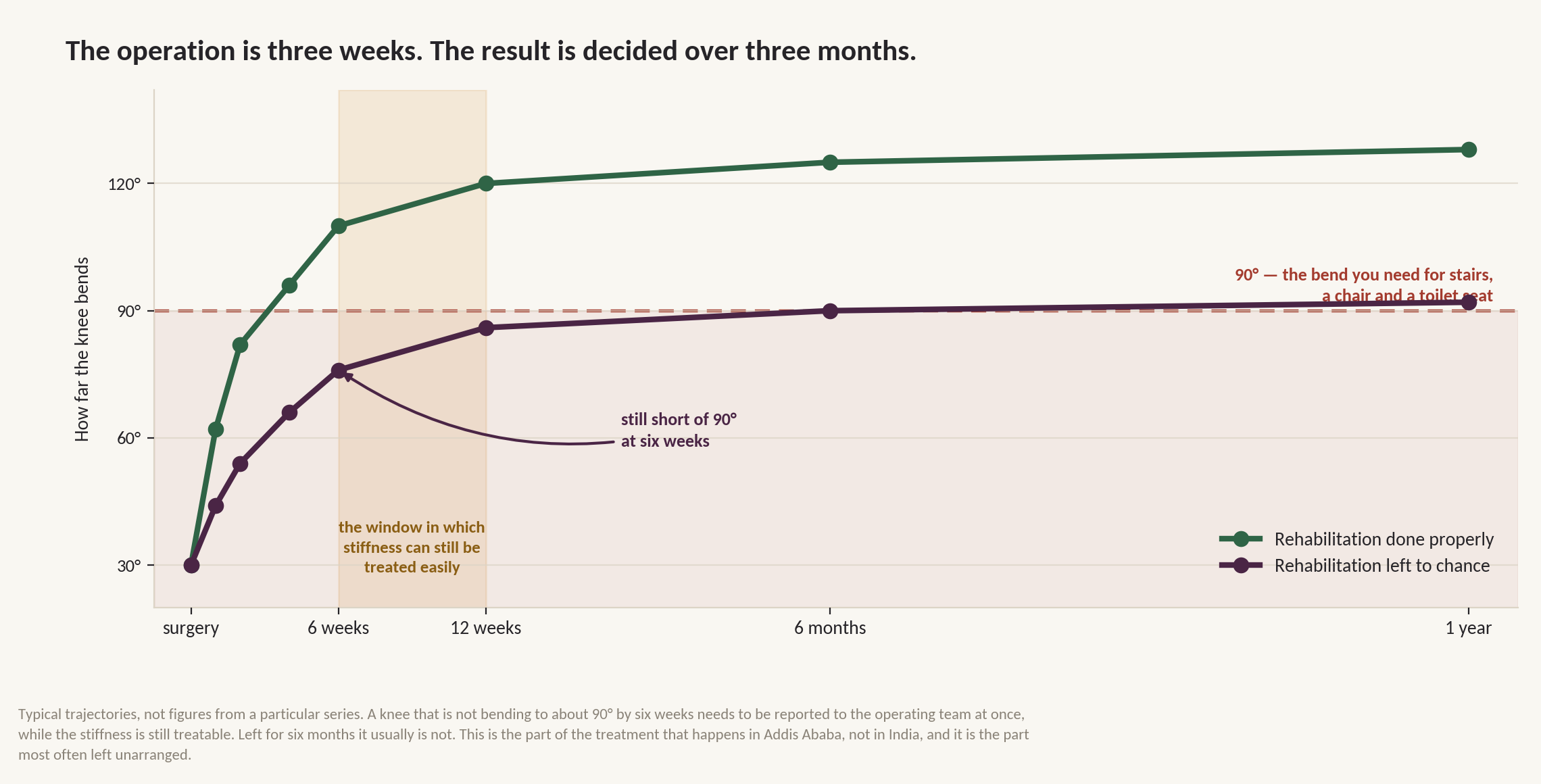
The number to watch, and the window in which it can still be fixed.
So before you fly, establish who your physiotherapist in Addis Ababa will be, what three months will cost, and whether they have handled replaced knees before. Ask the Indian unit for the written rehabilitation protocol and for a way to send them a video of the knee bending at six weeks.
Know the one number. If the knee is not reaching roughly ninety degrees at six weeks, tell the operating team immediately, while the stiffness can still be released under anaesthetic. Left until six months, it usually cannot.
Leave hospital holding the operation note, the implant card naming manufacturer, model and sizes, and the discharge X ‐ rays. If the knee ever needs revising, the surgeon in Addis Ababa will want all three.
The Ethiopian practicalities
Ethiopian Airlines' non ‐ stop services from Bole to Delhi, Mumbai, Bengaluru, Chennai and Hyderabad count for more with a knee than with most operations. A fresh replacement carries a clot risk, and six and a half hours in a single aircraft with room to straighten the leg is a materially different journey from fifteen hours broken by a change in the Gulf. Ask for the bulkhead seat when you book, not at the gate.
Two certificates are compulsory: yellow fever, given at least ten days before arrival, and oral polio vaccination, which needs roughly four weeks. Start the polio one in your first week of planning. It is the requirement most likely to move your surgery date.
The medical visa follows the hospital's invitation letter through the Embassy of India in Addis Ababa, and your attendant's visa should be lodged with it — after a knee replacement you will need that person. Confirm current rules with the Embassy, since they change. Ask for an Amharic ‐ speaking coordinator, and mention the fasting calendar before admission if you keep it: protein matters a great deal during knee rehabilitation, and a dietitian can plan around a fast if told in advance rather than afterwards.
A closing word
Send the standing X ‐ rays — both knees, weight ‐ bearing, and a full ‐ length film if you can obtain one — with your age and a line on what the knee stops you doing. I will tell you which gate you are standing at, and whether the honest answer is a smaller operation, a hospital in Addis Ababa, or a flight.
Frequently Asked Questions by Ethiopians about Knee Surgery in India
Should Ethiopian patients have knee replacement surgery in Ethiopia or India?
Routine knee replacement can often be performed successfully in Ethiopia. However, patients with severe deformities, ligament instability, previous knee infections or those requiring specialised implants may benefit from treatment at experienced knee replacement centres in India.
Why is standing weight-bearing X-ray important before knee surgery?
A standing weight-bearing X-ray, preferably extending from the hip to the ankle, accurately measures the degree of deformity. This measurement helps determine the appropriate implant type and influences the overall treatment plan and cost.
Is total knee replacement always the best option?
No. Younger patients or those with arthritis affecting only one part of the knee may be suitable for joint-preserving procedures such as osteotomy or partial knee replacement, which may delay the need for a total knee replacement.
How much does knee replacement surgery in India cost for Ethiopian patients?
The guide indicates that unilateral total knee replacement generally costs approximately USD 3,500–6,500, while bilateral knee replacement may cost around USD 6,000–10,500, depending on implant selection and surgical complexity.
How long should Ethiopian patients stay in India for knee surgery?
Patients undergoing a single knee replacement usually remain in India for 2–3 weeks, while those having both knees replaced during the same admission generally stay 3–4 weeks for assessment, surgery, rehabilitation and fitness-to-fly clearance.
What should patients ask before accepting a knee replacement quotation?
Patients should ask which implant tier has been recommended, whether the implant manufacturer and model are specified, how many physiotherapy sessions are included, the expected hospital stay, and whether additional costs such as blood transfusions or extended rehabilitation may apply.
Why is rehabilitation so important after knee replacement?
Unlike hip replacement, knee replacement requires intensive rehabilitation. The guide highlights that patients should aim to achieve approximately 90 degrees of knee flexion within six weeks, as delayed rehabilitation may result in long-term stiffness.
Can both knees be replaced during one visit to India?
Yes, in selected patients. Performing bilateral knee replacement during one admission may reduce overall travel costs, but suitability depends on the patient's overall health, blood loss risk and clinical assessment rather than financial considerations alone.
What medical records should Ethiopian patients carry before travelling?
Patients should bring standing weight-bearing X-rays of both knees, full-length alignment X-rays if available, previous imaging studies, blood test results, medication lists and any previous orthopaedic treatment records.
What documents should patients receive before returning to Ethiopia?
Before leaving India, patients should receive their operation note, implant card detailing the manufacturer and model, discharge X-rays, medication schedule, written rehabilitation protocol and follow-up instructions for continued physiotherapy and orthopaedic care in Ethiopia.
How long will I be in India for a knee replacement?
About two to three weeks for one knee and three to four for both, covering assessment, surgery, early physiotherapy and fitness-to-fly clearance.
Can both knees be done on the same trip?
Often, and it saves a second set of flights. But it is a clinical decision, not a budgeting one: it asks more of the heart and lungs and loses more blood, so an anaemic or unfit patient should be staged instead.
How long will the new knee last?
Most modern replacements do fifteen to twenty years. That is precisely why your age matters, and why a joint- preserving operation is worth asking about if you are in your forties.
Will the quotation cover the implant I actually need?
Only if it names the implant. Ask which tier it assumes and what a constrained one would add. This is the commonest gap between a knee quote and a knee bill.
Who pays for this in Ethiopia?
You do. Neither community-based insurance nor the pending formal-sector scheme funds treatment abroad, though a bank may now advance up to US$20,000 against the hospital's letter.
Page Summary
This guide explains how Ethiopian patients can decide whether knee surgery should be performed in Ethiopia or India by assessing knee deformity, implant requirements and rehabilitation needs before comparing treatment costs. It discusses standing weight-bearing imaging, implant selection, osteotomy versus total knee replacement, treatment costs, rehabilitation milestones, medical travel planning and long-term follow-up. The guide helps patients compare hospitals based on clinical suitability, implant availability and rehabilitation quality rather than package price alone.
Citation Block
| Topic | Information |
|---|---|
| Topic Information | Details |
| Procedure | Knee Surgery & Total Knee Replacement |
| Country | India |
| Intended Audience | Ethiopian Patients |
| Conditions Covered | Osteoarthritis, Severe Knee Deformity, Post-Traumatic Arthritis, Inflammatory Arthritis, Previous Knee Infection, Ligament Instability |
| Procedures | Total Knee Replacement, Partial Knee Replacement, Osteotomy, Bilateral Knee Replacement, Constrained Knee Replacement, Rotating Hinge Knee Replacement |
| Typical Stay | Approximately 2–3 Weeks (Single Knee) / 3–4 Weeks (Both Knees) |
| Hospital Stay | Approximately 5–7 Days |
| Recovery | Several Weeks to Months with Structured Physiotherapy and Rehabilitation |
| Average Knee Replacement Cost | USD 3,500–6,500 (Unilateral); USD 6,000–10,500 (Bilateral) |
| Key Pre-Travel Records | Standing Weight-Bearing X-Rays of Both Knees and Full-Length Hip-to-Ankle Films |
| Implant Documentation | Manufacturer, Implant Model, Constraint Level, Implant Sizes and Implant Card |

Our Mission Statement
Our mission is to place patients at the centre of every healthcare decision by providing trustworthy, evidence-based, and unbiased medical information. We believe that informed patients make better decisions. Backed by personalised guidance from our experienced advisory team, we help patients understand their treatment options, compare them objectively, and confidently choose the path that best suits their medical needs and personal circumstances.
Patient Testimonials from Ethiopia
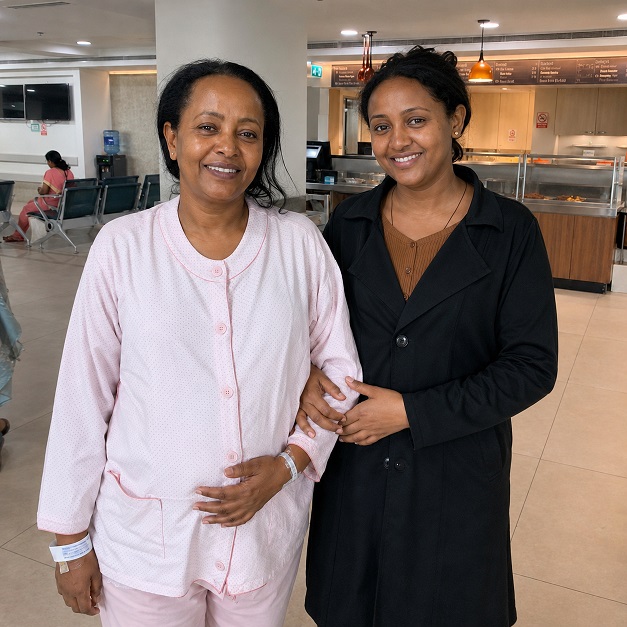

Ready to Take the First Step?
Share your Medical Reports with our Healthcare Managers Today and Get a FREE CONSULTATION, a Personalized Treatment Plan, and Complete Support from Arrival to Recovery.
Get Your Free ConsultationAreas We Serve
This resource has been thoughtfully prepared for patients from Ethiopia who are considering medical treatment in India. We also welcome patients from the wider region in the countries mentioned below-
We assist patients from:
- Eritrea
- Djibouti
- Somalia
- Kenya
- South Sudan
- Sudan
- Burundi
- Comoros
- Ethiopia
- Madagascar
- Malawi
- Mauritius
- Mozambique
- Rwanda
Many of the insights, treatment pathways, hospital recommendations, travel guidance, and patient support services described here are equally relevant and may be used as a reference when planning treatment in India.
From Ethiopia to India: Your Complete Patient Support Guide
- Brain Tumour Surgery in India for Ethiopians
- Cancer Treatment in India for Ethiopians
- Cardiac Surgery in India for Ethiopian Patients
- Cervical and Disc Replacement Surgery in India for Ethiopians
- Cosmetic and Plastic Surgery in India for Ethiopians
- CyberKnife Treatment in India for Ethiopians
- Eye Surgery in India for Ethiopians
- Gamma Knife Treatment in India for Ethiopians
- Heart Valve Replacement Surgery in India for Ethiopians
- Hip Surgery in India for Ethiopian Patients
- Knee Surgery in India for Ethiopian Patients
- Laparoscopic and Robotic Myomectomy Surgery in India for Ethiopians
- Neurosurgery in India for Ethiopians
- Paediatric Cardiac Surgery in India for Ethiopians
- Paediatric Neurosurgery in India for Ethiopians
- Prostate Cancer Treatment and Surgery in India for Ethiopians
- Robotic Cancer Surgery in India for Ethiopians
- Scoliosis Surgery in India for Ethiopians