

Selecting the Best Spine Surgeons and Hospitals in India
An Ethiopian patient's guide to choosing well — because once you have decided to have spine surgery in India, the harder and more consequential decision is which surgeon, and which hospital, you put your spine in the hands of.
Spine surgery is one of the most second-guessed operations in medicine, and for good reason. The same scan can honestly be read two ways, the line between a problem that needs an operation and one that needs time and physiotherapy is genuinely blurry, and the financial incentive in many health systems points toward doing more rather than less. None of that is unique to Ethiopia or to India. It is simply the terrain a spine patient is standing on before any hospital is chosen. What makes this guide different from a simple hospital comparison is the order it insists on. Most patients start by asking where to go. The more useful first question is whether the recommendation they already have is even the right one — and only once that is settled does choosing the surgeon and the hospital actually matter. In 24 years of arranging surgical care in India for patients across Africa and Asia, the single habit that has protected more spines than any other is treating a second opinion as mandatory rather than optional. This guide exists to help you choose the surgeon and the hospital well — and, just as importantly, to help you recognise when the first answer you were given deserves to be questioned before you travel anywhere at all.
Healing Journeys of Ethiopian Patients









Key Takeaways
- A second opinion should be treated as an essential step before spine surgery. A scoping review covering 14 studies found that 61.3% of second opinions disagreed with the first recommendation, and about three in four of those disagreements recommended less surgery rather than more.
- The surgeon's experience with the exact operation matters more than general spine-surgery experience. Ethiopian patients should ask how many procedures identical or closely comparable to their own the surgeon performs each year, particularly for complex fusion, deformity correction or revision surgery.
- A good surgeon should be willing to explain when surgery may not be necessary. The guide emphasises distinguishing nerve-related arm or leg pain from back or neck pain alone, because surgery is more reliably beneficial for compressed-nerve symptoms than for pain without nerve involvement.
- Spinal tuberculosis should be considered when evaluating Ethiopian patients with destructive or unusual spinal changes. The guide recommends choosing a hospital where infectious-disease specialists are available if imaging or biopsy suggests that an apparently degenerative condition could actually be spinal TB.
- Spine-specific fellowship training is an important qualification to verify. General orthopaedic or neurosurgical training alone does not establish dedicated spine expertise; patients should check for additional spine-surgery fellowship training and independently verify professional registration.
- Hospital capability becomes particularly important for complex spine operations. Ethiopian patients should confirm routine intraoperative neuromonitoring, dedicated spine or neuro-intensive care, on-site MRI, infectious-disease support and a structured physiotherapy and rehabilitation programme.
- Spine surgery costs in India vary substantially according to complexity. The guide's illustrative hospital ranges are approximately US$2,800–5,000 for microdiscectomy, US$3,200–5,800 for lumbar decompression, US$5,500–9,000 for single-level fusion, US$8,500–14,000 for multi-level fusion and US$10,000–18,000 for complex deformity correction.
- The quotation should clearly identify what is included before an Ethiopian patient travels. Patients should confirm implants, neuromonitoring, ICU or extended admission costs, additional surgical levels, physiotherapy and what happens financially if the surgical plan changes during the operation.
Quick Facts
- Author
- Dr. Dheeraj Bojwani
- Experience
- 24+ Years
- Guide For
- Patients from Ethiopia
- Treatment
- Spine Surgery in India
- Common Procedures
- Microdiscectomy, lumbar decompression, spinal fusion, revision surgery and deformity correction
- Important Screening
- Independent second opinion before committing to surgery
- Surgeon Qualification
- Spine-specific fellowship training should be verified
- Key Experience Check
- Ask for annual volume in the exact procedure required
- Spinal TB Consideration
- Infectious-disease assessment may be important where imaging or biopsy suggests spinal tuberculosis
- Indicative India Cost
- US$2,800–18,000 depending on procedure complexity
- Complex Surgery Cost
- Approximately US$10,000–18,000 for complex deformity correction
- Hospital Requirements
- Intraoperative neuromonitoring, MRI, intensive-care capability and rehabilitation support
- Accreditation
- NABH accreditation should be independently verified
- Ethiopia Follow-Up
- Obtain a written rehabilitation plan and coordinate care with a named physiotherapist or doctor in Ethiopia
- International Patient Support
- Confirm medical-visa assistance, travel arrangements and clear communication before departure.
In Brief
For Ethiopian patients considering spine surgery in India, choosing the right surgeon should begin with confirming whether surgery is actually necessary through an independent second opinion, followed by verification of spine-specific training and experience in the exact procedure required. Hospital selection should then focus on intraoperative neuromonitoring, MRI, intensive-care capability, infectious-disease support where spinal TB is a possibility, rehabilitation and NABH accreditation. Patients should also obtain a detailed quotation covering implants, monitoring, ICU requirements and possible changes to the surgical plan, while arranging a written rehabilitation plan and follow-up contact for continued care in Ethiopia.
First: should you travel at all?
Ethiopia's spine and neurosurgical capacity has grown substantially over the past two decades. Tikur Anbessa (Black Lion) Specialized Hospital in Addis Ababa performs a genuine range of spine surgery, and organisations including CURE Ethiopia have built real expertise in paediatric and deformity cases specifically. For a straightforward, well-defined case — a single-level disc problem with clear nerve-root symptoms, in a surgeon you can verify has real experience in it — treatment at home is a reasonable and often sensible choice, and I say so when it genuinely applies.
The case for travelling strengthens for complex deformity correction, multi-level fusion, revision surgery after a previous operation has not gone well, and any case where the diagnosis itself remains uncertain. These are exactly the cases where surgeon volume in the specific procedure, and the depth of support around the operating theatre, matter most — and where the gap between an experienced centre and an occasional one shows up most clearly in the result. What follows is written for exactly that decision: once you have decided India is the right place, how do you choose well within it?
The one fact to carry into every conversation
A scoping review pooling fourteen studies on second opinions in spine surgery found that 61.3 percent of second opinions disagreed with the first, most often on whether surgery was needed at all — and about three in four of those disagreements recommended less surgery, not more. Separately, surgery reliably relieves pain radiating down an arm or leg from a compressed nerve; it is a far less reliable answer for back or neck pain alone, with no such nerve involvement. A surgeon who distinguishes these two things plainly, and who welcomes rather than resists a second opinion, is telling you something important before you have even discussed technique.
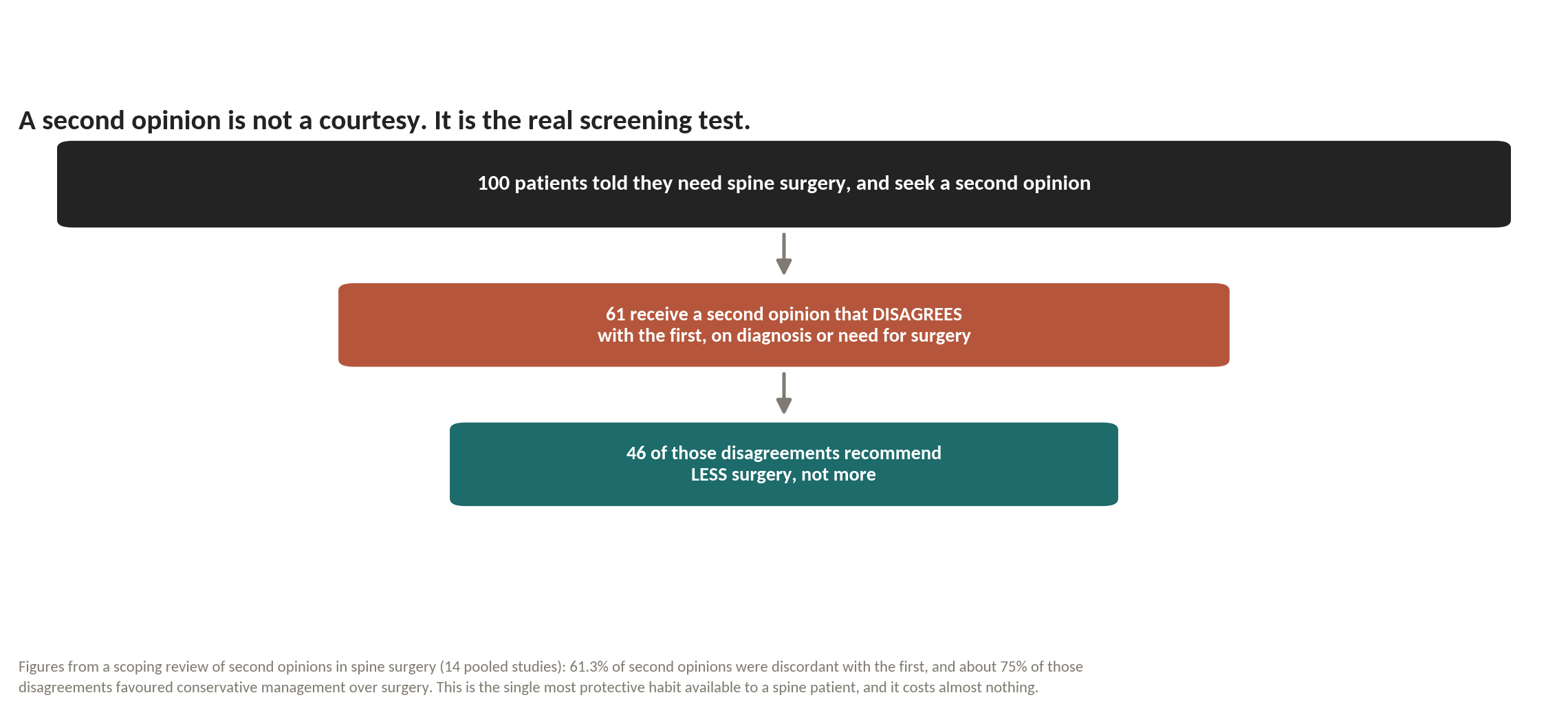
A second opinion is not a courtesy. It is the real screening test.
Two decisions, not one
Choosing where to have spine surgery is really two separate judgements, weighted differently.
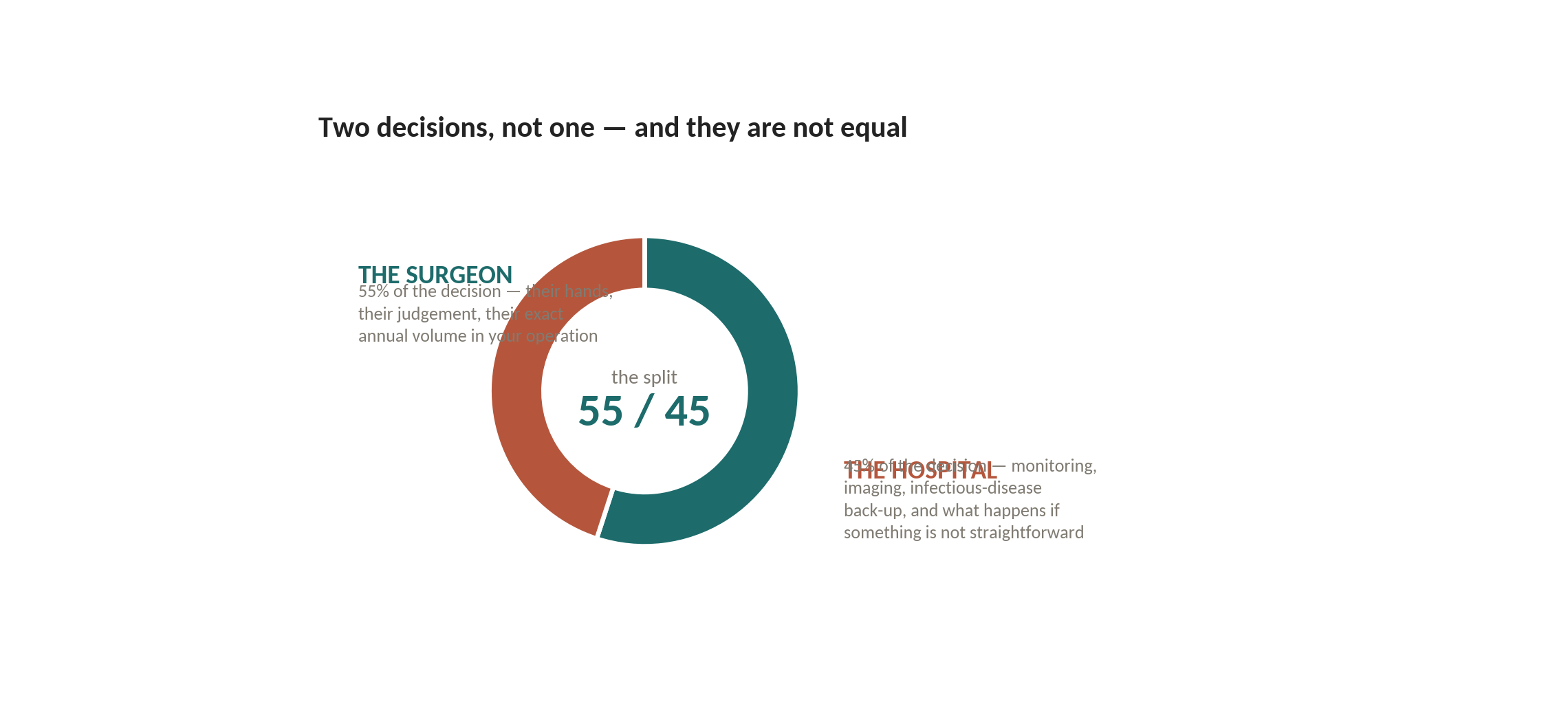
The surgeon's hands matter most, but the hospital around them is not a formality.
Part One: Judging the surgeon
- Annual volume in your exact operation. Not general spine surgery — the specific procedure you need. A surgeon who does many decompressions but few multi-level fusions is not necessarily the right choice for a multi-level fusion.
- Willingness to say "you may not need surgery." Given the second-opinion evidence above, a surgeon who never recommends conservative management is a signal worth noticing.
- Distinguishes leg or arm pain from back or neck pain alone in their explanation of why surgery is being recommended, rather than treating all pain as equally likely to respond.
- Actively considers spinal tuberculosis before assuming a deformity or destructive change is ordinary degenerative disease — a real and important differential given Ethiopia's tuberculosis burden.
- Qualification: fellowship-trained specifically in spine , not general orthopaedic or neurosurgical training alone (see the qualification ladder below).
- Discloses their own complication and reoperation rate when asked directly, rather than speaking only in generalities about the operation's reputation.
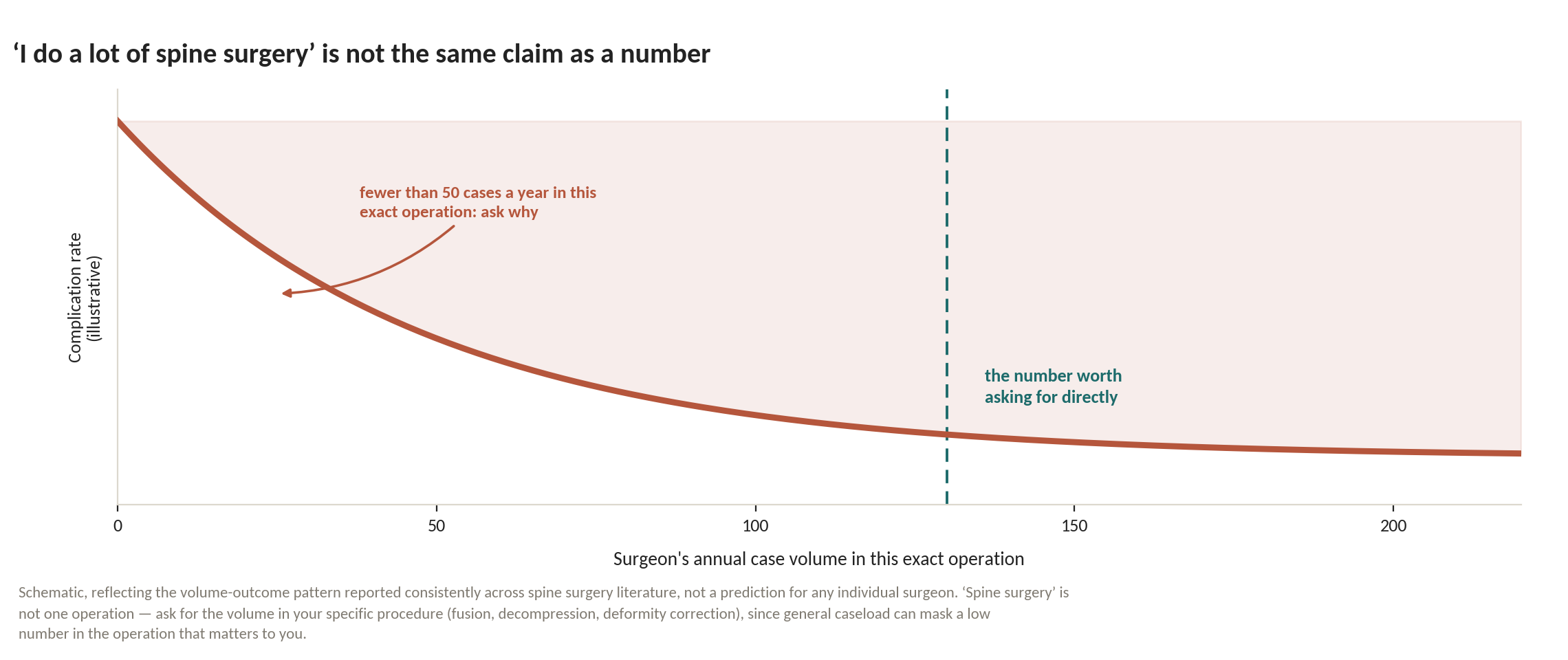
"I do a lot of spine surgery" is not the same claim as a number.
Part Two: Judging the hospital
- Intraoperative neuromonitoring available and used routinely for fusion and deformity surgery, not offered only "on request" or at extra cost as an afterthought.
- Infectious disease specialists available on site for co-management, in case a suspected ordinary degenerative case turns out to be spinal tuberculosis once imaging or biopsy results return.
- A dedicated spine or neuro-intensive-care capability for complex or multi-level cases, not a general surgical ward stretched to cover everything.
- NABH accreditation , verifiable independently rather than taken on the hospital's word.
- MRI available on site , without outsourcing that delays diagnosis and planning by days.
- A written physiotherapy and rehabilitation protocol tied to the surgical team, that you can carry home to a named physiotherapist in Ethiopia.
The qualification ladder
| Stage | Qualification | What it means |
|---|---|---|
| Base medical degree | MBBS | Basic medical qualification, required before any specialisation |
| Specialist degree | MS (Orthopaedics) or MCh/DNB (Neurosurgery) | General orthopaedic or neurosurgical training — not spine-specific on its own |
| Sub-specialty fellowship | Spine surgery fellowship | The stage that matters most. Confirms dedicated, supervised training in spine surgery specifically, beyond the general degree |
The money, and what it should include
Ethiopia's health financing does not follow a patient abroad. Community ‐ Based Health Insurance covers contracted facilities inside the country, and the formal ‐ sector scheme is still not settling claims. Since February 2026 a bank may release up to twenty thousand US dollars per case against a letter from the treating hospital, without a visa or ticket in hand.
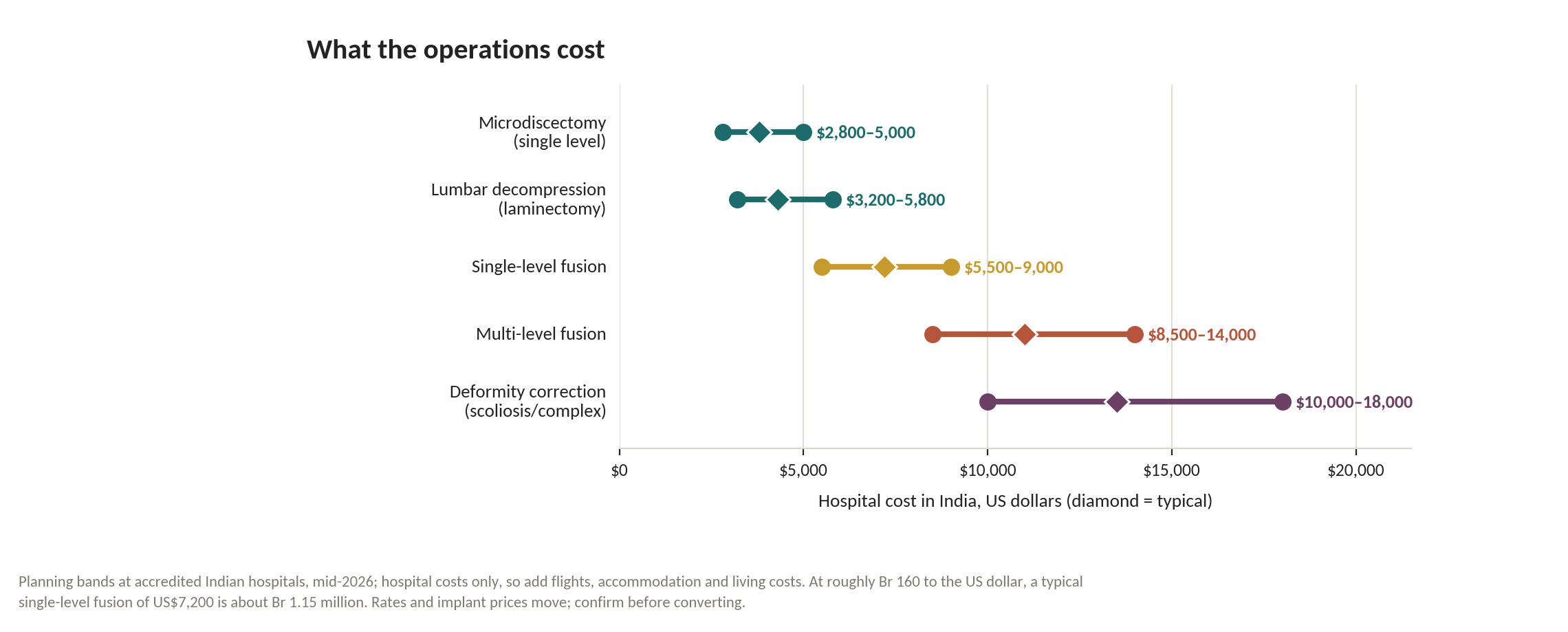
Complexity, not reputation, drives the price.
In 24 years , disputes over spine surgery bills have almost never concerned the quoted price itself. They have concerned what the quote silently left out — neuromonitoring, implants, a longer ICU stay, or a second procedure discovered mid-operation.
| A quotation, annotatedA composite of the spine surgery quotes that reach me, with the questions I send back. | |
| Spine surgery — USD 7,200 | For which exact procedure? Ask before the number means anything. |
| Implants: standard system | Ask the specific brand and whether it is included in full. |
| Neuromonitoring: included | Confirm this explicitly. It should never be optional. |
| Includes: 5 days admission | Ask what a longer ICU stay would add if needed. |
| Excludes: additional level if found intraoperatively | Ask what happens, and what it costs, if the plan changes on the table. |
| Excludes: physiotherapy after discharge | Ask for a written plan to carry home to Ethiopia. |
Pay the hospital and never an individual, and never settle a balance before you arrive.
Four signals that should make you pause
- A firm surgical recommendation given before any imaging has been reviewed by the operating surgeon personally.
- Reluctance, or outright refusal, to support a second opinion from an independent doctor.
- No willingness to state a specific annual case volume in your exact procedure.
- A quotation that does not name the implant, the neuromonitoring, or what happens if the plan changes mid- operation.
The Ethiopian practicalities
Ethiopian Airlines flies non ‐ stop from Bole to Delhi, Mumbai, Bengaluru, Chennai and Hyderabad. Yellow fever certification is required at least ten days before arrival and oral polio vaccination roughly four weeks before. The medical visa follows the hospital's invitation letter through the Embassy of India in Addis Ababa, with the attendant visa lodged in the same batch. Confirm current rules with the Embassy, since they change, and ask for an Amharic ‐ speaking coordinator to help carry your written rehabilitation plan back to a named doctor in Ethiopia.
Straight Answers for Ethiopians about Spine Surgeons and Hospitals in India
Do I really need a second opinion if a surgeon has already recommended surgery?
Yes, almost always. A large scoping review found most second opinions in spine surgery disagree with the first, and most of those disagreements favour less surgery, not more. It is the cheapest, safest step available before committing to an operation.
What is the single most important question to ask a surgeon?
How many operations exactly like mine, specifically, do you perform each year? General spine experience can mask a low number in the particular procedure you need.
Why does it matter whether the hospital can manage infectious disease?
Because in Ethiopia, a deformity that looks like ordinary degenerative spine disease is sometimes spinal tuberculosis instead. A hospital equipped to test for and manage this, rather than assume, protects you from the wrong treatment entirely.
Is intraoperative neuromonitoring really necessary?
For most fusion and deformity surgery, yes. It gives the surgical team a live warning if a nerve is under strain during the operation, and its absence should be asked about directly, not assumed.
Who pays for this in Ethiopia?
You do. Neither community-based insurance nor the pending formal-sector scheme funds treatment abroad, though a bank may now advance up to US$20,000 against the hospital's letter.
A closing word
Send your imaging — the scans themselves, not only the written report — along with what any surgeon has already told you and why. I will help you judge whether that recommendation holds up, which questions from this guide matter most for your specific case, and where the honest answer is that Ethiopian care would serve you well, I will say so.
Sources
- 🌐 Alentado VJ, et al. Second opinion in spine surgery: a scoping review
- 🌐 Epstein NE, Hood DC. "Unnecessary" spinal surgery: a prospective study of one type of elective spine surgery
- 🌐 Van Hooff ML, et al. Second opinion for degenerative spinal conditions: an option or a necessity? BMC Musculoskeletal Disorders
- 🌐 National Medical Commission of India — Indian Medical Register, for verifying a treating surgeon's qualification and registration
- 🌐 National Accreditation Board for Hospitals & Healthcare Providers (NABH), Quality Council of India
- 🌐 National Bank of Ethiopia Directive FXD/04/2026 (foreign exchange, advance payments for treatment abroad); Embassy of India, Addis Ababa
Frequently Asked Questions by Ethiopians about Spine Surgeons and Hospitals in India
Should Ethiopian patients get a second opinion before spine surgery in India?
Yes. The guide strongly recommends an independent second opinion before travelling or committing to surgery, particularly because many second opinions change the original recommendation.
How should Ethiopian patients choose a spine surgeon in India?
They should verify spine-specific fellowship training and ask how many operations identical to their own the surgeon performs annually. General spine experience alone is not enough.
What is the approximate cost of spine surgery in India for Ethiopian patients?
The guide gives indicative hospital ranges from approximately US$2,800 for microdiscectomy to US$18,000 for complex deformity correction, depending on the procedure.
Should spinal tuberculosis be considered for Ethiopian spine patients?
Yes, where imaging shows destructive or unusual changes. The guide recommends access to infectious-disease specialists because spinal TB can sometimes resemble ordinary degenerative spine disease.
Is intraoperative neuromonitoring important for spine surgery?
The guide recommends routine intraoperative neuromonitoring for fusion and deformity surgery. Patients should confirm that it is routinely available rather than offered only as an optional extra.
What hospital facilities should Ethiopian patients check in India?
Patients should look for NABH accreditation, on-site MRI, neuromonitoring, dedicated spine or neuro-intensive care, infectious-disease support and a structured physiotherapy and rehabilitation programme.
What should be included in a spine surgery quotation?
The quotation should clearly identify the exact procedure, implants, neuromonitoring, admission period, ICU costs and charges if an additional level or procedure becomes necessary during surgery.
Can Ethiopian patients continue rehabilitation after returning home?
Yes. The guide recommends taking a written physiotherapy and rehabilitation protocol home and coordinating it with a named physiotherapist or doctor in Ethiopia.
What are warning signs when selecting a spine surgeon in India?
Patients should be cautious if surgery is recommended before the surgeon personally reviews imaging, if a second opinion is discouraged, or if the surgeon will not disclose specific annual experience with the required procedure.
What should Ethiopian patients arrange before travelling to India for spine surgery?
They should prepare their actual imaging, medical records and previous recommendations, obtain a second opinion, verify the surgeon and hospital, secure an itemised estimate and arrange medical-visa and follow-up planning before departure.
Page Summary
This guide provides Ethiopian patients with a practical framework for deciding whether spine surgery in India is appropriate and, once travel is considered, how to select the right surgeon and hospital. It places particular emphasis on obtaining an independent second opinion, verifying spine-specific fellowship training, checking the surgeon's annual experience with the exact operation, and ensuring that the surgeon can distinguish nerve-related symptoms from back or neck pain that may not respond reliably to surgery. For hospital selection, the guide highlights intraoperative neuromonitoring, on-site MRI, dedicated spine or neuro-intensive care, infectious-disease support for possible spinal tuberculosis, NABH accreditation and structured rehabilitation. It also explains the importance of reviewing itemised costs, including implants, neuromonitoring, longer ICU stays and unexpected additional procedures, and establishing a clear rehabilitation and follow-up pathway before returning to Ethiopia.
Citation Block
| Topic | Information |
|---|---|
| Topic | Selecting the Best Spine Surgeons and Hospitals in India for Ethiopian Patients |
| Treatment Area | Spine Surgery & Neurosurgery |
| Second Opinion | 61.3% of second opinions in a 14-study review disagreed with the first recommendation |
| Surgeon Selection | Verify spine fellowship training, exact-procedure experience, annual case volume and complication/reoperation rates |
| Common Procedures | Microdiscectomy, lumbar decompression, single-level fusion, multi-level fusion and deformity correction |
| India Cost Range | Approximately US$2,800–18,000 depending on procedure complexity |
| Hospital Requirements | Neuromonitoring, MRI, spine/neuro-intensive care, infectious-disease support and rehabilitation |
| Spinal TB | Consider infectious-disease evaluation when destructive or unusual spinal findings raise suspicion |
| Accreditation | NABH accreditation should be independently verified |
| Cost Transparency | Confirm implants, neuromonitoring, ICU stay and possible additional procedures |
| Ethiopia Follow-Up | Written rehabilitation plan and coordination with a named provider in Ethiopia |
| Travel Planning | Medical visa, attendant arrangements and current vaccination requirements should be confirmed before travel |
| Warning Signs | Avoid recommendations made without personal imaging review, resistance to second opinions or quotations that omit key surgical costs |


Our Mission Statement
Our mission is to place patients at the centre of every healthcare decision by providing trustworthy, evidence-based, and unbiased medical information. We believe that informed patients make better decisions. Backed by personalised guidance from our experienced advisory team, we help patients understand their treatment options, compare them objectively, and confidently choose the path that best suits their medical needs and personal circumstances.
Patient Testimonials from Ethiopia










Ready to Take the First Step?
Share your Medical Reports with our Healthcare Managers Today and Get a FREE CONSULTATION, a Personalized Treatment Plan, and Complete Support from Arrival to Recovery.
Get Your Free ConsultationAreas We Serve
This resource has been thoughtfully prepared for patients from Ethiopia who are considering medical treatment in India. We also welcome patients from the wider region in the countries mentioned below-
We assist patients from:
- Eritrea
- Djibouti
- Somalia
- Kenya
- Sudan
- Burundi
- Comoros
- Ethiopia
- Madagascar
- Malawi
- Mauritius
- Mozambique
- Rwanda
- South Sudan
Many of the insights, treatment pathways, hospital recommendations, travel guidance, and patient support services described here are equally relevant and may be used as a reference when planning treatment in India.
From Ethiopia to India: Your Complete Patient Support Guide
- Brain Tumour Surgery in India for Ethiopians
- Cancer Treatment in India for Ethiopians
- Cardiac Surgery in India for Ethiopian Patients
- Cervical and Disc Replacement Surgery in India for Ethiopians
- Cosmetic and Plastic Surgery in India for Ethiopians
- CyberKnife Treatment in India for Ethiopians
- Eye Surgery in India for Ethiopians
- Gamma Knife Treatment in India for Ethiopians
- Heart Valve Replacement Surgery in India for Ethiopians
- Hip Surgery in India for Ethiopian Patients
- Knee Surgery in India for Ethiopian Patients
- Laparoscopic and Robotic Myomectomy Surgery in India for Ethiopians
- Neurosurgery in India for Ethiopians
- Paediatric Cardiac Surgery in India for Ethiopians
- Paediatric Neurosurgery in India for Ethiopians
- Prostate Cancer Treatment and Surgery in India for Ethiopians
- Robotic Cancer Surgery in India for Ethiopians
- Scoliosis Surgery in India for Ethiopians