

Robotic Cancer Surgery in India for Ethiopian Patients
Five gates every robotic cancer case should pass before booking a flight — and why, with Ethiopia's first robotic training centres only months old, India's high-volume robotic programmes are where the recovery benefits of this technology are delivered by surgeons who have already climbed past the steepest part of the learning curve.
Robotic-assisted surgery has become the default way many solid cancers are operated on at leading centres worldwide, and the honest first fact to understand is what it actually changes. In 24 years of arranging surgical care in India for patients across Africa and Asia, the single most common misunderstanding I hear is that a robotic operation is a better cancer operation. For most solid tumours, it isn't — it is a gentler one, with faster recovery and less blood loss, delivering the same cancer-clearance outcome as open surgery. That distinction matters because it changes what's actually worth prioritising when choosing where to be treated. Ethiopia opened its first robotic surgery training centres in Addis Ababa in July 2026, a genuine and welcome step, developed with Chinese partners and already training more than thirty specialists from across the continent. But a training centre is not a treatment programme, and the single variable that most determines whether robotic surgery is actually safer than open surgery for a given patient is not whether a robot is in the building — it is how many times the surgeon at the console has already done this specific operation. India's robotic programmes, with more than 180 surgical systems now operating nationally and surgeons who have performed this specific technique hundreds or thousands of times, are where that experience already exists. These five gates walk through what robotic surgery genuinely changes for a specific cancer, where it should specifically be avoided, and why India is where the experience behind the console is most reliably established today.
Healing Journeys of Ethiopian Patients









Key Takeaways
- Robotic surgery does not automatically provide better cancer control than open surgery for most solid tumours. The main documented advantages are generally less blood loss, shorter hospitalisation and faster recovery.
- The PDF identifies early-stage cervical cancer as an important exception. The LACC trial and its 2024 final analysis found worse survival with minimally invasive or robotic radical hysterectomy compared with open surgery. Open surgery remains the standard approach for this specific cancer.
- The page 2 chart illustrates the recovery difference: hospital stay of about 3 days with robotic surgery versus 7.5 days with open surgery, lower blood loss and a faster return to normal activity. These are presented as an illustrative pattern from published comparative series.
- Surgeon experience is one of the most important factors. The learning-curve chart on page 4 shows major complication rates falling substantially during the surgeon's early robotic experience, with a published learning-curve plateau of roughly 80–100 cases for many robotic cancer procedures.
- Ethiopia opened its first robotic surgery training centres in Addis Ababa in July 2026. The PDF describes this as an important training development, but not yet a treatment programme with established high-volume robotic cancer surgery. India, by comparison, has more than 180 robotic surgical systems nationally and established surgeons with hundreds to thousands of cases in specific procedures.
- The page 5 cost chart shows that robotic surgery costs vary considerably by procedure. Indicative ranges include USD 6,500–13,400 for robotic prostatectomy, USD 7,000–12,000 for non-cervical robotic hysterectomy, USD 8,000–15,000 for robotic gastric/colorectal surgery, and USD 8,500–14,000 for robotic partial nephrectomy.
- Patients should therefore ask for the surgeon's personal case count for the exact operation, rather than judging a hospital only by whether it owns a robotic system. The annotated quotation on page 6 also highlights possible additional costs if surgery converts to open surgery or requires chemotherapy or radiotherapy.
Quick Facts
- Treatment
- Robotic Cancer Surgery
- Country
- India
- Patients
- Ethiopian Patients
- Primary Use
- Selected Solid Tumours
- Main Benefit
- Faster Recovery and Less Blood Loss
- Important Exception
- Early-Stage Cervical Cancer
- Key Selection Factor
- Surgeon's Experience in the Exact Procedure
- Robotic Systems in India
- 180+
- Ethiopia
- Robotic Training Centres Established in 2026
- Prostatectomy Cost
- USD 6,500–13,400
- Non-Cervical Hysterectomy
- USD 7,000–12,000
- Gastric/Colorectal Surgery
- USD 8,000–15,000
- Partial Nephrectomy
- USD 8,500–14,000
- Hospital Stay
- Usually 2–4 Days
- Total Trip
- Approximately 1–2 Weeks
- Follow-Up
- Written Oncology Follow-Up Plan
In Brief
For Ethiopian patients considering robotic cancer surgery in India, the first question should be whether robotic surgery is actually appropriate for the specific cancer. For most suitable solid tumours, the main benefit is faster recovery rather than superior cancer survival. Choosing an experienced surgeon is particularly important because robotic outcomes improve along the learning curve. Patients should also be aware of the specific cervical cancer exception, where open radical hysterectomy remains the recommended approach for early-stage disease. Before travelling, patients should confirm the exact procedure, surgeon's personal case volume, expected hospital stay, conversion-to-open policy and complete treatment cost.
1 Gate One
Better recovery, or better cure?
A recommendation for "robotic surgery" is what usually starts this conversation, often presented as if it were automatically the superior cancer operation. For the great majority of solid tumours — prostate, kidney, stomach, colorectal, and most gynaecological cancers outside the specific exception in Gate Two — long-term cancer control and survival are equivalent between robotic-assisted and open surgery.
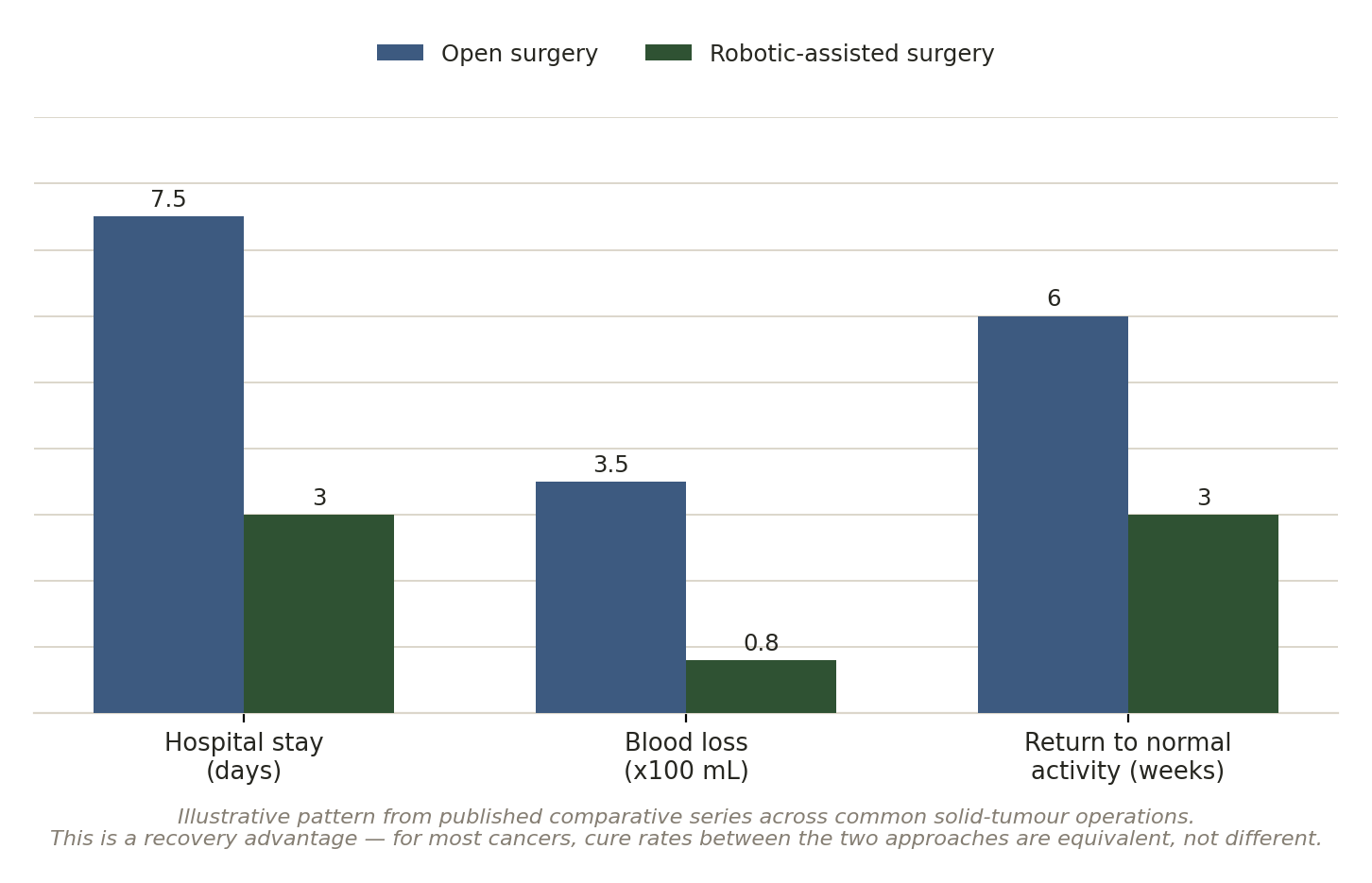
The real, well-documented advantage is recovery, not cancer control.
What genuinely differs is the experience of recovering: less blood loss, a shorter hospital stay, and a faster return to ordinary life. That is a real and valuable difference, particularly for a patient travelling internationally for treatment, but it is a different claim from "better cancer outcomes," and a hospital that blurs the two is not giving an honest picture of what you are actually choosing between.
2 Gate Two
The cervical cancer exception
There is one well-documented, important exception to Gate One, and it needs to be named plainly. The LACC trial, a large randomised study, tested whether minimally invasive and robotic radical hysterectomy was as safe as open surgery for early-stage cervical cancer. The result surprised the field.
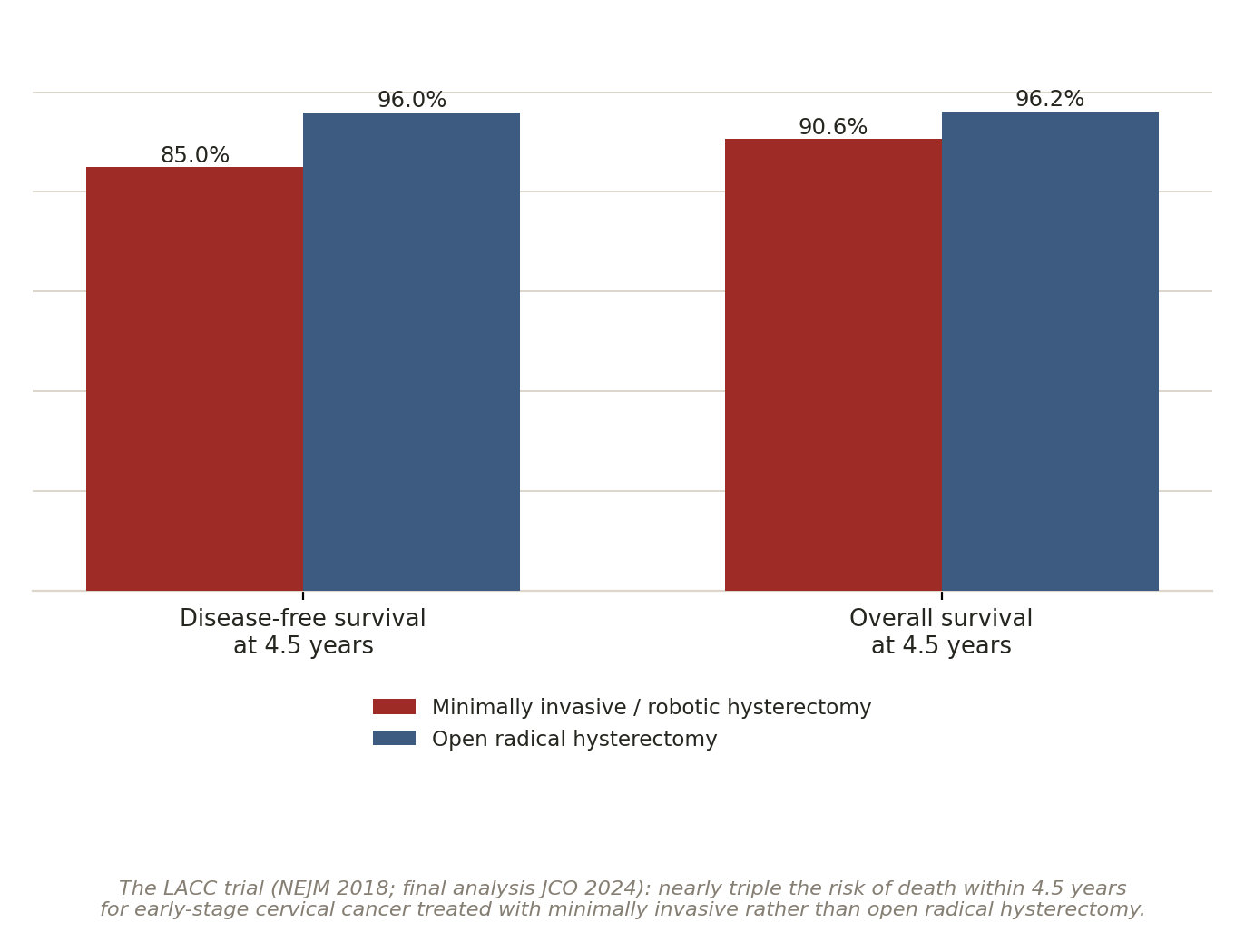
For this one cancer, minimally invasive surgery is not equivalent — it measurably underperforms.
Why this matters specifically: the final analysis, published in 2024, confirmed nearly triple the risk of death within 4.5 years for patients who had minimally invasive or robotic radical hysterectomy compared with open surgery. Major gynaecologic oncology societies now recommend open surgery as the standard of care for early-stage cervical cancer specifically. If cervical cancer is the diagnosis, and a robotic hysterectomy is proposed, ask directly why, in light of this trial.
This exception does not apply to endometrial (uterine lining) cancer or most other gynaecological cancers, where minimally invasive approaches remain well supported. The distinction is specific to cervical cancer, and it is worth confirming explicitly which cancer is actually being treated before accepting any surgical approach.
3 Gate Three
Whose hands are on the console?
For the cancers where robotic surgery is genuinely appropriate, the single strongest predictor of a good outcome is not the machine but the surgeon's cumulative experience with it. Published learning-curve literature across robotic cancer operations consistently shows major complication rates falling sharply over a surgeon's first several dozen cases before levelling off.
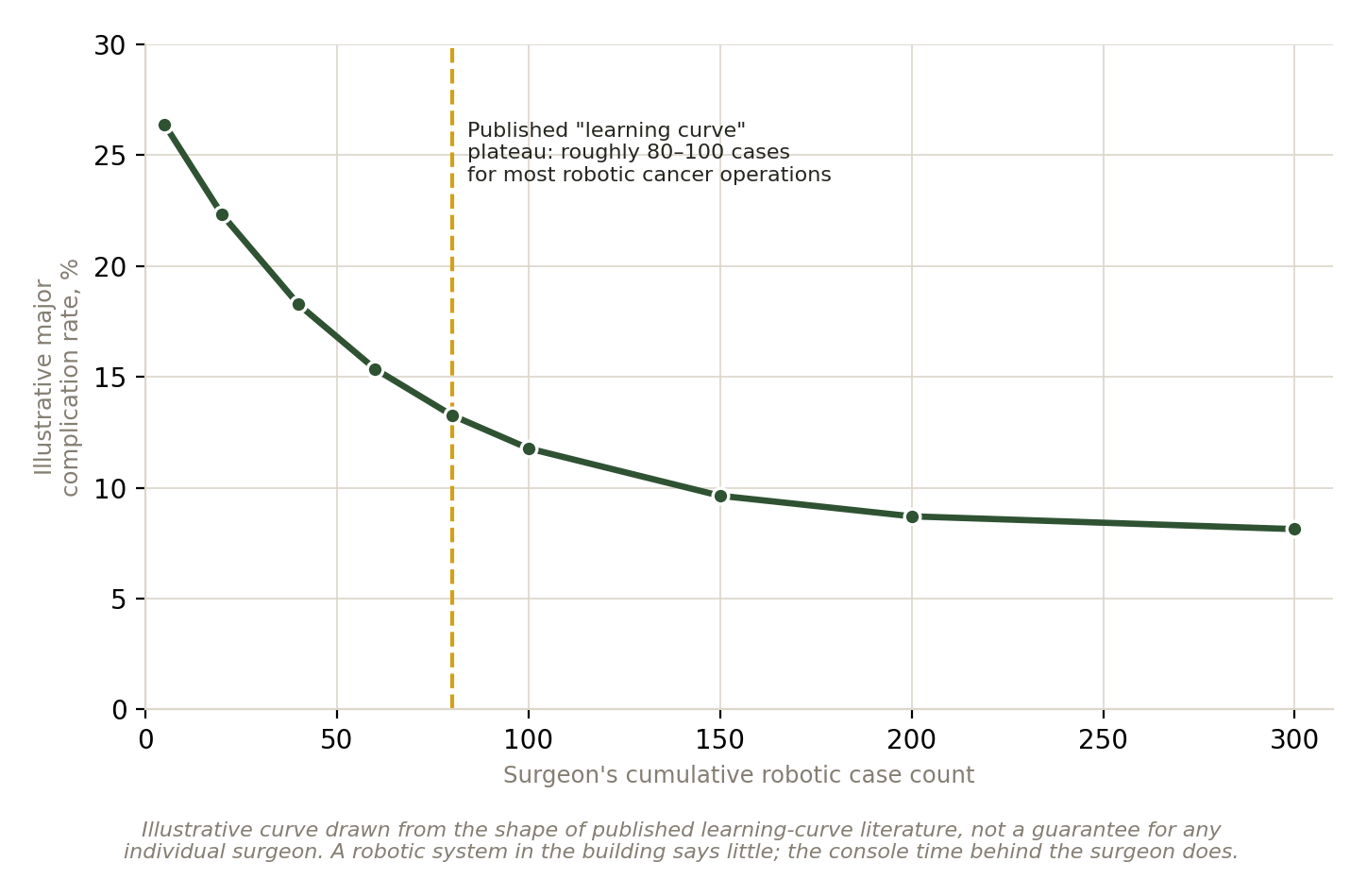
A robotic system newly installed says little. The case count behind the surgeon says a great deal.
This is precisely why the presence of a robotic system in a hospital, on its own, tells you very little about whether robotic surgery will be performed safely there. Ask any centre directly how many robotic cases of your specific cancer type the operating surgeon has personally performed — not the hospital in aggregate, and not a different procedure on the same platform. A surgeon early in their own learning curve, even with excellent open-surgery skills, is a different proposition from one who has passed it.
4 Gate Four
Could this be done in Ethiopia?
Ethiopia's progress here deserves genuine recognition: in July 2026, the China-Africa Robotic Surgery Training Centre and a companion endoscopic technology centre opened at Silk Road General Hospital in Addis Ababa, with more than thirty specialists from across the continent already in training. This is a meaningful first step, and one worth watching.
It is, honestly, still a training programme rather than a treatment one. There is no published evidence yet of robotic cancer surgery being performed on patients in Ethiopia at the case volume that Gate Three shows genuinely matters for safety. Given that the single most important variable is surgeon case count, a brand-new programme, however well-intentioned, starts at exactly the point on the learning curve where outcomes are least predictable.
This is precisely where India's position is strongest. India now operates more than 180 robotic surgical systems nationally, with dedicated cancer centres where individual surgeons have personally performed hundreds to thousands of robotic cancer operations of a specific type. For a technology where outcome depends this directly on repetition, that already-established volume is not a convenience — it is the entire basis on which robotic surgery's recovery advantage actually gets delivered safely. Ask any centre for the specific operating surgeon's personal case count in your exact procedure, not the hospital's total robotic case volume across all specialties.
5 Gate Five
Is the money arranged?
Ethiopia's health financing does not follow a patient abroad. Community-Based Health Insurance covers contracted facilities inside the country, and the formal-sector scheme still isn't settling claims. Since February 2026 a bank may release up to US$20,000 per case against a letter from the treating hospital, without a visa or ticket in hand.
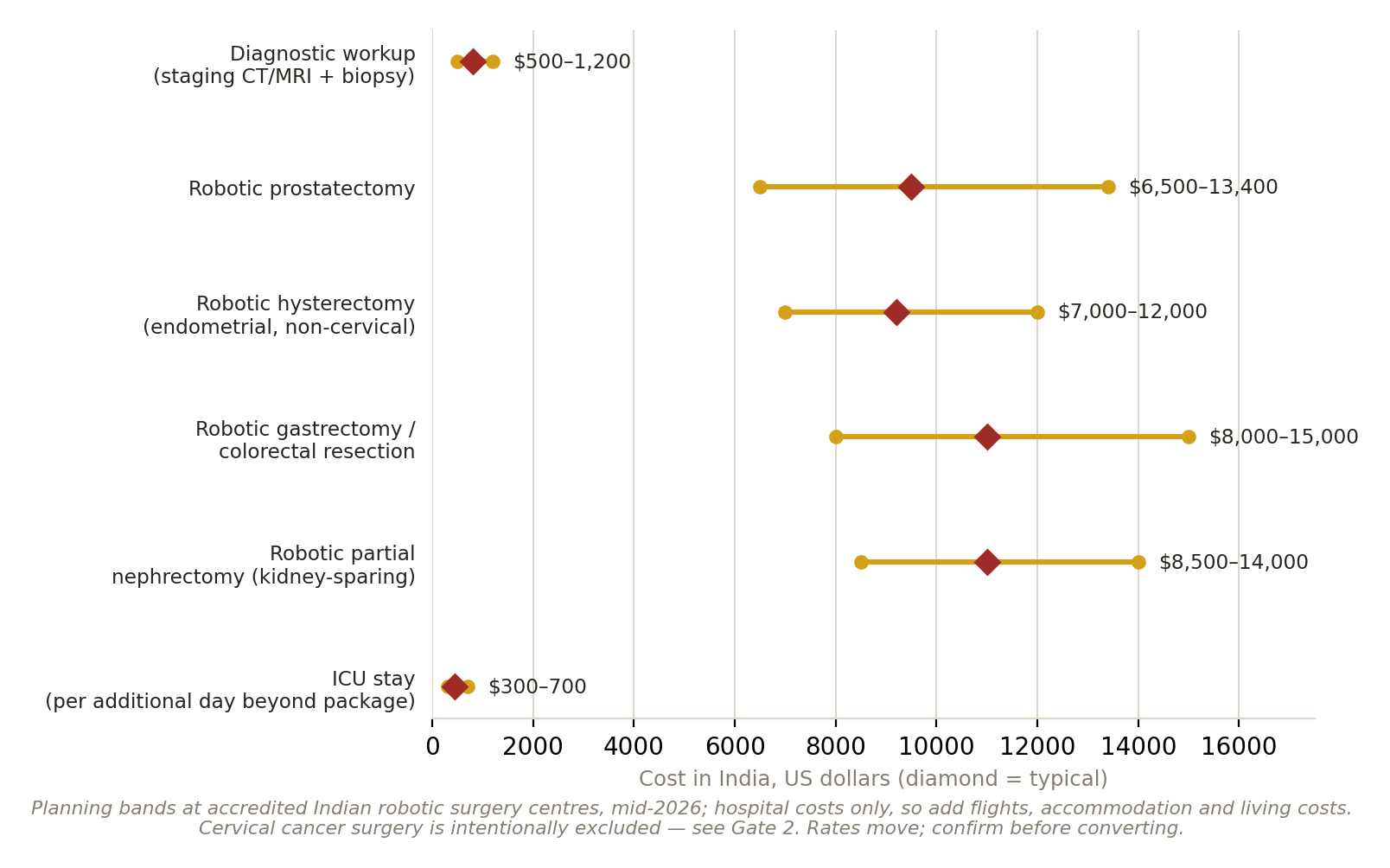
Budget for the specific operation your diagnosis calls for, not the most familiar figure.
The figures differ by procedure and complexity, and cervical cancer is intentionally excluded from this list, per Gate Two. Even at the top of these ranges, robotic surgery at a leading Indian cancer centre remains a fraction of an equivalent operation in the Gulf, Europe, or the United States. Confirm the specific procedure before assuming any single number applies to your case.
| A quotation, annotatedA composite of the robotic surgery quotes that reach me, with the questions I send back. | |
| Robotic cancer surgery — USD 10,000 | Which organ and procedure? Price and technique vary considerably by cancer type. |
| Surgeon: extensive robotic experience | Ask for the specific number of this exact procedure the surgeon has personally performed. |
| Includes: 3 days admission | Reasonable for robotic recovery. Ask what conversion to open surgery, if needed, would add. |
| Pathology: standard margins report | Confirm this matches the reporting standard for your specific cancer type. |
| Excludes: adjuvant chemo or radiotherapy | Ask whether your staging is likely to need this, and its separate cost. |
| Excludes: conversion-to-open contingency | Ask what the price becomes if the surgery must convert to open mid-operation. |
In 24 years the robotic surgery patients most satisfied with their outcome were the ones who asked for the surgeon's personal case count before asking about the machine's specifications.
The Ethiopian practicalities
Ethiopian Airlines flies non-stop from Bole to Delhi, Mumbai, Bengaluru, Chennai, and Hyderabad. Ask for written clearance to fly rather than assuming a fixed number of days after surgery, since this varies by procedure and whether conversion to open surgery occurred. Yellow fever certification is required at least ten days before arrival, oral polio vaccination roughly four weeks before. The medical visa follows the hospital's invitation letter through the Embassy of India, Addis Ababa, and an attendant is worth arranging for the days around surgery. Where treatment spans the Orthodox fasting calendar, raise this with the hospital's dietary team beforehand. Confirm current rules with the Embassy, since they change, and ask for an Amharic-speaking coordinator to carry a written follow-up plan back to a named oncologist in Ethiopia.
Straight Answers for Ethiopian Patients about Robotic Cancer Surgery in India
Does robotic surgery cure cancer better than open surgery?
For most solid cancers, no. Cancer clearance and survival are equivalent between robotic and open surgery. What differs is recovery: less blood loss, shorter hospital stay, faster return to normal activity. Cervical cancer is a documented exception.
Is robotic surgery safe for cervical cancer?
The LACC trial found minimally invasive and robotic radical hysterectomy resulted in worse survival than open surgery for early-stage cervical cancer — nearly triple the risk of death within 4.5 years. Open surgery remains the standard of care for this specific cancer.
Is robotic cancer surgery available in Ethiopia?
Ethiopia opened its first robotic surgery training centres in mid-2026, where surgeons are learning the technique. This is training capacity, not yet treatment capacity at meaningful volume.
How long does robotic cancer surgery in India take?
The operation typically runs two to five hours. Hospital recovery is usually two to four days. Total trip length, including staging and follow-up, is often one to two weeks.
Who pays for this in Ethiopia?
You do. Neither Community-Based Health Insurance nor the pending formal-sector scheme funds treatment abroad, though a bank may now advance up to US$20,000 against the treating hospital's letter.
A closing word
Send the diagnosis, staging imaging, and any surgical plan already proposed, including which technique. I will tell you honestly whether robotic surgery genuinely fits your specific cancer, and why India's already-established case volumes are where that technology's real advantage is most reliably delivered today.
Sources
- 🌐 Ramirez PT, Frumovitz M, Pareja R, et al. Minimally invasive versus abdominal radical hysterectomy for cervical cancer. N Engl J Med
- 🌐 Ramirez PT, Robledo KP, Frumovitz M, et al. LACC trial
- 🌐 Xinhua/Guangming Online. China-Africa Robotic Surgery Training Center and Endoscopic Technology Training Center launch
- 🌐 National Medical Commission of India — Indian Medical Register, for verifying a treating surgeon's qualification and registration
- 🌐 National Accreditation Board for Hospitals & Healthcare Providers (NABH), Quality Council of India
- 🌐 National Bank of Ethiopia Directive FXD/04/2026 (foreign exchange, advance payments for treatment abroad); Embassy of India, Addis Ababa
Frequently Asked Questions by Ethiopians about Robotic Cancer Surgery in India
Does robotic surgery cure cancer better than open surgery?
For most solid cancers, no. The main documented benefits are less blood loss, shorter hospitalisation and faster recovery, while cancer clearance and survival are generally equivalent.
Is robotic surgery recommended for cervical cancer?
The PDF identifies early-stage cervical cancer as a specific exception. The LACC trial found worse survival with minimally invasive or robotic radical hysterectomy, so open surgery remains the standard approach for this cancer.
Which cancers may be suitable for robotic surgery?
The guide discusses robotic approaches for cancers including prostate, kidney, stomach, colorectal and selected gynaecological cancers. Suitability depends on the individual diagnosis and stage.
Why is the surgeon's experience important?
Robotic surgery has a learning curve. The guide notes that complication rates generally fall as a surgeon performs more cases, with the learning curve for many robotic cancer procedures reaching a plateau at roughly 80–100 cases.
How many robotic systems are available in India?
The document states that India has more than 180 robotic surgical systems operating nationally, with some surgeons having performed hundreds to thousands of specific robotic cancer procedures.
Is robotic cancer surgery available in Ethiopia?
Ethiopia opened its first robotic surgery training centres in Addis Ababa in mid-2026. The PDF describes these as training programmes rather than established high-volume robotic cancer treatment programmes.
How much does robotic cancer surgery cost in India?
Indicative ranges include USD 6,500–13,400 for robotic prostatectomy, USD 7,000–12,000 for non-cervical robotic hysterectomy, USD 8,000–15,000 for gastric/colorectal surgery, and USD 8,500–14,000 for partial nephrectomy.
How long does robotic cancer surgery take?
The operation typically takes around two to five hours, while hospital recovery is generally about two to four days. The total India trip may be approximately one to two weeks, depending on staging and follow-up.
What should Ethiopian patients ask a robotic surgeon?
The most important question is how many times the surgeon has personally performed the exact robotic procedure being proposed. Patients should also ask about conversion to open surgery, complications, pathology reporting and additional treatment requirements.
What additional costs should patients check?
Patients should clarify whether chemotherapy or radiotherapy is excluded and what happens financially if the robotic operation needs to be converted to open surgery. The annotated quotation on page 6 specifically highlights these potential additional costs.
Page Summary
This guide explains what robotic cancer surgery genuinely offers, focusing on recovery benefits rather than claims of superior cancer control. It highlights the importance of surgeon-specific experience and identifies early-stage cervical cancer as a major exception where open surgery remains the standard. It also compares Ethiopia's emerging robotic training capacity with India's established robotic programmes and provides indicative costs, hospital-stay expectations, quotation checks and practical travel guidance for Ethiopian patients.
Citation Block
| Topic | Information |
|---|---|
| Topic Information | Robotic Cancer Surgery in India for Ethiopian Patients |
| Treatment | Robotic Cancer Surgery |
| Country | India |
| Intended Audience | Ethiopian Patients |
| Main Benefit | Faster Recovery |
| Key Advantage | Less Blood Loss and Shorter Hospital Stay |
| Important Exception | Early-Stage Cervical Cancer |
| Cervical Cancer Standard | Open Radical Hysterectomy |
| Key Selection Factor | Surgeon-Specific Case Volume |
| Learning-Curve Plateau | Approximately 80–100 Cases |
| Robotic Systems in India | 180+ |
| Ethiopia Robotic Programme | Training Centres Established in 2026 |
| Prostatectomy | USD 6,500–13,400 |
| Non-Cervical Hysterectomy | USD 7,000–12,000 |
| Gastric/Colorectal Surgery | USD 8,000–15,000 |
| Partial Nephrectomy | USD 8,500–14,000 |
| Diagnostic Workup | USD 500–1,200 |
| ICU Beyond Package | USD 300–700 Per Day |
| Hospital Recovery | Approximately 2–4 Days |
| Total Trip | Approximately 1–2 Weeks |
| Key Specialists | Surgical Oncologist and Robotic Surgeon |
| Important Documents | Diagnosis, Staging Imaging and Surgical Plan |
| Follow-Up | Continued Oncology Care in Ethiopia |
| Payment Advice | Confirm Exact Procedure and Surgeon Case Count |
| Author | Dr. Dheeraj Bojwani |
| Experience | 24+ Years |


Our Mission Statement
Our mission is to place patients at the centre of every healthcare decision by providing trustworthy, evidence-based, and unbiased medical information. We believe that informed patients make better decisions. Backed by personalised guidance from our experienced advisory team, we help patients understand their treatment options, compare them objectively, and confidently choose the path that best suits their medical needs and personal circumstances.
Patient Testimonials from Ethiopia










Ready to Take the First Step?
Share your Medical Reports with our Healthcare Managers Today and Get a FREE CONSULTATION, a Personalized Treatment Plan, and Complete Support from Arrival to Recovery.
Get Your Free ConsultationAreas We Serve
This resource has been thoughtfully prepared for patients from Ethiopia who are considering medical treatment in India. We also welcome patients from the wider region in the countries mentioned below-
We assist patients from:
- Eritrea
- Djibouti
- Somalia
- Kenya
- Sudan
- Burundi
- Comoros
- Ethiopia
- Madagascar
- Malawi
- Mauritius
- Mozambique
- Rwanda
- South Sudan
Many of the insights, treatment pathways, hospital recommendations, travel guidance, and patient support services described here are equally relevant and may be used as a reference when planning treatment in India.
From Ethiopia to India: Your Complete Patient Support Guide
- Brain Tumour Surgery in India for Ethiopians
- Cancer Treatment in India for Ethiopians
- Cardiac Surgery in India for Ethiopian Patients
- Cervical and Disc Replacement Surgery in India for Ethiopians
- Cosmetic and Plastic Surgery in India for Ethiopians
- CyberKnife Treatment in India for Ethiopians
- Eye Surgery in India for Ethiopians
- Gamma Knife Treatment in India for Ethiopians
- Heart Valve Replacement Surgery in India for Ethiopians
- Hip Surgery in India for Ethiopian Patients
- Knee Surgery in India for Ethiopian Patients
- Laparoscopic and Robotic Myomectomy Surgery in India for Ethiopians
- Neurosurgery in India for Ethiopians
- Paediatric Cardiac Surgery in India for Ethiopians
- Paediatric Neurosurgery in India for Ethiopians
- Prostate Cancer Treatment and Surgery in India for Ethiopians
- Robotic Cancer Surgery in India for Ethiopians
- Scoliosis Surgery in India for Ethiopians