

Proton Therapy for Ethiopian Patients in India
Five gates every proton therapy question should pass before booking a flight — starting with the fact that this specific technology exists nowhere on the African continent, and ending with why India offers the same equipment used in the world's leading cancer centres at a quarter of the price.
Proton therapy is not simply a more expensive version of radiotherapy; it is a genuinely different physical process, and the honest first task is understanding when that difference actually matters. In 24 years of arranging medical care in India for patients across Africa and Asia, this is a field where the access gap is unlike almost anything else in this series — not a matter of degree, but of kind. Every other radiotherapy technology covered elsewhere in this series exists somewhere in Ethiopia or the wider region, in however limited a form. Proton therapy exists nowhere on the entire African continent. Globally, more than 130 proton therapy centres are now in operation, concentrated overwhelmingly in high-income countries. Not one operates in Africa; a single centre is in the planning stages in Egypt. This matters most acutely for children, whose developing brains and organs are more sensitive to radiation exposure than an adult's, and where Africa's childhood cancer mortality rate runs roughly four times that of North America. India, home to South Asia and the Middle East's first proton therapy centre, offers the same equipment installed at leading centres in the United States and Europe, at roughly a quarter to a third of the price. These five gates walk through whether a specific cancer genuinely needs proton therapy's particular advantage, why this technology remains absent across an entire continent, and why India is where that absence is most directly and affordably addressed.
Healing Journeys of Ethiopian Patients









Key Takeaways
- Proton therapy is not automatically better than conventional radiotherapy. Its main advantage is the ability to stop the proton dose at a controlled depth, reducing radiation exposure to tissues beyond the tumour.
- The PDF highlights proton therapy particularly for tumours near critical structures, children and selected patients requiring re-irradiation, where reducing radiation to healthy tissue can be especially important.
- Proton therapy is currently unavailable anywhere in Africa. The page 2 visual shows zero operating centres across 54 African countries, compared with more than 100 operating centres elsewhere worldwide.
- The page 3 visual highlights how scarce proton therapy remains even globally, showing approximately 0.5 proton therapy treatment rooms per 10 million people compared with 20 conventional radiotherapy systems.
- Children may benefit particularly from proton therapy because their developing brains and organs are more sensitive to radiation exposure and they have a longer lifetime during which late effects may develop.
- The PDF specifically highlights paediatric brain tumours, sarcomas near the spine and eye tumours as situations where Ethiopian families should ask whether proton therapy has been considered.
- India provides access to proton therapy that is otherwise unavailable in Africa. The guide identifies Apollo Proton Cancer Centre in Chennai as the regional facility using an IBA Proteus system comparable to systems used at leading international centres.
- The page 5 cost chart gives an indicative range of US$30,000–70,000 in India, compared with US$100,000–150,000 in Europe, US$140,000–200,000 in Canada and US$125,000–205,000 in the United States.
- The annotated quotation gives an example of a US$48,000 proton therapy course, including planning CT and treatment simulation, while chemotherapy, extended accommodation and some caregiver costs may be excluded.
- Ethiopian patients should confirm the exact number of sessions, clinical indication, treatment planning, concurrent chemotherapy and total accommodation requirements before accepting a quotation.
- Proton therapy generally requires a longer stay than a short medical visit. The PDF states that planning may take 1–2 weeks, followed by approximately 4–7 weeks of daily treatment, with many patients planning 6–9 weeks in India.
- Ethiopian patients should arrange appropriate medical travel documentation, vaccination requirements, an attendant where needed and a written follow-up plan for a named oncologist in Ethiopia.
Quick Facts
- Treatment
- Proton Therapy
- Country
- India
- Patients
- Ethiopian Patients
- Main Technology
- Proton Beam Therapy
- Key Advantage
- Reduced radiation dose to healthy tissue beyond the tumour
- Best-Suited Cases
- Critical-structure tumours, children and selected re-irradiation cases
- African Availability
- No operating proton therapy centre
- India Cost
- US$30,000–70,000
- Europe Cost
- US$100,000–150,000
- Canada Cost
- US$140,000–200,000
- USA Cost
- US$125,000–205,000
- Example Quotation
- US$48,000
- Planning Period
- Approximately 1–2 weeks
- Treatment Course
- Approximately 4–7 weeks
- Total India Stay
- Approximately 6–9 weeks
- Key Specialist
- Radiation Oncologist
- Important Infrastructure
- Proton therapy system and specialised treatment planning
- Follow-Up
- Named Oncologist in Ethiopia
- Financing Mentioned
- Up to US$20,000 against treating hospital letter
- Required Records
- Diagnosis, staging imaging and previous radiotherapy history
In Brief
Proton therapy offers Ethiopian patients access to a highly specialised form of radiation treatment that is currently unavailable anywhere on the African continent. The PDF explains that proton therapy should not be selected simply because it is considered more advanced; its value depends on whether reducing radiation exposure to surrounding healthy tissue is clinically meaningful for the specific tumour. The strongest situations discussed include tumours near the brain, spine or eye, paediatric cancers and selected cases requiring re-irradiation. India provides access to this technology at substantially lower indicative costs than the United States, Canada and Europe. Ethiopian patients should therefore obtain a specialist radiation oncology opinion confirming that proton therapy is genuinely indicated before arranging the extended treatment stay.
1 Gate One
Protons, or standard beams?
A cancer diagnosis and a mention of "the most advanced radiotherapy" is what usually starts this conversation, and the honest first question is whether proton therapy's specific physical advantage actually applies to the case in front of you. Conventional radiotherapy delivers X-ray beams that pass through the body, depositing some radiation dose beyond the tumour on their way out. Proton beams deposit almost all of their energy at a controlled depth and stop, sparing tissue beyond the tumour almost entirely.
For many common cancers, standard radiotherapy already achieves excellent, well-established outcomes, and the proton advantage is marginal at best. It becomes clinically meaningful for tumours near critical structures such as the brain, spine, or eye, for children, and for patients who have already had radiotherapy before and need more without exceeding safe cumulative dose to healthy tissue. Ask specifically whether your cancer's location and type are among those where published evidence shows a genuine benefit, not just a theoretical one, and ask the same question of a second opinion if the first answer seems uncertain.
2 Gate Two
Zero on an entire continent
This is where proton therapy differs from every other technology covered elsewhere in this series.
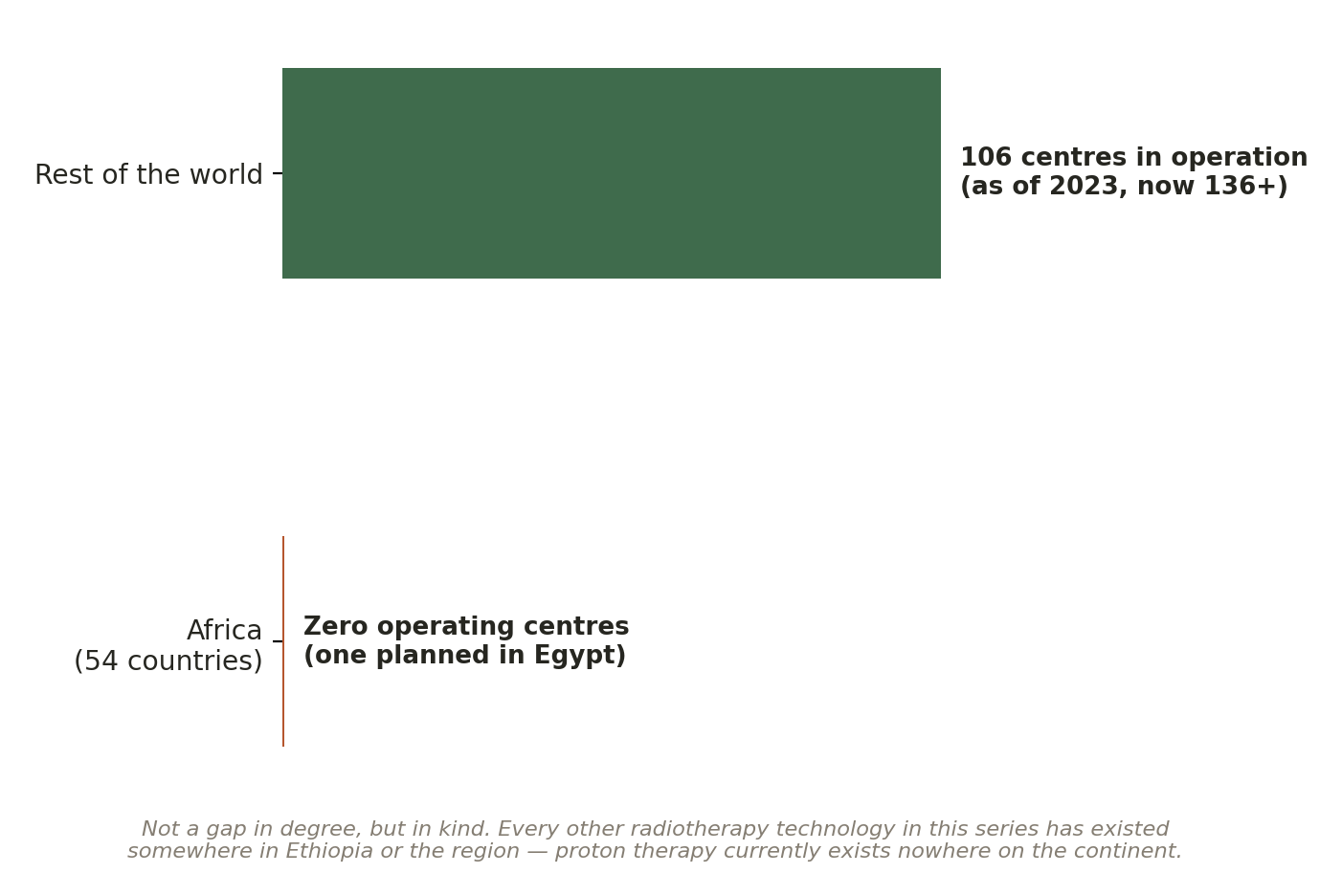
Cobalt units, linear accelerators, even CyberKnife and Gamma Knife exist somewhere in the region. Proton therapy exists nowhere on the continent.
It's worth being equally honest in the other direction: proton therapy remains a scarce, specialised resource even in wealthy countries.
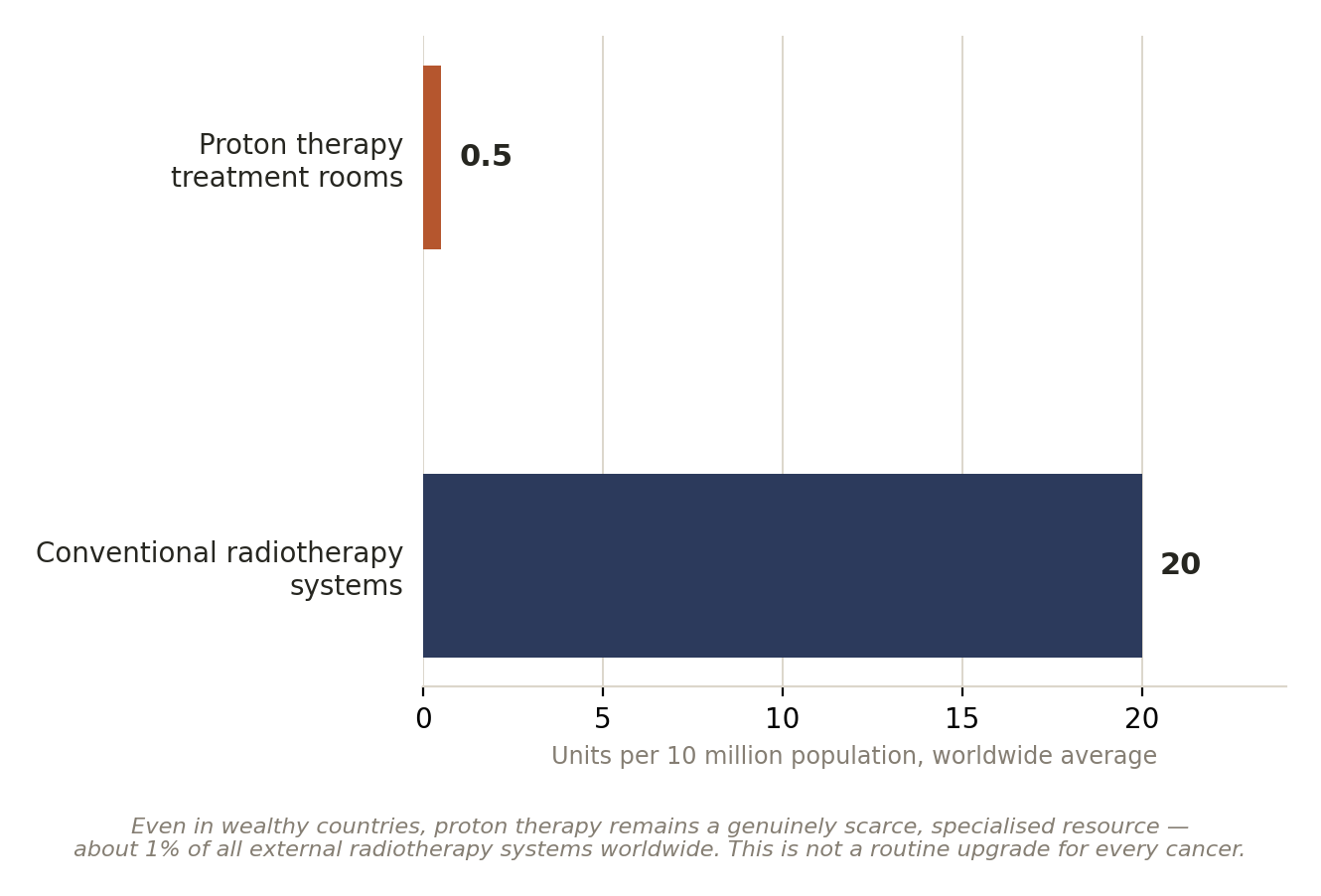
This is not a technology being withheld from Africa specifically. It is genuinely rare everywhere, and reserved for cases where its advantage is greatest.
3 Gate Three
A child's brain, not a small adult's
Proton therapy's advantage matters most, and most urgently, for children. A child's brain and other organs are still developing, more sensitive to radiation exposure, and have decades of remaining life during which a second radiation-induced cancer could appear. Sparing healthy tissue during treatment is not a marginal benefit here; it is central to giving a child the best chance at a full, healthy life after treatment.
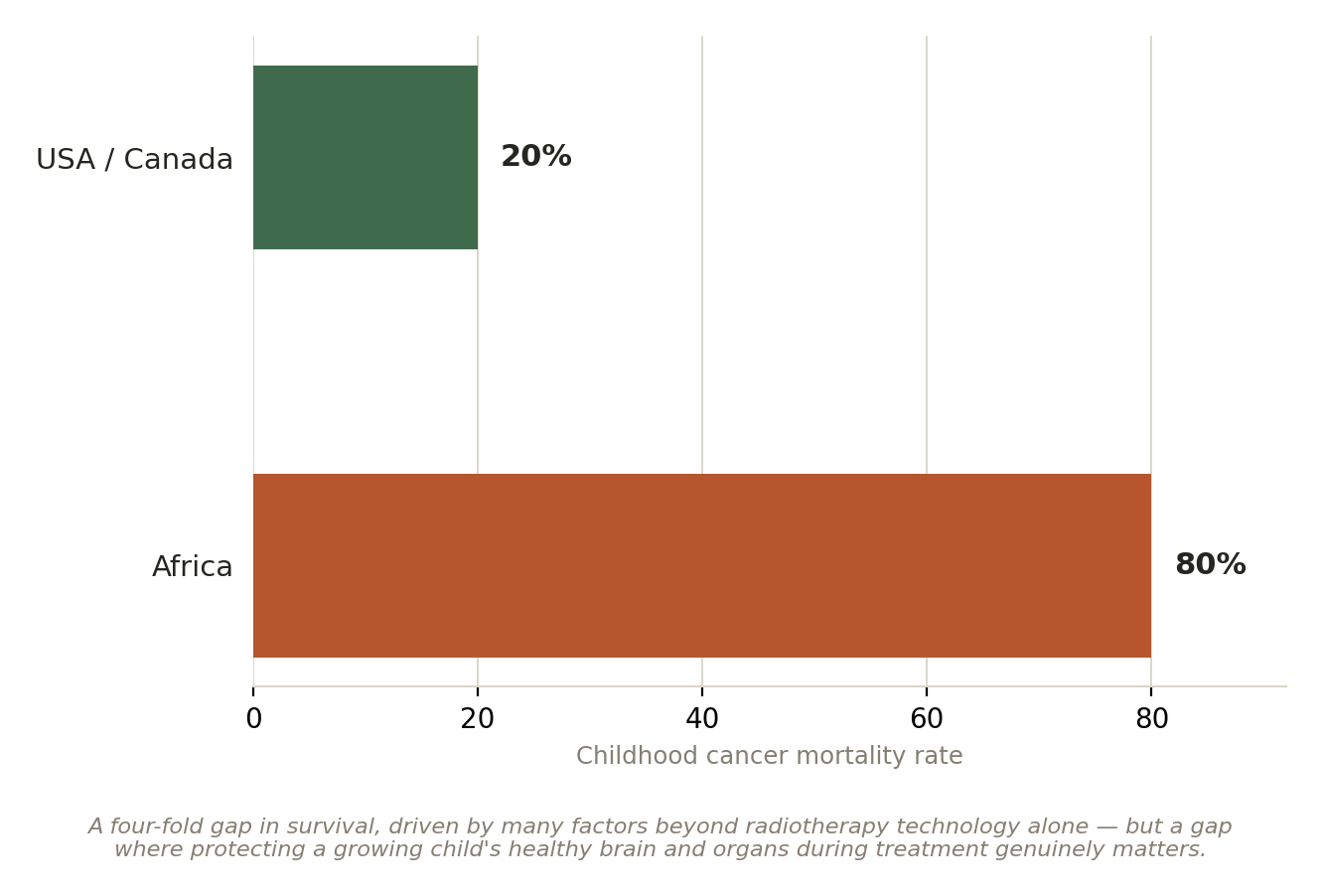
Many factors drive this gap beyond radiotherapy technology alone, but protecting a growing child's healthy tissue during treatment is part of closing it.
Why this deserves specific attention: for children with brain tumours, sarcomas near the spine, or eye tumours, ask explicitly whether proton therapy has been considered and why, given the long-term stakes for a still- developing body. This is precisely the population where the case for seeking out this specific technology is strongest.
4 Gate Four
Could this be done in Ethiopia?
No, and honestly, not soon. This is not a reflection of Ethiopian medical skill or effort; it reflects a genuinely absolute continental gap, not a domestic one specific to any single country. Even South Africa, the continent's most developed healthcare system, does not yet have an operating proton centre; a project is in active planning in Cape Town.
This is precisely why India's position matters so directly here. Apollo Proton Cancer Centre in Chennai, South Asia and the Middle East's first proton therapy facility, uses the same IBA Proteus system installed at leading centres in the United States and Europe. India became the sixteenth country in the world to offer this treatment, ahead of many wealthier nations. For a technology this specialised, having it available at all, on a continent within reach of Ethiopian patients, at genuinely accessible cost, is what actually matters, not marginal differences between centres in wealthy countries thousands of kilometres further away.
5 Gate Five
Is the money arranged?
Ethiopia's health financing does not follow a patient abroad. Community-Based Health Insurance covers contracted facilities inside the country, and the formal-sector scheme still isn't settling claims. Since February 2026 a bank may release up to US$20,000 per case against a letter from the treating hospital, without a visa or ticket in hand, worth noting that proton therapy's cost, even in India, will typically exceed this single advance, and additional financing arrangements are usually necessary.
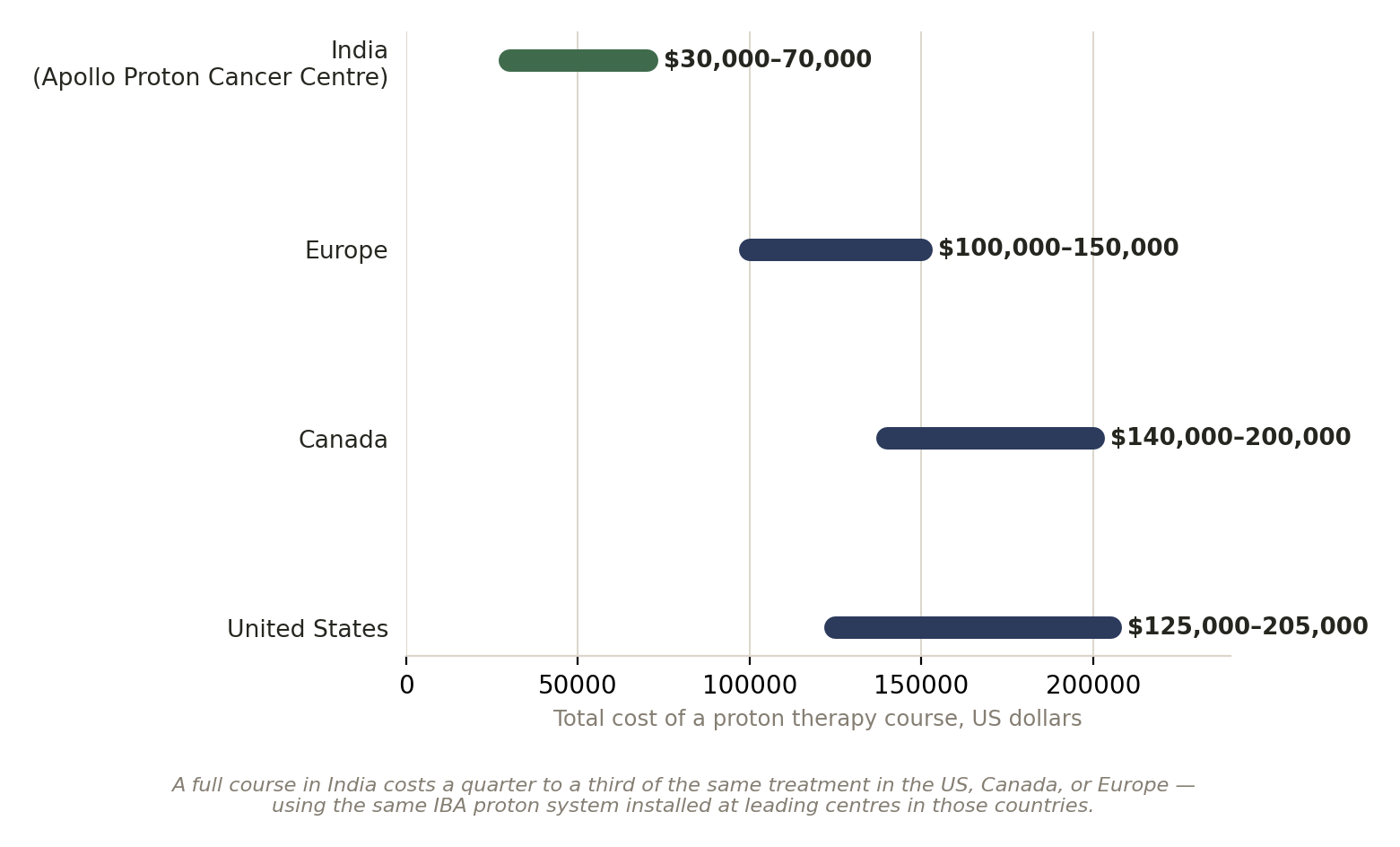
The same equipment, the same treatment, for a fraction of the price charged elsewhere.
Even at the lower end, proton therapy remains a substantial expense relative to standard radiotherapy, reflecting the genuine cost of this specialised equipment worldwide. Confirm the exact number of treatment sessions your specific cancer requires before assuming any single figure applies to your case, since course length varies considerably by diagnosis.
| A quotation, annotatedA composite of the proton therapy quotes that reach me, with the questions I send back. | |
| Proton therapy course — USD 48,000 | How many sessions does this cover, and does your cancer type typically need more or fewer? |
| Includes: planning CT and treatment simulation | Good sign. Ask whether a second radiation oncology opinion confirmed proton therapy is genuinely indicated. |
| Facility: IBA Proteus system | Confirm this matches systems used at leading US/European centres, as it does at Apollo Chennai. |
| Includes: 5 days initial hospital stay | Ask about accommodation arrangements for the full outpatient treatment course afterward. |
| Excludes: chemotherapy if given concurrently | Ask whether your treatment plan combines proton therapy with chemotherapy, and its separate cost. |
| Excludes: extended stay for a paediatric patient's caregiver | For a child's treatment, confirm accommodation support for an accompanying parent throughout. |
In 24 years the proton therapy patients most satisfied with their outcome were the ones who confirmed a genuine clinical indication first, then compared centres offering the identical technology on price and experience.
The Ethiopian practicalities
Ethiopian Airlines flies non-stop from Bole to Chennai via connecting hubs, or to other major Indian cities with onward connections. Given the multi-week treatment course, plan for an extended stay rather than a short visit; many patients arrange accommodation near the treatment centre for the full duration. Yellow fever certification is required at least ten days before arrival, oral polio vaccination roughly four weeks before. The medical visa follows the hospital's invitation letter through the Embassy of India, Addis Ababa; given the length of stay, confirm the visa validity covers the full treatment course plus buffer time. An attendant is essential throughout, particularly for a child undergoing treatment. Where treatment spans the Orthodox fasting calendar, raise this with the hospital's dietary team beforehand. Confirm current rules with the Embassy, since they change, and ask for an Amharic-speaking coordinator to carry a written follow-up plan back to a named oncologist in Ethiopia.
Straight Answers for Ethiopian Patients about Proton Therapy in India
Is proton therapy simply a better version of radiotherapy?
Not for every cancer. It deposits energy precisely at the tumour, sparing surrounding tissue more than conventional radiotherapy. Standard radiotherapy already works excellently for many cancers; the proton advantage is greatest near critical structures, for children, and for re-irradiation.
Is proton therapy available anywhere in Africa?
No. There are no operating proton therapy centres anywhere on the continent, out of over 130 worldwide. A centre is in planning stages in Egypt, but nothing is currently operational.
Why does proton therapy matter especially for children?
A child's brain and organs are still developing and more radiation-sensitive. Conventional radiotherapy's exposure to healthy tissue matters more over a much longer remaining lifespan, including the risk of a second cancer years later. Proton precision reduces this exposure.
How long does proton therapy in India take?
Planning takes one to two weeks. The treatment course itself runs four to seven weeks of daily sessions depending on cancer type. Many patients plan six to nine weeks total in India.
Who pays for this in Ethiopia?
You do. Neither Community-Based Health Insurance nor the pending formal-sector scheme funds treatment abroad, though a bank may now advance up to US$20,000 against the treating hospital's letter.
A closing word
Send the diagnosis, staging imaging, and any prior radiotherapy history. I will tell you honestly whether proton therapy's specific advantage genuinely applies to this case, and why India's Apollo Proton Cancer Centre is, for an Ethiopian patient today, the nearest, most affordable place this technology reliably exists.
Sources
- 🌐 Global democratisation of proton radiotherapy. Lancet Oncol. 2023
- 🌐 University of Cape Town Proton Therapy Initiative. Distribution of operational proton therapy centres worldwide by region and income group
- 🌐 Proton therapy in Asia Pacific: current resources, international disparities and steps forward. J Med Radiat Sci. 2024
- 🌐 National Medical Commission of India — Indian Medical Register
- 🌐 National Bank of Ethiopia Directive FXD/04/2026 (foreign exchange, advance payments for treatment abroad); Embassy of India, Addis Ababa
Frequently Asked Questions by Ethiopians about Proton Therapy in India
Is proton therapy available anywhere in Africa for Ethiopian patients?
No. The PDF states that there are currently no operating proton therapy centres anywhere in Africa. A centre is in the planning stage in Egypt, but it is not operational, making India one of the accessible options for Ethiopian patients.
Should every Ethiopian cancer patient choose proton therapy instead of conventional radiotherapy?
No. Ethiopian patients should first establish whether their specific cancer is one where proton therapy provides a meaningful clinical advantage. The PDF notes that conventional radiotherapy already provides excellent outcomes for many common cancers.
Which cancers may make proton therapy particularly relevant for Ethiopian patients?
The guide highlights tumours close to critical structures such as the brain, spine and eye, as well as selected paediatric cancers and cases requiring further radiation after previous radiotherapy. The final decision should be made after specialist review of the individual diagnosis and imaging.
Why can proton therapy be especially important for Ethiopian children with cancer?
A child's brain and other organs are still developing and may be more sensitive to radiation exposure. For Ethiopian children, reducing unnecessary radiation to healthy tissue may help limit long-term treatment effects, which is why the PDF specifically highlights paediatric brain tumours and other childhood cancers.
Can Ethiopian children with brain or spine tumours receive proton therapy in India?
Yes, selected Ethiopian children with brain tumours or tumours near the spine can be assessed for proton therapy in India. The PDF recommends asking specifically whether proton therapy has been considered because of the long-term importance of protecting developing healthy tissue.
How much does proton therapy cost for Ethiopian patients in India?
The PDF gives an indicative Indian range of approximately US$30,000–70,000 for a full proton therapy course. It also presents an example quotation of US$48,000, but the final cost depends on the cancer type, number of sessions and services included.
How long do Ethiopian patients need to stay in India for proton therapy?
Ethiopian patients should plan for a relatively long stay. The PDF states that treatment planning may take 1–2 weeks, followed by approximately 4–7 weeks of daily treatment, with many patients planning around 6–9 weeks in India overall.
What should Ethiopian patients check in a proton therapy quotation from India?
Ethiopian patients should confirm how many treatment sessions are included, whether planning CT and simulation are covered, whether chemotherapy is charged separately and whether accommodation for the full treatment course is included. For children, caregiver accommodation should also be clarified.
Can Ethiopian health insurance pay for proton therapy treatment in India?
The PDF states that Ethiopia's Community-Based Health Insurance does not cover planned treatment abroad and that the formal-sector scheme is not currently settling such claims. It notes that a bank may advance up to US$20,000 against a treating hospital letter, but proton therapy will generally require additional financing.
What should Ethiopian patients carry when travelling to India for proton therapy?
Ethiopian patients should carry their confirmed diagnosis, staging imaging and previous radiotherapy records, if applicable. They should also obtain a written treatment and follow-up plan and arrange continued monitoring with a named oncologist in Ethiopia after returning home.
Page Summary
This guide explains proton therapy for Ethiopian patients considering advanced cancer treatment in India, beginning with the key question of whether proton therapy offers a genuine clinical advantage over conventional radiotherapy. It explains how proton beams can reduce radiation exposure to healthy tissue and identifies children, brain, spine and eye tumours, and selected re-irradiation cases as situations where this may be particularly valuable. The guide highlights that no operating proton therapy centre currently exists in Africa, making India an important regional option for Ethiopian patients. It compares indicative proton therapy costs in India with those in the United States, Canada and Europe. The guide also examines an example treatment quotation and the costs that may not be included. Finally, it covers treatment duration, medical travel planning, accommodation, financing and follow-up with an oncologist in Ethiopia.
Citation Block
| Topic | Information |
|---|---|
| Topic Information | Proton Therapy for Ethiopian Patients in India |
| Treatment | Proton Therapy |
| Country | India |
| Intended Audience | Ethiopian Patients |
| Key Technology | Proton Beam Therapy |
| Main Advantage | Reduced radiation exposure beyond the tumour |
| African Availability | No operating proton therapy centres |
| Key Indications | Children, critical-structure tumours and selected re-irradiation |
| India Cost | US$30,000–70,000 |
| Example Quotation | US$48,000 |
| Planning Time | Approximately 1–2 weeks |
| Treatment Duration | Approximately 4–7 weeks |
| Typical India Stay | Approximately 6–9 weeks |
| Key Specialist | Radiation Oncologist |
| Important Check | Confirm genuine clinical indication before treatment |
| Follow-Up | Named Oncologist in Ethiopia |
| Financing Arrangement | Up to US$20,000 against treating hospital letter |
| Required Records | Diagnosis, staging imaging and previous radiotherapy history |
| Pre-Travel Check | Confirm sessions, total cost, accommodation and chemotherapy requirements |
| Author | Dr. Dheeraj Bojwani |
| Experience | 24+ Years |


Our Mission Statement
Our mission is to place patients at the centre of every healthcare decision by providing trustworthy, evidence-based, and unbiased medical information. We believe that informed patients make better decisions. Backed by personalised guidance from our experienced advisory team, we help patients understand their treatment options, compare them objectively, and confidently choose the path that best suits their medical needs and personal circumstances.
Patient Testimonials from Ethiopia










Ready to Take the First Step?
Share your Medical Reports with our Healthcare Managers Today and Get a FREE CONSULTATION, a Personalized Treatment Plan, and Complete Support from Arrival to Recovery.
Get Your Free ConsultationAreas We Serve
This resource has been thoughtfully prepared for patients from Ethiopia who are considering medical treatment in India. We also welcome patients from the wider region in the countries mentioned below-
We assist patients from:
- Eritrea
- Djibouti
- Somalia
- Kenya
- Sudan
- Burundi
- Comoros
- Ethiopia
- Madagascar
- Malawi
- Mauritius
- Mozambique
- Rwanda
- South Sudan
Many of the insights, treatment pathways, hospital recommendations, travel guidance, and patient support services described here are equally relevant and may be used as a reference when planning treatment in India.
From Ethiopia to India: Your Complete Patient Support Guide
- Brain Tumour Surgery in India for Ethiopians
- Cancer Treatment in India for Ethiopians
- Cardiac Surgery in India for Ethiopian Patients
- Cervical and Disc Replacement Surgery in India for Ethiopians
- Cosmetic and Plastic Surgery in India for Ethiopians
- CyberKnife Treatment in India for Ethiopians
- Eye Surgery in India for Ethiopians
- Gamma Knife Treatment in India for Ethiopians
- Heart Valve Replacement Surgery in India for Ethiopians
- Hip Surgery in India for Ethiopian Patients
- Knee Surgery in India for Ethiopian Patients
- Laparoscopic and Robotic Myomectomy Surgery in India for Ethiopians
- Neurosurgery in India for Ethiopians
- Paediatric Cardiac Surgery in India for Ethiopians
- Paediatric Neurosurgery in India for Ethiopians
- Prostate Cancer Treatment and Surgery in India for Ethiopians
- Robotic Cancer Surgery in India for Ethiopians
- Scoliosis Surgery in India for Ethiopians