

Parkinson's Treatment and DBS Surgery in India for Ethiopian Patients
Five gates every Parkinson's case should pass before booking a flight — and why, for a treatment with no established programme anywhere in Ethiopia, and in only three countries on the entire African continent, India's high-volume functional neurosurgery centres are where this treatment reliably exists.
Parkinson's disease is almost certainly under-recognised across Ethiopia, not genuinely rare, and deep brain stimulation — DBS — the surgery that transforms life for a well-defined subset of patients whose medication alone can no longer control their symptoms, is a treatment most Ethiopian patients have never been told exists as an option. In 24 years of arranging surgical care in India for patients across Africa and Asia, this is a field where the gap is not primarily about surgical skill; it is about a diagnosis that is frequently missed, and a treatment that, even once considered, has almost nowhere on the continent to actually happen. Published prevalence figures for Parkinson's disease in Ethiopia are the lowest reported anywhere in sub-Saharan Africa — a pattern far more consistent with tremor being dismissed as ordinary aging than with Ethiopians genuinely developing the disease less often. Movement disorder specialists remain scarce nationally, and DBS, the surgery that gives the best-selected patients years of meaningfully better function, is established in only three African countries, none of them Ethiopia. India, over the same period, has built some of the highest-volume functional neurosurgery programmes in the world, combining neurology, neurosurgery, and neuropsychology teams that see and select DBS candidates by the hundreds each year. These five gates walk through getting the diagnosis right, understanding honestly who actually benefits from DBS, and for the patients who do, why India is where this specific, carefully selective surgery is performed often enough to be trusted with it.
Healing Journeys of Ethiopian Patients









Key Takeaways
- Parkinson’s disease may be under-recognised in Ethiopia, with published prevalence figures considerably lower than those reported elsewhere in sub-Saharan Africa. The guide highlights the importance of distinguishing Parkinson’s disease from other causes of tremor, including essential tremor, thyroid disease and medication effects.
- DBS is not appropriate for every Parkinson’s patient. It is considered for a specific group whose symptoms remain inadequately controlled despite properly optimised medication, particularly those with significant motor fluctuations or disabling dyskinesia.
- Formal DBS selection may include a levodopa challenge test and neuropsychological assessment. The chart on page 3 shows that 18.9% of confirmed Parkinson’s patients in the cited study met strict DBS criteria, while only 1.5% had actually undergone DBS.
- The PDF states that Ethiopia currently has no established DBS programme. Across Africa, established programmes are identified in Egypt, Morocco and South Africa, with occasional access in Algeria and Tunisia.
- India is presented as an option because leading functional neurosurgery centres combine movement-disorder neurology, functional neurosurgery, neuropsychology, precise targeting and long-term DBS programming.
- The page 5 cost chart shows that the battery type is a major cost factor. Non-rechargeable DBS surgery is shown at approximately USD 15,000–20,000, while rechargeable systems are approximately USD 20,000–28,000.
- Patients should compare not only the initial surgery price but also programming visits, battery replacement, MRI compatibility and longer-term follow-up. The annotated quotation on page 6 specifically recommends confirming these items in writing before accepting a package.
Quick Facts
- Treatment
- Parkinson’s Disease Treatment and DBS Surgery
- Country
- India
- Patients
- Ethiopian Patients
- Primary Condition
- Parkinson’s Disease
- Initial Assessment
- Movement-Disorder Neurological Evaluation
- Key Medication
- Levodopa and Other Dopaminergic Medicines
- DBS Consideration
- Persistent Motor Fluctuations or Disabling Dyskinesia
- DBS Eligibility
- Levodopa Response and Neuropsychological Assessment
- Main Procedure
- Deep Brain Stimulation
- Key Specialists
- Movement Disorder Neurologist and Functional Neurosurgeon
- DBS Availability in Ethiopia
- No Established Programme
- Established African Programmes
- Egypt, Morocco and South Africa
- DBS Selection Rate
- Approximately 18.9% in the Cited Study
- DBS Surgery Rate
- Approximately 1.5% in the Cited Study
- Non-Rechargeable DBS Cost
- USD 15,000–20,000
- Rechargeable DBS Cost
- USD 20,000–28,000
- Programming Visits
- USD 150–350
- Battery Replacement
- USD 6,000–9,000
- Treatment Duration
- Approximately 3–4 Weeks Total
- Follow-Up
- Long-Term DBS Programming and Neurology Care
- Payment Advice
- Confirm Battery Type and All Included Costs in Writing
In Brief
Ethiopian patients considering DBS should first confirm the Parkinson’s diagnosis and ensure that medication has been properly optimised and consistently available. DBS is reserved for carefully selected patients whose motor symptoms remain inadequately controlled, with levodopa response and cognitive status forming important parts of the assessment. India offers established functional neurosurgery programmes with multidisciplinary DBS teams and long-term programming services. Before travelling, patients should obtain a clear DBS evaluation, confirm the battery type and total cost, and arrange a follow-up and programming plan with a neurologist in Ethiopia.
1 Gate One
Tremor, or Parkinson's?
A shaking hand, a slower walk, or a stiffer arm is what usually starts this conversation, and in Ethiopia it is very often attributed to ordinary aging rather than investigated as a specific neurological disease. Published Parkinson's prevalence in Ethiopia is the lowest reported figure anywhere in sub-Saharan Africa.
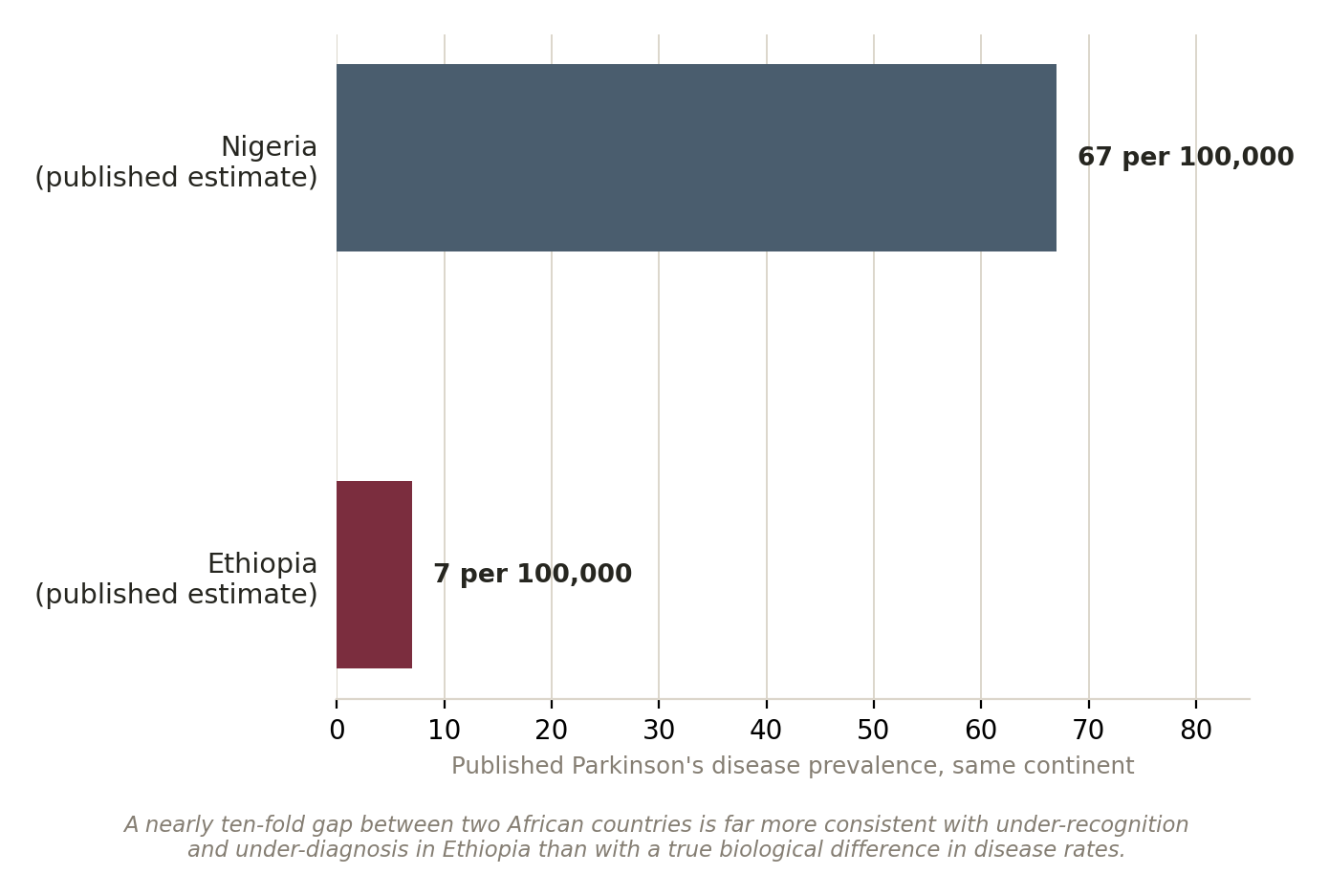
Same continent, ten-fold difference — a diagnosis gap, not a biological one.
Tremor has many causes besides Parkinson's, including essential tremor, thyroid disease, and medication side effects, and a confident diagnosis needs a movement-disorder-trained neurologist examining specific features: resting tremor, slowness of movement, muscle stiffness, and a real response to levodopa. Ask explicitly whether the person making the diagnosis has specific movement disorder training, since the treatment path from here depends entirely on getting this first answer right.
2 Gate Two
Is medication still working?
Parkinson's disease is, for most patients, for most of the course of the illness, a medical condition managed with levodopa and other dopaminergic medications, not a surgical one. Surgery is not a substitute for good medical management, and DBS is only ever considered once medication, properly optimised, is no longer controlling symptoms well.
An Ethiopia-specific complication worth naming: published work on medication access describes real, recurring shortages of Parkinson's medications in parts of Ethiopia, which can look clinically like disease progression when the actual problem is inconsistent drug supply. Before concluding that medication has stopped working, confirm that a consistent, correctly dosed regimen was genuinely tried without interruption.
The specific pattern that raises DBS as a genuine option is motor fluctuation: periods when medication works well ("on" time) alternating with periods when it doesn't ("off" time), or medication-induced involuntary movements (dyskinesia) that become disabling in their own right. This pattern, confirmed over time by a neurologist, is what leads to gate three.
3 Gate Three
Who actually benefits from DBS?
DBS is not a treatment for Parkinson's disease in general — it is a treatment for a specific, well-defined subset of patients within it. Formal selection uses a levodopa ("dopamine") challenge test, where a strong response to medication predicts a strong response to surgery, alongside neuropsychological testing to rule out significant cognitive decline, which is a contraindication rather than a detail.
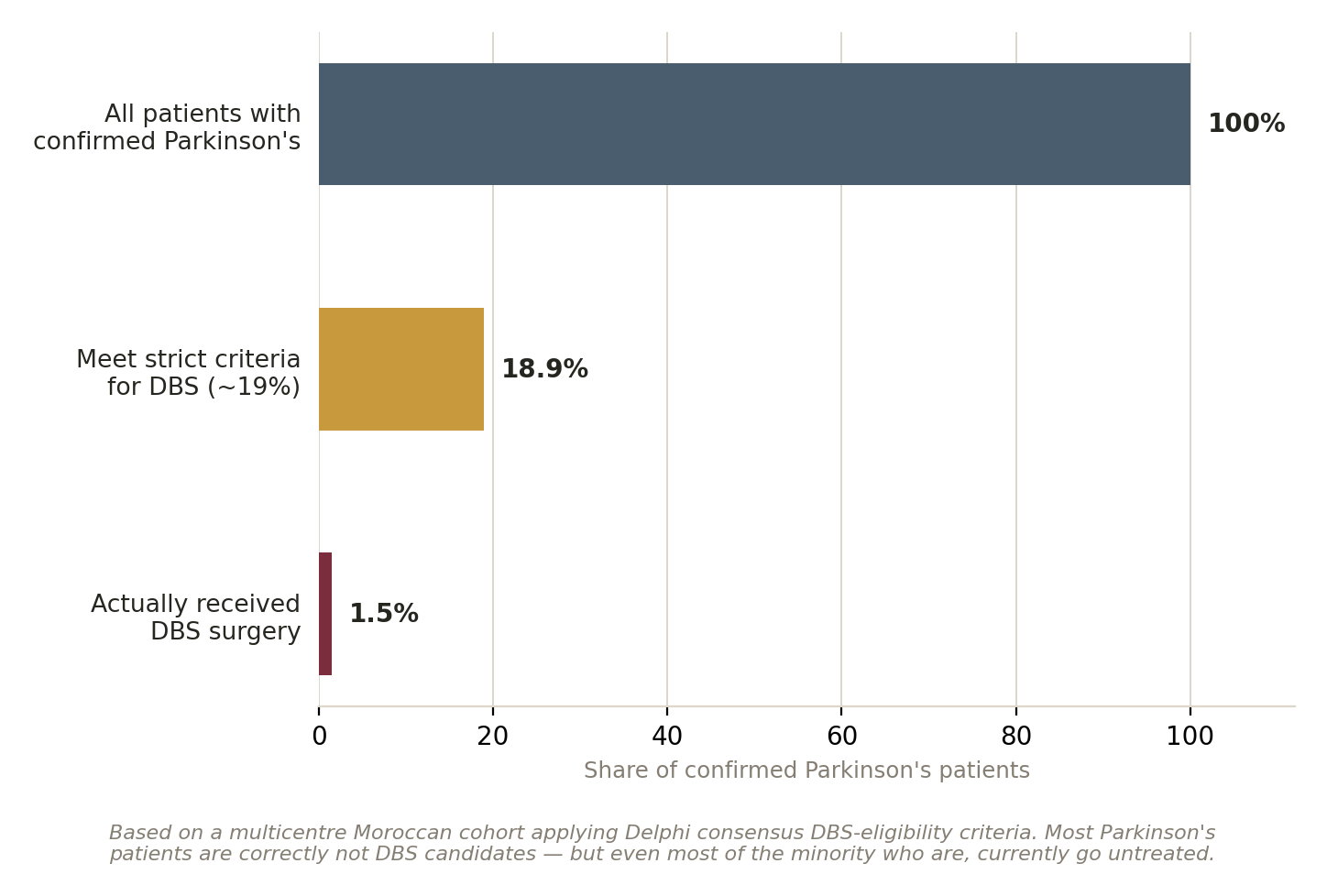
Most Parkinson's patients are, correctly, not DBS candidates. But most of the minority who are, currently go untreated.
A multicentre study using formal Delphi-consensus criteria found that fewer than one in five confirmed Parkinson's patients actually qualified for DBS — and of that already-small group, only a tiny fraction had actually received the surgery. This is exactly why a trustworthy centre spends real time on selection before recommending an operation:
DBS done in the wrong patient, or done too early or too late in the disease course, can disappoint even where the technique itself is performed well. Ask any centre what their formal selection process involves, not just what the surgery itself costs.
4 Gate Four
Could this be done in Ethiopia?
Honestly: not currently. Across the entire African continent, DBS has an established programme in only three countries — Egypt, Morocco, and South Africa — with occasional availability in Algeria and Tunisia. Ethiopia, like the large majority of African nations, has no established programme of its own.
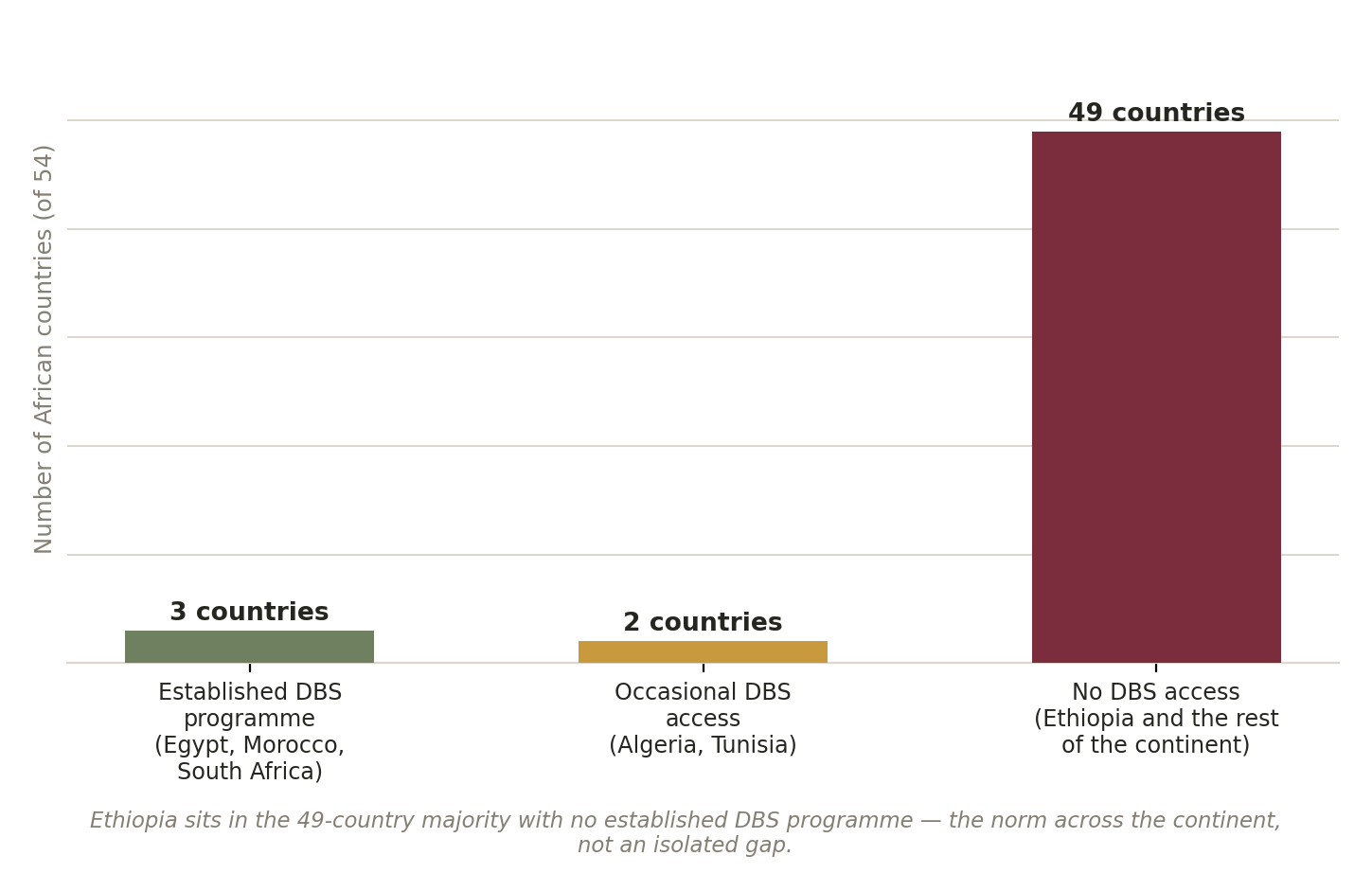
Ethiopia's position here is the continental norm, not an outlier.
This is precisely the gap India's functional neurosurgery centres are positioned to close. DBS requires a specific combination that is genuinely hard to assemble: a movement disorder neurologist for diagnosis and patient selection, a functional neurosurgeon experienced in stereotactic electrode placement, intraoperative microelectrode recording or imaging-based targeting, and a long-term programming service for the years afterward. India's leading centres run this as an established, high-volume subspecialty, seeing and selecting candidates by the hundreds each year rather than occasionally. For a surgery this dependent on precise targeting and honest patient selection, that concentration of specific experience is close to the only reliable route to this treatment existing at all for an Ethiopian patient today.
A second opinion on the diagnosis and DBS candidacy before committing to a specific centre is always worth arranging. Ask how many DBS cases the team performs each year, and what their long-term programming and follow-up service looks like once you are back home — India's high-volume centres answer both with real numbers.
5 Gate Five
Is the money arranged?
Ethiopia's health financing does not follow a patient abroad. Community-Based Health Insurance covers contracted facilities inside the country, and the formal-sector scheme still isn't settling claims. Since February 2026 a bank may release up to US$20,000 per case against a letter from the treating hospital, without a visa or ticket in hand.
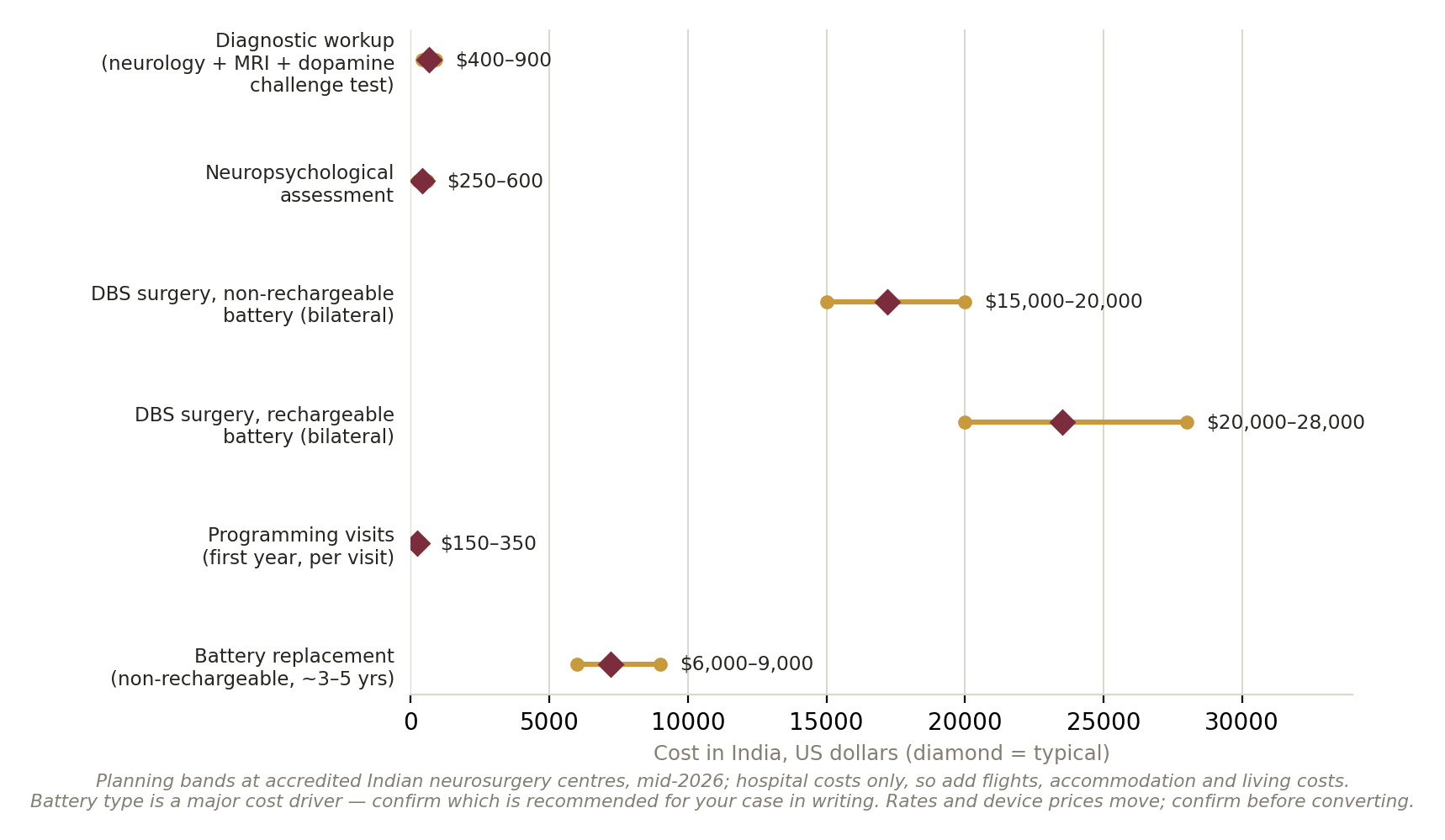
Battery type, more than any other single choice, decides where you land in this range.
The largest cost decision is the type of implanted battery: a non-rechargeable device costs less upfront but needs surgical replacement roughly every three to five years, while a rechargeable device costs more initially but can last over a decade. Even at the top of these ranges, DBS in India remains substantially less expensive than equivalent surgery in the Gulf, Europe, or the United States. Confirm which battery type is being recommended, and why, before assuming any single number applies to your case.
| A quotation, annotatedA composite of the DBS quotes that reach me, with the questions I send back. | |
| DBS surgery — USD 22,000 | Rechargeable or non-rechargeable battery? This alone can swing the price by $8,000 or more. |
| Includes: dopamine challenge test | Good sign. Confirm neuropsychological testing is included too, not billed separately later. |
| Includes: 7 days admission | Ask what a longer stay or a hardware complication would add. |
| Programming: 3 visits included | Ask what a programming visit costs after the included visits are used. |
| Excludes: battery replacement | Ask for the expected replacement interval and cost in writing, based on your battery type. |
| Excludes: MRI compatibility confirmation | Ask whether the specific device is MRI-conditional, relevant for any future scans. |
In 24 years the DBS patients most satisfied with their outcome were the ones who spent as much time on the selection conversation as the price conversation — asking honestly whether they were the right candidate before asking what the surgery would cost.
The Ethiopian practicalities
Ethiopian Airlines flies non-stop from Bole to Delhi, Mumbai, Bengaluru, Chennai, and Hyderabad. Ask for written clearance to fly rather than assuming a fixed number of days after surgery, since initial programming visits are usually timed for a few weeks after the operation. Yellow fever certification is required at least ten days before arrival, oral polio vaccination roughly four weeks before. The medical visa follows the hospital's invitation letter through the Embassy of India, Addis Ababa, and an attendant familiar with the patient's medication schedule is worth arranging, since consistent dosing around surgery matters. Where treatment spans the Orthodox fasting calendar, raise this with the hospital's dietary team beforehand. Confirm current rules with the Embassy, since they change, and ask for an Amharic- speaking coordinator to carry a written follow-up and programming plan back to a named neurologist in Ethiopia.
Straight Answers for Ethiopian Patients about Parkinson's Treatment and DBS Surgery in India
My relative has a tremor. Is this Parkinson's disease?
Not necessarily. Tremor has many causes and is often mistaken for Parkinson's, or dismissed as ordinary aging in the other direction. A movement-disorder-trained neurologist examining specific features, and response to levodopa, is needed to confirm the diagnosis.
Is DBS surgery right for every Parkinson's patient?
No. DBS is reserved for patients whose motor symptoms fluctuate significantly despite optimised medication, who respond well to levodopa when it works, and who don't have significant cognitive decline. Most Parkinson's patients are, correctly, not DBS candidates.
Is DBS available in Ethiopia?
No established programme currently operates in Ethiopia. Across Africa, DBS is only reliably available in Egypt, Morocco, and South Africa, with occasional access in Algeria and Tunisia.
How long does DBS treatment in India take?
The diagnostic workup typically takes three to five days. Surgery and initial recovery need about a week, with programming beginning two to four weeks later over several visits. Many patients plan a total stay of three to four weeks.
Who pays for this in Ethiopia?
You do. Neither Community-Based Health Insurance nor the pending formal-sector scheme funds treatment abroad, though a bank may now advance up to US$20,000 against the treating hospital's letter.
A closing word
Send the neurology notes, any medication history and response pattern, and imaging if it exists. I will tell you honestly whether this looks like a DBS-eligible pattern or a medication-management conversation instead, and for the patients it genuinely fits, why India's functional neurosurgery centres are, for now, close to the only place this specific treatment reliably exists.
Sources
- 🌐 Kissani N, Amoussa K, Otiobanda RM, et al. Parkinson's disease in sub-Saharan Africa: a review of epidemiology, genetics and access to care
- 🌐 Daghi M, Lakhdar A, El Otmani H. Deep brain stimulation for movement disorders treatment in Africa: the current status, outcomes
- 🌐 Barriers to accessing deep brain stimulation for Parkinson's disease patients in Morocco
- 🌐 National Medical Commission of India — Indian Medical Register
- 🌐 National Accreditation Board for Hospitals & Healthcare Providers (NABH), Quality Council of India
- 🌐 National Bank of Ethiopia Directive FXD/04/2026 (foreign exchange, advance payments for treatment abroad); Embassy of India, Addis Ababa
Frequently Asked Questions by Ethiopians about Parkinson's Treatment and DBS Surgery in India
Does every person with a tremor have Parkinson’s disease?
No. Tremor can have several causes, including essential tremor, thyroid disease and medication effects. A movement-disorder-trained neurologist should assess the symptoms and response to levodopa before confirming Parkinson’s disease.
Is DBS surgery suitable for every Parkinson’s patient?
No. DBS is intended for a specific group of patients whose motor symptoms remain inadequately controlled despite properly optimised medication and who meet appropriate selection criteria.
What tests are used to determine DBS eligibility?
The guide highlights a levodopa challenge test and neuropsychological assessment. Significant cognitive decline can make a patient unsuitable for DBS.
When is DBS considered for Parkinson’s disease?
DBS may be considered when medication produces significant “on” and “off” fluctuations or disabling dyskinesia despite appropriate medical management.
Is DBS available in Ethiopia?
The PDF states that Ethiopia currently has no established DBS programme. Established programmes are identified in Egypt, Morocco and South Africa, with occasional access in Algeria and Tunisia.
Why may Ethiopian patients consider DBS treatment in India?
India has established functional neurosurgery programmes combining movement-disorder neurology, functional neurosurgery, neuropsychology, precise electrode targeting and long-term programming services.
How much does DBS surgery cost in India?
The PDF gives an indicative range of USD 15,000–20,000 for non-rechargeable DBS and USD 20,000–28,000 for rechargeable DBS. Diagnostic assessments, programming and battery replacement may involve additional costs.
Why does the DBS battery type matter?
A non-rechargeable battery generally costs less initially but may require replacement approximately every three to five years. A rechargeable system costs more initially and may last more than a decade, according to the guide.
How long does DBS treatment in India take?
The diagnostic workup generally takes three to five days. Surgery and initial recovery require about a week, with programming beginning approximately two to four weeks later. Many patients plan a total stay of around three to four weeks.
What should Ethiopian patients check before choosing a DBS centre?
Patients should ask about the centre's annual DBS volume, formal patient-selection process, programming services, battery type, MRI compatibility and long-term follow-up arrangements after returning to Ethiopia.
Page Summary
This guide explains Parkinson’s diagnosis, medication management and DBS eligibility for Ethiopian patients considering treatment in India. It focuses on careful patient selection, levodopa response, cognitive assessment and the importance of long-term DBS programming. It also covers Africa’s limited DBS availability, Indian treatment costs, battery choices, travel preparation and follow-up planning after returning to Ethiopia.
Citation Block
| Topic | Information |
|---|---|
| Topic Information | Parkinson’s Treatment and DBS Surgery in India for Ethiopian Patients |
| Treatment | Parkinson’s Treatment and Deep Brain Stimulation |
| Country | India |
| Intended Audience | Ethiopian Patients |
| Primary Condition | Parkinson’s Disease |
| Initial Assessment | Movement-Disorder Neurological Evaluation |
| Key Medication | Levodopa |
| DBS Selection | Motor Fluctuations, Dyskinesia, Levodopa Response and Cognitive Assessment |
| Main Procedure | Deep Brain Stimulation |
| Key Specialists | Movement Disorder Neurologist and Functional Neurosurgeon |
| DBS Availability in Ethiopia | No Established Programme |
| Established African Programmes | Egypt, Morocco and South Africa |
| DBS Eligibility in Cited Study | 18.9% |
| Patients Receiving DBS in Cited Study | 1.5% |
| Non-Rechargeable DBS | USD 15,000–20,000 |
| Rechargeable DBS | USD 20,000–28,000 |
| Programming Visits | USD 150–350 |
| Battery Replacement | USD 6,000–9,000 |
| Neuropsychological Assessment | USD 250–600 |
| Diagnostic Workup | USD 400–900 |
| Treatment Duration | Approximately 3–4 Weeks |
| Follow-Up | Long-Term Programming and Neurology Care |
| Travel Requirement | Medical Visa and Required Vaccinations |
| Important Documents | Neurology Notes, Medication History and Imaging |
| Payment Advice | Confirm Battery Type and Package Inclusions |
| Author | Dr. Dheeraj Bojwani |
| Experience | 24+ Years |


Our Mission Statement
Our mission is to place patients at the centre of every healthcare decision by providing trustworthy, evidence-based, and unbiased medical information. We believe that informed patients make better decisions. Backed by personalised guidance from our experienced advisory team, we help patients understand their treatment options, compare them objectively, and confidently choose the path that best suits their medical needs and personal circumstances.
Patient Testimonials from Ethiopia










Ready to Take the First Step?
Share your Medical Reports with our Healthcare Managers Today and Get a FREE CONSULTATION, a Personalized Treatment Plan, and Complete Support from Arrival to Recovery.
Get Your Free ConsultationAreas We Serve
This resource has been thoughtfully prepared for patients from Ethiopia who are considering medical treatment in India. We also welcome patients from the wider region in the countries mentioned below-
We assist patients from:
- Eritrea
- Djibouti
- Somalia
- Kenya
- Sudan
- Burundi
- Comoros
- Ethiopia
- Madagascar
- Malawi
- Mauritius
- Mozambique
- Rwanda
- South Sudan
Many of the insights, treatment pathways, hospital recommendations, travel guidance, and patient support services described here are equally relevant and may be used as a reference when planning treatment in India.
From Ethiopia to India: Your Complete Patient Support Guide
- Brain Tumour Surgery in India for Ethiopians
- Cancer Treatment in India for Ethiopians
- Cardiac Surgery in India for Ethiopian Patients
- Cervical and Disc Replacement Surgery in India for Ethiopians
- Cosmetic and Plastic Surgery in India for Ethiopians
- CyberKnife Treatment in India for Ethiopians
- Eye Surgery in India for Ethiopians
- Gamma Knife Treatment in India for Ethiopians
- Heart Valve Replacement Surgery in India for Ethiopians
- Hip Surgery in India for Ethiopian Patients
- Knee Surgery in India for Ethiopian Patients
- Laparoscopic and Robotic Myomectomy Surgery in India for Ethiopians
- Neurosurgery in India for Ethiopians
- Paediatric Cardiac Surgery in India for Ethiopians
- Paediatric Neurosurgery in India for Ethiopians
- Prostate Cancer Treatment and Surgery in India for Ethiopians
- Robotic Cancer Surgery in India for Ethiopians
- Scoliosis Surgery in India for Ethiopians