

Pancreatic Cancer Surgery in India for Ethiopian Patients
Five gates every pancreatic cancer case should pass before booking a flight — and why, for the operation with one of the steepest volume-outcome relationships in all of surgery, India's high-volume HPB centres are where the difference between the published 16% and the published 3.8% mortality figure is decided.
Pancreatic cancer carries the worst prognosis of any common malignancy, and the single operation that offers a real chance of cure — the Whipple procedure — is also one of the most technically demanding in all of surgery, with outcomes that depend more heavily on hospital and surgeon volume than almost any other cancer operation performed today. In 24 years of arranging surgical care in India for patients across Africa and Asia, pancreatic cancer is the field where the case for a high-volume centre is not a preference but a documented, published, multiple- fold difference in the odds of surviving the operation itself. Ethiopia's own published data makes the local picture plain. Among the small number of pancreatic cancer patients who reach an operating theatre at Tikur Anbessa Specialized Hospital — itself the country's main referral point for this disease — more than three in four end up with a palliative bypass rather than the curative resection they came in hoping for, a pattern echoed across the wider East African region. India, over the same period, has built dedicated hepatopancreatobiliary (HPB) surgery units that perform this specific operation at many multiples of the volume any Ethiopian centre currently manages, with the imaging, endoscopic staging, and perioperative care that make a genuinely curative operation possible more often. These five gates walk through whether a pancreatic cancer is genuinely operable, and for the patients whose disease is, why the honest arithmetic of surgical volume points so clearly toward India as where that operation is performed often enough to trust with it.
Healing Journeys of Ethiopian Patients









Key Takeaways
- A pancreatic mass does not automatically mean cancer. Cysts, chronic pancreatitis and benign tumours can appear similar on imaging, so tissue confirmation is important before treatment decisions are made. Endoscopic ultrasound-guided biopsy, CT or MRI staging and CA 19-9 testing are highlighted in the guide.
- The most important question after confirming cancer is resectability—whether the tumour can be removed with clear margins. The guide states that globally only around 10–20% of patients have resectable disease at diagnosis, although some borderline tumours may become operable after neoadjuvant chemotherapy.
- For patients with resectable disease, the Whipple procedure (pancreaticoduodenectomy) can offer a genuine chance of cure. The document strongly emphasises surgeon and hospital volume because published data show a major difference in operative mortality between low- and high-volume centres.
- The chart on page 3 shows 16.3% in-hospital mortality at low-volume centres compared with 3.8% at high-volume centres for Whipple surgery. This is presented as evidence of the unusually strong volume-outcome relationship associated with this operation.
- The Ethiopia-versus-India volume chart on page 4 shows approximately 10 Whipple procedures per year at Tikur Anbessa Specialized Hospital, compared with a published high-volume threshold of around 20 per year and approximately 150 per year at leading Indian HPB centres. The guide therefore identifies surgical volume as a major reason Ethiopian patients may consider India.
- Treatment costs depend substantially on the exact operation and stage. The page 5 cost chart gives planning ranges of USD 6,000–13,000 for Whipple surgery, USD 5,000–10,000 for distal pancreatectomy, USD 2,000–5,500 for neoadjuvant chemotherapy per course, and USD 1,800–5,000 for postoperative chemotherapy.
- Before travelling, patients should confirm whether their disease is resectable, borderline resectable or unresectable, ask for the surgical team's annual Whipple volume and mortality rate, and clarify exactly what the hospital quotation includes. The annotated quotation on page 6 specifically highlights biopsy, CA 19-9, CT/MRI staging, ICU duration, pancreatic-leak costs, chemotherapy and possible enzyme or insulin requirements.
Quick Facts
- Treatment
- Pancreatic Cancer Surgery
- Country
- India
- Patients
- Ethiopian Patients
- Primary Condition
- Pancreatic Cancer
- Diagnosis
- EUS-Guided Biopsy, CT/MRI and CA 19-9
- Main Surgical Options
- Whipple Procedure and Distal Pancreatectomy
- Key Treatment Decision
- Resectable, Borderline Resectable or Unresectable
- Main Selection Factor
- Surgical Team Volume
- Whipple Mortality
- 16.3% at Low-Volume Centres vs 3.8% at High-Volume Centres
- Ethiopia Whipple Volume
- Approximately 10 Procedures/Year
- Leading Indian HPB Centres
- Approximately 150 Whipples/Year
- Neoadjuvant Treatment
- Chemotherapy for Selected Borderline Cases
- Whipple Cost
- USD 6,000–13,000
- Distal Pancreatectomy Cost
- USD 5,000–10,000
- Treatment Duration
- Approximately 2–3 Weeks for Surgery and Initial Recovery
- Why Consider India
- High-Volume HPB Surgery and Specialised Perioperative Care
- Follow-Up
- Continued Oncology Care in Ethiopia
- Payment Advice
- Obtain a Written, Itemised Quotation
In Brief
Ethiopian patients considering pancreatic cancer surgery in India should first establish a confirmed diagnosis and determine whether the tumour is resectable. CT or MRI, endoscopic ultrasound-guided biopsy and CA 19-9 assessment help establish the diagnosis and treatment pathway. For resectable disease, Whipple surgery may offer a chance of cure, but outcomes are strongly influenced by the number of procedures performed by the surgical team. The guide therefore recommends choosing a high-volume HPB centre, confirming the team's annual Whipple volume and mortality rate, and obtaining a detailed quotation that separates surgery, chemotherapy, ICU care and longer-term digestive or diabetes management costs.
1 Gate One
A mass, or a cancer?
Jaundice, unexplained weight loss, or a mass found on abdominal imaging is what usually starts this conversation. Not every pancreatic mass is cancer — cysts, chronic pancreatitis, and benign tumours can all look similar on a scan. A confirmed diagnosis needs tissue, usually obtained by endoscopic ultrasound-guided biopsy, alongside CT or MRI staging and the CA 19-9 blood marker.
Be cautious of any treatment plan, surgical or otherwise, proposed before tissue confirmation is in hand. The biopsy also does more than confirm cancer is present — the specific pathology and staging findings are what determine every decision in the gates that follow.
2 Gate Two
Operable, or not yet?
Once cancer is confirmed, the single most important question is resectability: can the tumour be physically removed with clear margins. Globally, only 10 to 20 percent of patients have resectable disease at the time of diagnosis, most commonly because the tumour has already grown into nearby blood vessels or spread beyond the pancreas.
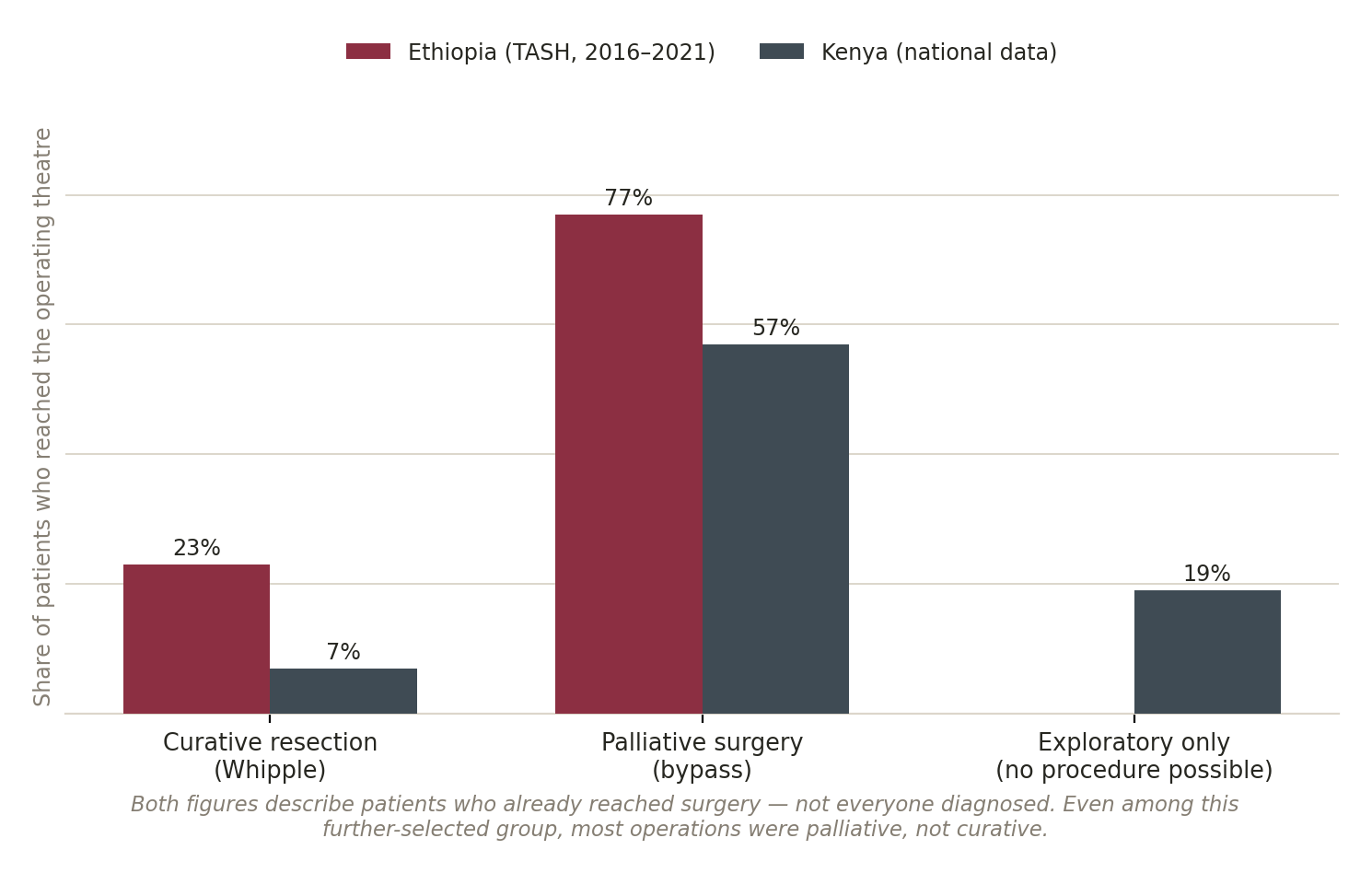
Even among patients who reach the operating theatre, most operations in the region are palliative, not curative.
Why this matters beyond the individual case: a course of chemotherapy (neoadjuvant treatment) can sometimes shrink a borderline tumour enough to make it operable. This decision needs the same high-quality CT and MRI staging that determines resectability in the first place, ideally reviewed by a surgeon who regularly operates on this disease and can judge the difference between technically difficult and technically impossible.
Ask explicitly, in writing, whether your case is being classified as resectable, borderline resectable, or unresectable, and what specific finding on imaging supports that classification.
3 Gate Three
Does the surgeon's volume decide?
For resectable disease, the Whipple procedure — pancreaticoduodenectomy — is the operation that offers a genuine chance of cure. It is also, by a wide margin, one of the most volume-sensitive major operations performed anywhere in surgery.
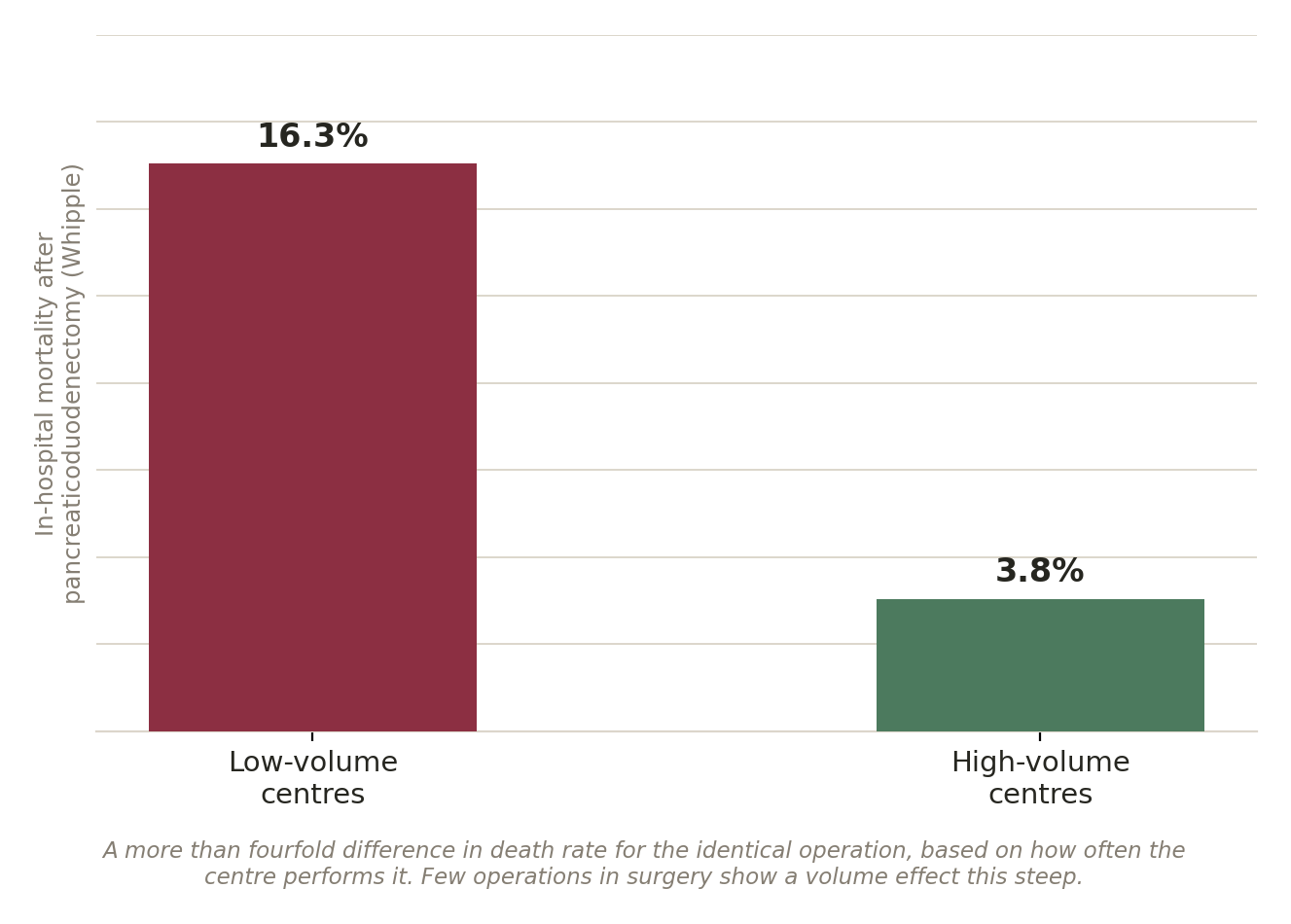
The identical operation, performed at centres seeing different case volumes, with a fourfold difference in the odds of survival.
A landmark analysis published in the New England Journal of Medicine found in-hospital mortality of roughly 16 percent at low-volume hospitals compared with under 4 percent at high-volume centres for this exact operation. Few decisions in oncology carry this much documented weight from a single variable: not the stage, not the patient's age, but simply how many times this year the operating team has already done this specific procedure. Ask any centre directly, before agreeing to anything, how many Whipple procedures their team performs annually.
4 Gate Four
Could this be done in Ethiopia?
Diagnosis and staging are increasingly available within Ethiopia, concentrated at Tikur Anbessa Specialized Hospital. The honest picture on the operation itself is one of volume: published data from the country's main referral centre for this disease describes roughly ten Whipple procedures a year, below the threshold most published volume- outcome studies use to define a high-volume programme.
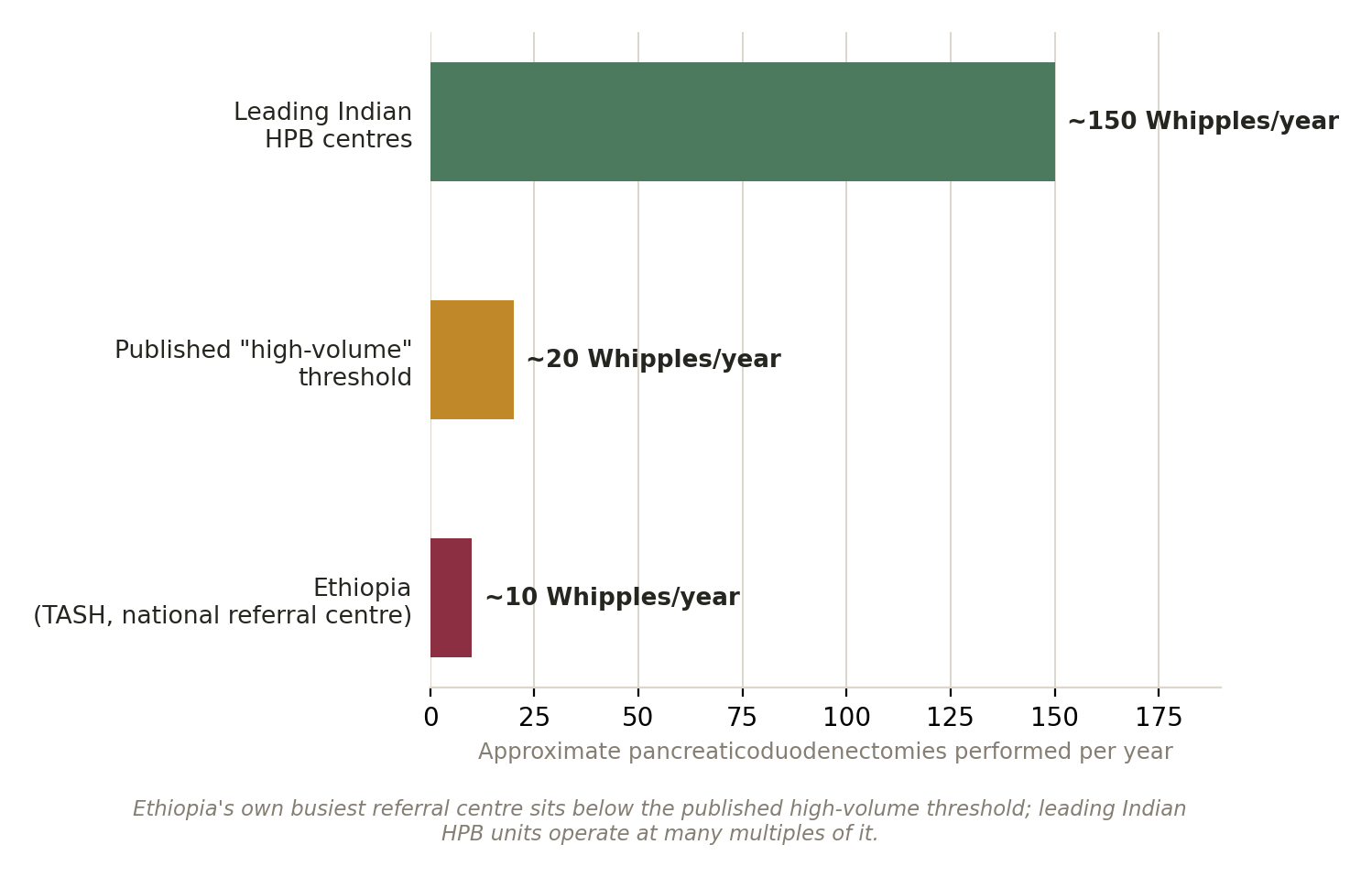
The gap here is not access to a surgeon. It is access to the volume that makes a surgeon's outcomes trustworthy.
This is precisely the gap India's dedicated HPB surgery units are built to close. Leading Indian centres perform this operation at many multiples of the published high-volume threshold, with the endoscopic ultrasound staging, interventional radiology, and specialised ICU care that a technically demanding operation like this needs around it. For a surgery where outcome depends this directly on repetition and team experience, that concentration of volume is not a convenience — it is the single largest lever on whether the operation itself is survived well.
A second opinion on the imaging and resectability before committing to a specific operation is always worth arranging. Ask any centre how many Whipple procedures they perform each year, and what their own in-hospital mortality and major complication rates are — India's high-volume HPB units answer this with real numbers.
5 Gate Five
Is the money arranged?
Ethiopia's health financing does not follow a patient abroad. Community-Based Health Insurance covers contracted facilities inside the country, and the formal-sector scheme still isn't settling claims. Since February 2026 a bank may release up to US$20,000 per case against a letter from the treating hospital, without a visa or ticket in hand.
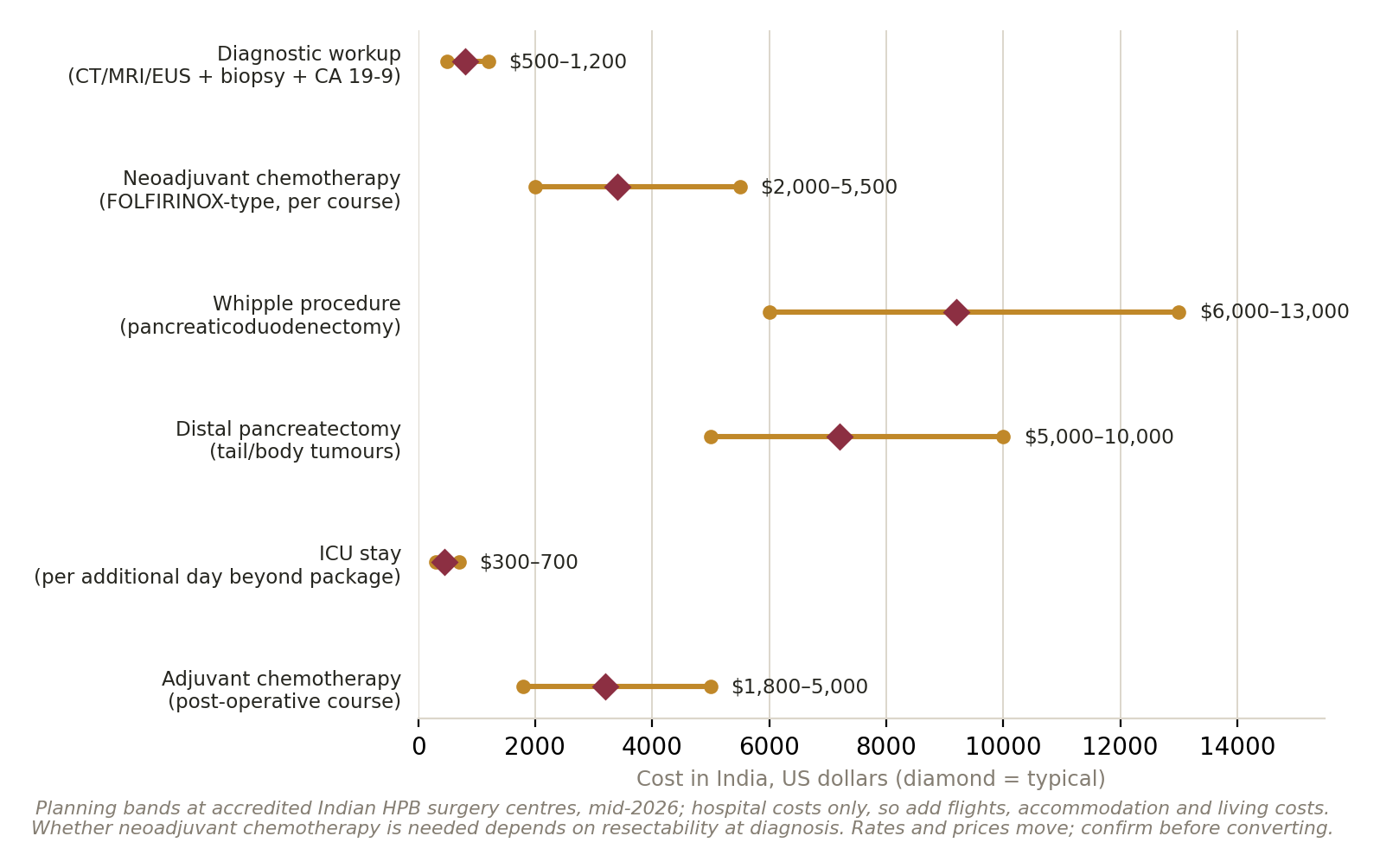
Budget for the operation your staging actually points to, not the most familiar figure.
The figures differ substantially by resectability and location within the pancreas: a straightforward distal pancreatectomy sits below a full Whipple procedure, and neoadjuvant chemotherapy adds a separate, significant cost for borderline cases. Even at the top of these ranges, treatment at a leading Indian HPB centre remains a fraction of an equivalent package in the Gulf, Europe, or the United States. Confirm the resectability and planned procedure before assuming any single number applies to your case.
| A quotation, annotatedA composite of the pancreatic cancer quotes that reach me, with the questions I send back. | |
| Pancreatic cancer surgery — USD 9,000 | Whipple or distal pancreatectomy? The two procedures price and recover very differently. |
| Includes: EUS-guided biopsy | Good sign. Ask whether CA 19-9 and full CT/MRI staging are included too. |
| Includes: 12 days admission incl. ICU | Reasonable for this operation. Ask what a pancreatic leak or delayed recovery would add. |
| Team volume: ask directly | Ask for the surgical team's annual Whipple volume and mortality rate in writing. |
| Excludes: neoadjuvant chemotherapy | Ask whether your staging calls for this before surgery, and its separate cost. |
| Excludes: enzyme replacement, insulin if needed | Ask what ongoing digestive and diabetes management costs after surgery. |
In 24 years the pancreatic cancer patients most satisfied with their outcome were the ones who asked for the surgical team's actual case volume before asking for the price — and chose accordingly.
The Ethiopian practicalities
Ethiopian Airlines flies non-stop from Bole to Delhi, Mumbai, Bengaluru, Chennai, and Hyderabad. Ask for written clearance to fly rather than assuming a fixed number of days after surgery, since recovery from a Whipple procedure is longer and more variable than most abdominal operations. Yellow fever certification is required at least ten days before arrival, oral polio vaccination roughly four weeks before. The medical visa follows the hospital's invitation letter through the Embassy of India, Addis Ababa, and an attendant is worth arranging for the full hospital stay. Where treatment spans the Orthodox fasting calendar, raise this with the hospital's dietary team beforehand, since post-Whipple nutrition needs are demanding and specific. Confirm current rules with the Embassy, since they change, and ask for an Amharic-speaking coordinator to carry a written follow-up plan back to a named oncologist in Ethiopia.
Straight Answers for Ethiopian Patients about Pancreatic Cancer Surgery in India
I was told I have a mass on my pancreas. Does that mean I have cancer?
Not always. Cysts, chronic pancreatitis, and benign tumours can all appear as a mass on imaging. A confirmed diagnosis needs tissue biopsy, usually guided by endoscopic ultrasound, alongside CT or MRI staging and the CA 19-9 marker.
Is my pancreatic cancer operable?
Only careful staging can answer this. Globally, 10 to 20 percent of patients have resectable disease at diagnosis. Some borderline cases become operable after chemotherapy shrinks the tumour first. Ask explicitly whether your case is resectable, borderline, or unresectable.
Does it matter how many Whipple procedures a hospital performs?
Yes, enormously. Published data shows in-hospital mortality of roughly 16% at low-volume hospitals versus under 4% at high-volume centres for this exact operation. Ask any centre directly how many they perform each year.
How long does treatment in India take?
Staging typically takes three to five days. Surgery and initial recovery need two to three weeks. Where neoadjuvant chemotherapy is needed first, this adds two to four months, often split between India and Ethiopia.
Who pays for this in Ethiopia?
You do. Neither Community-Based Health Insurance nor the pending formal-sector scheme funds treatment abroad, though a bank may now advance up to US$20,000 against the treating hospital's letter.
A closing word
Send the CT or MRI imaging, the biopsy report, and CA 19-9 level if available. I will tell you honestly whether this looks resectable, and for the patients whose disease is, why India's high-volume HPB centres are where the arithmetic of this specific operation is decided in your favour.
Sources
- 🌐 Surgical management of pancreatic cancer in Tikur Anbessa Specialized Hospital, Addis Ababa, Ethiopia
- 🌐 Bharadwaj S, et al. The current landscape of pancreatic cancer management in sub-Saharan Africa: a perspective review. Health Sci Rep. 2025
- 🌐 Birkmeyer JD, Siewers AE, Finlayson EV, et al. Hospital volume and surgical mortality in the United States. N Engl J Med
- 🌐 National Medical Commission of India — Indian Medical Register, for verifying a treating surgeon's qualification and registration
- 🌐 National Accreditation Board for Hospitals & Healthcare Providers (NABH), Quality Council of India
- 🌐 National Bank of Ethiopia Directive FXD/04/2026 (foreign exchange, advance payments for treatment abroad); Embassy of India, Addis Ababa
Frequently Asked Questions by Ethiopians about Pancreatic Cancer Surgery in India
Does a pancreatic mass always mean cancer?
No. Cysts, chronic pancreatitis and benign tumours can also appear as pancreatic masses. A confirmed diagnosis generally requires tissue biopsy, supported by CT or MRI staging and CA 19-9 testing.
What tests should Ethiopian patients complete before travelling to India?
Patients should have the available CT or MRI imaging, tissue biopsy report and CA 19-9 level. These help the Indian HPB team assess the diagnosis and whether the tumour may be surgically removable.
What does resectable pancreatic cancer mean?
Resectable means the tumour appears physically removable with clear margins. The guide also distinguishes borderline resectable and unresectable disease based on tumour involvement and spread.
Can borderline pancreatic cancer become operable?
In some cases, yes. The guide explains that neoadjuvant chemotherapy can sometimes shrink a borderline tumour sufficiently to make surgery possible. This decision requires high-quality imaging and review by an experienced pancreatic surgeon.
What is the Whipple procedure?
The Whipple procedure, also called pancreaticoduodenectomy, is the major operation used for selected pancreatic cancers and can offer a genuine chance of cure when the disease is resectable.
Does the number of Whipple procedures performed by a hospital matter?
Yes, significantly. The PDF reports in-hospital mortality of approximately 16.3% at low-volume centres compared with 3.8% at high-volume centres. Patients should ask the centre for its annual Whipple volume and procedure-specific mortality rate.
How many Whipple procedures are performed in Ethiopia compared with India?
The guide cites approximately 10 Whipple procedures per year at Tikur Anbessa Specialized Hospital, compared with approximately 150 per year at leading Indian HPB centres. A published high-volume threshold is shown at approximately 20 procedures per year.
How much does pancreatic cancer surgery cost in India?
The PDF gives indicative planning ranges of USD 6,000–13,000 for Whipple surgery and USD 5,000–10,000 for distal pancreatectomy. Neoadjuvant and postoperative chemotherapy are separate costs, and additional ICU days may also increase the final bill.
How long does pancreatic cancer treatment in India take?
Staging generally takes around three to five days, while surgery and initial recovery may require approximately two to three weeks. If neoadjuvant chemotherapy is required first, treatment may extend by another two to four months, sometimes divided between India and Ethiopia.
What should Ethiopian patients check in a pancreatic cancer quotation?
Patients should confirm whether the quotation includes EUS-guided biopsy, CA 19-9, complete CT/MRI staging, ICU admission and management of complications such as pancreatic leaks. They should also clarify whether neoadjuvant chemotherapy, enzyme replacement or insulin costs are excluded.
Page Summary
This guide explains how Ethiopian patients can evaluate pancreatic cancer surgery in India, beginning with tissue confirmation and CT/MRI staging and then determining whether the tumour is resectable, borderline resectable or unresectable. It focuses particularly on the Whipple procedure and the importance of surgical volume, comparing published outcomes and procedure volumes in Ethiopia with high-volume Indian HPB centres. It also covers treatment costs, chemotherapy, travel preparation and quotation checks.
Citation Block
| Topic | Information |
|---|---|
| Topic Information | Pancreatic Cancer Surgery in India for Ethiopian Patients |
| Treatment | Pancreatic Cancer Surgery |
| Country | India |
| Intended Audience | Ethiopian Patients |
| Primary Condition | Pancreatic Cancer |
| Diagnosis | EUS-Guided Biopsy, CT/MRI and CA 19-9 |
| Key Treatment Decision | Resectable, Borderline Resectable or Unresectable |
| Main Curative Surgery | Whipple Procedure |
| Alternative Surgery | Distal Pancreatectomy |
| Whipple Medical Term | Pancreaticoduodenectomy |
| Neoadjuvant Treatment | Chemotherapy for Selected Borderline Cases |
| Key Selection Factor | Surgical Team Volume |
| Low-Volume Mortality | 16.3% |
| High-Volume Mortality | 3.8% |
| Ethiopia Whipple Volume | Approximately 10/Year |
| High-Volume Threshold | Approximately 20/Year |
| Leading Indian HPB Centres | Approximately 150/Year |
| Key Specialists | HPB Surgeon, Medical Oncologist, Radiologist and ICU Team |
| Why Consider India | High-Volume HPB Surgery |
| Diagnostic Workup | USD 500–1,200 |
| Neoadjuvant Chemotherapy | USD 2,000–5,500 Per Course |
| Whipple Procedure | USD 6,000–13,000 |
| Distal Pancreatectomy | USD 5,000–10,000 |
| Postoperative Chemotherapy | USD 1,800–5,000 |
| Additional ICU Stay | USD 300–700 Per Day |
| Treatment Duration | Approximately 3–5 Days Staging + 2–3 Weeks Recovery |
| Neoadjuvant Treatment | May Add 2–4 Months |
| Travel Requirement | Medical Visa and Required Vaccinations |
| Follow-Up | Continued Oncology Care in Ethiopia |
| Author | Dr. Dheeraj Bojwani |
| Experience | 24 Years |


Our Mission Statement
Our mission is to place patients at the centre of every healthcare decision by providing trustworthy, evidence-based, and unbiased medical information. We believe that informed patients make better decisions. Backed by personalised guidance from our experienced advisory team, we help patients understand their treatment options, compare them objectively, and confidently choose the path that best suits their medical needs and personal circumstances.
Patient Testimonials from Ethiopia










Ready to Take the First Step?
Share your Medical Reports with our Healthcare Managers Today and Get a FREE CONSULTATION, a Personalized Treatment Plan, and Complete Support from Arrival to Recovery.
Get Your Free ConsultationAreas We Serve
This resource has been thoughtfully prepared for patients from Ethiopia who are considering medical treatment in India. We also welcome patients from the wider region in the countries mentioned below-
We assist patients from:
- Eritrea
- Djibouti
- Somalia
- Kenya
- Sudan
- Burundi
- Comoros
- Ethiopia
- Madagascar
- Malawi
- Mauritius
- Mozambique
- Rwanda
- South Sudan
Many of the insights, treatment pathways, hospital recommendations, travel guidance, and patient support services described here are equally relevant and may be used as a reference when planning treatment in India.
From Ethiopia to India: Your Complete Patient Support Guide
- Brain Tumour Surgery in India for Ethiopians
- Cancer Treatment in India for Ethiopians
- Cardiac Surgery in India for Ethiopian Patients
- Cervical and Disc Replacement Surgery in India for Ethiopians
- Cosmetic and Plastic Surgery in India for Ethiopians
- CyberKnife Treatment in India for Ethiopians
- Eye Surgery in India for Ethiopians
- Gamma Knife Treatment in India for Ethiopians
- Heart Valve Replacement Surgery in India for Ethiopians
- Hip Surgery in India for Ethiopian Patients
- Knee Surgery in India for Ethiopian Patients
- Laparoscopic and Robotic Myomectomy Surgery in India for Ethiopians
- Neurosurgery in India for Ethiopians
- Paediatric Cardiac Surgery in India for Ethiopians
- Paediatric Neurosurgery in India for Ethiopians
- Prostate Cancer Treatment and Surgery in India for Ethiopians
- Robotic Cancer Surgery in India for Ethiopians
- Scoliosis Surgery in India for Ethiopians