

Paediatric Orthopaedic Surgery for Ethiopian Children in India
Five gates every child's bone or joint condition should pass before booking a flight — and why, for a birth condition that roughly half of Ethiopian families currently cannot reach organised treatment for, it is genuinely never too late to ask the question again.
Children's bones behave differently from adult ones, and nowhere does that matter more than in a condition present from birth. In 24 years of arranging surgical care in India for patients across Africa and Asia, paediatric orthopaedics is a field defined by timing: the same deformity, treated in the first weeks of life, often needs nothing more than gentle weekly casting; left until a child is walking, running, and old enough to remember the shape of their own foot, it needs considerably more. Clubfoot is the clearest example, and it is common in Ethiopia, not rare — published hospital data puts its prevalence at roughly 7 per 1,000 children under five, with an estimated 3,000 to 5,000 new cases every year. The Ponseti method, a non-surgical technique of gentle manipulation and casting, corrects it successfully in the great majority of cases when started early, and current programme coverage in Ethiopia reaches only around half of the children who need it. The honest, genuinely hopeful message in this specific gap is that Ponseti treatment continues to work well even in children who present years late — it is a condition worth pursuing treatment for at almost any age, and India's paediatric orthopaedic centres see this exact pattern, delayed presentation and all, as routine practice. These five gates walk through what a child's specific condition actually is, why timing matters as much as the treatment itself, and why India is where both the early and the long-delayed cases are treated with equal seriousness.
Healing Journeys of Ethiopian Patients









Key Takeaways
- Early assessment matters in paediatric orthopaedics, particularly for congenital conditions such as clubfoot. The PDF explains that a newborn's flexible positional foot deformity can differ from true congenital clubfoot, making specialist assessment in the first weeks important.
- Clubfoot is relatively common in Ethiopia, with the cited data estimating approximately 7 cases per 1,000 children under five and around 3,000–5,000 new cases each year. The page 2 chart shows that only about 50% of affected children currently reach an established Ponseti programme.
- The guide emphasises that delayed treatment does not mean treatment is no longer possible. The page 4 meta-analysis visual reports approximately 89% satisfactory outcomes in children treated with Ponseti after walking age, although recurrence and casting complications can occur.
- The treatment approach depends strongly on the child's age and condition. The page 3 visual shows that early cases are more likely to be managed with casting alone, while older or neglected cases may require minor tenotomy or, in selected cases, more extensive reconstructive surgery.
- India is presented as an option for Ethiopian children who are outside established Ponseti programmes, have failed previous treatment or have more complex conditions such as developmental hip dysplasia or growth-plate fractures. The guide highlights access to casting, bracing, surgery and growth-plate-sparing fixation under specialist paediatric orthopaedic care.
- Indicative Indian costs vary significantly by age and condition: US$2,500–3,200 for infant Ponseti casting with tenotomy, US$4,000–7,000 for neglected/complex clubfoot correction, US$500–1,200 for non-surgical developmental hip dysplasia treatment, US$5,000–6,300 for surgical hip reduction and US$1,500–3,500 for paediatric fracture fixation.
- Ethiopian families should not accept a major reconstructive operation without asking whether a modified Ponseti approach or another less invasive treatment has been genuinely considered, particularly for an older child with untreated clubfoot.
- The annotated quotation highlights several costs families should verify, including the number of casting sessions, Achilles tenotomy, bracing after correction, treatment if casting fails and accommodation for the accompanying parent.
Quick Facts
- Treatment
- Paediatric Orthopaedic Surgery
- Country
- India
- Patients
- Ethiopian Children
- Main Conditions
- Clubfoot, Developmental Hip Dysplasia and Paediatric Fractures
- Primary Clubfoot Treatment
- Ponseti Casting
- Estimated Ethiopian Clubfoot Cases
- 3,000–5,000 new cases annually
- Programme Coverage
- Approximately 50%
- Satisfactory Outcome After Walking Age
- 89% in cited meta-analysis
- Infant Ponseti + Tenotomy
- US$2,500–3,200
- Neglected / Complex Clubfoot
- US$4,000–7,000
- Hip Dysplasia Non-Surgical
- US$500–1,200
- Hip Dysplasia Surgical Reduction
- US$5,000–6,300
- Paediatric Fracture Fixation
- US$1,500–3,500
- Key Specialist
- Paediatric Orthopaedic Surgeon
- Important Expertise
- Delayed clubfoot, hip dysplasia and growth-plate conditions
- Typical Clubfoot Treatment
- 4–8 weeks of weekly casting plus brief tenotomy
- Typical India Stay
- 6–10 weeks for casting-based treatment; 1–2 weeks for single procedures
- Follow-Up
- Named Paediatric Orthopaedic Provider in Ethiopia
- Financing Mentioned
- Up to US$20,000 against treating hospital letter
- Required Records
- Child's age, photographs/imaging and previous treatment details
In Brief
Paediatric orthopaedic treatment for Ethiopian children depends heavily on the child's age, diagnosis and previous treatment. The PDF uses clubfoot as the clearest example: early treatment with the Ponseti method can often avoid major surgery, while older or neglected cases may require more involved treatment. Importantly, the guide notes that even children presenting after walking age can still achieve satisfactory outcomes with casting-based treatment. It also discusses developmental hip dysplasia and paediatric fractures involving growth plates, where specialist assessment and appropriate fixation techniques become important. Indian paediatric orthopaedic centres are presented as an option for complex, delayed or previously unsuccessful cases, particularly where the full range of casting, bracing and surgical treatment is available.
1 Gate One
A twisted foot, or a passing one?
A newborn's foot that looks curled or twisted is what usually starts this conversation, and it is worth knowing that not every unusual-looking infant foot is clubfoot. Positional deformities, caused by the baby's position in the womb, are flexible and often correct with simple handling and time. True congenital talipes equinovarus is stiffer and does not straighten with gentle pressure.
A paediatric orthopaedic assessment, ideally in the first weeks of life, is what reliably tells the two apart. This distinction matters because it determines whether treatment is needed at all, and getting it right early avoids both unnecessary treatment and, more importantly, delayed treatment of something that genuinely needs it. A brief physical examination by a specialist familiar with both presentations is usually enough to settle the question, without needing extensive imaging in a newborn.
2 Gate Two
Every week matters more in a child
Clubfoot is common in Ethiopia, and the gap between how many children are born with it and how many reach organised treatment is real and documented.
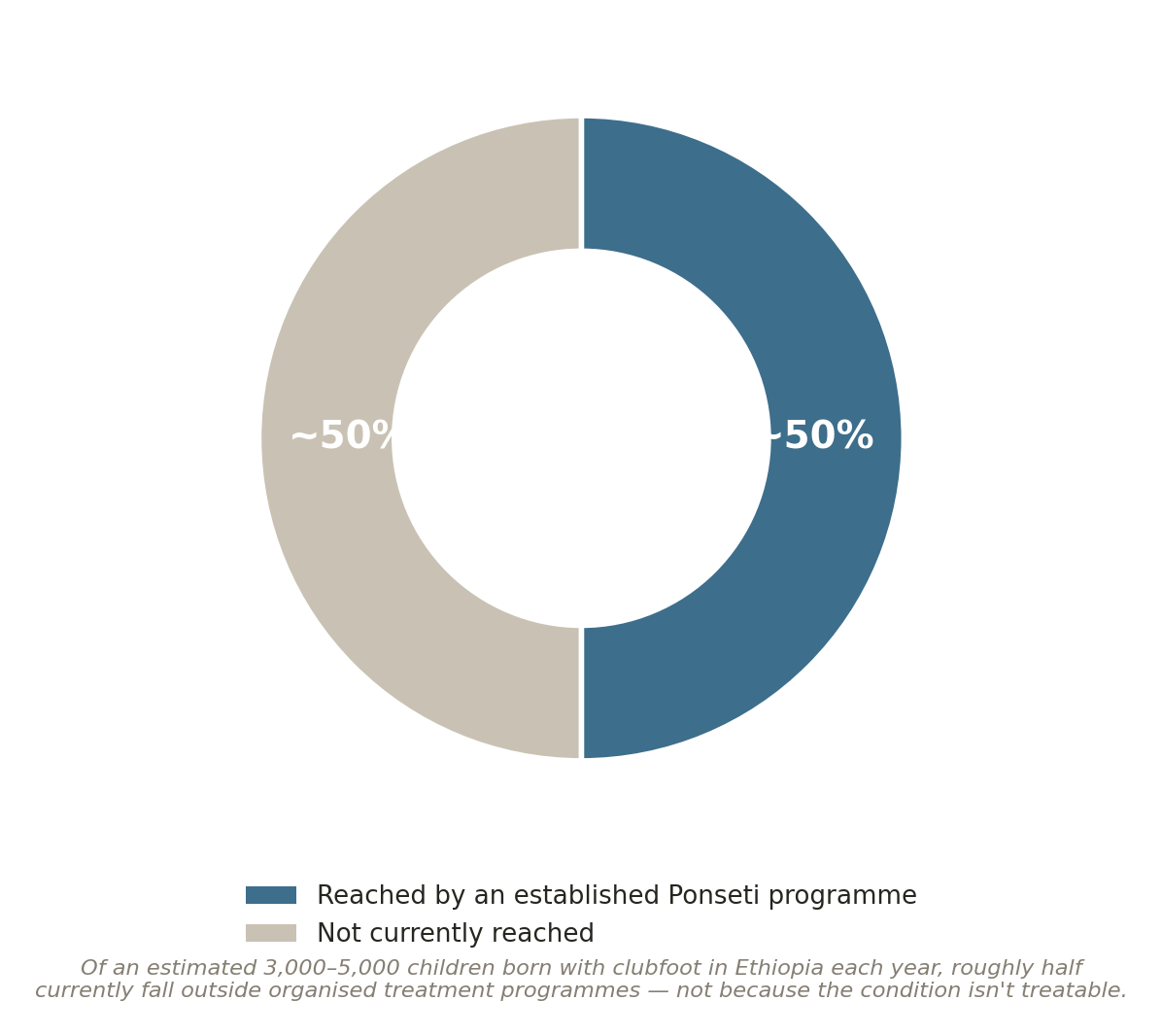
Roughly half of Ethiopian children born with clubfoot currently fall outside an established treatment programme.
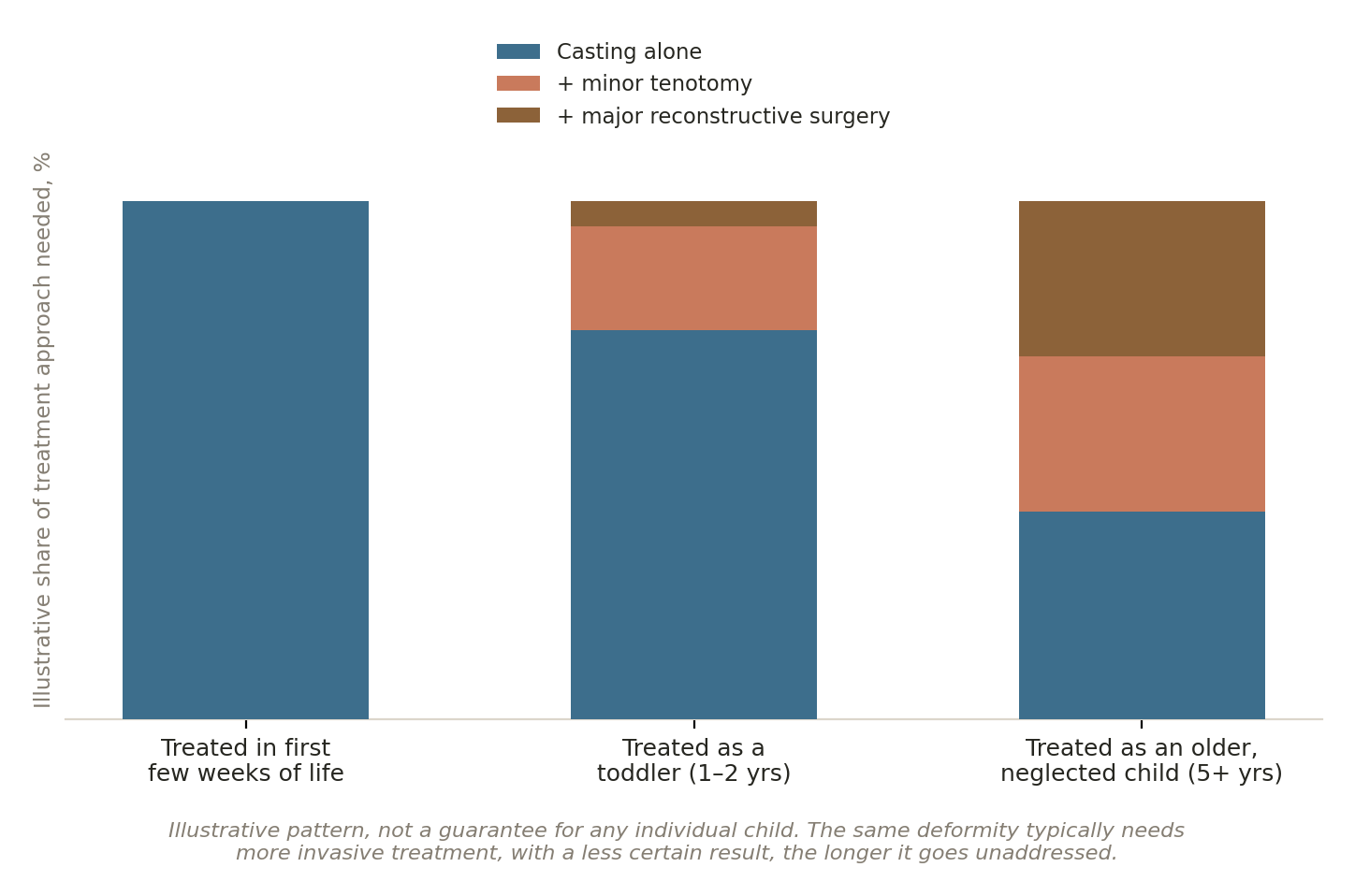
The same deformity, addressed later, typically needs a bigger intervention for a less certain result.
This is precisely why age at first treatment is worth asking about explicitly, whatever a child's current age happens to be. A child treated at six weeks and a child treated at six years are not facing the same conversation, and knowing which one applies changes what to ask for next, and how urgently to act on it.
3 Gate Three
Cast, or surgery?
There is a genuinely hopeful, and often overlooked, fact for families of older children with untreated or neglected clubfoot: casting still works, more often than expected.
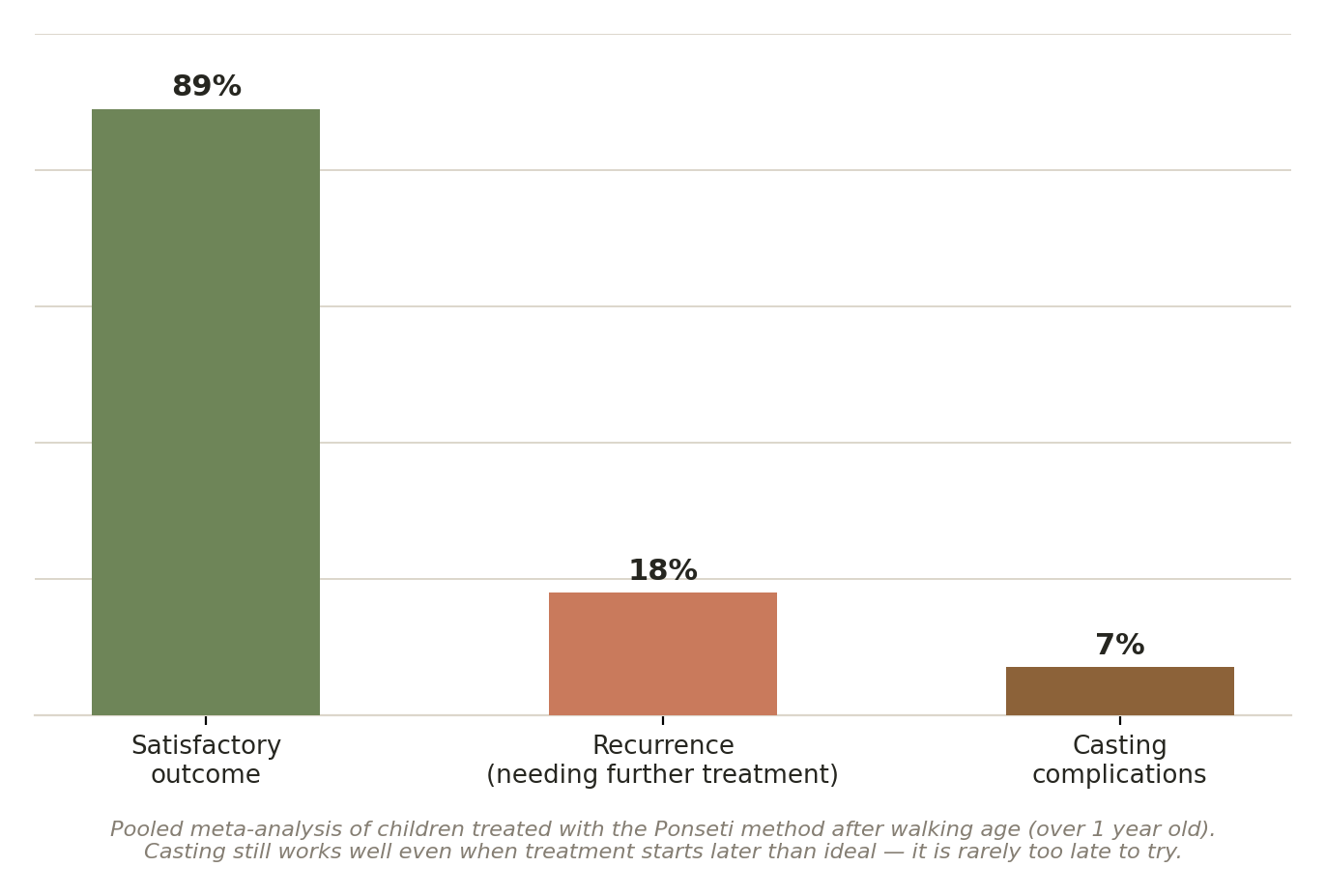
Even well past walking age, casting-based treatment succeeds for most children.
Why this matters for the treatment plan offered: a centre that moves straight to major reconstructive surgery for an older child, without genuinely attempting a modified Ponseti approach first, may be offering more surgery than the case requires. Ask specifically whether casting has been tried or seriously considered before agreeing to an invasive procedure.
This doesn't mean surgery is never needed — for some neglected, rigid, or syndrome-associated cases, it genuinely is. It means the decision should follow a real attempt at the less invasive option first, not skip past it because the child is older than ideal. A second opinion specifically on whether casting has a realistic chance of working is always worth seeking before committing to an operation.
4 Gate Four
Could this be done in Ethiopia?
For clubfoot specifically, yes, for roughly half of affected children, through established Ponseti programmes. For the other half, and for children whose treatment has already failed once, or who have more complex conditions such as developmental hip dysplasia needing surgical correction, or fractures involving the growth plate, specialist paediatric orthopaedic capacity is considerably thinner.
This is precisely where India's paediatric orthopaedic centres add genuine, comparative depth: subspecialist surgeons who manage delayed-presentation and complex cases as routine practice, the full range of casting, bracing, and surgical options available under one roof, and growth-plate-sparing fixation techniques for fractures in growing bones. For a field this dependent on matching the right level of intervention to a child's specific age and presentation, that range of expertise is not a convenience — it is what actually protects a child from either under- or over-treatment. Ask any centre how many cases of your child's specific condition, and at your child's specific age, they manage each year.
5 Gate Five
Is the money arranged?
Ethiopia's health financing does not follow a patient abroad. Community-Based Health Insurance covers contracted facilities inside the country, and the formal-sector scheme still isn't settling claims. Since February 2026 a bank may release up to US$20,000 per case against a letter from the treating hospital, without a visa or ticket in hand.
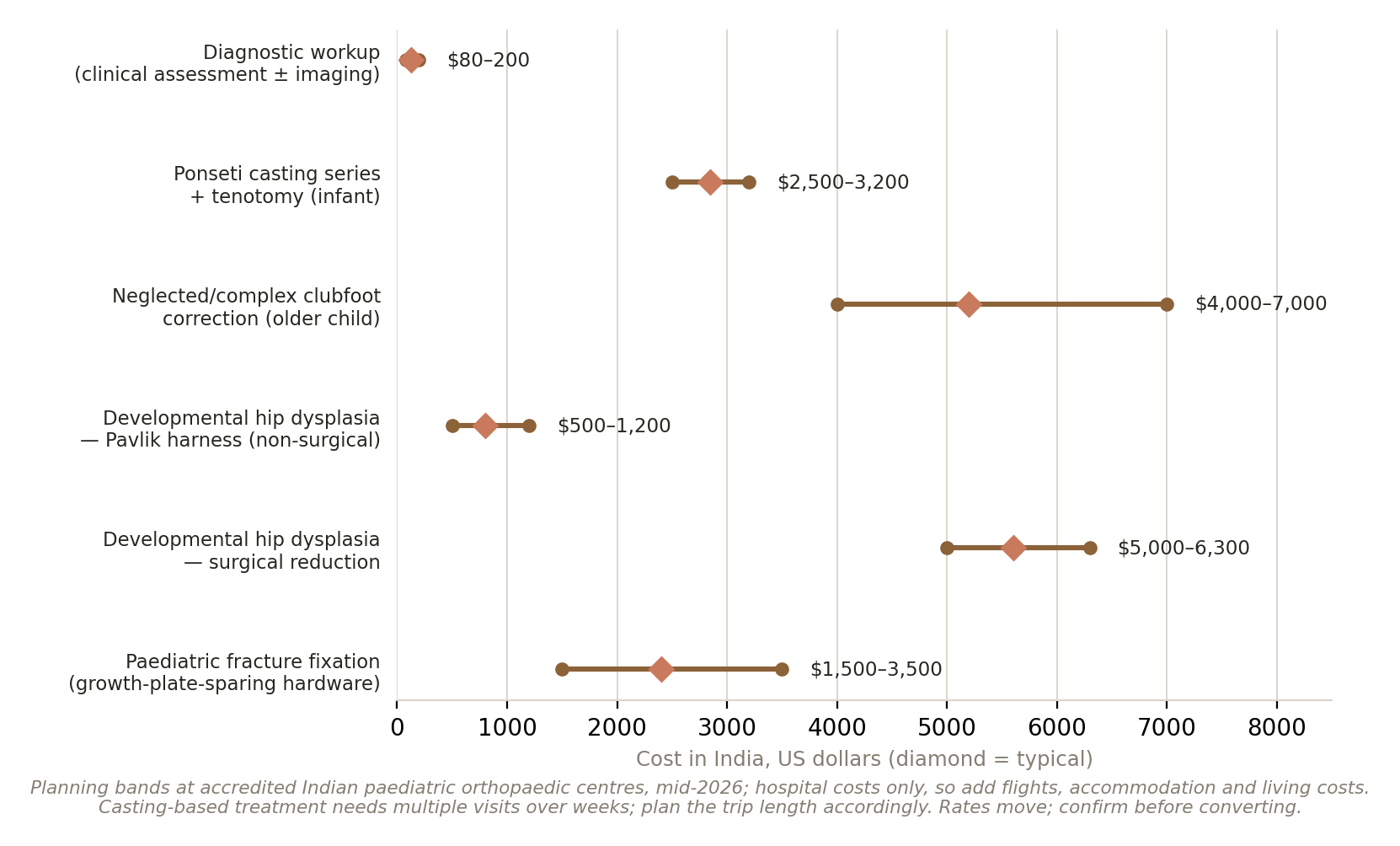
Budget for the condition and age your child actually presents with, not the most familiar figure.
The figures differ substantially by condition and age at treatment: infant Ponseti casting sits well below neglected or complex correction in an older child. Even at the top of these ranges, treatment at an accredited Indian paediatric orthopaedic centre remains a fraction of an equivalent case in the Gulf, Europe, or the United States. Confirm the specific diagnosis and your child's age before assuming any single number applies to your case.
| A quotation, annotatedA composite of the paediatric orthopaedic quotes that reach me, with the questions I send back. | |
| Clubfoot treatment — USD 2,800 | What is your child's current age? Casting-only pricing may not reflect an older, more complex case. |
| Includes: weekly casting sessions | Ask how many weeks this covers, and the cost if more sessions are needed. |
| Includes: Achilles tenotomy | Reasonable for most cases. Confirm this is anaesthesia-appropriate for your child's age. |
| Excludes: bracing after correction | Ask for the brace cost and the years of follow-up wear typically needed to prevent relapse. |
| Excludes: major surgery if casting fails | Ask what the plan and price become if casting alone doesn't fully correct the deformity. |
| Excludes: accompanying parent's stay | For a multi-week casting course, confirm accommodation options nearby. |
In 24 years the families most satisfied with their child's outcome were the ones who asked what the least invasive effective option was, at whatever age their child happened to present.
The Ethiopian practicalities
Ethiopian Airlines flies non-stop from Bole to Delhi, Mumbai, Bengaluru, Chennai, and Hyderabad. Casting-based treatment needs weekly visits over several weeks, so plan for either one extended stay or two shorter trips with a gap between them, depending on the centre's protocol. Yellow fever certification is required at least ten days before arrival for children over nine months, oral polio vaccination roughly four weeks before. The medical visa follows the hospital's invitation letter through the Embassy of India, Addis Ababa; confirm whether an accompanying parent needs a separate visa category. Where treatment spans the Orthodox fasting calendar, this rarely affects paediatric care directly, but confirm any dietary considerations with the hospital. Confirm current rules with the Embassy, since they change, and ask for an Amharic-speaking coordinator to carry a written follow-up and bracing schedule back to a named provider in Ethiopia.
Straight Answers for Ethiopian Patients about Paediatric Orthopaedic Surgery in India
My baby's foot looks twisted. Is this clubfoot?
Not always. Some newborns have a flexible foot position that resolves on its own. True clubfoot is stiffer and doesn't correct with gentle stretching. A paediatric orthopaedic assessment in the first weeks of life reliably tells the two apart.
My child's clubfoot was never treated and they are now older. Is it too late?
No. Research on children treated with the Ponseti method well after walking age shows satisfactory outcomes in most cases, often avoiding major surgery. It's more complex the longer it's delayed, but genuinely still worth pursuing.
Is clubfoot treatment available in Ethiopia?
Yes, through established Ponseti programmes, though these currently reach only around half of affected children. Families outside their reach, or whose treatment already failed once, often need to look further afield.
How long does paediatric orthopaedic treatment in India take?
Ponseti casting runs four to eight weeks of weekly sessions plus a brief tenotomy, so most families plan six to ten weeks, or split visits. A single fracture fixation or hip dysplasia procedure typically needs one to two weeks.
Who pays for this in Ethiopia?
You do. Neither Community-Based Health Insurance nor the pending formal-sector scheme funds treatment abroad, though a bank may now advance up to US$20,000 against the treating hospital's letter.
A closing word
Send photographs of your child's foot or the affected joint, their age, and any previous treatment already tried. I will tell you honestly whether casting is still a realistic option, and why India's paediatric orthopaedic centres treat both the earliest and the most delayed presentations with equal seriousness.
Sources
- 🌐 Prevalence and pattern of congenital clubfoot among less than 5-year-old children in Ethiopia: a cross-sectional study
- 🌐 Ayana B, Klungsoyr PJ. Good results after Ponseti treatment for neglected congenital clubfoot in Ethiopia
- 🌐 Ferreira GF, Stefani KC, Haje DP, Nogueira MP
- 🌐 National Medical Commission of India — Indian Medical Register
- 🌐 National Bank of Ethiopia Directive FXD/04/2026 (foreign exchange, advance payments for treatment abroad); Embassy of India, Addis Ababa
Frequently Asked Questions by Ethiopians about Paediatric Orthopaedic Surgery in India
How can Ethiopian parents know whether their baby's twisted foot is actually clubfoot?
An Ethiopian baby's foot may appear twisted because of its position in the womb and may correct naturally. True clubfoot is usually stiffer and does not straighten with gentle pressure, so a paediatric orthopaedic assessment during the first weeks of life is recommended.
How common is clubfoot among Ethiopian children?
The PDF cites Ethiopian hospital data estimating clubfoot prevalence at approximately 7 per 1,000 children under five, with around 3,000–5,000 new cases each year. About half of affected children currently reach an established Ponseti treatment programme.
Can Ethiopian children with untreated clubfoot still receive Ponseti treatment after walking age?
Yes. The PDF cites research showing that Ponseti treatment can still produce satisfactory results in children treated after walking age. The condition may be more complex when treatment is delayed, but the guide stresses that it is still worth seeking assessment rather than assuming treatment is too late.
Should Ethiopian parents agree to major clubfoot surgery immediately for an older child?
Not necessarily. The guide recommends asking whether a modified Ponseti casting approach has been tried or seriously considered before committing to major reconstructive surgery. Some older children can still respond to less invasive treatment.
How much does Ponseti treatment cost for Ethiopian children in India?
The PDF gives an indicative range of approximately US$2,500–3,200 for an infant Ponseti casting series with tenotomy. Ethiopian parents should confirm how many casting sessions are included and whether bracing and additional sessions are charged separately.
How much can complex or neglected clubfoot treatment cost for Ethiopian children in India?
The indicative range for neglected or complex clubfoot correction in an older child is US$4,000–7,000. The final treatment and cost depend on the child's age, deformity, previous treatment and whether surgery is required.
Can Ethiopian children receive treatment for developmental hip dysplasia in India?
Yes. The PDF identifies developmental hip dysplasia as one of the conditions for which Indian paediatric orthopaedic centres may provide specialist treatment. The indicative range is US$500–1,200 for non-surgical Pavlik harness treatment and US$5,000–6,300 for surgical reduction.
Can Ethiopian children with fractures involving a growth plate receive specialist treatment in India?
Yes. The guide specifically discusses paediatric fractures involving growth plates and highlights growth-plate-sparing fixation as an important area of specialist paediatric orthopaedic care. The indicative cost for paediatric fracture fixation is US$1,500–3,500.
How long would an Ethiopian child need to stay in India for clubfoot treatment?
Ponseti casting generally requires four to eight weeks of weekly sessions, so families may need to plan approximately six to ten weeks in India or consider split visits depending on the treating centre's protocol. A single fracture fixation or hip dysplasia procedure typically requires around one to two weeks.
What should Ethiopian parents arrange before travelling to India for their child's orthopaedic treatment?
Parents should send the child's photographs or relevant imaging, confirm the child's age and provide details of previous treatment. They should also confirm the number of casting sessions, bracing requirements, accommodation, medical visa arrangements and a written follow-up and bracing plan for a named provider in Ethiopia.
Page Summary
This guide provides Ethiopian families with a practical overview of paediatric orthopaedic treatment in India, with particular emphasis on clubfoot and the importance of treating children at the right stage of growth. It explains how a specialist assessment can distinguish true clubfoot from flexible positional deformities and why early Ponseti treatment can reduce the need for surgery. The guide also addresses older and neglected cases, showing that casting may still be effective even after walking age. It discusses when surgery may be appropriate and highlights developmental hip dysplasia and growth-plate fractures as other conditions requiring specialist care. Indicative Indian costs are provided for casting, complex clubfoot correction, hip dysplasia treatment and paediatric fracture fixation. The final sections cover quotation checks, treatment duration, travel arrangements, accompanying parents and follow-up in Ethiopia.
Citation Block
| Topic | Information |
|---|---|
| Topic Information | Paediatric Orthopaedic Surgery for Ethiopian Children in India |
| Treatment | Paediatric Orthopaedic Treatment |
| Country | India |
| Intended Audience | Ethiopian Children / Families |
| Main Conditions | Clubfoot, Hip Dysplasia and Paediatric Fractures |
| Primary Clubfoot Treatment | Ponseti Casting |
| Estimated Ethiopian Clubfoot Cases | 3,000–5,000 annually |
| Programme Coverage | Approximately 50% |
| Satisfactory Outcome After Walking Age | 89% in cited meta-analysis |
| Infant Ponseti + Tenotomy | US$2,500–3,200 |
| Complex Clubfoot Correction | US$4,000–7,000 |
| Hip Dysplasia Surgery | US$5,000–6,300 |
| Paediatric Fracture Fixation | US$1,500–3,500 |
| Key Specialist | Paediatric Orthopaedic Surgeon |
| Typical Treatment Duration | 4–8 weeks for casting; 1–2 weeks for single procedures |
| Follow-Up | Paediatric Orthopaedic Provider in Ethiopia |
| Financing Arrangement | Up to US$20,000 against treating hospital letter |
| Pre-Travel Check | Confirm diagnosis, child's age, treatment approach and complete quotation |
| Author | Dr. Dheeraj Bojwani |
| Experience | 24+ Years |


Our Mission Statement
Our mission is to place patients at the centre of every healthcare decision by providing trustworthy, evidence-based, and unbiased medical information. We believe that informed patients make better decisions. Backed by personalised guidance from our experienced advisory team, we help patients understand their treatment options, compare them objectively, and confidently choose the path that best suits their medical needs and personal circumstances.
Patient Testimonials from Ethiopia










Ready to Take the First Step?
Share your Medical Reports with our Healthcare Managers Today and Get a FREE CONSULTATION, a Personalized Treatment Plan, and Complete Support from Arrival to Recovery.
Get Your Free ConsultationAreas We Serve
This resource has been thoughtfully prepared for patients from Ethiopia who are considering medical treatment in India. We also welcome patients from the wider region in the countries mentioned below-
We assist patients from:
- Eritrea
- Djibouti
- Somalia
- Kenya
- Sudan
- Burundi
- Comoros
- Ethiopia
- Madagascar
- Malawi
- Mauritius
- Mozambique
- Rwanda
- South Sudan
Many of the insights, treatment pathways, hospital recommendations, travel guidance, and patient support services described here are equally relevant and may be used as a reference when planning treatment in India.
From Ethiopia to India: Your Complete Patient Support Guide
- Brain Tumour Surgery in India for Ethiopians
- Cancer Treatment in India for Ethiopians
- Cardiac Surgery in India for Ethiopian Patients
- Cervical and Disc Replacement Surgery in India for Ethiopians
- Cosmetic and Plastic Surgery in India for Ethiopians
- CyberKnife Treatment in India for Ethiopians
- Eye Surgery in India for Ethiopians
- Gamma Knife Treatment in India for Ethiopians
- Heart Valve Replacement Surgery in India for Ethiopians
- Hip Surgery in India for Ethiopian Patients
- Knee Surgery in India for Ethiopian Patients
- Laparoscopic and Robotic Myomectomy Surgery in India for Ethiopians
- Neurosurgery in India for Ethiopians
- Paediatric Cardiac Surgery in India for Ethiopians
- Paediatric Neurosurgery in India for Ethiopians
- Prostate Cancer Treatment and Surgery in India for Ethiopians
- Robotic Cancer Surgery in India for Ethiopians
- Scoliosis Surgery in India for Ethiopians