

Oral and Maxillofacial Trauma Surgery for Ethiopian Patients in India
Five gates every facial fracture should pass before booking a flight — and why, where published Ethiopian data shows fewer than one in twenty of these fractures actually receive the surgical fixation they need, India's high-volume trauma centres are where that gap closes before it becomes a lifelong one.
Abroken jaw or cheekbone is an acute injury with a narrow treatment window, and what happens in the days after it matters as much as the injury itself. In 24 years of arranging surgical care in India for patients across Africa and Asia, facial trauma is a field where the honest starting point is a specific, documented mismatch: the treatment most displaced facial fractures need is surgical open reduction with plates and screws, and published Ethiopian clinical data shows that fewer than one in twenty patients actually receive it. This isn't a story about unusual injuries. Road traffic accidents and interpersonal violence, both common and well- documented causes of facial trauma across Ethiopian clinical studies, overwhelmingly affect young, working-age men. The treatment gap that follows is explained plainly in the Ethiopian literature itself: a shortage of qualified maxillofacial surgeons and specialised fixation equipment means most fractures are managed conservatively, with debridement or closed reduction, rather than the surgical fixation a displaced fracture typically needs to heal correctly. India's dedicated maxillofacial trauma units, by contrast, perform open reduction and internal fixation as routine, high-volume practice, with the CT-based surgical planning that gives a fractured jaw or cheekbone the best chance of healing in the right position the first time. These five gates walk through whether a specific injury genuinely needs surgery, what happens when it doesn't get the surgery it needs, and why India is where that treatment gap closes reliably today.
Healing Journeys of Ethiopian Patients









Key Takeaways
- Facial trauma does not always require surgery. The guide explains that a facial CT scan is important for determining whether a bone is fractured and whether the fragments are displaced or stable. Simple, non-displaced fractures that do not affect the bite or jaw movement may sometimes heal with monitoring and a soft diet, while displaced fractures, fractures affecting the bite, eye-socket injuries or multiple facial fractures may require surgical correction.
- The PDF highlights road traffic accidents and interpersonal violence as major causes of facial trauma in Ethiopia, particularly among young working-age men. The page 2 chart compares published data from Gondar and Jimma, showing substantial contributions from road traffic accidents and interpersonal violence, with the leading cause varying by region.
- The page 3 treatment chart shows that only 4.6% of patients in the cited university-hospital data received surgical open reduction and internal fixation (ORIF), compared with 45.7% receiving closed reduction and 49.7% conservative treatment. The guide links this treatment gap to shortages of qualified maxillofacial surgeons and fixation equipment rather than assuming that surgery was unnecessary in every case.
- A displaced fracture that heals in the wrong position can result in malunion, potentially causing a misaligned bite, difficulty chewing, facial asymmetry or chronic jaw pain. The page 4 chart reports a 52.2% post-treatment surgical-site infection rate in the cited Ethiopian clinic series, compared with a typical 5–10% range in well-resourced trauma centres. The guide stresses that correcting an established malunion can be substantially more complex than treating the original fracture.
- India is presented as an option for patients requiring specialist maxillofacial trauma care because dedicated centres can provide CT-based planning, open reduction and internal fixation, titanium plates and screws and high-volume facial fracture surgery. The guide recommends asking how many facial fracture cases the treating maxillofacial surgeon manages each year and whether the proposed plan has been reviewed specifically by a maxillofacial surgeon.
- The page 5 cost chart gives indicative Indian planning ranges of USD 150–400 for diagnostic workup, USD 1,200–2,500 for a single mandible fracture ORIF, USD 1,500–3,000 for zygomatic/orbital fracture ORIF, USD 3,000–6,000 for complex or multiple facial fractures, USD 4,000–8,000 for delayed malunion correction and USD 300–800 for follow-up plus hardware removal where required. The PDF emphasises that costs depend substantially on fracture complexity and how long ago the injury occurred.
Quick Facts
- Treatment
- Oral and Maxillofacial Trauma Surgery
- Country
- India
- Patients
- Ethiopian Patients
- Main Conditions
- Mandible, Zygomatic, Orbital and Multiple Facial Fractures
- Key Diagnosis
- Facial CT Scan
- Main Surgery
- Open Reduction and Internal Fixation (ORIF)
- Fixation
- Titanium Plates and Screws
- Diagnostic Workup
- USD 150–400
- Single Mandible Fracture ORIF
- USD 1,200–2,500
- Zygomatic / Orbital Fracture ORIF
- USD 1,500–3,000
- Complex / Multiple Facial Fractures
- USD 3,000–6,000
- Delayed Malunion Correction
- USD 4,000–8,000
- Follow-Up + Hardware Removal
- USD 300–800
- Single Fracture Treatment
- Approximately 3–5 Days
- Complex / Multiple Fractures
- Approximately 7–10 Days
- Delayed Malunion Correction
- Approximately 2–3 Weeks
- Important Risk
- Malunion After Incorrect or Delayed Healing
- Key Planning Requirement
- Confirm Fracture Pattern, Displacement and Timing
- Follow-Up
- Dental / Orthodontic and Maxillofacial Follow-Up Where Required
- Payment Advice
- Confirm CT, Surgical Planning, Hardware, Admission and Revision Costs
In Brief
Ethiopian patients with a suspected facial fracture should first receive appropriate emergency assessment and stabilisation rather than delaying urgent care for travel planning. Once imaging confirms a fracture, the key questions are whether it is displaced, whether the bite is affected, whether the eye socket or multiple facial bones are involved and whether surgical fixation is recommended. Before travelling to India, patients should send their CT or X-ray images, details of how and when the injury occurred and photographs if available. They should confirm the proposed fixation method, admission period, hardware costs, dental or orthodontic follow-up and whether the case is a fresh fracture or an established malunion.
1 Gate One
A bruise, or a break?
Swelling, bruising, or pain after a road accident, fall, or assault is what usually starts this conversation, and not every facial injury involves a fracture, and not every fracture needs surgery. A facial CT scan, not a physical exam alone, is what actually shows whether a bone is broken, and if so, whether the fragments are displaced or stable.
A simple, non-displaced fracture, or one that doesn't affect the bite or jaw movement, can sometimes heal well with monitoring and a soft diet alone. A displaced fracture, one affecting the bite, or one involving the eye socket or multiple facial bones typically needs surgical correction to heal in the right position. Ask specifically what the imaging shows and whether the fracture is displaced before accepting any treatment plan.
2 Gate Two
Why don't fractures get fixed?
Facial trauma in Ethiopia is common, not rare, and its causes are well documented. Across published clinical studies, road traffic accidents and interpersonal violence together account for the large majority of cases, overwhelmingly among young men in their twenties and thirties.
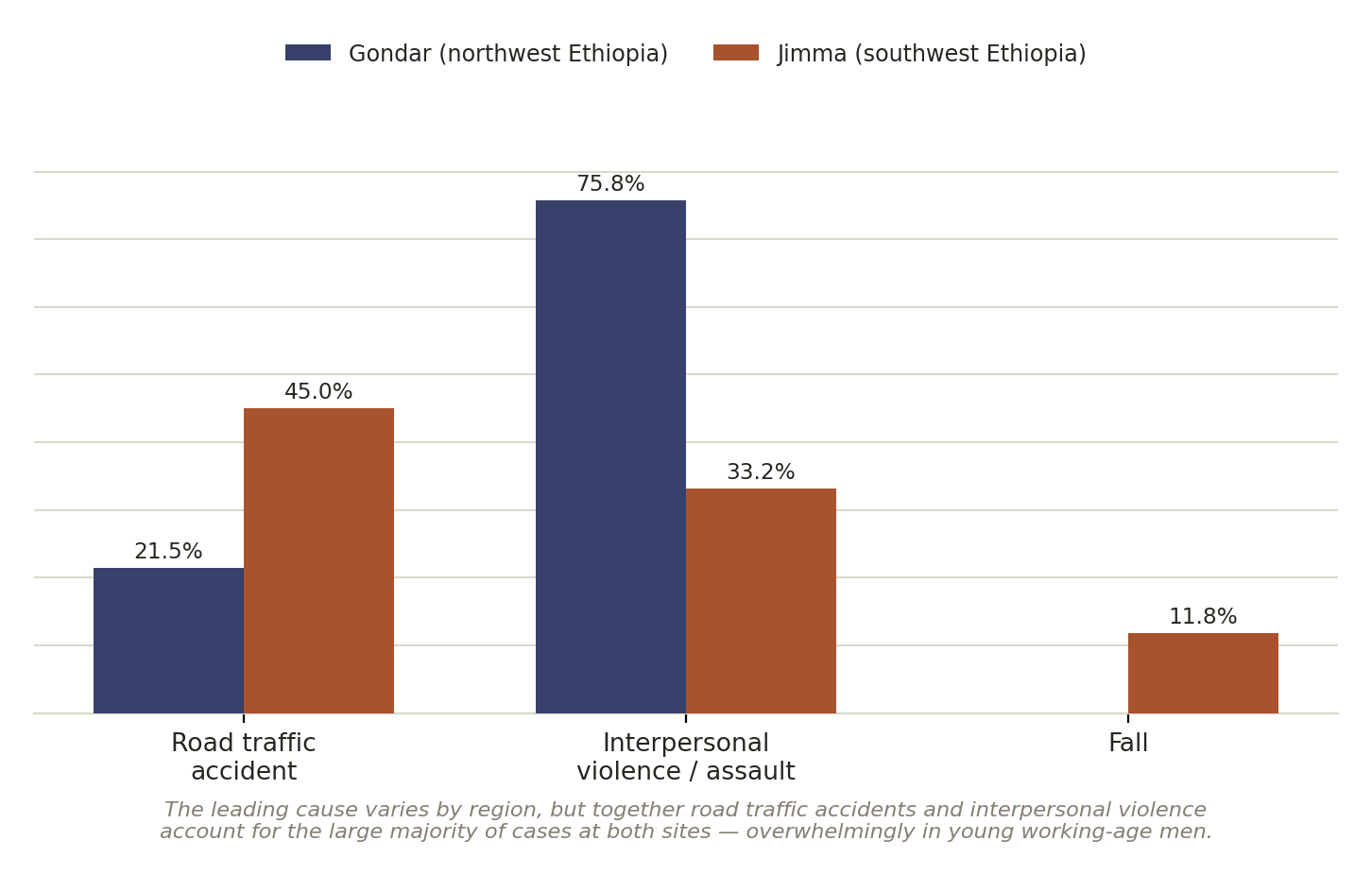
The specific leading cause varies by region — but the underlying volume of serious facial injury does not.
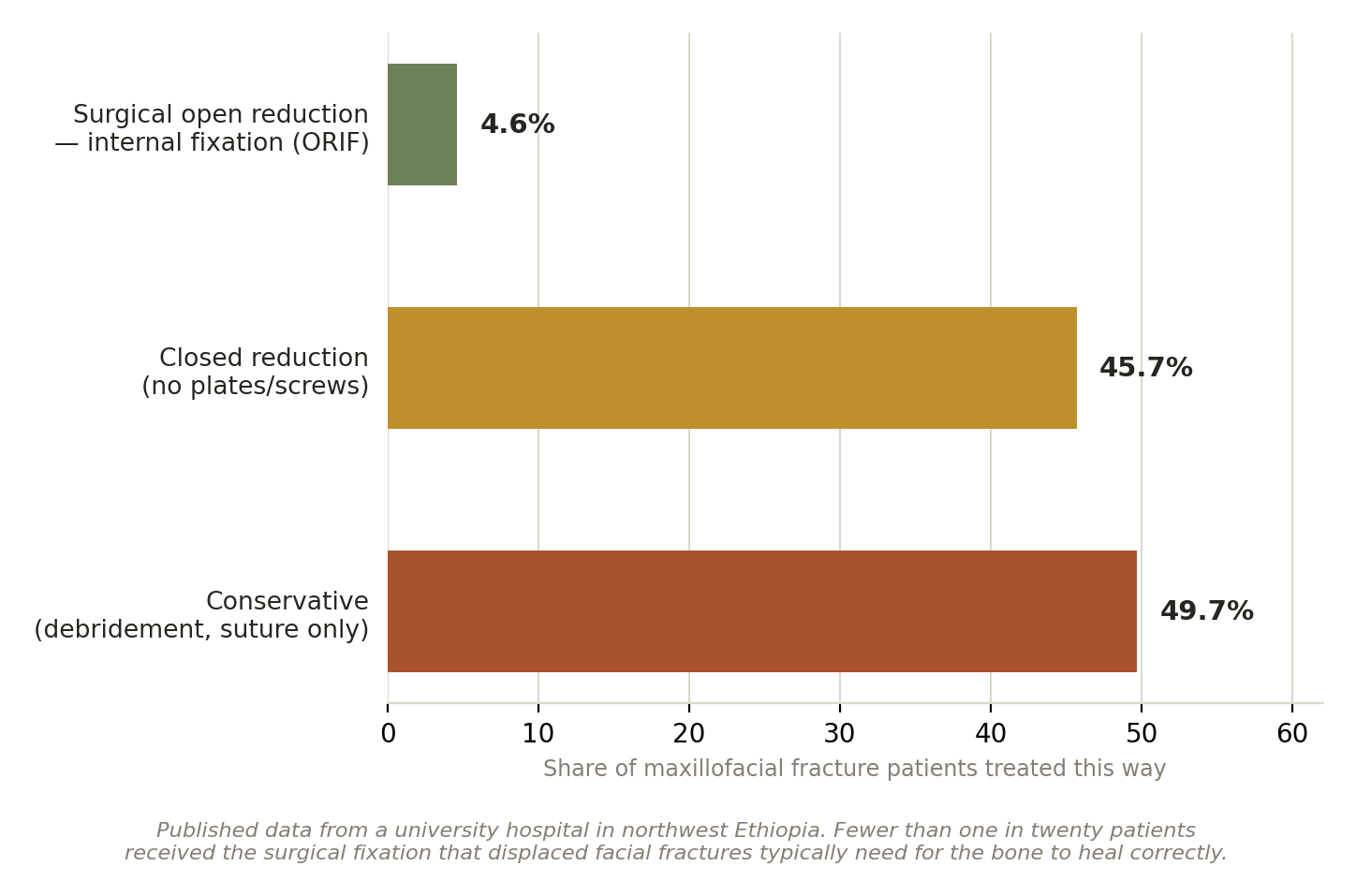
Most patients don't get surgery because it isn't indicated for their case. Published Ethiopian research is explicit that this reflects a shortage
In the words of Ethiopian clinical researchers themselves: a published study from a university hospital describes "the absence of experts in oral and maxillofacial and plastic surgery for internal fixation and open reduction" as a major obstacle to proper healing and restoring appearance after facial trauma — naming the gap plainly, in their own words.
3 Gate Three
What happens when it heals wrong?
A displaced facial fracture that heals without proper fixation doesn't simply resolve — it heals in the position it was left in. This is called a malunion, and it can mean a misaligned bite, difficulty chewing, visible facial asymmetry, or chronic jaw pain, sometimes not fully apparent until the swelling has gone down weeks later.
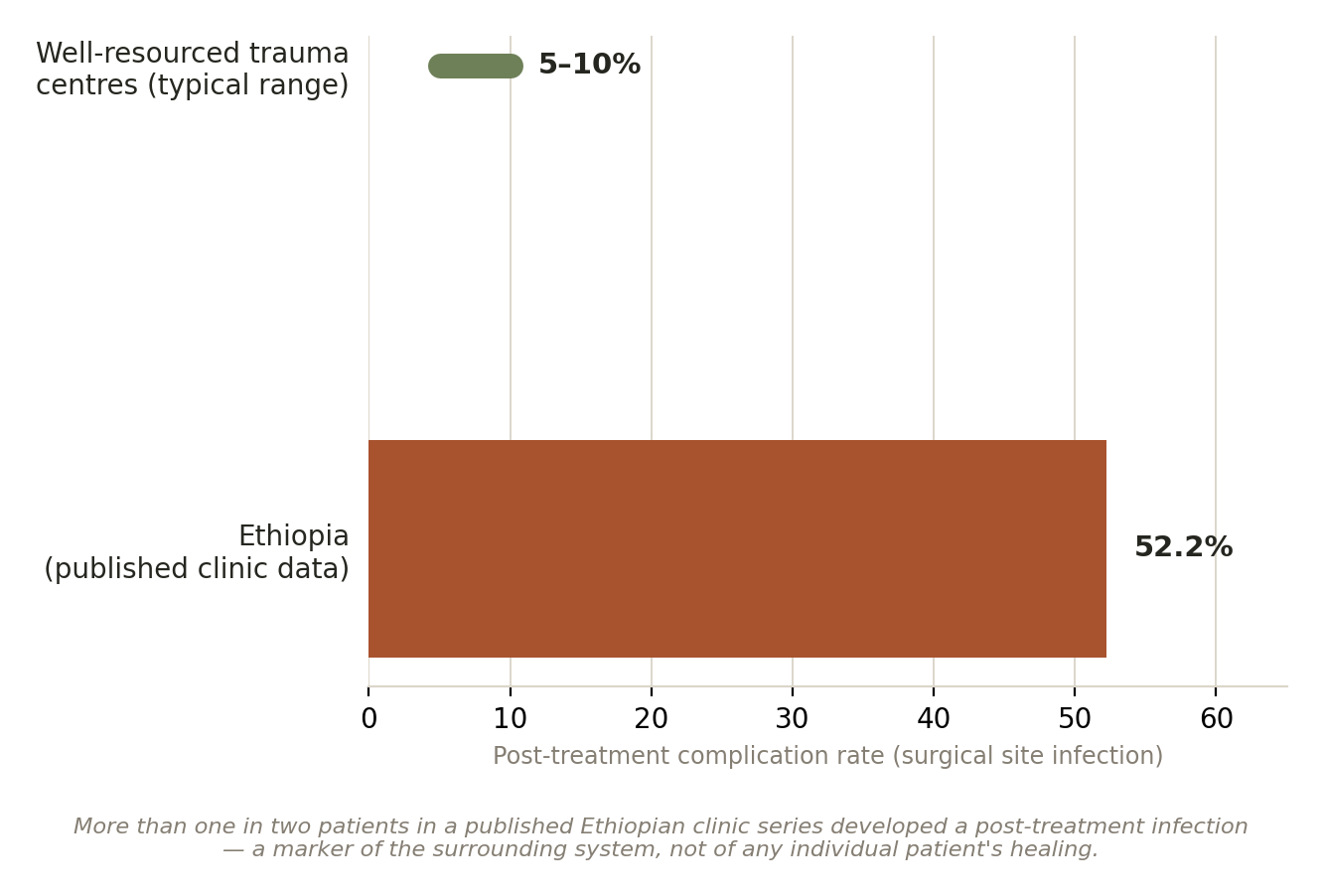
A complication rate this high is a signal about the surrounding system, not the individual patients.
Correcting a malunion later is a fundamentally harder operation than treating the original fracture would have been: the bone has already healed, often requiring the surgeon to deliberately re-break and reposition it under more complex conditions than a fresh injury presents. This is precisely why the timing of the first treatment matters as much as the treatment itself — a fracture treated correctly within the first one to two weeks has a meaningfully better prognosis than the same fracture revisited months later.
4 Gate Four
Could this be done in Ethiopia?
Emergency stabilisation and wound care are available at hospitals across Ethiopia, and that initial care matters and should not be delayed. The specific combination this injury often needs beyond that — a maxillofacial surgeon experienced in open reduction and internal fixation, CT-based surgical planning, and the plates and screws used for rigid fixation — is, as Ethiopian clinical researchers themselves describe, concentrated in very few hands nationally.
This is precisely the gap India's dedicated maxillofacial trauma units are built to close. Leading Indian centres treat facial fractures as routine, high-volume surgical practice, with same-week imaging, planning, and surgery, and the specific fixation technique and hardware that give a fractured jaw or cheekbone the best chance of healing correctly the first time. For an injury where the difference between a two-week recovery and a lifelong malunion often comes down to whether surgery happens at all, that established capability is not a convenience — it is the entire basis on which a good outcome is actually achieved. Ask any centre how many facial fracture cases their maxillofacial surgeon treats each year.
5 Gate Five
Is the money arranged?
Ethiopia's health financing does not follow a patient abroad. Community-Based Health Insurance covers contracted facilities inside the country, and the formal-sector scheme still isn't settling claims. Since February 2026 a bank may release up to US$20,000 per case against a letter from the treating hospital, without a visa or ticket in hand.
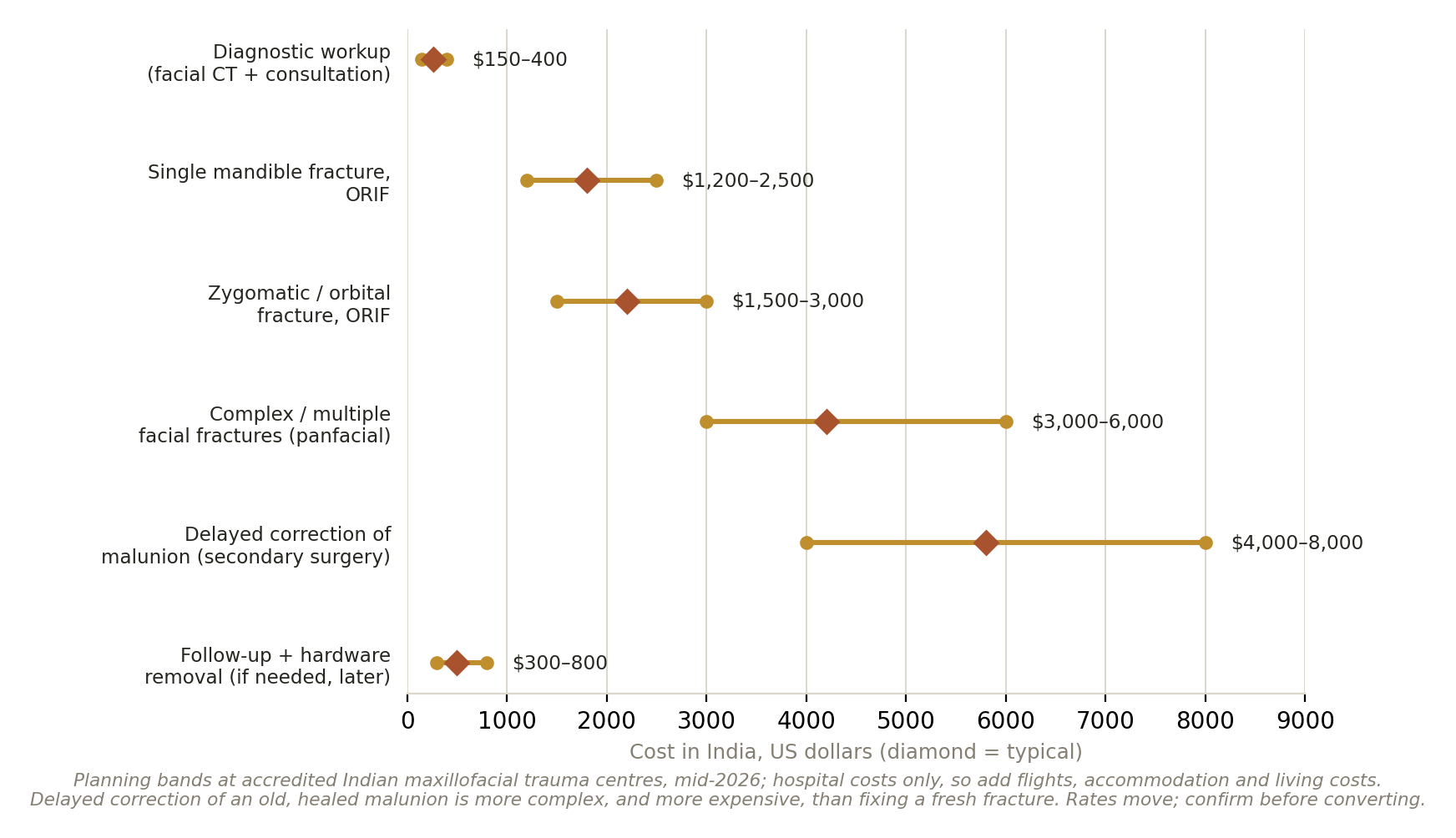
Fixing a fresh fracture costs a fraction of correcting the same injury after it has healed wrong.
The figures differ substantially by complexity and by timing: a single, fresh fracture costs well below a complex multi-fracture case, and both cost considerably less than a delayed correction of an old malunion. Even at the top of these ranges, treatment at an accredited Indian trauma centre remains a fraction of an equivalent case in the Gulf, Europe, or the United States. Confirm the fracture pattern and timing since injury before assuming any single number applies to your case.
| A quotation, annotatedA composite of the maxillofacial trauma quotes that reach me, with the questions I send back. | |
| Facial fracture surgery — USD 2,200 | Single fracture or multiple? Fresh injury or old malunion? These change the price substantially. |
| Includes: facial CT and surgical planning | Good sign. Confirm the plan is reviewed by a maxillofacial surgeon, not only a general surgeon. |
| Includes: 5 days admission | Reasonable for a single fracture. Ask what a complex case or complication would add. |
| Fixation: titanium plates and screws | Ask whether hardware removal is typically needed later, and its separate cost. |
| Excludes: dental or orthodontic follow-up | Ask whether your fracture involves the bite, and what follow-up care that needs. |
| Excludes: revision if malunion has already occurred | If treatment was delayed, ask for a separate quote reflecting the more complex correction. |
In 24 years the facial trauma patients most satisfied with their outcome were the ones who acted quickly after the injury, before a treatable fracture became a permanent malunion.
The Ethiopian practicalities
Ethiopian Airlines flies non-stop from Bole to Delhi, Mumbai, Bengaluru, Chennai, and Hyderabad. Given the time- sensitive nature of fracture treatment, contact a centre as soon as imaging confirms a displaced fracture rather than waiting, since the surgical window narrows as healing begins. Ask for written clearance to fly if there are associated head or other injuries. Yellow fever certification is required at least ten days before arrival, oral polio vaccination roughly four weeks before; where an injury is acute and urgent, ask the treating centre and the Embassy of India, Addis Ababa about expedited medical visa processing. An attendant is worth arranging for the days around surgery, particularly if jaw fixation limits eating or speaking temporarily. Confirm current rules with the Embassy, since they change, and ask for an Amharic-speaking coordinator to carry a written follow-up plan back to a named provider in Ethiopia.
Straight Answers for Ethiopian Patients about Oral and Maxillofacial Trauma Surgery in India
I have a facial injury from an accident. Does it need surgery?
Not always. A simple, non-displaced fracture can sometimes heal well with conservative care. The deciding factor is whether the fracture is displaced or affects your bite — a facial CT scan answers this, not an exam alone.
Why do so many facial fractures in Ethiopia go without surgery?
Published Ethiopian clinical data describes a shortage of qualified maxillofacial surgeons and fixation equipment. Many fractures that would benefit from surgical plates and screws are instead managed conservatively, driven by capacity, not by what the case actually needs.
What happens if a facial fracture heals without proper treatment?
The bone can heal in the wrong position (malunion), causing a misaligned bite, facial asymmetry, or chronic pain. Correcting this later is more complex and expensive than treating the original fracture correctly, since the bone often needs to be surgically re-broken.
How long does facial trauma treatment in India take?
A single, straightforward fracture typically needs three to five days including imaging, surgery, and recovery. Complex or multiple fractures may need seven to ten days. Delayed malunion correction may need two to three weeks.
Who pays for this in Ethiopia?
You do. Neither Community-Based Health Insurance nor the pending formal-sector scheme funds treatment abroad, though a bank may now advance up to US$20,000 against the treating hospital's letter.
A closing word
Send any facial CT or X-ray imaging, a note on how the injury happened and when, and photographs if available. I will tell you honestly whether this looks like a case needing surgical fixation, and why, for facial fractures specifically, acting quickly with India's dedicated trauma centres matters as much as which centre you choose.
Sources
- 🌐 Two years retrospective study of maxillofacial trauma at a tertiary center in North West Ethiopia. BMC Res Notes. 2017
- 🌐 Etiology and pattern of maxillofacial fractures among patients who visited Jimma Medical Center Dental Clinic, Jimma, Southwest Ethiopia
- 🌐 Epidemiology of maxillofacial injury among adults in sub-Saharan Africa: a scoping review. Inj Epidemiol. 2023
- 🌐 National Medical Commission of India — Indian Medical Register
- 🌐 National Accreditation Board for Hospitals & Healthcare Providers (NABH), Quality Council of India
- 🌐 National Bank of Ethiopia Directive FXD/04/2026 (foreign exchange, advance payments for treatment abroad); Embassy of India, Addis Ababa
Frequently Asked Questions by Ethiopians about Oral and Maxillofacial Trauma Surgery in India
Does every facial fracture require surgery?
No. A simple, non-displaced fracture may sometimes heal with conservative care. Surgery is more commonly considered when the fracture is displaced, affects the bite, involves the eye socket or affects multiple facial bones.
How is a facial fracture diagnosed?
A facial CT scan is important for determining whether a bone is fractured and whether the fragments are displaced or stable. The guide states that a physical examination alone cannot provide the same information.
Why do many facial fractures in Ethiopia go without surgery?
The PDF identifies a shortage of qualified maxillofacial surgeons and fixation equipment as important factors. It explains that many fractures that could benefit from plates and screws are instead managed conservatively because of treatment capacity.
What happens if a facial fracture heals incorrectly?
The bone may heal in the wrong position, known as malunion. This can cause a misaligned bite, difficulty chewing, facial asymmetry or chronic pain, and correcting it later can require a more complex operation.
How much does facial fracture surgery cost in India?
Indicative ranges include USD 1,200–2,500 for a single mandible fracture ORIF, USD 1,500–3,000 for zygomatic/orbital ORIF and USD 3,000–6,000 for complex or multiple facial fractures.
How much does delayed malunion correction cost?
The guide gives an indicative range of USD 4,000–8,000. Delayed correction is more complex because the bone may already have healed incorrectly and may need to be surgically repositioned.
How long does facial trauma treatment in India take?
A straightforward fracture typically requires approximately 3–5 days including imaging, surgery and recovery. Complex or multiple fractures may require 7–10 days, while delayed malunion correction may require approximately 2–3 weeks.
What should I send before travelling to India?
Patients should provide facial CT or X-ray imaging, details about how and when the injury occurred and photographs where available. These help the treating team assess whether surgical fixation may be required.
What should I ask about a facial fracture surgery quotation?
Ask whether facial CT and surgical planning are included, whether the plan has been reviewed by a maxillofacial surgeon, how many admission days are covered, what fixation hardware is included and whether hardware removal or dental follow-up will cost extra.
Who pays for facial trauma treatment abroad for Ethiopian patients?
The PDF states that Community-Based Health Insurance does not fund treatment abroad. It also notes that, from February 2026, a bank may advance up to US$20,000 per case against a letter from the treating hospital, subject to applicable requirements.
Page Summary
This guide explains facial fracture and maxillofacial trauma surgery options for Ethiopian patients considering treatment in India. It highlights the importance of CT diagnosis, fracture displacement and timely surgical fixation where indicated. The guide discusses Ethiopia's treatment-capacity gap and the potential consequences of untreated or incorrectly healed fractures. It provides indicative costs for ORIF, complex fractures and delayed malunion correction. It also covers treatment duration, quotation considerations, travel planning and follow-up requirements. Overall, patients should seek timely specialist assessment and confirm the complete treatment plan before travelling to India.
Citation Block
| Topic | Information |
|---|---|
| Topic Information | Oral and Maxillofacial Trauma Surgery for Ethiopian Patients in India |
| Treatment | Facial Fracture and Maxillofacial Trauma Surgery |
| Country | India |
| Intended Audience | Ethiopian Patients |
| Main Conditions | Mandible, Zygomatic, Orbital and Multiple Facial Fractures |
| Main Surgery | Open Reduction and Internal Fixation (ORIF) |
| Fixation | Titanium Plates and Screws |
| Diagnostic Workup | USD 150–400 |
| Single Mandible ORIF | USD 1,200–2,500 |
| Zygomatic / Orbital ORIF | USD 1,500–3,000 |
| Complex / Multiple Fractures | USD 3,000–6,000 |
| Delayed Malunion Correction | USD 4,000–8,000 |
| Treatment Duration | 3–5 Days for Simple; 7–10 Days for Complex Cases |
| Important Planning | Confirm Fracture Pattern, Displacement and Timing |
| Important Cost Check | Confirm Hardware, Admission and Revision Costs |
| Follow-Up | Maxillofacial and Dental / Orthodontic Care |
| Author | Dr. Dheeraj Bojwani |
| Experience | 24+ Years |


Our Mission Statement
Our mission is to place patients at the centre of every healthcare decision by providing trustworthy, evidence-based, and unbiased medical information. We believe that informed patients make better decisions. Backed by personalised guidance from our experienced advisory team, we help patients understand their treatment options, compare them objectively, and confidently choose the path that best suits their medical needs and personal circumstances.
Patient Testimonials from Ethiopia










Ready to Take the First Step?
Share your Medical Reports with our Healthcare Managers Today and Get a FREE CONSULTATION, a Personalized Treatment Plan, and Complete Support from Arrival to Recovery.
Get Your Free ConsultationAreas We Serve
This resource has been thoughtfully prepared for patients from Ethiopia who are considering medical treatment in India. We also welcome patients from the wider region in the countries mentioned below-
We assist patients from:
- Eritrea
- Djibouti
- Somalia
- Kenya
- Sudan
- Burundi
- Comoros
- Ethiopia
- Madagascar
- Malawi
- Mauritius
- Mozambique
- Rwanda
- South Sudan
Many of the insights, treatment pathways, hospital recommendations, travel guidance, and patient support services described here are equally relevant and may be used as a reference when planning treatment in India.
From Ethiopia to India: Your Complete Patient Support Guide
- Brain Tumour Surgery in India for Ethiopians
- Cancer Treatment in India for Ethiopians
- Cardiac Surgery in India for Ethiopian Patients
- Cervical and Disc Replacement Surgery in India for Ethiopians
- Cosmetic and Plastic Surgery in India for Ethiopians
- CyberKnife Treatment in India for Ethiopians
- Eye Surgery in India for Ethiopians
- Gamma Knife Treatment in India for Ethiopians
- Heart Valve Replacement Surgery in India for Ethiopians
- Hip Surgery in India for Ethiopian Patients
- Knee Surgery in India for Ethiopian Patients
- Laparoscopic and Robotic Myomectomy Surgery in India for Ethiopians
- Neurosurgery in India for Ethiopians
- Paediatric Cardiac Surgery in India for Ethiopians
- Paediatric Neurosurgery in India for Ethiopians
- Prostate Cancer Treatment and Surgery in India for Ethiopians
- Robotic Cancer Surgery in India for Ethiopians
- Scoliosis Surgery in India for Ethiopians