

Neuronavigation and Advanced Brain Surgery for Ethiopian Patients in India
Five gates every "inoperable" brain tumour should pass before accepting that word as final — and why, in a world where 90% of imaging scanners sit in high-income countries, the gap between an inoperable tumour and an operable one is often a gap in technology, not biology.
"Inoperable" is one of the heaviest words in medicine, and it deserves more scrutiny than it usually gets. In 24 years of arranging surgical care in India for patients across Africa and Asia, brain tumour surgery is a field where that word is sometimes true in an absolute sense — and sometimes true only relative to the technology available at a specific hospital. A tumour sitting near the parts of the brain that control movement or speech can be genuinely too risky to remove with standard technique alone. The same tumour, at a centre equipped with neuronavigation and functional brain mapping, can sometimes be safely and substantially resected. This distinction matters enormously for patients in Ethiopia and across the wider region. Globally, roughly 90 percent of imaging scanners are concentrated in high-income countries, and neuronavigation depends on exactly this imaging infrastructure to function. Published surveys of Sub-Saharan Africa describe neuronavigation availability as genuinely limited across the continent, and a national survey of Ethiopian neurosurgeons found even basic CT scanning present at only 62 percent of the institutions surveyed. This is not a reflection of surgical skill — Ethiopian neurosurgeons perform hundreds of craniotomies competently every year. It is a reflection of what equipment those skilled hands have to work with. India's leading neurosurgery centres run the complete technology stack — neuronavigation, functional MRI mapping, and awake craniotomy — as routine, everyday practice. These five gates walk through what "inoperable" actually means in a specific case, what neuronavigation technology can and can't change about that answer, and why India is where the technology gap closes for an Ethiopian patient today.
Healing Journeys of Ethiopian Patients









Key Takeaways
- Being told that a brain tumour is “inoperable” does not always mean surgery is impossible. The guide recommends asking whether the assessment was made with neuronavigation and functional imaging or based only on anatomical assessment.
- Neuronavigation uses preoperative imaging to guide the surgeon during brain surgery. Functional navigation goes further by mapping areas responsible for movement, speech and other critical functions specific to the patient.
- The page 3 visual shows that approximately 90% of imaging scanners are located in high-income countries, while around 70% of the world's population has very limited MRI access.
- A national survey cited in the PDF found that only 62% of surveyed Ethiopian institutions had CT scanning, highlighting the broader imaging infrastructure gap that affects access to advanced neurosurgical technology.
- The guide distinguishes between standard anatomical navigation, functional mapping and awake craniotomy, where brain function can be tested during surgery while the patient is conscious for relevant portions of the procedure.
- Ethiopian neurosurgeons already perform substantial brain tumour surgery. The PDF cites 153 craniotomies documented during one month at Tikur Anbessa Specialized Hospital, emphasising that the main issue is access to advanced technology rather than absence of surgical expertise.
- A Malawi neuronavigation case series cited in the guide reported 74.4% early survival without complications, supporting the feasibility of advanced neuronavigation in a comparable regional setting.
- Indicative Indian planning costs range from US$4,800–7,000 for standard craniotomy, US$7,000–9,500 with neuronavigation and US$8,500–12,000 for awake craniotomy with functional mapping.
- Ethiopian patients should verify exactly which technology their tumour requires, the surgeon's experience with that specific technique, whether functional imaging is included and what happens if a more advanced procedure is required.
- Ethiopian patients should also plan for 3–5 days of diagnostic workup and approximately 1–2 weeks for surgery and initial recovery, with many patients allowing 2–3 weeks in total for wound review and early imaging.
- The PDF states that Ethiopian health insurance does not fund planned treatment abroad, while a bank may advance up to US$20,000 per case against a treating hospital letter, subject to the applicable requirements.
- Travel planning includes medical visa arrangements, vaccination requirements, an attendant for the full stay and a written follow-up plan for a named neurosurgeon or oncologist in Ethiopia.
Quick Facts
- Treatment
- Neuronavigation and Advanced Brain Surgery
- Country
- India
- Patients
- Ethiopian Patients
- Main Procedures
- Craniotomy, Neuronavigation-Guided Surgery, Functional Mapping and Awake Craniotomy
- Main Condition
- Brain Tumours
- Key Technology
- Neuronavigation
- Advanced Mapping
- Functional MRI / Functional Brain Mapping
- Ethiopian CT Availability
- 62% of surveyed institutions
- Cited Ethiopian Neurosurgical Volume
- 153 brain tumour craniotomies in one month at Tikur Anbessa
- Standard Craniotomy
- US$4,800–7,000
- Craniotomy with Neuronavigation
- US$7,000–9,500
- Awake Craniotomy with Functional Mapping
- US$8,500–12,000
- Diagnostic Workup
- US$300–700
- Stereotactic Biopsy
- US$400–800
- ICU / Monitoring
- US$300–600 per additional day
- Diagnostic Stay
- Approximately 3–5 days
- Total India Stay
- Approximately 2–3 weeks
- Key Specialist
- Neurosurgeon with Advanced Brain Tumour Surgery Experience
- Important Expertise
- Procedure-specific neuronavigation and functional-mapping experience
- Hospital Accreditation
- JCI or NABH can be independently verified
- Follow-Up
- Named Neurosurgeon / Oncologist in Ethiopia
- Financing Mentioned
- Up to US$20,000 against treating hospital letter
- Required Records
- MRI/CT imaging, pathology report and previous “inoperable” assessment
In Brief
For Ethiopian patients told that a brain tumour is “inoperable,” the first question should be whether that assessment was made using the technology required to evaluate the tumour safely. The PDF explains that neuronavigation can provide real-time guidance using preoperative imaging, while functional mapping can identify areas controlling speech and movement. For tumours near critical brain regions, awake craniotomy may allow the surgical team to test function during the procedure. The guide recognises the substantial surgical work already performed by Ethiopian neurosurgeons but identifies limited access to advanced imaging, neuronavigation and functional mapping as an important technology gap. Indian centres with established advanced neurosurgical infrastructure may therefore provide an opportunity for a technology-based second opinion and reassessment of selected cases.
1 Gate One
Inoperable, or under-equipped?
Being told a brain tumour cannot be removed is what usually starts this conversation, and it is a genuinely serious statement that deserves a genuinely serious follow-up question: inoperable with what technology, and by what technique, at this specific centre? A tumour deep inside brain tissue, or wrapped closely around a major blood vessel, may truly be unsafe to remove anywhere. A tumour that is simply close to, but not inside, an area controlling movement or speech is a different and more nuanced situation.
Ask specifically whether the "inoperable" assessment was made with access to neuronavigation and functional imaging, or by anatomical judgement alone. This single question changes the entire conversation for a meaningful share of patients, and it costs nothing to ask before accepting a diagnosis that closes off surgical options entirely.
2 Gate Two
Why 70% of the world barely has an MRI
Neuronavigation is not a standalone device; it is built entirely on imaging infrastructure that, globally, is distributed very unevenly.
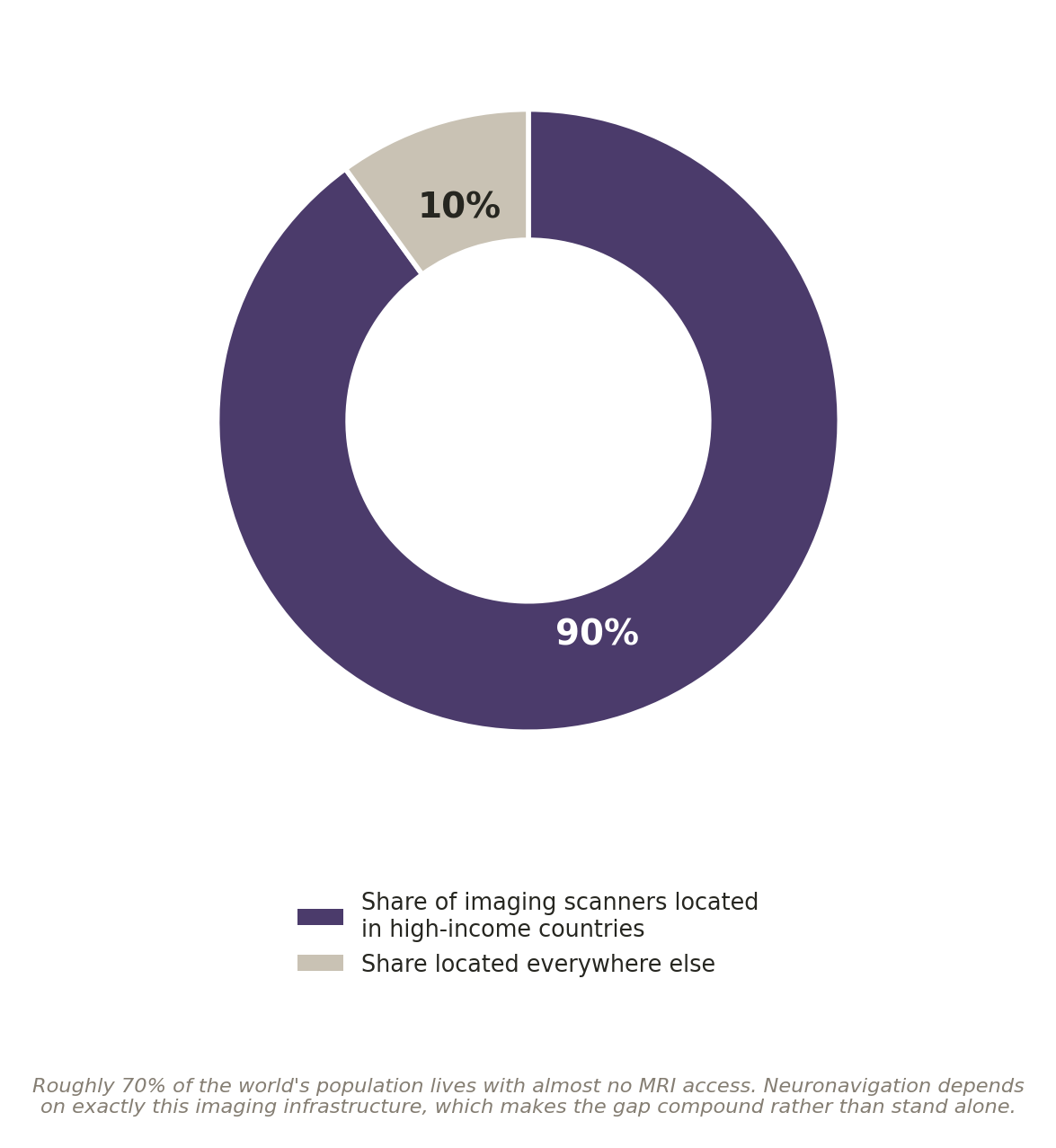
Roughly 70% of the world's population lives with almost no MRI access — the exact resource neuronavigation depends on.
Ethiopia's own picture, from a national survey of practising neurosurgeons, is specific and worth knowing directly:
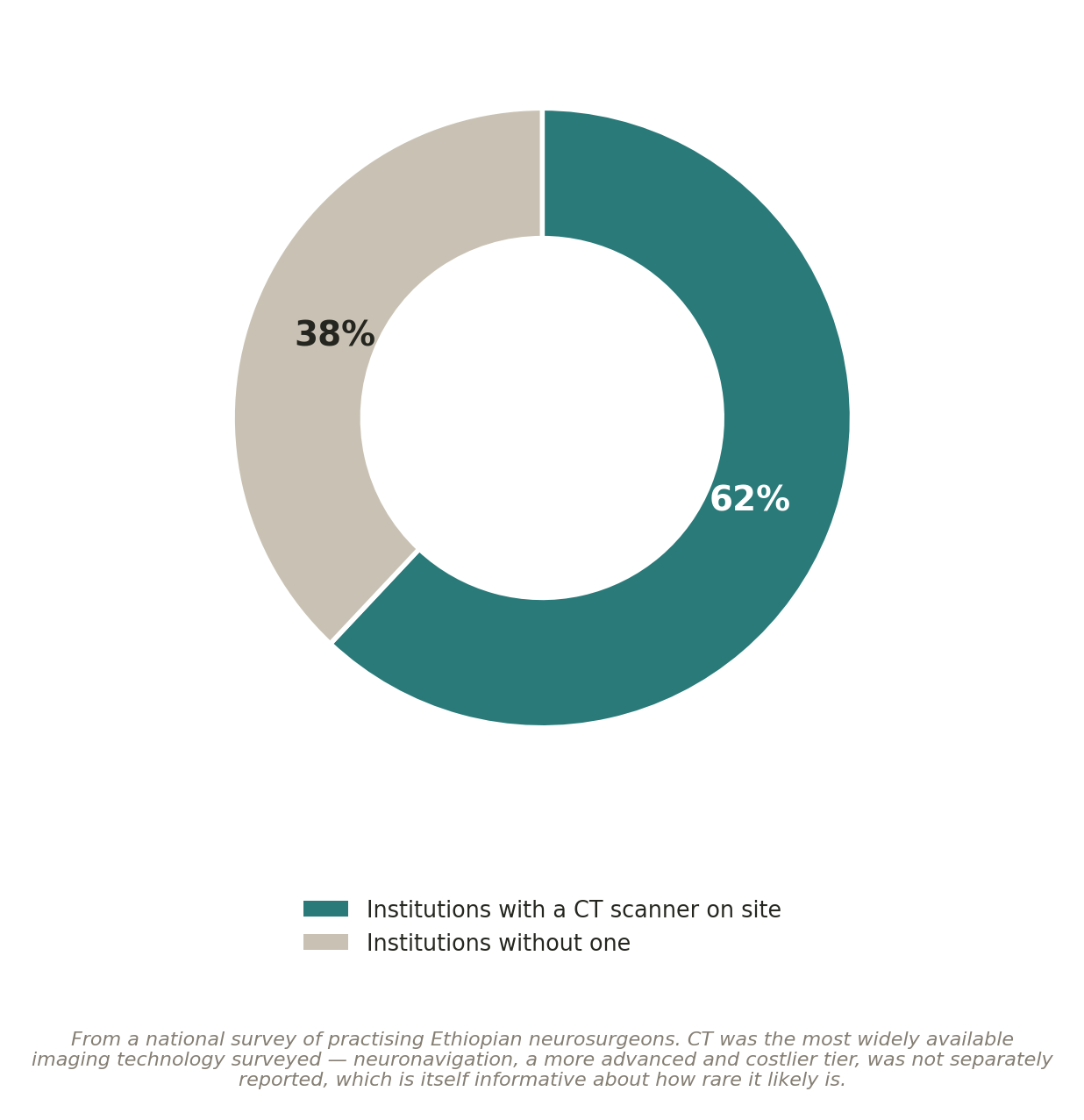
CT, the most basic imaging tier, is missing at nearly four in ten surveyed institutions — neuronavigation sits well above this on the technology ladder.
3 Gate Three
Which navigation, and trusted how?
Neuronavigation is not one single technology. Standard anatomical navigation shows a tumour's location relative to fixed brain structures. Functional navigation goes further, merging in specialised scans that map exactly where movement, speech, and other critical functions actually sit in that specific patient's brain, since this varies somewhat from person to person. Awake craniotomy, where the patient is kept conscious for parts of the operation, allows the surgical team to directly test function in real time as tissue near a critical area is removed.
Why the specific modality matters as much as having one at all: a surgeon experienced in standard anatomical navigation but unfamiliar with functional mapping may not get the full safety benefit this technology offers for a tumour near an eloquent brain area. Ask specifically which type of navigation is being proposed, and how many cases of this specific technique the surgeon has personally performed, not simply how many years they have practised neurosurgery overall.
4 Gate Four
Could this be done in Ethiopia?
Ethiopian neurosurgeons perform genuine, high-volume work: a review of one month at Tikur Anbessa Specialized Hospital alone documented 153 craniotomies for brain tumours. The surgical skill and judgement this reflects deserves real recognition. The specific technology layer this guide is about — neuronavigation and functional mapping — is, per the regional literature, still genuinely limited across Sub-Saharan Africa.
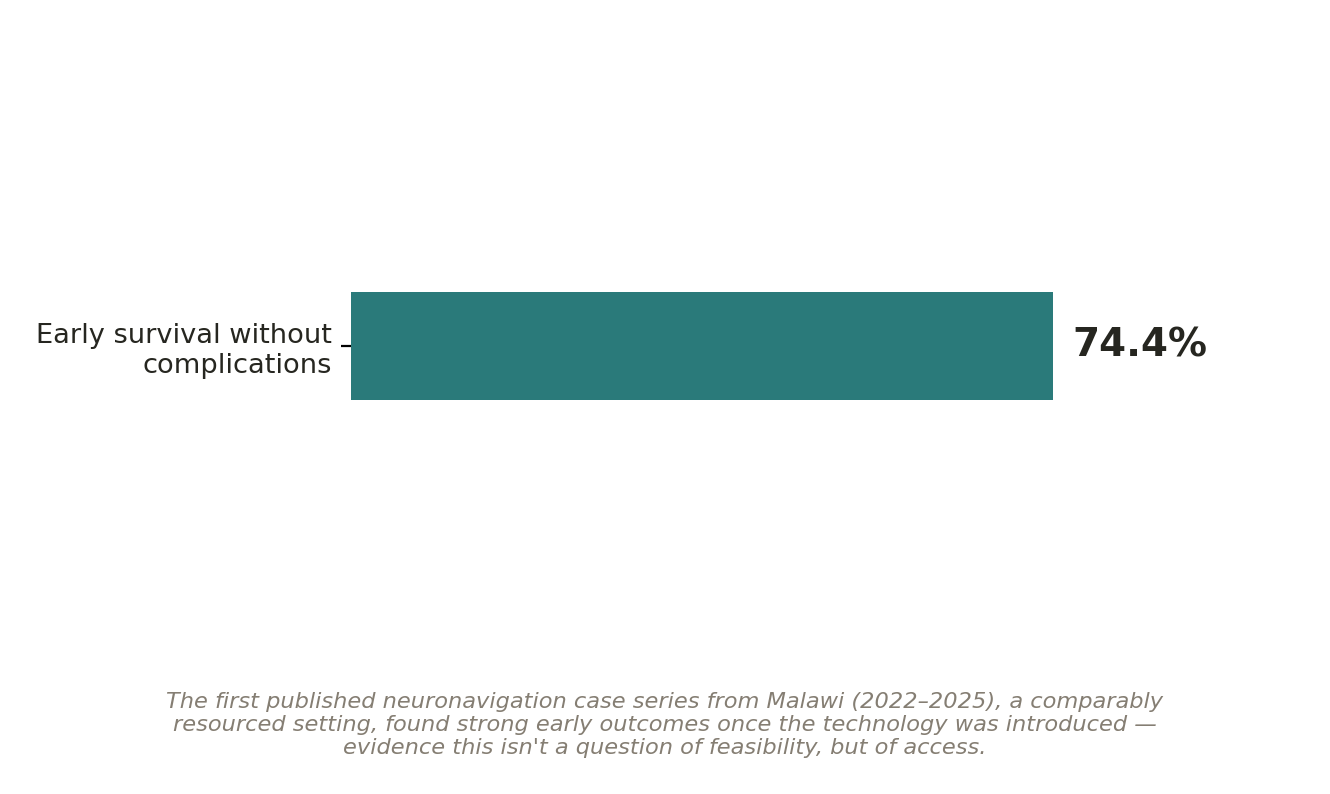
Where this technology has been introduced in a comparable regional setting, it has worked well — the barrier has been access, not feasibility.
This is precisely where India's neurosurgery centres add genuine, comparative depth: neuronavigation and functional MRI mapping as routine equipment, surgeons who perform awake craniotomies as a defined part of their practice rather than an occasional case, and multidisciplinary teams including neuro-anaesthesia experienced specifically in awake procedures. For a tumour where the difference between "inoperable" and "safely resectable" genuinely depends on this technology, that established infrastructure is not a convenience — it is what actually reopens the door to surgery. Ask any centre what specific navigation technology they use and how many functional-mapping cases they perform annually.
5 Gate Five
Is the money arranged?
Ethiopia's health financing does not follow a patient abroad. Community-Based Health Insurance covers contracted facilities inside the country, and the formal-sector scheme still isn't settling claims. Since February 2026 a bank may release up to US$20,000 per case against a letter from the treating hospital, without a visa or ticket in hand.
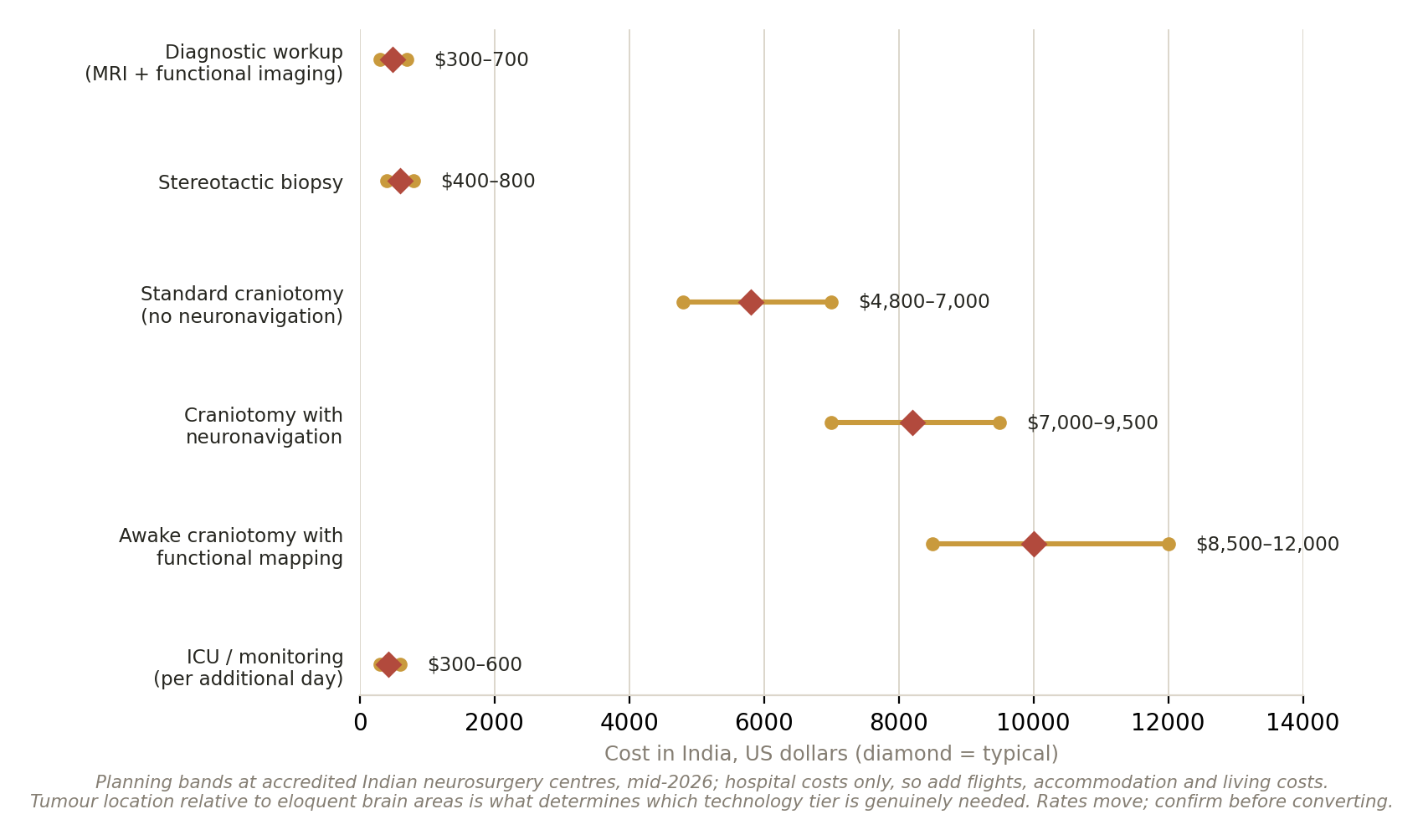
Budget for the technology tier your tumour's location actually requires, not the most familiar figure.
The figures differ substantially by technology tier: a standard craniotomy sits below one performed with neuronavigation, and awake craniotomy with functional mapping, the most technically demanding tier, costs more still. Even at the top of these ranges, treatment at a leading Indian neurosurgery centre remains a fraction of an equivalent case in the Gulf, Europe, or the United States. Confirm which tier your tumour's location genuinely requires before assuming any single number applies to your case.
| A quotation, annotatedA composite of the brain surgery quotes that reach me, with the questions I send back. | |
| Craniotomy — USD 6,500 | With neuronavigation, or without? This determines whether this price actually fits your case. |
| Includes: MRI review and surgical planning | Ask whether functional imaging was included in this planning, if the tumour is near an eloquent area. |
| Technique: standard craniotomy | If your tumour is near motor or speech areas, ask explicitly why neuronavigation isn't being used. |
| Includes: 7 days admission | Reasonable for standard cases. Ask what a longer ICU stay or complication would add. |
| Excludes: awake craniotomy / functional mapping | Ask what this would cost if your case is reassessed as needing it. |
| Excludes: post-operative radiotherapy if indicated | Ask whether your tumour type typically needs this, and its separate cost. |
In 24 years the brain tumour patients most satisfied with their outcome were the ones who asked for a second opinion specifically from a centre with functional mapping before accepting "inoperable" as a final answer.
The Ethiopian practicalities
Ethiopian Airlines flies non-stop from Bole to Delhi, Mumbai, Bengaluru, Chennai, and Hyderabad. Ask for written clearance to fly rather than assuming a fixed number of days after surgery, since this varies by tumour type and technique used. Yellow fever certification is required at least ten days before arrival, oral polio vaccination roughly four weeks before. The medical visa follows the hospital's invitation letter through the Embassy of India, Addis Ababa, and an attendant is essential for the full stay. Where treatment spans the Orthodox fasting calendar, raise this with the hospital's dietary team beforehand. Confirm current rules with the Embassy, since they change, and ask for an Amharic- speaking coordinator to carry a written follow-up plan, including any imaging schedule, back to a named neurosurgeon or oncologist in Ethiopia.
Straight Answers for Ethiopian Patients about Neuronavigation and Advanced Brain Surgery in India
I was told my brain tumour is inoperable. Is that final?
Not always. Ask specifically: inoperable with what technology, at this centre? A tumour near critical brain function may be genuinely unsafe to remove with standard technique, but sometimes safely resectable with neuronavigation and functional mapping. A second opinion is worth seeking.
What is neuronavigation, in plain terms?
A real-time guidance system for brain surgery, similar to GPS. Preoperative scans are loaded into a system tracking instruments during surgery, showing the surgeon's position relative to the tumour and nearby critical structures.
Is neuronavigation available in Ethiopia?
Skilled neurosurgeons perform brain tumour surgery routinely. Neuronavigation specifically remains limited regionally; a national survey found even basic CT scanning at only 62% of surveyed institutions.
How long does brain tumour surgery in India take?
Diagnostic workup takes three to five days. Surgery and initial recovery need one to two weeks. Many patients plan two to three weeks total, including a wound check and early follow-up imaging.
Who pays for this in Ethiopia?
You do. Neither Community-Based Health Insurance nor the pending formal-sector scheme funds treatment abroad, though a bank may now advance up to US$20,000 against the treating hospital's letter.
A closing word
Send the MRI or CT imaging, the pathology report if a biopsy was already done, and the specific reasoning behind any "inoperable" assessment. I will tell you honestly whether neuronavigation and functional mapping could genuinely change that assessment, and why India's neurosurgery centres are where that specific technology gap closes for an Ethiopian patient today.
Sources
- 🌐 Asfaw ZK, Tirsit A, Barthélemy EJ, et al. Current neurosurgical care in Ethiopia using the lens of a high-quality health system framework
- 🌐 Perioperative care and outcomes of patients with brain tumors undergoing elective craniotomy
- 🌐 Balogun JA. Situating Sub-Saharan Africa within intra-operative innovations in neurooncology. Front Surg. 2022
- 🌐 Neuronavigation-guided brain surgery: a retrospective case series from Malawi (2022-2025). PMC. 2025
- 🌐 Bridging the global technology gap in neurosurgery: disparities in access to advanced tools for brain tumor resection. Neurosurg Pract. 2024
- 🌐 National Medical Commission of India — Indian Medical Register, for verifying a treating neurosurgeon's qualification and registration
- 🌐 National Bank of Ethiopia Directive FXD/04/2026 (foreign exchange, advance payments for treatment abroad); Embassy of India, Addis Ababa
Frequently Asked Questions by Ethiopians about Neuronavigation and Advanced Brain Surgery in India
Does an “inoperable” brain tumour diagnosis mean Ethiopian patients cannot have surgery?
Not necessarily. Ethiopian patients should ask whether the tumour was assessed at a centre with neuronavigation and functional imaging. A second opinion may determine whether advanced technology could make selected tumours safer to approach.
Can Ethiopian patients get a neuronavigation-based second opinion in India?
Yes. Ethiopian patients can have their MRI or CT imaging and previous medical reports reviewed by an Indian neurosurgical team experienced in neuronavigation. The PDF specifically recommends seeking a technology-based second opinion before accepting “inoperable” as the final answer.
What does neuronavigation mean for an Ethiopian patient undergoing brain surgery?
Neuronavigation is a real-time guidance system that uses preoperative scans to show the surgeon the position of the tumour and nearby structures during surgery. It is particularly useful when precise localisation is important.
When might functional brain mapping be important for Ethiopian patients?
Functional mapping may be particularly relevant when an Ethiopian patient's tumour is close to areas responsible for speech, movement or other critical functions. It helps the surgical team understand the patient's individual functional anatomy before or during surgery.
Can Ethiopian patients undergo awake craniotomy in India?
Selected Ethiopian patients may be assessed for awake craniotomy when a tumour is located near important functional brain areas. The PDF explains that keeping the patient conscious during relevant portions of surgery allows the team to test neurological function while removing tissue.
How much does neuronavigation brain surgery cost for Ethiopian patients in India?
The PDF gives an indicative range of US$7,000–9,500 for craniotomy with neuronavigation. If functional mapping and awake craniotomy are required, the indicative range increases to approximately US$8,500–12,000.
How long should Ethiopian patients stay in India for advanced brain tumour surgery?
Ethiopian patients should generally allow 3–5 days for diagnostic workup, followed by approximately one to two weeks for surgery and initial recovery. Many patients may plan around two to three weeks in total, including wound review and early follow-up imaging.
Is advanced neuronavigation widely available in Ethiopia?
The PDF recognises that Ethiopian neurosurgeons perform substantial brain tumour surgery, but access to neuronavigation and functional mapping remains limited. A cited national survey found CT scanning at only 62% of surveyed institutions, placing more advanced navigation technology considerably higher on the technology ladder.
Can Ethiopian patients get financial assistance for brain surgery in India?
The PDF states that Ethiopian health insurance does not fund planned treatment abroad, while a bank may provide an advance of up to US$20,000 against a treating hospital's letter under the cited 2026 arrangement. Patients should confirm the current requirements directly with the relevant bank.
What should Ethiopian patients carry before travelling to India for brain tumour surgery?
Ethiopian patients should provide their MRI or CT imaging, pathology report if a biopsy has been performed, and the specific reasoning behind any “inoperable” assessment. They should also obtain a written follow-up and imaging plan for a named neurosurgeon or oncologist in Ethiopia.
Page Summary
This guide helps Ethiopian patients understand whether a brain tumour described as “inoperable” should receive a technology-based second opinion before surgery is ruled out. It explains how neuronavigation, functional brain mapping and awake craniotomy can provide additional information and surgical precision for tumours close to important brain functions. The guide also highlights Ethiopia's existing neurosurgical expertise while identifying limitations in access to advanced imaging and navigation technology. It presents evidence from Ethiopia and a comparable African setting to explain why access, rather than surgical feasibility alone, can influence treatment options. Indicative Indian costs are provided for standard craniotomy, neuronavigation-guided surgery and awake craniotomy with functional mapping. The final sections cover quotation checks, financing, travel requirements, expected stay and follow-up arrangements in Ethiopia.
Citation Block
| Topic | Information |
|---|---|
| Topic Information | Neuronavigation and Advanced Brain Surgery for Ethiopian Patients in India |
| Treatment | Advanced Brain Tumour Surgery |
| Country | India |
| Intended Audience | Ethiopian Patients |
| Main Procedures | Craniotomy, Neuronavigation, Functional Mapping and Awake Craniotomy |
| Main Condition | Brain Tumours |
| Key Technology | Neuronavigation |
| Functional Technology | Functional MRI / Brain Mapping |
| Ethiopian CT Availability | 62% of surveyed institutions |
| Cited Ethiopian Surgery Volume | 153 brain tumour craniotomies in one month |
| Standard Craniotomy Cost | US$4,800–7,000 |
| Neuronavigation Craniotomy | US$7,000–9,500 |
| Awake Craniotomy | US$8,500–12,000 |
| Diagnostic Workup | US$300–700 |
| Typical India Stay | Approximately 2–3 weeks |
| Key Specialist | Advanced Brain Tumour Neurosurgeon |
| Important Experience | Specific neuronavigation and functional-mapping case volume |
| Hospital Accreditation | JCI or NABH can be independently verified |
| Follow-Up | Named Neurosurgeon / Oncologist in Ethiopia |
| Financing Arrangement | Up to US$20,000 against treating hospital letter |
| Pre-Travel Check | Confirm tumour location, required technology and complete quotation |
| Author | Dr. Dheeraj Bojwani |
| Experience | 24+ Years |


Our Mission Statement
Our mission is to place patients at the centre of every healthcare decision by providing trustworthy, evidence-based, and unbiased medical information. We believe that informed patients make better decisions. Backed by personalised guidance from our experienced advisory team, we help patients understand their treatment options, compare them objectively, and confidently choose the path that best suits their medical needs and personal circumstances.
Patient Testimonials from Ethiopia










Ready to Take the First Step?
Share your Medical Reports with our Healthcare Managers Today and Get a FREE CONSULTATION, a Personalized Treatment Plan, and Complete Support from Arrival to Recovery.
Get Your Free ConsultationAreas We Serve
This resource has been thoughtfully prepared for patients from Ethiopia who are considering medical treatment in India. We also welcome patients from the wider region in the countries mentioned below-
We assist patients from:
- Eritrea
- Djibouti
- Somalia
- Kenya
- Sudan
- Burundi
- Comoros
- Ethiopia
- Madagascar
- Malawi
- Mauritius
- Mozambique
- Rwanda
- South Sudan
Many of the insights, treatment pathways, hospital recommendations, travel guidance, and patient support services described here are equally relevant and may be used as a reference when planning treatment in India.
From Ethiopia to India: Your Complete Patient Support Guide
- Brain Tumour Surgery in India for Ethiopians
- Cancer Treatment in India for Ethiopians
- Cardiac Surgery in India for Ethiopian Patients
- Cervical and Disc Replacement Surgery in India for Ethiopians
- Cosmetic and Plastic Surgery in India for Ethiopians
- CyberKnife Treatment in India for Ethiopians
- Eye Surgery in India for Ethiopians
- Gamma Knife Treatment in India for Ethiopians
- Heart Valve Replacement Surgery in India for Ethiopians
- Hip Surgery in India for Ethiopian Patients
- Knee Surgery in India for Ethiopian Patients
- Laparoscopic and Robotic Myomectomy Surgery in India for Ethiopians
- Neurosurgery in India for Ethiopians
- Paediatric Cardiac Surgery in India for Ethiopians
- Paediatric Neurosurgery in India for Ethiopians
- Prostate Cancer Treatment and Surgery in India for Ethiopians
- Robotic Cancer Surgery in India for Ethiopians
- Scoliosis Surgery in India for Ethiopians