

Liver Transplant Surgery for Ethiopian Patients in India
Five gates every liver failure or liver cancer case should pass before booking a flight — and why, in a country with no functioning transplant programme yet and roughly one liver disease death every 35 minutes, India's living-donor model is not simply the faster option but often the only one that arrives in time.
Liver transplant is the only cure for end-stage liver failure and for liver cancer confined to the organ, and Ethiopia does not yet have a fully functional programme to deliver it. In 24 years of arranging surgical care in India for patients across Africa and Asia, liver disease is a field where the human cost of that absence is unusually stark and well documented: published hepatitis data puts Ethiopia's toll from HBV and HCV-related liver disease at roughly one death every 35 minutes, almost entirely from causes that are either preventable, treatable, or curable with the right care delivered at the right time. The disease pattern itself is also specific to Ethiopia in a way that changes the right questions to ask. Where liver failure in much of the West traces to alcohol or fatty liver disease, roughly three in four Ethiopian liver deaths trace to hepatitis B or C — infections that antiviral therapy can control, sometimes for years, before transplant ever becomes necessary. And when transplant is genuinely needed, India's model changes the entire calculation: rather than joining a scarce deceased-donor waiting list measured in months to years, a healthy, willing family member with a compatible blood type can donate a portion of their liver directly, with surgery scheduled in weeks. These five gates walk through whether antiviral treatment can still change the course of the disease, what a transplant actually requires, and why India's living-donor transplant programmes are where Ethiopian patients can access this treatment fastest and most reliably today.
Healing Journeys of Ethiopian Patients









Key Takeaways
- Ethiopian patients with liver disease should establish whether transplant is genuinely required before travelling. MELD scoring helps assess liver function and urgency, while compensated cirrhosis may sometimes be managed without transplant.
- Hepatitis B and C are particularly important in Ethiopia. The guide highlights that antiviral treatment can sometimes control liver disease and may delay or prevent the need for transplantation when started early.
- When transplantation is necessary, a compatible living family donor can significantly change the timeline. India's transplant system performs a large proportion of liver transplants using living donors, allowing suitable patients to avoid a deceased-donor waiting list.
- Ethiopia does not currently have a fully functional liver transplant programme, although a programme is in development. Patients requiring transplantation today therefore need to consider treatment abroad.
- The PDF highlights India's living-donor transplant infrastructure, including donor evaluation, hepatobiliary surgeons and specialised post-transplant ICU care.
- Patients should understand their MELD score, donor suitability and complete treatment pathway before comparing transplant costs.
- Another important consideration is long-term follow-up after transplantation. Ethiopian patients should confirm their immunosuppressive medication requirements, follow-up schedule and communication plan with a hepatologist in Ethiopia before leaving India, so post-transplant care can continue safely after returning home.
Quick Facts
- Treatment
- Liver Transplant Surgery
- Country
- India
- Patients
- Ethiopian Patients
- Primary Condition
- End-Stage Liver Disease and Selected Liver Cancer
- Key Assessment
- MELD Score
- Important Causes
- Hepatitis B and Hepatitis C
- First Treatment Consideration
- Antiviral Therapy Where Appropriate
- Main Transplant Options
- Living-Donor and Deceased-Donor Liver Transplant
- Preferred Donor Route
- Compatible Living Family Donor
- Living Donor
- Usually Donates a Portion of the Liver
- Key Donor Assessment
- Blood Group, Imaging, Medical and Psychological Evaluation
- Main Surgical Team
- Hepatobiliary and Liver Transplant Team
- Key Specialists
- Transplant Surgeon, Hepatologist, Anaesthetist and ICU Team
- Main Selection Factor
- MELD Score and Donor Suitability
- Why Consider India
- High-Volume Living-Donor Liver Transplant Programmes
- Ethiopia Treatment Option
- Fully Functional Liver Transplant Programme Not Yet Available
- Diagnostic Workup Cost
- USD 500–1,200
- Donor Evaluation Cost
- USD 1,500–3,500
- Living-Donor Transplant Cost
- USD 25,000–40,000
- Deceased-Donor Transplant Cost
- USD 30,000–50,000 Where Pursued
- Antiviral Therapy
- USD 200–800 Per Year
- Post-Transplant Immunosuppression
- USD 150–400 Per Month
- Treatment Duration
- Many Patients Plan Approximately 6–8 Weeks Total
- Travel Route
- Direct Ethiopian Airlines Flights to Delhi, Mumbai, Bengaluru, Chennai and Hyderabad
- Travel Requirement
- Medical Visa, Yellow Fever Certificate and Oral Polio Vaccination
- Important Documents
- Liver Function Tests, MELD Score, Viral Hepatitis Reports and Imaging
- Follow-Up
- Written Plan for Continued Care with a Hepatologist in Ethiopia
- Payment Advice
- Obtain a Written, Itemised Transplant Quotation
In Brief
Ethiopian patients considering liver transplantation in India should first determine whether antiviral treatment can still control the underlying liver disease or whether transplantation has become necessary. MELD assessment helps establish disease severity and urgency. For patients who genuinely require transplantation, India's living-donor model can allow a suitable family member to donate part of their liver, avoiding a potentially lengthy deceased-donor waiting period. Before travelling, patients should complete donor evaluation, obtain liver function and viral hepatitis reports, understand the transplant quotation and arrange a clear post-transplant follow-up plan with a hepatologist in Ethiopia.
1 Gate One
Failing, or still fighting?
Jaundice, swelling, confusion, or a mass found on liver imaging is what usually starts this conversation, and not every one of these findings means transplant is the next step. Doctors use the MELD score, based on routine blood tests, to measure how well the liver is currently functioning and how urgently intervention is needed.
Compensated cirrhosis, where the liver is scarred but still managing its basic functions, can often be monitored and managed for years without transplant. Decompensated cirrhosis, where the liver can no longer keep up, and certain liver cancers within specific size and number limits, are where transplant genuinely becomes the conversation. Ask explicitly what your MELD score is and what stage of liver disease it reflects, since this determines everything that follows.
2 Gate Two
Which virus, and is it still treatable?
The cause of liver disease in Ethiopia looks different from the pattern most international guidance is written around.
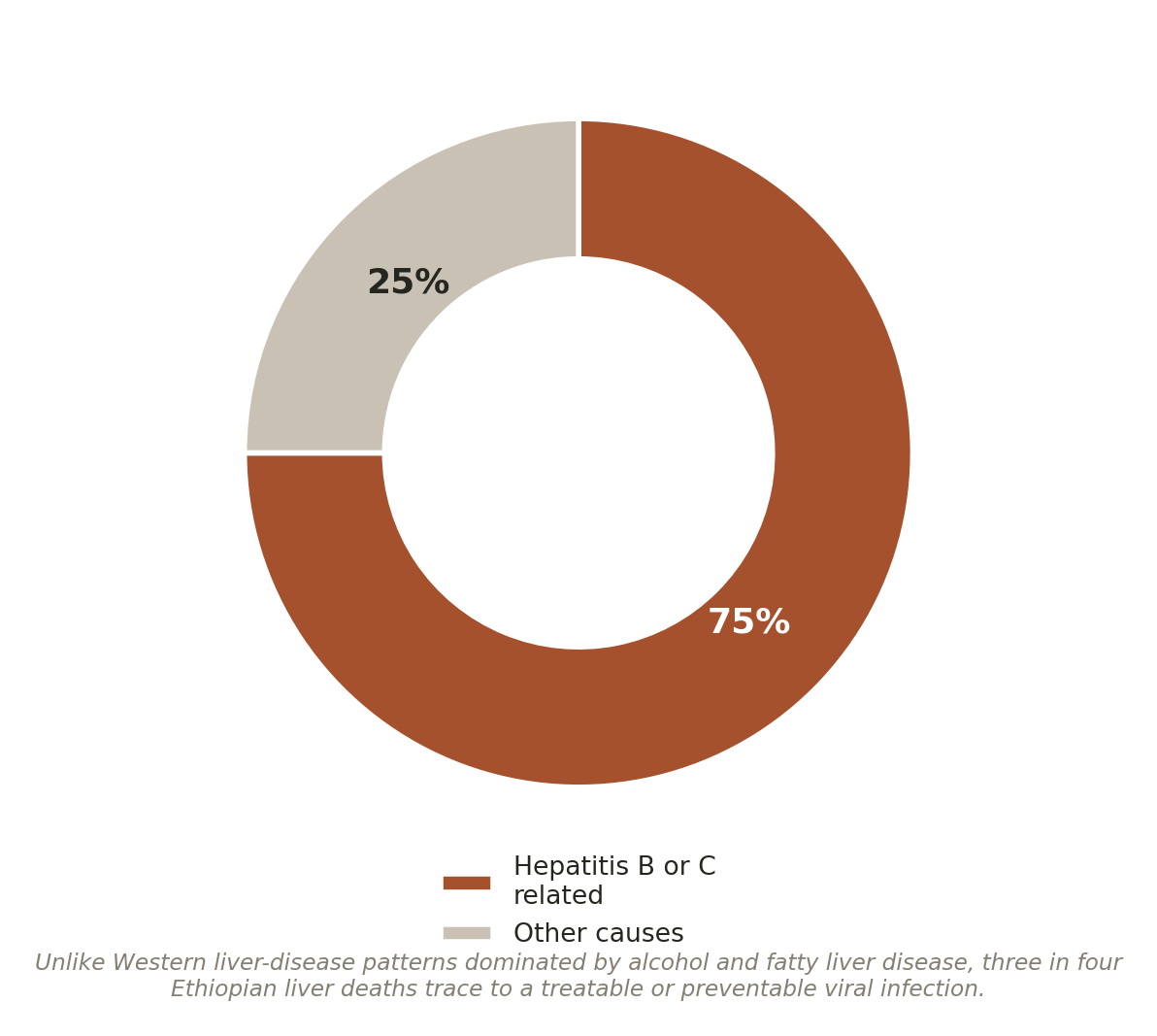
Three in four Ethiopian liver deaths trace to a virus that antiviral therapy can often control.
Why timing matters more than almost anything else here: a five-year Ethiopian treatment programme found that patients who started antiviral therapy for hepatitis B before developing cirrhosis had a 99 percent chance of remaining free of liver cancer five years later, against 54 percent for those who started treatment only after their cirrhosis had already decompensated. The single most powerful intervention in this entire guide may be a blood test and a course of antiviral tablets, started early enough.
Ask whether hepatitis B or C has been tested for and treated, and if not, why not, before any transplant conversation begins. For many patients, this question matters more than any hospital choice that follows.
3 Gate Three
Living donor, or a waiting list?
Once transplant is genuinely needed, the donor question shapes everything about timing. A deceased-donor liver comes from a person who has died, allocated by national waiting lists ranked by urgency — a system where roughly a fifth to a quarter of patients die while still waiting, according to published transplant literature. A living-donor liver comes from a healthy, willing relative, usually removing roughly half of their liver, which regenerates to near- full size and function within weeks in both donor and recipient.
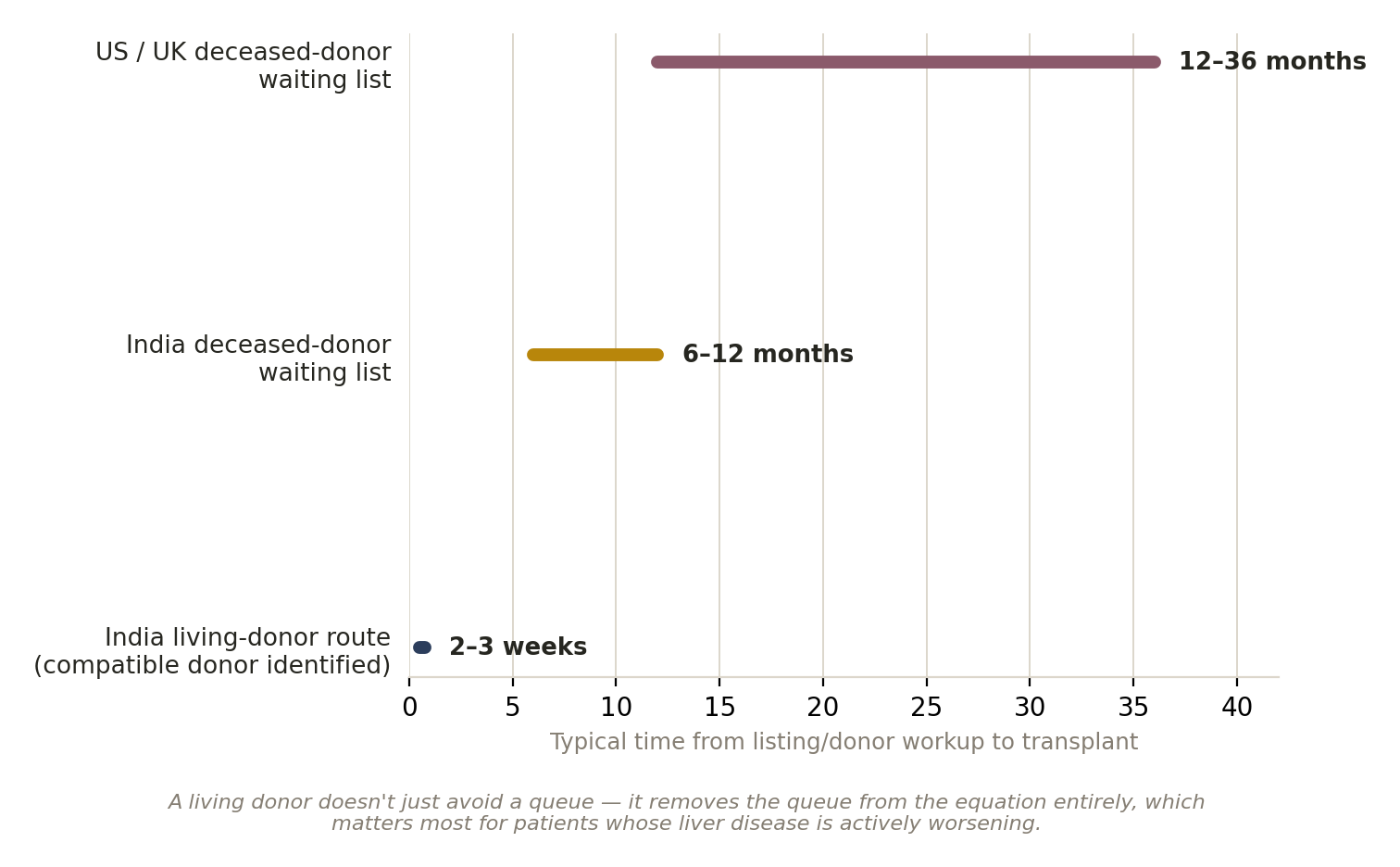
A living donor doesn't shorten the queue. It removes it.
India performs the large majority of its liver transplants using living donors, precisely because deceased-organ donation rates remain comparatively low nationally — a circumstance that happens to make India's transplant system unusually well suited to patients arriving with a willing family donor already identified. Ask any centre what share of their transplants are living-donor, and what their donor safety outcomes look like.
4 Gate Four
Could this be done in Ethiopia?
Honestly: not yet. Ethiopia does not currently have a fully functional liver transplant programme. A first programme is in active development, led by Ethiopian-born specialists working with international partners at St. Paul's Hospital Millennium Medical College, and it represents genuine, hopeful progress — but it is not yet a resource a patient with liver failure today can rely on.
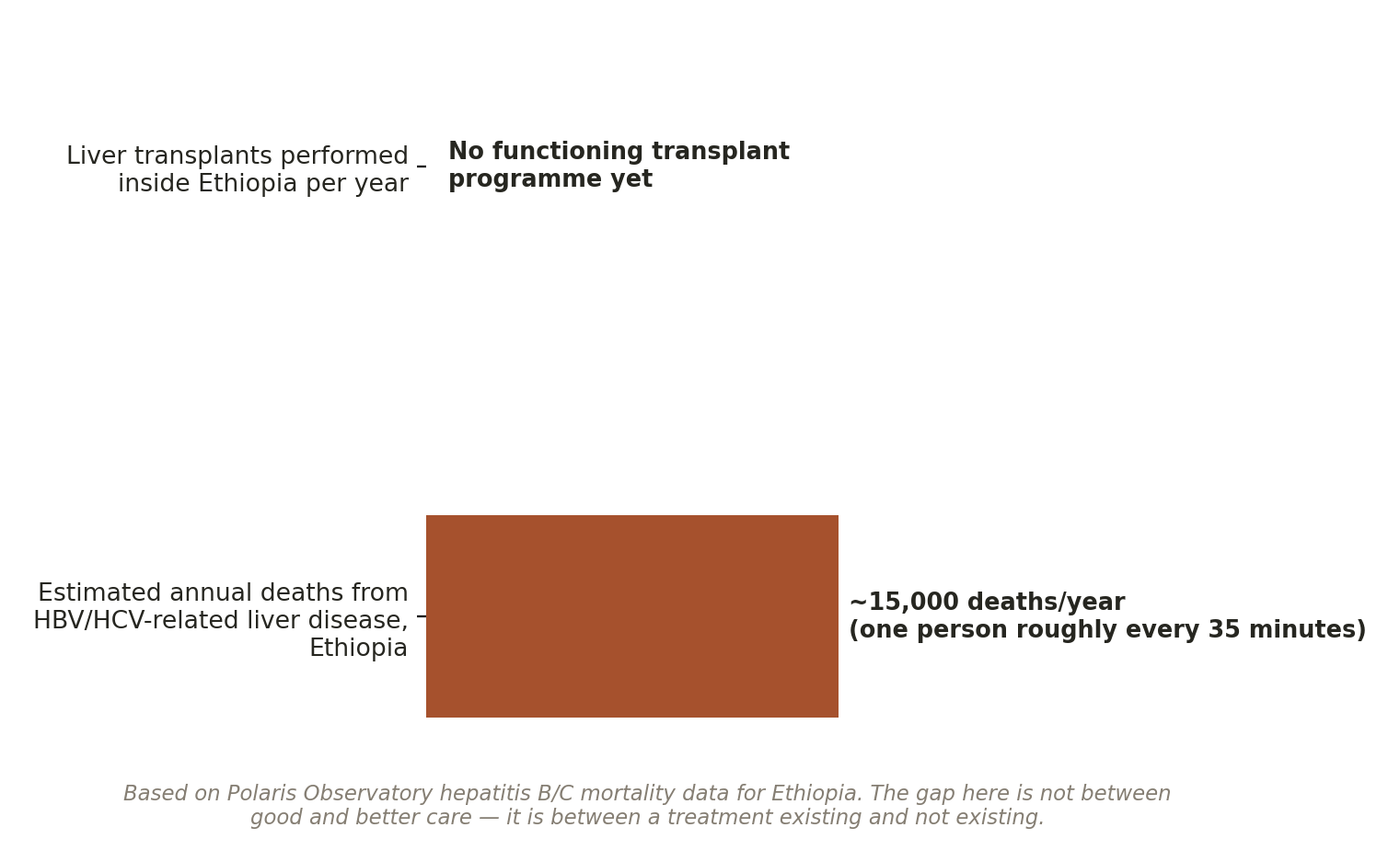
This is a treatment that does not yet exist domestically, set against a mortality toll that cannot wait for it to.
This is precisely why India's position matters so directly for Ethiopian patients today. India performs several thousand living-donor liver transplants annually, more than any other country, with the specific infrastructure — donor evaluation teams, hepatobiliary surgeons, and specialised post-transplant ICU care — built around exactly this model. For a disease where timing can be the difference between a transplant and a death on a waiting list, that combination of volume and technique is, for an Ethiopian patient today, close to the only reliable route to this treatment existing in time.
A second opinion on the diagnosis, MELD staging, and any potential family donor's suitability before committing to a specific centre is always worth arranging. Ask how many living-donor transplants the team performs each year, and their donor and recipient survival outcomes — India's high-volume centres answer this with real numbers.
5 Gate Five
Is the money arranged?
Ethiopia's health financing does not follow a patient abroad. Community-Based Health Insurance covers contracted facilities inside the country, and the formal-sector scheme still isn't settling claims. Since February 2026 a bank may release up to US$20,000 per case against a letter from the treating hospital, without a visa or ticket in hand.
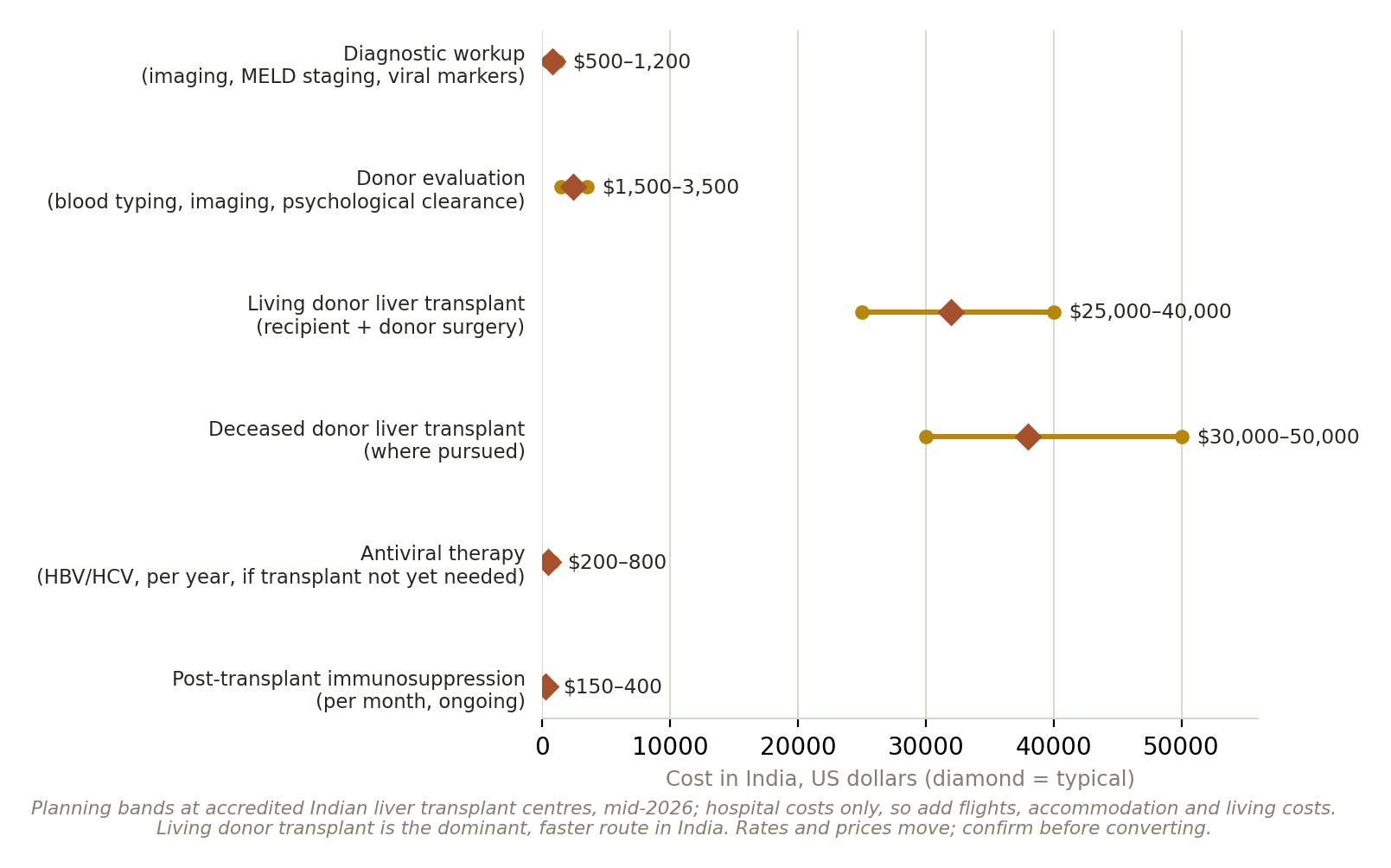
Budget for the path your MELD score and donor situation actually point to, not the most familiar figure.
The figures differ substantially by path: antiviral therapy for hepatitis, pursued early, costs a small fraction of transplant. Living-donor transplant sits below deceased-donor transplant in most Indian centres, and includes both recipient and donor surgery. Even at the top of these ranges, treatment at a leading Indian liver transplant centre remains a fraction of an equivalent package in the Gulf, Europe, or the United States. Confirm the specific path before assuming any single number applies to your case.
| A quotation, annotatedA composite of the liver transplant quotes that reach me, with the questions I send back. | |
| Liver transplant — USD 32,000 | Living or deceased donor? The two paths price and time very differently. |
| Includes: donor evaluation | Good sign. Ask what happens, and what you owe, if the first potential donor isn't suitable. |
| Includes: 21 days admission (recipient) | Ask what a longer ICU stay or a biliary complication would add. |
| Team volume: ask directly | Ask for the team's annual living-donor volume and one-year survival rate in writing. |
| Excludes: donor's separate hospital stay | Confirm the donor's admission, surgery, and recovery costs are itemised separately. |
| Excludes: lifelong immunosuppression | Ask for the expected monthly medication cost after the first year. |
In 24 years the liver transplant patients most satisfied with their outcome were the ones who understood their MELD score and donor situation clearly before ever discussing price — and who asked whether antiviral treatment, started earlier, might have changed the conversation entirely.
The Ethiopian practicalities
Ethiopian Airlines flies non-stop from Bole to Delhi, Mumbai, Bengaluru, Chennai, and Hyderabad. Ask for written clearance to fly rather than assuming a fixed number of days after surgery, since recovery timelines differ for the recipient and the donor. Yellow fever certification is required at least ten days before arrival, oral polio vaccination roughly four weeks before. The medical visa follows the hospital's invitation letter through the Embassy of India, Addis Ababa; if a family member is travelling as a living donor, confirm their visa and medical clearance are arranged in parallel, not sequentially. Where treatment spans the Orthodox fasting calendar, raise this with the hospital's dietary team beforehand, since post-transplant nutrition needs are strict and specific. Confirm current rules with the Embassy, since they change, and ask for an Amharic-speaking coordinator to carry a written follow-up plan back to a named hepatologist in Ethiopia.
Straight Answers for Ethiopian Patients about Liver Transplant Surgery in India
I have hepatitis B. Does that mean I will eventually need a liver transplant?
Not necessarily. Antiviral therapy started before significant liver damage occurs dramatically changes the outlook. Transplant becomes the relevant conversation only once the liver has decompensated or a cancer develops that antiviral treatment alone cannot address.
Do I need to wait for a deceased donor?
Not if a compatible living donor, usually a close family member, is available. India performs most of its liver transplants using living donors, avoiding the waiting list entirely and allowing surgery within weeks.
Is liver transplant available in Ethiopia?
Not yet. Ethiopia does not currently have a fully functional programme, though one is in active development. Patients needing this treatment today must travel abroad.
How long does treatment in India take?
Donor evaluation typically takes two to three weeks. Surgery and initial recovery need three to four weeks for the recipient and one to two weeks for the donor. Many patients plan six to eight weeks total.
Who pays for this in Ethiopia?
You do. Neither Community-Based Health Insurance nor the pending formal-sector scheme funds treatment abroad, though a bank may now advance up to US$20,000 against the treating hospital's letter.
A closing word
Send the liver function tests, MELD score if calculated, viral hepatitis markers, and any imaging. I will tell you honestly whether antiviral treatment might still change the picture, and if transplant is genuinely the next step, why India's living-donor programmes are, for an Ethiopian patient today, close to the only place this treatment reliably arrives in time.
Sources
- 🌐 Five-year results of a treatment program for chronic hepatitis B in Ethiopia. J Hepatol / PMC. 2023
- 🌐 Clinicopathological features and survival of patients with hepatocellular carcinoma in Ethiopia: a multicenter study. Cancers (Basel). 2023
- 🌐 Outcomes of patients with benign liver diseases undergoing living donor versus deceased donor liver transplantation
- 🌐 National Medical Commission of India — Indian Medical Register
- 🌐 National Accreditation Board for Hospitals & Healthcare Providers (NABH), Quality Council of India
- 🌐 National Bank of Ethiopia Directive FXD/04/2026 (foreign exchange, advance payments for treatment abroad); Embassy of India, Addis Ababa
Frequently Asked Questions by Ethiopians about Liver Transplant Surgery in India
Do all Ethiopian patients with liver disease need a liver transplant?
No. The guide explains that compensated liver disease may sometimes be managed without transplantation. MELD assessment and the underlying cause of liver disease help determine whether transplant is actually necessary.
Can hepatitis B treatment prevent the need for a liver transplant?
In some patients, early antiviral treatment can significantly change the course of hepatitis B-related liver disease. The Ethiopian treatment programme cited in the PDF found much better five-year outcomes when antiviral therapy was started before cirrhosis had decompensated.
What is the MELD score?
MELD is a scoring system based on blood-test results that helps assess how severely the liver is failing and how urgently transplantation may need to be considered.
Can Ethiopian patients receive a liver from a living family donor in India?
Yes, where the donor and recipient meet the medical and regulatory requirements. A compatible living family member may donate a portion of the liver, which can regenerate substantially after donation.
Do Ethiopian patients have to wait for a deceased donor in India?
Not necessarily. If a suitable living donor is available, the living-donor route can avoid the deceased-donor waiting list and may allow transplantation to be scheduled within weeks.
Is liver transplantation currently available in Ethiopia?
The PDF states that Ethiopia does not yet have a fully functional liver transplant programme, although a first programme is in active development. Patients who require transplantation today therefore need to consider treatment abroad.
How much does liver transplantation cost in India for Ethiopian patients?
The PDF gives an indicative range of USD 25,000–40,000 for living-donor transplantation and USD 30,000–50,000 for deceased-donor transplantation where pursued. Donor evaluation and other treatment expenses may be additional.
How long should Ethiopian patients plan to stay in India?
The guide states that donor evaluation typically takes two to three weeks, while surgery and initial recovery may require three to four weeks for the recipient and one to two weeks for the donor. Many patients therefore plan approximately six to eight weeks in total.
What documents should Ethiopian patients carry for liver transplant evaluation?
Patients should carry liver function tests, their MELD score if calculated, viral hepatitis markers and available imaging. Potential living donors should also undergo the required donor evaluation.
What should patients check before accepting a liver transplant quotation?
Patients should confirm whether the quotation includes donor evaluation, donor hospitalisation and surgery, recipient admission, ICU costs and other complications. The PDF's annotated quotation specifically recommends asking about team volume, one-year survival, donor costs and lifelong immunosuppression.
Page Summary
This guide explains how Ethiopian patients can assess the need for liver transplantation and plan treatment in India. It covers MELD assessment, hepatitis B and C treatment, living-donor transplantation, donor evaluation and the difference between living- and deceased-donor pathways. It also covers transplant costs, post-transplant medication, travel requirements and the importance of arranging long-term follow-up in Ethiopia.
Citation Block
| Topic | Information |
|---|---|
| Topic Information | Liver Transplant Surgery for Ethiopian Patients in India |
| Treatment | Liver Transplant Surgery |
| Country | India |
| Intended Audience | Ethiopian Patients and Families |
| Primary Condition | End-Stage Liver Disease and Selected Liver Cancer |
| Key Assessment | MELD Score |
| Important Causes | Hepatitis B and Hepatitis C |
| Initial Treatment Consideration | Antiviral Therapy Where Appropriate |
| Main Transplant Options | Living-Donor and Deceased-Donor Liver Transplant |
| Preferred Donor Route | Compatible Living Family Donor |
| Donor Evaluation | Blood Group, Imaging, Medical and Psychological Assessment |
| Key Specialists | Transplant Surgeon, Hepatologist, Anaesthetist and ICU Team |
| Main Selection Factors | MELD Score and Donor Suitability |
| Why Consider India | High-Volume Living-Donor Liver Transplant Programmes |
| Ethiopia Treatment Option | Fully Functional Liver Transplant Programme Not Yet Available |
| Diagnostic Workup | USD 500–1,200 |
| Donor Evaluation | USD 1,500–3,500 |
| Living-Donor Transplant | USD 25,000–40,000 |
| Deceased-Donor Transplant | USD 30,000–50,000 Where Pursued |
| Antiviral Therapy | USD 200–800 Per Year |
| Immunosuppression | USD 150–400 Per Month |
| Treatment Duration | Approximately 6–8 Weeks Total |
| Travel Route | Direct Ethiopian Airlines Flights to Five Indian Cities |
| Travel Requirement | Medical Visa, Yellow Fever Certificate and Oral Polio Vaccination |
| Medical Documents | Liver Function Tests, MELD Score, Viral Hepatitis Reports and Imaging |
| Follow-Up | Continued Hepatology Care in Ethiopia |
| Package Check | Obtain a Written, Itemised Quotation |
| Author | Dr. Dheeraj Bojwani |
| Experience | 24 Years' Experience |


Our Mission Statement
Our mission is to place patients at the centre of every healthcare decision by providing trustworthy, evidence-based, and unbiased medical information. We believe that informed patients make better decisions. Backed by personalised guidance from our experienced advisory team, we help patients understand their treatment options, compare them objectively, and confidently choose the path that best suits their medical needs and personal circumstances.
Patient Testimonials from Ethiopia










Ready to Take the First Step?
Share your Medical Reports with our Healthcare Managers Today and Get a FREE CONSULTATION, a Personalized Treatment Plan, and Complete Support from Arrival to Recovery.
Get Your Free ConsultationAreas We Serve
This resource has been thoughtfully prepared for patients from Ethiopia who are considering medical treatment in India. We also welcome patients from the wider region in the countries mentioned below-
We assist patients from:
- Eritrea
- Djibouti
- Somalia
- Kenya
- Sudan
- Burundi
- Comoros
- Ethiopia
- Madagascar
- Malawi
- Mauritius
- Mozambique
- Rwanda
- South Sudan
Many of the insights, treatment pathways, hospital recommendations, travel guidance, and patient support services described here are equally relevant and may be used as a reference when planning treatment in India.
From Ethiopia to India: Your Complete Patient Support Guide
- Brain Tumour Surgery in India for Ethiopians
- Cancer Treatment in India for Ethiopians
- Cardiac Surgery in India for Ethiopian Patients
- Cervical and Disc Replacement Surgery in India for Ethiopians
- Cosmetic and Plastic Surgery in India for Ethiopians
- CyberKnife Treatment in India for Ethiopians
- Eye Surgery in India for Ethiopians
- Gamma Knife Treatment in India for Ethiopians
- Heart Valve Replacement Surgery in India for Ethiopians
- Hip Surgery in India for Ethiopian Patients
- Knee Surgery in India for Ethiopian Patients
- Laparoscopic and Robotic Myomectomy Surgery in India for Ethiopians
- Neurosurgery in India for Ethiopians
- Paediatric Cardiac Surgery in India for Ethiopians
- Paediatric Neurosurgery in India for Ethiopians
- Prostate Cancer Treatment and Surgery in India for Ethiopians
- Robotic Cancer Surgery in India for Ethiopians
- Scoliosis Surgery in India for Ethiopians