

Kidney Transplant Surgery for Ethiopian Patients in India
Five gates every kidney failure case should pass before booking a flight — and why, for a programme that proved it could work and then nearly stopped, India's uninterrupted, high-volume transplant centres are where consistency itself becomes the deciding factor.
Kidney failure is one of the few areas of Ethiopian medicine where the country has genuinely demonstrated it can deliver a complex transplant programme — and also one where that demonstrated capability has, in practice, gone mostly quiet for several years. In 24 years of arranging surgical care in India for patients across Africa and Asia, this is a field where the honest story is not absence but interruption, and where the practical question for a patient today is less "can this be done in Ethiopia" and more "can it be done reliably, on a timeline my kidneys can wait for." St Paul's Hospital Millennium Medical College, working with the University of Michigan, opened Ethiopia's first and only kidney transplant centre in September 2015 and performed 145 living-donor transplants in under five years — genuine proof that local surgical and nephrology teams could do this well. Activity then fell sharply after March 2020, and a 2026 fellowship call suggests the programme is now working to rebuild, but it is not back to its earlier pace. Meanwhile, the dialysis that bridges a patient to transplant is itself unusually precarious in Ethiopia, with published one-year survival on maintenance hemodialysis around 42 percent. India's kidney transplant centres, by contrast, have run without interruption for decades, at volumes that make scheduling predictable rather than hopeful. These five gates walk through whether transplant is genuinely the next step, how much can safely be asked of dialysis as a bridge, and why India's uninterrupted track record matters as much as its technical capability for a patient facing this specific disease today.
Healing Journeys of Ethiopian Patients









Key Takeaways
- Kidney failure does not automatically mean that a patient needs a transplant immediately. The guide first distinguishes acute kidney injury, which may be reversible, from chronic kidney disease and end-stage renal disease. Patients should confirm their kidney disease stage and whether the condition is acute or chronic before making plans for transplantation.
- Dialysis is an important bridge while a transplant is being arranged, but the PDF highlights the challenges of maintaining dialysis in Ethiopia. The page 2 chart shows approximately 42.1% one-year survival among patients starting maintenance haemodialysis in the cited Ethiopian data, compared with a typical 85–92% range in well-resourced dialysis programmes. The document also notes that only about one-third of Ethiopian maintenance-dialysis patients receive the recommended three sessions per week.
- Ethiopia has demonstrated that kidney transplantation can be performed successfully. Its first and only kidney transplant centre, established at St Paul's Hospital Millennium Medical College, performed 145 living-donor transplants between 2015 and early 2020, but activity subsequently fell sharply. The page 3 activity chart shows the decline after 2020 and indicates that a 2026 fellowship programme suggests rebuilding is underway.
- India is highlighted for its continuous, high-volume kidney transplant programmes. The guide explains that this continuity matters because transplantation requires not only surgery but also years of nephrology and transplant follow-up. The page 4 chart also shows the concentration of Ethiopia's nephrology workforce, with approximately 80% based in Addis Ababa, making long-term specialist follow-up more difficult for patients living elsewhere.
- The page 5 cost chart gives indicative Indian planning ranges of USD 400–1,000 for diagnostic workup, USD 500–1,200 for pre-transplant crossmatch and HLA typing, USD 13,000–18,000 for a kidney transplant with a blood-group-compatible donor, and USD 18,000–24,000 with a blood-group-incompatible donor. It also lists indicative immunosuppression costs of USD 250–500 per month during year one and USD 130–300 per month from year two onward.
- The annotated quotation advises patients to confirm whether donor evaluation is included, what happens if the first donor is unsuitable, whether the recipient's admission covers longer stays, whether the donor's hospital costs are separate and what lifelong immunosuppression will cost. The guide particularly recommends asking about the transplant centre's continuous years of operation and annual transplant volume, rather than relying only on its historical reputation.
Quick Facts
- Treatment
- Kidney Transplant Surgery
- Country
- India
- Patients
- Ethiopian Patients
- Main Indication
- End-Stage Renal Disease
- Initial Assessment
- Kidney Function Tests and Nephrology Evaluation
- Donor Type
- Living Family Donor or Suitable Living Donor
- Key Donor Assessment
- Blood-Group Compatibility and HLA / Crossmatch Testing
- Diagnostic Workup
- USD 400–1,000
- Pre-Transplant Crossmatch & HLA Typing
- USD 500–1,200
- Compatible-Donor Transplant
- USD 13,000–18,000
- Blood-Group-Incompatible Transplant
- USD 18,000–24,000
- Immunosuppression Year One
- USD 250–500 Per Month
- Immunosuppression Year Two Onward
- USD 130–300 Per Month
- Donor Evaluation
- Approximately 1–2 Weeks
- Recipient Recovery
- Approximately 7–14 Days
- Donor Recovery
- Approximately 3–5 Days
- Overall Planning
- Approximately 3–4 Weeks
- Ethiopia Kidney Transplant Programme
- 145 Living-Donor Transplants Between 2015 and Early 2020; Rebuilding Indicated in 2026
- Key Planning Requirement
- Confirm Donor Suitability and Blood-Group Compatibility
- Follow-Up
- Lifelong Nephrology and Transplant Monitoring
- Payment Advice
- Confirm Donor Costs, Longer Admission, Immunosuppression and All Exclusions
In Brief
Ethiopian patients considering kidney transplantation in India should first confirm that they have reached end-stage renal disease and that transplantation is medically appropriate. Before travelling, patients should complete kidney-function evaluation, dialysis history review and donor assessment where applicable. They should clarify whether the donor is blood-group compatible, whether additional treatment is required for an incompatible donor, what the transplant package includes, how donor expenses are handled and what long-term immunosuppression will cost. A written follow-up plan with a named nephrologist in Ethiopia should also be arranged before returning home.
1 Gate One
Failing, or reversible?
Swelling, fatigue, reduced urine output, or abnormal blood tests are what usually start this conversation, and not every finding means transplant is the eventual answer. Acute kidney injury, often triggered by dehydration, infection, or pregnancy-related complications, is frequently reversible with prompt treatment and does not signal chronic disease.
Chronic kidney disease can often be managed medically for years, with dietary changes, blood pressure control, and medication, before reaching end-stage renal disease, the point where the kidneys can no longer sustain life without dialysis or transplant. Ask explicitly what stage of kidney disease has been confirmed, and whether the current picture is acute or chronic, before any conversation about transplant begins.
2 Gate Two
A bridge, or a dead end?
Once end-stage renal disease is confirmed, dialysis is what keeps a patient alive while a transplant is arranged. In many countries this bridge is stable enough that patients wait months to years without excess risk. Ethiopia's published data tells a different, more urgent story.
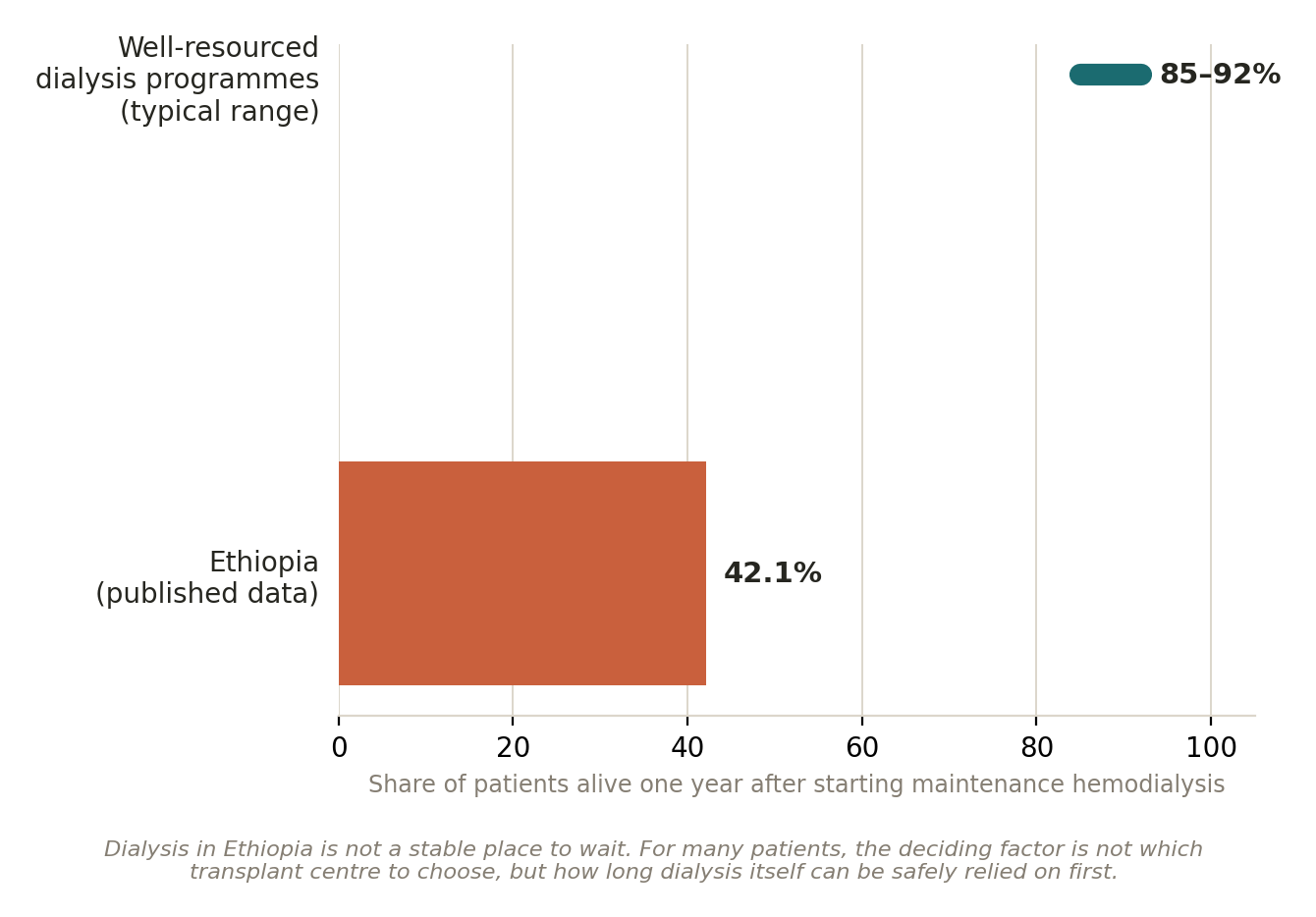
Dialysis in Ethiopia is a genuine bridge, but a considerably less stable one than in many other countries.
Why this changes the calculation: a single hemodialysis session in Ethiopia costs roughly US$70, an unaffordable recurring expense for most families, and is not covered by the national health programme. Published data shows only about a third of patients on maintenance dialysis receive the recommended three sessions a week. Waiting for a transplant is not a neutral, low-risk choice here in the way it might be elsewhere.
This is precisely why, for a patient with confirmed end-stage renal disease in Ethiopia, the honest question is rarely just "when can I get a transplant" but "how much can I safely ask of dialysis while I wait" — and why that answer often points toward acting sooner rather than later.
3 Gate Three
Proved it worked, then stalled
Ethiopia's kidney transplant story is genuinely different from most other treatments in this series: this is not a case of a programme that never existed. It is a case of one that worked, then largely stopped.
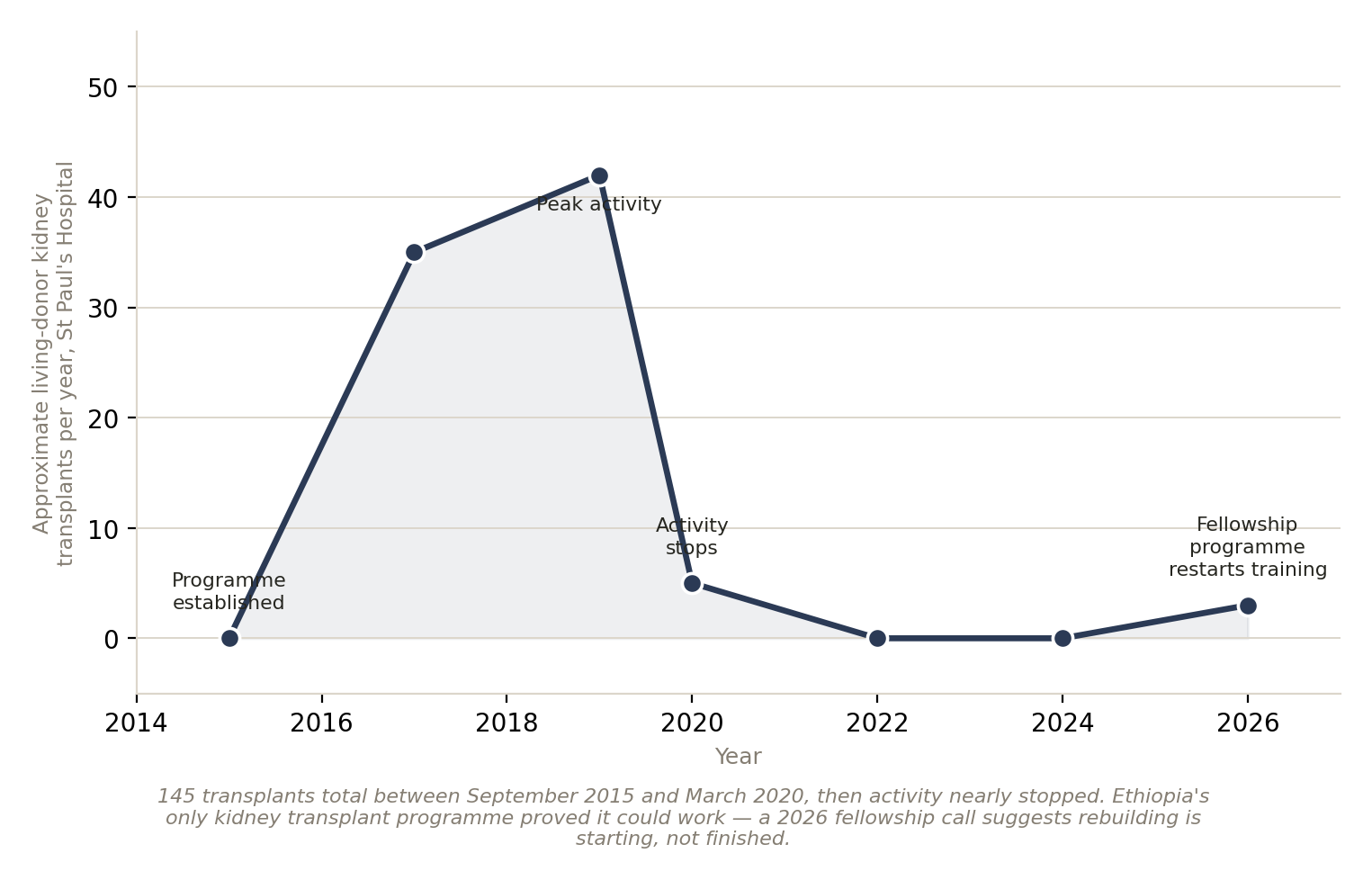
The capability was real. The consistency, since 2020, has not been.
This history matters for a very practical reason: a programme rebuilding from a multi-year pause is not the same proposition as one that has run continuously. Case volume, team cohesion, and the routine familiarity that keeps outcomes predictable all take time to rebuild after an interruption this long. None of this reflects badly on the skill of the doctors and nurses who built the original programme — it reflects the genuine difficulty of sustaining a service this complex without uninterrupted resources behind it.
4 Gate Four
Could this be done in Ethiopia?
In principle, and with time, likely yes again. In practice, today, a patient facing end-stage renal disease is choosing between a domestic programme that is still rebuilding toward its earlier pace and a thin, capital-concentrated nephrology workforce for the follow-up care a transplant needs for life afterward.
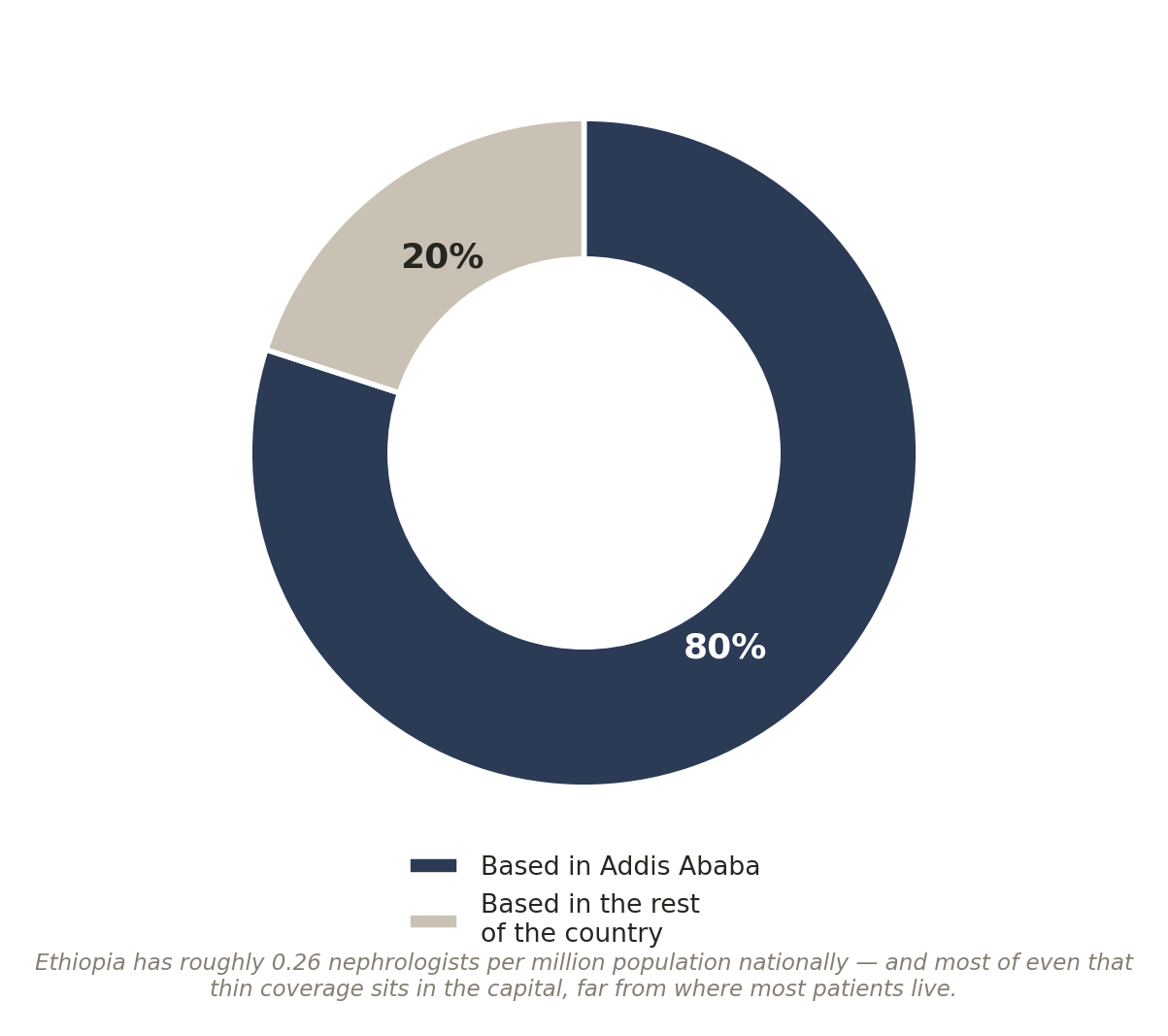
Even the specialists who exist are heavily concentrated in one city.
This is precisely where India's position is strongest for this specific disease. India's leading kidney transplant centres have operated continuously for decades, performing thousands of transplants annually across a nephrology workforce many multiples the size and geographic spread of Ethiopia's. For a treatment that depends on immediate surgical execution and then years of consistent specialist follow-up, that uninterrupted continuity is not simply a matter of higher volume — it is the entire basis on which long-term outcomes after transplant actually get protected. Ask any centre for their team's continuous years of operation and annual transplant volume, not just their historical total.
A second opinion on the diagnosis and donor suitability before committing to a specific centre is always worth arranging. Coordinating a clear, written follow-up plan with a named nephrologist in Ethiopia before returning home is equally important, given the geographic concentration shown above.
5 Gate Five
Is the money arranged?
Ethiopia's health financing does not follow a patient abroad. Community-Based Health Insurance covers contracted facilities inside the country, and the formal-sector scheme still isn't settling claims. Since February 2026 a bank may release up to US$20,000 per case against a letter from the treating hospital, without a visa or ticket in hand.
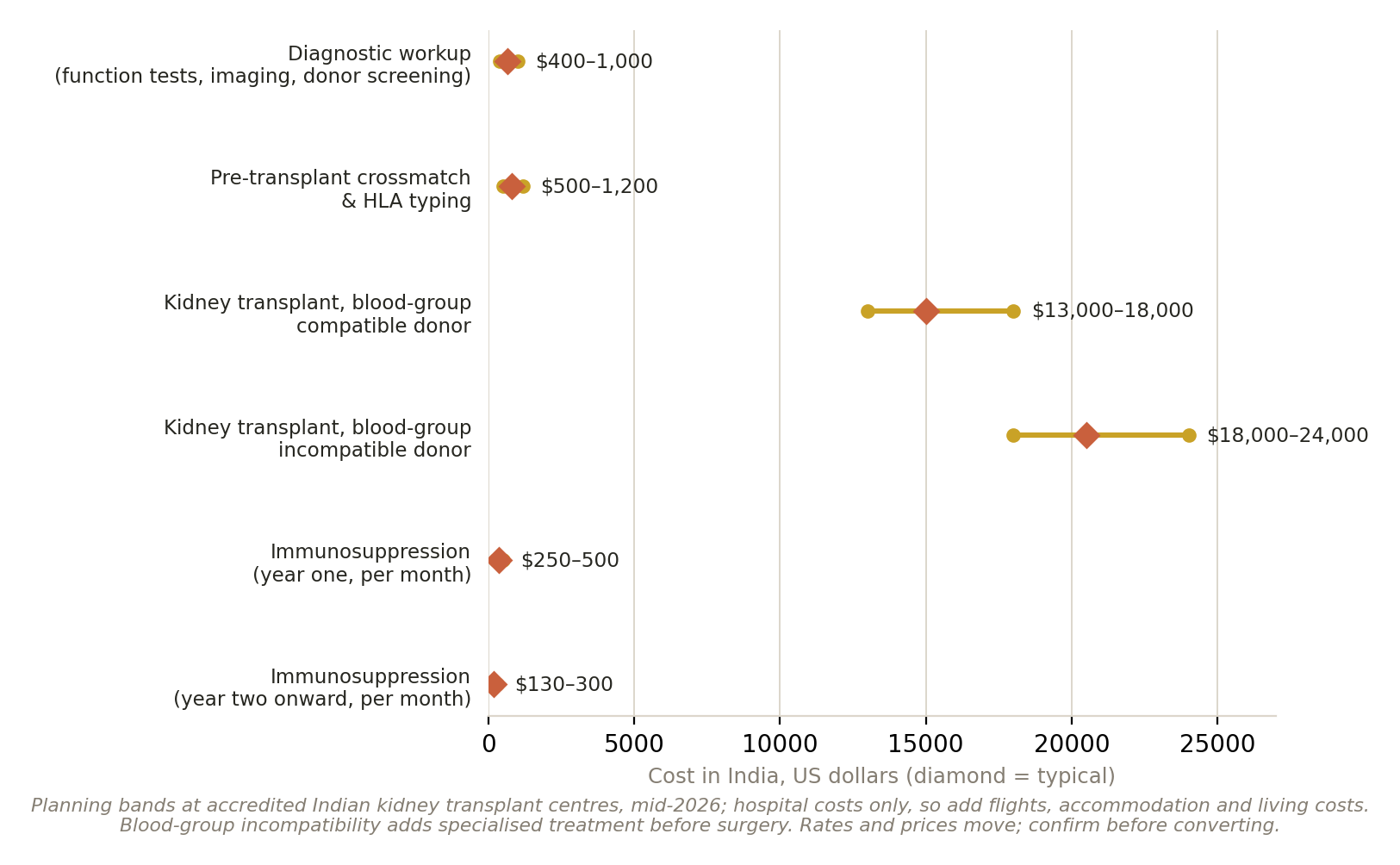
Budget for the donor situation you actually have, not the most familiar figure.
The figures differ substantially by donor blood-group compatibility: an incompatible donor needs additional specialised treatment before surgery, adding meaningfully to cost. Even at the top of these ranges, treatment at a leading Indian kidney transplant centre remains a fraction of an equivalent package in the Gulf, Europe, or the United States, and considerably less than years of dialysis. Confirm the donor's blood-group compatibility before assuming any single number applies to your case.
| A quotation, annotatedA composite of the kidney transplant quotes that reach me, with the questions I send back. | |
| Kidney transplant — USD 16,000 | Blood-group compatible or incompatible donor? This changes the price meaningfully. |
| Includes: donor evaluation | Good sign. Ask what happens, and what you owe, if the first potential donor isn't suitable. |
| Includes: 10 days admission (recipient) | Ask what a longer stay or a rejection episode would add. |
| Centre: continuous operation, ask directly | Ask how many consecutive years the programme has run without interruption. |
| Excludes: donor's separate hospital stay | Confirm the donor's admission, surgery, and recovery costs are itemised separately. |
| Excludes: lifelong immunosuppression | Ask for the expected monthly medication cost, year one and beyond. |
In 24 years the kidney transplant patients most satisfied with their outcome were the ones who asked about the transplant centre's continuity of operation as carefully as its technical reputation — and who arranged their Ethiopian follow-up plan before, not after, travelling.
The Ethiopian practicalities
Ethiopian Airlines flies non-stop from Bole to Delhi, Mumbai, Bengaluru, Chennai, and Hyderabad. Ask for written clearance to fly rather than assuming a fixed number of days after surgery, since recovery timelines differ for the recipient and the donor. Yellow fever certification is required at least ten days before arrival, oral polio vaccination roughly four weeks before. The medical visa follows the hospital's invitation letter through the Embassy of India, Addis Ababa; if a family member is travelling as a living donor, confirm their visa and medical clearance are arranged in parallel. Where treatment spans the Orthodox fasting calendar, raise this with the hospital's dietary team beforehand, since post-transplant nutrition needs are specific. Confirm current rules with the Embassy, since they change, and ask for an Amharic-speaking coordinator to carry a written follow-up plan back to a named nephrologist in Ethiopia — given how concentrated that specialty is, confirm this named contact exists before travelling.
Straight Answers for Ethiopian Patients about Kidney Transplant Surgery in India
My kidneys are failing. Do I need a transplant right away?
Not necessarily. Acute kidney injury is often reversible. Chronic kidney disease can be managed medically for years before reaching the point of end-stage renal disease. A nephrologist needs to confirm which stage applies first.
Can I just stay on dialysis while I wait?
This deserves an honest, Ethiopia-specific answer. Published one-year survival on maintenance hemodialysis in Ethiopia is around 42 percent, far below the 85 to 92 percent typical of well-resourced programmes. Dialysis is a real bridge, but a less stable one here than elsewhere.
Is kidney transplant available in Ethiopia?
Ethiopia's only programme performed 145 living-donor transplants between 2015 and early 2020, then activity nearly stopped. A 2026 fellowship programme suggests rebuilding is underway, but not yet back to its earlier pace.
How long does treatment in India take?
Donor evaluation typically takes one to two weeks. Surgery and initial recovery need seven to fourteen days for the recipient and three to five days for the donor. Many patients plan three to four weeks total.
Who pays for this in Ethiopia?
You do. Neither Community-Based Health Insurance nor the pending formal-sector scheme funds treatment abroad, though a bank may now advance up to US$20,000 against the treating hospital's letter.
A closing word
Send the kidney function tests, dialysis history if applicable, and details of any potential family donor. I will tell you honestly what stage of kidney disease this looks like, and if transplant is genuinely the next step, why India's uninterrupted, high-volume centres offer a consistency that matters as much as technical skill for this particular disease.
Sources
- 🌐 Global Dialysis Perspective: Ethiopia. Kidney360. 2022
- 🌐 Shimels T, Getachew A, Tadesse M, Thompson A. Providers' view on the first kidney transplantation center in Ethiopia
- 🌐 Organ transplantation in Ethiopia. Transplantation. 2019
- 🌐 National Medical Commission of India — Indian Medical Register
- 🌐 National Accreditation Board for Hospitals & Healthcare Providers (NABH), Quality Council of India
- 🌐 National Bank of Ethiopia Directive FXD/04/2026 (foreign exchange, advance payments for treatment abroad); Embassy of India, Addis Ababa
Frequently Asked Questions by Ethiopians about Kidney Transplant Surgery in India
Do all patients with kidney failure need a transplant immediately?
No. Acute kidney injury can sometimes be reversible, while chronic kidney disease may be managed for years before reaching end-stage renal disease. A nephrologist should confirm the stage and transplant suitability first.
Can Ethiopian patients remain on dialysis while waiting for a transplant?
Dialysis can provide a bridge to transplantation, but the guide highlights the comparatively unstable dialysis situation in Ethiopia. It cites approximately 42.1% one-year survival in the published Ethiopian data.
Is kidney transplant available in Ethiopia?
Ethiopia has previously demonstrated kidney transplant capability. Its first programme performed 145 living-donor transplants between 2015 and early 2020, but activity later declined substantially, with rebuilding indicated in 2026.
Who can donate a kidney?
The guide focuses on living donors and recommends completing donor evaluation before travelling. Blood-group compatibility, crossmatching and HLA testing help determine whether a potential donor is suitable.
What is the cost of a kidney transplant in India?
The indicative range is USD 13,000–18,000 for a blood-group-compatible donor and USD 18,000–24,000 for a blood-group-incompatible donor. Additional diagnostic testing and long-term medicines may increase the overall expense.
Why does blood-group compatibility affect transplant cost?
A blood-group-incompatible donor may require additional specialised treatment before transplantation. The guide therefore recommends confirming the donor's blood-group compatibility before relying on a standard transplant cost.
How long does kidney transplant treatment in India take?
Donor evaluation typically takes one to two weeks. Surgery and initial recovery may require approximately 7–14 days for the recipient and 3–5 days for the donor, with many patients planning around three to four weeks overall.
What medicines are needed after kidney transplantation?
Patients require long-term immunosuppressive medicines to help prevent rejection. The guide gives indicative costs of USD 250–500 per month during the first year and USD 130–300 per month from the second year onward.
What should I ask a kidney transplant centre before travelling?
Ask about the centre's continuous years of operation, annual transplant volume, donor evaluation, admission duration, donor hospital costs, rejection management and long-term immunosuppression. A written follow-up plan with a nephrologist in Ethiopia should also be arranged.
What should Ethiopian patients send before seeking a transplant opinion?
The guide recommends sharing kidney-function tests, dialysis history where applicable and details of any potential family donor. These records help the transplant team assess disease stage and whether transplantation is likely to be the appropriate next step.
Page Summary
This guide explains kidney transplant options for Ethiopian patients considering treatment in India, including donor evaluation and transplant suitability. It highlights the challenges of dialysis and the interrupted kidney transplant programme in Ethiopia. India’s continuous, high-volume transplant centres are presented as an option for consistent treatment and follow-up. The guide provides indicative costs for compatible and incompatible donor transplants, HLA testing and immunosuppression. It also covers treatment duration, travel planning and follow-up care in Ethiopia. Overall, patients should confirm donor suitability, complete costs and long-term care arrangements before travelling to India.
Citation Block
| Topic | Information |
|---|---|
| Topic Information | Kidney Transplant Surgery for Ethiopian Patients in India |
| Treatment | Kidney Transplant Surgery |
| Country | India |
| Intended Audience | Ethiopian Patients |
| Main Indication | End-Stage Renal Disease |
| Donor Type | Living Donor |
| Key Donor Assessment | Blood-Group Compatibility, HLA Typing and Crossmatch |
| Diagnostic Workup | USD 400–1,000 |
| Pre-Transplant Testing | USD 500–1,200 |
| Compatible-Donor Transplant | USD 13,000–18,000 |
| Incompatible-Donor Transplant | USD 18,000–24,000 |
| Immunosuppression | USD 250–500/Month in Year One; USD 130–300/Month Thereafter |
| Treatment Duration | Approximately 3–4 Weeks Overall |
| Important Planning | Confirm Donor Suitability and Centre Continuity |
| Important Cost Check | Confirm Donor Stay, Longer Admission and Lifelong Medicines |
| Follow-Up | Lifelong Nephrology and Transplant Care |
| Author | Dr. Dheeraj Bojwani |
| Experience | 24+ Years |


Our Mission Statement
Our mission is to place patients at the centre of every healthcare decision by providing trustworthy, evidence-based, and unbiased medical information. We believe that informed patients make better decisions. Backed by personalised guidance from our experienced advisory team, we help patients understand their treatment options, compare them objectively, and confidently choose the path that best suits their medical needs and personal circumstances.
Patient Testimonials from Ethiopia










Ready to Take the First Step?
Share your Medical Reports with our Healthcare Managers Today and Get a FREE CONSULTATION, a Personalized Treatment Plan, and Complete Support from Arrival to Recovery.
Get Your Free ConsultationAreas We Serve
This resource has been thoughtfully prepared for patients from Ethiopia who are considering medical treatment in India. We also welcome patients from the wider region in the countries mentioned below-
We assist patients from:
- Eritrea
- Djibouti
- Somalia
- Kenya
- Sudan
- Burundi
- Comoros
- Ethiopia
- Madagascar
- Malawi
- Mauritius
- Mozambique
- Rwanda
- South Sudan
Many of the insights, treatment pathways, hospital recommendations, travel guidance, and patient support services described here are equally relevant and may be used as a reference when planning treatment in India.
From Ethiopia to India: Your Complete Patient Support Guide
- Brain Tumour Surgery in India for Ethiopians
- Cancer Treatment in India for Ethiopians
- Cardiac Surgery in India for Ethiopian Patients
- Cervical and Disc Replacement Surgery in India for Ethiopians
- Cosmetic and Plastic Surgery in India for Ethiopians
- CyberKnife Treatment in India for Ethiopians
- Eye Surgery in India for Ethiopians
- Gamma Knife Treatment in India for Ethiopians
- Heart Valve Replacement Surgery in India for Ethiopians
- Hip Surgery in India for Ethiopian Patients
- Knee Surgery in India for Ethiopian Patients
- Laparoscopic and Robotic Myomectomy Surgery in India for Ethiopians
- Neurosurgery in India for Ethiopians
- Paediatric Cardiac Surgery in India for Ethiopians
- Paediatric Neurosurgery in India for Ethiopians
- Prostate Cancer Treatment and Surgery in India for Ethiopians
- Robotic Cancer Surgery in India for Ethiopians
- Scoliosis Surgery in India for Ethiopians