

Joint Arthroscopy and Sports Medicine for Ethiopian Patients in India
Five gates every ligament or joint injury should pass before booking a flight — and why, for an injury where the damage inside the knee keeps accumulating for every month it goes untreated, India's high-volume arthroscopy centres are where that clock stops ticking.
Atorn ligament is an unusual injury in this series: the surgery itself is often quick and minimally invasive, and yet the cost of delay is unusually steep. In 24 years of arranging surgical care in India for patients across Africa and Asia, sports medicine is a field defined by a fact many patients never hear until it's too late to matter: an unstable, ACL-deficient knee doesn't simply wait patiently for treatment. Every episode of the knee giving way causes fresh, often irreversible damage to the meniscus and cartilage inside the joint, and that damage accumulates steadily the longer surgery is delayed. This matters directly for Ethiopia. A documented surgical mission to Addis Ababa in recent years, performing some of the country's first arthroscopic procedures, found a striking pattern: a predominance of ACL tears and multiligament knee injuries, shoulder instability, and rotator cuff tears, many with what the visiting surgeon described as "significant associated injuries" — the signature of injuries that had gone unaddressed for a long time. That same surgeon was explicit about the cause: quality of care was not the issue in treating these complex orthopedic injuries, but rather a lack of access to resources and specialty devices. India's sports medicine centres, built around exactly this equipment and technique, treat this specific injury pattern as routine, high-volume practice. These five gates walk through recognising a genuine ligament injury, understanding why the clock matters more than almost anywhere else in orthopaedics, and why India is where that clock is reliably stopped.
Healing Journeys of Ethiopian Patients









Key Takeaways
- A knee that continues to give way, swell or buckle weeks after an injury may indicate a ligament tear rather than a simple sprain.
- MRI, rather than X-ray, is the appropriate imaging method for confirming ligament or meniscus injuries.
- The PDF highlights that delaying ACL reconstruction can increase the risk of secondary meniscus and cartilage damage.
- A systematic review cited in the guide found that delays beyond six months were consistently associated with more meniscus damage, while delays beyond twelve months were associated with significantly more cartilage damage.
- Arthroscopic surgery uses small incisions, a camera and specialised instruments and is now the usual approach for many ligament and meniscus procedures.
- The page 3 chart illustrates shorter hospital stay and faster return to activity with arthroscopic surgery compared with open surgery.
- The page 5 cost chart gives indicative India ranges of US$1,800–3,000 for meniscus repair, US$2,500–4,500 for ACL reconstruction, US$3,500–5,500 for combined ACL and meniscus repair, and US$2,500–4,500 for shoulder arthroscopy/rotator cuff repair.
- The PDF notes that Ethiopian arthroscopy is developing but access to specialised equipment remains more limited than in high-volume Indian centres.
- Ethiopian patients should verify the surgeon's annual ACL and meniscus procedure volume, whether physiotherapy is included, and whether additional procedures discovered during surgery will change the quotation.
- A typical India stay is approximately 1–2 weeks, with structured rehabilitation continuing in Ethiopia.
Quick Facts
- Treatment
- Joint Arthroscopy and Sports Medicine
- Country
- India
- Patients
- Ethiopian Patients
- Main Procedures
- ACL Reconstruction, Meniscus Repair, Combined ACL and Meniscus Repair, Shoulder Arthroscopy and Rotator Cuff Repair
- Key Diagnosis
- Ligament or Meniscus Tear
- Preferred Imaging
- MRI
- ACL Delay Risk
- Delays beyond 6 months linked to more meniscus damage; beyond 12 months to more cartilage damage
- Meniscus Repair Cost
- US$1,800–3,000
- ACL Reconstruction Cost
- US$2,500–4,500
- Combined ACL + Meniscus
- US$3,500–5,500
- Shoulder Arthroscopy / Rotator Cuff
- US$2,500–4,500
- Diagnostic Workup
- US$150–350
- Physiotherapy
- US$500–1,200
- Typical India Stay
- Approximately 1–2 weeks
- Key Specialist
- Sports Medicine / Arthroscopic Orthopaedic Surgeon
- Important Expertise
- Annual ACL and meniscus procedure volume
- Hospital Accreditation
- JCI or NABH can be independently verified
- Follow-Up
- Physiotherapist / Orthopaedic Provider in Ethiopia
- Required Records
- MRI images, surgical report and rehabilitation plan
- Financing Mentioned
- Up to US$20,000 bank advance against treating hospital letter
In Brief
Ethiopian patients with ongoing knee instability, swelling or locking after a sports injury should establish whether the problem is a ligament or meniscus tear rather than continuing to treat it as a simple sprain. The PDF explains that MRI is required to confirm these injuries and highlights evidence linking delayed ACL reconstruction with increasing secondary meniscus and cartilage damage. Most ligament and meniscus procedures are performed arthroscopically using specialised equipment and fixation devices. The page 5 cost chart provides indicative Indian planning ranges, while the annotated quotation highlights the importance of confirming graft type, MRI review, admission, physiotherapy and the cost of additional meniscus repair. Ethiopian patients should verify procedure-specific surgeon volume and arrange rehabilitation before travelling.
1 Gate One
A sprain, or a tear?
A twisted knee or shoulder during football, running, or a fall is what usually starts this conversation, and the instinct to call it a sprain and rest is often right — most sprains settle within a couple of weeks. A knee that keeps giving way, swells repeatedly, or buckles doing ordinary daily activities is describing something different: the pattern of a ligament tear, most commonly the ACL.
An MRI, not an X-ray, is what actually confirms a ligament or meniscus tear; X-rays only show bone. If instability, repeated swelling, or a sense that the joint "doesn't feel right" persists beyond two to three weeks, ask specifically for MRI imaging rather than continuing to treat it as an ordinary sprain.
2 Gate Two
Why waiting makes it worse
This is the single most important fact in this entire guide, and it is well established in the published literature: an ACL-deficient knee does not simply stay the same while waiting for surgery. Every episode of instability causes the femur and tibia to shift abnormally against each other, and this repeated abnormal motion progressively damages the meniscus and the cartilage that cushion the joint.
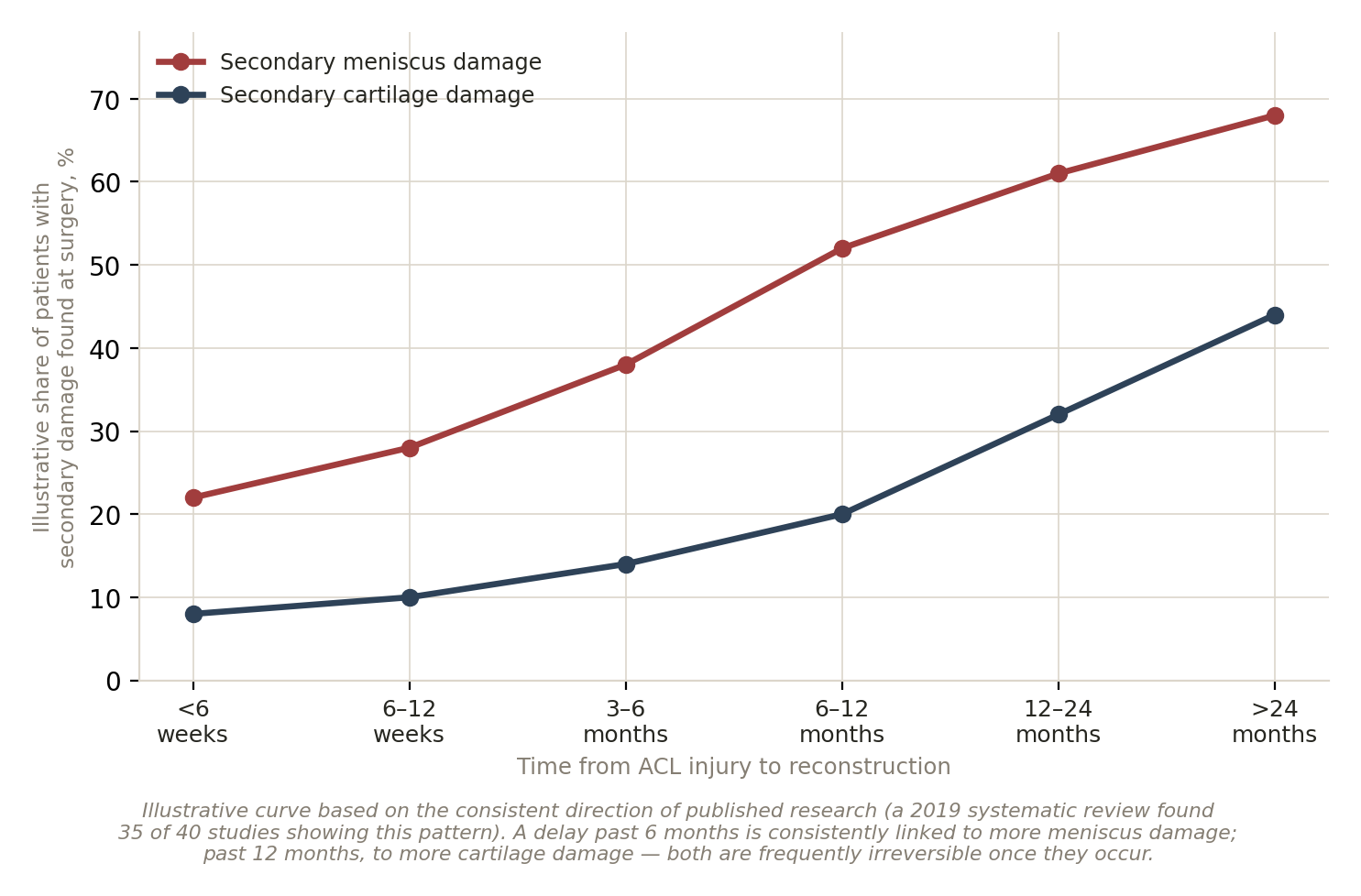
The knee doesn't wait patiently. It accumulates damage for every month reconstruction is delayed.
Why this changes the urgency of the conversation: a systematic review pooling forty studies found this pattern in the overwhelming majority of them — a delay beyond six months was consistently linked to a significantly higher risk of secondary medial meniscus damage, and a delay beyond twelve months to significantly higher cartilage damage. Once cartilage is damaged this way, it does not reliably heal or regenerate.
This is precisely why "I'll wait and see" is a genuinely costly decision for a confirmed ACL tear in an active person, in a way it isn't for many other orthopaedic conditions. The knee itself is keeping a clock running whether or not a decision has been made.
3 Gate Three
Scope, or open surgery?
Most ligament and meniscus repairs today are performed arthroscopically — through a few small incisions with a camera and instruments, rather than a single large open incision. This isn't a cosmetic difference.
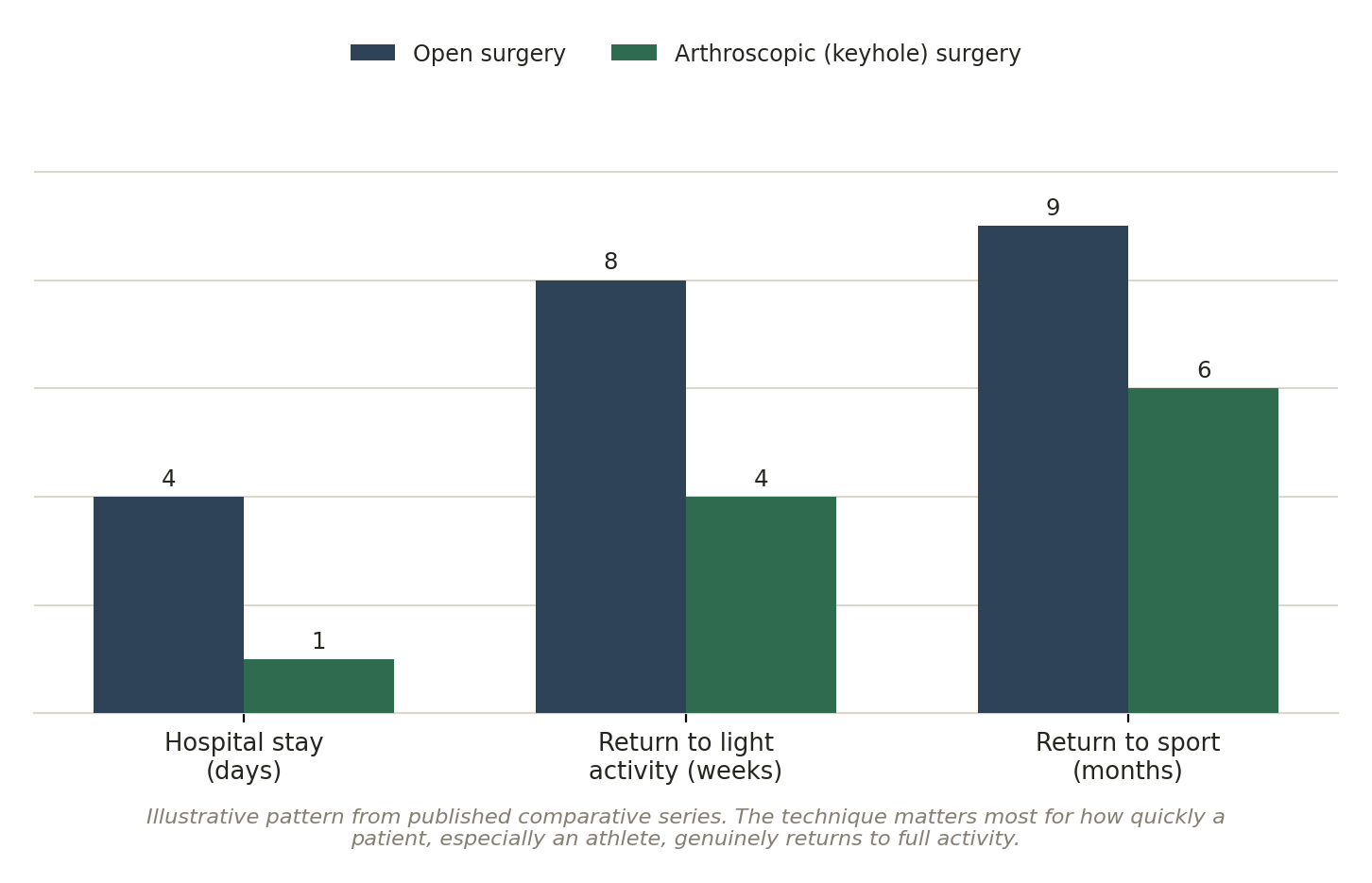
For an athlete or an active adult, the difference between these two approaches is measured in months of a working life.
Arthroscopic technique needs specific equipment — a camera system, specialised instruments, and fixation devices — and surgeons experienced specifically in this technique, not just in orthopaedic surgery generally. Ask any centre explicitly whether the proposed procedure will be arthroscopic or open, and if open, why, given the injury described.
4 Gate Four
Could this be done in Ethiopia?
Genuine progress is underway, and it deserves to be said plainly: skilled Ethiopian orthopaedic surgeons exist, and arthroscopic procedures are now being performed in the country, including at centres in Addis Ababa. The honest picture, from a documented surgical mission at one of the country's hospitals, is that the limiting factor has not been surgical skill.
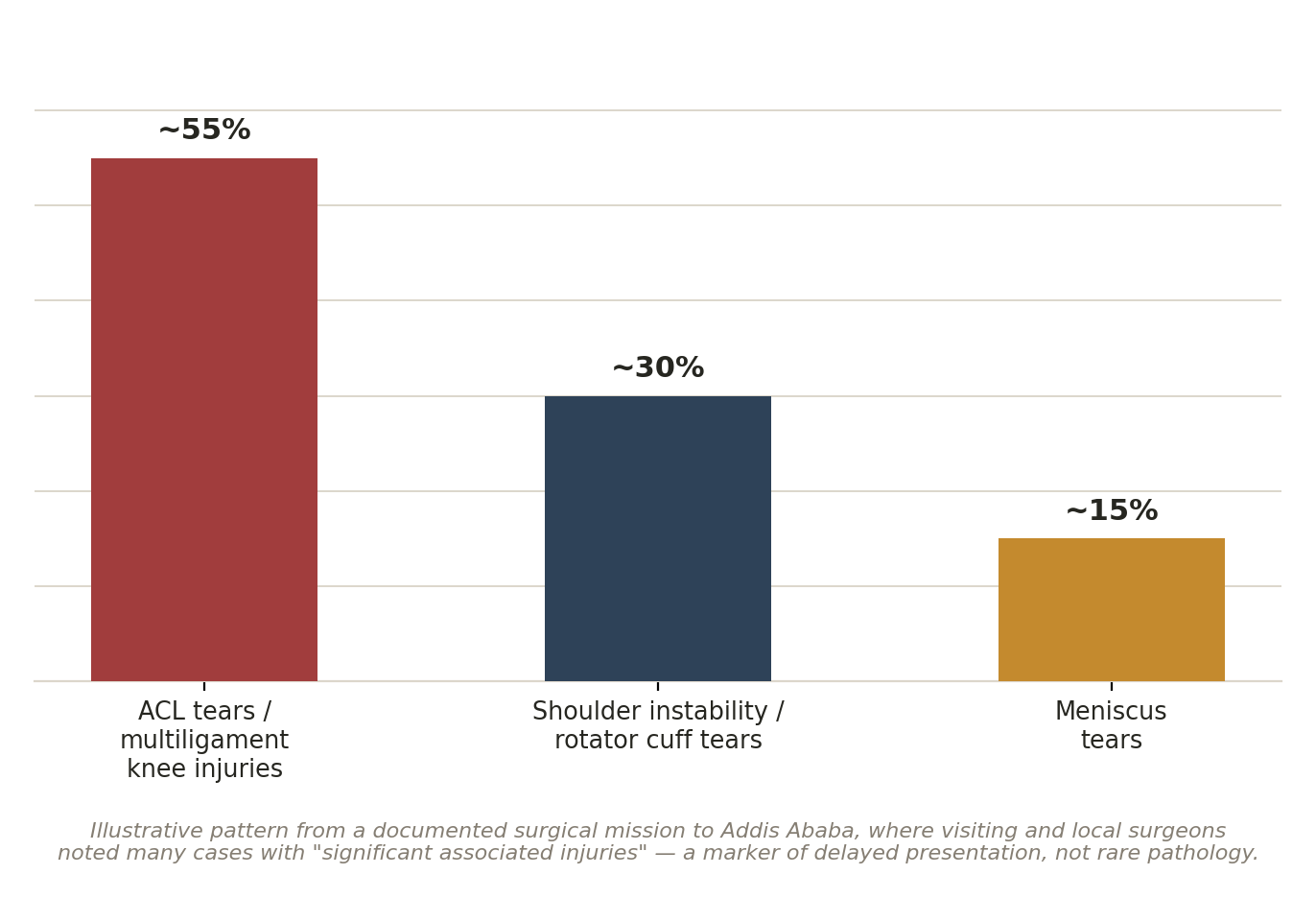
A pattern of significant, often multi-structure injuries consistent with delayed access to timely treatment.
This is precisely where India's sports medicine centres add genuine, comparative depth: the full range of arthroscopic equipment and fixation devices in routine stock, surgeons who perform hundreds of ACL and meniscus procedures a year as a defined subspecialty, and structured post-operative physiotherapy programmes built specifically around returning to sport. For an injury where both equipment access and surgical timing directly determine the long-term outcome, that established infrastructure is not a convenience — it is what actually protects the joint from the damage described in gate two. Ask any centre how many arthroscopic ACL reconstructions they perform annually.
5 Gate Five
Is the money arranged?
Ethiopia's health financing does not follow a patient abroad. Community-Based Health Insurance covers contracted facilities inside the country, and the formal-sector scheme still isn't settling claims. Since February 2026 a bank may release up to US$20,000 per case against a letter from the treating hospital, without a visa or ticket in hand.
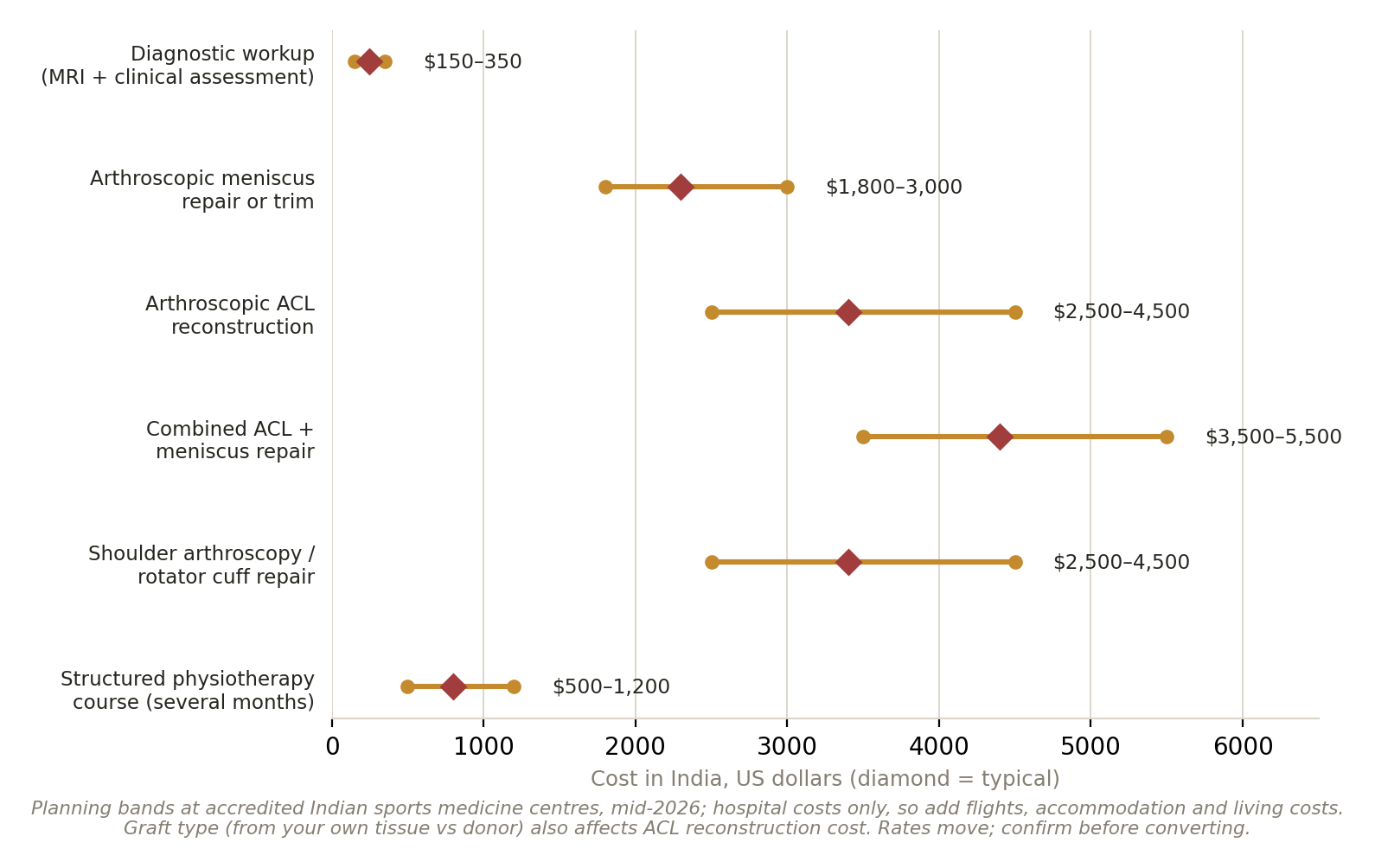
Budget for the specific structures involved, not the most familiar figure.
The figures differ by which structures need repair: a single meniscus procedure sits below an ACL reconstruction, and a combined injury costs more than either alone. Even at the top of these ranges, treatment at an accredited Indian sports medicine centre remains a fraction of an equivalent case in the Gulf, Europe, or the United States. Confirm which specific structures your MRI shows before assuming any single number applies to your case.
| A quotation, annotatedA composite of the sports medicine quotes that reach me, with the questions I send back. | |
| ACL reconstruction — USD 3,400 | Which graft source (your own tissue vs donor)? This affects both price and recovery profile. |
| Includes: MRI review and surgical planning | Good sign. Confirm the surgeon reviewed your actual MRI, not just the written report. |
| Includes: 2 days admission | Reasonable for arthroscopic surgery. Ask what a combined-injury case would add. |
| Technique: arthroscopic | Confirm this explicitly in writing, and the surgeon's annual case volume. |
| Excludes: structured physiotherapy programme | Ask for a written rehab plan and whether it can continue remotely from Ethiopia. |
| Excludes: meniscus repair if found during surgery | Ask what the price becomes if meniscus damage is discovered intraoperatively. |
In 24 years the sports medicine patients most satisfied with their outcome were the ones who acted within weeks of a confirmed diagnosis, not months.
The Ethiopian practicalities
Ethiopian Airlines flies non-stop from Bole to Delhi, Mumbai, Bengaluru, Chennai, and Hyderabad. Given how directly timing affects outcomes here, contact a centre as soon as an MRI confirms a ligament or meniscus tear rather than waiting. Ask for written clearance to fly a few days after surgery once wound healing is confirmed. Yellow fever certification is required at least ten days before arrival, oral polio vaccination roughly four weeks before. The medical visa follows the hospital's invitation letter through the Embassy of India, Addis Ababa. Arrange a structured physiotherapy plan before leaving India, ideally with a written programme a physiotherapist in Ethiopia can continue. Where treatment spans the Orthodox fasting calendar, this rarely affects sports medicine care directly, but confirm any dietary considerations with the hospital. Confirm current rules with the Embassy, since they change, and ask for an Amharic-speaking coordinator to carry the written rehabilitation plan back to a named provider in Ethiopia.
Straight Answers for Ethiopian Patients about Joint Arthroscopy and Sports Medicine in India
I twisted my knee playing football and it still feels unstable weeks later. Is this just a sprain?
Not necessarily. A simple sprain usually settles within a couple of weeks. A knee that keeps giving way or swells repeatedly is describing the pattern of a ligament tear. An MRI, not an X-ray, is what confirms this.
Does it matter how long I wait to have ACL surgery?
Yes, significantly. Research consistently shows the longer an unstable knee goes without reconstruction, the higher the risk of secondary, often permanent, damage to the meniscus and cartilage. Most guidance recommends reconstruction within about six months where possible.
Is arthroscopic surgery available in Ethiopia?
Emerging but still limited. A documented surgical mission found quality of care wasn't the issue, but access to specialised equipment was. This is improving, but capacity remains below demand.
How long does sports injury treatment in India take?
Diagnostic MRI workup typically takes two to three days. Surgery and initial hospital stay need one to three days. Most patients plan one to two weeks total, continuing fuller rehabilitation afterward.
Who pays for this in Ethiopia?
You do. Neither Community-Based Health Insurance nor the pending formal-sector scheme funds treatment abroad, though a bank may now advance up to US$20,000 against the treating hospital's letter.
A closing word
Send the MRI report and images if available, a note on how the injury happened, and how long ago. I will tell you honestly whether this looks like a ligament tear needing prompt surgery, and why India's high-volume arthroscopy centres are where that specific, time-sensitive treatment is most reliably available to an Ethiopian patient today.
Sources
- 🌐 MedStar Health orthopedic surgeon visits Ethiopia to treat the community and perform some of the country's first arthroscopic procedures
- 🌐 Chen JL, et al. The ACL-deficient knee and the prevalence of meniscus and cartilage lesions: a systematic review and meta-analysis
- 🌐 Ding L, et al. Longer time between anterior cruciate ligament injury and reconstruction is associated with a greater risk of medial meniscus injury
- 🌐 National Medical Commission of India — Indian Medical Register
- 🌐 National Bank of Ethiopia Directive FXD/04/2026 (foreign exchange, advance payments for treatment abroad); Embassy of India, Addis Ababa
Frequently Asked Questions by Ethiopians about Joint Arthroscopy and Sports Medicine in India
How can Ethiopian patients tell whether a knee injury is more than a simple sprain?
Ethiopian patients whose knee continues to give way, swell repeatedly or buckle during normal activities may have a ligament tear. The PDF recommends MRI rather than X-ray when these symptoms persist beyond two to three weeks.
Why should Ethiopian patients avoid delaying ACL reconstruction for too long?
For Ethiopian patients with a confirmed ACL tear and an unstable knee, prolonged delay can increase the risk of secondary meniscus and cartilage damage. The PDF notes that delays beyond six months were consistently associated with more meniscus damage.
Can Ethiopian patients receive arthroscopic ACL reconstruction in India?
Yes. Ethiopian patients can be assessed for arthroscopic ACL reconstruction at Indian sports medicine centres with appropriate equipment and specialised surgeons. The PDF recommends checking the centre's annual ACL reconstruction volume.
How much does ACL reconstruction cost for Ethiopian patients in India?
The PDF gives an indicative Indian planning range of approximately US$2,500–4,500 for arthroscopic ACL reconstruction. The final quotation depends on the graft, associated injuries and services included.
How much does meniscus repair cost for Ethiopian patients travelling to India?
The indicative India range is approximately US$1,800–3,000 for arthroscopic meniscus repair or trimming. Ethiopian patients should confirm whether any additional repair discovered during surgery is included in the quotation.
Can Ethiopian patients receive combined ACL and meniscus surgery in India?
Yes. Ethiopian patients with combined ACL and meniscus injuries can be assessed for treatment during the same arthroscopic procedure when clinically appropriate. The PDF gives an indicative cost range of US$3,500–5,500.
Can Ethiopian patients receive shoulder arthroscopy or rotator cuff repair in India?
Yes. Ethiopian patients with shoulder instability or rotator cuff injuries may be assessed for arthroscopic treatment in India. The PDF gives an indicative range of US$2,500–4,500 for shoulder arthroscopy or rotator cuff repair.
Is arthroscopic surgery widely available to Ethiopian patients within Ethiopia?
Arthroscopic surgery is developing in Ethiopia, including at centres in Addis Ababa, but the PDF notes that access to specialised equipment remains a limiting factor. Ethiopian patients should compare the availability of the required equipment and procedure-specific expertise before deciding where to undergo surgery.
How long should Ethiopian patients stay in India for sports injury surgery?
Ethiopian patients should generally plan for approximately one to two weeks in India. The PDF states that diagnostic MRI workup typically takes two to three days, while surgery and initial hospital care require approximately one to three days.
How should Ethiopian patients continue physiotherapy after returning from India?
Ethiopian patients should arrange a structured rehabilitation programme before leaving India, preferably with a written plan that a physiotherapist in Ethiopia can continue. The PDF also recommends carrying the rehabilitation plan to a named provider in Ethiopia.
Page Summary
This guide provides Ethiopian patients with a practical overview of joint arthroscopy and sports medicine treatment in India for ACL, meniscus and shoulder injuries. It explains why persistent knee instability and swelling require proper assessment, with MRI playing an important role in confirming ligament and meniscus injuries. The guide highlights how delaying ACL reconstruction may increase the risk of secondary meniscus and cartilage damage. It also explains arthroscopic surgery, its recovery advantages and the growing availability of specialised sports-medicine services in India compared with Ethiopia. The cost section presents indicative treatment ranges and an annotated ACL quotation, including important questions about graft type, additional procedures and rehabilitation. It also covers travel planning, the expected stay in India and arrangements for physiotherapy and follow-up after returning to Ethiopia.
Citation Block
| Topic | Information |
|---|---|
| Topic Information | Joint Arthroscopy and Sports Medicine for Ethiopian Patients in India |
| Treatment | Joint Arthroscopy / Sports Medicine |
| Country | India |
| Intended Audience | Ethiopian Patients |
| Main Procedures | ACL Reconstruction, Meniscus Repair and Shoulder Arthroscopy |
| Key Diagnosis | Ligament or Meniscus Tear |
| Preferred Imaging | MRI |
| ACL Delay Finding | Delays beyond 6 months linked to more meniscus damage |
| Meniscus Repair Cost | US$1,800–3,000 |
| ACL Reconstruction Cost | US$2,500–4,500 |
| Combined ACL + Meniscus | US$3,500–5,500 |
| Shoulder Arthroscopy / Rotator Cuff | US$2,500–4,500 |
| Diagnostic Workup | US$150–350 |
| Typical India Stay | Approximately 1–2 weeks |
| Key Specialist | Sports Medicine / Arthroscopic Orthopaedic Surgeon |
| Important Experience | Annual ACL and meniscus procedure volume |
| Hospital Accreditation | JCI or NABH can be independently verified |
| Follow-Up | Orthopaedic Provider / Physiotherapist in Ethiopia |
| Required Records | MRI, surgical report and rehabilitation plan |
| Financing Arrangement | Up to US$20,000 bank advance against treating hospital letter |
| Pre-Travel Check | Confirm MRI findings, procedure, quotation and rehabilitation plan |
| Author | Dr. Dheeraj Bojwani |
| Experience | 24+ Years |


Our Mission Statement
Our mission is to place patients at the centre of every healthcare decision by providing trustworthy, evidence-based, and unbiased medical information. We believe that informed patients make better decisions. Backed by personalised guidance from our experienced advisory team, we help patients understand their treatment options, compare them objectively, and confidently choose the path that best suits their medical needs and personal circumstances.
Patient Testimonials from Ethiopia










Ready to Take the First Step?
Share your Medical Reports with our Healthcare Managers Today and Get a FREE CONSULTATION, a Personalized Treatment Plan, and Complete Support from Arrival to Recovery.
Get Your Free ConsultationAreas We Serve
This resource has been thoughtfully prepared for patients from Ethiopia who are considering medical treatment in India. We also welcome patients from the wider region in the countries mentioned below-
We assist patients from:
- Eritrea
- Djibouti
- Somalia
- Kenya
- Sudan
- Burundi
- Comoros
- Ethiopia
- Madagascar
- Malawi
- Mauritius
- Mozambique
- Rwanda
- South Sudan
Many of the insights, treatment pathways, hospital recommendations, travel guidance, and patient support services described here are equally relevant and may be used as a reference when planning treatment in India.
From Ethiopia to India: Your Complete Patient Support Guide
- Brain Tumour Surgery in India for Ethiopians
- Cancer Treatment in India for Ethiopians
- Cardiac Surgery in India for Ethiopian Patients
- Cervical and Disc Replacement Surgery in India for Ethiopians
- Cosmetic and Plastic Surgery in India for Ethiopians
- CyberKnife Treatment in India for Ethiopians
- Eye Surgery in India for Ethiopians
- Gamma Knife Treatment in India for Ethiopians
- Heart Valve Replacement Surgery in India for Ethiopians
- Hip Surgery in India for Ethiopian Patients
- Knee Surgery in India for Ethiopian Patients
- Laparoscopic and Robotic Myomectomy Surgery in India for Ethiopians
- Neurosurgery in India for Ethiopians
- Paediatric Cardiac Surgery in India for Ethiopians
- Paediatric Neurosurgery in India for Ethiopians
- Prostate Cancer Treatment and Surgery in India for Ethiopians
- Robotic Cancer Surgery in India for Ethiopians
- Scoliosis Surgery in India for Ethiopians