

Dental and Maxillofacial Surgery for Ethiopian Patients in India
Five gates every dental and maxillofacial case should pass before booking a flight — from a straightforward implant to the complex facial reconstruction some Ethiopian children need after surviving a disease most of the world has never heard of, and why India's specialist centres cover that entire range reliably.
Dental care is often treated as the least urgent branch of medicine, and for routine needs — a filling, a crown, a single implant — that is often fair. In 24 years of arranging surgical care in India for patients across Africa and Asia, what surprises people about this field is not the routine end of it but the serious end: oral disease left untreated for years becomes surgical, and in a small but real number of Ethiopian children, becomes one of the most severe and disfiguring conditions in medicine. The African region's oral health workforce sits at roughly a third of what basic universal coverage requires, and Ethiopia ranks among the weakest even within that thin regional average, particularly for dental assistants and therapists. That gap has a specific, severe consequence worth naming directly: noma, a rapidly progressing gangrenous disease of the mouth and face that mainly affects malnourished young children, has been recognised by the World Health Organization as a neglected tropical disease, and Ethiopia has documented a rising number of cases since 2010. Survivors need staged reconstructive surgery that very few centres anywhere in the region can reliably provide. India's specialist dental and maxillofacial units, by contrast, cover this entire spectrum — from routine implants to complex facial reconstruction — as established, everyday practice. These five gates walk through what level of care a specific case genuinely needs, why Ethiopia's oral health gap runs deeper than routine access, and why India is where the full range of this care, including its most serious end, is reliably available.
Healing Journeys of Ethiopian Patients









Key Takeaways
- Dental and maxillofacial treatment covers a wide range of care, from routine fillings, root canals, crowns and single dental implants to complex surgical and reconstructive procedures involving the mouth, jaw and face. The PDF emphasises that routine dental problems may increasingly be managed locally in Ethiopia, while complex cases may require specialist expertise and facilities that are more limited.
- The guide highlights Ethiopia's oral-health workforce and service-delivery challenges. The page 2 chart compares the workforce needed for basic universal oral-health coverage with the current African regional situation, while the document also discusses the limited dedicated oral-health structure within Ethiopia's healthcare system.
- Noma is an important focus of the guide. It describes noma as a rapidly progressing disease affecting the mouth and face and notes its recognition by WHO as a neglected tropical disease in December 2023. Survivors can experience severe damage to the lips, cheeks, nose or jaw and may require multiple stages of reconstructive surgery.
- The document explains that India may be considered for complex cases because specialist centres can bring together prosthodontics, oral surgery, maxillofacial reconstruction, CBCT imaging, bone grafting and staged surgical planning. This is particularly relevant for patients requiring full-mouth rehabilitation, cleft repair or reconstruction following noma.
- The page 5 cost chart provides indicative treatment ranges, including USD 100–300 for diagnostic workup, USD 200–500 per tooth for root canal and crown, USD 300–800 for a single dental implant, USD 6,500–16,000 for full-mouth implants, USD 3,500–7,000 per stage for cleft lip/palate repair and USD 8,000–20,000 per surgical stage for noma-sequelae reconstruction.
- The annotated quotation on page 6 emphasises that patients should look beyond the headline price. They should confirm whether CBCT planning, bone grafting, implant systems, revision visits and all planned reconstructive stages are included, particularly when treatment is expected to take place over multiple visits.
Quick Facts
- Treatment
- Dental and Maxillofacial Surgery
- Country
- India
- Patients
- Ethiopian Patients
- Main Treatment Areas
- Dental Implants, Full-Mouth Rehabilitation, Cleft Repair and Facial Reconstruction
- Routine Treatments
- Fillings, Root Canals, Crowns and Single Dental Implants
- Complex Conditions
- Noma Sequelae, Cleft Conditions, Facial Trauma and Structural Facial Conditions
- Key Decision
- Routine Dental Care vs Surgical / Reconstructive Treatment
- Main Specialist Areas
- Prosthodontics, Oral Surgery and Maxillofacial Reconstruction
- Diagnostic Workup
- USD 100–300
- Root Canal + Crown
- USD 200–500 Per Tooth
- Single Dental Implant
- USD 300–800
- Full-Mouth Implants
- USD 6,500–16,000
- Cleft Lip/Palate Repair
- USD 3,500–7,000 Per Stage
- Noma-Sequelae Reconstruction
- USD 8,000–20,000 Per Surgical Stage
- Full-Mouth Rehabilitation
- Approximately 1–2 Weeks
- Complex Reconstruction
- Approximately 1–2 Years
- Key Requirement
- Specialist Matching to Case Complexity
- Important Imaging
- CBCT and Dental / Facial Imaging
- Follow-Up
- Required Between Stages and After Reconstruction
- Travel Planning
- Multiple Trips May Be Required for Staged Reconstruction
- Payment Advice
- Confirm Bone Grafting, Implant System, Revision Costs and All Treatment Stages
In Brief
Ethiopian patients considering dental or maxillofacial treatment in India should first determine whether their condition requires routine dental care or complex surgical and reconstructive treatment. Before travelling, patients should provide available dental imaging, photographs where relevant and previous treatment records. They should clarify the proposed procedure, need for bone grafting, number of treatment stages, expected treatment duration, complete cost and follow-up requirements. For complex reconstruction, multiple visits may be necessary because adequate healing time is required between procedures.
1 Gate One
A toothache, or the whole mouth?
Pain, a broken tooth, or a missing one is what usually starts this conversation, and most of the time the answer is routine: a filling, a root canal, a crown, or a single implant. These are treatable well at a competent local clinic and rarely need international travel.
The picture changes when years of untreated decay or missing teeth have affected the bite, the jaw, or several teeth at once, or where a birth condition like cleft lip or palate, facial trauma, or a disease process has affected the structure of the mouth or face itself. Ask plainly whether a specific case is a dental problem or a surgical, reconstructive one — the two need very different kinds of expertise, and confusing them wastes both time and money.
2 Gate Two
Why is basic care so hard to get at home?
This isn't really a question of individual clinics falling short. It is a structural gap, documented across the region and specifically in Ethiopia.
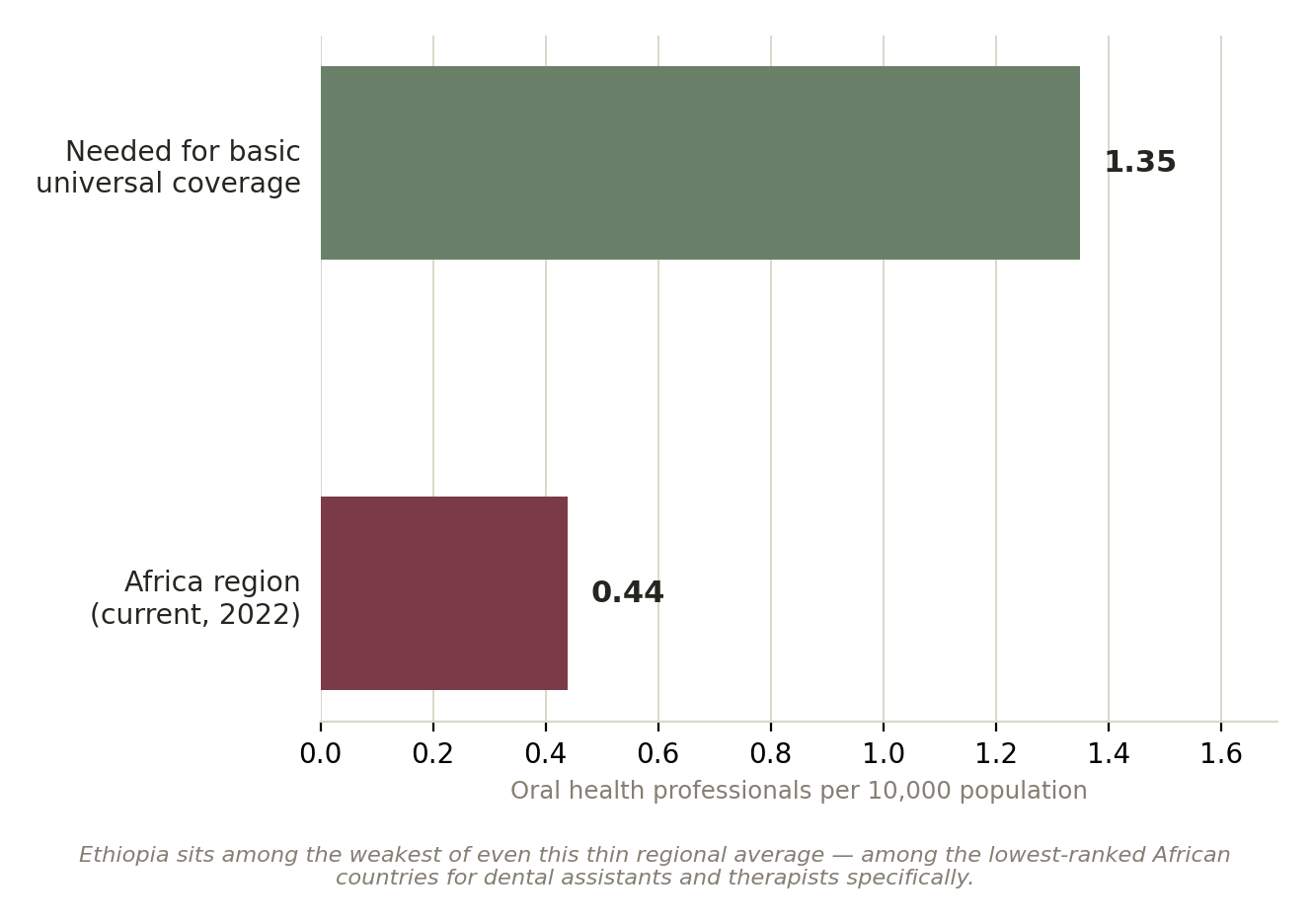
The region has roughly a third of the oral health workforce basic coverage requires — and Ethiopia sits among the weaker countries even within that average.
A policy gap, not just a workforce one: a national health-policy review found that Ethiopia's Ministry of Health has no dedicated oral health structure comparable to other disease programmes, which health managers themselves identify as a source of coordination gaps in service delivery. This compounds the workforce shortage rather than offsetting it.
The practical result is that untreated oral disease accumulates over years rather than being caught early, which is exactly how routine problems become surgical ones by the time they're finally seen.
3 Gate Three
When a toothache becomes a face
There is one consequence of this gap severe enough that it deserves to be named directly, not softened. Noma is a rapidly progressing gangrenous disease of the mouth and face that begins, in many cases, as ordinary gum disease in a malnourished young child, and can disfigure or kill within weeks without treatment. The World Health Organization formally recognised it as a neglected tropical disease in December 2023.
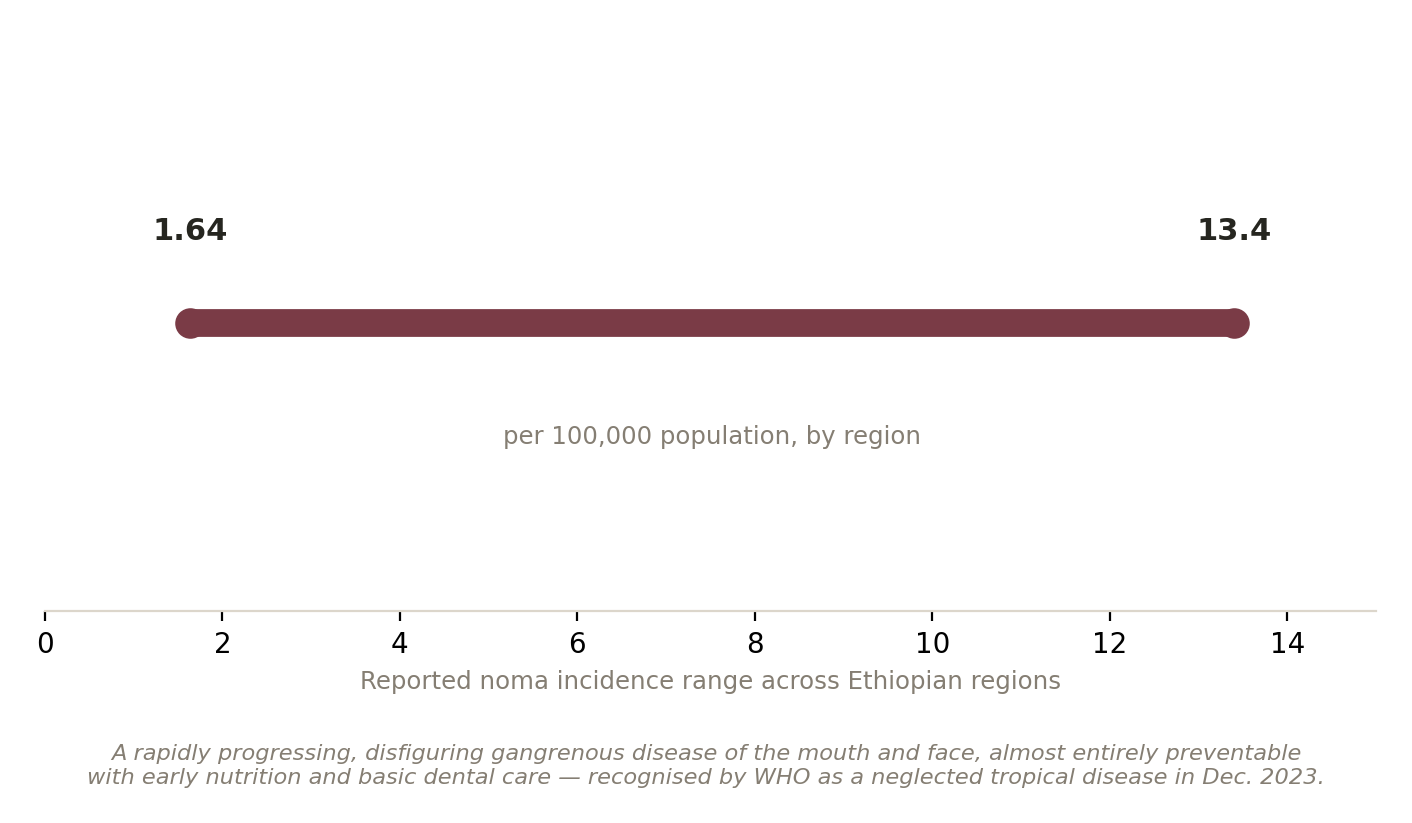
Ethiopia has documented a rising number of cases since 2010, with a particular concentration in the Gambella region.
Children who survive noma are frequently left with severe facial disfigurement — loss of parts of the lips, cheek, nose, or jaw — requiring staged reconstructive surgery over months to years to restore both function and appearance. This is not a cosmetic afterthought; difficulty eating, speaking, and profound social stigma follow survivors without it. If a noma survivor or a similarly severe facial condition is the reason for this search, ask specifically about staged reconstructive maxillofacial experience, not general cosmetic dentistry.
4 Gate Four
Could this be done in Ethiopia?
For routine dental care, increasingly yes — private clinics in Addis Ababa have grown considerably. For complex, surgical, or reconstructive needs, the picture is much thinner and heavily concentrated in one city.
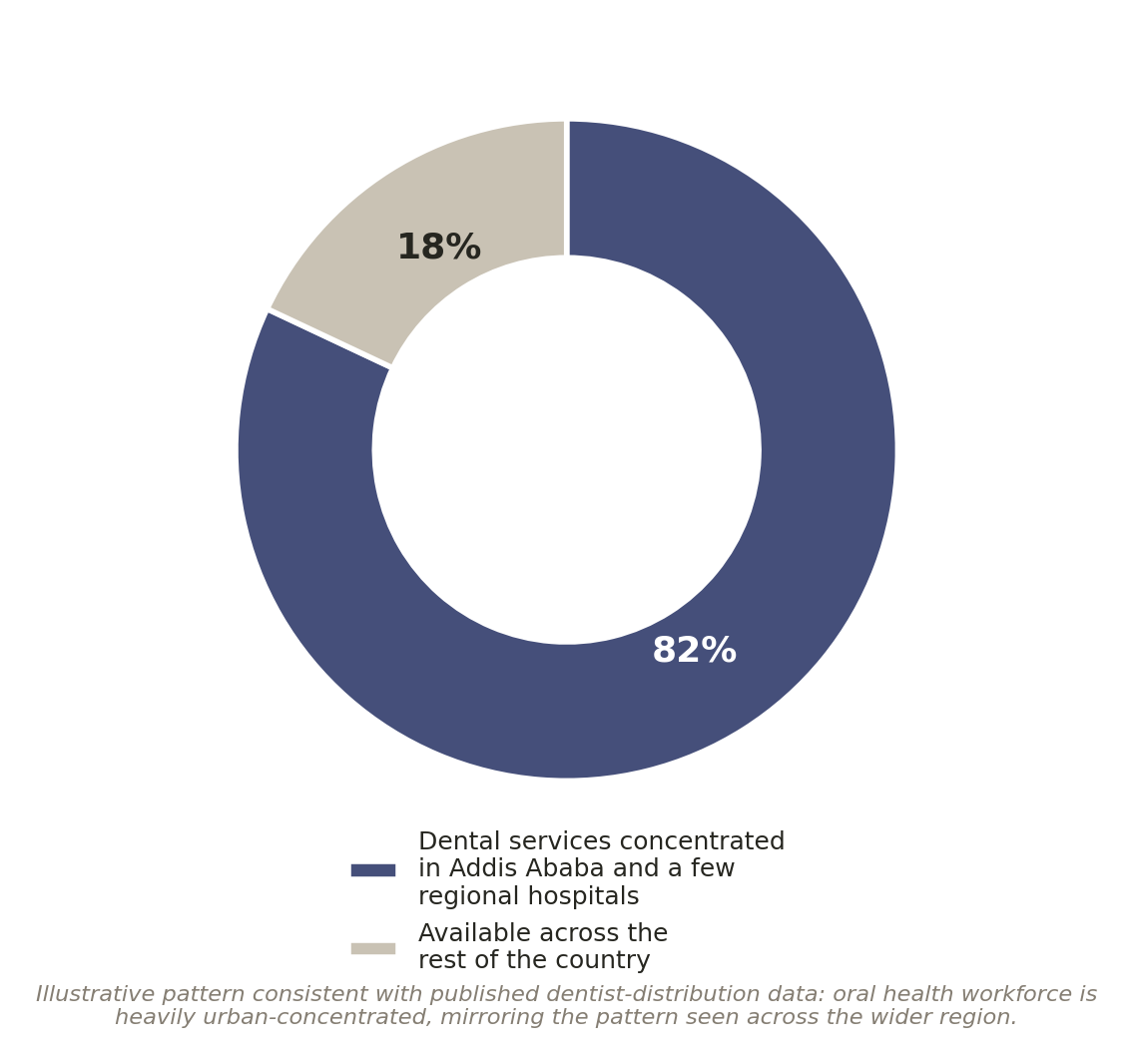
Most of the country has little practical access to anything beyond the most basic dental care.
This is precisely why India's position matters for the more serious end of this spectrum. India's specialist dental and maxillofacial units combine prosthodontics, oral surgery, and reconstructive plastic surgery as routine, high-volume practice, with the CBCT imaging, bone-grafting technique, and staged surgical planning that full-mouth rehabilitation, cleft repair, and noma-sequelae reconstruction all specifically require. For conditions this dependent on specialist technique and multi-stage planning, that established infrastructure is not a convenience — for many Ethiopian patients, it is the realistic route to treatment that actually restores function, not just appearance.
A second opinion on the diagnosis and treatment plan before committing to a specific centre is always worth arranging, particularly for staged reconstructive cases. Ask any centre how many cases of your specific type — full- mouth rehabilitation, cleft repair, or facial reconstruction — they manage each year.
5 Gate Five
Is the money arranged?
Ethiopia's health financing does not follow a patient abroad. Community-Based Health Insurance covers contracted facilities inside the country, and the formal-sector scheme still isn't settling claims. Since February 2026 a bank may release up to US$20,000 per case against a letter from the treating hospital, without a visa or ticket in hand.
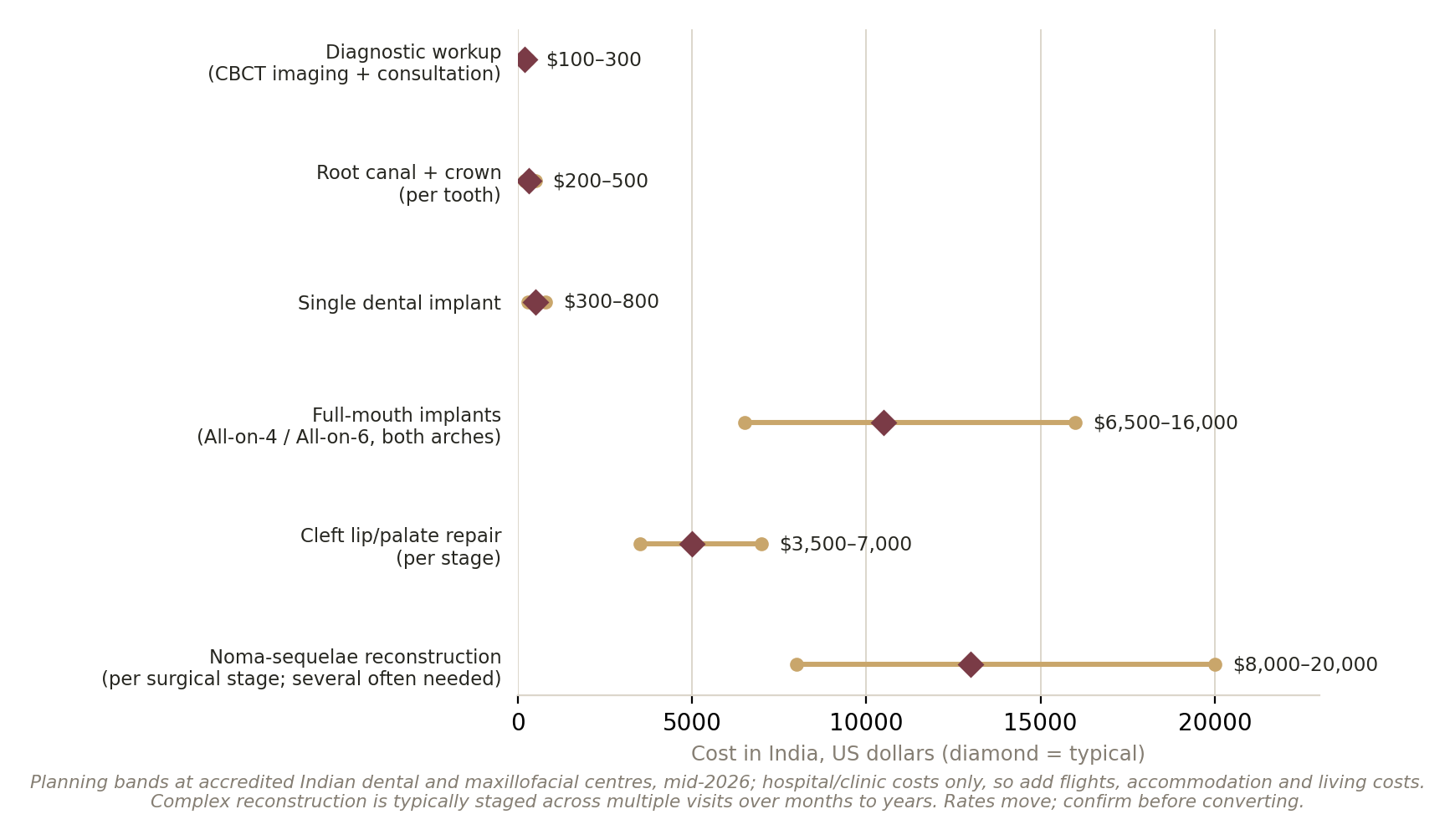
Budget for the level of care the case actually needs, not the most familiar figure.
The figures differ by an order of magnitude between routine and reconstructive care: a single implant sits at one end, staged facial reconstruction at the other. Even at the top of these ranges, treatment at an accredited Indian centre remains a fraction of an equivalent package in the Gulf, Europe, or the United States. Confirm which category of care applies before assuming any single number applies to your case.
| A quotation, annotatedA composite of the dental and maxillofacial quotes that reach me, with the questions I send back. | |
| Full mouth rehabilitation — USD 9,000 | Ask whether this includes bone grafting if needed, or is priced as an add-on. |
| Includes: CBCT imaging and planning | Good sign. Confirm a prosthodontist, not only a general dentist, is leading the plan. |
| Implant system: ask which brand | Ask specifically which implant system is used and its long-term track record. |
| Reconstructive case: staged over 3 visits | Ask for the total cost across all stages, not just the first, and the expected timeline. |
| Excludes: bone grafting if required | Ask whether your imaging suggests this will be needed, and its separate cost. |
| Excludes: revision or touch-up visits | Ask what a revision visit within the first year would cost. |
In 24 years the dental and maxillofacial patients most satisfied with their outcome were the ones who matched the specialist to the actual complexity of their case — not a general dentist for a reconstructive problem, and not an expensive reconstructive workup for a case that only needed routine care.
The Ethiopian practicalities
Ethiopian Airlines flies non-stop from Bole to Delhi, Mumbai, Bengaluru, Chennai, and Hyderabad. For staged reconstructive cases, plan for multiple separate trips rather than one long stay, since healing time is needed between stages. Yellow fever certification is required at least ten days before arrival, oral polio vaccination roughly four weeks before. The medical visa follows the hospital's invitation letter through the Embassy of India, Addis Ababa. For children undergoing noma-sequelae or cleft reconstruction, an attendant familiar with post-operative feeding and wound care is essential for each visit. Where treatment spans the Orthodox fasting calendar, raise this with the clinic's dietary guidance beforehand, particularly for post-surgical nutrition needs. Confirm current rules with the Embassy, since they change, and ask for an Amharic-speaking coordinator to carry a written follow-up plan back to a named provider in Ethiopia between stages.
Straight Answers for Ethiopian Patients about Dental and Maxillofacial Surgery in India
I just need a filling or a crown. Is this guide relevant to me?
Routine care is increasingly available at private clinics in Addis Ababa and usually doesn't need international travel. This guide is aimed more at surgical and reconstructive needs, where specialist capacity is genuinely limited in Ethiopia.
What is noma, and why does a dental guide mention it?
A rapidly progressing gangrenous disease of the mouth and face mainly affecting malnourished young children, recognised by WHO as a neglected tropical disease in December 2023. Ethiopia has documented rising cases since 2010. Survivors often need staged reconstructive surgery.
Is complex dental and maxillofacial surgery available in Ethiopia?
For routine care, increasingly yes, mainly in Addis Ababa. For complex reconstructive surgery, capacity is very limited nationally, reflecting a regional workforce shortage Ethiopia sits near the weaker end of.
How long does dental treatment in India take?
Routine implants typically need one visit of a few days, plus a shorter follow-up visit months later. Full-mouth rehabilitation often needs one to two weeks. Complex reconstruction is usually staged over one to two years.
Who pays for this in Ethiopia?
You do. Neither Community-Based Health Insurance nor the pending formal-sector scheme funds treatment abroad, though a bank may now advance up to US$20,000 against the treating hospital's letter.
A closing word
Send any dental imaging, a description of the problem, and photographs if the concern involves facial structure. I will tell you honestly whether this is a routine matter best handled locally or a reconstructive one, and if it's the latter, why India's specialist centres are where that entire range of care, including its most serious end, is reliably available.
Sources
- 🌐 Oral health workforce in Africa: a scarce resource. Int J Environ Res Public Health. 2023
- 🌐 WHO Regional Office for Africa. Africa faces critical shortage of oral health workers amid rising disease burden. 2024
- 🌐 Enbiale W, Wunder EA. Rapid assessment of noma: reporting on forgotten and neglected disease in Ethiopia. PLOS Negl Trop Dis. 2024
- 🌐 Gebretsadik HG. Estimation of the prevalence of noma in Ethiopia, 2007-2019: a retrospective study. Am J Trop Med Hyg. 2023
- 🌐 National Medical Commission of India — Indian Medical Register
- 🌐 National Bank of Ethiopia Directive FXD/04/2026 (foreign exchange, advance payments for treatment abroad); Embassy of India, Addis Ababa
Frequently Asked Questions by Ethiopians about Dental and Maxillofacial Surgery in India
Does every dental patient from Ethiopia need to travel to India?
No. Routine care such as fillings, crowns, root canals and many single implants is increasingly available through private clinics in Addis Ababa. The guide is primarily aimed at surgical and reconstructive cases where specialist capacity is more limited.
What dental treatments are covered in the guide?
The guide covers routine dental treatment as well as dental implants, full-mouth rehabilitation, cleft lip and palate repair, oral surgery and complex maxillofacial reconstruction.
What is noma, and why does a dental guide mention it?
Noma is a rapidly progressing disease affecting the mouth and face, mainly associated with malnourished young children. WHO recognised it as a neglected tropical disease in December 2023. Survivors can require staged reconstructive surgery.
What treatment may noma survivors require?
Noma survivors may have severe damage involving the lips, cheeks, nose or jaw. The guide explains that reconstruction may require several surgical stages over months or years to restore eating, speaking and facial function.
Is complex dental and maxillofacial surgery available in Ethiopia?
Routine dental care is increasingly available, particularly in Addis Ababa. For complex reconstructive surgery, the guide states that specialist capacity remains limited and concentrated in fewer locations.
How much does a dental implant cost in India?
The guide gives an indicative range of USD 300–800 for a single dental implant. The final cost can vary depending on the implant system, bone condition, additional procedures and the treating centre.
How much does full-mouth rehabilitation cost?
The guide gives an indicative range of USD 6,500–16,000 for full-mouth implants. Patients should confirm whether bone grafting, additional procedures and follow-up visits are included.
How much does noma-sequelae reconstruction cost?
The document gives an indicative range of USD 8,000–20,000 per surgical stage. Because reconstruction is usually staged, patients should ask for the estimated total cost across all planned stages.
How long does dental treatment in India take?
Routine implants may require one visit lasting a few days followed by a shorter follow-up visit months later. Full-mouth rehabilitation may take approximately one to two weeks, while complex reconstruction can be staged over one to two years.
What should Ethiopian patients ask before accepting a dental quotation?
Patients should ask whether CBCT imaging and planning, bone grafting, the implant system, all surgical stages and revision visits are included. For reconstructive cases, patients should confirm the total cost and expected timeline across all stages rather than considering only the initial quotation.
Page Summary
This guide explains dental and maxillofacial treatment options available to Ethiopian patients considering care in India, distinguishing routine dental procedures from complex surgical and reconstructive cases requiring specialist expertise. It highlights noma and the potential need for staged facial reconstruction, while providing indicative Indian treatment costs for dental implants, full-mouth rehabilitation, cleft repair and noma reconstruction. The guide also covers quotation considerations, treatment duration, travel planning and the importance of choosing specialists according to the complexity of the case. Overall, patients are encouraged to understand the complete treatment plan, expected costs and follow-up requirements before travelling to India.
Citation Block
| Topic | Information |
|---|---|
| Topic Information | Dental and Maxillofacial Surgery for Ethiopian Patients in India |
| Treatment | Dental and Maxillofacial Surgery |
| Country | India |
| Intended Audience | Ethiopian Patients |
| Main Treatment Areas | Dental Implants, Full-Mouth Rehabilitation, Cleft Repair and Facial Reconstruction |
| Routine Treatments | Fillings, Root Canals, Crowns and Single Dental Implants |
| Complex Treatments | Full-Mouth Rehabilitation, Cleft Repair and Noma-Sequelae Reconstruction |
| Key Condition | Noma and Severe Facial Reconstruction |
| Main Specialists | Prosthodontist, Oral Surgeon and Maxillofacial Specialist |
| Diagnostic Workup | USD 100–300 |
| Root Canal + Crown | USD 200–500 Per Tooth |
| Single Dental Implant | USD 300–800 |
| Full-Mouth Implants | USD 6,500–16,000 |
| Cleft Lip/Palate Repair | USD 3,500–7,000 Per Stage |
| Noma-Sequelae Reconstruction | USD 8,000–20,000 Per Surgical Stage |
| Full-Mouth Rehabilitation | Approximately 1–2 Weeks |
| Complex Reconstruction | Approximately 1–2 Years |
| Staged Treatment | Multiple Visits May Be Required |
| Important Imaging | CBCT and Dental / Facial Imaging |
| Important Planning | Bone Grafting and Staged Surgical Planning |
| Important Cost Check | Confirm All Stages and Exclusions |
| Follow-Up | Continued Dental / Maxillofacial Care |
| Payment Advice | Confirm Bone Grafting, Implant System, Revision Costs and All Treatment Stages |
| Author | Dr. Dheeraj Bojwani |
| Experience | 24+ Years |


Our Mission Statement
Our mission is to place patients at the centre of every healthcare decision by providing trustworthy, evidence-based, and unbiased medical information. We believe that informed patients make better decisions. Backed by personalised guidance from our experienced advisory team, we help patients understand their treatment options, compare them objectively, and confidently choose the path that best suits their medical needs and personal circumstances.
Patient Testimonials from Ethiopia










Ready to Take the First Step?
Share your Medical Reports with our Healthcare Managers Today and Get a FREE CONSULTATION, a Personalized Treatment Plan, and Complete Support from Arrival to Recovery.
Get Your Free ConsultationAreas We Serve
This resource has been thoughtfully prepared for patients from Ethiopia who are considering medical treatment in India. We also welcome patients from the wider region in the countries mentioned below-
We assist patients from:
- Eritrea
- Djibouti
- Somalia
- Kenya
- Sudan
- Burundi
- Comoros
- Ethiopia
- Madagascar
- Malawi
- Mauritius
- Mozambique
- Rwanda
- South Sudan
Many of the insights, treatment pathways, hospital recommendations, travel guidance, and patient support services described here are equally relevant and may be used as a reference when planning treatment in India.
From Ethiopia to India: Your Complete Patient Support Guide
- Brain Tumour Surgery in India for Ethiopians
- Cancer Treatment in India for Ethiopians
- Cardiac Surgery in India for Ethiopian Patients
- Cervical and Disc Replacement Surgery in India for Ethiopians
- Cosmetic and Plastic Surgery in India for Ethiopians
- CyberKnife Treatment in India for Ethiopians
- Eye Surgery in India for Ethiopians
- Gamma Knife Treatment in India for Ethiopians
- Heart Valve Replacement Surgery in India for Ethiopians
- Hip Surgery in India for Ethiopian Patients
- Knee Surgery in India for Ethiopian Patients
- Laparoscopic and Robotic Myomectomy Surgery in India for Ethiopians
- Neurosurgery in India for Ethiopians
- Paediatric Cardiac Surgery in India for Ethiopians
- Paediatric Neurosurgery in India for Ethiopians
- Prostate Cancer Treatment and Surgery in India for Ethiopians
- Robotic Cancer Surgery in India for Ethiopians
- Scoliosis Surgery in India for Ethiopians