

Dental Implants and Smile Makeover in India for Ethiopian Patients
Five gates every smile makeover should pass before booking a flight — starting with the fact that this is elective treatment, which means the honest question is never "should I do this at all" but "does the plan in front of me actually need to remove healthy tooth structure to get me there."
Asmile makeover is different from almost everything else in this series: nobody needs one. That doesn't make the decision trivial, but it does change what an honest guide should focus on. In 24 years of arranging dental and surgical care in India for patients across Africa and Asia, the biggest risk in cosmetic dentistry isn't usually the destination — it's the gap between what a specific concern actually requires and what gets sold as the solution, and that gap tends to run in one direction: toward more tooth structure removed than necessary. Ethiopia's underlying oral health picture matters here too, even for a cosmetic decision. Published clinic-based studies put untreated oral disease in Ethiopia at a striking share of the population, with dental caries and gum disease both common. A cosmetic plan built on top of unaddressed disease, or built by a provider who skips that check, is treating the surface of a larger problem. Basic cosmetic dentistry is increasingly available in Addis Ababa; digital smile design, a genuine range of premium ceramic materials, and high-volume, specialist-led cosmetic and restorative practice remain considerably harder to find, and this is where India's dental centres have built real, comparative depth. These five gates walk through matching the treatment to the actual concern, understanding what's reversible and what isn't, and why India's specialist cosmetic dental centres are where that full range of options, honestly explained, is most reliably available.
Healing Journeys of Ethiopian Patients









Key Takeaways
- A smile makeover is elective treatment, so the guide places strong emphasis on determining whether treatment is actually necessary and how much healthy tooth structure needs to be removed. It explains that staining, chips, gaps and missing teeth require different solutions, ranging from whitening and bonding to veneers, implants or a broader multi-tooth makeover.
- The PDF highlights the importance of preserving healthy tooth structure. Its page 2 chart illustrates an approximate enamel-removal range from 0 mm for professional whitening to around 0.05 mm for composite bonding, around 0.3 mm for no-prep/minimal-prep veneers, around 0.6 mm for traditional porcelain veneers and around 1.8 mm for a full crown. The document stresses that once healthy enamel is removed, it does not grow back.
- The guide compares composite, E-max/porcelain and zirconia materials. Composite is presented as the lower-cost option with a shorter expected lifespan, while E-max and porcelain offer a more natural appearance and zirconia is described as the strongest and longest-lasting option. The page 3 chart gives indicative lifespans of approximately 3–7 years for composite, 10–15 years for E-max/porcelain and 15–20 years for zirconia with normal care.
- Ethiopian patients can increasingly access basic cosmetic dentistry in Addis Ababa, including straightforward whitening and single-veneer treatment. The guide explains that India's specialist cosmetic dental centres may offer greater depth in digital smile design, specialist prosthodontics and premium ceramic systems, particularly for complex multi-tooth cases.
- The page 5 cost chart gives indicative Indian planning ranges of USD 80–250 for consultation plus digital smile design mock-up, USD 80–200 for professional whitening, USD 50–150 per tooth for composite veneer/bonding, USD 150–350 per tooth for E-max/porcelain veneer, USD 150–300 per tooth for zirconia veneer or crown, and approximately USD 2,000–6,000 for a full smile makeover involving 6–8 veneers. The document notes that these are planning bands and do not include items such as flights, accommodation or living expenses.
- The annotated quotation shows why Ethiopian patients should examine the complete treatment proposal rather than focusing only on the headline price. The guide recommends confirming the number of teeth, specific material and brand, digital smile design, involvement of a prosthodontist, pre-treatment for decay or gum disease and what warranty or replacement provisions apply if a veneer chips or debonds.
Quick Facts
- Treatment
- Dental Implants and Smile Makeover
- Country
- India
- Patients
- Ethiopian Patients
- Main Treatment Options
- Whitening, Composite Bonding, Veneers, Crowns and Dental Implants
- Key Decision
- Reversible Treatment vs Tooth Preparation
- Main Specialists
- Cosmetic Dentist and Prosthodontist
- Digital Smile Design
- Available for Treatment Planning
- Professional Whitening
- USD 80–200
- Composite Veneer / Bonding
- USD 50–150 Per Tooth
- E-max / Porcelain Veneer
- USD 150–350 Per Tooth
- Zirconia Veneer / Crown
- USD 150–300 Per Tooth
- Full Smile Makeover
- USD 2,000–6,000 for 6–8 Veneers
- Composite Lifespan
- Approximately 3–7 Years
- E-max / Porcelain Lifespan
- Approximately 10–15 Years
- Zirconia Lifespan
- Approximately 15–20 Years
- Single-Tooth Treatment
- Approximately 1–2 Days
- Multi-Tooth Makeover
- Approximately 5–7 Days for First Visit, Followed by a Shorter Second Visit 2–3 Weeks Later
- Ethiopia
- Basic Cosmetic Dentistry Increasingly Available in Addis Ababa
- Key Planning Requirement
- Confirm Material, Brand, Number of Teeth and Tooth Preparation
- Payment Advice
- Confirm Full-Case Cost, Pre-Treatment Requirements and Warranty
In Brief
Ethiopian patients considering a smile makeover or dental implants in India should first establish whether whitening, bonding, a single veneer or a broader treatment plan is actually required. Before agreeing to tooth preparation, patients should ask whether a more reversible option could achieve the desired result and how much healthy enamel would be removed. They should also confirm the exact material and brand, number of teeth, involvement of a prosthodontist, digital smile design, treatment stages, total cost and warranty arrangements. For multi-tooth smile makeovers, the PDF indicates that two visits approximately two to three weeks apart are commonly planned.
1 Gate One
An upgrade, or an overhaul?
Discoloured teeth, a chip, a gap, or a missing tooth is what usually starts this conversation, and each has a different natural answer. Staining responds to whitening. A single chip or gap often needs only bonding or one veneer. A missing tooth needs an implant. Multiple issues across the visible teeth, or a bite that doesn't feel right, may genuinely call for a broader smile makeover.
The mistake worth avoiding is letting a single-tooth concern turn into an eight-veneer package because it was offered as one, or a broad concern being patched tooth by tooth when a coordinated plan would give a better result. Ask for the specific reasoning behind the number of teeth being proposed, not just an itemised price list.
2 Gate Two
Grinding, or just whitening?
This is the single most important honesty question in cosmetic dentistry, and the one most often skipped. Veneers, in their traditional form, require removing a thin layer of enamel so the shell sits flush — and enamel, once removed, does not grow back. A tooth prepared for a veneer will need a veneer or crown for the rest of its life.
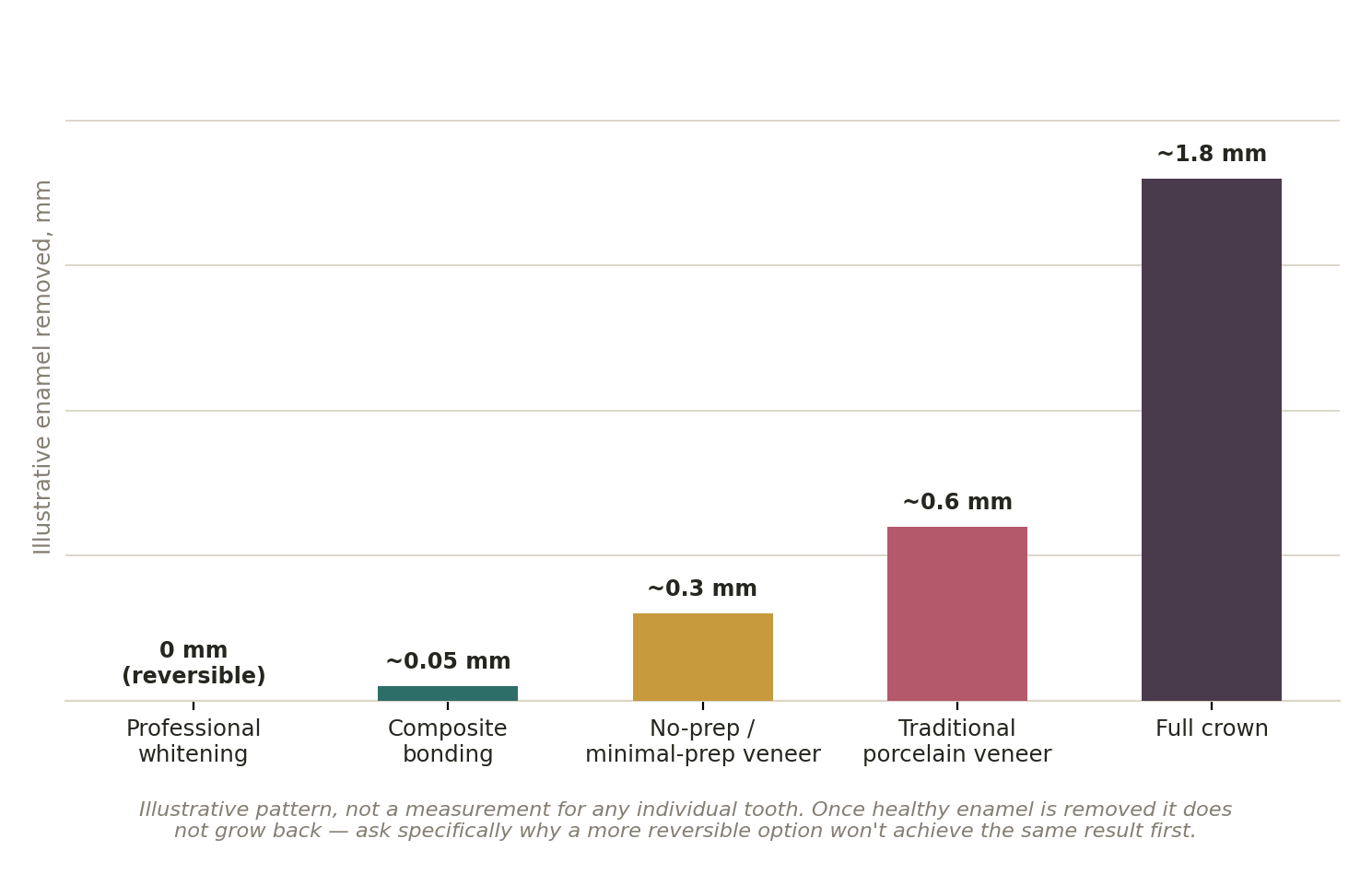
Whitening leaves the tooth untouched. Traditional veneer preparation does not.
The question worth asking before any preparation begins: would whitening, bonding, or a no-prep or minimal- prep veneer achieve the same result? A dentist who can answer this clearly, and who doesn't default to the most invasive option for every concern, is the one worth trusting with healthy teeth.
None of this means veneers are wrong — for genuine shape or alignment concerns, they are often the right answer, and can transform a smile in ways whitening alone never could. It means the decision to remove enamel should be made deliberately, with the reversible alternatives genuinely considered first, not skipped past on the way to a bigger treatment plan and a bigger invoice.
3 Gate Three
Which material, and for how long?
Not all veneers, or all crowns, are the same material, and the difference shows up years later, not on the day of treatment when everything looks equally polished. Composite is fabricated chairside, costs the least, and needs replacing soonest, making it a reasonable choice for a single tooth or a temporary fix but a poor one for a lasting multi-tooth investment. E-max and porcelain give a more natural, translucent appearance and are the standard material for most quality smile makeovers. Zirconia is the strongest and longest-lasting, often preferred for back teeth or patients who grind their teeth at night.
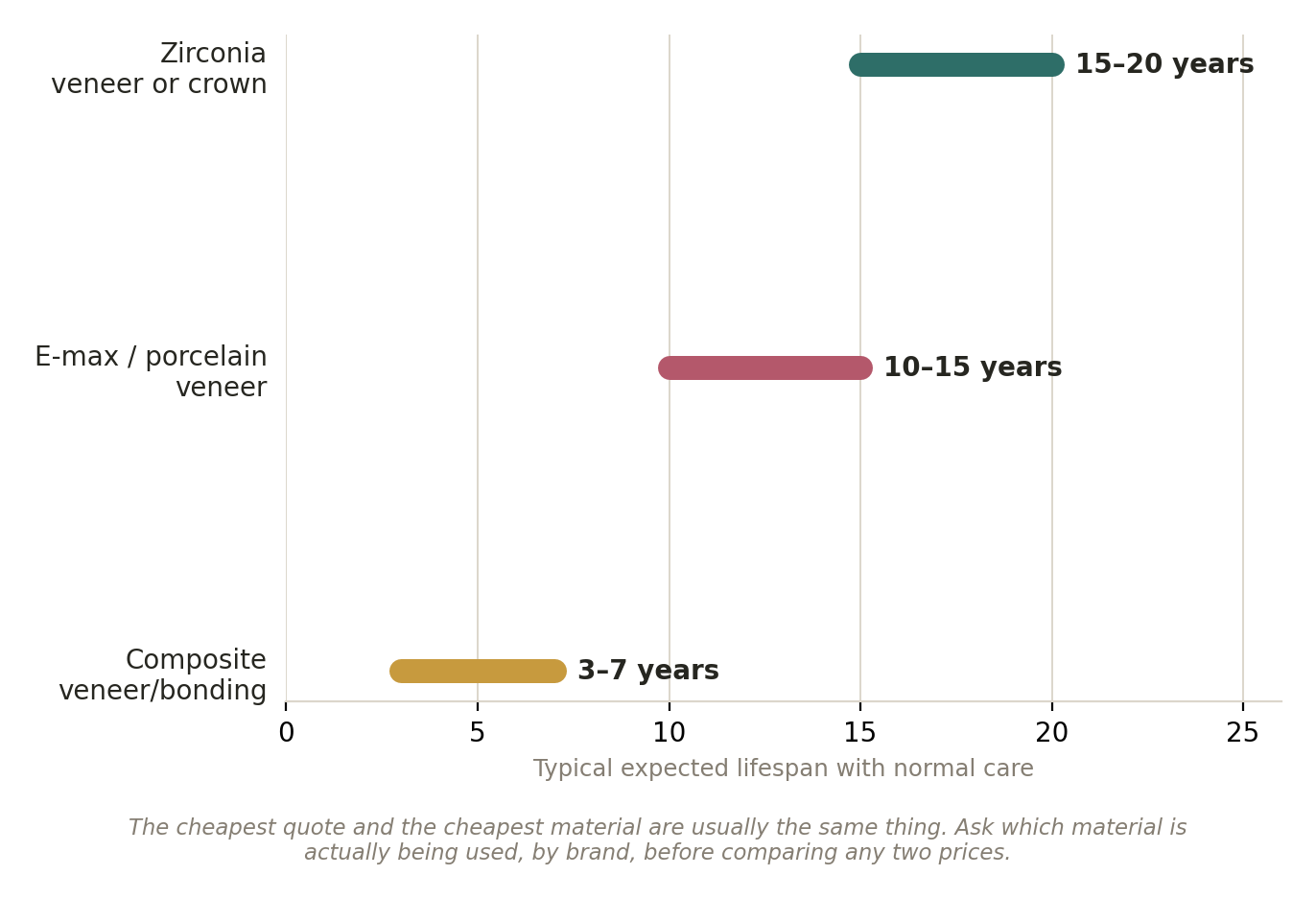
The cheapest quote and the cheapest material are usually the same thing.
Ask specifically which material and which brand is being used — "porcelain" alone doesn't specify quality, since it covers a wide range of products with very different track records. A quote that won't name the specific material is a quote worth questioning.
4 Gate Four
Could this be done in Ethiopia?
For straightforward whitening or a single veneer, increasingly yes — private clinics in Addis Ababa now offer cosmetic dentistry as a routine service, and the quality of the best of them continues to improve. It's worth remembering, though, that Ethiopia's underlying oral disease burden remains high, which changes what a responsible cosmetic consultation should actually involve.
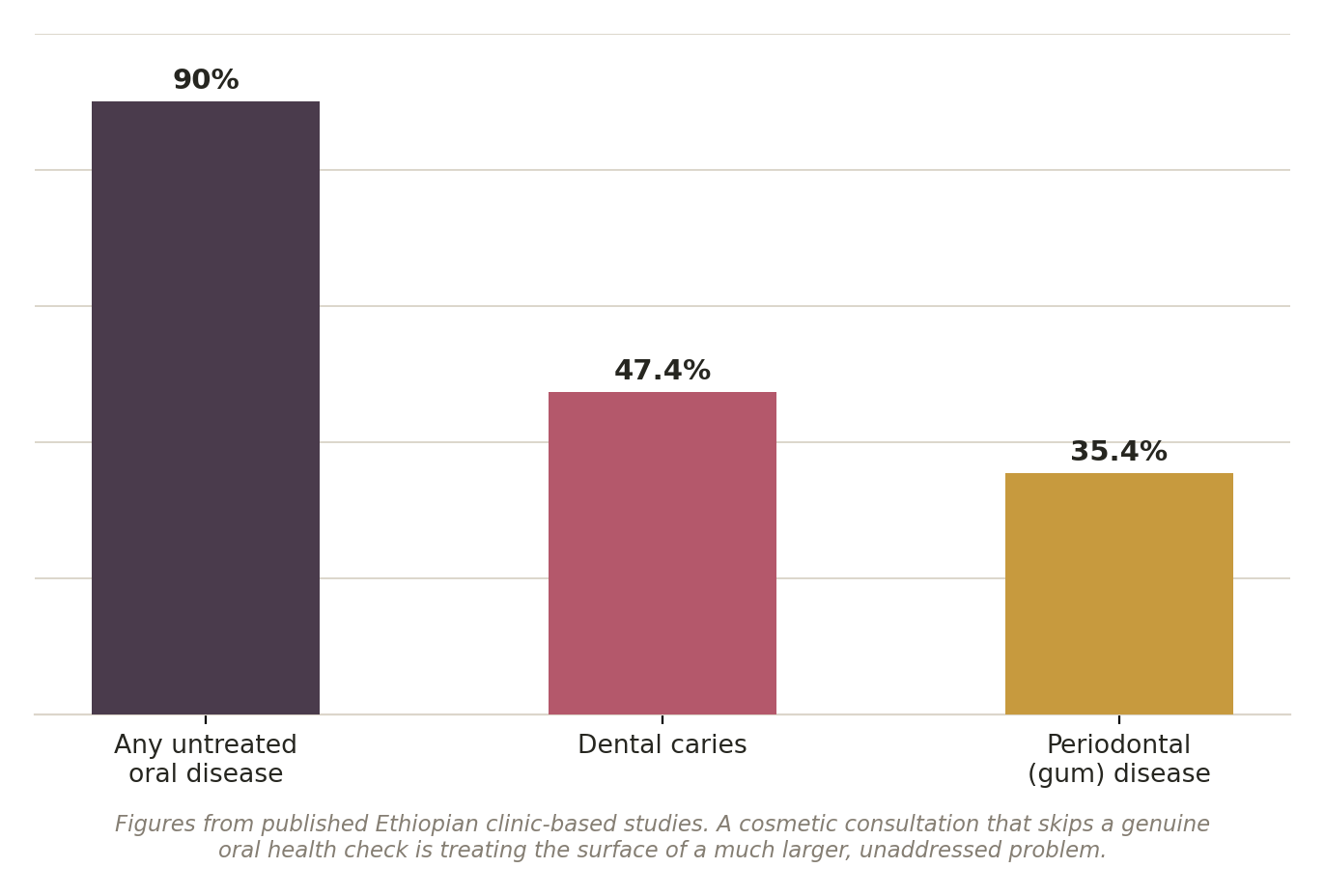
A cosmetic plan is only as good as the oral health foundation underneath it.
This is precisely where India's specialist cosmetic dental centres add genuine, comparative depth: digital smile design technology that lets a patient preview the result before any tooth is touched, prosthodontists — specialists in exactly this kind of restorative planning, not general dentists — leading multi-tooth cases, and a wide range of premium ceramic systems fabricated in-house. For a decision this dependent on getting the material and the technique right the first time, that specialist infrastructure matters. Ask any centre whether a prosthodontist or a general dentist is leading a multi-tooth plan, and how many smile makeover cases they complete each year.
5 Gate Five
Is the money arranged?
This is elective treatment, so it sits outside Ethiopia's health financing entirely — it is not covered by Community- Based Health Insurance, and there is no equivalent of the medical bank-advance provisions that apply to urgent treatment abroad. That also means there is no need to rush a decision the way a medical diagnosis might require.
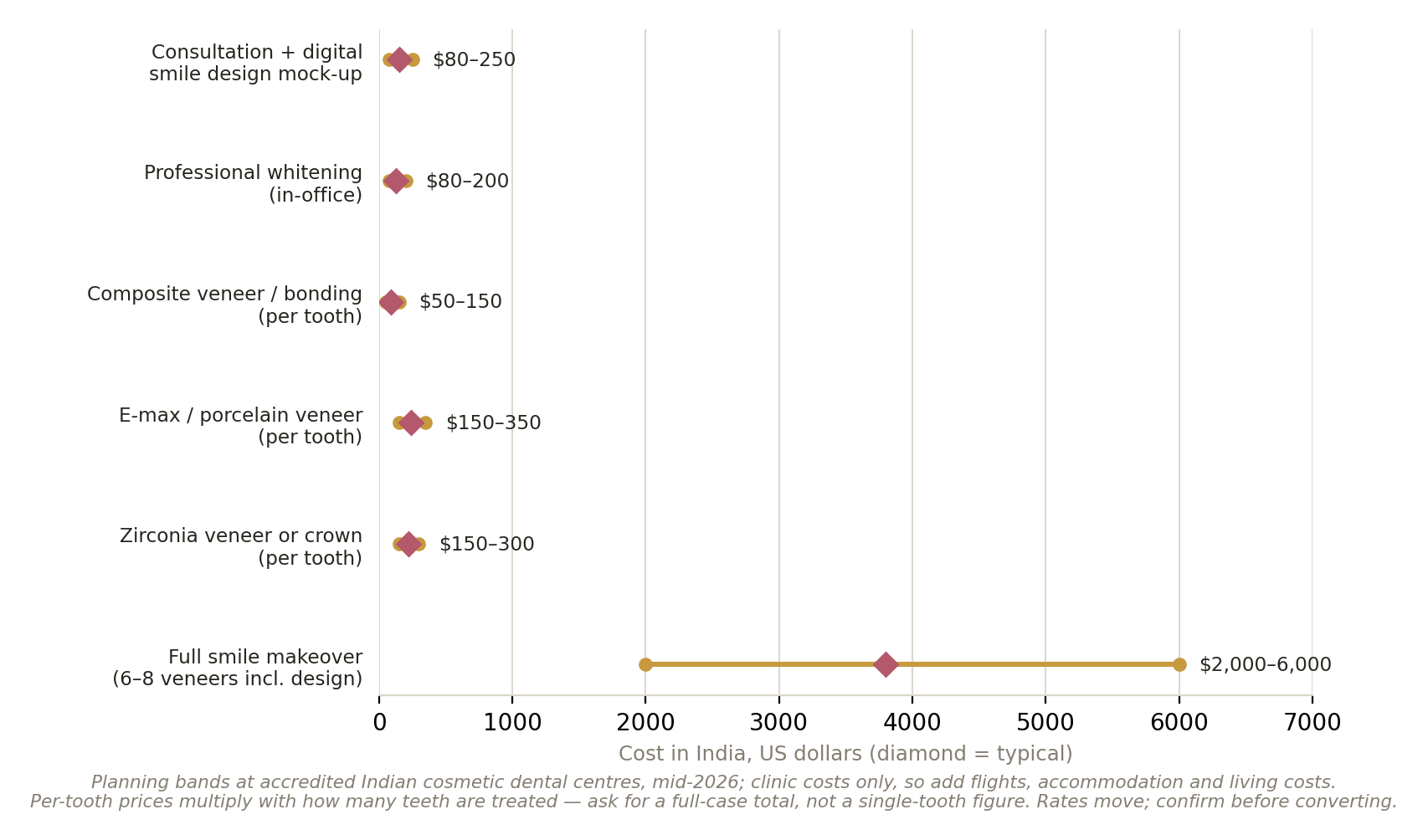
Per-tooth prices multiply quickly — always ask for the full-case total.
The figures differ enormously by material and scope: a single composite veneer sits at one end, a full multi-tooth makeover with premium ceramics at the other. Even at the top of these ranges, treatment at a reputable Indian cosmetic dental centre remains a fraction of an equivalent case in the Gulf, Europe, or the United States. Confirm the material, the number of teeth, and whether digital smile design is included before assuming any single number applies to your case.
| A quotation, annotatedA composite of the smile makeover quotes that reach me, with the questions I send back. | |
| Smile makeover — USD 2,500 | How many teeth, and which material? These two facts explain almost the entire price. |
| Includes: digital smile design | Good sign. Ask to see the actual digital mock-up before treatment begins. |
| Material: "premium porcelain" | Ask for the specific brand and product name, not just the category. |
| Led by: cosmetic dentist | For multi-tooth cases, ask whether a prosthodontist is involved in the plan. |
| Excludes: pre-treatment of decay or gum disease | Ask whether a full oral health check was done before this quote was given. |
| Excludes: replacement if a veneer chips or debonds | Ask what the warranty covers and for how long. |
In 24 years the smile makeover patients most satisfied with their outcome were the ones who asked what could be left alone as carefully as they asked what could be improved.
The Ethiopian practicalities
Ethiopian Airlines flies non-stop from Bole to Delhi, Mumbai, Bengaluru, Chennai, and Hyderabad. Most smile makeovers need two visits roughly two to three weeks apart, so many patients plan the trip around this rather than a single long stay. A tourist visa is normally sufficient for elective cosmetic treatment, though confirm this with the Embassy of India, Addis Ababa, since requirements can vary. Yellow fever certification is required at least ten days before arrival, oral polio vaccination roughly four weeks before. Since sensitivity is common in the days after preparation, avoid scheduling intense travel or dietary extremes immediately afterward. Confirm current visa rules with the Embassy, since they change, and keep a written record of the material and brand used for any future touch-up or maintenance visit back in Ethiopia.
Straight Answers for Ethiopian Patients about Dental Implants and Smile Makeover in India
Do I need veneers, or would whitening be enough?
For simple staining, whitening is reversible, cheaper, and leaves the tooth untouched. Veneers suit chips, gaps, or shape changes whitening can't fix. A trustworthy dentist tells you plainly when whitening would achieve your goal.
Is getting veneers reversible?
Traditional porcelain veneers require removing enamel that doesn't grow back. No-prep or minimal-prep veneers remove little to none and are far more reversible. Ask specifically which approach is proposed and how much tooth structure it removes.
Is cosmetic dentistry available in Ethiopia?
Basic cosmetic dentistry is increasingly available in Addis Ababa. Digital smile design, a wide range of premium materials, and high-volume specialist prosthodontists remain harder to find locally.
How long does a smile makeover in India take?
A straightforward whitening or single-tooth treatment takes one to two days. A multi-tooth veneer makeover typically needs a five-to-seven-day first visit, then a shorter second visit two to three weeks later.
Who pays for this in Ethiopia?
This is elective treatment, so it isn't covered by Community-Based Health Insurance or any Ethiopian financing scheme. It's paid for directly, and there's no need to rush the decision the way urgent medical care might require.
A closing word
Send photographs of your smile and a description of what you'd like to change. I will tell you honestly whether this looks like a whitening conversation, a single-tooth fix, or a genuine makeover — and why, for the multi-tooth cases, India's specialist cosmetic dental centres are where that plan is most reliably built well.
Sources
- 🌐 Oral hygiene practices and associated factors among patients visiting private dental clinics at Hawassa City, Southern Ethiopia. Int J Dent
- 🌐 Tooth brushing practice in Ethiopia: a systematic review and meta-analysis. Sci Rep. 2023
- 🌐 Oral health workforce in Africa: a scarce resource. Int J Environ Res Public Health. 2023
- 🌐 National Medical Commission of India — Indian Medical Register
- 🌐 National Bank of Ethiopia Directive FXD/04/2026 (foreign exchange, advance payments for treatment abroad); Embassy of India, Addis Ababa
Frequently Asked Questions by Ethiopians about Dental Implants and Smile Makeover in India
Do I need veneers, or would whitening be enough?
For simple staining, whitening is presented as a reversible option that leaves the tooth untouched. Veneers may be more appropriate for chips, gaps or shape changes that whitening cannot correct.
Is getting traditional veneers reversible?
Traditional porcelain veneers require removal of enamel, which does not grow back. The guide explains that no-prep or minimal-prep veneers remove little or no enamel and may therefore be more reversible.
What is the difference between composite, porcelain and zirconia?
Composite is generally less expensive and has a shorter expected lifespan. E-max/porcelain provides a natural appearance, while zirconia is described as stronger and longer-lasting, particularly for selected situations.
Is cosmetic dentistry available in Ethiopia?
Yes. The guide states that basic cosmetic dentistry is increasingly available in Addis Ababa, including straightforward whitening and single-veneer treatment. Digital smile design, premium materials and high-volume specialist prosthodontic services are described as harder to find locally.
How long does a smile makeover in India take?
A straightforward whitening or single-tooth treatment may take approximately one to two days. A multi-tooth veneer makeover typically requires a five-to-seven-day first visit followed by a shorter second visit approximately two to three weeks later.
How much does a full smile makeover cost in India?
The guide gives an indicative planning range of USD 2,000–6,000 for a 6–8 veneer smile makeover. The actual cost depends on the material, number of teeth and treatment requirements.
How much do veneers cost in India?
The indicative ranges are USD 50–150 per tooth for composite, USD 150–350 for E-max/porcelain, and USD 150–300 for zirconia veneers or crowns.
What should I ask before getting veneers?
Patients should ask how much tooth structure will be removed, whether whitening or bonding could achieve the same result, which material and brand will be used and whether a prosthodontist is involved in a multi-tooth treatment plan.
Is digital smile design included in treatment?
It may be included depending on the quotation. The guide recommends asking whether digital smile design is part of the proposed treatment and requesting to see the actual digital mock-up before treatment begins.
Who pays for cosmetic dental treatment in Ethiopia?
The PDF states that smile makeover treatment is elective and is not covered by Community-Based Health Insurance or an Ethiopian financing scheme. Patients therefore pay directly for the treatment and should arrange the full budget before travelling.
Page Summary
This guide explains dental implants and smile makeover options available to Ethiopian patients considering cosmetic dental treatment in India. It focuses on choosing the least invasive treatment that can appropriately address the patient's actual concern. The guide compares whitening, bonding, veneers and different ceramic materials, including their indicative lifespan and cost. It highlights India's specialist cosmetic dental infrastructure, including digital smile design and prosthodontic expertise. The guide also covers treatment duration, Ethiopia-specific travel considerations and important quotation questions. Overall, patients are encouraged to understand tooth preparation, materials, total costs and long-term maintenance before travelling to India.
Citation Block
| Topic | Information |
|---|---|
| Topic Information | Dental Implants and Smile Makeover in India for Ethiopian Patients |
| Treatment | Dental Implants and Cosmetic Smile Makeover |
| Country | India |
| Intended Audience | Ethiopian Patients |
| Main Treatment Options | Whitening, Bonding, Veneers, Crowns and Dental Implants |
| Main Specialists | Cosmetic Dentist and Prosthodontist |
| Digital Planning | Digital Smile Design |
| Professional Whitening | USD 80–200 |
| Composite Veneer / Bonding | USD 50–150 Per Tooth |
| E-max / Porcelain Veneer | USD 150–350 Per Tooth |
| Zirconia Veneer / Crown | USD 150–300 Per Tooth |
| Full Smile Makeover | USD 2,000–6,000 for 6–8 Veneers |
| Composite Lifespan | Approximately 3–7 Years |
| E-max / Porcelain Lifespan | Approximately 10–15 Years |
| Zirconia Lifespan | Approximately 15–20 Years |
| Treatment Duration | 1–2 Days for Simple Treatment; 2 Visits for Multi-Tooth Makeover |
| Important Planning | Confirm Tooth Preparation, Material and Brand |
| Important Cost Check | Confirm Full-Case Cost and Exclusions |
| Follow-Up | Maintenance and Future Touch-Up Planning |
| Author | Dr. Dheeraj Bojwani |
| Experience | 24+ Years |


Our Mission Statement
Our mission is to place patients at the centre of every healthcare decision by providing trustworthy, evidence-based, and unbiased medical information. We believe that informed patients make better decisions. Backed by personalised guidance from our experienced advisory team, we help patients understand their treatment options, compare them objectively, and confidently choose the path that best suits their medical needs and personal circumstances.
Patient Testimonials from Ethiopia










Ready to Take the First Step?
Share your Medical Reports with our Healthcare Managers Today and Get a FREE CONSULTATION, a Personalized Treatment Plan, and Complete Support from Arrival to Recovery.
Get Your Free ConsultationAreas We Serve
This resource has been thoughtfully prepared for patients from Ethiopia who are considering medical treatment in India. We also welcome patients from the wider region in the countries mentioned below-
We assist patients from:
- Eritrea
- Djibouti
- Somalia
- Kenya
- Sudan
- Burundi
- Comoros
- Ethiopia
- Madagascar
- Malawi
- Mauritius
- Mozambique
- Rwanda
- South Sudan
Many of the insights, treatment pathways, hospital recommendations, travel guidance, and patient support services described here are equally relevant and may be used as a reference when planning treatment in India.
From Ethiopia to India: Your Complete Patient Support Guide
- Brain Tumour Surgery in India for Ethiopians
- Cancer Treatment in India for Ethiopians
- Cardiac Surgery in India for Ethiopian Patients
- Cervical and Disc Replacement Surgery in India for Ethiopians
- Cosmetic and Plastic Surgery in India for Ethiopians
- CyberKnife Treatment in India for Ethiopians
- Eye Surgery in India for Ethiopians
- Gamma Knife Treatment in India for Ethiopians
- Heart Valve Replacement Surgery in India for Ethiopians
- Hip Surgery in India for Ethiopian Patients
- Knee Surgery in India for Ethiopian Patients
- Laparoscopic and Robotic Myomectomy Surgery in India for Ethiopians
- Neurosurgery in India for Ethiopians
- Paediatric Cardiac Surgery in India for Ethiopians
- Paediatric Neurosurgery in India for Ethiopians
- Prostate Cancer Treatment and Surgery in India for Ethiopians
- Robotic Cancer Surgery in India for Ethiopians
- Scoliosis Surgery in India for Ethiopians