

Complex Orthopaedic and Joint Revision Surgery for Ethiopian Patients in India
Five gates every failed joint replacement should pass before booking a flight — starting with the fact that a younger population getting joint replacements today is signing up for a relationship with revision surgery that most people never think about until the pain comes back.
Joint replacement is often presented as a one-time fix, and for many patients, especially older ones, it essentially is. That framing quietly breaks down for a younger patient, and this matters directly for Ethiopia and the wider region, where hip and knee replacement is increasingly performed on patients in their thirties and forties, often for avascular necrosis linked to sickle cell disease or the aftermath of trauma, rather than the age-related arthritis that dominates in wealthier countries. In 24 years of arranging surgical care in India for patients across Africa and Asia, revision surgery is a field where the honest starting point is that a joint replaced young is not a single operation — it is very often the first chapter of one. Revision surgery is also, categorically, a harder and more specialised undertaking than the original operation. It carries a substantially higher infection rate, needs a far broader inventory of implant components to handle unpredictable bone loss, and, where infection is the cause, typically requires a two-stage approach spanning months rather than a single procedure. Ethiopia's primary joint replacement programme has made genuine, real progress, with skilled local surgeons now performing modern techniques. Revision surgery, and particularly infected revision surgery, is a different order of complexity, and India's high-volume revision arthroplasty centres are built specifically around it. These five gates walk through whether a failing joint is loose or infected, why the odds of needing this operation are higher than most patients realise, and why India is where the deep specialisation this specific problem needs is reliably available.
Healing Journeys of Ethiopian Patients









Key Takeaways
- Pain returning after a previously replaced hip or knee should not automatically be considered normal ageing; imaging and often joint aspiration are needed to determine whether the implant is loose or infected.
- Younger Ethiopian patients may receive joint replacements earlier because of conditions such as avascular necrosis related to sickle cell disease or post-traumatic arthritis, giving the implant more years in which revision may eventually become necessary.
- The page 2 visual illustrates how implant survival without revision can decline more substantially over time when the primary replacement is performed at a younger age.
- The page 3 chart shows periprosthetic joint infection rates of approximately 1–2% after primary replacement compared with 3–10% after revision replacement.
- The page 4 cause-of-failure visual identifies infection, aseptic loosening, dislocation/instability, and fracture, wear and other causes as major reasons for revision.
- An aseptic revision may often be completed as one procedure, while an infected joint typically requires a two-stage revision, with implant removal, an antibiotic spacer, targeted antibiotics and later reimplantation.
- The indicative India cost ranges on page 5 include US$6,500–14,000 for aseptic revision, while two-stage infected revision may involve approximately US$6,000–10,000 for stage 1 and US$6,000–12,000 for stage 2, excluding other applicable expenses.
- The PDF explains that Ethiopian primary hip and knee replacement services are increasingly established, while complex revision—especially infected revision—requires deeper implant inventory, microbiology support and subspecialised revision expertise.
- For Ethiopian patients with an infected revision, treatment may require two separate trips several weeks to months apart, rather than one continuous stay.
- Before travelling, patients should establish whether infection has been ruled out, confirm the exact revision components available, understand the complete cost across all stages and arrange follow-up and antibiotic monitoring in Ethiopia.
Quick Facts
- Treatment
- Complex Orthopaedic and Joint Revision Surgery
- Country
- India
- Patients
- Ethiopian Patients
- Main Procedures
- Hip Revision, Knee Revision, Aseptic Revision and Two-Stage Infected Revision
- Common Causes
- Infection, Loosening, Instability, Wear and Fracture
- Primary Joint Infection Rate
- Approximately 1–2%
- Revision Joint Infection Rate
- Approximately 3–10%
- Aseptic Revision
- Often one procedure
- Infected Revision
- Typically two-stage treatment
- Stage 1
- Implant removal and temporary antibiotic spacer
- Stage 2
- Reimplantation after infection clearance
- Diagnostic Workup
- US$300–700
- Aseptic Revision
- US$6,500–14,000
- Infected Revision
- US$6,000–12,000 per stage
- Extended IV Antibiotics
- US$1,500–4,000
- Aseptic Revision Stay
- Approximately 1–2 weeks
- Infected Revision
- Two visits several weeks to months apart
- Key Specialist
- Revision Arthroplasty / Orthopaedic Surgeon
- Important Expertise
- High annual revision volume and infection-specific experience
- Hospital Accreditation
- JCI or NABH can be independently verified
- Follow-Up
- Named Orthopaedic Provider in Ethiopia
- Required Records
- Imaging, original surgery details, revision plan and antibiotic monitoring plan
- Financing Mentioned
- Up to US$20,000 bank advance against treating hospital letter under the cited arrangement
In Brief
Ethiopian patients with a painful or failing hip or knee replacement should first establish whether the problem is aseptic loosening, infection, instability, wear or another mechanical complication. The PDF emphasises that imaging and often joint aspiration are important because an infected replacement requires a completely different treatment pathway from a straightforward aseptic revision. The page 3 chart shows a higher periprosthetic infection range after revision surgery than after primary replacement, while page 4 illustrates the major causes of revision. Indian high-volume revision arthroplasty centres are presented as having revision-specific implant systems, microbiology coordination and teams experienced in complex and infected revisions. Ethiopian patients should confirm the annual revision volume, infection-specific case volume, implant availability and the total cost if two stages are required.
1 Gate One
Worn, or failed?
Pain returning in a previously replaced hip or knee is what usually starts this conversation, and it should never be waved away as ordinary aging or "just getting used to it again." Imaging and, in most cases, a joint aspiration to test the fluid for infection are what actually distinguish the possible causes — and the two broad categories, loosening and infection, need completely different treatment paths.
Ask explicitly whether infection has been tested for and ruled out before any revision plan is finalised. Treating an infected joint as if it were simply loose is a mistake that can cost months and make the eventual correct treatment considerably harder.
2 Gate Two
Why the odds catch up with the young
An implant does not last forever, and how many years it needs to last depends entirely on how old the patient is when it goes in. This is where the regional pattern matters directly: published data from African joint replacement registries shows patients presenting meaningfully younger than in wealthier countries, often for avascular necrosis related to sickle cell disease or post-traumatic arthritis rather than age-related wear.
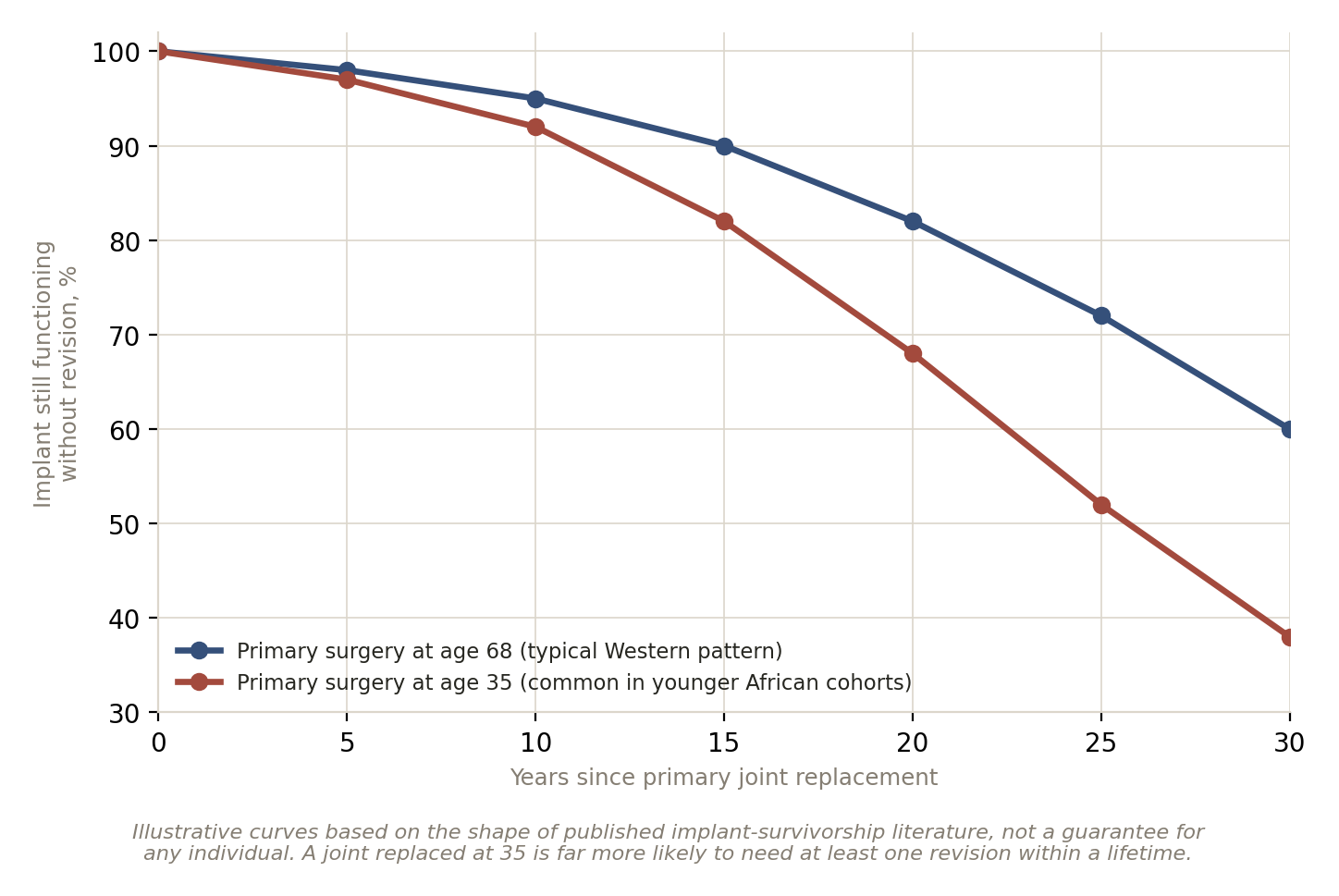
A joint replaced at 35 has decades more ahead of it during which it can fail.
This is not a reason to avoid or delay a needed primary replacement — the pain relief and function it restores are real and substantial. It is a reason to plan with open eyes: ask specifically what the expected implant lifespan is for a patient of your age and activity level, and understand that a second operation, someday, is a realistic part of that plan rather than a remote possibility.
3 Gate Three
Infected, or just loose?
Once revision is genuinely needed, the cause changes everything about how it's done.
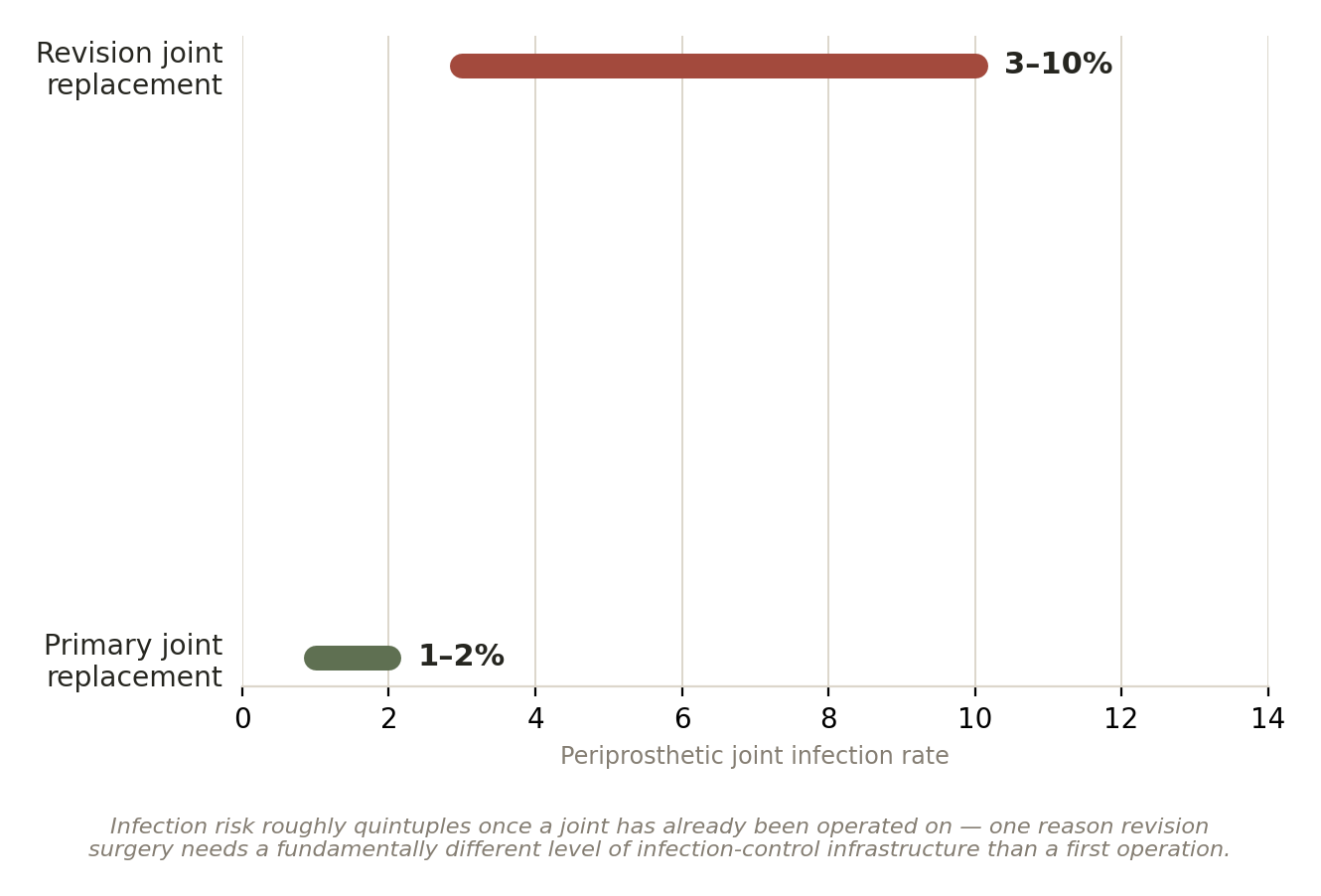
Every previous operation on a joint raises the odds the next one will need to deal with infection too.
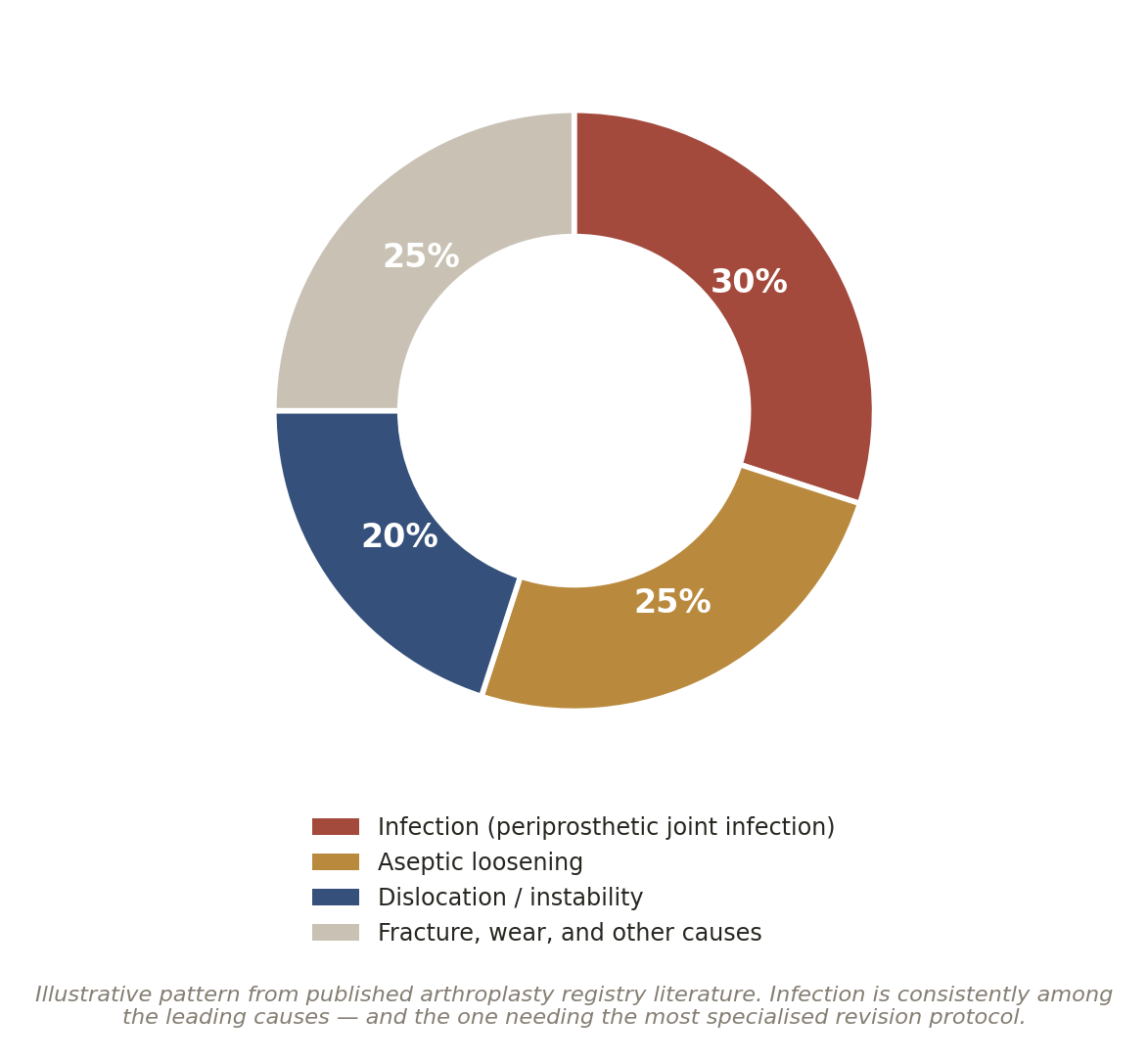
Infection is consistently among the leading reasons a joint replacement needs to be redone.
Why this distinction changes the whole plan: an aseptic revision, for simple loosening or wear, is often a single procedure. An infected joint typically needs a two-stage approach: removing the infected implant and placing a temporary antibiotic-releasing spacer, followed by weeks of targeted intravenous antibiotics, and only then reimplanting new components once the infection is confirmed cleared. Rushing this sequence is one of the most common causes of a revision failing a second time.
4 Gate Four
Could this be done in Ethiopia?
For primary hip and knee replacement, increasingly yes — Ethiopia now has skilled local surgeons performing modern techniques, including muscle-sparing approaches. Revision surgery is a genuinely different undertaking, and it is honest to say the specific infrastructure it depends on — a deep inventory of revision-specific implant components in multiple sizes to handle unpredictable bone loss, microbiology support for targeted antibiotic selection, and a subspecialised revision team — takes a primary arthroplasty programme considerably longer to build than the skill to perform a first replacement well.
This is precisely where India's high-volume revision arthroplasty centres add genuine, comparative depth: surgeons who perform revision surgery as a defined subspecialty rather than an occasional complex case, the full range of revision implant systems in stock, and infectious disease coordination built into the two-stage protocol as standard practice. For an operation this dependent on having the right component available in the operating room and the right antibiotic chosen from culture results, that infrastructure is not a convenience — it is what actually determines whether the second operation succeeds where the first one didn't. Ask any centre how many revision cases they perform annually, and separately, how many of those were for infection specifically.
5 Gate Five
Is the money arranged?
Ethiopia's health financing does not follow a patient abroad. Community-Based Health Insurance covers contracted facilities inside the country, and the formal-sector scheme still isn't settling claims. Since February 2026 a bank may release up to US$20,000 per case against a letter from the treating hospital, without a visa or ticket in hand.
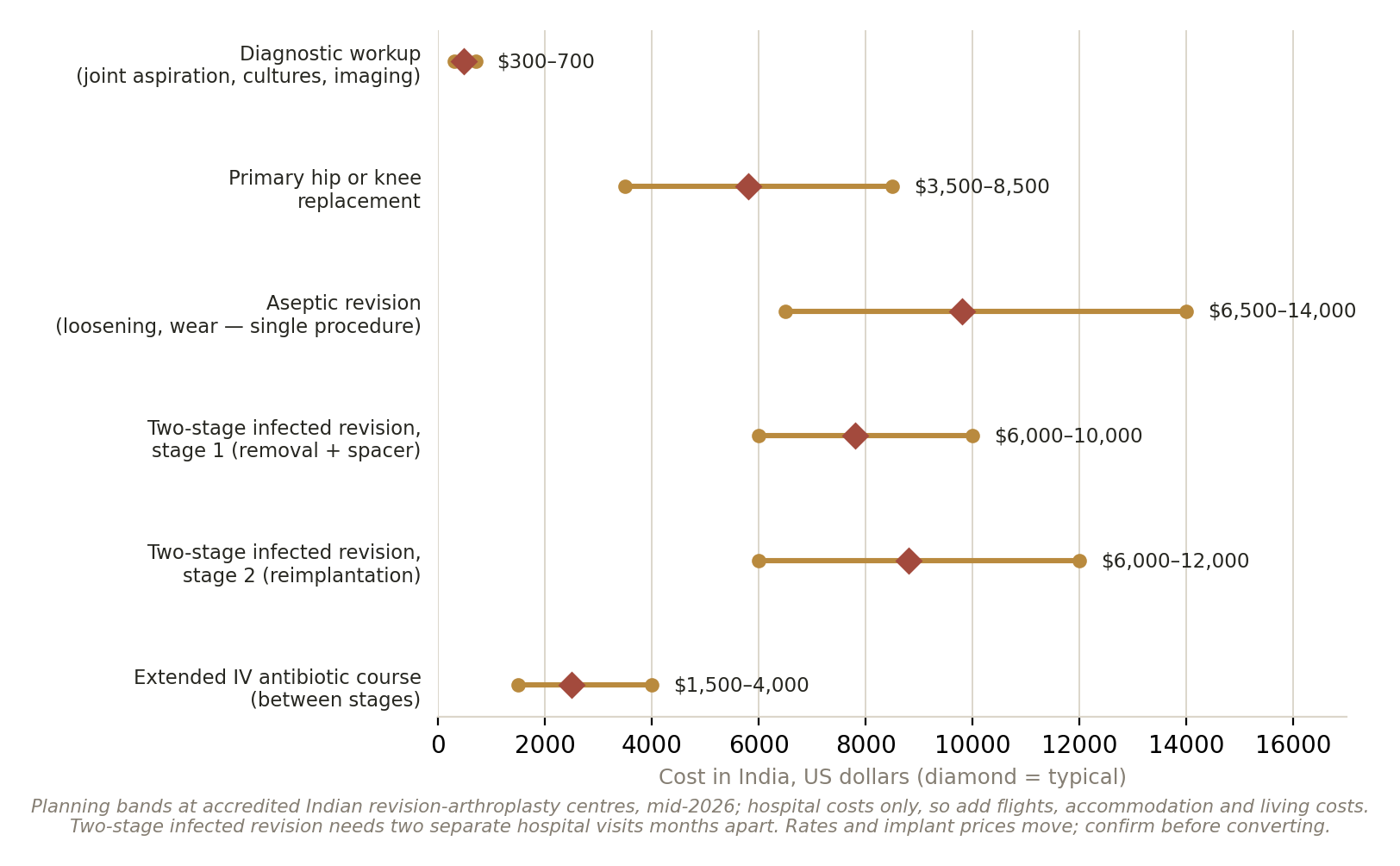
Budget for the cause your diagnosis actually points to, not the most familiar figure.
The figures differ substantially by cause and complexity: an aseptic revision sits well below a two-stage infected revision, which involves two separate procedures and an extended antibiotic course in between. Even at the top of these ranges, treatment at a leading Indian revision arthroplasty centre remains a fraction of an equivalent case in the Gulf, Europe, or the United States. Confirm whether infection has been ruled in or out before assuming any single number applies to your case.
| A quotation, annotatedA composite of the revision surgery quotes that reach me, with the questions I send back. | |
| Revision joint replacement — USD 9,000 | Aseptic or infected? A two-stage infected revision needs two separate procedures, not one. |
| Includes: joint aspiration and cultures | Good sign. Ask what happens, and what the price becomes, if infection is confirmed. |
| Implant: revision-specific system | Ask whether augments or stemmed components are available if bone loss is significant. |
| Includes: 7 days admission | Ask what a longer stay or a second stage, if needed, would add. |
| Excludes: extended IV antibiotic course | Ask how this is delivered, for how long, and its separate cost. |
| Excludes: second-stage reimplantation | If two-stage, ask for the total cost across both stages, not just the first. |
In 24 years the revision surgery patients most satisfied with their outcome were the ones who insisted on knowing whether their joint was infected before agreeing to any plan, price, or timeline.
The Ethiopian practicalities
Ethiopian Airlines flies non-stop from Bole to Delhi, Mumbai, Bengaluru, Chennai, and Hyderabad. For a two-stage infected revision, plan for two separate trips months apart rather than one long stay, since the antibiotic course between stages is usually managed with local medical support once initiated. Ask for written clearance to fly rather than assuming a fixed recovery timeline, since this varies considerably between aseptic and infected revisions. Yellow fever certification is required at least ten days before arrival, oral polio vaccination roughly four weeks before. The medical visa follows the hospital's invitation letter through the Embassy of India, Addis Ababa. Where treatment spans the Orthodox fasting calendar, raise this with the hospital's dietary team beforehand, since post-surgical and antibiotic- course nutrition needs are specific. Confirm current rules with the Embassy, since they change, and ask for an Amharic- speaking coordinator to carry a written follow-up and antibiotic monitoring plan back to a named provider in Ethiopia between stages.
Straight Answers for Ethiopian Patients about Complex Orthopaedic and Joint Revision Surgery in India
My hip or knee replacement is painful again. Does that mean it has failed?
Not necessarily, but it should never be dismissed as ordinary aging. It needs imaging and often a joint aspiration to test for infection, since a loose implant and an infected one need completely different treatment.
Why would a joint replacement need to be redone?
The most common reasons are infection, loosening over time, instability, and mechanical wear. Younger patients face a meaningfully higher lifetime chance of needing at least one revision simply because their implant has more years ahead of it.
Is revision joint replacement available in Ethiopia?
Primary replacement is increasingly well established, with skilled local surgeons. Revision surgery, particularly for infection, needs a much deeper inventory of components and infrastructure a still-young primary programme is less likely to have built out yet.
How long does revision joint replacement in India take?
An aseptic revision typically needs one to two weeks. An infected revision usually needs two visits several weeks to months apart: one to remove the implant and place a spacer, and a second to reimplant after an antibiotic course.
Who pays for this in Ethiopia?
You do. Neither Community-Based Health Insurance nor the pending formal-sector scheme funds treatment abroad, though a bank may now advance up to US$20,000 against the treating hospital's letter.
A closing word
Send any imaging, the original surgery details if available, and a note on when the pain returned and whether fever or drainage has been present. I will tell you honestly whether this looks like loosening or infection, and why India's revision arthroplasty centres are where the specific components and protocol this problem needs are reliably in place.
Sources
- 🌐 Periprosthetic joint infection: a multifaceted burden undermining arthroplasty success. Orthopedic Reviews. 2025
- 🌐 Preoperative strategies to prevent periprosthetic joint infection after knee replacement
- 🌐 Joint replacement surgery in Ghana (West Africa): an observational study. PMC. 2019
- 🌐 National Medical Commission of India — Indian Medical Register
- 🌐 National Bank of Ethiopia Directive FXD/04/2026 (foreign exchange, advance payments for treatment abroad); Embassy of India, Addis Ababa
Frequently Asked Questions by Ethiopians about Complex Orthopaedic and Joint Revision Surgery in India
Should Ethiopian patients with a painful hip or knee replacement assume that the implant has failed?
No. Ethiopian patients with renewed pain after joint replacement should have the problem investigated rather than assuming normal ageing or immediate implant failure. Imaging and often joint aspiration are needed to distinguish loosening from infection.
Why might younger Ethiopian patients need joint revision surgery later in life?
Ethiopian patients may undergo hip or knee replacement at younger ages because of conditions such as avascular necrosis associated with sickle cell disease or post-traumatic arthritis. A replacement performed at a younger age has more years during which it can potentially wear or fail.
How can Ethiopian patients find out whether their failed joint replacement is infected?
Ethiopian patients should ask for appropriate imaging and, where indicated, joint aspiration and cultures before a revision plan is finalised. The PDF emphasises that treating an infected joint as simple loosening can make the eventual treatment considerably more difficult.
Can Ethiopian patients receive aseptic hip or knee revision surgery in India?
Yes. Ethiopian patients with loosening or wear without confirmed infection may be assessed for aseptic revision surgery in India. The PDF indicates that an aseptic revision is often performed as a single procedure and provides an indicative India cost range of US$6,500–14,000.
Can Ethiopian patients with an infected joint replacement receive two-stage revision surgery in India?
Yes. Ethiopian patients with an infected hip or knee replacement may require a two-stage revision involving removal of the infected implant, placement of an antibiotic spacer, targeted antibiotics and later reimplantation after infection clearance.
How much can two-stage infected joint revision cost for Ethiopian patients in India?
The PDF gives indicative ranges of US$6,000–10,000 for stage 1 and US$6,000–12,000 for stage 2, with an additional estimated US$1,500–4,000 for extended IV antibiotics. Patients should confirm the complete cost across both stages rather than budgeting only for the first operation.
Can Ethiopian patients receive complex joint revision surgery locally in Ethiopia?
Primary hip and knee replacement is increasingly established in Ethiopia, with skilled local surgeons performing modern techniques. However, the PDF explains that complex and infected revision surgery requires deeper implant inventory, microbiology support and specialised revision infrastructure that may be less developed locally.
How long does joint revision treatment take for Ethiopian patients travelling to India?
An aseptic revision typically requires approximately one to two weeks in India. An infected revision generally requires two separate visits several weeks to months apart, because the antibiotic treatment occurs between implant removal and reimplantation.
What should Ethiopian patients check in an Indian revision-surgery quotation?
Ethiopian patients should confirm whether infection testing and joint aspiration are included, whether revision-specific implants and components are available, how significant bone loss will be managed, what admission period is included, and whether antibiotic treatment and second-stage reimplantation are separately charged.
How should Ethiopian patients manage follow-up between two revision surgeries in India?
Ethiopian patients undergoing a two-stage infected revision should arrange local medical support in Ethiopia for the antibiotic period between operations. The PDF recommends carrying a written follow-up and antibiotic-monitoring plan to a named provider and arranging written clearance before each journey.
Page Summary
This guide explains complex hip and knee revision surgery in India for Ethiopian patients. It focuses on identifying whether a previously replaced joint is loose, worn or infected. Page 1 introduces the challenges of revision surgery and why younger patients may face revision later in life. Page 2 explains implant lifespan and infection assessment. Page 3 compares infection risk after primary and revision surgery. Page 4 outlines the major causes of revision and explains aseptic versus infected revision. Pages 5–7 cover costs, quotation checks, travel planning, treatment duration and follow-up in Ethiopia.
Citation Block
| Topic | Information |
|---|---|
| Topic Information | Complex Orthopaedic and Joint Revision Surgery for Ethiopian Patients in India |
| Treatment | Complex Joint Revision Surgery |
| Country | India |
| Intended Audience | Ethiopian Patients |
| Main Procedures | Hip Revision, Knee Revision, Aseptic Revision and Two-Stage Infected Revision |
| Common Causes | Infection, Loosening, Instability, Wear and Fracture |
| Primary Infection Rate | Approximately 1–2% |
| Revision Infection Rate | Approximately 3–10% |
| Aseptic Revision | Often a single procedure |
| Infected Revision | Typically a two-stage procedure |
| Stage 1 | Implant removal and antibiotic spacer |
| Stage 2 | Reimplantation after infection clearance |
| Diagnostic Workup | US$300–700 |
| Aseptic Revision Cost | US$6,500–14,000 |
| Infected Revision Cost | US$6,000–12,000 per stage |
| Extended IV Antibiotics | US$1,500–4,000 |
| Aseptic Revision Stay | Approximately 1–2 weeks |
| Infected Revision Timeline | Two visits several weeks to months apart |
| Key Specialist | Revision Arthroplasty / Orthopaedic Surgeon |
| Important Experience | Annual revision and infection-specific case volume |
| Hospital Accreditation | JCI or NABH can be independently verified |
| Follow-Up | Named Orthopaedic Provider in Ethiopia |
| Required Records | Imaging, original surgery details and treatment plan |
| Financing Arrangement | Up to US$20,000 bank advance against treating hospital letter |
| Pre-Travel Check | Confirm infection status, revision plan and total cost |
| Author | Dr. Dheeraj Bojwani |
| Experience | 24+ Years |


Our Mission Statement
Our mission is to place patients at the centre of every healthcare decision by providing trustworthy, evidence-based, and unbiased medical information. We believe that informed patients make better decisions. Backed by personalised guidance from our experienced advisory team, we help patients understand their treatment options, compare them objectively, and confidently choose the path that best suits their medical needs and personal circumstances.
Patient Testimonials from Ethiopia










Ready to Take the First Step?
Share your Medical Reports with our Healthcare Managers Today and Get a FREE CONSULTATION, a Personalized Treatment Plan, and Complete Support from Arrival to Recovery.
Get Your Free ConsultationAreas We Serve
This resource has been thoughtfully prepared for patients from Ethiopia who are considering medical treatment in India. We also welcome patients from the wider region in the countries mentioned below-
We assist patients from:
- Eritrea
- Djibouti
- Somalia
- Kenya
- Sudan
- Burundi
- Comoros
- Ethiopia
- Madagascar
- Malawi
- Mauritius
- Mozambique
- Rwanda
- South Sudan
Many of the insights, treatment pathways, hospital recommendations, travel guidance, and patient support services described here are equally relevant and may be used as a reference when planning treatment in India.
From Ethiopia to India: Your Complete Patient Support Guide
- Brain Tumour Surgery in India for Ethiopians
- Cancer Treatment in India for Ethiopians
- Cardiac Surgery in India for Ethiopian Patients
- Cervical and Disc Replacement Surgery in India for Ethiopians
- Cosmetic and Plastic Surgery in India for Ethiopians
- CyberKnife Treatment in India for Ethiopians
- Eye Surgery in India for Ethiopians
- Gamma Knife Treatment in India for Ethiopians
- Heart Valve Replacement Surgery in India for Ethiopians
- Hip Surgery in India for Ethiopian Patients
- Knee Surgery in India for Ethiopian Patients
- Laparoscopic and Robotic Myomectomy Surgery in India for Ethiopians
- Neurosurgery in India for Ethiopians
- Paediatric Cardiac Surgery in India for Ethiopians
- Paediatric Neurosurgery in India for Ethiopians
- Prostate Cancer Treatment and Surgery in India for Ethiopians
- Robotic Cancer Surgery in India for Ethiopians
- Scoliosis Surgery in India for Ethiopians