

Colorectal Cancer Surgery in India for Ethiopian Patients
Five gates every colorectal case should pass before booking a flight — and why, for the majority of Ethiopian patients whose cancer sits in the rectum rather than the colon, India's high-volume specialist units handle the technically hardest part of this disease best.
Colorectal cancer is now the leading cancer among Ethiopian men and a major one among women, and published data from Tikur Anbessa Specialized Hospital — the country's only full oncology centre — changes the entire treatment conversation. In 24 years of arranging surgical care in India for patients across Africa and Asia, colorectal cancer is the field where India's specialist infrastructure answers the exact shape of the Ethiopian disease: dedicated colorectal units doing hundreds of the hardest of these operations a year, precisely the technique that a shortage of case volume elsewhere puts at risk. Ethiopian colorectal cancer looks different from the disease most international guidance is written around. It is usually rectal, not colonic — the harder of the two to operate on well. It is usually found late, because the scope that would catch it earlier is one of the scarcest pieces of medical equipment in the country. And the operation it most often needs, total mesorectal excision performed close enough to the sphincter to decide whether a patient goes home with or without a permanent stoma, is exactly the kind of surgery where outcomes track case volume more tightly than almost any other cancer operation. India's dedicated colorectal units, built around exactly this volume, are where that risk is smallest. These five gates walk through what the diagnosis actually is, and for patients who need this surgery, why India is where it is done most often and most safely, at a fraction of the cost of comparable centres in the Gulf, Europe, or the United States.
Healing Journeys of Ethiopian Patients









Key Takeaways
- Ethiopian patients with symptoms such as rectal bleeding, persistent bowel changes or unexplained weight loss should undergo proper evaluation, usually beginning with colonoscopy and biopsy.
- The location of the cancer matters because rectal cancer requires technically more complex surgery than many colon cancers.
- Pelvic MRI is particularly important for rectal cancer staging and surgical planning, alongside CT imaging where appropriate.
- Surgery may include low anterior resection with total mesorectal excision or abdominoperineal resection, depending on tumour location and sphincter involvement.
- High-volume colorectal teams may offer greater experience with sphincter-preserving surgery and complex rectal cancer procedures.
- Treatment may include neoadjuvant chemoradiotherapy, surgery and chemotherapy depending on the stage and location of the cancer.
- Patients should obtain their colonoscopy, biopsy, CT/MRI reports and an itemised quotation before travelling to India.
Quick Facts
- Treatment
- Colorectal Cancer Surgery
- Country
- India
- Patients
- Ethiopian Patients
- Primary Condition
- Colorectal Cancer
- Diagnosis
- Colonoscopy and Biopsy
- Key Imaging
- CT Scan and Pelvic MRI
- Main Cancer Types
- Colon Cancer and Rectal Cancer
- Main Surgical Options
- Low Anterior Resection and Abdominoperineal Resection
- Surgical Goal
- Sphincter Preservation Where Appropriate
- Rectal Cancer Treatment
- Neoadjuvant Therapy, Surgery and Chemotherapy
- Key Specialists
- Colorectal Surgeon, Medical Oncologist and Radiation Oncologist
- Why Consider India
- High-Volume Colorectal Cancer Teams
- Treatment Duration
- Surgery and recovery may require 1–2 weeks; other treatment may continue for months
- Payment Advice
- Obtain a Written, Itemised Quotation
In Brief
Ethiopian patients considering colorectal cancer surgery in India should first establish whether the cancer is located in the colon or rectum and determine its stage. Colonoscopy with biopsy confirms the diagnosis, while CT and pelvic MRI help plan treatment, particularly for rectal cancer. Depending on tumour location and response to treatment, surgery may involve sphincter-preserving low anterior resection with total mesorectal excision or abdominoperineal resection with a permanent colostomy. Patients should also discuss neoadjuvant treatment, surgical experience, stoma planning, treatment costs and follow-up before travelling.
1 Gate One
Found by a scope, or found too late?
Rectal bleeding, a persistent change in bowel habit, or unexplained weight loss usually starts this conversation, and each is far more often caused by haemorrhoids or infection than cancer. The proper next step is a colonoscopy: direct visual examination of the colon and rectum, with biopsy of anything suspicious.
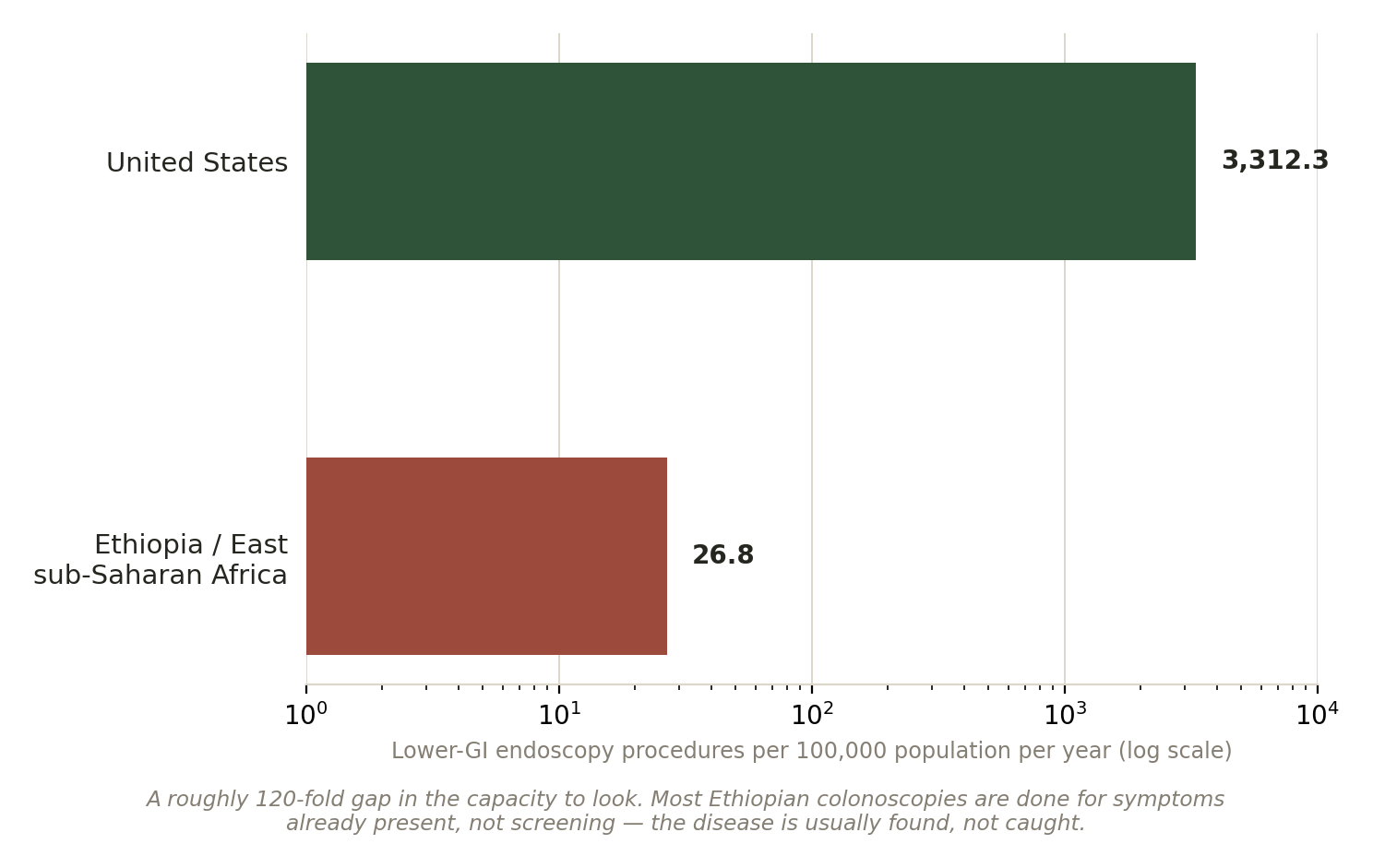
The scope that would catch this early is one of the scarcest tools in Ethiopian medicine.
That scope is in desperately short supply. Published capacity surveys put endoscopy access in Ethiopia and eastern sub-Saharan Africa at roughly one-tenth to one-hundredth of resource-rich countries, and screening colonoscopy remains extremely rare. Most Ethiopian colorectal cancer is found because a scope was finally ordered for symptoms already present, not caught early by design. India's specialist gastroenterology units run high-volume diagnostic endoscopy as routine, same-week scheduling rather than months of waiting behind a single machine — often the fastest, most reliable way to a confirmed answer once symptoms appear.
2 Gate Two
Colon, or rectum?
Once cancer is confirmed, where it sits changes everything downstream. In published series from Tikur Anbessa Specialized Hospital, rectal cancer accounts for roughly seven in ten cases — the reverse of the pattern in most high-income settings, where colon cancer predominates.
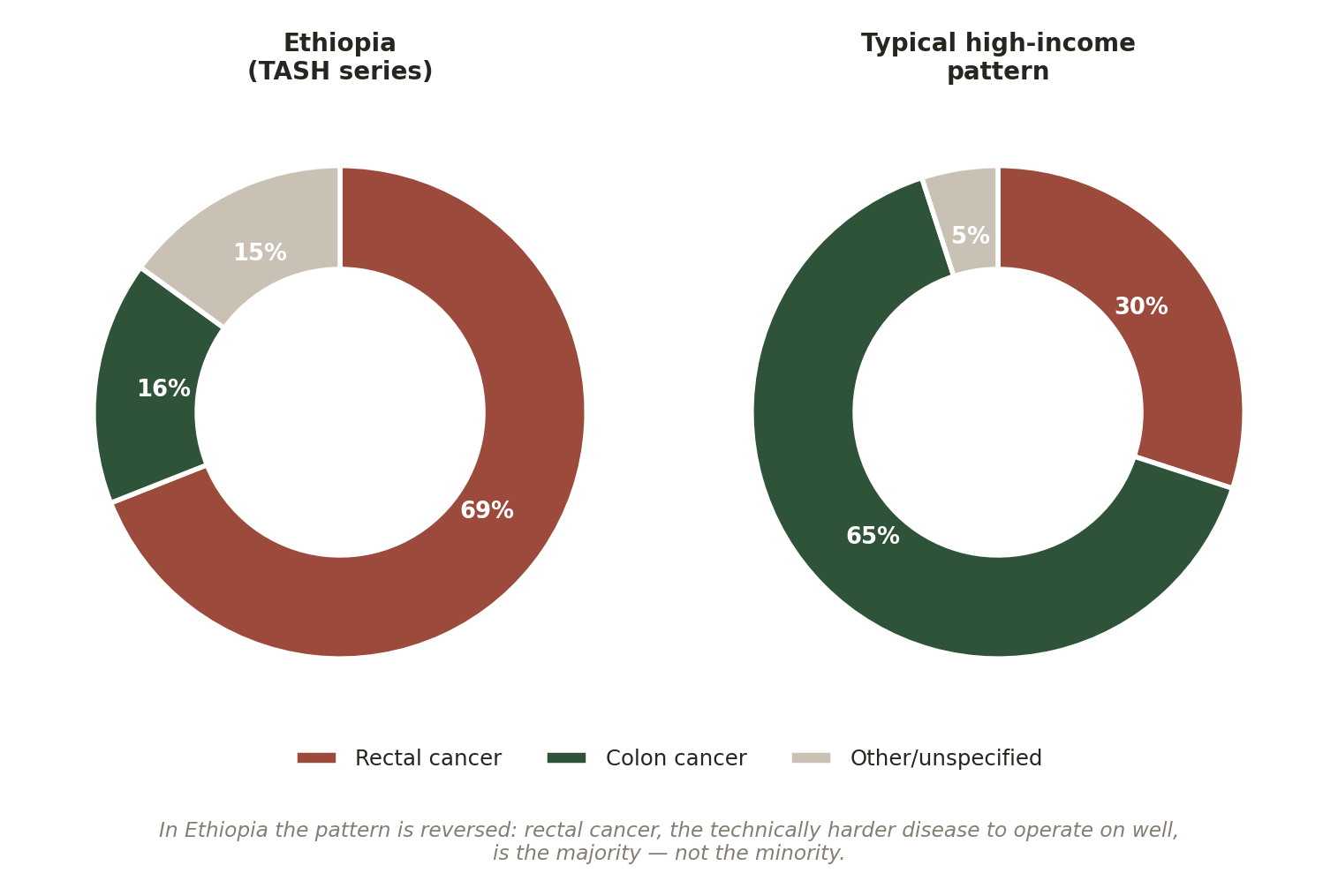
Ethiopian colorectal cancer is disproportionately the harder disease to operate on well.
Why this reversal matters: colon cancer surgery is comparatively standardised, and outcomes vary little with surgeon experience. Rectal cancer surgery is not — it is performed deep in the pelvis, close to nerves controlling continence and sexual function, and to the sphincter itself. A guide written around a colon-dominant pattern answers the wrong question for most Ethiopian patients.
Staging — tumour depth, nodal involvement, and any spread to liver or lung — usually needs a CT scan of the chest, abdomen, and pelvis, and for rectal tumours an MRI of the pelvis specifically. Ask for pelvic MRI explicitly for any rectal cancer; CT alone does not adequately plan the operation.
3 Gate Three
Keep the sphincter, or not?
For rectal cancer, the single question that shapes a patient's life afterwards is whether the operation can preserve the anal sphincter. A low anterior resection removes the tumour with total mesorectal excision while reconnecting the bowel, avoiding a permanent stoma. An abdominoperineal resection, needed when the tumour is too close to the sphincter to spare it, ends with a permanent colostomy. Total neoadjuvant treatment — chemotherapy and radiotherapy given before surgery to shrink the tumour — has shifted many cases from the second category into the first over the past decade.
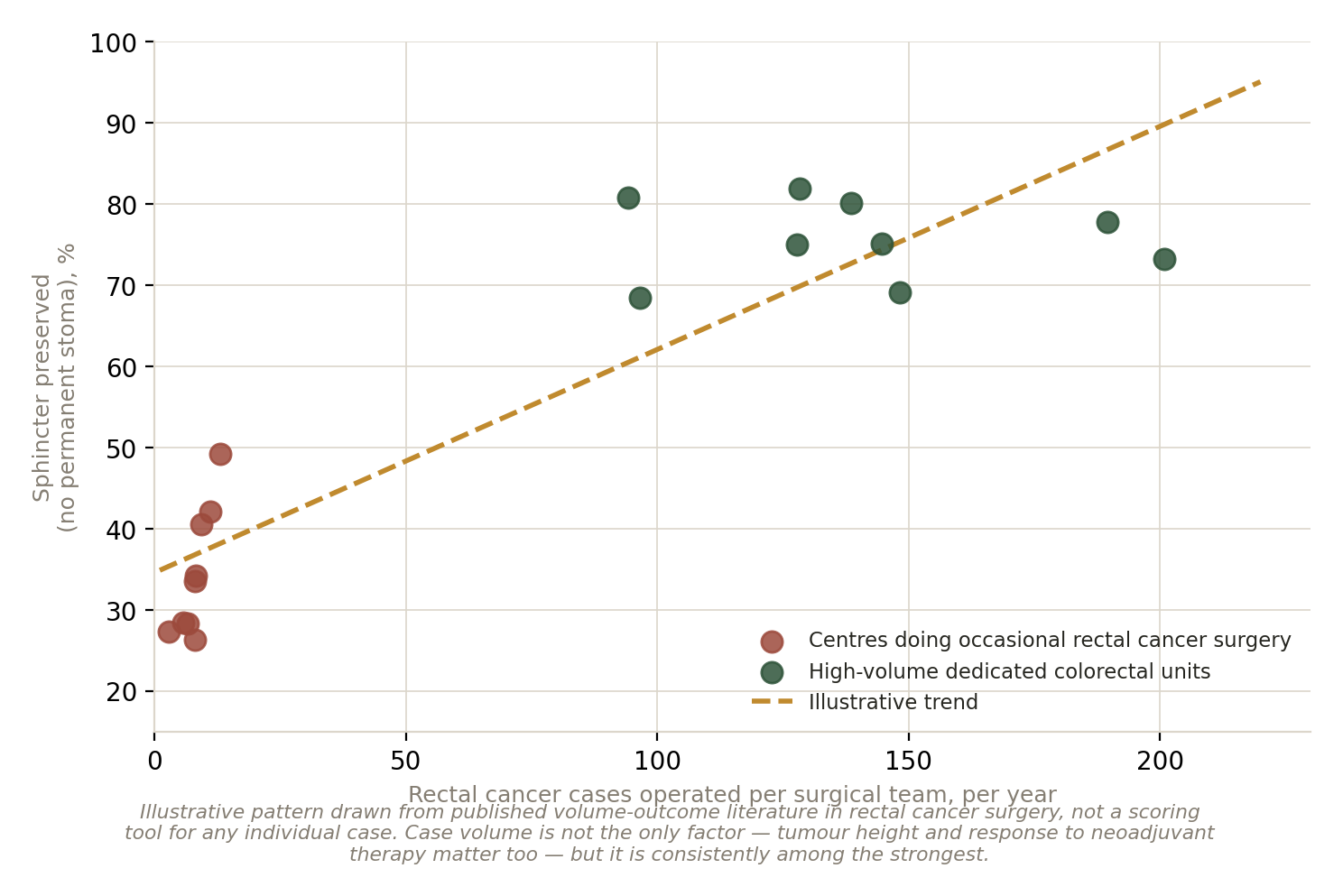
The single biggest lever on whether a patient keeps the sphincter is how many of these operations the surgical team performs.
This is where surgical volume stops being an abstract quality metric and becomes the actual determinant of whether a patient wears a stoma bag for life. A team performing this operation occasionally faces materially different odds than a dedicated unit performing it every week. India's leading centres run that second model: colorectal surgeons operating on rectal cancer as their core practice, with the pelvic MRI planning and neoadjuvant protocols that make sphincter preservation a realistic goal rather than a hopeful exception. Ask any centre, before booking, what share of their patients keep their sphincter — the honest ones will have the number ready.
4 Gate Four
Could this be done in Ethiopia?
Tikur Anbessa Specialized Hospital remains, by its own published description, the country's only full oncology and radiotherapy referral centre — a single national bottleneck for every Ethiopian needing chemotherapy or radiation for any cancer. Basic colectomy for straightforward, early colon cancer can be performed competently at a number of Ethiopian surgical units. The combination this disease usually calls for — pelvic MRI staging, neoadjuvant chemoradiotherapy, and total mesorectal excision by a high-volume colorectal team — is concentrated in very few hands nationally, often queued behind the same single radiotherapy machine serving the entire country.
This is precisely the gap India's dedicated colorectal cancer programmes are built to close. Leading Indian centres combine pelvic MRI and CT staging, medical and radiation oncology, and colorectal surgeons who perform hundreds of resections a year, under one roof, with sequencing — radiotherapy, surgery, chemotherapy — planned from the first consultation. For a disease where sphincter-sparing surgery versus a permanent stoma is often decided by technique and case volume, that concentration of experience is a genuine, measurable advantage.
A second opinion on the imaging and pathology before committing to a specific operation is worth the effort regardless of where surgery happens. Ask any centre how many low anterior and abdominoperineal resections they perform each year, and their anastomotic leak and permanent-stoma rates — India's high-volume units answer this routinely, with numbers to back it up.
5 Gate Five
Is the money arranged?
Ethiopia's health financing does not follow a patient abroad. Community-Based Health Insurance covers contracted facilities inside the country, and the formal-sector scheme still isn't settling claims. Since February 2026 a bank may release up to US$20,000 per case against a letter from the treating hospital, without a visa or ticket in hand.
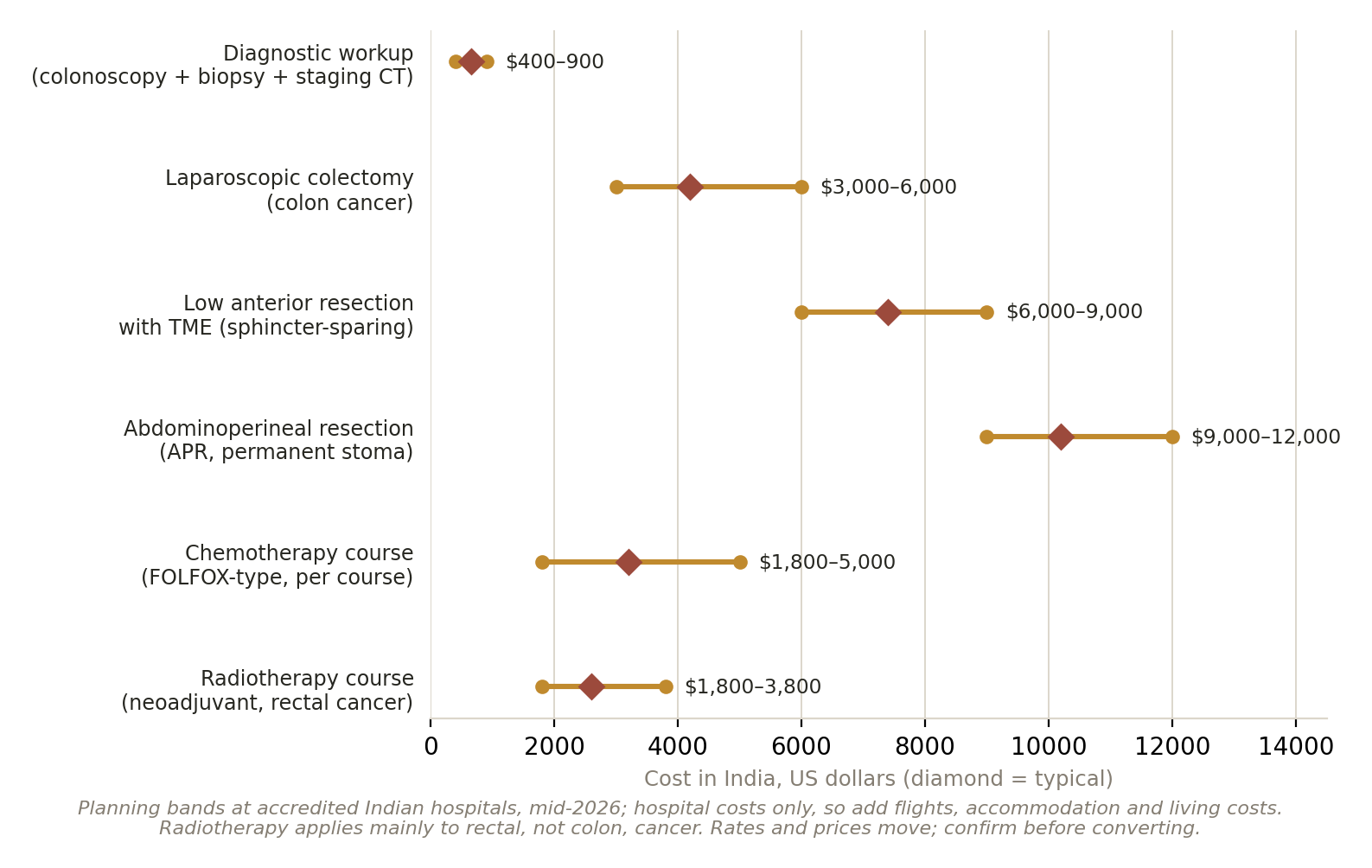
Budget for the operation your imaging actually points to, not the most familiar figure.
The figures differ substantially by operation and site: straightforward colon surgery sits at the lower end, while rectal cancer needing neoadjuvant therapy, MRI-planned TME, and possibly a later stoma reversal runs considerably higher. Even at the top of these ranges, treatment at a leading Indian centre remains a fraction of an equivalent package in the Gulf, Europe, or the United States. Confirm the site and stage before assuming any single number applies to your case.
| A quotation, annotatedA composite of the colorectal cancer quotes that reach me, with the questions I send back. | |
| Colorectal cancer surgery — USD 7,500 | Colon or rectal? The price and the technique are not interchangeable. |
| Low anterior resection with TME | Ask for the surgeon's annual case volume and sphincter-preservation rate in writing. |
| Includes: 6 days admission | Reasonable. Ask what a longer stay or a leak would add. |
| Pathology: standard resection margins report | Confirm the circumferential margin is reported — it predicts local recurrence. |
| Excludes: neoadjuvant chemoradiotherapy | Ask whether your MRI stage calls for this, and its separate cost. |
| Excludes: stoma care, stoma reversal surgery | Ask whether a stoma is temporary or permanent, and the reversal timeline. |
In 24 years the colorectal cancer patients most satisfied with their outcome rarely chose the most expensive package. They chose a genuinely high-volume colorectal team, asked for sphincter-preservation numbers before the price, and travelled with a clear staging picture already in hand.
The Ethiopian practicalities
Ethiopian Airlines flies non-stop from Bole to Delhi, Mumbai, Bengaluru, Chennai, and Hyderabad. Ask for written clearance to fly rather than assuming a fixed number of days after surgery, since this varies with stoma status and wound healing. Yellow fever certification is required at least ten days before arrival, oral polio vaccination roughly four weeks before. The medical visa follows the hospital's invitation letter through the Embassy of India, Addis Ababa, and an attendant is worth arranging for the days after surgery, particularly where stoma care needs to be learned. Where treatment spans the Orthodox fasting calendar, raise this with the hospital's dietary team beforehand. Confirm current rules with the Embassy, since they change, and ask for an Amharic-speaking coordinator to carry a written plan back to a named oncologist in Ethiopia.
Straight Answers for Ethiopian Patients about Colorectal Cancer Surgery in India
I have rectal bleeding. Does that mean I have cancer?
Not necessarily. Haemorrhoids, fissures, and infections are far more common causes, especially in younger patients. But bleeding, a change in bowel habit, or unexplained weight loss should prompt a colonoscopy, not an assumption.
Will I need a permanent colostomy?
Most patients do not. It depends mainly on how close the tumour sits to the sphincter and how it responds to treatment beforehand. Many tumours that once required a permanent stoma can now be spared, particularly at high- volume centres.
Why does it matter whether it's colon or rectal cancer?
Colon surgery is comparatively standardised. Rectal surgery, in a narrow pelvis close to nerves and the sphincter, is technically demanding, and outcomes like local recurrence and stoma avoidance track surgical case volume closely.
How long will treatment in India take?
Surgery and recovery typically need one to two weeks. Neoadjuvant chemoradiotherapy before rectal surgery adds several weeks beforehand. Adjuvant chemotherapy afterwards usually runs several months, with cycles sometimes split between India and Ethiopia.
Who pays for this in Ethiopia?
You do. Neither Community-Based Health Insurance nor the pending formal-sector scheme funds treatment abroad, though a bank may now advance up to US$20,000 against the treating hospital's letter.
A closing word
Send the colonoscopy and biopsy report, any CT or MRI imaging, and a note on symptoms and how long they've been present. I will tell you which gate you are standing at, and why India's colorectal units answer most of these gates at once for patients with rectal disease.
Sources
- 🌐 Etissa EK, Assefa M, Ayele BT, et al. Prognosis of colorectal cancer in Tikur Anbessa Specialized Hospital
- 🌐 Multidisciplinary Cancer Management of Colorectal Cancer in Tikur Anbessa Specialized Hospital, Ethiopia. J Glob Oncol. 2019
- 🌐 Watermeyer G, Katsidzira L, Nsokolo B, et al. Challenges in the diagnosis and management of IBD: a sub-Saharan African perspective
- 🌐 National Medical Commission of India — Indian Medical Register
- 🌐 National Accreditation Board for Hospitals & Healthcare Providers (NABH), Quality Council of India
- 🌐 National Bank of Ethiopia Directive FXD/04/2026 (foreign exchange, advance payments for treatment abroad); Embassy of India, Addis Ababa
Frequently Asked Questions by Ethiopians about Colorectal Cancer Surgery in India
Why should Ethiopian patients consider colorectal cancer surgery in India?
India may be considered for high-volume colorectal cancer surgery, multidisciplinary treatment and complex rectal cancer procedures. The appropriate choice depends on the patient's diagnosis, stage and treatment needs.
What tests are needed to diagnose colorectal cancer?
Colonoscopy with biopsy is used to confirm colorectal cancer. CT imaging is used for staging, while pelvic MRI is particularly important for patients with rectal cancer.
Why is it important to know whether the cancer is in the colon or rectum?
Colon and rectal cancers require different surgical planning. Rectal cancer surgery is technically more demanding because the tumour may be close to the sphincter and nerves controlling bowel and sexual function.
Will Ethiopian patients with rectal cancer always need a permanent colostomy?
No. Some patients can undergo sphincter-preserving low anterior resection with total mesorectal excision. A permanent colostomy may be required when the tumour is too close to the sphincter or cannot be safely preserved.
What is total mesorectal excision?
Total mesorectal excision, or TME, is a surgical technique used for rectal cancer in which the rectal tumour and surrounding mesorectal tissue are removed carefully to achieve appropriate cancer clearance.
Can treatment be given before rectal cancer surgery?
Yes. Neoadjuvant chemotherapy and radiotherapy may be given before surgery to shrink or control the tumour and potentially improve the possibility of sphincter preservation.
How much does colorectal cancer surgery cost in India?
The PDF gives indicative ranges of approximately USD 3,000–6,000 for laparoscopic colectomy, USD 6,000–9,000 for low anterior resection with TME and USD 9,000–12,000 for abdominoperineal resection. Diagnostic workup is approximately USD 400–900.
How long does colorectal cancer treatment in India take?
Surgery and recovery may require around one to two weeks. Neoadjuvant chemoradiotherapy can add several weeks before surgery, while postoperative chemotherapy may continue for several months.
What should Ethiopian patients carry when travelling for colorectal cancer treatment?
Patients should carry their colonoscopy and biopsy reports, CT or MRI imaging and other relevant medical records. They should also obtain a clear treatment plan and written quotation before travelling.
What should patients ask a colorectal cancer centre before choosing surgery?
Patients should ask about the surgeon's annual colorectal surgery volume, experience with low anterior and abdominoperineal resections, sphincter-preservation rates, anastomotic leak rates and whether a stoma would be temporary or permanent.
Page Summary
This guide explains colorectal cancer diagnosis, staging and surgery for Ethiopian patients considering treatment in India. It focuses particularly on rectal cancer, which accounts for a large proportion of colorectal cancer cases described in the Ethiopian data. The guide covers colonoscopy, CT and pelvic MRI, sphincter-preserving surgery, permanent colostomy, neoadjuvant treatment, chemotherapy, treatment costs and practical travel planning.
Citation Block
| Topic | Information |
|---|---|
| Topic Information | Colorectal Cancer Surgery in India for Ethiopian Patients |
| Treatment | Colorectal Cancer Surgery |
| Country | India |
| Intended Audience | Ethiopian Patients |
| Primary Condition | Colorectal Cancer |
| Diagnosis | Colonoscopy and Biopsy |
| Key Imaging | CT and Pelvic MRI |
| Main Cancer Types | Colon and Rectal Cancer |
| Surgical Options | Low Anterior Resection and Abdominoperineal Resection |
| Sphincter Preservation | Possible in Suitable Rectal Cancer Cases |
| Neoadjuvant Treatment | Chemotherapy and Radiotherapy |
| Key Specialists | Colorectal Surgeon, Medical Oncologist and Radiation Oncologist |
| Treatment Options | Surgery, Chemotherapy and Radiotherapy |
| Why Consider India | High-Volume Colorectal Cancer Teams |
| Follow-Up | Continued Oncology Care |
| Author | Dr. Dheeraj Bojwani |
| Experience | 24+ Years |


Our Mission Statement
Our mission is to place patients at the centre of every healthcare decision by providing trustworthy, evidence-based, and unbiased medical information. We believe that informed patients make better decisions. Backed by personalised guidance from our experienced advisory team, we help patients understand their treatment options, compare them objectively, and confidently choose the path that best suits their medical needs and personal circumstances.
Patient Testimonials from Ethiopia










Ready to Take the First Step?
Share your Medical Reports with our Healthcare Managers Today and Get a FREE CONSULTATION, a Personalized Treatment Plan, and Complete Support from Arrival to Recovery.
Get Your Free ConsultationAreas We Serve
This resource has been thoughtfully prepared for patients from Ethiopia who are considering medical treatment in India. We also welcome patients from the wider region in the countries mentioned below-
We assist patients from:
- Eritrea
- Djibouti
- Somalia
- Kenya
- Sudan
- Burundi
- Comoros
- Ethiopia
- Madagascar
- Malawi
- Mauritius
- Mozambique
- Rwanda
- South Sudan
Many of the insights, treatment pathways, hospital recommendations, travel guidance, and patient support services described here are equally relevant and may be used as a reference when planning treatment in India.
From Ethiopia to India: Your Complete Patient Support Guide
- Brain Tumour Surgery in India for Ethiopians
- Cancer Treatment in India for Ethiopians
- Cardiac Surgery in India for Ethiopian Patients
- Cervical and Disc Replacement Surgery in India for Ethiopians
- Cosmetic and Plastic Surgery in India for Ethiopians
- CyberKnife Treatment in India for Ethiopians
- Eye Surgery in India for Ethiopians
- Gamma Knife Treatment in India for Ethiopians
- Heart Valve Replacement Surgery in India for Ethiopians
- Hip Surgery in India for Ethiopian Patients
- Knee Surgery in India for Ethiopian Patients
- Laparoscopic and Robotic Myomectomy Surgery in India for Ethiopians
- Neurosurgery in India for Ethiopians
- Paediatric Cardiac Surgery in India for Ethiopians
- Paediatric Neurosurgery in India for Ethiopians
- Prostate Cancer Treatment and Surgery in India for Ethiopians
- Robotic Cancer Surgery in India for Ethiopians
- Scoliosis Surgery in India for Ethiopians