

Choosing the Best Proton Therapy Treatment Team and Hospital in India: A Guide for Ethiopian Patients
Proton therapy's core advantage is physics, not precision alone. Protons stop at the tumour and spare tissue beyond it, which is why the strongest evidence for this expensive, rare technology is in paediatric cancers and tumours near critical structures, not necessarily every case it's marketed for.
Most patients researching proton therapy in India spend the bulk of their time comparing prices, and understandably so — cost is often what makes the trip possible at all. But price is the easiest variable to compare and, on its own, the least useful one for predicting whether this specific, expensive technology genuinely offers an advantage for a specific case. Two quotes that look identical on paper can represent centres with very different track records, and, more importantly, very different honesty about whether proton therapy is actually the right choice at all. This matters more for proton therapy than for other forms of radiation treatment, because of two things worth naming directly. The first is that proton therapy's genuine advantage over conventional radiation, including other advanced radiosurgery techniques, is a specific physics property: protons deposit their energy at a defined depth and then stop, sparing healthy tissue beyond the tumour. This matters most for a narrower set of cases than the marketing sometimes suggests, particularly paediatric cancers, where reducing radiation exposure to developing, healthy tissue meaningfully lowers the risk of second cancers and long-term developmental effects decades later, and tumours near critical structures such as the spine, skull base, or eye. For many other cancers, conventional radiotherapy or other radiosurgery techniques achieve an equivalent outcome at a fraction of the cost, and an honest oncologist says so plainly. The second is that, because proton therapy is an enormously expensive technology available at only a small handful of centres in India, there is a well-documented, genuine risk of it being recommended beyond where the evidence actually supports it, simply because a centre has made the investment and needs to justify it. In 24 years of arranging medical care in India for patients across Africa and Asia, asking directly whether proton therapy offers a genuine, evidence-based advantage for a specific case, not simply because it is the newest technology available, is the single most important question in this entire process. The two decisions, treatment team and hospital, deserve equal weight. A skilled team without the right hospital infrastructure behind them, and a well-equipped hospital without a team genuinely experienced in this specific technology, can each independently produce a disappointing result. What follows is a practical guide to evaluating both, together with the other factors that quietly shape how well the entire treatment goes.
Healing Journeys of Ethiopian Patients









Key Takeaways
- The guide explains that the main advantage of proton therapy comes from its physics: protons deposit energy at a defined depth and then stop, reducing radiation exposure beyond the tumour. The strongest rationale is highlighted for paediatric cancers and tumours near critical structures, while conventional radiotherapy may provide equivalent outcomes for many other cancers at lower cost.
- The page 2 graphic gives equal 50% weighting to the treatment team and hospital. Team assessment focuses on NMC registration, recognised radiation oncology qualifications, proton-specific planning experience, experience with the patient's tumour site and honest assessment of whether proton therapy is genuinely indicated.
- The page 3 chart illustrates increasing local tumour-control rates with higher annual proton therapy volume in the relevant tumour site, from 81% for fewer than 25 cases annually to 97% for 100+ cases. The guide therefore recommends asking about the team's experience with the specific tumour type, rather than relying on overall radiation oncology volume.
- The guide places particular emphasis on honest modality selection. Patients should ask whether conventional radiotherapy or another radiosurgery technique could achieve an equivalent result. For children, families should also confirm the team's paediatric proton experience and arrangements for repeated daily sedation or anaesthesia when required.
- Hospital assessment focuses on NABH or JCI accreditation, the specific proton beam delivery system, institutional experience operating the technology and multidisciplinary review of alternatives. The page 4 chart illustrates uncomplicated outcomes of 79% without formal accreditation, 90% with NABH and 96% with JCI, while the guide specifically recommends checking whether the centre uses modern pencil beam scanning or older passive scattering technology.
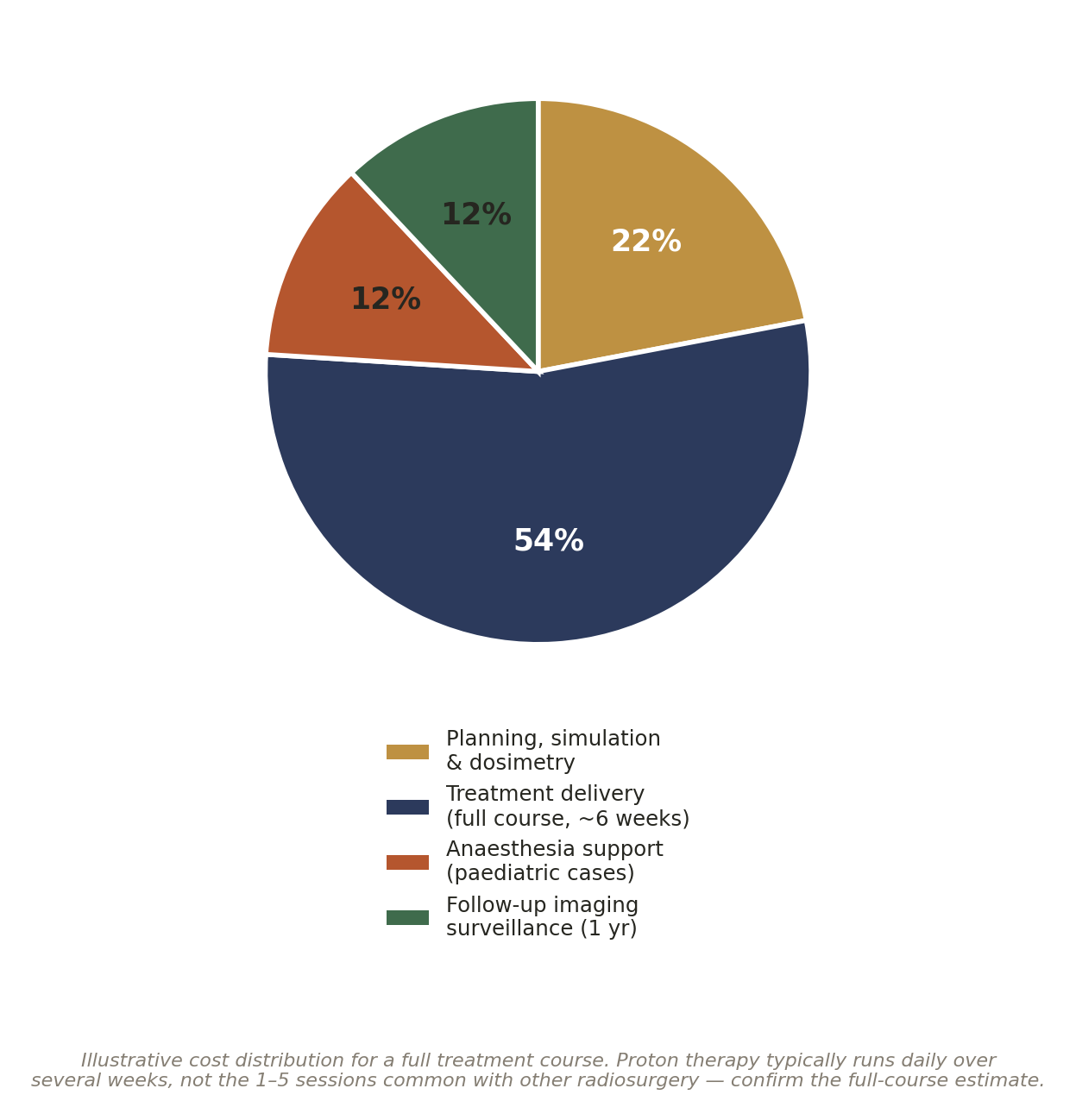
- The guide recommends a second opinion specifically on treatment modality, independent verification of credentials and a full-course cost estimate. The page 7 cost graphic illustrates an indicative distribution of 54% for the full treatment delivery course, 22% for planning/simulation and dosimetry, 12% for paediatric anaesthesia support and 12% for one-year follow-up imaging.
- For Ethiopian patients, the guide emphasises clear communication throughout the multi-week treatment course and a concrete imaging follow-up plan after returning home. A named contact should be established before treatment, with written follow-up arrangements provided to a named oncologist in Ethiopia.
Quick Facts
- Author
- Dr. Dheeraj Bojwani
- Experience
- 24+ Years
- Treatment
- Proton Therapy
- Patients
- Ethiopian Patients
- Key Specialist
- Radiation Oncologist / Proton Therapy Treatment Team
- Selection Weighting
- 50% treatment team / 50% hospital
- Key Principle
- Confirm that proton therapy offers a genuine advantage
- Qualification Check
- DM or MD Radiation Oncology or equivalent recognised degree
- Planning Expertise
- Proton-specific dosimetry and treatment planning
- Volume Check
- Annual cases for the specific tumour site
- Technology Check
- Pencil beam scanning versus passive scattering
- Institutional Experience
- Years operating the proton therapy programme
- Paediatric Care
- Repeated sedation/anaesthesia capability where required
- Hospital Check
- NABH or JCI accreditation
- Multidisciplinary Review
- Proton therapy versus conventional radiation and other options
- Second Opinion
- Specifically on modality choice
- Cost Check
- Full multi-week treatment course
- Follow-Up
- Imaging surveillance in Ethiopia
- Key Warning
- Do not choose proton therapy simply because it is newer or more advanced
- Decision Principle
- Choose proton therapy only when the technology, team and evidence genuinely fit the patient's case.
In Brief
For Ethiopian patients considering proton therapy in India, the guide recommends prioritising genuine evidence-based indication, proton-specific team experience, tumour-site volume, modern beam technology and strong hospital quality systems rather than choosing based on the newest technology or price alone. A modality-specific second opinion, complete treatment-cost estimate and long-term imaging follow-up plan should be confirmed before travelling.
01 The Proton Therapy Treatment Team in India: What Actually Matters
The treating radiation oncologist's qualifications are the starting point, not the finish line. The following, taken together, give a genuinely reliable picture of the whole team.
Registration and formal qualification. Confirm the treating radiation oncologist is registered with the National Medical Commission of India (NMC), and holds a postgraduate qualification in radiation oncology (DM or MD Radiation Oncology, or an equivalent recognised degree). This is independently verifiable through the NMC's public Indian Medical Register and is worth checking directly rather than taking on trust.
Genuine, specific proton therapy planning experience. Proton dosimetry and treatment planning is technically distinct from conventional or photon-based radiosurgery planning. Ask specifically how much of the oncologist's and physics team's experience is with proton therapy itself, not radiation oncology broadly.
Case volume, specifically in your tumour site. Ask directly how many proton therapy cases for your specific tumour location the team treats each year. Planning consistency and outcomes are closely tied to this specific experience.
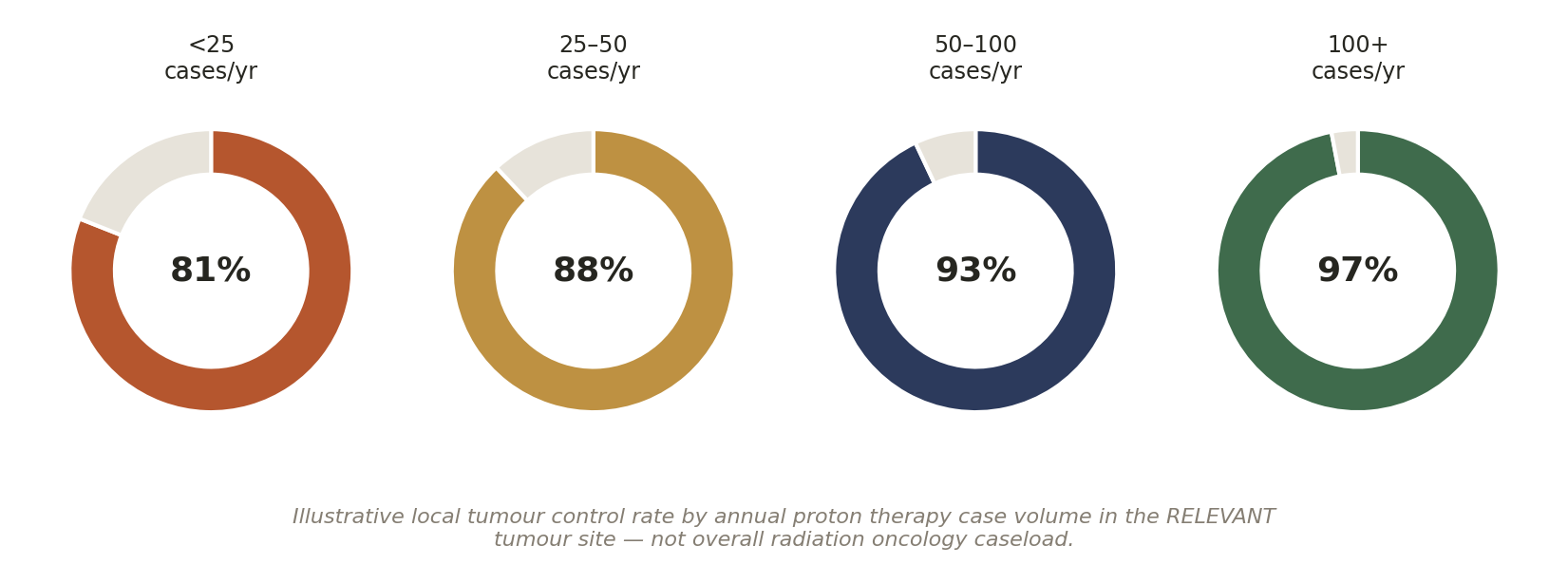
Why "how many of THIS tumour type do you treat a year?" matters more than overall radiation oncology caseload.
Honest guidance on whether proton therapy is genuinely indicated. Ask directly whether conventional radiotherapy or another radiosurgery technique would achieve an equivalent outcome for your specific case, and if so, why proton therapy is still being recommended. A team willing to say proton therapy isn't necessary, when that's genuinely true, is showing real integrity.
Genuine paediatric proton therapy experience, where relevant. Treating children often requires daily sedation or anaesthesia across a multi-week course. Ask specifically about the team's experience with paediatric cases and their anaesthesia protocol for repeated sedation.
Transparency about outcomes and experience with international patients. A radiation oncologist willing to discuss the team's own outcomes candidly, and who is accustomed to patients travelling from Ethiopia and the wider region, is showing exactly the accountability and practical attentiveness worth trusting.
02 The Proton Therapy Hospital in India: What Actually Matters
The hospital is not simply a venue for the treatment team's work; because so few centres in India offer proton therapy at all, verifying the specific technology and track record at the available options matters more than comparing across a broad market.
Accreditation. National Accreditation Board for Hospitals & Healthcare Providers (NABH) accreditation is the baseline worth confirming for any hospital under consideration; Joint Commission International (JCI) accreditation, held by a smaller number of leading Indian hospitals, reflects an internationally benchmarked standard of safety and quality worth actively seeking out for a treatment this significant.
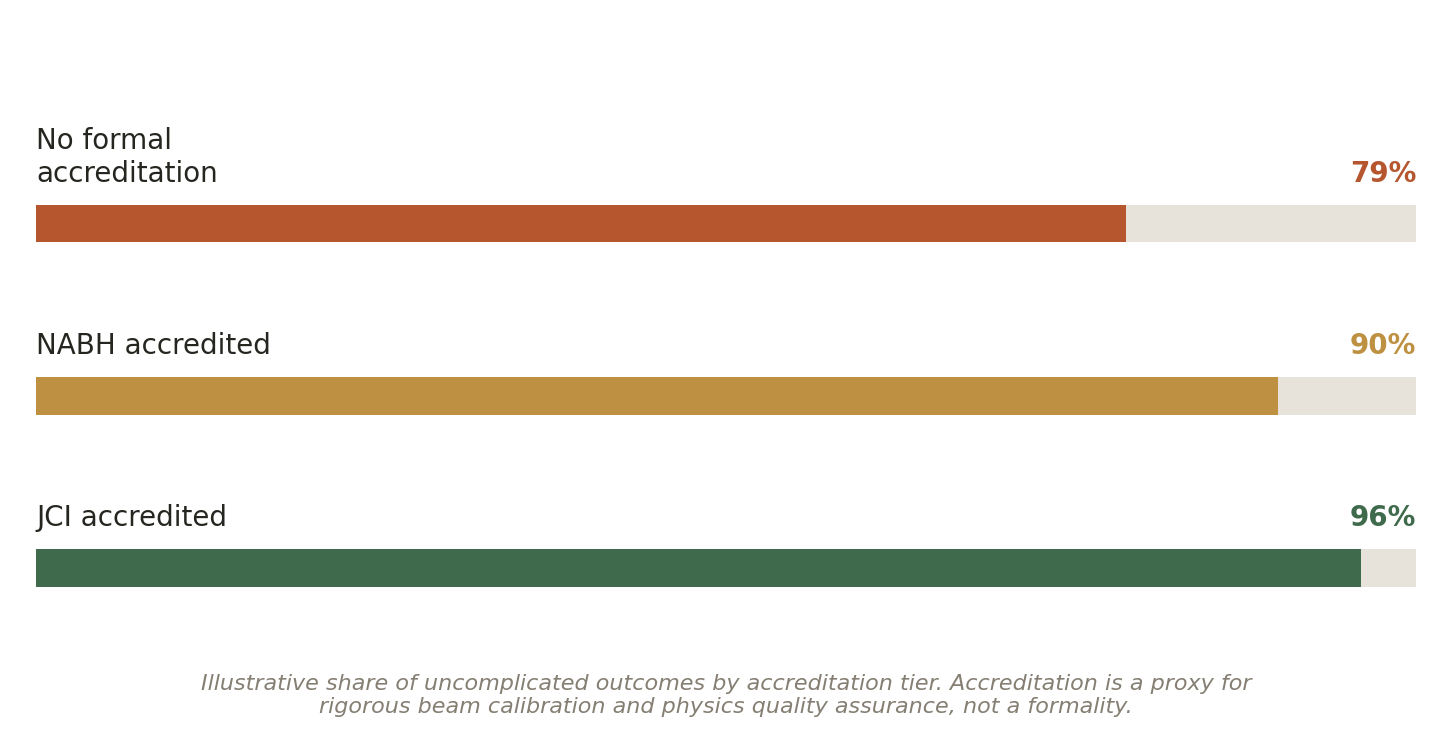
Accreditation is a proxy for rigorous beam calibration and physics quality assurance, not a formality.
The specific beam delivery technology. Ask whether the system uses pencil beam scanning, the more modern, precise delivery technique, or older passive scattering technology, since this materially affects treatment precision.
Total institutional experience operating the technology. Given how few centres exist, ask specifically how long the programme has been operating, not only its annual case volume, since proton therapy's institutional learning curve is genuinely long.
A genuine multidisciplinary tumour board that considers alternatives. Confirm your case was reviewed by a team that genuinely compared proton therapy against conventional radiotherapy and other radiosurgery options, not recommended through a pathway that defaults to proton therapy.
Dedicated paediatric infrastructure, where relevant. For a child needing daily sedation across a multi-week course, confirm the hospital has a dedicated paediatric anaesthesia team equipped for this specific, repeated demand.
International patient services. A dedicated international patient department, offering visa support, airport coordination, interpreter or Amharic-speaking liaison support, and clear pre-departure communication, is a meaningful sign that the hospital is genuinely set up for patients travelling from Ethiopia, not simply willing to accept them.
03 Other Factors in India That Quietly Shape the Outcome of Proton Therapy
Beyond the treatment team and the hospital individually, a handful of practical factors determine how smoothly the whole process actually runs.
A genuine second opinion, specifically on modality choice. Before committing to travel, it is worth having a second specialist review the imaging and confirm specifically whether proton therapy offers a genuine advantage for this case, or whether conventional radiotherapy would achieve an equivalent result.
Independent credential verification. Do not rely solely on a hospital's own marketing material. Cross-check the treating oncologist's registration on the NMC's Indian Medical Register, and the hospital's accreditation status through the NABH or JCI's own public directories.
Full cost transparency across the entire treatment course. Ask for a detailed, itemised estimate covering the full course, typically delivered daily over several weeks, not a single headline session price.
Clear communication across a multi-week stay. Confirm who your point of contact will be throughout an extended treatment course, and that this person can communicate clearly with you throughout, not only through a general enquiries line.
A concrete imaging follow-up plan. Ask specifically how follow-up imaging will be scheduled and reviewed once you are back in Ethiopia, with a written plan handed to a named oncologist there.
Why this balance matters in practice: a well-regarded radiation oncologist operating without a genuinely rigorous physics team and modern beam technology behind them, and a state-of-the-art hospital without a team willing to say honestly when proton therapy isn't necessary, can each still produce a disappointing result. The strongest choice is where both are independently verified to be excellent, not one compensating for the other.
A practical checklist before you commit
- Treating oncologist's NMC registration verified
- independently
- Team's proton-specific planning experience confirmed
- Team's specific case volume in your tumour site confirmed
- Hospital's NABH or JCI accreditation verified
- independently
- Beam delivery technology (pencil beam scanning vs older
- systems) confirmed
- Total institutional experience operating the technology confirmed
- Multidisciplinary review of proton vs conventional options
- confirmed
- Paediatric anaesthesia infrastructure confirmed, if
- relevant
- Second opinion obtained specifically on modality choice
- Full itemised cost estimate for the entire course requested
- Long-term imaging follow-up plan confirmed
- Named post-treatment follow-up contact confirmed
A closing word
Send your diagnosis, staging imaging, and tumour location, and, if relevant, the patient's age. I will help you compare specific treatment teams and hospitals against these exact criteria, so the decision rests on verified substance rather than the most polished website or the newest technology alone.
Sources
- 🌐 National Medical Commission of India — Indian Medical Register, for verifying a radiation oncologist's qualification and registration
- 🌐 National Accreditation Board for Hospitals & Healthcare Providers (NABH), Quality Council of India
- 🌐 Joint Commission International — directory of JCI-accredited organisations worldwide
- 🌐 The evidence base distinguishing indications where proton therapy offers a genuine clinical advantage
Frequently Asked Questions by Ethiopians about Proton Therapy Treatment Teams and Hospitals in India
Is proton therapy appropriate for every cancer?
No. The guide explains that its strongest evidence is in paediatric cancers and tumours near critical structures, while conventional radiotherapy may provide equivalent outcomes for many other cancers.
What qualification should I check for the radiation oncologist?
Confirm that the treating oncologist is NMC registered and holds DM or MD Radiation Oncology or an equivalent recognised qualification.
Why is proton-specific experience important?
Proton dosimetry and treatment planning differ technically from conventional radiation planning. Ask about the team's actual proton therapy experience, not simply their overall radiation oncology experience.
Why should I ask about my specific tumour type?
Overall proton therapy volume does not necessarily reflect experience with your tumour. The guide recommends asking how many proton cases involving your specific tumour location the team treats annually.
What beam technology should I check?
Ask whether the centre uses pencil beam scanning or passive scattering, as the guide identifies beam delivery technology as an important factor in treatment precision.
Should conventional radiotherapy also be considered?
Yes. The guide recommends confirming that the treatment team has genuinely compared proton therapy with conventional radiotherapy and other radiosurgery options before recommending proton treatment.
What should families of children receiving proton therapy ask?
Ask about the team's paediatric proton experience and repeated sedation or anaesthesia protocols, because children may require daily support throughout a multi-week treatment course.
What hospital accreditation should I check?
The guide recommends verifying NABH or JCI accreditation and treating accreditation as an indicator of rigorous beam calibration, physics quality assurance and structured oversight.
What should the cost estimate include?
Request a complete estimate covering the planning, simulation, dosimetry, full treatment course, paediatric anaesthesia where relevant and follow-up imaging, rather than relying on a single headline treatment price.
How should follow-up be arranged in Ethiopia?
Before travelling, establish a written imaging follow-up plan and identify a named oncologist in Ethiopia who can review the patient's post-treatment imaging and coordinate ongoing care.
Page Summary
This guide helps Ethiopian patients evaluate proton therapy treatment teams and hospitals in India, giving equal importance to the treatment team and hospital. The page 3 chart highlights the importance of tumour-specific proton therapy volume, while the page 4 chart reinforces accreditation and structured quality systems. Beam technology, institutional experience, paediatric infrastructure, modality comparison, transparent costs and long-term imaging follow-up are central to the selection process.
Citation Block
| Topic | Information |
|---|---|
| Topic | Choosing the Best Proton Therapy Treatment Team and Hospital in India for Ethiopian Patients |
| Treatment | Proton Therapy |
| Patients | Ethiopian Patients |
| Key Specialist | Radiation Oncologist / Proton Therapy Team |
| Selection Weighting | 50% treatment team / 50% hospital |
| Qualification | DM or MD Radiation Oncology or equivalent recognised qualification |
| Planning Expertise | Proton-specific dosimetry and treatment planning |
| Volume Check | Annual proton cases for the specific tumour site |
| Treatment Indication | Evidence-based comparison with conventional radiotherapy and other radiosurgery |
| Paediatric Expertise | Proton treatment and repeated anaesthesia capability where relevant |
| Hospital Accreditation | NABH or JCI |
| Beam Technology | Pencil beam scanning or passive scattering |
| Institutional Experience | Duration of operating the proton therapy programme |
| Multidisciplinary Review | Proton versus conventional radiation and other treatment options |
| Second Opinion | Specifically on modality choice |
| Cost Assessment | Planning, full treatment course, anaesthesia and follow-up |
| International Support | Visa, airport and Amharic-speaking liaison services |
| Follow-Up | Named oncologist and imaging plan in Ethiopia |
| Warning Signs | Proton therapy recommended without demonstrating a genuine clinical advantage |
| Key Decision | Independently verify the indication, team expertise, technology and hospital systems |


Our Mission Statement
Our mission is to place patients at the centre of every healthcare decision by providing trustworthy, evidence-based, and unbiased medical information. We believe that informed patients make better decisions. Backed by personalised guidance from our experienced advisory team, we help patients understand their treatment options, compare them objectively, and confidently choose the path that best suits their medical needs and personal circumstances.
Patient Testimonials from Ethiopia










Ready to Take the First Step?
Share your Medical Reports with our Healthcare Managers Today and Get a FREE CONSULTATION, a Personalized Treatment Plan, and Complete Support from Arrival to Recovery.
Get Your Free ConsultationAreas We Serve
This resource has been thoughtfully prepared for patients from Ethiopia who are considering medical treatment in India. We also welcome patients from the wider region in the countries mentioned below-
We assist patients from:
- Eritrea
- Djibouti
- Somalia
- Kenya
- Sudan
- Burundi
- Comoros
- Ethiopia
- Madagascar
- Malawi
- Mauritius
- Mozambique
- Rwanda
- South Sudan
Many of the insights, treatment pathways, hospital recommendations, travel guidance, and patient support services described here are equally relevant and may be used as a reference when planning treatment in India.
From Ethiopia to India: Your Complete Patient Support Guide
- Brain Tumour Surgery in India for Ethiopians
- Cancer Treatment in India for Ethiopians
- Cardiac Surgery in India for Ethiopian Patients
- Cervical and Disc Replacement Surgery in India for Ethiopians
- Cosmetic and Plastic Surgery in India for Ethiopians
- CyberKnife Treatment in India for Ethiopians
- Eye Surgery in India for Ethiopians
- Gamma Knife Treatment in India for Ethiopians
- Heart Valve Replacement Surgery in India for Ethiopians
- Hip Surgery in India for Ethiopian Patients
- Knee Surgery in India for Ethiopian Patients
- Laparoscopic and Robotic Myomectomy Surgery in India for Ethiopians
- Neurosurgery in India for Ethiopians
- Paediatric Cardiac Surgery in India for Ethiopians
- Paediatric Neurosurgery in India for Ethiopians
- Prostate Cancer Treatment and Surgery in India for Ethiopians
- Robotic Cancer Surgery in India for Ethiopians
- Scoliosis Surgery in India for Ethiopians