

Cardiac Pacemaker Treatments for Ethiopian Patients in India
Five gates every bradyarrhythmia case should pass before booking a flight — starting with a fainting spell most people dismiss, and ending with why India's full range of pacing technology is where the specific device a rhythm disorder actually calls for is genuinely available.
Apacemaker treats one of the most mechanically simple problems in cardiology — a heart beating too slowly — and yet, globally, the gap between who needs one and who receives one is measured in roughly a million deaths a year. In 24 years of arranging surgical care in India for patients across Africa and Asia, pacing is a field where the honest starting point is how ordinary the warning sign usually looks: a single fainting spell, often walked off and never investigated, that can be the only notice the heart's electrical system gives before it fails more seriously. Ethiopian clinical data on this is specific and worth knowing. At the country's tertiary hospitals, complete heart block accounts for the large majority of pacemaker implantations, and the pacing technology actually used is overwhelmingly the simplest available — single-chamber devices, not the dual-chamber physiological pacing, MRI-conditional devices, or leadless systems increasingly used elsewhere. Across the wider continent, the picture is starker still: roughly a third of African countries cannot implant a pacemaker at all, for lack of the basic diagnostic equipment the procedure depends on. India's cardiac electrophysiology centres, by contrast, offer the complete range of pacing technology as routine practice, matched to what a specific rhythm disorder actually needs rather than what happens to be on hand. These five gates walk through whether a specific case of fainting or fatigue is genuinely a pacing problem, what kind of device it actually calls for, and why India is where that full range of technology is reliably available to an Ethiopian patient today.
Healing Journeys of Ethiopian Patients









Key Takeaways
- A fainting episode, dizziness or unusual fatigue can sometimes indicate a heart rhythm problem, but an ECG and often Holter monitoring are needed before deciding whether pacing is required.
- At one Ethiopian tertiary hospital cited in the PDF, 78.8% of pacemaker implantations were for symptomatic third-degree or complete AV block, while 21.2% were for other bradyarrhythmia indications.
- The page 2 chart highlights the wider access gap, showing that approximately 33% of African countries cannot implant pacemakers at all because of inadequate diagnostic equipment.
- Pacemakers differ significantly: single-chamber, dual-chamber, MRI-conditional and leadless systems may be appropriate for different rhythm disorders.
- The page 4 comparison shows single- and dual-chamber pacing as routinely available in the cited Ethiopian practice, while MRI-conditional and leadless systems are much less available locally but routinely available in India.
- Indicative Indian costs shown on page 5 range from US$2,000–3,500 for a single-chamber pacemaker to US$12,000–15,000 for a leadless pacemaker.
- The PDF states that pacemaker implantation itself generally takes 1–2 hours, with most patients staying 2–3 days for monitoring and a total India trip of approximately one week.
- Ethiopian patients should confirm the exact device brand and model, MRI compatibility, expected battery life, remote monitoring availability and what happens if complications require additional hospital care.
- The Ethiopian financing section states that Community-Based Health Insurance does not fund treatment abroad, while a bank may release up to US$20,000 per case against a treating hospital's letter under the cited February 2026 arrangement.
- Ethiopian patients returning home should receive a device identification card and a written follow-up plan for a named cardiologist in Ethiopia.
Quick Facts
- Treatment
- Cardiac Pacemaker Implantation
- Country
- India
- Patients
- Ethiopian Patients
- Main Condition
- Bradyarrhythmia / Slow Heart Rhythm
- Major Indication in Cited Ethiopian Hospital
- Symptomatic Third-Degree / Complete AV Block
- Complete AV Block Share
- 78.8% of pacemaker implantations in the cited hospital
- Other Bradyarrhythmia Indications
- 21.2%
- African Access Gap
- Approximately 33% of African countries cannot implant pacemakers
- Single-Chamber Pacemaker
- US$2,000–3,500
- Dual-Chamber Pacemaker
- US$3,000–5,500
- MRI-Conditional Dual-Chamber
- US$5,800–8,000
- Leadless Pacemaker
- US$12,000–15,000
- Diagnostic Workup
- US$150–400
- Later Battery Replacement
- US$1,500–3,000
- Procedure Duration
- Approximately 1–2 hours
- Hospital Stay
- Approximately 2–3 days
- Total India Trip
- Approximately 1 week
- Anaesthesia
- Local anaesthesia
- Key Specialist
- Cardiac Electrophysiologist / Rhythm Specialist
- Device Verification
- Brand, model and MRI compatibility
- Remote Monitoring
- Availability should be confirmed before returning to Ethiopia
- Hospital Accreditation
- JCI or NABH can be independently verified
- Follow-Up
- Named Cardiologist in Ethiopia
- Important Travel Document
- Pacemaker device identification card
- Financing Mentioned
- Up to US$20,000 bank advance against treating hospital letter under cited arrangement
In Brief
Ethiopian patients considering pacemaker treatment in India should first establish that their fainting, dizziness or fatigue is actually related to a slow or interrupted heart rhythm through ECG and, when necessary, Holter monitoring. The PDF reports that symptomatic complete AV block accounted for 78.8% of pacemaker implantations in one Ethiopian tertiary-hospital series. It explains that while single-chamber pacing is increasingly available in Ethiopia, dual-chamber, MRI-conditional and leadless options can be harder to access. India's cardiac electrophysiology centres are described as offering the broader range of pacing technology. Ethiopian patients should therefore confirm the exact device required, brand and model, MRI compatibility, battery life, remote monitoring and total treatment cost before travelling.
1 Gate One
A faint, or a warning?
A fainting episode, dizziness, or unusual fatigue is what usually starts this conversation, and most fainting has ordinary causes: dehydration, standing up too quickly, low blood sugar. What separates a harmless faint from a dangerous one is whether the heart's own electrical system paused or slowed severely enough to briefly cut off blood flow to the brain — and that distinction needs an ECG, and often a Holter monitor worn for a day or more, not a guess based on how the episode felt.
Ask specifically whether an ECG was performed at the time of the episode or as soon as possible after it, and whether extended rhythm monitoring is being arranged if the first ECG looks normal. A single normal ECG does not rule out an intermittent rhythm problem, since the heart's electrical system can misbehave only occasionally, leaving a perfectly normal tracing on the day it happens to be checked.
2 Gate Two
Why does this gap kill a million a year?
Pacing is one of the oldest and most mechanically reliable treatments in modern medicine, in use since 1960, and yet access to it remains sharply unequal.
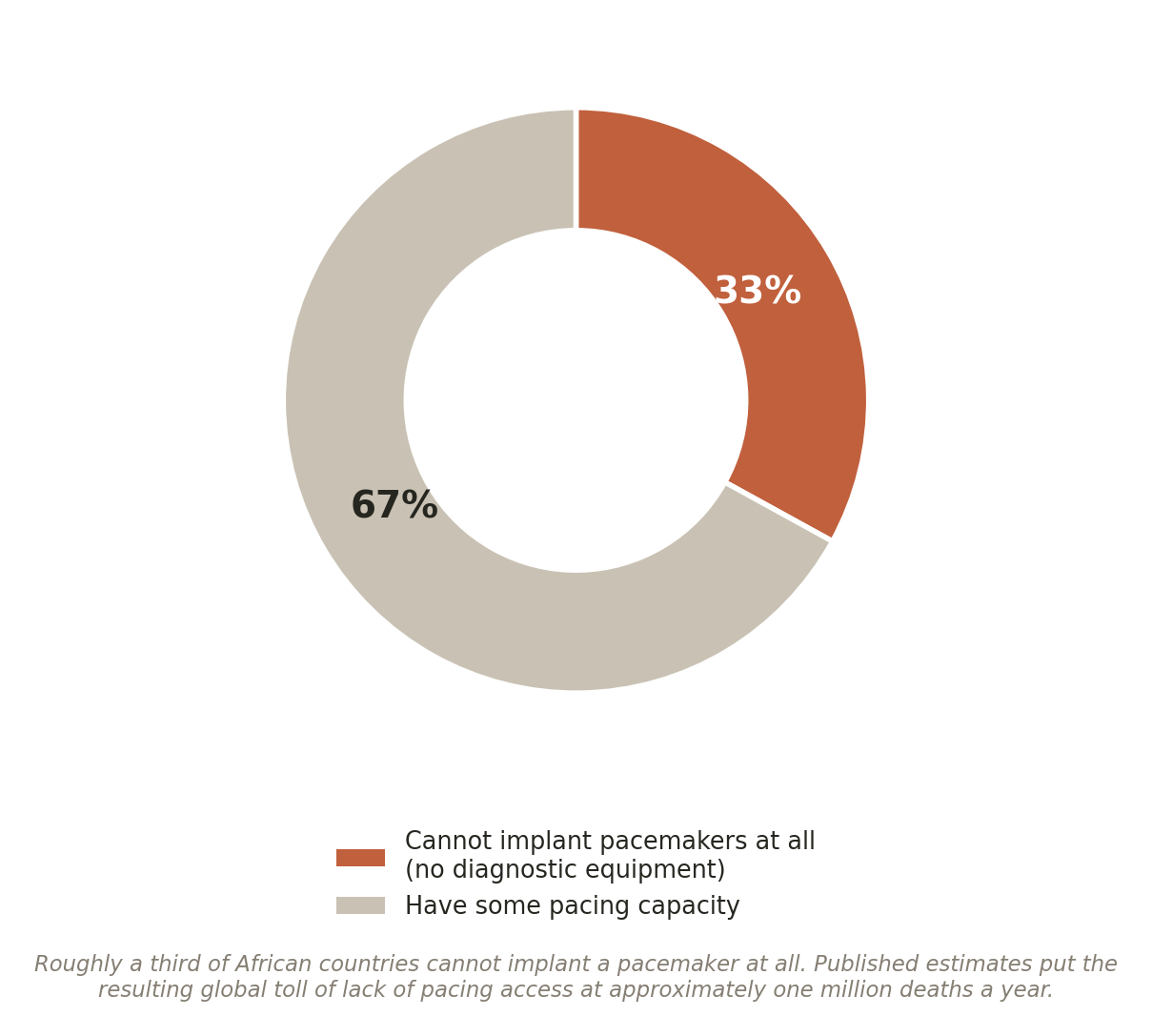
Not a shortage of skill so much as a shortage of the basic diagnostic equipment pacing depends on.
Ethiopia sits among the countries with some pacing capacity, concentrated at a small number of tertiary hospitals. Published data from one such hospital shows the pattern clearly:
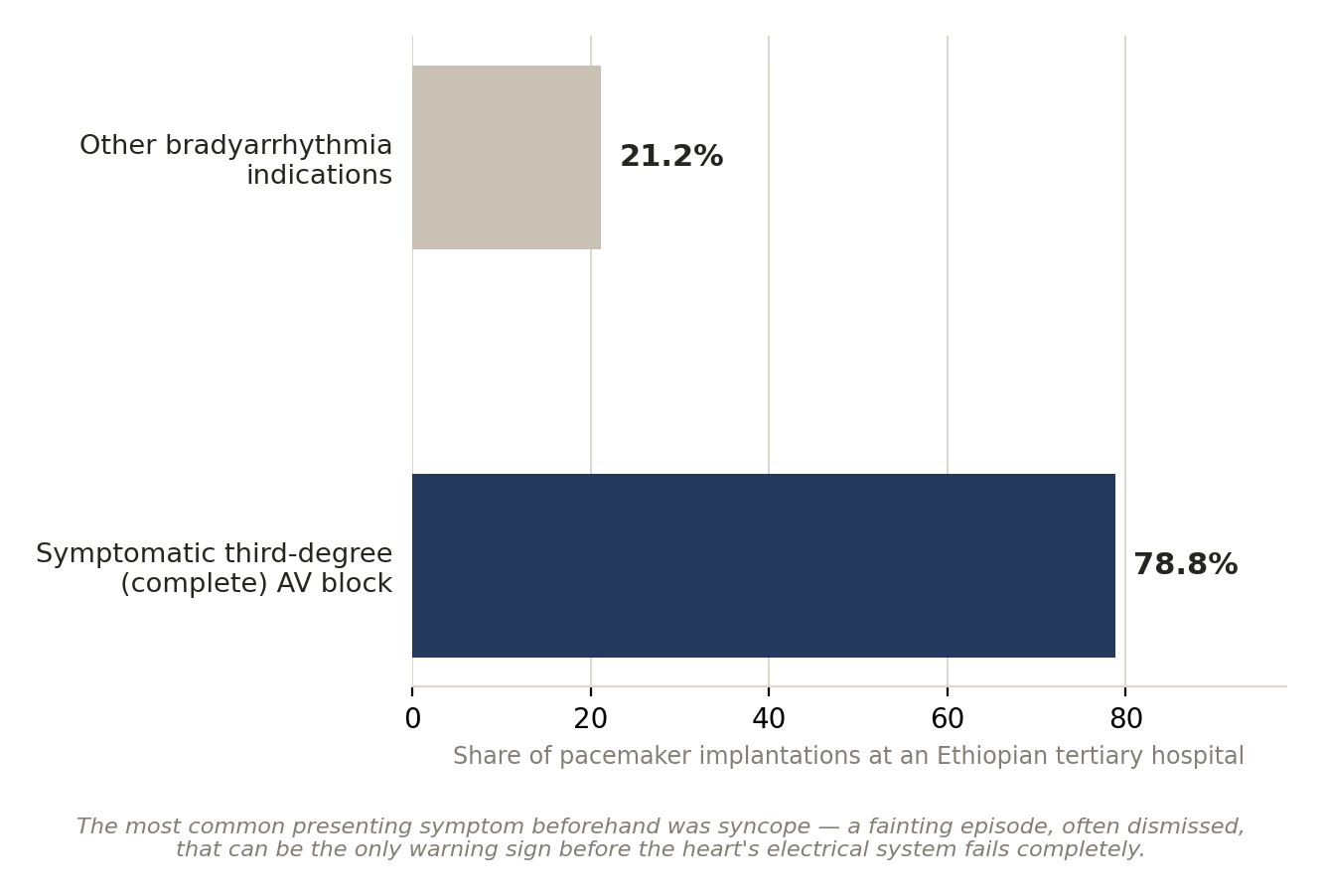
Complete heart block, the most serious and urgent bradyarrhythmia, dominates the cases that reach treatment.
Why syncope deserves to be taken seriously: complete heart block can progress from occasional fainting to sudden cardiac arrest without warning. A single dismissed fainting episode in someone with undiagnosed heart block is not a coincidence to be relieved about — it is often the only signal before a more dangerous event.
3 Gate Three
Which pacemaker, and how smart?
Not all pacemakers do the same job. A single-chamber device paces one heart chamber and is simpler and cheaper, appropriate for specific rhythm problems, particularly slow atrial fibrillation. A dual-chamber device coordinates both the upper and lower chambers, more closely matching the heart's natural rhythm, and is preferred for many patients where single-chamber pacing would work less physiologically well over years of use. MRI-conditional devices allow safe MRI scanning later in life, which matters more than it might seem given how often MRI becomes necessary for unrelated conditions; leadless pacemakers avoid the wires that carry their own long-term complication risks.
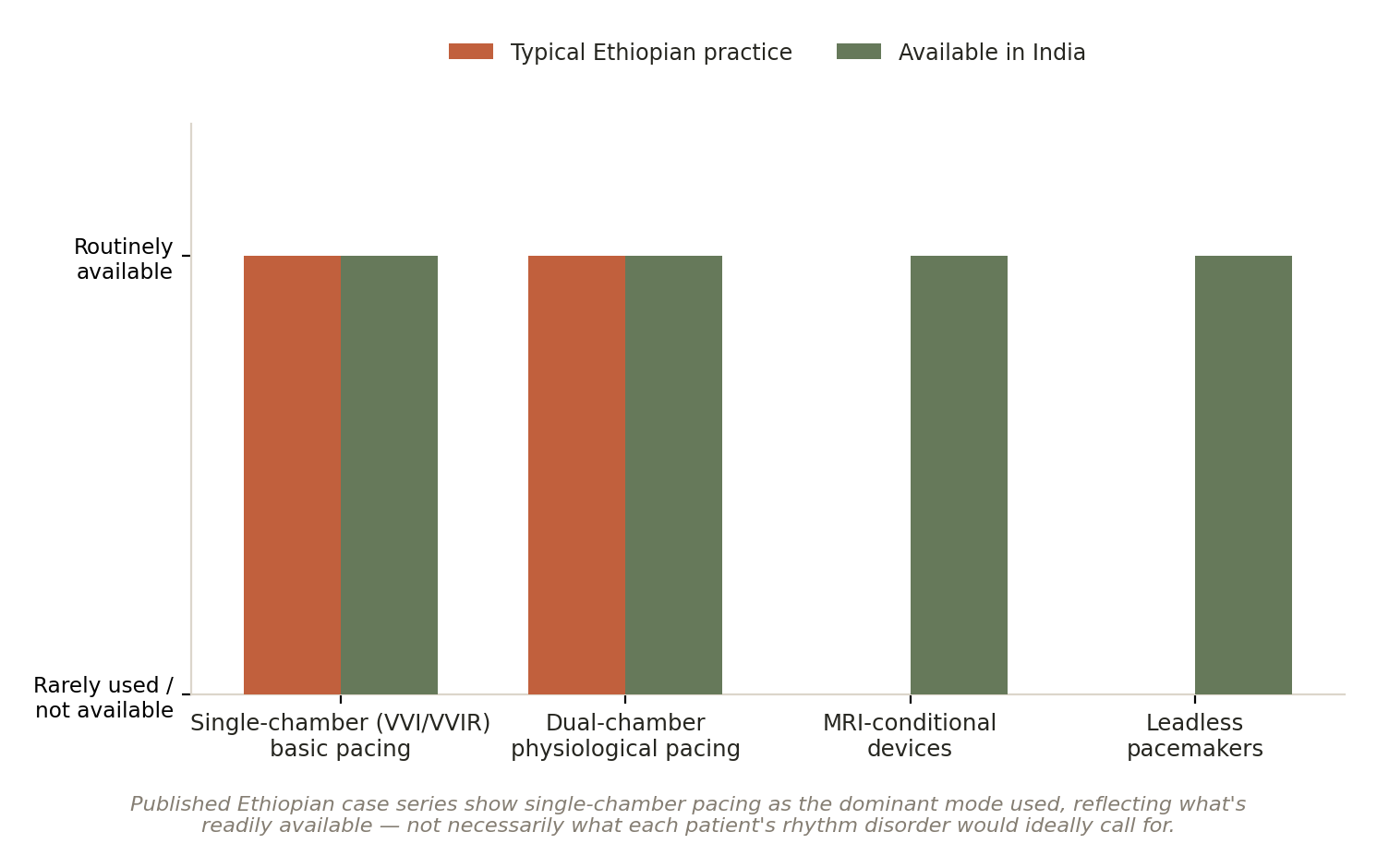
The device that actually gets implanted often reflects what's available, not necessarily what the rhythm disorder would ideally call for.
Ask explicitly which device type is being proposed and why, given the specific rhythm disorder diagnosed — not simply what happens to be in stock. A single-chamber device is the right choice for some patients and a compromise for others.
4 Gate Four
Could this be done in Ethiopia?
For straightforward, single-chamber pacing, increasingly yes, at Ethiopia's main tertiary hospitals. Where a patient's specific rhythm disorder would benefit from dual-chamber physiological pacing, needs MRI compatibility for other future medical care, or is a candidate for a leadless system, the picture is considerably thinner.
This is precisely where India's cardiac electrophysiology centres add genuine, comparative depth: the complete range of pacing technology available as routine stock, cardiologists specialised specifically in rhythm disorders rather than general cardiology, and same-week diagnosis-to-implantation turnaround. For a decision this dependent on matching the right device to the right rhythm disorder, that range of options is not a luxury — it is what actually lets treatment fit the diagnosis rather than the other way around. Ask any centre which specific device types they stock routinely, rather than assuming all pacemakers are interchangeable.
5 Gate Five
Is the money arranged?
Ethiopia's health financing does not follow a patient abroad. Community-Based Health Insurance covers contracted facilities inside the country, and the formal-sector scheme still isn't settling claims. Since February 2026 a bank may release up to US$20,000 per case against a letter from the treating hospital, without a visa or ticket in hand.
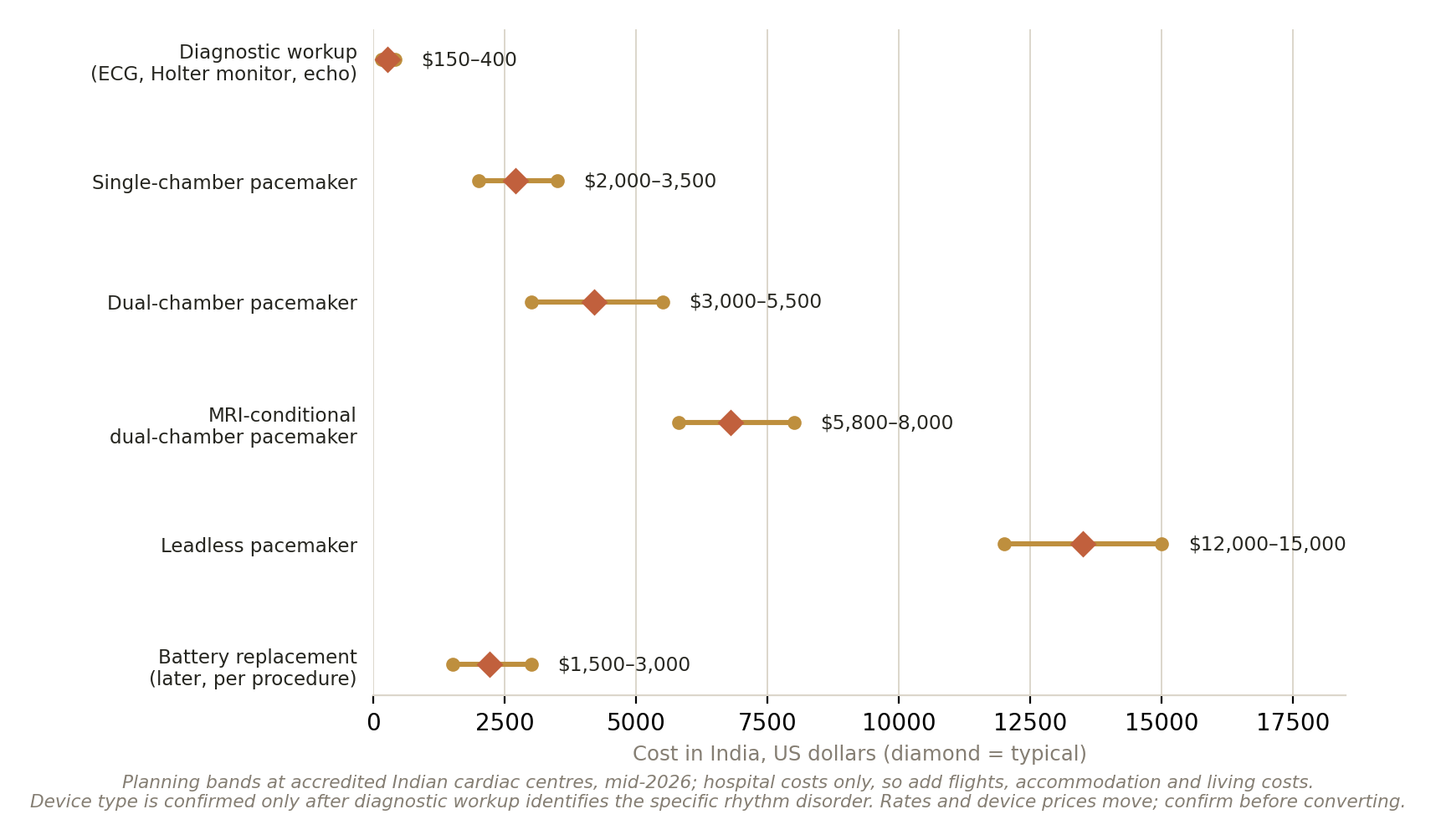
Budget for the device your rhythm disorder actually calls for, not the most familiar figure.
The figures differ substantially by device type: a single-chamber pacemaker sits well below a leadless system. Even at the top of these ranges, treatment at an accredited Indian cardiac centre remains a fraction of an equivalent case in the Gulf, Europe, or the United States. Confirm the specific device type recommended before assuming any single number applies to your case.
| A quotation, annotatedA composite of the pacemaker quotes that reach me, with the questions I send back. | |
| Pacemaker implantation — USD 3,500 | Single-chamber, dual-chamber, or leadless? This alone explains most of the price range. |
| Includes: ECG and Holter monitoring | Good sign. Ask what extended monitoring is done if the first ECG looks normal. |
| Device: brand and model, ask directly | Ask for the specific brand, model, and whether it's MRI-conditional. |
| Includes: 3 days admission | Reasonable for this procedure. Ask what a complication would add. |
| Excludes: battery replacement (later) | Ask for the expected battery life and the cost of eventual replacement. |
| Excludes: remote monitoring service | Ask whether remote device monitoring is available once you're back in Ethiopia. |
In 24 years the pacemaker patients most satisfied with their outcome were the ones who asked which specific device matched their rhythm disorder, rather than accepting whichever device happened to be quoted first.
The Ethiopian practicalities
Ethiopian Airlines flies non-stop from Bole to Delhi, Mumbai, Bengaluru, Chennai, and Hyderabad. This is usually a short trip — ask for written clearance to fly a few days after implantation, once the wound and device position have been checked. Yellow fever certification is required at least ten days before arrival, oral polio vaccination roughly four weeks before. The medical visa follows the hospital's invitation letter through the Embassy of India, Addis Ababa. Ask whether the device supports remote monitoring that can be accessed from Ethiopia, and request a device identification card before leaving India, since airport security and any future medical care will need it. Confirm current rules with the Embassy, since they change, and ask for an Amharic-speaking coordinator to carry a written follow-up plan back to a named cardiologist in Ethiopia.
Straight Answers for Ethiopian Patients about Cardiac Pacemaker Treatments in India
I fainted once. Does that mean I need a pacemaker?
Not necessarily. Fainting has many ordinary causes. But fainting from the heart's electrical system pausing is a serious warning sign, needing an ECG and often a Holter monitor to properly rule in or out.
Is a pacemaker the same as a defibrillator (ICD)?
No. A pacemaker treats a heart beating too slowly. An ICD treats the risk of a dangerous fast rhythm with a shock. Some devices combine both, but confirming which one a case needs matters first.
Is pacemaker implantation available in Ethiopia?
At main tertiary hospitals, yes, for the more common device types. Published case series describe single-chamber pacing as dominant. Dual-chamber, MRI-conditional, and leadless options are considerably harder to access locally.
How long does pacemaker treatment in India take?
The procedure itself takes one to two hours under local anaesthesia. Most patients stay two to three days for monitoring, with a total trip of about a week including diagnostics and a wound check.
Who pays for this in Ethiopia?
You do. Neither Community-Based Health Insurance nor the pending formal-sector scheme funds treatment abroad, though a bank may now advance up to US$20,000 against the treating hospital's letter.
A closing word
Send the ECG, any Holter monitor results, and a note on symptoms including any fainting episodes and how long they've been happening. I will tell you honestly whether this looks like a pacing problem, and if it is, why India's full range of pacing technology is where the specific device your rhythm disorder calls for is genuinely available.
Sources
- 🌐 Assessment of trend, indication, complications, and outcomes of pacemaker implantation in adult patients at a tertiary hospital of Ethiopia
- 🌐 Cardiac pacing training in Africa: endorsed by the Africa Heart Rhythm Association (AFHRA). JACC Int. 2020
- 🌐 Continental cartography of permanent pacemaker use in Africa: a scoping review. Ann Clin Cardiol. 2025
- 🌐 National Medical Commission of India — Indian Medical Register
- 🌐 National Bank of Ethiopia Directive FXD/04/2026 (foreign exchange, advance payments for treatment abroad); Embassy of India, Addis Ababa
Frequently Asked Questions by Ethiopians about Cardiac Pacemaker Treatments in India
Does one fainting episode mean an Ethiopian patient needs a pacemaker?
No. Ethiopian patients may faint for many reasons, including dehydration or low blood sugar. However, unexplained fainting can indicate an electrical heart problem, so an ECG and often Holter monitoring should be performed before deciding whether a pacemaker is necessary.
How common is complete heart block among Ethiopian patients receiving pacemakers?
In the Ethiopian tertiary-hospital data cited in the PDF, 78.8% of pacemaker implantations were for symptomatic third-degree or complete AV block. This was the dominant indication in that particular hospital series.
Can Ethiopian patients receive dual-chamber pacemakers in India?
Yes. Ethiopian patients who require dual-chamber physiological pacing can be assessed at Indian cardiac electrophysiology centres. The PDF highlights that India routinely has access to a wider range of pacing technologies than is commonly available in Ethiopian practice.
Can Ethiopian patients get an MRI-conditional pacemaker in India?
Yes. Ethiopian patients who need future MRI compatibility can ask Indian electrophysiology centres specifically about MRI-conditional devices. The PDF notes that these devices are considerably harder to access locally in Ethiopia but are routinely available in India.
Can Ethiopian patients receive a leadless pacemaker in India?
Yes, where clinically appropriate. Ethiopian patients who are candidates for leadless pacing can specifically ask Indian centres about this option because the PDF identifies leadless systems as considerably harder to access in Ethiopia and routinely available in India.
How much does a pacemaker cost for Ethiopian patients in India?
The PDF gives indicative Indian planning ranges of US$2,000–3,500 for single-chamber, US$3,000–5,500 for dual-chamber, US$5,800–8,000 for MRI-conditional dual-chamber, and US$12,000–15,000 for leadless pacemakers. The exact device required should be confirmed before budgeting.
Can Ethiopian health insurance pay for pacemaker treatment in India?
The PDF states that Ethiopia's Community-Based Health Insurance covers contracted facilities inside Ethiopia and does not follow patients abroad. It also states that the formal-sector scheme was not settling overseas claims, while a bank may advance up to US$20,000 against a treating hospital's letter under the cited arrangement.
How long does an Ethiopian patient's pacemaker treatment in India take?
For Ethiopian patients, the pacemaker implantation itself generally takes one to two hours under local anaesthesia. Most patients stay two to three days for monitoring, with a total India trip of approximately one week including diagnostics and a wound check.
What should Ethiopian patients check in a pacemaker quotation from an Indian hospital?
Ethiopian patients should ask whether the quotation specifies the device type, brand and model, whether it is MRI-conditional, whether ECG and Holter monitoring are included, how many admission days are covered, expected battery life, future battery replacement costs and whether remote monitoring is available after returning to Ethiopia.
What should Ethiopian patients arrange before returning home after pacemaker implantation in India?
Ethiopian patients should obtain written clearance to fly after the wound and device position have been checked, collect a device identification card and confirm whether remote monitoring works in Ethiopia. They should also carry a written follow-up plan to a named Ethiopian cardiologist.
Page Summary
This guide explains pacemaker treatment in India for Ethiopian patients with slow or interrupted heart rhythms. It begins with fainting and the importance of ECG and Holter monitoring. Page 2 highlights the African pacemaker access gap. Page 3 explains complete heart block and different pacemaker types. Page 4 compares device availability in Ethiopia and India. Page 5 presents indicative device costs and Ethiopian financing considerations. Pages 6–7 cover quotation checks, travel requirements, treatment duration and follow-up in Ethiopia.
Citation Block
| Topic | Information |
|---|---|
| Topic Information | Cardiac Pacemaker Treatments for Ethiopian Patients in India |
| Treatment | Cardiac Pacemaker Implantation |
| Country | India |
| Intended Audience | Ethiopian Patients |
| Main Condition | Bradyarrhythmia |
| Major Indication | Symptomatic Third-Degree / Complete AV Block |
| Complete AV Block | 78.8% of implantations in cited Ethiopian hospital |
| Pacemaker Options | Single-Chamber, Dual-Chamber, MRI-Conditional and Leadless |
| India Cost Range | US$2,000–15,000 depending on device |
| Diagnostic Workup | US$150–400 |
| Procedure Duration | 1–2 hours |
| Hospital Stay | 2–3 days |
| Total India Trip | Approximately 1 week |
| Key Specialist | Cardiac Electrophysiologist |
| Important Device Checks | Brand, model, MRI compatibility and battery life |
| Hospital Accreditation | JCI or NABH can be independently verified |
| Follow-Up | Named Cardiologist in Ethiopia |
| Travel Documentation | Device identification card and written follow-up plan |
| Financing Arrangement | Up to US$20,000 bank advance against treating hospital letter |
| Pre-Travel Check | Confirm exact device and complete quotation |
| Author | Dr. Dheeraj Bojwani |
| Experience | 24+ Years |


Our Mission Statement
Our mission is to place patients at the centre of every healthcare decision by providing trustworthy, evidence-based, and unbiased medical information. We believe that informed patients make better decisions. Backed by personalised guidance from our experienced advisory team, we help patients understand their treatment options, compare them objectively, and confidently choose the path that best suits their medical needs and personal circumstances.
Patient Testimonials from Ethiopia










Ready to Take the First Step?
Share your Medical Reports with our Healthcare Managers Today and Get a FREE CONSULTATION, a Personalized Treatment Plan, and Complete Support from Arrival to Recovery.
Get Your Free ConsultationAreas We Serve
This resource has been thoughtfully prepared for patients from Ethiopia who are considering medical treatment in India. We also welcome patients from the wider region in the countries mentioned below-
We assist patients from:
- Eritrea
- Djibouti
- Somalia
- Kenya
- Sudan
- Burundi
- Comoros
- Ethiopia
- Madagascar
- Malawi
- Mauritius
- Mozambique
- Rwanda
- South Sudan
Many of the insights, treatment pathways, hospital recommendations, travel guidance, and patient support services described here are equally relevant and may be used as a reference when planning treatment in India.
From Ethiopia to India: Your Complete Patient Support Guide
- Brain Tumour Surgery in India for Ethiopians
- Cancer Treatment in India for Ethiopians
- Cardiac Surgery in India for Ethiopian Patients
- Cervical and Disc Replacement Surgery in India for Ethiopians
- Cosmetic and Plastic Surgery in India for Ethiopians
- CyberKnife Treatment in India for Ethiopians
- Eye Surgery in India for Ethiopians
- Gamma Knife Treatment in India for Ethiopians
- Heart Valve Replacement Surgery in India for Ethiopians
- Hip Surgery in India for Ethiopian Patients
- Knee Surgery in India for Ethiopian Patients
- Laparoscopic and Robotic Myomectomy Surgery in India for Ethiopians
- Neurosurgery in India for Ethiopians
- Paediatric Cardiac Surgery in India for Ethiopians
- Paediatric Neurosurgery in India for Ethiopians
- Prostate Cancer Treatment and Surgery in India for Ethiopians
- Robotic Cancer Surgery in India for Ethiopians
- Scoliosis Surgery in India for Ethiopians