

Bone Marrow Transplant Treatment for Ethiopian Patients in India
Five gates every transplant case should pass before booking a flight — and why, for a treatment with no established programme anywhere in Ethiopia today, India's high-volume BMT centres are where the donor- matching odds, and the treatment itself, actually exist.
Bone marrow transplant — hematopoietic stem-cell transplantation, HSCT — is the only curative option for a range of blood cancers and blood disorders that no longer respond to standard treatment, and no established transplant programme currently operates anywhere in Ethiopia. In 24 years of arranging surgical and medical care in India for patients across Africa and Asia, this is a field where the honest starting point is not which hospital to choose, but the fact that the treatment does not yet exist to choose from at home at all. Leukemia and non-Hodgkin lymphoma both sit among Ethiopia's five leading cancers by new cases and deaths, a substantial and recurring burden rather than a rare edge case. Ethiopia's own national health roadmap acknowledges this directly, setting a target of establishing local transplant centres only by 2029 — meaning patients who need this treatment today must travel abroad by necessity, not preference. There is also a second, less obvious complication specific to patients of African ancestry: the genetic diversity that makes finding an unrelated matched donor hardest of all falls precisely on this population. India's transplant centres, built around exactly the techniques that solve this specific problem, are where both gaps close together. These five gates walk through whether a transplant is genuinely the right treatment, how the donor question actually gets answered for a patient without a matched sibling, and why India is where this treatment reliably exists for Ethiopian patients today.
Healing Journeys of Ethiopian Patients









Key Takeaways
- Bone marrow transplant, also called hematopoietic stem-cell transplantation (HSCT), is used for selected blood cancers and blood disorders when standard treatment may no longer be sufficient. The PDF highlights high-risk or relapsed leukemia, certain lymphomas, aplastic anaemia and some inherited blood disorders such as thalassemia.
- The donor question is particularly important for Ethiopian patients. The page 3 chart illustrates that unrelated donor matching can be more difficult for people of African ancestry, while a haploidentical transplant using a half-matched parent, child or sibling can make transplantation possible for many patients.
- The document distinguishes between autologous transplantation, which uses the patient's own stem cells, and allogeneic transplantation, which uses donor cells. Allogeneic transplantation may involve the additional risk of graft-versus-host disease (GvHD).
- Ethiopia currently has no established HSCT programme, although the national health roadmap targets establishing transplant centres by 2029. The PDF therefore presents international treatment as a current necessity for Ethiopian patients who require transplantation.
- India is highlighted for its established transplant infrastructure, including experience with autologous, allogeneic and haploidentical transplantation. The guide recommends asking centres for their annual transplant volume by the specific transplant type and their GvHD and survival outcomes.
- The page 5 cost chart shows indicative ranges of USD 14,000–20,000 for autologous transplant, USD 22,000–28,000 for allogeneic transplant, and USD 30,000–38,000 for haploidentical transplant. Diagnostic workup, extended isolation and follow-up may add to the total.
- The annotated quotation on page 6 shows why patients should look beyond the headline transplant price. HLA typing and donor search, 30 days of isolation, post-transplant medicines and follow-up beyond 12 months may have different inclusions or exclusions depending on the package.
Quick Facts
- Treatment
- Bone Marrow Transplant / HSCT
- Country
- India
- Patients
- Ethiopian Patients
- Main Conditions
- Leukemia, Lymphoma, Aplastic Anaemia and Selected Blood Disorders
- Main Types
- Autologous, Allogeneic and Haploidentical
- Key Decision
- Transplant Indication and Donor Type
- Ethiopia
- No Established HSCT Programme
- Key Donor Option
- Haploidentical Family Donor
- Autologous Cost
- USD 14,000–20,000
- Allogeneic Cost
- USD 22,000–28,000
- Haploidentical Cost
- USD 30,000–38,000
- Treatment Duration
- Approximately 2–3 Months Including Early Recovery
- Follow-Up
- Long-Term Haematology Monitoring
- Payment Advice
- Confirm Donor Search, Isolation and Medication Inclusions
In Brief
Ethiopian patients considering a bone marrow transplant in India should first confirm the exact diagnosis, risk category and reason transplantation is being recommended. The next major decision is whether an autologous or allogeneic transplant is appropriate and, for an allogeneic transplant, what donor options are realistically available. The PDF particularly highlights haploidentical transplantation as an important option when a fully matched donor is difficult to find. Before travelling, patients should clarify the transplant type, donor situation, expected isolation period, GvHD monitoring, post-transplant medication costs and long-term follow-up plan.
1 Gate One
Does this disease need a transplant?
A leukemia, lymphoma, or blood disorder diagnosis is what usually starts this conversation, and transplant is not the answer for every case. It is reserved for specific situations: high-risk or relapsed leukemia, certain lymphomas that have not responded to standard chemotherapy, aplastic anemia, and some inherited blood disorders such as thalassemia.
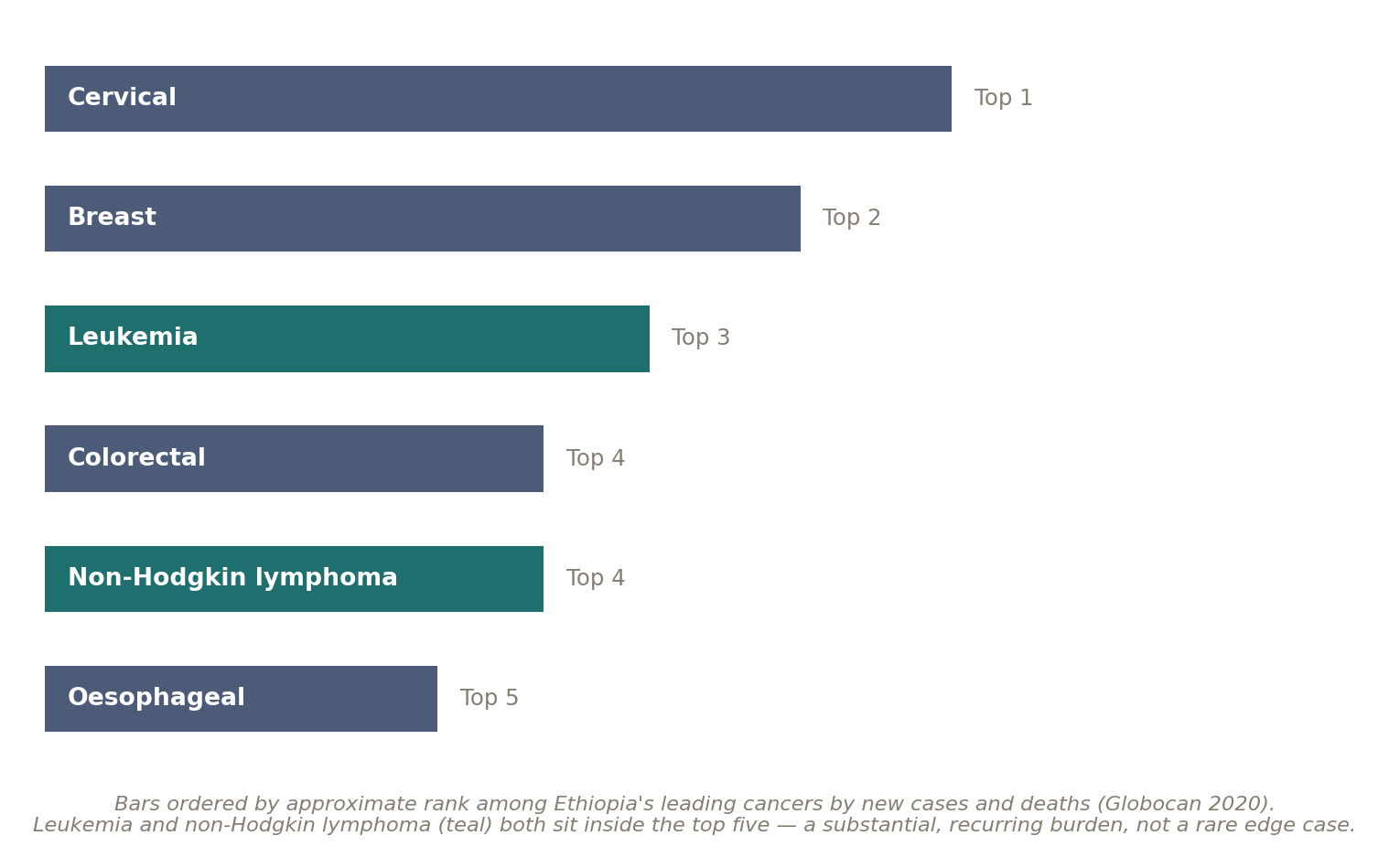
Leukemia and non-Hodgkin lymphoma are not rare diseases in Ethiopia — they are among the most common.
Many blood cancers are treated well with chemotherapy or targeted therapy alone, without ever needing a transplant. Ask specifically why transplant is being recommended for your case, which specific diagnosis and risk category it addresses, and whether standard treatment has genuinely been exhausted first.
2 Gate Two
Who is the donor?
For an allogeneic transplant — using someone else's cells — the donor question is the single most consequential fact in the entire process, and it plays out differently for Ethiopian patients than the international literature on transplant usually assumes.
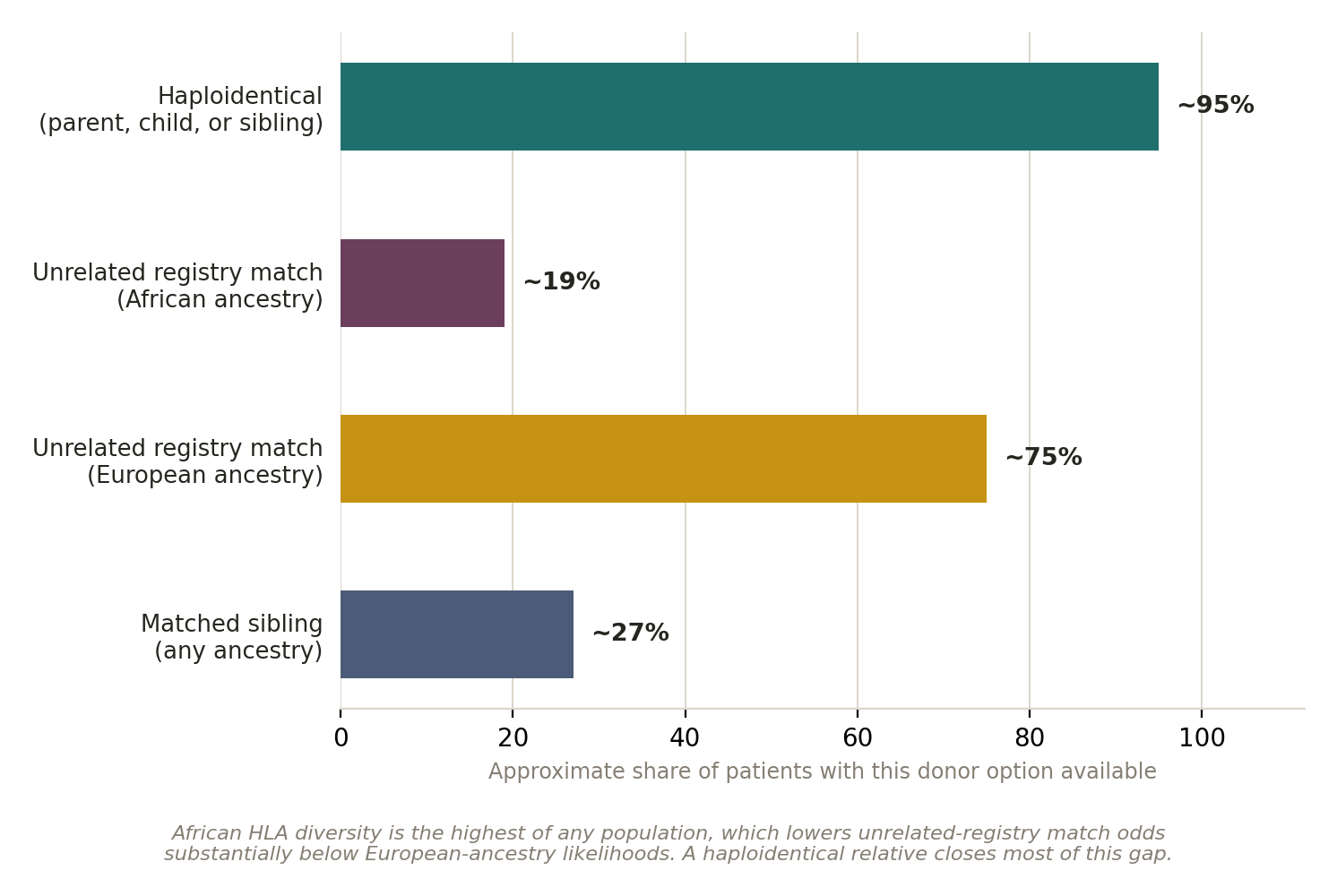
Without a matched sibling, ancestry changes the odds sharply — and a haploidentical relative is what closes that gap.
Why this matters specifically for Ethiopian patients: HLA genetic diversity is highest in African populations, a consequence of deep evolutionary history rather than anything about registry size alone. This means the odds of finding a full match through an international unrelated-donor registry are markedly lower for a patient of African ancestry than for a patient of European ancestry. A haploidentical transplant, using a half-matched parent, child, or sibling, is what makes this gap largely irrelevant — nearly every patient with a living relative has this option.
Ask any centre directly what proportion of their transplants are haploidentical, and how their outcomes for this specific technique compare with fully matched transplants — this is where real experience shows.
3 Gate Three
Own cells, or a donor's?
An autologous transplant uses the patient's own stem cells, collected before high-dose treatment and returned afterward — more a rescue technique than a true transplant, commonly used for multiple myeloma and some lymphomas, with no donor-matching question at all. An allogeneic transplant uses a donor's cells, needed for most leukemias, aplastic anemia, and inherited blood disorders, and carries both the donor-matching question from gate two and the risk of graft-versus-host disease, where the new immune system reacts against the patient's body.
These two paths differ substantially in cost, recovery, and risk profile, and confusing which one a specific diagnosis calls for is a common and costly misunderstanding. Ask explicitly, in writing, which type is being recommended and why, before any donor search or cost discussion begins.
4 Gate Four
Could this be done in Ethiopia?
Honestly, not yet. Diagnosis, staging, and chemotherapy for blood cancers are increasingly available within Ethiopia, concentrated at Tikur Anbessa Specialized Hospital. The transplant itself — the specialised isolation units, apheresis and cell-processing laboratories, and the intensive post-transplant monitoring for graft-versus-host disease and infection — has no established home anywhere in the country.
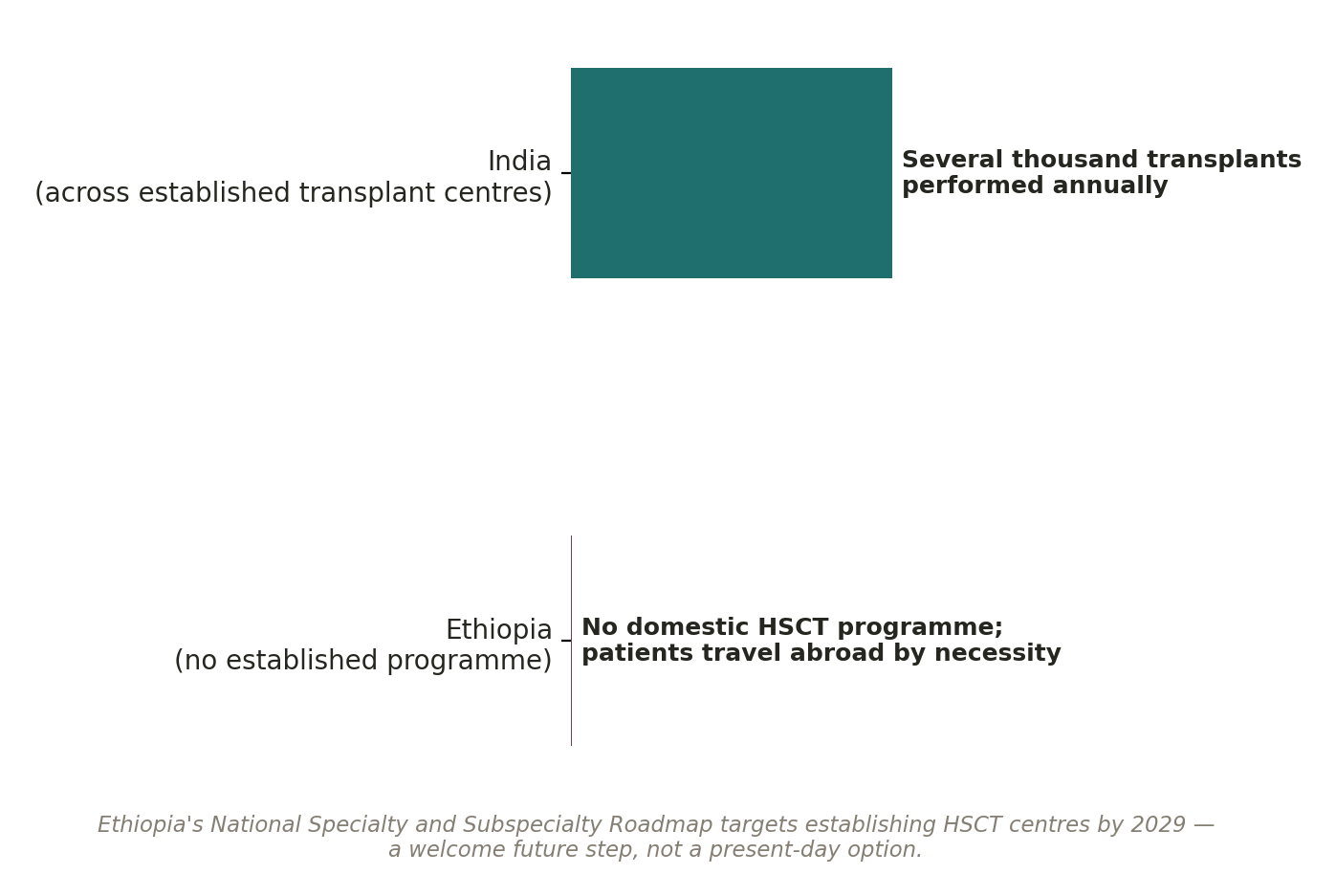
This is not a capacity shortfall to work around. It is a treatment that does not yet exist to be delivered locally.
This is precisely why India's position matters so directly for this specific disease group. Leading Indian transplant centres perform thousands of procedures a year across autologous, allogeneic, and haploidentical techniques, with the specific expertise in half-matched transplant that most directly answers the donor-matching disadvantage described in gate two. For a treatment where post-transplant infection control and specialist monitoring matter as much as the procedure itself, that combination of volume and specific technique experience is, for an Ethiopian patient today, close to the only route to this treatment existing at all.
A second opinion on the diagnosis and transplant indication before committing to a specific centre is always worth arranging. Ask how many transplants of your specific type the team performs each year, and what their graft- versus-host disease and survival outcomes look like — India's high-volume centres answer this with real numbers.
5 Gate Five
Is the money arranged?
Ethiopia's health financing does not follow a patient abroad. Community-Based Health Insurance covers contracted facilities inside the country, and the formal-sector scheme still isn't settling claims. Since February 2026 a bank may release up to US$20,000 per case against a letter from the treating hospital, without a visa or ticket in hand.
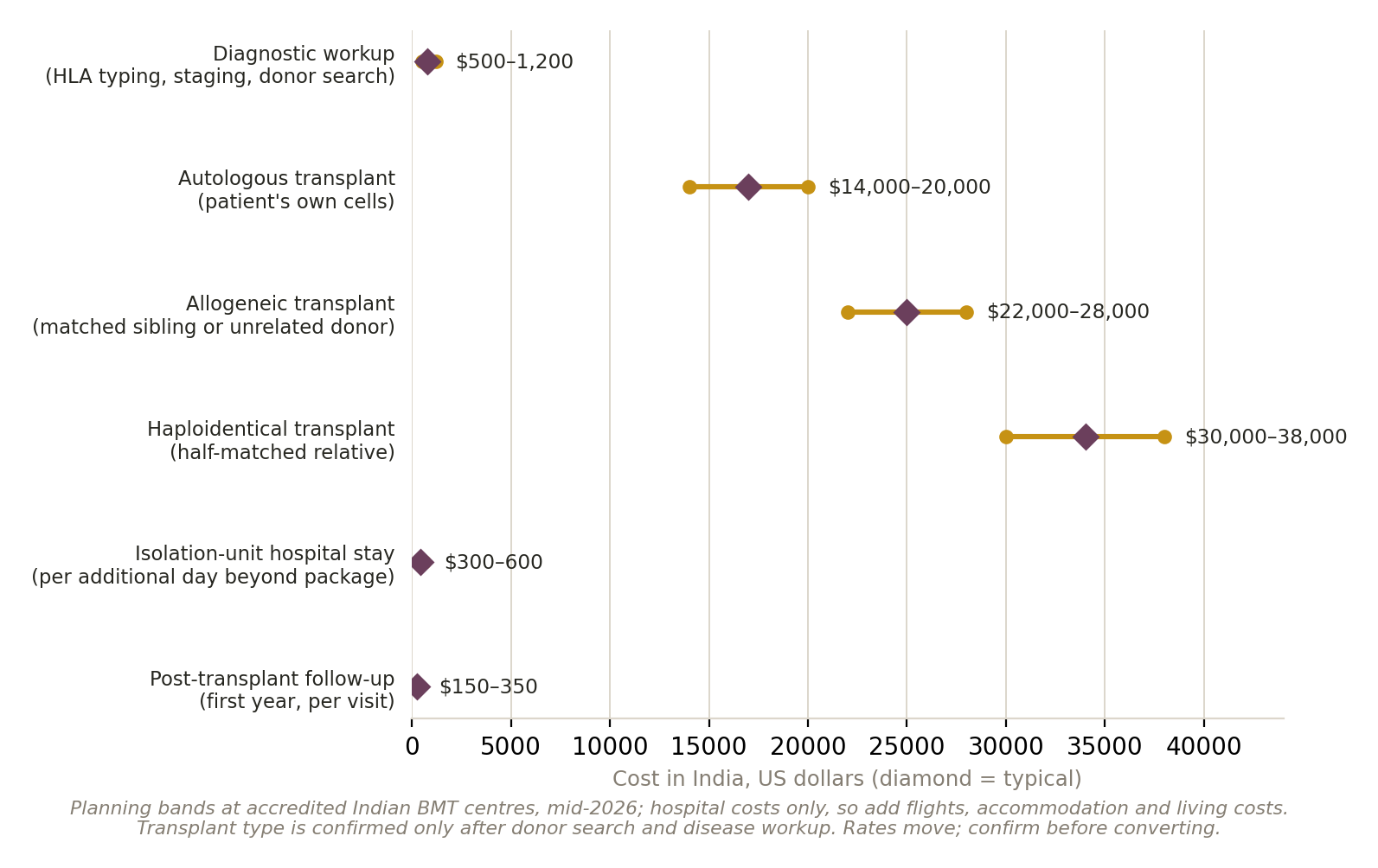
Budget for the transplant type your donor situation actually points to, not the most familiar figure.
The figures differ substantially by transplant type: autologous transplant sits well below allogeneic, and haploidentical transplant, needing the most intensive monitoring and processing, costs the most of the three. Even at the top of these ranges, treatment at a leading Indian BMT centre remains a fraction of an equivalent package in the Gulf, Europe, or the United States. Confirm the transplant type before assuming any single number applies to your case.
| A quotation, annotatedA composite of the transplant quotes that reach me, with the questions I send back. | |
| Bone marrow transplant — USD 25,000 | Autologous, allogeneic, or haploidentical? Each prices very differently. |
| Includes: donor HLA typing and search | Ask how many potential donors this covers, and the cost if none are found. |
| Includes: 30 days isolation-unit stay | Ask what extended stay for GvHD or infection would add. |
| Team volume: ask directly | Ask for the team's annual volume by transplant type, and their GvHD rates. |
| Excludes: post-transplant medications | Ask for the expected monthly cost of immunosuppressants for the first year. |
| Excludes: extended follow-up beyond 12 months | Ask what a longer-term monitoring plan costs and how it's delivered remotely. |
In 24 years the transplant patients most satisfied with their outcome were the ones who understood their donor situation clearly before ever discussing price — and chose a centre with real, specific experience in exactly that situation.
The Ethiopian practicalities
Ethiopian Airlines flies non-stop from Bole to Delhi, Mumbai, Bengaluru, Chennai, and Hyderabad. Ask for written clearance to fly rather than assuming a fixed number of days after discharge, since recovery and infection risk after transplant are longer and more variable than most treatments in this series. Yellow fever certification is required at least ten days before arrival, oral polio vaccination roughly four weeks before. The medical visa follows the hospital's invitation letter through the Embassy of India, Addis Ababa; because the stay is long, confirm the visa validity covers the full treatment and early recovery period. An attendant, ideally the donor if related, is worth arranging for the full stay. Where treatment spans the Orthodox fasting calendar, raise this with the hospital's dietary team beforehand, since post-transplant nutrition needs are strict and specific. Confirm current rules with the Embassy, since they change, and ask for an Amharic-speaking coordinator to carry a written follow-up plan back to a named haematologist in Ethiopia.
Straight Answers for Ethiopian Patients about Bone Marrow Transplant Treatment in India
My family member has leukemia. Does that mean they need a bone marrow transplant?
Not necessarily. Transplant is reserved for high-risk or relapsed leukemia, certain lymphomas, aplastic anemia, and some inherited blood disorders. Many blood cancers are treated well with chemotherapy or targeted therapy alone.
Who can be a donor?
A full sibling has roughly a 1-in-4 chance of being a complete match. Without one, an unrelated registry can be searched, though match odds are markedly lower for African-ancestry patients. A haploidentical (half-matched) relative closes most of this gap and is available to nearly everyone.
Is bone marrow transplant available in Ethiopia?
No established programme currently operates in Ethiopia. Patients needing this treatment must travel abroad by necessity, and Ethiopia's national health roadmap targets local centres only by 2029.
How long does treatment in India take?
Donor search and pre-transplant workup typically take two to four weeks. The transplant and initial isolation-unit stay need three to five weeks. Many patients plan two to three months total for early recovery and the highest-risk complication period.
Who pays for this in Ethiopia?
You do. Neither Community-Based Health Insurance nor the pending formal-sector scheme funds treatment abroad, though a bank may now advance up to US$20,000 against the treating hospital's letter.
A closing word
Send the haematology notes, the specific diagnosis and risk category, and details of any potential sibling or family donors. I will tell you honestly whether transplant is the right next step, and for the patients it fits, why India's high-volume BMT centres are, for now, close to the only place this treatment reliably exists for an Ethiopian patient.
Sources
- 🌐 Why and how should Ethiopia establish a stem cell transplant service? A review article. Blood Lymphat Cancer. 2023
- 🌐 Gragert L, Eapen M, Williams E, et al. HLA match likelihoods for hematopoietic stem-cell grafts in the U.S. registry. N Engl J Med
- 🌐 How ancestry influences the chances of finding unrelated donors: an investigation in admixed Brazilians. Front Immunol. 2020
- 🌐 National Medical Commission of India — Indian Medical Register, for verifying a treating haematologist's qualification and registration
- 🌐 National Accreditation Board for Hospitals & Healthcare Providers (NABH), Quality Council of India
- 🌐 National Bank of Ethiopia Directive FXD/04/2026 (foreign exchange, advance payments for treatment abroad); Embassy of India, Addis Ababa
Frequently Asked Questions by Ethiopians about Bone Marrow Transplant Treatment in India
Does every leukemia patient need a bone marrow transplant?
No. Transplant is reserved for selected high-risk or relapsed leukemias and other specific blood disorders. Many blood cancers can be treated with chemotherapy or targeted therapy without transplantation.
What conditions may require a bone marrow transplant?
The guide identifies high-risk or relapsed leukemia, certain lymphomas that have not responded to standard treatment, aplastic anaemia and some inherited blood disorders such as thalassemia.
Who can be a bone marrow donor?
A donor may be a matched sibling, an unrelated donor or a partially matched family member. The guide particularly highlights haploidentical transplantation using a parent, child or sibling.
Why is donor matching important for Ethiopian patients?
The document explains that HLA genetic diversity is particularly high in African populations, which can make finding a fully matched unrelated donor more difficult. A haploidentical family donor can help overcome much of this difficulty.
What is a haploidentical transplant?
It is a transplant using a half-matched family donor, such as a parent, child or sibling. The PDF identifies this as an important option when a fully matched donor is unavailable.
What is the difference between autologous and allogeneic transplant?
An autologous transplant uses the patient's own stem cells, while an allogeneic transplant uses cells from a donor. Allogeneic transplantation involves donor matching and risks such as graft-versus-host disease.
Is bone marrow transplant available in Ethiopia?
The PDF states that there is currently no established HSCT programme in Ethiopia. The national health roadmap targets establishing local transplant centres by 2029.
How much does bone marrow transplant cost in India?
The indicative ranges are USD 14,000–20,000 for autologous, USD 22,000–28,000 for allogeneic, and USD 30,000–38,000 for haploidentical transplantation. Additional isolation, medicines and follow-up may increase the final cost.
How long does treatment in India take?
The donor search and pre-transplant workup may take approximately two to four weeks. The transplant and initial isolation period may require three to five weeks, while many patients plan approximately two to three months for early recovery and the highest-risk period.
What should Ethiopian patients ask before choosing a transplant centre?
Patients should ask about the centre's annual volume for their specific transplant type, donor-search experience, GvHD rates, survival outcomes, isolation facilities, post-transplant medicines and long-term follow-up arrangements.
Page Summary
This guide explains when bone marrow transplantation may be recommended for Ethiopian patients and focuses on the important differences between autologous, allogeneic and haploidentical transplantation. It highlights Ethiopia's lack of an established HSCT programme, the donor-matching challenges for African-ancestry patients, India's established transplant capacity, indicative costs, recovery requirements and practical considerations for travelling to India.
Citation Block
| Topic | Information |
|---|---|
| Topic Information | Bone Marrow Transplant Treatment for Ethiopian Patients in India |
| Treatment | Bone Marrow Transplant / HSCT |
| Country | India |
| Intended Audience | Ethiopian Patients |
| Main Conditions | Leukemia, Lymphoma, Aplastic Anaemia and Selected Blood Disorders |
| Main Types | Autologous, Allogeneic and Haploidentical |
| Key Decision | Transplant Indication and Donor Situation |
| Ethiopia HSCT Programme | No Established Programme |
| Donor Option | Matched Sibling, Unrelated Donor or Haploidentical Relative |
| Autologous Transplant | USD 14,000–20,000 |
| Allogeneic Transplant | USD 22,000–28,000 |
| Haploidentical Transplant | USD 30,000–38,000 |
| Diagnostic Workup | USD 500–1,200 |
| Additional Isolation Stay | USD 300–600 Per Day |
| Follow-Up | USD 150–350 Per Visit |
| Initial Isolation | Approximately 3–5 Weeks |
| Overall Early Recovery | Approximately 2–3 Months |
| Key Specialists | Haematologist and Transplant Team |
| Important Risk | Graft-Versus-Host Disease |
| Important Documents | Haematology Notes, Diagnosis, Risk Category and Donor Details |
| Follow-Up | Continued Haematology Care in Ethiopia |
| Payment Advice | Confirm Transplant Type and Package Inclusions |
| Author | Dr. Dheeraj Bojwani |
| Experience | 24+ Years |


Our Mission Statement
Our mission is to place patients at the centre of every healthcare decision by providing trustworthy, evidence-based, and unbiased medical information. We believe that informed patients make better decisions. Backed by personalised guidance from our experienced advisory team, we help patients understand their treatment options, compare them objectively, and confidently choose the path that best suits their medical needs and personal circumstances.
Patient Testimonials from Ethiopia










Ready to Take the First Step?
Share your Medical Reports with our Healthcare Managers Today and Get a FREE CONSULTATION, a Personalized Treatment Plan, and Complete Support from Arrival to Recovery.
Get Your Free ConsultationAreas We Serve
This resource has been thoughtfully prepared for patients from Ethiopia who are considering medical treatment in India. We also welcome patients from the wider region in the countries mentioned below-
We assist patients from:
- Eritrea
- Djibouti
- Somalia
- Kenya
- Sudan
- Burundi
- Comoros
- Ethiopia
- Madagascar
- Malawi
- Mauritius
- Mozambique
- Rwanda
- South Sudan
Many of the insights, treatment pathways, hospital recommendations, travel guidance, and patient support services described here are equally relevant and may be used as a reference when planning treatment in India.
From Ethiopia to India: Your Complete Patient Support Guide
- Brain Tumour Surgery in India for Ethiopians
- Cancer Treatment in India for Ethiopians
- Cardiac Surgery in India for Ethiopian Patients
- Cervical and Disc Replacement Surgery in India for Ethiopians
- Cosmetic and Plastic Surgery in India for Ethiopians
- CyberKnife Treatment in India for Ethiopians
- Eye Surgery in India for Ethiopians
- Gamma Knife Treatment in India for Ethiopians
- Heart Valve Replacement Surgery in India for Ethiopians
- Hip Surgery in India for Ethiopian Patients
- Knee Surgery in India for Ethiopian Patients
- Laparoscopic and Robotic Myomectomy Surgery in India for Ethiopians
- Neurosurgery in India for Ethiopians
- Paediatric Cardiac Surgery in India for Ethiopians
- Paediatric Neurosurgery in India for Ethiopians
- Prostate Cancer Treatment and Surgery in India for Ethiopians
- Robotic Cancer Surgery in India for Ethiopians
- Scoliosis Surgery in India for Ethiopians