

Shoulder Surgery in India for Zambian Patients
Of all the joints in this guide series, the shoulder is the one where time itself is part of the treatment — the same dislocation is a simple problem on day one and a complex reconstruction by month three.
Shoulder problems fall into a few distinct categories — instability and dislocation, rotator cuff tears, and joint wear requiring replacement — and each carries its own timeline for action. Nowhere in this guide series is delay more costly than here: a shoulder put back in place within days is usually straightforward; the same shoulder left out of joint for months becomes a fundamentally harder operation. In 24 years of guiding patients through orthopaedic care abroad, I have seen this distinction matter more for the shoulder than almost any other joint. This guide explains why, and what a Zambian patient should understand before deciding when, and where, to seek treatment.
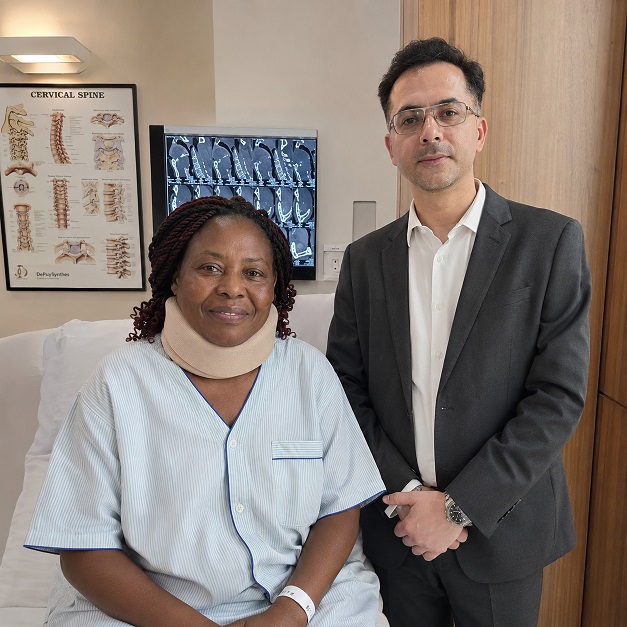
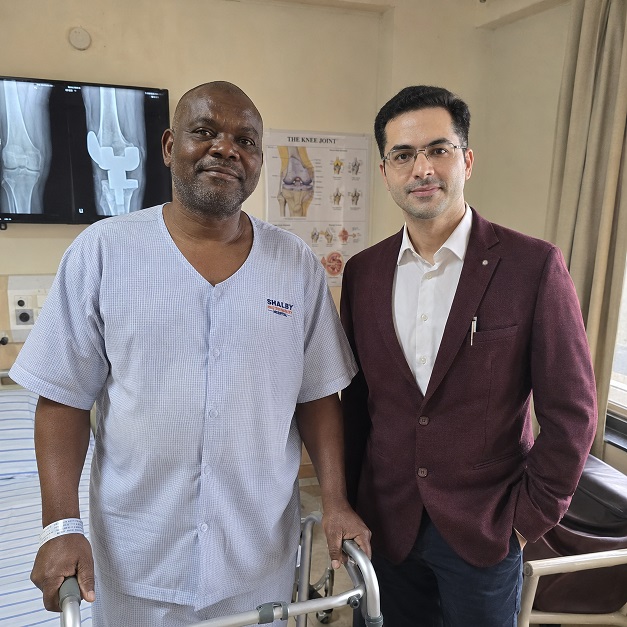
Healing Journeys of Zambian Patients



Key Takeaways
- The guide emphasises that timing is particularly important in shoulder injuries, especially dislocations. A shoulder reduced within days may require only simple treatment and rehabilitation, while a shoulder left out of joint for weeks or months can develop bone loss, scarring and deformity requiring much more complex reconstruction.
- For a first traumatic dislocation, age and activity level influence the decision about surgery. The page 2 chart shows an illustrative repeat-dislocation risk of approximately 72% for patients aged 12–22, 56% for ages 23–29 and 27% for those aged 30+ without surgery after a first traumatic dislocation. Young athletes and physically active workers may therefore benefit from discussing early stabilisation.
- The guide explains that repeated or neglected dislocations can cause bone loss around the shoulder socket and humeral head, potentially changing treatment from a straightforward arthroscopic repair to a bone-block procedure such as Latarjet. Chronic cases may require bone grafting, tendon transfer or even joint replacement depending on the damage.
- For rotator cuff problems, not every tear requires immediate surgery. Smaller partial tears, particularly in older patients, may initially be managed with physiotherapy and activity modification. However, significant weakness or a tear in a younger, physically active patient may favour earlier repair because the tear can enlarge and become harder to repair over time. For advanced arthritis with an irreparable rotator cuff, reverse shoulder replacement may be appropriate because it allows the deltoid muscle to substitute for the damaged cuff.
- When choosing an Indian shoulder surgeon, the guide recommends checking annual arthroscopic stabilisation volume, experience with Latarjet or other bone-block procedures, and specific experience with reverse shoulder replacement. Patients should also verify NABH accreditation, ideally JCI, assess the hospital's physiotherapy support and ask how imaging is used to measure bone loss before surgery.
- The page 4 cost chart gives a representative shoulder-surgery cost of approximately US$6,000 in India, compared with US$25,000 in the UK and US$45,000 in the US. The guide stresses that the complete cost should also consider hospital stay, physiotherapy, possible repeat imaging and the specific procedure required.
Quick Facts
- Author
- Dr. Dheeraj Bojwani
- Experience
- 24+ Years of Experience
- Treatment
- Shoulder Surgery
- Patients
- Zambian Orthopaedic Patients
- Key Specialist
- Shoulder & Orthopaedic Surgeon
- Main Conditions
- Shoulder dislocation, instability, rotator cuff tears and arthritis
- Key Priority
- Prompt assessment after a shoulder injury
- First Dislocation
- Young, active patients may need early stabilisation assessment
- Repeat Dislocation Risk
- Approximately 72% in ages 12–22, 56% in ages 23–29 and 27% in ages 30+ in the cited data
- Complex Reconstruction
- May involve Latarjet, bone grafting or tendon transfer
- Rotator Cuff Treatment
- Physiotherapy or arthroscopic repair depending on tear severity
- Replacement Option
- Reverse shoulder replacement for selected advanced arthritis with damaged rotator cuff
- Surgeon Check
- Procedure-specific experience and annual surgical volume
- Hospital Check
- NABH accreditation, ideally JCI
- India Cost
- Approximately US$6,000
- Pre-Travel Records
- Actual X-rays, MRI or CT images
- Follow-Up
- Structured physiotherapy in Zambia
- Key Warning
- Shoulder remaining out of joint for days or weeks requires urgent orthopaedic assessment
- Decision Principle
- Timing, age, bone loss and the exact shoulder condition should determine the treatment approach.
In Brief
For Zambian patients, the guide's central message is that shoulder treatment should not be delayed unnecessarily. Promptly reduced dislocations may remain straightforward, while chronic dislocations can require complex reconstruction. Treatment depends on age, activity level, bone loss, rotator cuff condition and the specific shoulder problem. The guide gives a representative shoulder-surgery cost of US$6,000 in India.
First, should you travel at all?
Zambia's orthopaedic surgeons manage a great deal of shoulder trauma and degenerative disease well, and a first-time shoulder dislocation, reduced promptly at a local hospital, often needs nothing more than a sling and physiotherapy. For straightforward rotator cuff tears and routine shoulder arthritis, local orthopaedic care may be entirely appropriate. Travel becomes worth considering for stabilisation surgery in young, high-risk patients, for complex or neglected dislocations, and for shoulder replacement surgery, particularly reverse shoulder replacement for advanced rotator cuff-related arthritis, where specific expertise and implants matter.
Rotator cuff tears deserve a brief word here too, since they are common in this region among people whose work involves repeated overhead motion or carrying heavy loads. Not every tear needs surgery immediately; smaller, partial tears in older patients are often managed successfully with physiotherapy and activity modification first. But a tear that causes significant weakness, or one in a younger, physically active patient, tends to do better with earlier repair, since tears can enlarge over time and become harder to repair well the longer they are left.
Whatever your situation, the single most useful thing you can do before travelling is get an honest, prompt assessment locally first — because for this joint more than most, what happens in the days and weeks immediately after an injury shapes everything that follows.
This is a genuinely different pattern from most of the other conditions in this guide series, where the main decision is choosing the right hospital once you have decided to travel. For the shoulder, the decision that matters most often happens before travel is even on the table — in the first hours and days after an injury, at whichever clinic or hospital is nearest to you.
Why time matters so much for a dislocated shoulder
Across Southern Africa, delayed presentation is a well-documented reason shoulder dislocations become chronic and far harder to treat. Studies from South African trauma centres describe patients arriving months, sometimes years, after a dislocation — a delay driven by difficulty accessing care, and in some cases by initial treatment from an untrained hand or a traditional healer that failed to restore the joint. The longer a shoulder remains out of joint, the more the bone and surrounding tissue change: the humeral head can erode a false socket into the bone, soft tissue scars and shortens, and a problem that would have been a same-day closed reduction becomes major reconstructive surgery, sometimes including bone grafting or joint replacement. If a shoulder injury has not resolved within days, or if reduction was attempted by someone without medical training, seeking a proper orthopaedic assessment without further delay is one of the most protective things you can do.
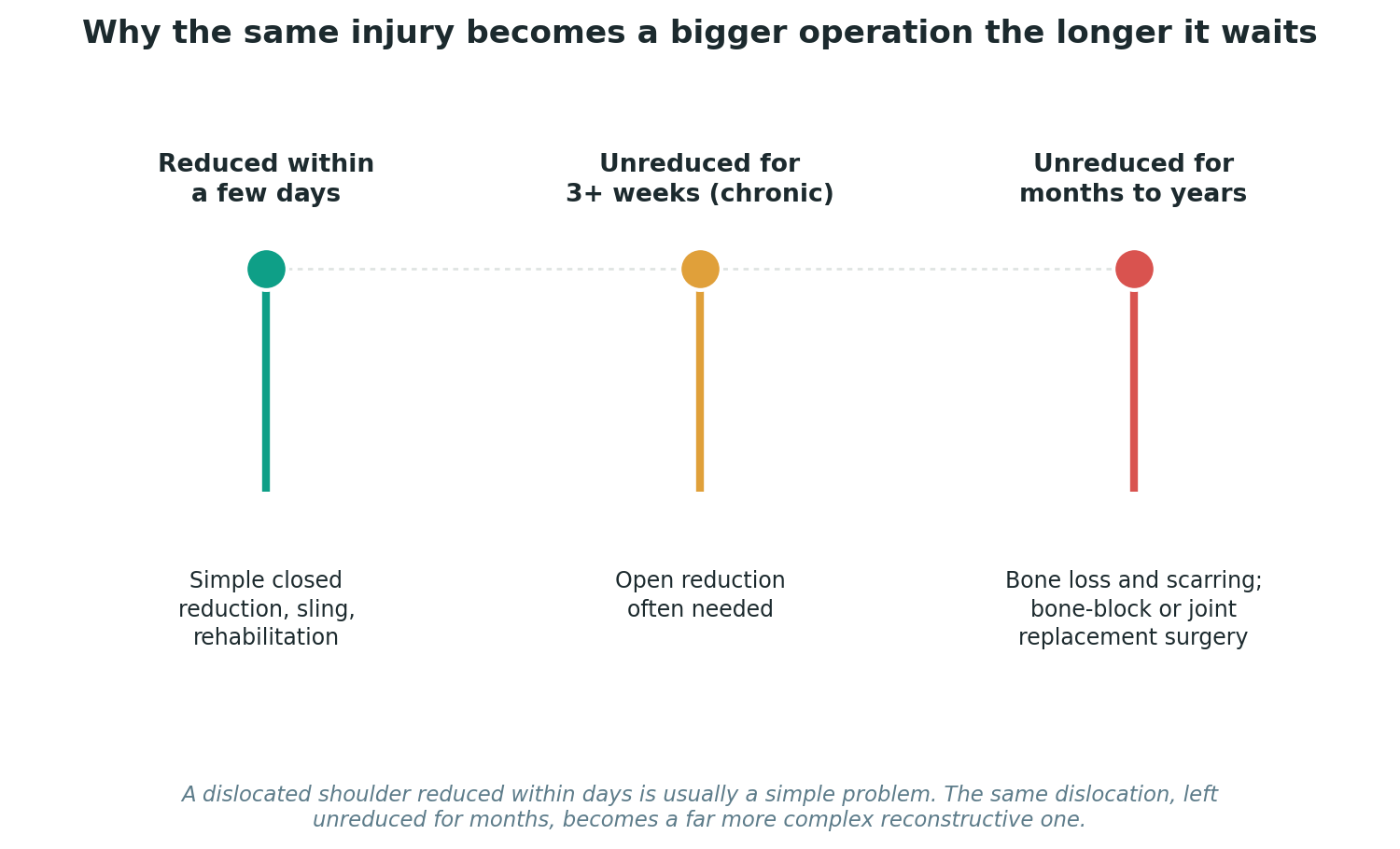
The single biggest factor in how complex your surgery will be is not the injury itself, but how long it has been left.
Why age matters for a first dislocation
For a first-time traumatic shoulder dislocation that is reduced promptly, the next decision is whether to repair the shoulder's stabilising structures surgically or manage it with rehabilitation alone — and here, age is one of the most powerful predictors of what happens next. Younger patients, particularly active men under 25, face a substantially higher risk of the shoulder dislocating again without surgery, while older patients are considerably less likely to have a repeat episode. This is why a young athlete or manual worker with a first dislocation is often a stronger candidate for early stabilisation surgery than an older patient with the same injury.
Each repeat dislocation also makes the next one more likely, and more damaging — every episode risks further injury to the bone at the front of the shoulder socket and the back of the humeral head, which is exactly the kind of bone loss that turns a straightforward soft-tissue repair into a more demanding bone-block procedure. This is why some surgeons now discuss stabilisation surgery after a first dislocation in a young, high-risk patient, rather than waiting for a second or third episode before acting.
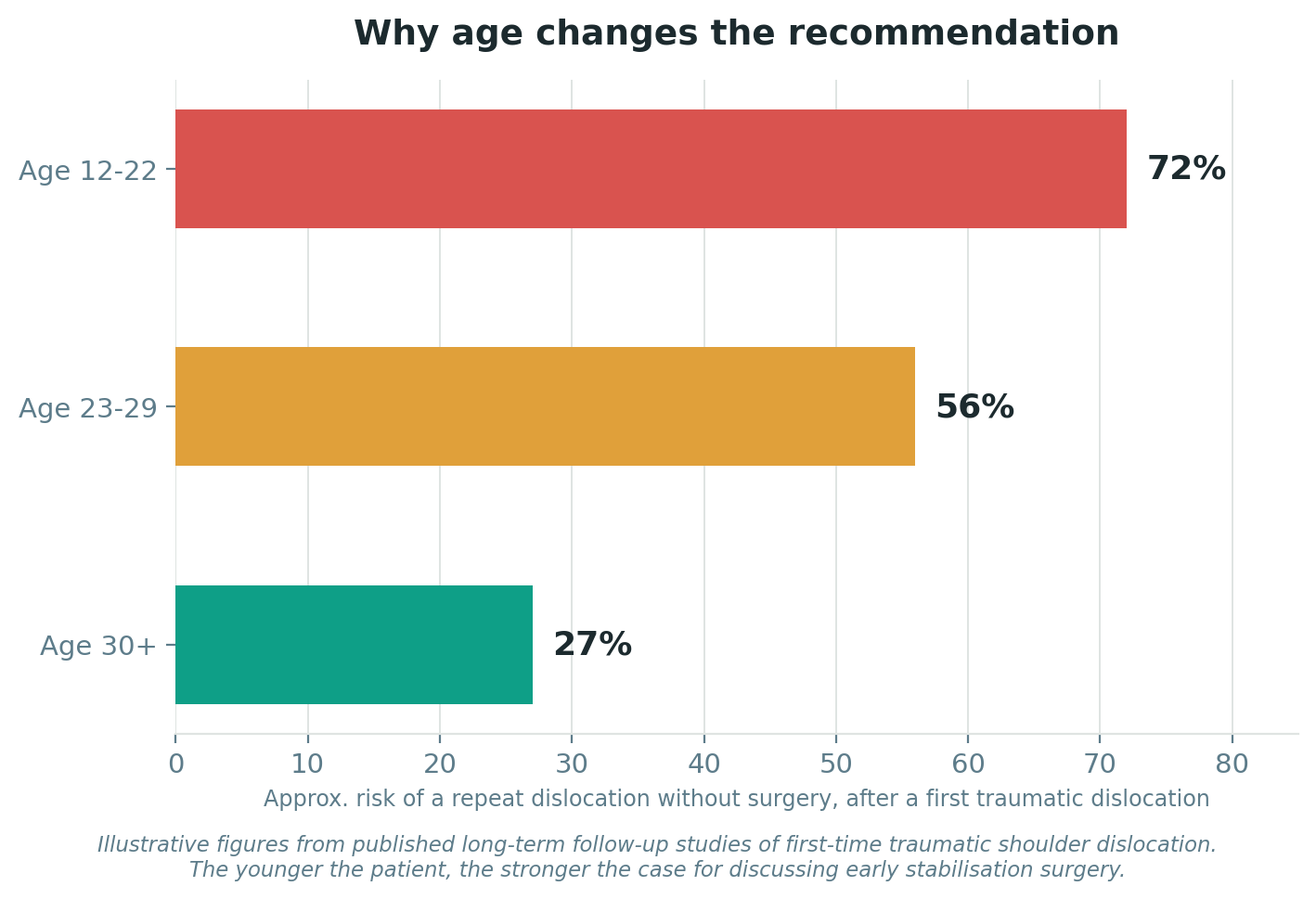
The younger the patient, the stronger the case for discussing surgery after even a first dislocation.
| Your situation | Typical approach | What it involves |
|---|---|---|
| First dislocation, young or active patient, reduced promptly | Discuss early stabilisation surgery | Arthroscopic repair of the torn labrum and ligaments to reduce a high risk of recurrence |
| First dislocation, older patient, reduced promptly | Rehabilitation first, often successful | Sling, physiotherapy, and surgery reserved for those who go on to have repeat episodes |
| Shoulder still out of joint after days or weeks | Urgent orthopaedic assessment | Reduction becomes progressively harder and open surgery more likely the longer this continues |
| Chronic, long-standing dislocation (months to years) | Complex reconstructive surgery | Bone grafting, tendon transfer, or joint replacement, depending on the damage found |
| Rotator cuff tear with pain and weakness | Repair, usually arthroscopic | The torn tendon is reattached to the bone; timing matters less urgently than for dislocation but delay can worsen tear size |
| Advanced shoulder arthritis with a damaged rotator cuff | Reverse shoulder replacement | A specialised implant that lets the deltoid muscle substitute for a non-functioning rotator cuff |
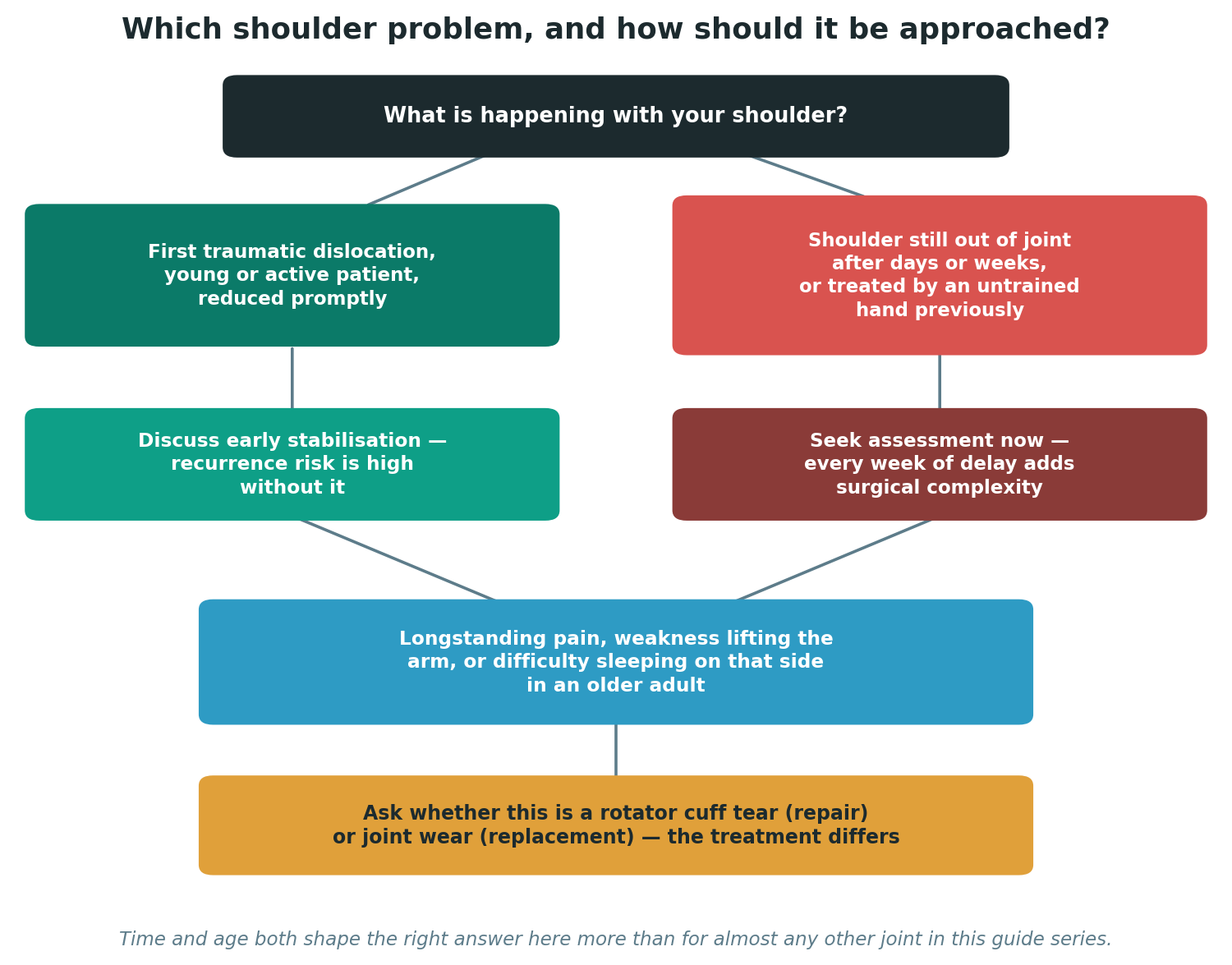
Time and age both shape the right answer here more than for almost any other joint in this series.
Choosing the surgeon and the hospital
For dislocation and instability surgery, ask how many arthroscopic stabilisation procedures the surgeon performs each year, and — if your case involves bone loss from a chronic or repeat dislocation — whether they are experienced in bone-block procedures such as the Latarjet technique, which is a more demanding operation than a first-time repair. For shoulder replacement, ask specifically about experience with reverse shoulder replacement if your rotator cuff is damaged, since this is a different implant and technique from a standard anatomic replacement and not every surgeon who performs hip and knee replacement has deep shoulder-specific experience.
Confirm accreditation (NABH, ideally JCI), and ask what physiotherapy support is available both during your stay and after you return home, since shoulder surgery outcomes depend heavily on structured rehabilitation over several months, not just the operation itself.
It is also worth asking directly how the team assesses and prepares for bone loss before surgery, particularly for any dislocation that has happened more than once or was left unreduced for any length of time. A confident surgical team will describe imaging specifically aimed at measuring bone loss on the glenoid and humeral head, since this measurement often decides whether a soft-tissue repair alone will be sufficient or whether a bone-block procedure is genuinely needed.
Cost and value: how to weigh the money honestly
Shoulder surgery in a good Indian hospital costs a small fraction of the equivalent procedure in the West, and India performs substantial volumes of both instability and replacement surgery. The saving is real, but for this joint especially, the choice of operation and its timing matter more to your outcome than the price you pay for it.
It is also worth remembering that surgery is only part of the total cost of getting a shoulder problem right. Physiotherapy over several months, and in some cases repeat imaging to check healing, add to the picture, and a headline surgery price that omits these is not the complete cost of your care.
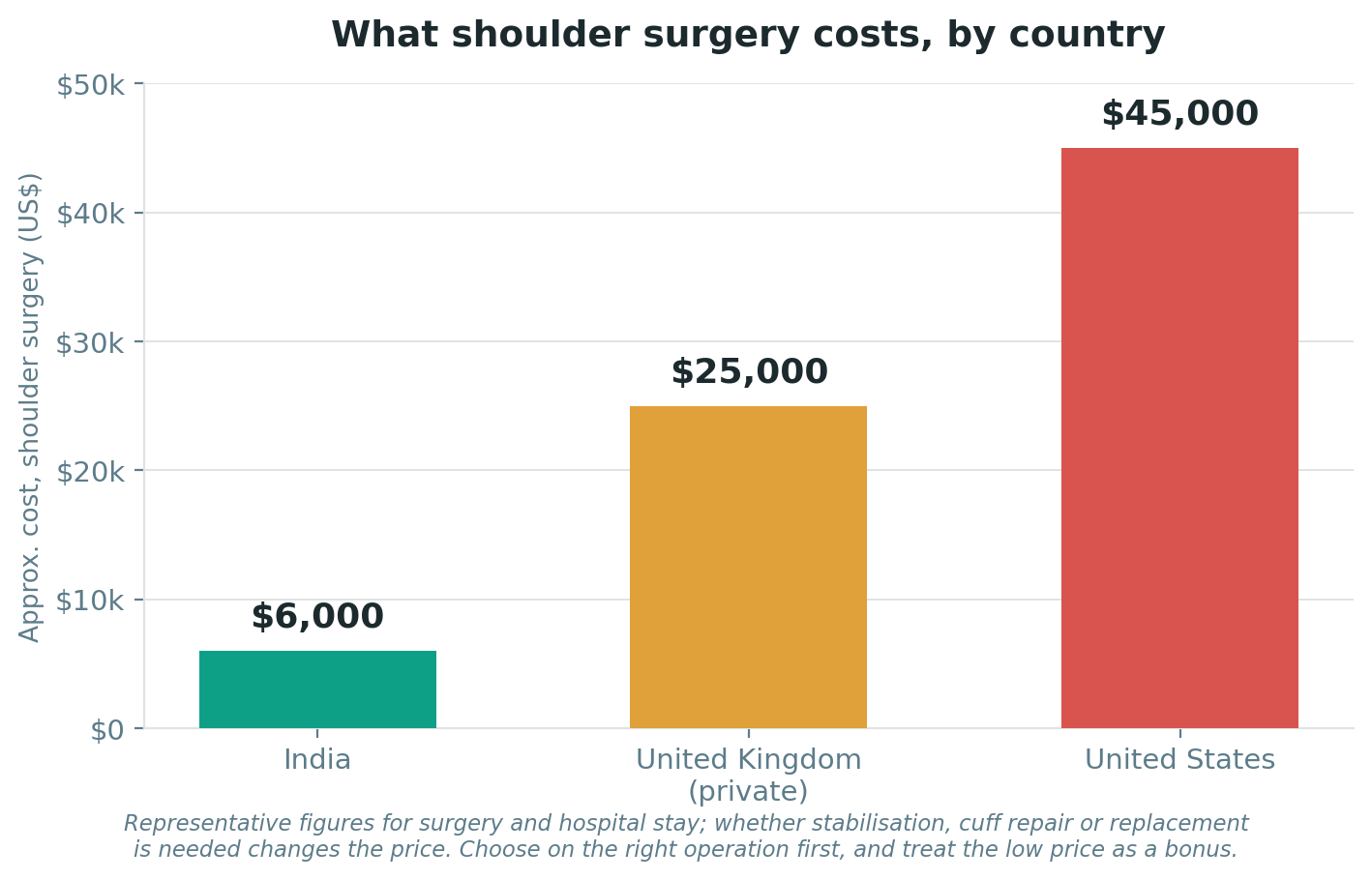
India's affordability is genuine — but for the shoulder, timing and the right operation matter even more.
In 24 years of arranging these journeys, I have found that the shoulder patients who do best are the ones who seek assessment promptly after an injury, rather than waiting to see if it settles on its own. Ask for a written, itemised quote covering surgery, hospital stay, and a physiotherapy plan, and clarify early what rehabilitation will look like once you are back in Zambia.
What a Zambian patient should weigh in particular
Beyond the surgical decision itself, several practical matters deserve attention. First, payment: NHIMA funds care at accredited facilities inside Zambia, not treatment abroad, so this comes from your own resources — another reason to seek a prompt local assessment first, since acting early may avoid the need for more complex, more costly surgery later. Second, if a shoulder injury has already been treated by a traditional healer or an untrained hand without full resolution, be honest about this with any surgeon you see, since it directly affects what is now technically possible and safe. Third, aftercare: arrange with a Zambian physiotherapist to continue your rehabilitation programme, and insist the Indian team provides a complete written operative report and rehabilitation plan before you leave.
Fourth, be realistic with your surgical team about the physical demands of your work, whether that is farming, mining, construction, or another physically demanding occupation. This shapes not only which operation is recommended but also how long a safe return to full duties is likely to take, and planning around a realistic timeline protects both your recovery and your livelihood.
The practical journey from Zambia
India requires a yellow fever vaccination certificate from travellers arriving from Zambia, valid only from ten days after the injection. Your medical visa is issued by the High Commission of India on Pandit Nehru Road in Lusaka against the hospital's invitation letter. There is no direct flight from Zambia to India; you will connect through Addis Ababa on Ethiopian Airlines, or through Dubai, Doha or Nairobi. Send your actual X-rays, MRI or CT images, not only written reports, for remote review before you travel, since the precise condition of your joint and any bone loss is what determines which operation is genuinely appropriate.
Signals that need urgent, not routine, attention
1. A shoulder still visibly out of joint, or clearly deformed, more than a few hours after an injury.
2. Numbness, weakness, or loss of pulse in the arm following a shoulder injury — this needs same-day medical attention.
3. Any previous attempt to treat a dislocation outside a hospital that did not fully resolve the problem.
4. A hospital that cannot explain how much more complex your surgery has become due to the delay in your presentation.
Straight answers for Zambian Patients about Shoulder Surgery in India
I dislocated my shoulder weeks ago and it's still not right. Is it too late to fix it?
No, but the surgery needed now is likely more complex than if it had been treated promptly. Seek an orthopaedic assessment as soon as possible — the longer the delay from this point, the more the treatment options narrow.
I'm young and just had my first shoulder dislocation. Do I really need surgery?
Not automatically, but the risk of it happening again without surgery is genuinely high in younger patients, and this is worth a specific conversation with your surgeon about your age, activity level, and the findings on your imaging.
What's the difference between a standard shoulder replacement and a reverse one?
A standard (anatomic) replacement mimics the normal ball-and-socket shoulder and requires a functioning rotator cuff to work well. A reverse replacement flips this arrangement and relies on the deltoid muscle instead, which makes it the better option when the rotator cuff is too damaged to function, common in older patients with advanced arthritis.
A traditional healer treated my shoulder after an injury. Should I mention this to a surgeon?
Yes, always. It does not need to be an uncomfortable conversation, and being honest about it helps the surgical team understand exactly what has happened to the joint and plan the safest, most effective treatment for you now.
How soon after surgery can I go back to physical work?
This varies considerably by operation and by the physical demands of your job, ranging from a few weeks for straightforward cases to several months for reconstructive surgery or joint replacement. Ask your surgical team for a realistic timeline specific to your operation and your work, rather than relying on a general estimate.
Sources
- 🌐 Medical visa, Lusaka — High Commission of India, requirements & process: hcizambia.gov.in/page/medical-visa
- 🌐 Hospital accreditation (India) — Verify a hospital's NABH accreditation: nabh.co
- 🌐 National Health Insurance (Zambia) — NHIMA cover, treatment abroad is not covered: nhima.co.zm
- 🌐 Ministry of Health Zambia — National health services & guidance: moh.gov.zm
- 🌐 National Medical Commission (verify a surgeon) — Confirm a surgeon's registration in India: nmc.org.in
- 🌐 WHO yellow fever — Vaccination requirements before travel: who.int/health-topics/yellow-fever
A Closing Word
Of everything I help patients with, the shoulder is where I most wish people had come to me sooner. If you send me your scans and a note on how and when your injury happened, and what treatment, if any, has already been tried, I will help you understand honestly how urgent your situation is, whether age or delay should change the plan, and which centres in India have the specific experience — in stabilisation, complex reconstruction, or replacement — to treat you well.
Frequently Asked Questions by Zambian Patients about Shoulder Surgery in India
Is every shoulder dislocation treated with surgery?
No. A first dislocation that is promptly reduced may be managed with a sling and physiotherapy, although young or highly active patients may need discussion about early stabilisation surgery.
Why is early treatment important?
A shoulder left out of joint for weeks or months can develop bone loss, scarring and shortening of surrounding tissues, making treatment substantially more complex.
What is the Latarjet procedure?
Latarjet is a bone-block stabilisation procedure that may be considered when repeated or chronic dislocations have caused significant bone loss around the shoulder socket.
Does every rotator cuff tear require surgery?
No. Smaller or partial tears may respond to physiotherapy and activity modification, while significant weakness or tears in younger active patients may favour surgical repair.
What is a reverse shoulder replacement?
It is a specialised replacement that reverses the normal ball-and-socket arrangement and allows the deltoid muscle to compensate for a severely damaged rotator cuff.
How much does shoulder surgery cost in India?
The guide gives a representative cost of approximately US$6,000, compared with US$25,000 in the UK and US$45,000 in the US.
What should I ask a shoulder surgeon?
Ask about their annual experience with arthroscopic stabilisation, Latarjet procedures or reverse shoulder replacement, depending on your diagnosis.
Why is imaging important before shoulder surgery?
X-rays, MRI or CT scans help assess the condition of the joint, rotator cuff and bone loss, which can determine whether a soft-tissue repair or more complex reconstruction is required.
How important is physiotherapy after shoulder surgery?
Very important. The guide stresses that shoulder outcomes depend heavily on structured rehabilitation over several months, not only on the operation itself.
What should I send before travelling to India?
Send the patient's actual X-rays, MRI or CT images, together with details of when the injury occurred and any treatment already attempted.
Page Summary
This five-page Zambia-to-India medical travel guide explains shoulder surgery and the importance of timely assessment, covering dislocations, instability, rotator cuff tears and shoulder replacement. The page 2 timeline shows how a dislocation can progress from simple closed reduction when treated within days to open reduction or complex reconstruction when left untreated for months or years. Its age-related chart gives repeat-dislocation risks of 72%, 56% and 27% across the cited age groups. The page 3 treatment table distinguishes stabilisation, Latarjet procedures, rotator cuff repair and reverse shoulder replacement, while the page 4 cost chart gives representative costs of US$6,000 in India, US$25,000 in the UK and US$45,000 in the US.
Citation Block
| Topic | Information |
|---|---|
| Topic | Shoulder Surgery in India for Zambian Patients |
| Treatment | Shoulder Surgery |
| Patients | Zambian Orthopaedic Patients |
| Specialist | Shoulder & Orthopaedic Surgeon |
| Main Conditions | Dislocation, instability, rotator cuff tears, arthritis |
| Key Priority | Prompt assessment after injury |
| First Dislocation | Early stabilisation discussion in young/high-risk patients |
| Repeat Risk | 72% ages 12–22; 56% ages 23–29; 27% ages 30+ |
| Complex Cases | Latarjet, bone grafting, tendon transfer or replacement |
| Rotator Cuff | Arthroscopic repair when indicated |
| Replacement | Reverse shoulder replacement for selected cuff-deficient arthritis |
| Surgeon Check | Procedure-specific volume and experience |
| Hospital Check | NABH, ideally JCI |
| India Cost | Approximately US$6,000 |
| UK Cost | Approximately US$25,000 |
| US Cost | Approximately US$45,000 |
| Pre-Travel Records | X-rays, MRI or CT images |
| Follow-Up | Physiotherapy and rehabilitation in Zambia |
| Key Warning | Persistent dislocation, numbness, weakness or loss of pulse |
| Patient Pathway | Assessment → imaging → treatment selection → surgery if required → rehabilitation |
| Decision Principle | Timing and the exact shoulder problem are more important than price alone |


Our Mission Statement
Our mission is to place patients at the centre of every healthcare decision by providing trustworthy, evidence-based, and unbiased medical information. We believe that informed patients make better decisions. Backed by personalised guidance from our experienced advisory team, we help patients understand their treatment options, compare them objectively, and confidently choose the path that best suits their medical needs and personal circumstances.
Patient Testimonials from Zambia
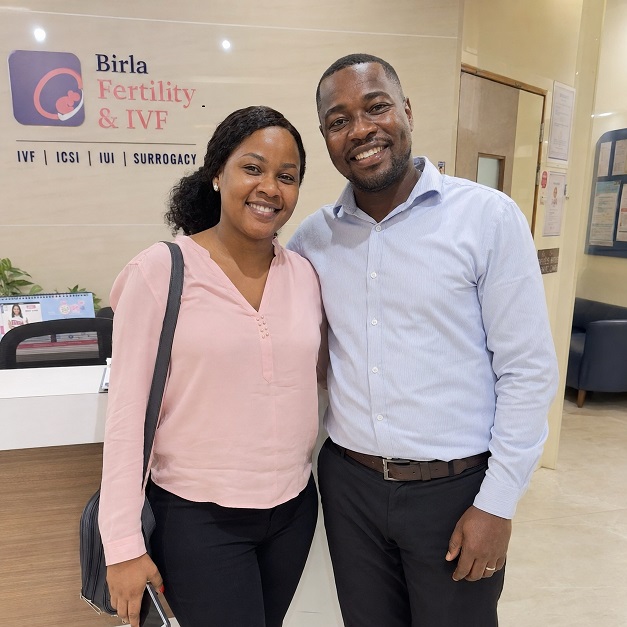
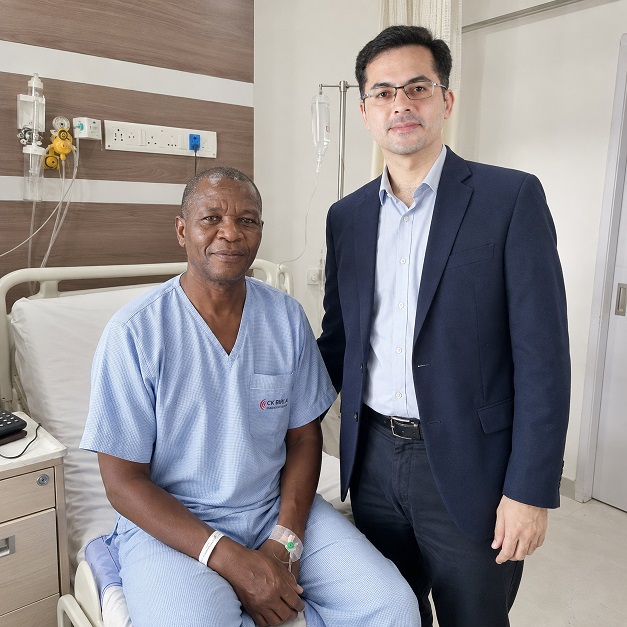

Ready to Take the First Step?
Share your Medical Reports with our Healthcare Managers Today and Get a FREE CONSULTATION, a Personalized Treatment Plan, and Complete Support from Arrival to Recovery.
Get Your Free ConsultationAreas We Serve
This resource has been thoughtfully prepared for patients from Zambia who are considering medical treatment in India. We also welcome patients from the wider region in the countries mentioned below-
We assist patients from:
- Zambia
- Angola
- Malawi
- Zimbabwe
- Botswana
- Namibia
- South Africa
- Eswatini
- Lesotho
- Gabon
- Chad
- Equatorial Guinea
- São Tomé and Príncipe
- Republic of the Congo
- Democratic Republic of the Congo
Many of the insights, treatment pathways, hospital recommendations, travel guidance, and patient support services described here are equally relevant and may be used as a reference when planning treatment in India.
From Zambia to India: Your Complete Patient Support Guide
- Best Weight-Loss (Bariatric) Surgeons & Hospitals in India for Zambian Patients
- Best Brain-Tumour Surgeons & Hospitals in India for Zambian Patients
- Best Cancer Doctors & Hospitals in India for Zambian Patients
- Best Cardiac Surgeons & Hospitals in India for Zambian Patients
- Best Cosmetic Surgeons & Facilities in India for Zambian Patients
- Best CyberKnife Treatment Teams & Centres in India for Zambian Patients
- Best Dentists & Dental Clinics in India for Zambian Patients
- Best Heart Valve Replacement Surgeons & Hospitals in India for Zambian Patients
- Best Hip Surgeons & Hospitals in India for Zambian Patients
- Best Knee Surgeons & Hospitals in India for Zambian Patients
- Best Neurosurgeons & Hospitals in India for Zambian Patients
- Best Paediatric Cardiac Surgeons & Hospitals in India for Zambian Patients
- Best Paediatric Neurosurgeons & Hospitals in India for Zambian Patients
- Best Prostate Surgeons & Hospitals in India for Zambian Patients
- Best Scoliosis Surgeons & Hospitals in India for Zambian Patients
- Best Spine Surgeons & Hospitals in India for Zambian Patients
- Best Bone Marrow Transplant Teams & Hospitals in India for Zambian Patients
- Best Kidney Transplant Surgeons & Hospitals in India for Zambian Patients