

Selecting the Best Hip Surgeons & Hospitals in India — a Zambian Patient’s Guide
The operation matters, but who performs it and where they perform it matter just as much — and for many Zambian hip patients, one particular fact should shape the whole choice. This guide sets out the criteria to weigh.
A worn or damaged hip steals more than comfort; it steals the ordinary freedoms of walking, working and sleeping without pain. A hip replacement can give all of that back — when it is done well, by the right surgeon, in the right hospital. When it is not, the price is measured in far more than money. For 24 years I have helped African patients make this choice, and with the hip there is an added reason to choose carefully, because many Zambian patients come to it younger than elsewhere, and for a particular cause. So this guide is not about the cheapest hip. It is about choosing the right surgeon and the right hospital — and what a Zambian patient, in particular, should weigh.
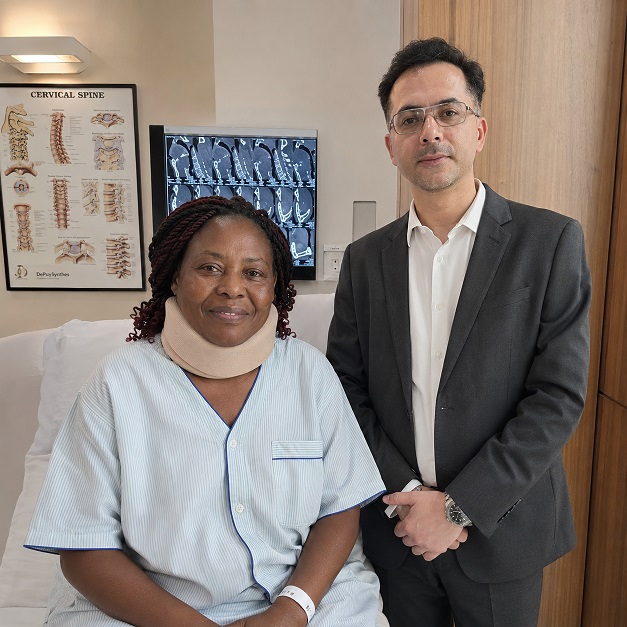
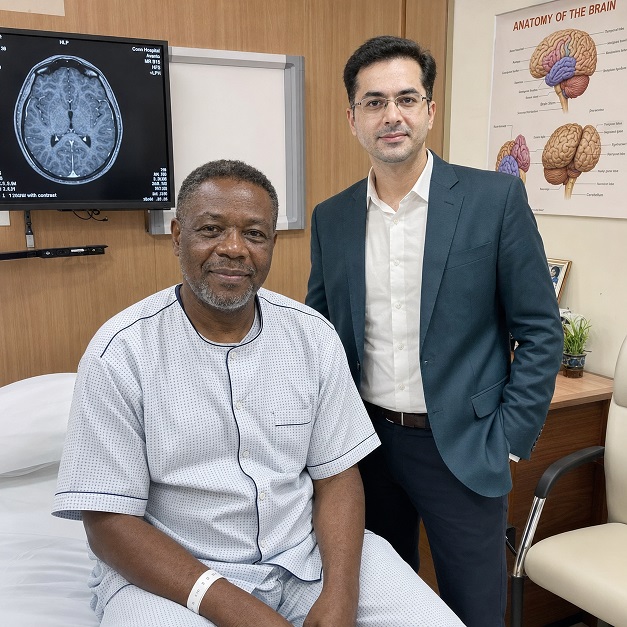
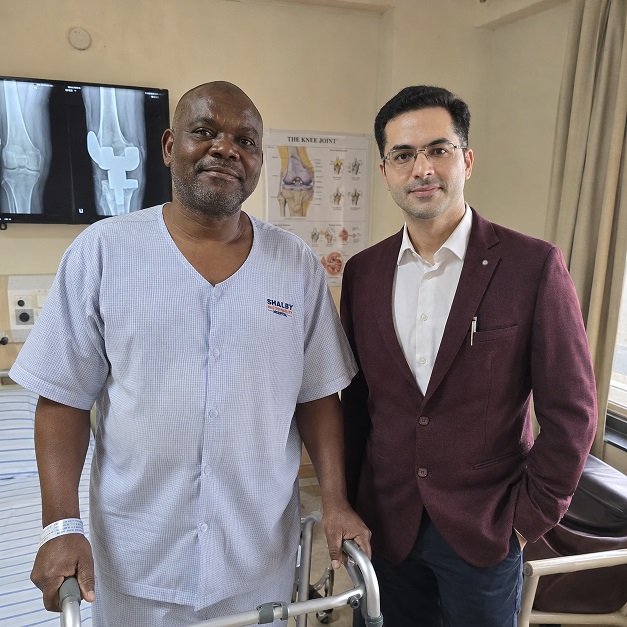
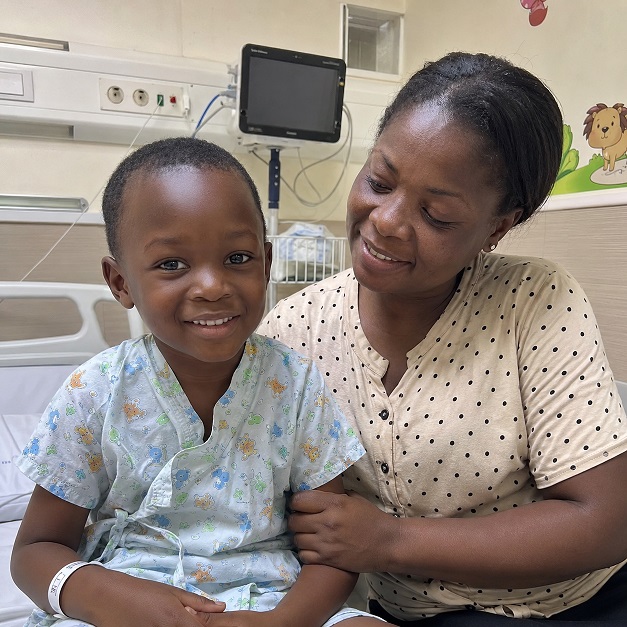
Healing Journeys of Zambian Patients


Key Takeaways
- The guide explains that choosing the right hip surgeon and hospital is as important as choosing the operation itself. For Zambian patients, the decision deserves particular care because some people requiring hip replacement are relatively young and may have conditions such as avascular necrosis.
- Before travelling, patients are encouraged to consider whether appropriate treatment is available in Zambia. The guide specifically identifies complex hip conditions, revision surgery, younger patients requiring careful implant selection and long local waiting periods as situations where travelling to a high-volume Indian centre may deserve consideration.
- One of the most important Zambia-specific issues discussed is avascular necrosis (AVN). The guide describes AVN as loss of bone caused by disruption of the blood supply to the ball of the hip.
- The document also highlights the relationship between sickle cell disease and AVN. This can mean that some patients requiring hip replacement are in their twenties, thirties or forties rather than being elderly.
- A younger patient's age affects treatment planning because the patient may outlive the first replacement and eventually require another procedure. Implant durability and accurate placement therefore receive particular emphasis.
- The guide treats surgeon selection and hospital selection as two separate decisions. A skilled surgeon still needs appropriate hospital infrastructure, while a strong hospital does not compensate for an inexperienced surgeon.
Quick Facts
- Treatment
- Hip Replacement / Joint Replacement Surgery
- Country
- India
- Intended Audience
- Zambian Patients
- Primary Condition
- Damaged or Diseased Hip Joint
- Important Zambia-Specific Condition
- Avascular Necrosis (AVN)
- Associated Condition Highlighted
- Sickle Cell Disease
- Other Health Condition Discussed
- HIV
- Patient Group Highlighted
- Younger Adults Requiring Hip Replacement
- Main Procedure
- Hip Replacement
- Complex Procedure Mentioned
- Revision Hip Replacement
- Preferred Surgeon Type
- Joint-Replacement / Arthroplasty Specialist
- Basic Medical Qualification
- MBBS
- Post-Return Support
- Teleconsultation + Written Implant and Surgical Records
- Medical Visa
- High Commission of India in Lusaka
In Brief
Zambian patients choosing hip replacement in India should look for a fellowship-trained joint-replacement surgeon with substantial hip-replacement experience and a hospital with strong joint-replacement infrastructure. The guide gives particular attention to younger patients with avascular necrosis and sickle cell disease because implant durability, surgical planning, blood support and long-term follow-up may require additional consideration. Hospital accreditation, infection control, haematology and blood-bank support where required, physiotherapy and a clear rehabilitation plan for Zambia are important parts of the selection process.
First, should you travel at all?
Begin honestly at home. Zambia has orthopaedic services — the University Teaching Hospital in Lusaka, the Zambian- Italian Orthopaedic Hospital in Lusaka with its long-standing joint work, Levy Mwanawasa University Teaching Hospital, Ndola Teaching Hospital, and private options such as Medcross. For some patients, a hip replacement can be done well without leaving the country, and that should always be considered first. But complex hips, revision surgery where a previous replacement has failed, younger patients who need careful implant choice, and cases where the local wait is long are exactly where travelling to a high-volume centre earns its place. The decision to travel is itself the first selection you make — weigh it clearly.
Knowledge that should shape a Zambian’s choice: the young hip and sickle cell
Here is the fact that sets hip surgery apart for many Zambian patients. A very common reason for a damaged hip in this region is not the wear of old age but avascular necrosis — the death of bone in the ball of the hip when its blood supply is cut off — and one of its leading causes is sickle cell disease , which is common across the region. This means many patients needing a new hip are young — in their twenties, thirties and forties — rather than elderly. That single fact changes what you should look for. A young patient may outlive a first replacement and need another in time, so the durability of the implant and the skill of its placement matter enormously; and a patient with sickle cell needs a hospital equipped to manage the blood and the higher surgical risks that come with it. Choose, therefore, not just any good hip surgeon, but one who understands your hip.
Two decisions, not one
The single most useful idea in this guide is that you are making two separate choices, not one: the surgeon and the hospital . They are not the same thing, and both must be right. A brilliant surgeon operating in a hospital with poor infection control or no proper blood support is a risk; an excellent hospital where you are handed to an inexperienced surgeon is a risk too. The surgeon’s skill carries the most weight — but not all of it. Weigh them together, and refuse to compromise on either.
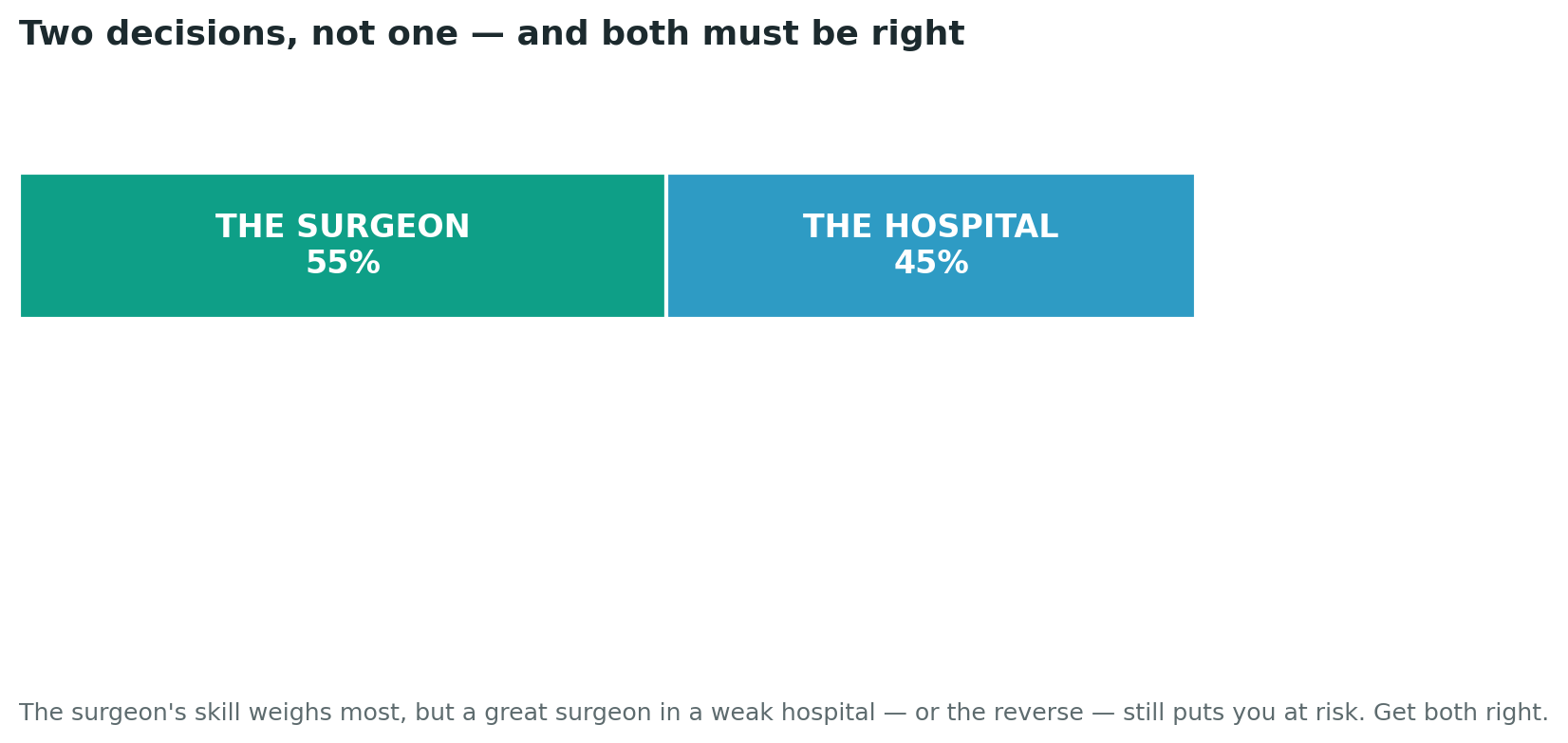
Both decisions matter, and they multiply rather than add. The surgeon’s skill weighs most, but the hospital around him decides whether that skill is safely delivered.
Part One: choosing the surgeon
1. Look for a joint-replacement specialist, not a general surgeon. Orthopaedics is broad, and the surgeon who sets fractures is not necessarily the one who should replace your hip. Seek a surgeon who has done a dedicated fellowship in arthroplasty or joint replacement, and confirm his Indian credentials.
2. Ask how many hip replacements he does a year — and favour high numbers. This is the best-evidenced predictor of a good result. Across large studies, high-volume hip surgeons have measurably lower rates of infection, dislocation, complications and the need for a second operation than low-volume ones. A surgeon performing well over a hundred hips a year is in a different league from one who does a handful. Ask directly, and expect a clear answer.
3. Ask about his experience with young patients, avascular necrosis and sickle cell. For the reasons above, this matters greatly in Zambia. A surgeon used to operating on young hips damaged by avascular necrosis — and on patients with sickle cell disease — will choose the implant and plan the surgery with your long life and your particular risks in mind. Ask plainly how often he treats hips like yours.
4. Ask about his outcomes. A confident, honest surgeon knows his own infection rate, dislocation rate and revision rate and will share them. Vague reassurance is not the same as a number. You are entitled to ask, “Of your last hundred hips, how many became infected, dislocated, or needed further surgery?”
5. Judge his honesty about implants. With a hip — especially a young one — the choice of implant and bearing surface affects how long it lasts. A good surgeon explains the options plainly and recommends what suits your age and activity, rather than steering you to the most expensive or the most convenient by default.
6. Confirm he will operate on you personally. At some large centres the surgeon you consult is not the one who holds the knife. Ask, and get it in writing, that the named surgeon you chose will perform your operation, not delegate it to a trainee.
7. Test his communication before you travel. The best surgeons will review your X-rays and history remotely, answer your questions clearly, and discuss the risks as readily as the benefits. How he communicates from a distance tells you much about the care you will receive up close.
How to read an Indian surgeon’s qualifications
| Stage | Qualification | What it tells you |
|---|---|---|
| Basic medical degree | MBBS | A qualified doctor — the starting point, not a specialist. |
| Orthopaedic specialist | MS (Orthopaedics) or DNB (Orthopaedics) | A trained orthopaedic surgeon — the essential specialist qualification. |
| Joint-replacement expertise | Fellowship in arthroplasty / joint replacement | Sub-specialist training focused on hip and knee replacement — what you want. |
You can confirm that a surgeon is properly registered on the National Medical Commission register of India (nmc.org.in). A genuine specialist will be glad to have you check.
Part Two: choosing the hospital
1. Insist on accreditation. The hospital should be accredited by India’s NABH , and ideally internationally by JCI . Accreditation is your assurance that theatres, anaesthesia, sterilisation and emergency care meet a proper standard. You can verify it directly, and you should.
2. Choose a high-volume joint-replacement centre. Just as with surgeons, hospitals that perform many joint replacements have lower complication and infection rates. Look for a dedicated joint-replacement unit rather than a general ward, with modern operating theatres designed to keep infection out.
3. Confirm strong haematology and blood-bank support. This is especially important for Zambian patients. A patient with sickle cell disease, or one who may need transfusion, needs a hospital with a reliable blood bank and haematologists who can manage the perioperative care that sickle cell demands. Ask directly whether the hospital is set up for this — a good joint centre will be.
4. Ask about infection control. A deep infection in a new hip is the complication you most want to avoid, because it can mean removing the implant and starting again. Ask what the hospital’s surgical-infection rate is and what it does to keep it low. Serious hospitals track this and will tell you.
5. Check the physiotherapy and rehabilitation. A hip replacement only half-succeeds in theatre; the rest is earned in rehabilitation. Confirm the hospital has strong in-house physiotherapy that begins the day after surgery, and that it will give you a clear programme to continue at home in Zambia.
6. Weigh the international-patient support and transparent pricing. A good centre helps with the invitation letter for your visa, arranges airport pick-up and accommodation, and gives you a coordinator. English is Zambia’s official language and India’s working language of care, so communication should be easy. Insist, too, on a written, itemised, fixed quote that states what is included and what happens to the cost if there is a complication.
7. Ask how it will support you after you fly home. The relationship should not end at the ward door. A good hospital offers teleconsultation for follow-up questions, provides a full written record of the implant fitted and the operation performed, and is willing to liaise with your doctor in Zambia if a query arises later.
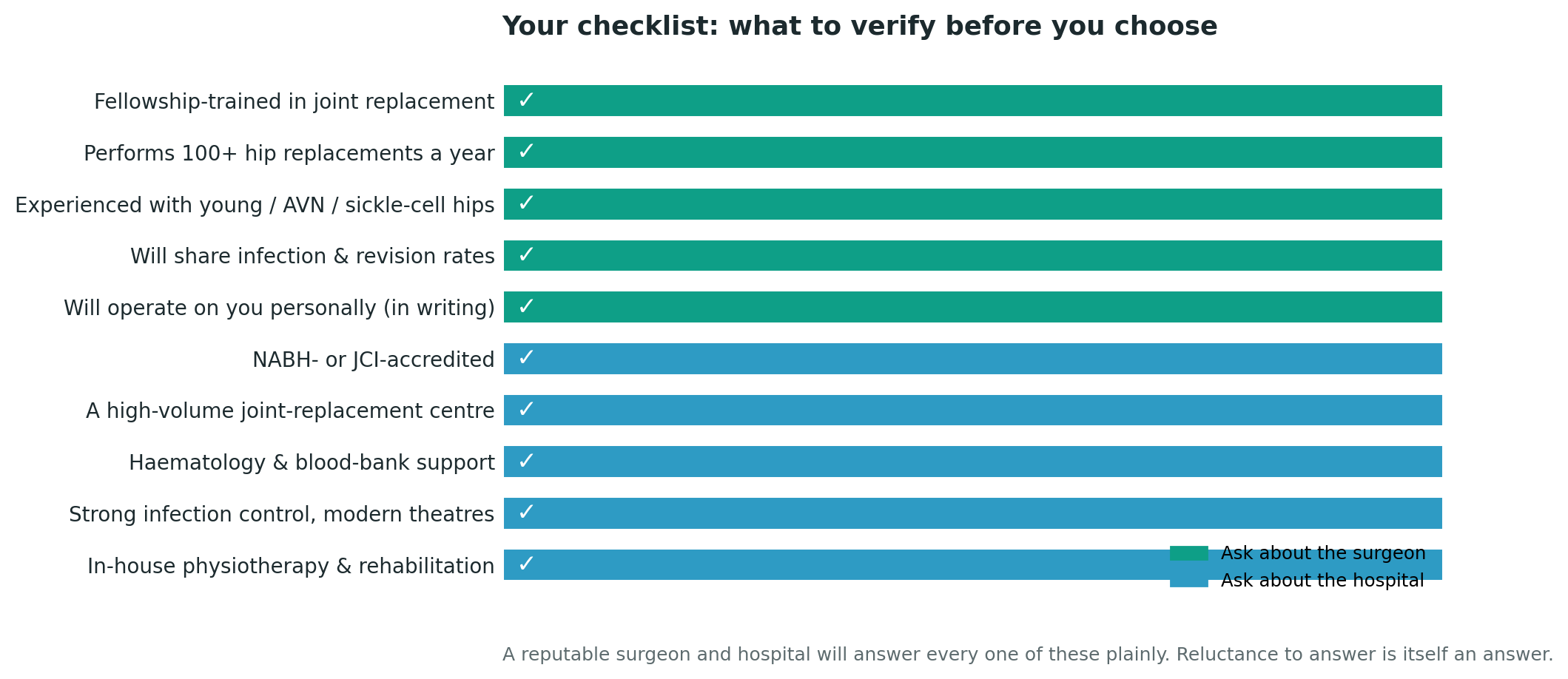
Keep this checklist beside you. A reputable surgeon and hospital will answer every point plainly — and reluctance to answer is itself an answer.
Cost and value: how to weigh the money honestly
A hip replacement in a good Indian hospital costs a fraction of Western private pricing, which is the real reason so many patients travel. At roughly ZK19 to the US dollar in mid-2026, the saving is large in kwacha; confirm the rate before travel, as it moves. But value is not the same as the lowest price. A slightly dearer quote from a high-volume surgeon at an accredited hospital is far better value than a cheaper one that risks a complication — because a single infection or revision can cost more than the whole operation, in money and in suffering, and for a young patient a well-chosen first hip is worth a great deal.
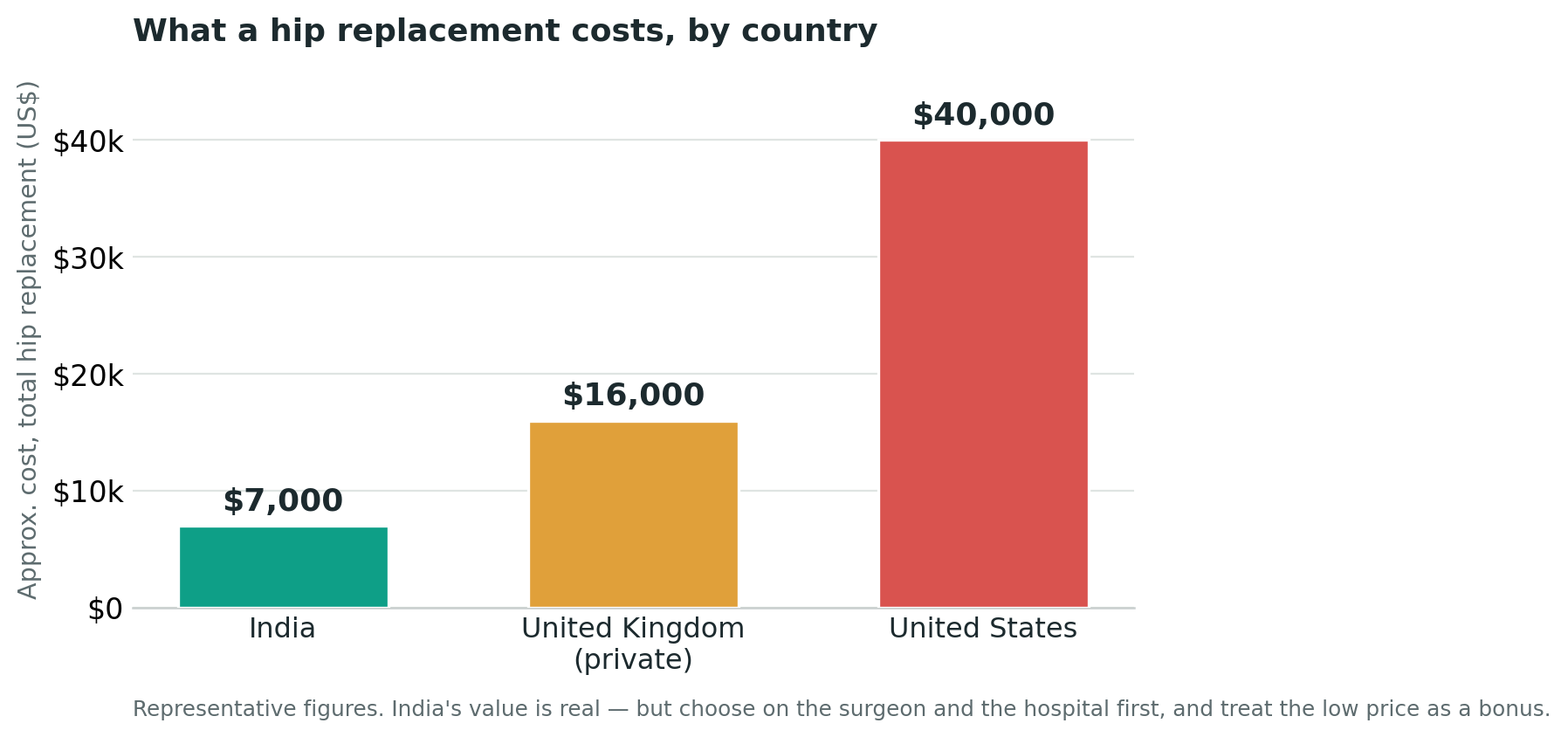
Representative figures. India’s affordability is genuine — but let it be the bonus that follows a good choice of surgeon and hospital, never the reason for it.
In 24 years of arranging these journeys, I have learned that the disputes that arise almost never concern the headline price — they concern what it left out. Insist on the full, itemised picture before you commit a single kwacha, and be sceptical of any figure that looks too clean to be complete.
What a Zambian patient should weigh in particular
Beyond the surgeon and the hospital, several things matter specifically for a patient travelling from Zambia. First, how you will pay : the National Health Insurance scheme funds care at accredited facilities inside Zambia, not elective surgery abroad, so this will come from your own resources — which makes value and transparency all the more important. Second, your own health picture : if you live with HIV, or carry the sickle cell trait or disease, disclose it fully and early. Well- controlled HIV is not a barrier to hip surgery, and sickle cell need not be either — but your team must know in order to plan the blood support, the anaesthesia and the timing safely. Third, and most overlooked, your aftercare at home : arrange a Zambian orthopaedic doctor and a physiotherapist to take over your recovery before you travel, and insist the Indian team writes a clear handover and rehabilitation plan. A hip looked after well after you land back in Lusaka is a hip that lasts.
The practical journey from Zambia
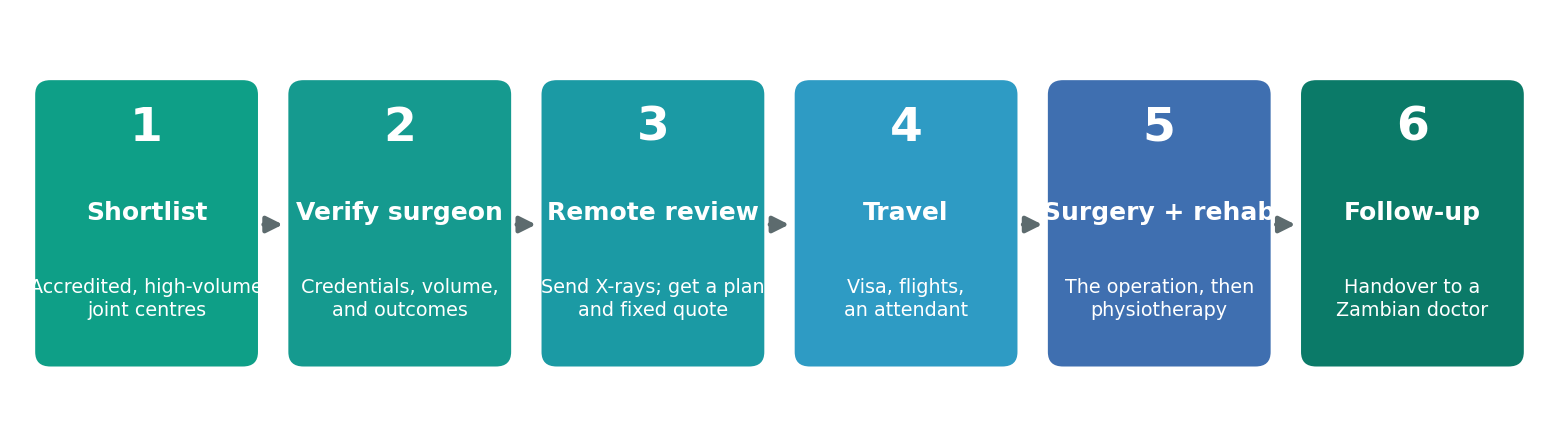
India requires a yellow fever vaccination certificate from travellers arriving from Zambia, valid only ten days after the injection. Your medical visa is issued by the High Commission of India on Pandit Nehru Road in Lusaka against the hospital’s invitation letter; apply for a medical-attendant visa in the same batch, as you will want someone with you after surgery. There is no direct flight — you will connect through Addis Ababa on Ethiopian Airlines, or through Dubai, Doha or Nairobi. Send your actual X-ray and scan files, not only the reports, for review before you travel, book a changeable return ticket to allow for recovery, and settle the hospital by traceable bank transfer rather than cash.
Four signals that should make you pause
- Unwilling to share volume or outcomes — the surgeon’s hip-replacement volume, infection rate or revision rate.
- No evident AVN or sickle cell experience — for a young or sickle cell patient, no proper blood and haematology support.
- No current NABH or JCI accreditation — or no dedicated joint-replacement unit.
- A single low price with no breakdown — no clarity on complications, and no aftercare plan for Zambia.
Straight Answers for Zambians about Hip Surgeons & Hospitals in India
I’m young and have been told I need a hip replacement. Does that change things?
Yes. A younger hip, often damaged by avascular necrosis, needs a surgeon experienced with such cases who will choose a durable implant with your long life in mind, since you may need a revision in time. Ask specifically about the surgeon’s experience with young patients and about implant choice.
I have sickle cell disease. Can I still have a hip replacement?
Yes, in appropriately selected patients it gives substantial relief. But sickle cell raises the surgical and medical risks, so choose a hospital with strong haematology and blood-bank support that can manage the perioperative care carefully. Disclose your condition fully and early.
What matters most — the surgeon or the hospital?
Both, and they work together. The surgeon’s skill and experience carry the most weight, but even the finest surgeon needs an accredited, high-volume hospital with good infection control, blood support and rehabilitation around him. Judge them as a pair.
Should I just choose the cheapest quote?
No. The cheapest hip can become the most expensive if it goes wrong, because a complication or revision costs far more than the original operation. Choose on the surgeon and hospital first; let the favourable price be the bonus that follows a sound choice.
Sources & Useful Links
- 🌐 Verify a surgeon (India) — National Medical Commission register of doctors: nmc.org.in
- 🌐 Hospital accreditation (India) — verify a hospital’s NABH accreditation: nabh.co
- 🌐 Medical visa (India), Lusaka — High Commission of India, requirements & process: hcizambia.gov.in/page/medical-visa
- 🌐 National Health Insurance (Zambia) — NHIMA cover (elective surgery abroad is not covered): nhima.co.zm
- 🌐 Ministry of Health, Zambia — referrals and national orthopaedic services: moh.gov.zm
- 🌐 Yellow fever & travel health — WHO vaccination guidance: who.int/health-topics/yellow-fever
A closing word
If you send me your X-rays and a note on your history — including your age and whether sickle cell is part of your story — I will help you apply these criteria to real names: whether your case is best treated in Zambia or in India, which surgeons are genuine high-volume specialists experienced with hips like yours, which hospitals are properly accredited and equipped, and what a fair, complete quote looks like. Choosing a hip surgeon and hospital is not about the lowest number; it is about matching a skilled, honest surgeon and a safe, well-equipped hospital to your particular hip — and planning the care that follows you home. That, for all these years, has been my work.
Frequently Asked Questions by Zambians about Hip Surgeons & Hospitals in India
How should Zambian patients choose a hip replacement surgeon in India?
Patients should look for an orthopaedic surgeon with focused arthroplasty or joint-replacement training, substantial hip-replacement volume and transparent infection, dislocation and revision outcomes.
Why is avascular necrosis important for Zambian hip patients?
The guide highlights AVN because it can damage the hip in comparatively young adults. Younger patients require careful consideration of implant durability and the possibility of revision surgery later in life.
Why does sickle cell disease matter when planning hip replacement?
Sickle cell disease is highlighted as an important cause of AVN and can create additional blood and perioperative considerations. The guide therefore recommends choosing a hospital with appropriate haematology and blood-bank support.
What qualifications should an Indian hip replacement surgeon have?
The guide identifies MS Orthopaedics or DNB Orthopaedics as specialist qualifications and recommends additional fellowship training in arthroplasty or joint replacement.
Why should patients ask about the surgeon's annual hip-replacement volume?
The guide treats procedure volume as an important indicator of experience and recommends favouring surgeons who regularly perform substantial numbers of hip replacements.
How should implants be selected for younger Zambian patients?
The surgeon should consider the patient's age, activity and long-term needs when recommending the implant and bearing surface. The guide does not identify one implant as universally best.
What hospital facilities are important for Zambian hip replacement patients?
Patients should consider accreditation, a high-volume joint-replacement programme, infection control and physiotherapy. Sickle cell patients should additionally check for haematology and blood-bank support.
What medical records should patients send before travelling?
The guide recommends sending the actual X-rays and scan files, not merely the written reports, together with relevant medical history.
What follow-up should be arranged in Zambia?
Patients should arrange an orthopaedic doctor and physiotherapist before travelling and obtain a written surgical, implant and rehabilitation handover from the Indian team.
What warning signs should patients watch for when selecting treatment?
Warning signs include unwillingness to disclose surgeon volume or outcomes, inadequate experience or hospital support for AVN/sickle cell cases, poor hospital credentials and a low headline price without a complete itemised quotation or Zambia aftercare plan.
Page Summary
This guide explains how Zambian patients should choose a hip surgeon and hospital in India, with the central message that both decisions matter. Surgeon expertise must be supported by an appropriately equipped hospital, and hospital reputation alone cannot replace the experience of the individual surgeon. A major Zambia-specific focus is avascular necrosis and sickle cell disease. Because AVN may affect comparatively young patients, some people undergoing hip replacement may be in their twenties, thirties or forties. This makes implant durability, accurate positioning and the possibility of future revision particularly important.
Citation Block
| Topic | Information |
|---|---|
| Topic Information | Details |
| Procedure | Hip Replacement / Joint Replacement Surgery |
| Country | India |
| Intended Audience | Zambian Patients |
| Primary Condition | Damaged or Diseased Hip Joint |
| Conditions Highlighted | Avascular Necrosis, Sickle Cell-Associated Hip Disease and Complex/Failed Hip Replacement |
| Procedures | Primary Hip Replacement and Revision Hip Replacement |
| Surgeon Qualification | MS Orthopaedics/DNB Orthopaedics + Fellowship in Arthroplasty/Joint Replacement |
| Surgeon Volume Highlighted | Well Over 100 Hip Replacements Annually |
| Important Outcomes | Infection, Dislocation and Revision Rates |
| Pre-Travel Requirement | Actual X-Rays/Scans + Relevant Medical History |
| Typical Stay | Not Specifically Stated in the Guide |
| Hospital Stay | Not Specifically Stated in the Guide |
| Recovery | No Single Recovery Period Specified; Continued Physiotherapy and Rehabilitation Required |


Our Mission Statement
Our mission is to place patients at the centre of every healthcare decision by providing trustworthy, evidence-based, and unbiased medical information. We believe that informed patients make better decisions. Backed by personalised guidance from our experienced advisory team, we help patients understand their treatment options, compare them objectively, and confidently choose the path that best suits their medical needs and personal circumstances.
Patient Testimonials from Zambia

Ready to Take the First Step?
Share your Medical Reports with our Healthcare Managers Today and Get a FREE CONSULTATION, a Personalized Treatment Plan, and Complete Support from Arrival to Recovery.
Get Your Free ConsultationAreas We Serve
This resource has been thoughtfully prepared for patients from Zambia who are considering medical treatment in India. We also welcome patients from the wider region in the countries mentioned below-
We assist patients from:
- Zambia
- Angola
- Malawi
- Zimbabwe
- Botswana
- Namibia
- South Africa
- Eswatini
- Lesotho
- Gabon
- Chad
- Equatorial Guinea
- São Tomé and Príncipe
- Republic of the Congo
- Democratic Republic of the Congo
Many of the insights, treatment pathways, hospital recommendations, travel guidance, and patient support services described here are equally relevant and may be used as a reference when planning treatment in India.
From Zambia to India: Your Complete Patient Support Guide
- Best Weight-Loss (Bariatric) Surgeons & Hospitals in India for Zambian Patients
- Best Brain-Tumour Surgeons & Hospitals in India for Zambian Patients
- Best Cancer Doctors & Hospitals in India for Zambian Patients
- Best Cardiac Surgeons & Hospitals in India for Zambian Patients
- Best Cosmetic Surgeons & Facilities in India for Zambian Patients
- Best CyberKnife Treatment Teams & Centres in India for Zambian Patients
- Best Dentists & Dental Clinics in India for Zambian Patients
- Best Heart Valve Replacement Surgeons & Hospitals in India for Zambian Patients
- Best Hip Surgeons & Hospitals in India for Zambian Patients
- Best Knee Surgeons & Hospitals in India for Zambian Patients
- Best Neurosurgeons & Hospitals in India for Zambian Patients
- Best Paediatric Cardiac Surgeons & Hospitals in India for Zambian Patients
- Best Paediatric Neurosurgeons & Hospitals in India for Zambian Patients
- Best Prostate Surgeons & Hospitals in India for Zambian Patients
- Best Scoliosis Surgeons & Hospitals in India for Zambian Patients
- Best Spine Surgeons & Hospitals in India for Zambian Patients
- Best Bone Marrow Transplant Teams & Hospitals in India for Zambian Patients
- Best Kidney Transplant Surgeons & Hospitals in India for Zambian Patients