

Selecting the Best Kidney Transplant Surgeons & Hospitals in India — a Zambian Patient’s Guide
Before you can choose a surgeon or a hospital, one question must be settled — and it is a legal question, not a medical one: is your donor eligible under Indian law at all?
Kidney failure asks a great deal of a family — years of dialysis, a life restructured around machines and schedules, and, for many, the hope of a transplant that gives it all back. For 24 years I have guided African families through this particular journey, and the lesson I share first, before any talk of surgeons or hospitals, is this: in India, a foreign patient cannot simply arrive with any willing donor. The law is specific about who may donate, and getting this wrong — discovered only after you have travelled — is the single most devastating and preventable mistake a family can make in this entire process.
Healing Journeys of Zambian Patients






Key Takeaways
- Before choosing a kidney transplant surgeon or hospital in India, Zambian patients must first confirm that their proposed donor is legally eligible. For foreign patients, Indian law generally requires a living donor to be a near relative such as a spouse, parent, child, sibling or grandparent/grandchild.
- The donor relationship needs proper documentation and verification. Birth certificates, marriage certificates and family records may be required, while embassy verification, Authorisation Committee review and increasingly DNA testing may be part of the process.
- Zambian patients should choose a transplant team with dedicated kidney transplant experience rather than relying only on a general urologist. Patients should ask about annual transplant volume, graft and patient survival rates, the named surgeon and nephrologist responsible for care, and the donor evaluation process.
- The hospital should be a properly registered transplant centre with strong nephrology, dialysis and blood-bank support. Accreditation such as NABH, and ideally JCI, should also be checked along with infection-control standards and the hospital's ability to manage international transplant patients.
- Kidney transplantation requires lifelong care after surgery. Immunosuppressive medicines and regular blood tests continue for as long as the transplanted kidney functions, while the donor should also receive periodic monitoring of their remaining kidney.
- The total financial planning should include more than the transplant operation. Zambian families should consider the recipient's and donor's evaluation, hospital stay, medicines and long-term immunosuppressive treatment, while obtaining a written and itemised quotation before travelling.
- Travel planning should begin early because both the patient and donor require medical visas, and the transplant process also involves an embassy no-objection certificate confirming the donor relationship. Zambian travellers need a yellow-fever certificate and generally connect to India through Addis Ababa, Dubai, Doha or Nairobi.
Quick Facts
- Treatment
- Kidney Transplantation
- Country
- India
- Patients
- Zambian Patients
- Main Route
- Living-Donor Kidney Transplant
- Donor Requirement
- Near Relative Under Indian Law
- Eligible Relationships
- Spouse, Parent, Child, Sibling, Grandparent or Grandchild
- Donor Verification
- Embassy, Authorisation Committee and Possible DNA Testing
- Surgeon Selection
- Fellowship-Trained Kidney Transplant Surgeon
- Team Experience
- Ask Annual Kidney Transplant Volume
- Outcome Data
- Ask for Graft and Patient Survival Rates
- Donor Safety
- Independent Medical and Psychological Evaluation
- Hospital Requirement
- Properly Registered Transplant Centre
- Hospital Support
- Nephrology, Dialysis and Blood Bank
- Accreditation
- NABH and Ideally JCI
In Brief
For Zambian patients considering kidney transplantation in India, donor eligibility is the first issue to settle because Indian law places specific restrictions on living donors for foreign patients. Once an eligible near-relative donor is confirmed, patients should evaluate the transplant team's experience, survival outcomes, donor safety procedures and hospital accreditation. They should also establish a lifelong medication and monitoring plan that can continue in Zambia after returning home.
First, should you travel at all?
Kidney transplant capacity within Zambia is very limited, and most patients with kidney failure rely on dialysis rather than transplantation as their ongoing treatment. For patients and families for whom a transplant is the right long-term answer, travelling abroad is, realistically, the main route, and India’s transplant programmes — well established, high in volume, and experienced with international patients — make it a leading destination. But before travel is even planned, one legal question must be answered, because it decides whether the journey can happen at all.
The knowledge that matters most: your donor must be a “near relative”
India’s organ transplant law, the Transplantation of Human Organs and Tissues Act, is deliberately strict for foreign patients, specifically to prevent organ trafficking and the exploitation of vulnerable donors. For a foreign national, the law requires that a living kidney donor be a near relative — defined as a spouse, parent, child, sibling, or grandparent/grandchild. A friend, a more distant relative such as a cousin or in-law, or any unrelated donor is, in practice, not an available route for a foreign patient, however genuine the relationship or the willingness to donate. This is verified rigorously: your national embassy must confirm the relationship, a hospital-level or state Authorisation Committee reviews the case, and increasingly a DNA test is required to prove the biological relationship claimed. There is no route around this requirement, and no hospital, however excellent, can perform a transplant that the law does not permit. Establish clearly, before anything else, which of your relatives could serve as a donor, and begin gathering the documents that prove the relationship — birth certificates, marriage certificates, and family records — as early as possible.
It is also worth knowing that deceased-donor transplantation is generally not available to foreign patients in India; the near-relative living-donor route described above is, in practice, the only realistic path. This is precisely why identifying and preparing an eligible family donor matters so much before travel is even considered.
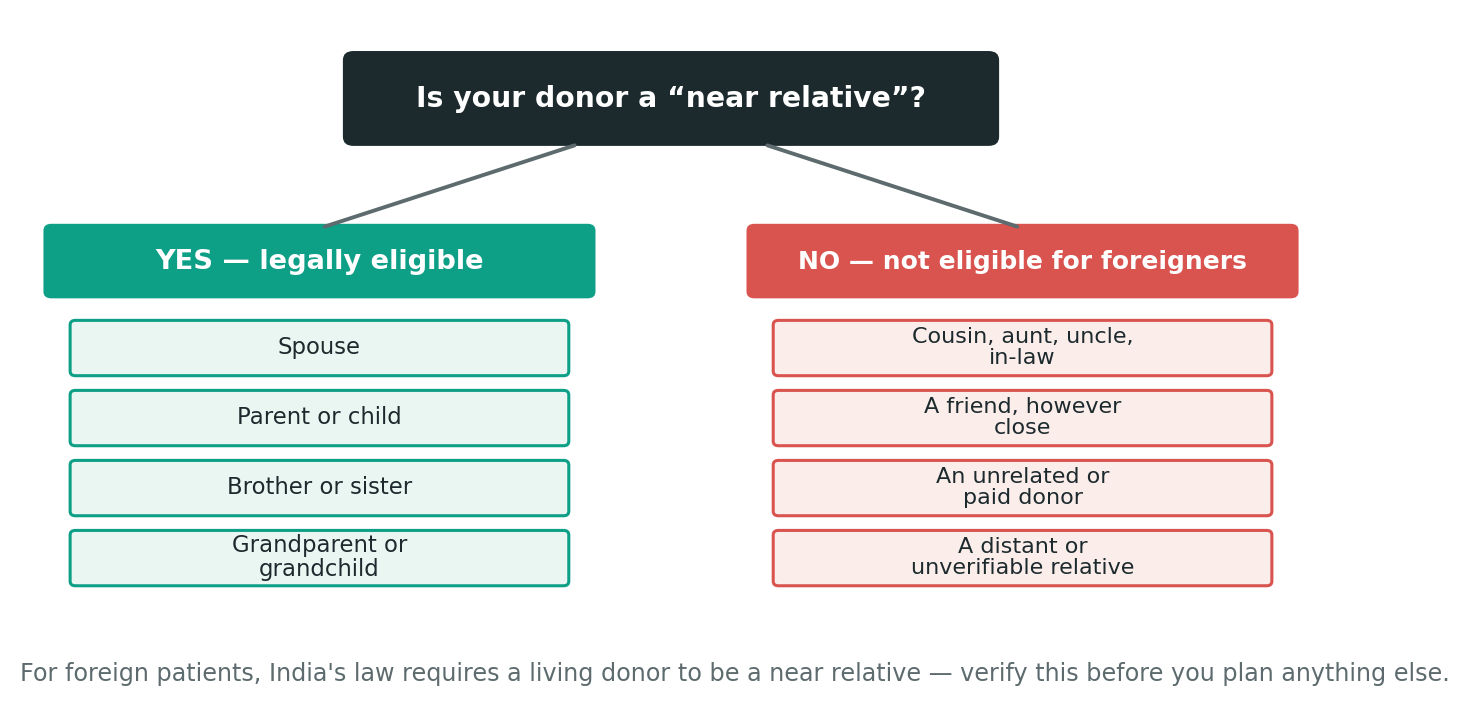
For foreign patients, India's law requires a living donor to be a near relative — verify this before you plan anything else.
Two decisions, not one
Once a legally eligible donor is confirmed, you are choosing the transplant team and the accredited programme around them. Both matter enormously, because a kidney transplant is not a single operation but the beginning of a lifelong relationship between your body, a new organ, and the medicines that protect it.
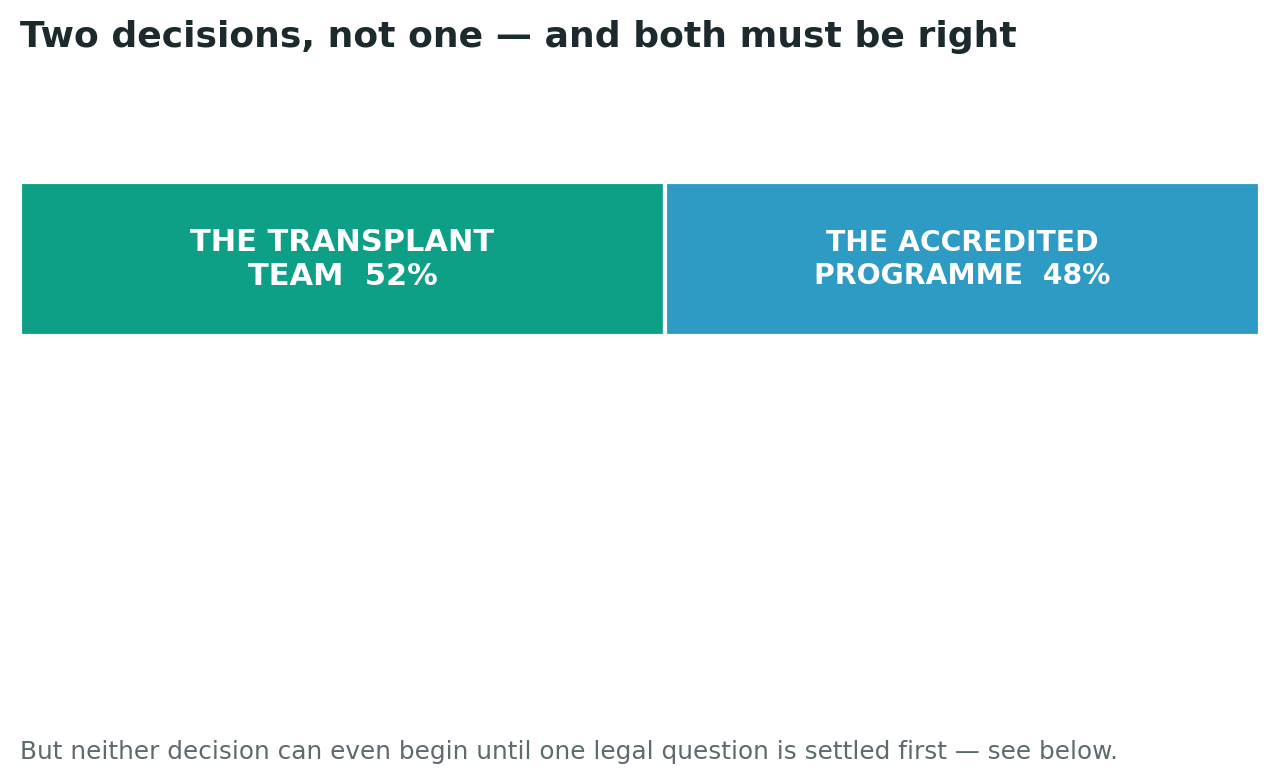
But neither decision can even begin until the legal donor question, above, is settled first.
Part One: choosing the transplant surgeon and team
1. Choose a fellowship-trained transplant surgeon. Seek a surgeon whose practice centres specifically on kidney transplantation, working alongside a nephrologist, rather than a general urologist who performs transplants occasionally.
2. Ask the team’s volume of kidney transplants each year. Experience predicts better outcomes, including fewer surgical complications and better graft survival. Ask directly how many transplants the team performs annually.
3. Expect donor eligibility discussed honestly and early. A trustworthy team reviews your proposed donor’s relationship and documentation early, tells you plainly whether it meets the legal standard, and does not proceed on hope alone.
4. Ask about graft and patient survival rates. A confident team shares its own results, including how many transplanted kidneys are still functioning well after one and five years. Vague reassurance is not the same as a candid number.
5. Insist your donor receives just as thorough an evaluation as you do. A living donor is a healthy person undergoing surgery for someone else's benefit, and their own long-term safety matters as much as the recipient's outcome. A responsible team evaluates the donor's kidney function, overall health, and psychological readiness independently and thoroughly, and will decline a donor who is not genuinely fit to give up a kidney safely — even if the recipient is eager to proceed.
6. Confirm who leads your care personally. Ask, and get it in writing, which named surgeon and nephrologist are responsible for your case throughout.
7. Ask how blood-group incompatibility is handled, if relevant. If your willing donor's blood group does not match yours, ask whether the programme offers ABO-incompatible transplant techniques or a paired-exchange option, rather than simply telling you no donor is available.
8. Test communication before you travel. The best teams review your and your donor’s medical history and relationship documents remotely, explain the Authorisation Committee process clearly, and are honest about realistic timelines.
How to read an Indian transplant specialist’s qualifications
| Stage | Qualification | What it tells you |
|---|---|---|
| Basic medical degree | MBBS | A qualified doctor — the starting point, not a specialist. |
| Surgical/medical specialist | MS/MCh (Urology) for the surgeon; DM (Nephrology) for the physician | Fully trained specialists in the two disciplines a transplant needs together. |
| Transplant expertise | Fellowship in renal transplantation | Focused, hands-on training specifically in transplant surgery — what you want. |
You can confirm that a doctor is properly registered on the National Medical Commission register of India (nmc.org.in). A genuine specialist will be glad to have you check.
Part Two: choosing the accredited programme
1. Confirm it is a properly registered transplant centre. Kidney transplant can only lawfully be performed at hospitals specifically registered and approved for it. Ask for confirmation of this registration, not just general hospital accreditation.
2. Ask whether the Authorisation Committee process is handled in-house. A hospital experienced with international transplants will guide you through embassy documentation, the committee interview, and DNA testing efficiently, rather than leaving you to navigate Indian bureaucracy alone.
3. Check on-site nephrology, dialysis and blood bank support. Both before and after transplant, ready access to dialysis (in case it is needed), a strong nephrology team, and blood bank support matter for safety.
4. Insist on a clear, written lifelong monitoring plan. A transplanted kidney requires immunosuppressive medication and blood monitoring for the rest of your life. Ask exactly what this involves — which drugs, how often blood levels are checked, and for how long — before you even have surgery.
5. Check accreditation and infection control. The hospital should be accredited by India’s NABH, and ideally by JCI, with infection rates tracked and controlled — particularly important given the infection risk that comes with immunosuppression.
6. Weigh international support and transparent pricing. A good programme helps with the visa invitation for both patient and donor, accommodation for the weeks around surgery, and gives a written, itemised, fixed quote.
7. Ask how it will support you after you fly home. A good hospital offers teleconsultation, a complete written record of the transplant and your medication regimen, and clear guidance for a Zambian doctor to continue your lifelong monitoring.
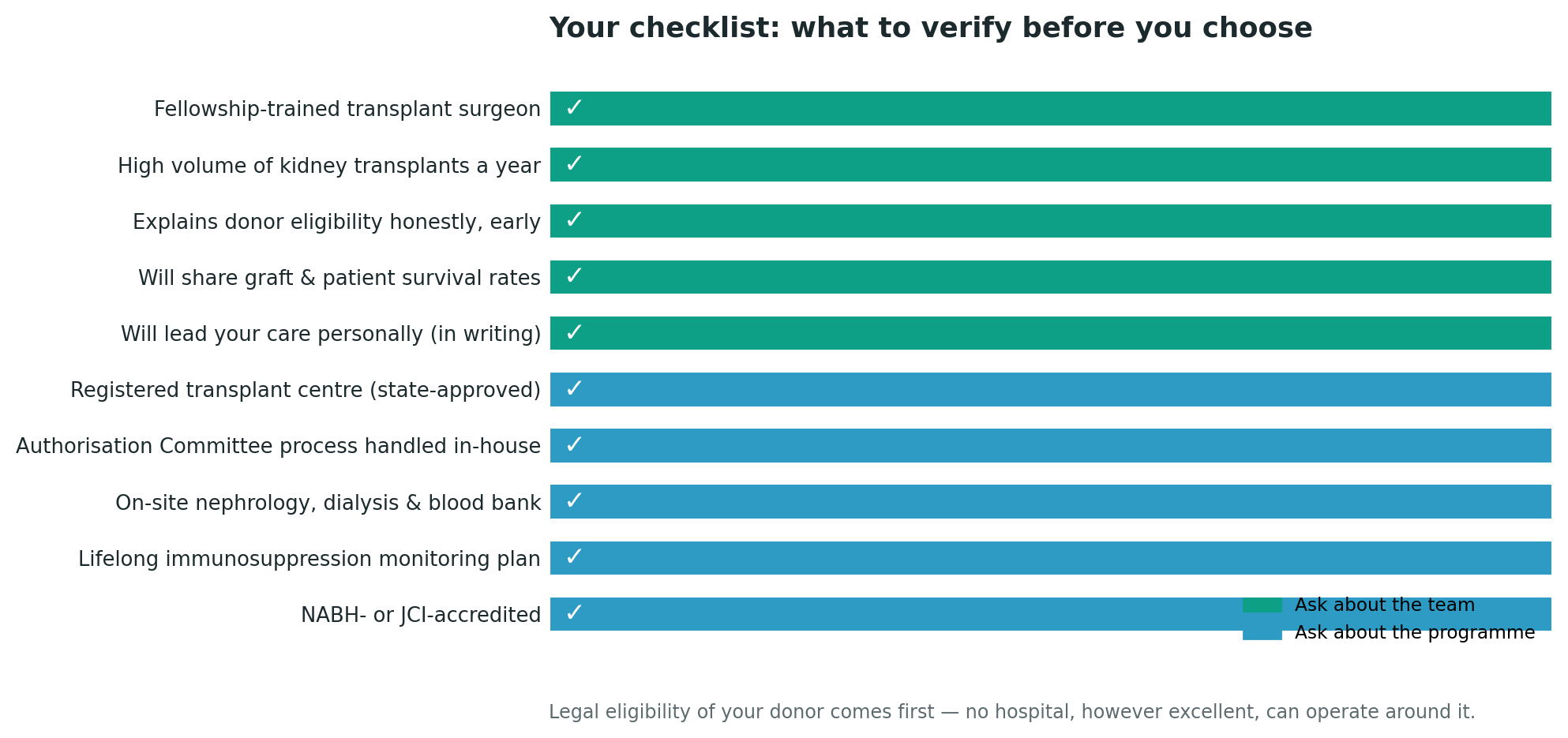
Legal eligibility of your donor comes first — no hospital, however excellent, can operate around it.
Lifelong follow-up: the part that lasts longer than the operation
A kidney transplant succeeds not only in the operating theatre but over the years that follow, and the monitoring required to protect a transplanted kidney never fully ends. Immunosuppressive medicines, taken daily for life, prevent your immune system from rejecting the new kidney — but they also raise infection risk and need regular blood tests to keep the dose correctly balanced, since too little risks rejection and too much raises other health risks. Your donor, too, deserves ongoing care: a single healthy kidney generally adapts well and most donors live full, healthy lives, but periodic check-ups to monitor their remaining kidney function are a sensible, standard precaution, not an afterthought.
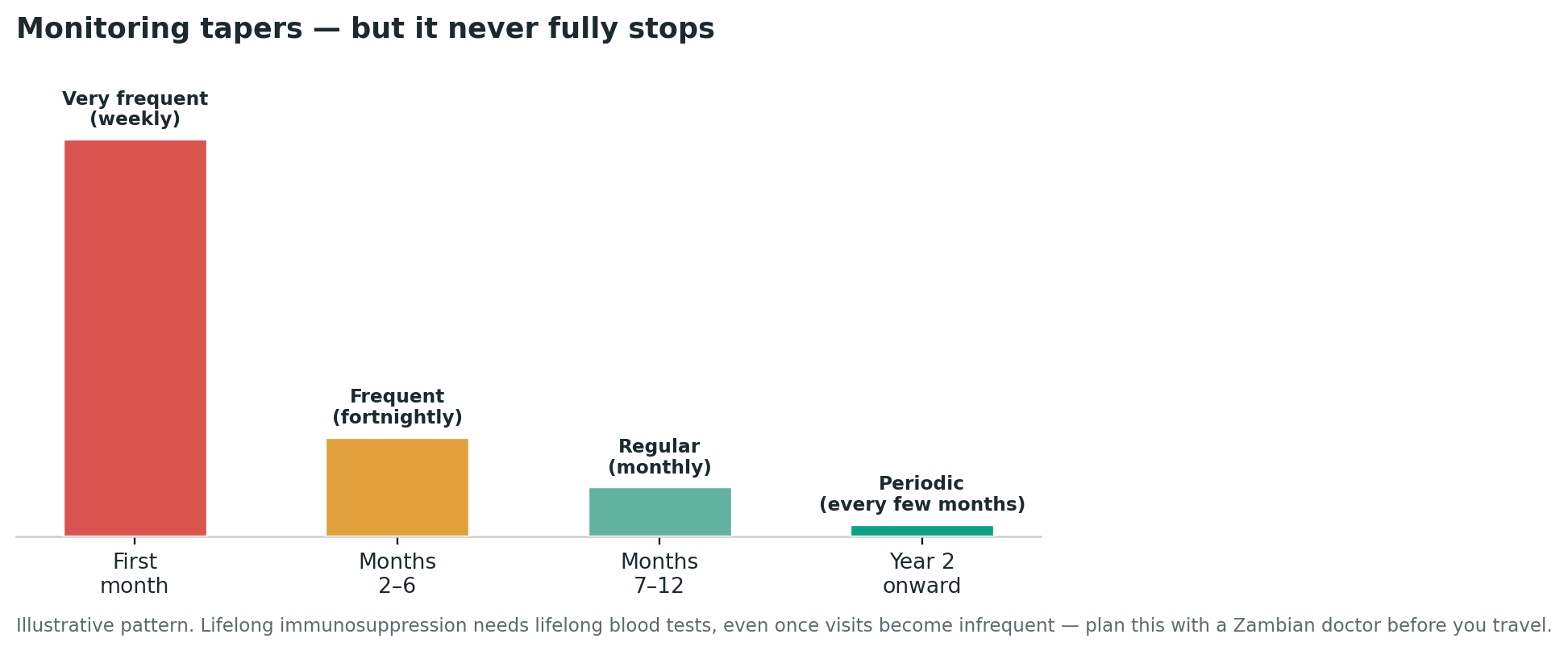
Illustrative pattern. Lifelong immunosuppression needs lifelong blood tests, even once visits become infrequent.
Cost and value
Kidney transplant in a good Indian hospital costs a fraction of Western private pricing. At roughly ZK19 to the US dollar in mid-2026, the saving is substantial in kwacha; confirm the rate before travel, as it moves. But the true cost of a transplant is not the operation alone — the pre-transplant work-up, the donor’s own evaluation and care, the hospital stay, and years of immunosuppressive medication afterward all add to the total picture.
In 24 years of arranging these journeys, I have found that the hardest situations are never about price — they are families who travelled before confirming their donor was legally eligible, and learned the truth only in India. Settle the donor question first, in writing, before any other plan is made.
What a Zambian family should weigh in particular
Beyond the surgeon and the programme, several things matter specifically for a family travelling from Zambia. First, confirm donor eligibility before you do anything else — gather relationship documents early, and discuss your specific family situation with the hospital’s international patient office before booking any travel. Second, how you will pay : the National Health Insurance scheme funds care inside Zambia, not treatment abroad, so the full cost, including the donor’s care and years of medication, comes from your own resources. Third, arrange lifelong local monitoring : a Zambian doctor, ideally with access to the specific blood tests immunosuppression requires, should be briefed with a complete written record before you return home.
The practical journey from Zambia
India requires a yellow fever certificate from Zambian travellers, valid from ten days after vaccination. Both patient and donor need a medical visa, issued by the High Commission of India in Lusaka against the hospital’s invitation letter — and because a transplant additionally requires an embassy no-objection certificate confirming the donor relationship, begin this process well before you plan to travel, since it can take longer than a routine medical visa. There is no direct flight, so plan to connect via Addis Ababa, Dubai, Doha or Nairobi. Send both your and your donor’s medical history and relationship documents for review before you travel.
Four signals that should make you pause
- Any suggestion a friend or distant relative can donate — without genuine, verified near-relative status, for a foreign patient.
- An offer to "arrange" a donor or bypass documentation — this is illegal and dangerous.
- No willingness to share survival rates — the transplant team's graft and patient survival rates.
- No clear, written monitoring plan — for lifelong immunosuppression, or no aftercare arrangement for Zambia.
Straight Answers for Zambians about Kidney Transplant Surgeons & Hospitals in India
My friend wants to donate a kidney to me. Can they, in India?
For a foreign patient, Indian law requires a living donor to be a near relative — spouse, parent, child, sibling, or grandparent/grandchild. A friend, however willing and genuine, is not an available route for a foreigner. Confirm your donor options among close family before planning any travel.
What documents will we need to prove the relationship?
Typically birth certificates, marriage certificates, and other official family records, verified through your embassy, plus increasingly a DNA test confirming the biological relationship. Start gathering these early, since the process can take time.
What if my donor and I have different blood groups?
Ask the transplant programme specifically about ABO-incompatible transplant techniques or paired-exchange options, both of which can make a mismatched donor usable in experienced centres, rather than assuming the donor cannot be used at all.
Does the medication and monitoring ever end?
No. Immunosuppressive medication and periodic blood monitoring continue for as long as the transplanted kidney is working, which for many patients means the rest of their life. The frequency of visits decreases over time, but the need for it does not disappear.
Sources & useful links
- 🌐 Medical visa (India), Lusaka — High Commission of India, requirements & process: hcizambia.gov.in/page/medical-visa
- 🌐 National Health Insurance (Zambia) — NHIMA cover (treatment abroad is not covered): nhima.co.zm
- 🌐 Ministry of Health, Zambia — referrals and national services: moh.gov.zm
- 🌐 Verify a doctor (India) — National Medical Commission register of doctors: nmc.org.in
- 🌐 Hospital accreditation (India) — verify a hospital’s NABH accreditation: nabh.co
- 🌐 National transplant organisation (India) — NOTTO, India's national organ & tissue transplant body: notto.mohfw.gov.in
A closing word
If you send me your family situation and your donor’s relationship to you, I will help you with the questions that matter most: whether your proposed donor genuinely meets India’s legal standard, which transplant teams are genuinely experienced and honest, which hospitals can guide you efficiently through the Authorisation Committee process, and how to plan the years of monitoring that follow a successful transplant. Settling the legal question first, before anything else, is the single most protective thing I can help a family do. That, for all these years, has been my work.
Frequently Asked Questions by Zambians about Kidney Transplant Surgeons & Hospitals in India
Can a friend donate a kidney to a Zambian patient in India?
No. For a foreign patient, the guide states that Indian law requires a living donor to be a near relative, including a spouse, parent, child, sibling or grandparent/grandchild. A friend is not an available donor route for a foreign patient.
Who can legally donate a kidney to a Zambian patient in India?
The permitted near-relative categories described in the guide are spouse, parent, child, sibling and grandparent/grandchild. The relationship must also be properly verified.
What documents are needed to prove the donor relationship?
Documents can include birth certificates, marriage certificates and other official family records. Embassy verification and DNA testing may also be required to confirm the biological relationship.
Can a Zambian patient receive a kidney transplant in India if the donor has a different blood group?
Potentially. Patients should ask experienced transplant programmes whether they offer ABO-incompatible transplantation or paired-exchange options when the donor and recipient have different blood groups.
How should Zambian patients choose a kidney transplant surgeon in India?
Patients should look for a fellowship-trained transplant surgeon and ask about the team's annual kidney transplant volume, graft survival, patient survival and experience with international patients.
What should Zambian patients check when choosing a kidney transplant hospital in India?
The hospital should be properly registered for transplantation and have nephrology, dialysis and blood-bank support. NABH accreditation and ideally JCI accreditation should also be checked.
Do kidney transplant medicines continue after surgery for Zambian patients?
Yes. Immunosuppressive medication and blood monitoring continue for as long as the transplanted kidney is functioning, which for many patients means lifelong treatment.
Does the Zambian National Health Insurance scheme cover kidney transplantation in India?
The guide states that Zambia's National Health Insurance scheme funds care inside Zambia and does not cover treatment abroad. Families therefore need to plan for the full cost themselves.
What travel documents do Zambian kidney transplant patients and donors need?
Both the patient and donor require medical visas based on the hospital invitation letter. A yellow-fever certificate is also required, and the transplant process involves an embassy no-objection certificate confirming the donor relationship.
Can kidney transplant follow-up continue in Zambia after treatment in India?
Yes. Patients should return with complete transplant records and a medication plan so that a doctor in Zambia can continue lifelong monitoring. The hospital should ideally provide teleconsultation support after the patient returns home.
Page Summary
This guide explains how Zambian patients can choose kidney transplant surgeons and hospitals in India. It first highlights donor eligibility under Indian law, which is essential before planning international travel. The guide covers transplant team experience, donor safety, survival outcomes and hospital accreditation, along with lifelong immunosuppressive treatment and follow-up for both recipient and donor. Financial planning should include surgery, donor care, hospital costs and long-term medicines. Medical visas, yellow-fever certification, travel connections and continued monitoring in Zambia are also discussed.
Citation Block
| Topic | Information |
|---|---|
| Topic Information | Kidney Transplant Surgeons & Hospitals in India for Zambian Patients |
| Treatment | Kidney Transplantation |
| Country | India |
| Intended Audience | Zambian Patients |
| Donor Requirement | Near Relative Under Indian Law |
| Eligible Donor | Spouse, Parent, Child, Sibling or Grandparent/Grandchild |
| Verification | Embassy Confirmation, Authorisation Committee and Possible DNA Test |
| Surgeon Selection | Fellowship-Trained Kidney Transplant Surgeon |
| Team Assessment | Annual Volume and Graft/Patient Survival Rates |
| Hospital Selection | Registered Transplant Centre With Nephrology, Dialysis and Blood Bank |
| Accreditation | NABH and Ideally JCI |
| Long-Term Care | Lifelong Immunosuppressive Medication and Blood Monitoring |
| Donor Follow-Up | Periodic Monitoring of Remaining Kidney Function |
| Cost Planning | Include Surgery, Donor Care, Hospital Stay and Long-Term Medicines |


Our Mission Statement
Our mission is to place patients at the centre of every healthcare decision by providing trustworthy, evidence-based, and unbiased medical information. We believe that informed patients make better decisions. Backed by personalised guidance from our experienced advisory team, we help patients understand their treatment options, compare them objectively, and confidently choose the path that best suits their medical needs and personal circumstances.
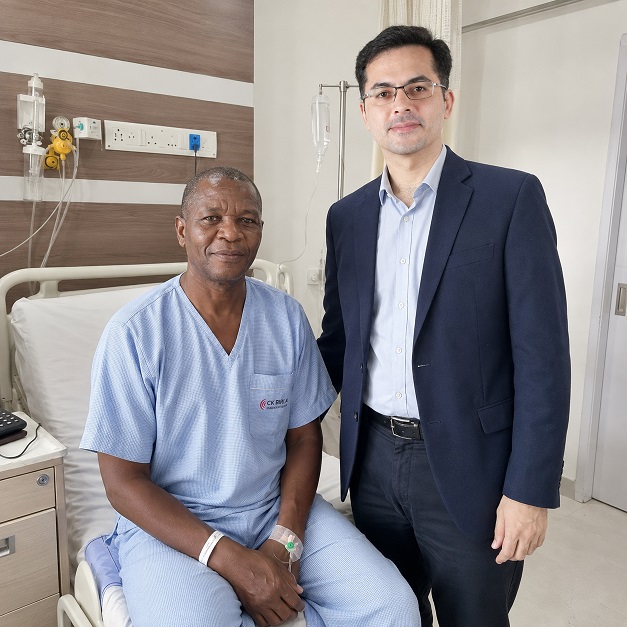
Patient Testimonials from Zambia


Ready to Take the First Step?
Share your Medical Reports with our Healthcare Managers Today and Get a FREE CONSULTATION, a Personalized Treatment Plan, and Complete Support from Arrival to Recovery.
Get Your Free ConsultationAreas We Serve
This resource has been thoughtfully prepared for patients from Zambia who are considering medical treatment in India. We also welcome patients from the wider region in the countries mentioned below-
We assist patients from:
- Zambia
- Angola
- Malawi
- Zimbabwe
- Botswana
- Namibia
- South Africa
- Eswatini
- Lesotho
- Gabon
- Chad
- Equatorial Guinea
- São Tomé and Príncipe
- Republic of the Congo
- Democratic Republic of the Congo
Many of the insights, treatment pathways, hospital recommendations, travel guidance, and patient support services described here are equally relevant and may be used as a reference when planning treatment in India.
From Zambia to India: Your Complete Patient Support Guide
- Best Weight-Loss (Bariatric) Surgeons & Hospitals in India for Zambian Patients
- Best Brain-Tumour Surgeons & Hospitals in India for Zambian Patients
- Best Cancer Doctors & Hospitals in India for Zambian Patients
- Best Cardiac Surgeons & Hospitals in India for Zambian Patients
- Best Cosmetic Surgeons & Facilities in India for Zambian Patients
- Best CyberKnife Treatment Teams & Centres in India for Zambian Patients
- Best Dentists & Dental Clinics in India for Zambian Patients
- Best Heart Valve Replacement Surgeons & Hospitals in India for Zambian Patients
- Best Hip Surgeons & Hospitals in India for Zambian Patients
- Best Knee Surgeons & Hospitals in India for Zambian Patients
- Best Neurosurgeons & Hospitals in India for Zambian Patients
- Best Paediatric Cardiac Surgeons & Hospitals in India for Zambian Patients
- Best Paediatric Neurosurgeons & Hospitals in India for Zambian Patients
- Best Prostate Surgeons & Hospitals in India for Zambian Patients
- Best Scoliosis Surgeons & Hospitals in India for Zambian Patients
- Best Spine Surgeons & Hospitals in India for Zambian Patients
- Best Bone Marrow Transplant Teams & Hospitals in India for Zambian Patients
- Best Kidney Transplant Surgeons & Hospitals in India for Zambian Patients