

Selecting the Best Heart Valve Replacement Surgeons & Hospitals in India — a Zambian Patient’s Guide
Before “which replacement valve,” there is a more valuable question: can this valve be repaired at all? This guide sets out how to choose the surgeon, and the valve, with that question first.
When a doctor says a heart valve needs attention, most patients hear only the word “replacement,” and the conversation jumps straight to which artificial valve to choose. For 24 years I have guided patients through this decision, and the most valuable thing I can tell you is this: for a meaningful number of damaged valves, particularly the mitral valve, repairing your own valve is possible — and where it is, it is usually the wiser course, sparing you the lifelong complications that come with any artificial valve. This guide is built around that one question, asked first, before any talk of which replacement to choose.
Healing Journeys of Zambian Patients



Key Takeaways
- The most important message in the guide is to ask “Can my valve be repaired rather than replaced?” before discussing artificial-valve options. The document places this question ahead of cost, hospital choice and even the mechanical-versus-tissue valve decision.
- Valve repair is described as particularly relevant to the mitral valve. Where technically feasible and safe, the guide states that repair can preserve the patient's natural valve and avoid some of the lifelong issues associated with prosthetic replacement.
Quick Facts
- Treatment
- Heart Valve Repair & Replacement Surgery
- Country
- India
- Intended Audience
- Zambian Patients
- Primary Conditions
- Heart Valve Disease
- Important Zambia-Specific Condition
- Rheumatic Heart Disease
- Main Valves Discussed
- Mitral Valve, Aortic Valve and Tricuspid Valve
- First Treatment Question
- Can the Valve Be Repaired Instead of Replaced?
- Valve Most Commonly Discussed for Repair
- Mitral Valve
- Aortic Valve
- More Commonly Replaced, Particularly with Severe Calcification
- Zambia-Specific Follow-Up
- Lifelong Monitoring with a Zambian Cardiologist
- Pre-Travel Record
- Actual Echocardiogram + Medical History
- Medical Visa
- High Commission of India in Lusaka
- Medical Attendant
- Medical-Attendant Visa Recommended
- Travel Routes Mentioned
- Addis Ababa, Dubai, Doha or Nairobi
In Brief
Zambian patients considering heart valve surgery in India should first establish whether their damaged valve can be repaired rather than automatically replaced. This is especially relevant to mitral-valve disease, where repair may be technically possible in selected patients. The guide recommends choosing a cardiac surgeon with focused valve-repair experience, transparent outcomes and substantial experience with the specific affected valve. Hospital selection should include accreditation, a dedicated cardiac ICU, strong infection control, echocardiography and written endocarditis-prevention guidance. If valve replacement is necessary, mechanical-versus-tissue valve selection and the patient's ability to maintain lifelong follow-up should form part of the decision.
First, should you travel at all?
Zambia has cardiac surgery capacity for some valve problems, and treatment at home may be right and sufficient for some patients. But valve repair is a more technically demanding skill than replacement, requiring a genuinely experienced valve surgeon and team, and this is often where travelling to a high-volume centre earns its place, with India a leading destination. As always, travelling is the second decision; understanding whether your valve can be repaired comes first.
Knowledge that must come first: repair, if possible, before replacement
This is the single most valuable question in this guide. Published research consistently shows that where a damaged valve — especially the mitral valve — can be safely repaired rather than replaced, repair tends to offer better long- term survival, avoids the lifelong presence of foreign material in the heart, and carries a materially lower risk of a serious infection called infective endocarditis . Repair is not always possible: it depends on which valve is affected, how much of your own valve tissue remains healthy, and the exact nature of the damage. But because repair is technically more demanding than replacement, some centres reach for replacement by default, simply because it is more straightforward to perform reliably. Before agreeing to any valve operation, ask directly: is repair possible for my valve? A surgeon who can explain clearly why repair isn’t possible, rather than one who defaults to replacement, is the one to trust.
It helps to know that the answer differs by valve. The mitral valve , on the heart’s left side, is the one most often successfully repaired, particularly when its own tissue has stretched or its supporting cords have weakened rather than been destroyed by infection or severe calcium build-up. The aortic valve , by contrast, is more often replaced than repaired, especially once it has become thickened and hardened with calcium, though repair is occasionally possible in younger patients with specific patterns of damage. There are also less invasive options in some centres, including catheter-based valve procedures for certain patients, particularly older adults or those at higher surgical risk; ask whether any of these apply to you, though open surgery remains the standard approach for most valve problems in younger, otherwise fit patients.
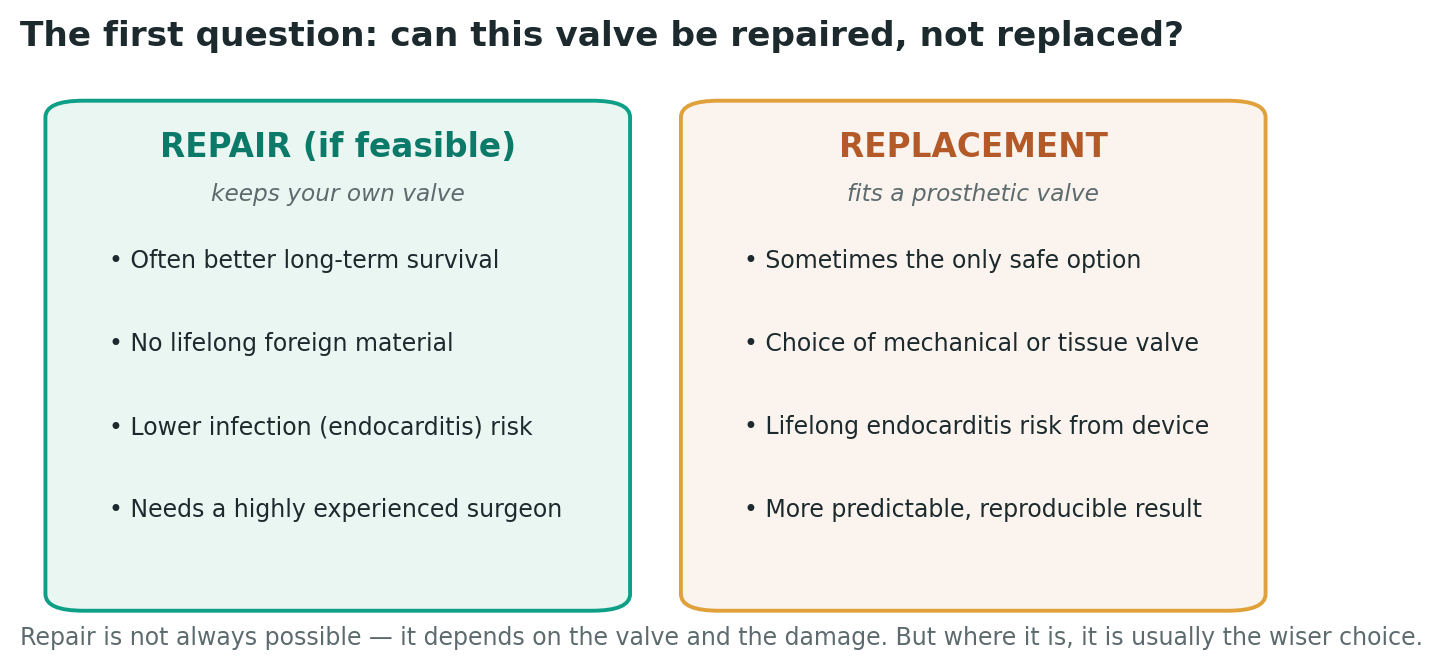
Repair is not always possible — it depends on the valve and the damage. But where it is, it is usually the wiser choice.
Two decisions, not one
You are choosing the surgeon and the hospital . Both must be right, and here the surgeon’s specific skill in repair — not merely replacement — carries unusual weight, because a suboptimal repair by an inexperienced surgeon may fail and still end in replacement, having gained nothing.
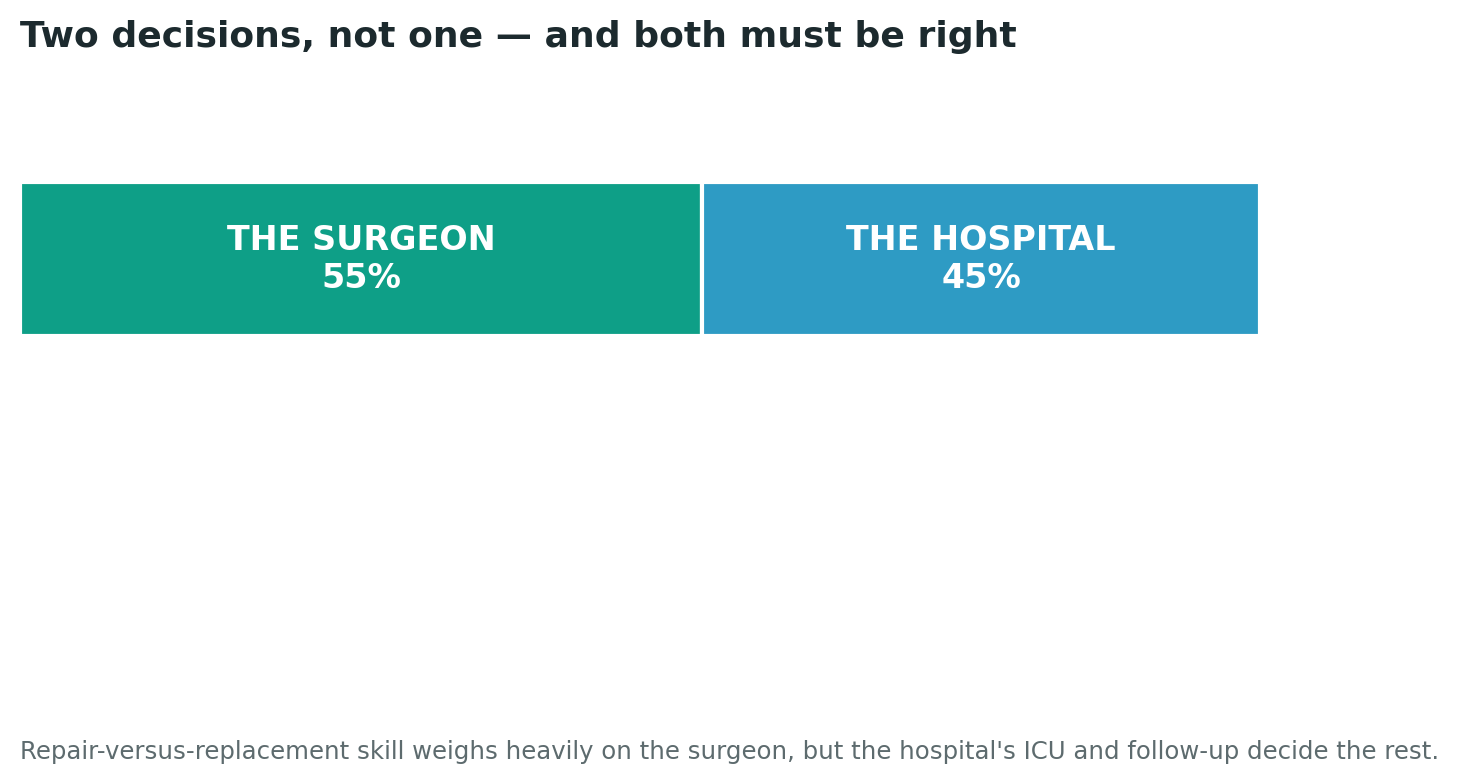
Repair-versus-replacement skill weighs heavily on the surgeon, but the hospital's intensive care and follow-up decide the rest.
Part One: choosing the surgeon
1. Choose a surgeon specifically skilled in valve repair. Not every cardiac surgeon who replaces valves competently is equally practised in repair, which demands finer, more individualised technique. Ask directly what share of his valve operations are repairs rather than replacements.
2. Ask his volume with your specific valve. Mitral, aortic and tricuspid valve problems differ, and repair is more commonly feasible for some than others. Ask how many operations on your particular valve he performs each year, repair and replacement combined.
3. Expect an honest assessment of repair feasibility. A trustworthy surgeon examines your imaging and tells you plainly whether repair is realistic for your valve, and explains clearly if it is not, rather than moving straight to replacement without that conversation.
4. If replacement is genuinely necessary, expect an honest discussion of valve choice. The mechanical-versus-tissue decision that follows is itself significant — consider it alongside your access to lifelong monitoring, exactly as with any other valve replacement.
5. Ask about his outcomes for both repair and replacement. A confident surgeon shares his repair success rate, his reoperation rate, and his complication rates candidly. Vague reassurance is not the same as a clear number.
6. Confirm he will operate on you personally. Ask, and get it in writing, that the named surgeon you chose will perform your operation, not delegate it to a trainee.
7. Test his communication before you travel. The best surgeons review your echocardiogram remotely, discuss repair feasibility honestly, and explain risks as readily as benefits.
How to read an Indian valve surgeon’s qualifications
| Stage | Qualification | What it tells you |
|---|---|---|
| Basic medical degree | MBBS | A qualified doctor — the starting point, not a specialist. |
| Cardiothoracic specialist | MCh (Cardiothoracic Surgery) or DNB (CTVS) | A fully trained heart surgeon — the essential qualification. |
| Valve & repair expertise | Fellowship in valve surgery, with a specific repair-focused practice | Focused training and experience in valve repair — what you want. |
You can confirm that a surgeon is properly registered on the National Medical Commission register of India (nmc.org.in). A genuine specialist will be glad to have you check.
Part Two: choosing the hospital
1. Insist on accreditation. The hospital should be accredited by India’s NABH , and ideally internationally by JCI .
2. Confirm a dedicated cardiac intensive-care unit. Recovery from valve surgery, whether repair or replacement, needs specialised cardiac-ICU staff with round-the-clock cover.
3. Ask for clear, written endocarditis-prevention guidance. This matters for every valve patient, but especially if replacement with any prosthetic material is used. Any repaired or replaced valve carries a lifelong increased risk of infective endocarditis, a serious infection of the heart’s lining, which can be triggered by infections entering the bloodstream — including from dental procedures. A good hospital gives you a written card or letter explaining this risk and, in many cases, recommending antibiotic cover before certain dental treatments for the rest of your life. Take this seriously, and show it to any dentist you see in future, in Zambia or elsewhere — a dentist unaware of your valve history cannot protect you properly, so this small piece of paper deserves a permanent place in your medical records.
4. Check on-site echocardiography for follow-up. Valve function should be checked by echocardiogram at intervals after surgery; confirm the hospital has this readily available, and a plan for how follow-up scans will be arranged once you are home.
5. Ask about infection control. Given the endocarditis risk that follows any valve surgery, ask what the hospital’s own infection rates are and how they are kept low.
6. Weigh international support and transparent pricing. A good centre helps with the visa invitation, accommodation and a coordinator, and gives a written, itemised, fixed quote.
7. Ask how it will support your lifelong follow-up. A good hospital offers teleconsultation, a full written record of exactly what was done to your valve, and clear guidance for a Zambian doctor to continue your monitoring and endocarditis-prevention care.
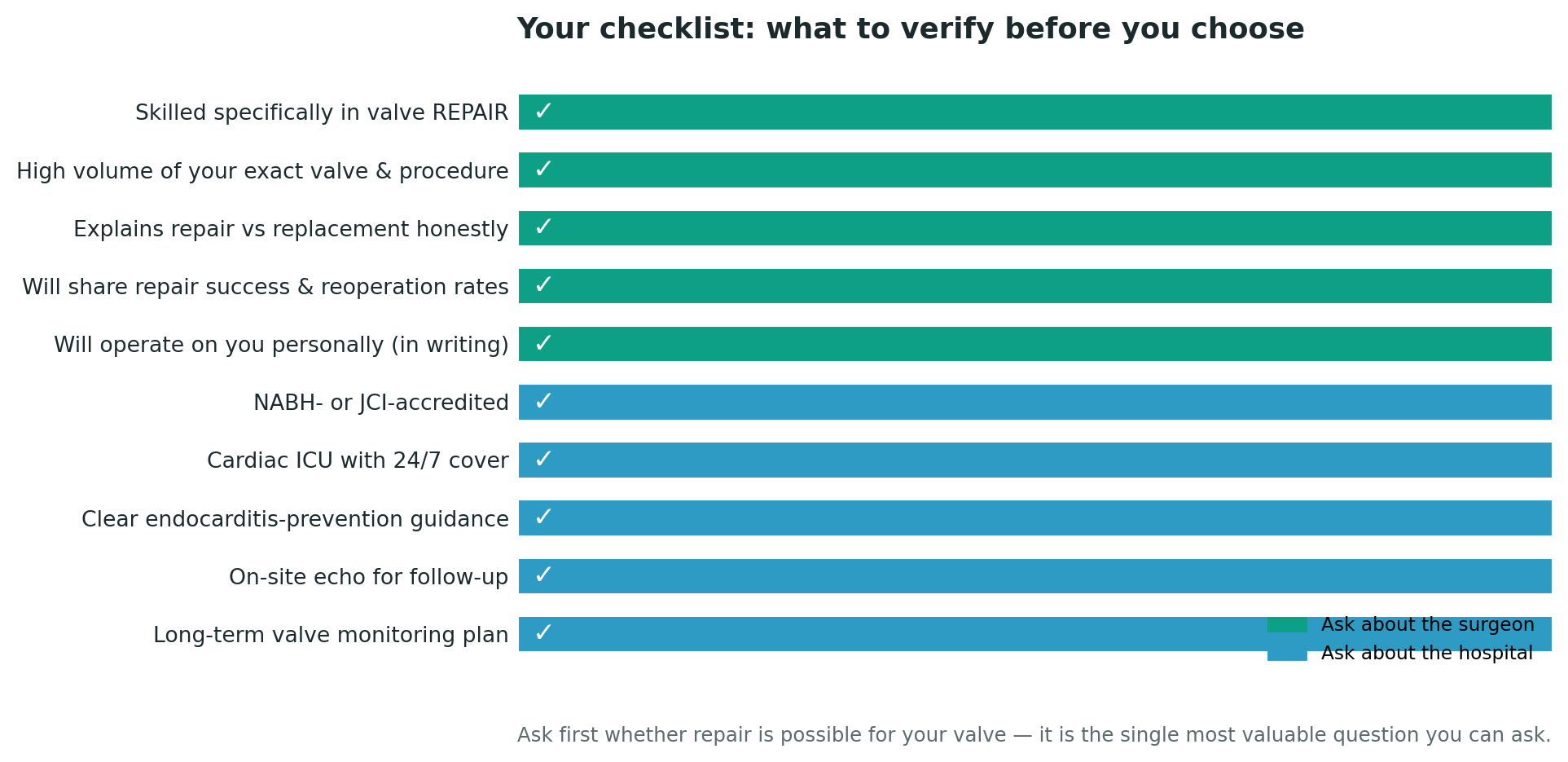
Keep this checklist beside you. Ask first whether repair is possible for your valve — it is the single most valuable question you can ask.
Cost and value: how to weigh the money honestly
Heart valve surgery in a good Indian hospital costs a fraction of Western private pricing, which is why many patients travel. At roughly ZK19 to the US dollar in mid-2026, the saving is large in kwacha; confirm the rate before travel, as it moves. But value here begins with the repair-versus-replacement question, not the price: a successful repair can spare you a lifetime of endocarditis risk and anticoagulation that a replacement would carry, so weigh a surgeon’s genuine repair skill well above any modest difference in fee.
In 24 years of arranging these journeys, I have learned that the disputes that arise almost never concern the headline price — they concern patients who were moved straight to replacement without a serious attempt, or even a conversation, about whether their valve could have been repaired. Insist on that conversation, and the full itemised picture, before you commit a single kwacha.
What a Zambian patient should weigh in particular
Beyond the surgeon and the hospital, several things matter specifically for a patient travelling from Zambia. First, ask about repair explicitly , since valve damage from rheumatic heart disease — common in this region — is sometimes repairable, particularly if addressed before the valve is severely destroyed; this is one more reason not to delay assessment once symptoms such as breathlessness, tiredness or swelling appear, since repair becomes less likely the longer severe damage is left unaddressed. Second, take your endocarditis-prevention guidance seriously , and carry it with you to every future dental visit and medical consultation in Zambia, since any dentist treating you should know your history before certain procedures. Third, how you will pay and follow up : the National Health Insurance scheme funds care inside Zambia, not treatment abroad, so this comes from your own resources, and arranging a Zambian cardiologist for lifelong monitoring before you travel is essential.
The practical journey from Zambia
India requires a yellow fever vaccination certificate from travellers arriving from Zambia, valid only ten days after the injection. Your medical visa is issued by the High Commission of India on Pandit Nehru Road in Lusaka against the hospital’s invitation letter; apply for a medical-attendant visa in the same batch, as you will want someone with you. There is no direct flight — you will connect through Addis Ababa on Ethiopian Airlines, or through Dubai, Doha or Nairobi. Send your actual echocardiogram, not just a summary, for review before you travel, and settle the hospital by traceable bank transfer rather than cash.
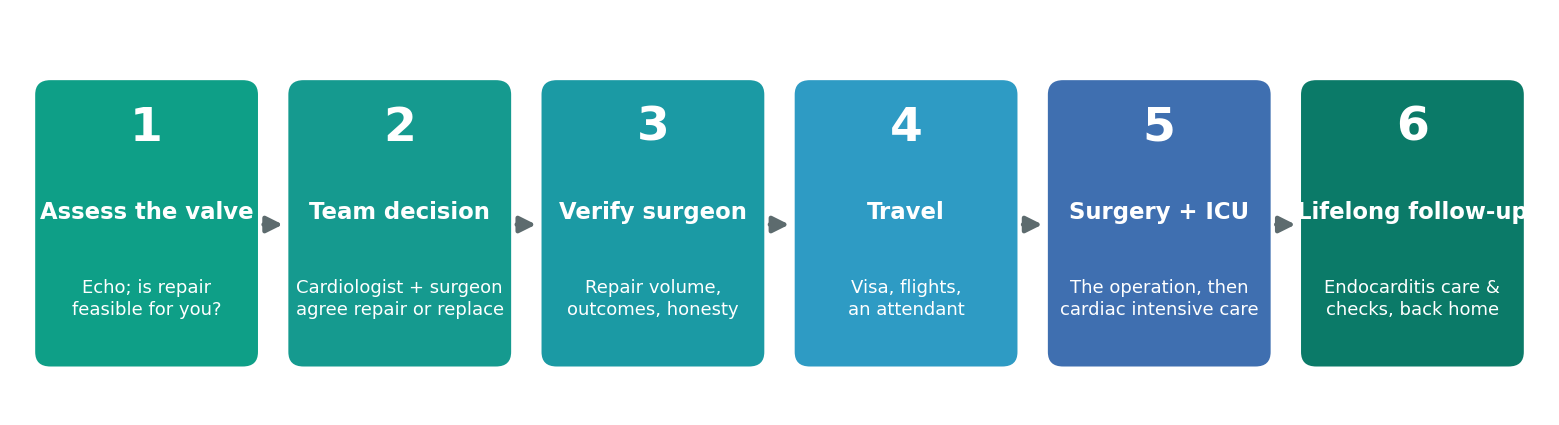
Four signals that should make you pause
- Replacement recommended without discussing repair — or attempting whether repair is feasible for your valve.
- No willingness to share results — his personal repair success rate or reoperation rate.
- No written endocarditis-prevention guidance — provided before you leave the hospital.
- A single price with no follow-up plan — for lifelong echocardiogram monitoring and no aftercare arrangement for Zambia.
Straight Answers for Zambians about Heart Valve Replacement Surgeons & Hospitals in India
Can my valve be repaired instead of replaced?
Possibly — it depends on which valve is affected and how much healthy tissue remains, and is most often feasible for the mitral valve. Ask your surgeon to assess this specifically and explain their reasoning, rather than assuming replacement is the only option.
Why is repair generally preferred over replacement?
Where feasible, repair tends to offer better long-term survival, avoids placing lifelong foreign material in the heart, and carries a lower risk of infective endocarditis than replacement. It is technically harder to perform well, which is why the surgeon's specific repair skill and experience matter so much.
What is infective endocarditis, and why does it matter to me?
It is a serious infection of the heart's lining or valve, and the risk is higher for life after any valve repair or replacement, particularly with prosthetic material. Certain dental and medical procedures can trigger it, which is why you should carry written guidance about your risk to every future dentist or doctor.
What matters most in the hospital I choose?
A dedicated cardiac intensive-care unit, on-site echocardiography for follow-up, clear written endocarditis-prevention guidance, and support coordinating your lifelong monitoring with a doctor in Zambia.
Sources & Useful Links
- 🌐 Verify a surgeon (India) — National Medical Commission register of doctors: nmc.org.in
- 🌐 Hospital accreditation (India) — verify a hospital’s NABH accreditation: nabh.co
- 🌐 Medical visa (India), Lusaka — High Commission of India, requirements & process: hcizambia.gov.in/page/medical-visa
- 🌐 National Health Insurance (Zambia) — NHIMA cover (treatment abroad is not covered): nhima.co.zm
- 🌐 Ministry of Health, Zambia — referrals and national cardiac services: moh.gov.zm
- 🌐 Yellow fever & travel health — WHO vaccination guidance: who.int/health-topics/yellow-fever
A closing word
If you send me your echocardiogram and a note on your history, I will help you with the question that should come before any other: whether repair is genuinely possible for your valve, and which surgeons have the specific skill and honesty to attempt it rather than defaulting to replacement. If replacement truly is necessary, I will help you weigh the mechanical-versus-tissue decision and find a hospital that takes your lifelong endocarditis risk as seriously as the operation itself. Keeping your own valve, where it can safely be done, is very often the best gift a heart surgeon can give you. That, for all these years, has been my work.
Frequently Asked Questions by Zambians about Heart Valve Replacement Surgeons & Hospitals in India
How should Zambian patients choose the best heart valve surgeon in India?
They should look for a fully trained cardiac surgeon with specific experience in valve surgery and, importantly, valve repair. Patients should ask about procedure volume for their particular valve, repair success, complication and reoperation rates and whether the named surgeon will personally perform the operation.
Should Zambian patients ask about valve repair before replacement?
Yes. The guide treats this as the most important initial question, particularly for mitral-valve disease. Repair is not always possible, but it should be assessed explicitly rather than assuming replacement is the only option.
Which heart valve is most commonly considered for repair?
The guide identifies the mitral valve as the valve most often successfully repaired. Feasibility depends on the exact pattern and severity of damage.
Why is the aortic valve more often replaced?
According to the guide, the aortic valve is more commonly replaced when it becomes severely thickened or calcified. Repair may still be considered in selected younger patients with particular patterns of disease.
What qualifications should Zambian patients check in an Indian heart surgeon?
The guide identifies MBBS as the basic medical qualification and MCh in Cardiothoracic Surgery or DNB CTVS as specialist cardiac-surgery qualifications. Focused experience or fellowship training in valve surgery and valve repair adds the expertise most relevant to these cases.
What hospital facilities are important for heart valve surgery in India?
Patients should look for NABH accreditation, ideally JCI accreditation, a dedicated cardiac ICU, strong infection control, echocardiography services and a clear system for postoperative and international follow-up.
Why does the guide emphasise infective endocarditis prevention?
Patients with repaired or replaced valves can remain at increased risk of infective endocarditis. The guide recommends obtaining written prevention guidance and ensuring future dentists and doctors know the patient's valve history.
What should Zambian patients send to the Indian surgeon before travelling?
The guide specifically recommends sending the actual echocardiogram, rather than only a written summary, together with the patient's relevant medical history.
What follow-up should be arranged after returning to Zambia?
Patients should arrange a Zambian cardiologist for continuing monitoring, including periodic echocardiography, and obtain complete written details of the valve repair or replacement from the Indian hospital.
What are the major red flags when choosing heart valve treatment in India?
The guide highlights four warning signs: replacement recommended without a genuine repair discussion, unwillingness to disclose repair or reoperation outcomes, no written endocarditis-prevention guidance and a quotation with no clear lifelong follow-up or echocardiography plan.
Page Summary
This guide explains how Zambian patients should choose a heart valve surgeon and hospital in India, but it deliberately begins before the question of hospital or artificial-valve choice. Its central message is that patients should first determine whether their own valve can safely be repaired rather than replaced.
Citation Block
| Topic | Information |
|---|---|
| Topic Information | Details |
| Procedure | Heart Valve Repair & Replacement Surgery |
| Country | India |
| Intended Audience | Zambian Patients |
| Primary Condition | Heart Valve Disease |
| Conditions Highlighted | Mitral Valve Disease, Aortic Valve Disease, Tricuspid Valve Disease and Rheumatic Heart Disease |
| Primary Decision | Repair if Safely Feasible Before Replacement |
| Procedures | Valve Repair, Surgical Valve Replacement and Selected Catheter-Based Valve Procedures |
| Replacement Valve Options | Mechanical Valve and Tissue/Bioprosthetic Valve |
| Typical Stay | Not Specifically Stated in the Guide |
| Hospital Stay | Not Specifically Stated in the Guide |
| Recovery | No Single Recovery Period Specified; Long-Term Cardiology and Echocardiography Follow-Up Required |
| Average Treatment Cost | No Specific Heart Valve Surgery Cost Range Stated in the Retrieved Guide Content |
| Zambia Follow-Up | Lifelong Monitoring with a Zambian Cardiologist + Indian Team Support |


Our Mission Statement
Our mission is to place patients at the centre of every healthcare decision by providing trustworthy, evidence-based, and unbiased medical information. We believe that informed patients make better decisions. Backed by personalised guidance from our experienced advisory team, we help patients understand their treatment options, compare them objectively, and confidently choose the path that best suits their medical needs and personal circumstances.
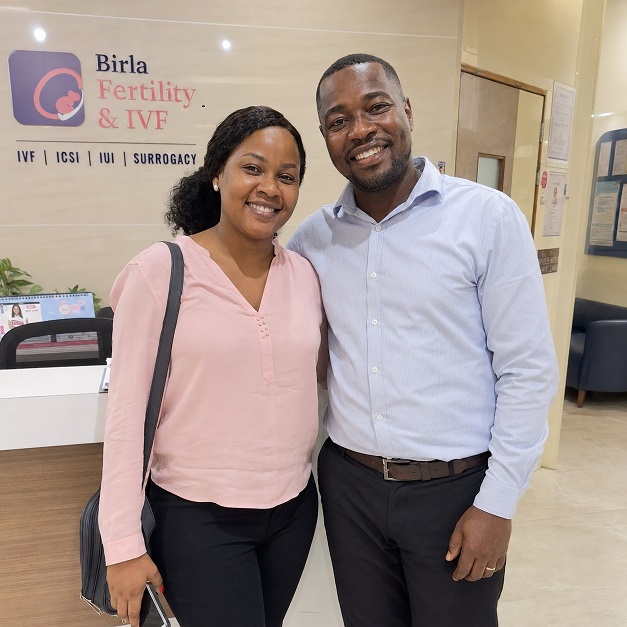
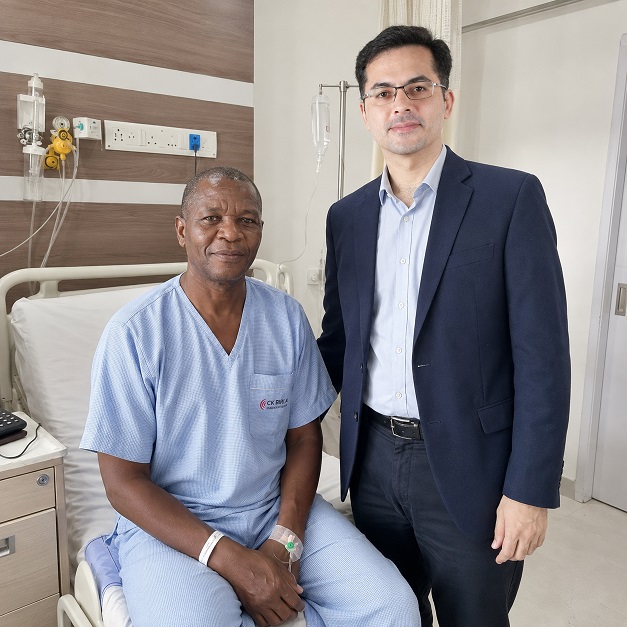
Patient Testimonials from Zambia

Ready to Take the First Step?
Share your Medical Reports with our Healthcare Managers Today and Get a FREE CONSULTATION, a Personalized Treatment Plan, and Complete Support from Arrival to Recovery.
Get Your Free ConsultationAreas We Serve
This resource has been thoughtfully prepared for patients from Zambia who are considering medical treatment in India. We also welcome patients from the wider region in the countries mentioned below-
We assist patients from:
- Zambia
- Angola
- Malawi
- Zimbabwe
- Botswana
- Namibia
- South Africa
- Eswatini
- Lesotho
- Gabon
- Chad
- Equatorial Guinea
- São Tomé and Príncipe
- Republic of the Congo
- Democratic Republic of the Congo
Many of the insights, treatment pathways, hospital recommendations, travel guidance, and patient support services described here are equally relevant and may be used as a reference when planning treatment in India.
From Zambia to India: Your Complete Patient Support Guide
- Best Weight-Loss (Bariatric) Surgeons & Hospitals in India for Zambian Patients
- Best Brain-Tumour Surgeons & Hospitals in India for Zambian Patients
- Best Cancer Doctors & Hospitals in India for Zambian Patients
- Best Cardiac Surgeons & Hospitals in India for Zambian Patients
- Best Cosmetic Surgeons & Facilities in India for Zambian Patients
- Best CyberKnife Treatment Teams & Centres in India for Zambian Patients
- Best Dentists & Dental Clinics in India for Zambian Patients
- Best Heart Valve Replacement Surgeons & Hospitals in India for Zambian Patients
- Best Hip Surgeons & Hospitals in India for Zambian Patients
- Best Knee Surgeons & Hospitals in India for Zambian Patients
- Best Neurosurgeons & Hospitals in India for Zambian Patients
- Best Paediatric Cardiac Surgeons & Hospitals in India for Zambian Patients
- Best Paediatric Neurosurgeons & Hospitals in India for Zambian Patients
- Best Prostate Surgeons & Hospitals in India for Zambian Patients
- Best Scoliosis Surgeons & Hospitals in India for Zambian Patients
- Best Spine Surgeons & Hospitals in India for Zambian Patients
- Best Bone Marrow Transplant Teams & Hospitals in India for Zambian Patients
- Best Kidney Transplant Surgeons & Hospitals in India for Zambian Patients