

Selecting the Best Scoliosis Surgeons & Hospitals in India — a Zambian Patient’s Guide
A curved spine is not automatically an operation. One number — the Cobb angle — and one further question, whether the child is still growing, decide almost everything. This guide sets out how to choose well.
A parent who is told their child’s spine is curving carries a particular kind of worry, because it seems to threaten not just health but the whole shape of a young life ahead. For 24 years I have guided African families through this, and the first thing I always explain is that scoliosis is measured, not guessed — by a precise number, the Cobb angle , read from an X-ray — and that number, together with how much growing the child has left to do, decides whether the right course is simply watching, a brace, or surgery. Understanding this before you meet any surgeon changes the whole conversation, and protects you from both needless alarm and needless delay.
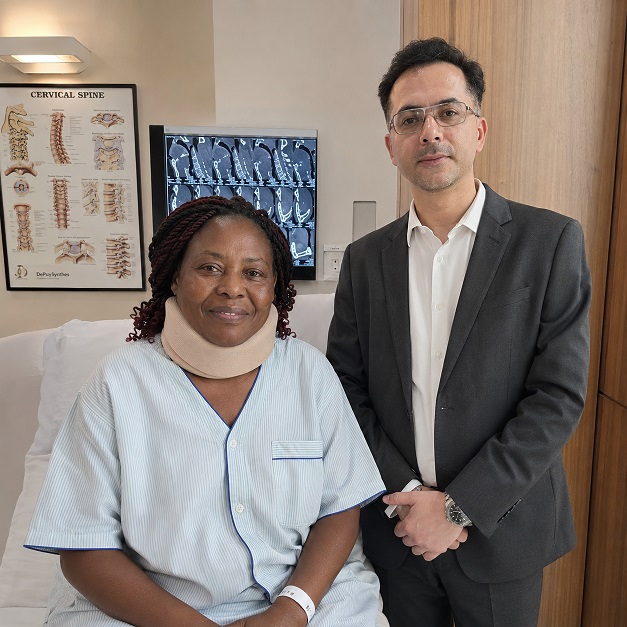
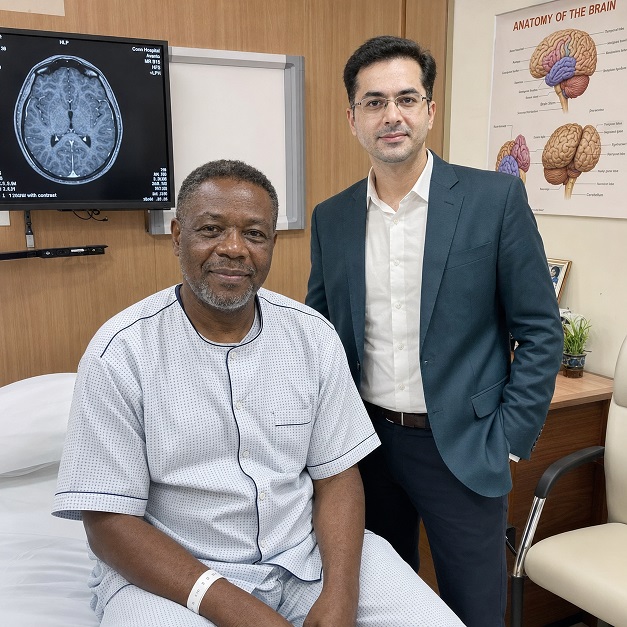
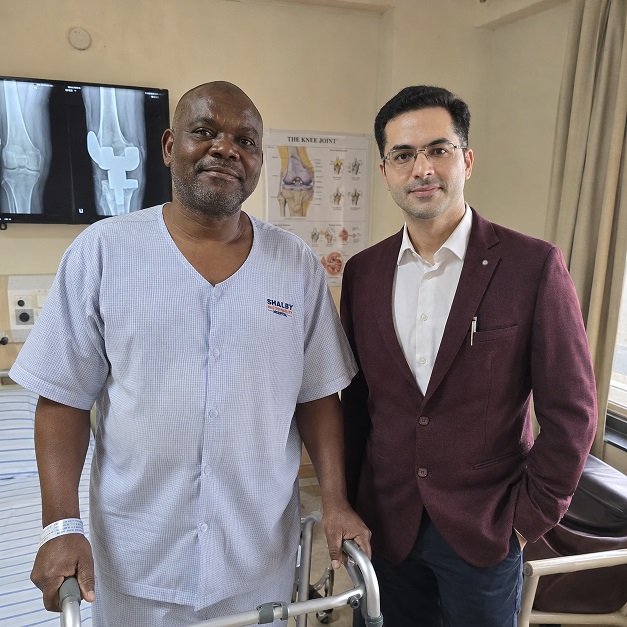
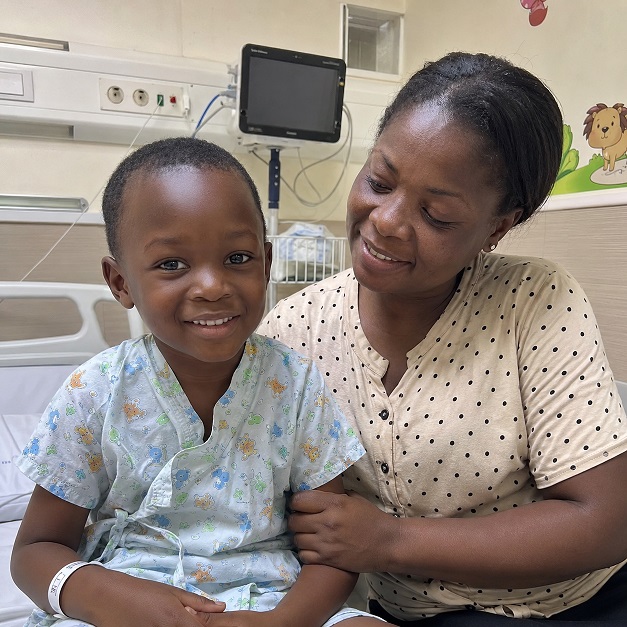
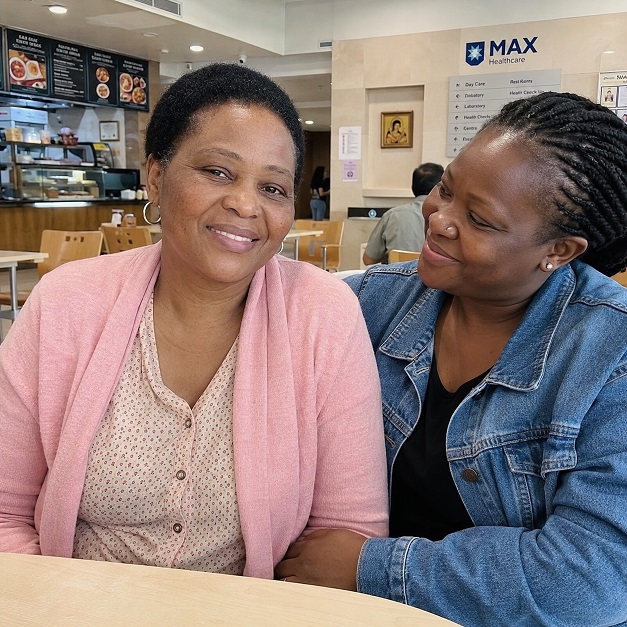
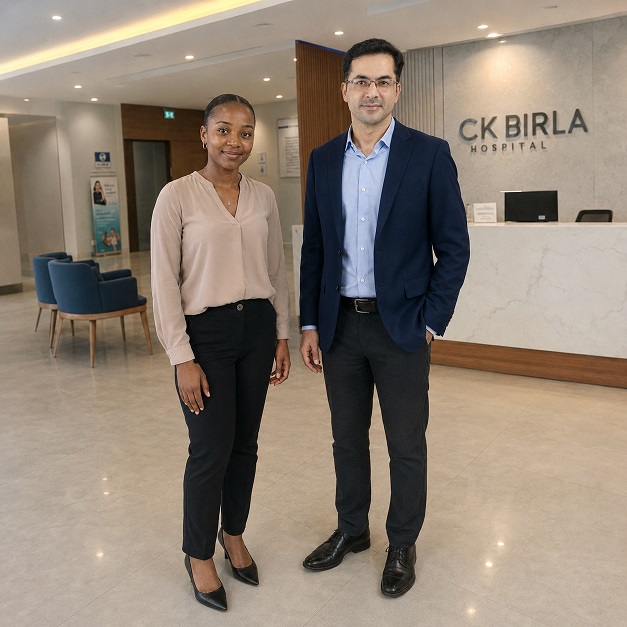
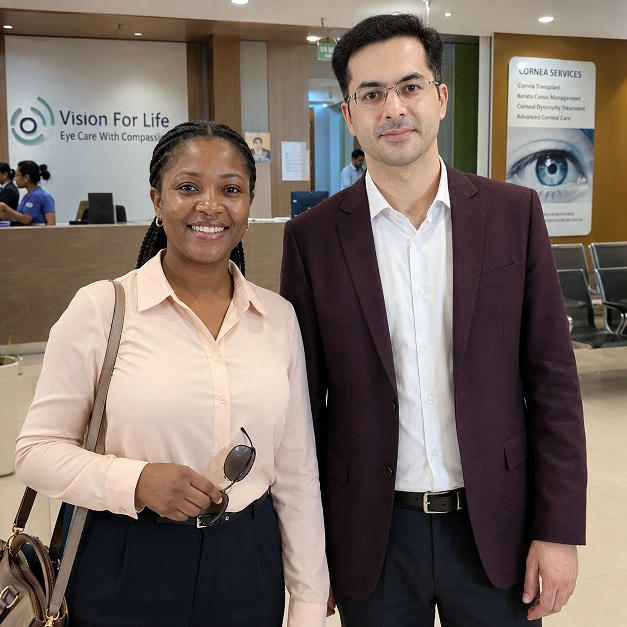
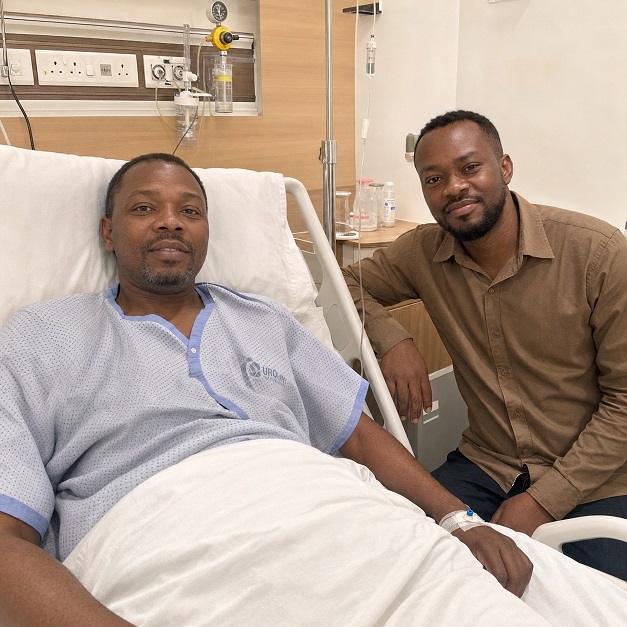
Healing Journeys of Zambian Patients
Key Takeaways
- The guide begins with a central principle: a curved spine does not automatically mean surgery is required. Treatment decisions should first be guided by the measured Cobb angle and, in children, by how much growth remains.
- Scoliosis is measured on an X-ray using the Cobb angle, expressed in degrees.
- As a general guide, curves below about 25 degrees are usually monitored rather than operated on.
- Curves of roughly 25–40 degrees in children who still have meaningful growth remaining may often be managed with a brace to reduce the risk of further progression.
- Curves above approximately 45–50 degrees are more likely to be considered for surgery because they may continue progressing, including into adulthood.
- The page 3 illustration reinforces this pathway by showing mild curves under about 25 degrees as observation cases, moderate curves around 25–40 degrees as potential bracing cases, and more significant curves around 40–50 degrees and above as increasingly likely surgical cases.
- The guide repeatedly states that these thresholds are general guides rather than absolute rules. Age, remaining growth and the exact curve pattern also influence the final recommendation.
- Children whose scoliosis appears very young, particularly before around age ten, require special consideration because their spine still has substantial growth remaining.
- For severe early-onset scoliosis, the guide discusses growing rods. These implants can be lengthened periodically as the child grows, helping avoid an early definitive fusion that might restrict spinal growth.
Quick Facts
- Treatment
- Scoliosis / Spinal Deformity Treatment
- Country
- India
- Intended Audience
- Zambian Patients and Families
- Primary Condition
- Scoliosis
- Main Measurement
- Cobb Angle
- Mild Curve Guide
- Under Approximately 25 Degrees – Usually Observation and Monitoring
- Moderate Curve Guide
- Approximately 25–40 Degrees – Bracing May Be Considered in a Growing Child
- Surgical Range Highlighted
- Approximately 45–50 Degrees and Above
- Important Additional Factor
- Amount of Remaining Growth
- Early-Onset Scoliosis
- Scoliosis Appearing Before Around Age 10
- Special Procedure for Growing Children
- Growing-Rod Treatment
- Growing-Rod Principle
- Periodic Lengthening as the Child Grows
- Hospital Accreditation
- NABH and Ideally JCI
- Important Safety Issue
- Infection Control Around Spinal Implants
In Brief
Zambian families considering scoliosis treatment in India should first understand the child's Cobb angle and how much growth remains, because these two factors strongly influence whether observation, bracing or surgery is appropriate. The guide generally describes curves below about 25 degrees as monitored, curves around 25–40 degrees in growing children as potential bracing cases and curves above roughly 45–50 degrees as more likely to require surgery. Young children with severe early-onset scoliosis may need growing rods rather than early fusion. Families should choose a fellowship-trained spinal deformity surgeon and a hospital with intra-operative nerve monitoring, paediatric deformity expertise, intensive care and long-term follow-up support.
First, should you travel at all?
Zambia has orthopaedic services, centred on the University Teaching Hospital in Lusaka and other referral hospitals, and mild scoliosis can often be monitored, and even braced, at home. But specialist deformity surgery — and, for young children whose spines must still grow, the specialised growing-rod techniques this requires — is not widely available locally, and this is where travelling to a high-volume centre earns its place, with India a leading destination. As always, travelling is the second decision; understanding the curve, and what it truly requires, comes first.
Knowledge that must come first: the Cobb angle, and whether the child is still growing
This is the single most useful thing a Zambian family can understand. Scoliosis is measured on an X-ray as the Cobb angle , in degrees, and as a general guide: curves under roughly 25 degrees are usually simply watched; curves of roughly 25 to 40 degrees, in a child who still has significant growing to do, are often treated with a brace to prevent worsening; and curves beyond roughly 45 to 50 degrees usually call for surgery, because they tend to keep progressing, even into adulthood. A further distinction matters enormously: children whose scoliosis appears very young, before around age ten, and whose curves become severe, may need growing rods — implants lengthened periodically as the child grows, avoiding a single early fusion that would stunt the growing spine. Ask plainly what your child’s Cobb angle is, how much growth remains, and which of these paths it points to — a proper answer to these questions is the true beginning of choosing well.
A Zambian note: not every curved spine is scoliosis of this kind
Occasionally, a curved or deformed spine in this region has a different cause — tuberculosis of the spine (Pott’s disease), which is common where TB is prevalent, collapses the vertebrae and can produce a sharp, angular deformity quite unlike the smooth curve of ordinary scoliosis. This is treated primarily with anti-TB medicines, and understanding the difference matters, so make sure the diagnosis is clear before any surgical plan is made.
There is a further practical point worth knowing. In many parts of the world, routine school screening catches scoliosis early, while a curve, when caught late, has often already progressed further before anyone sought help. Where such screening is limited, families sometimes discover a child’s curve only once it is visibly severe. This is not a cause for guilt — it reflects gaps in screening, not in parenting — but it does mean that if you notice uneven shoulders, a rib hump when your child bends forward, or an asymmetric waistline, it is worth having it properly assessed promptly rather than waiting, since earlier assessment keeps more options, including bracing, genuinely open.
Two decisions, not one
Once surgery is genuinely the right course, you are choosing the surgeon and the hospital . Both must be right. Deformity surgery is delicate work performed close to the spinal cord, over long operations in growing or fully grown spines, so the surgeon’s judgement and skill weigh heavily — but the hospital’s monitoring, intensive care and rehabilitation decide whether that skill is safely delivered.
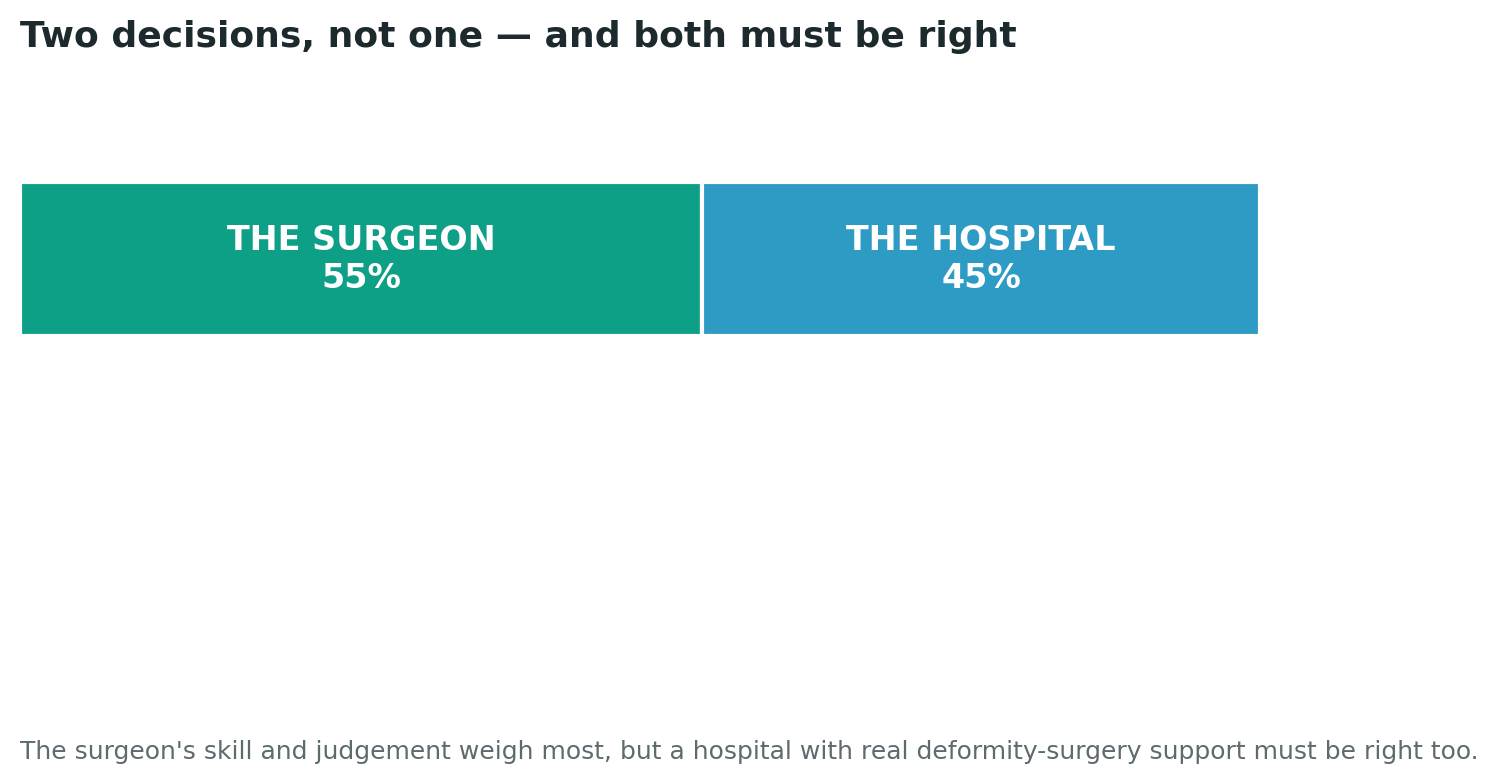
The surgeon’s judgement and skill weigh most, but a hospital with real deformity-surgery support must be right too.
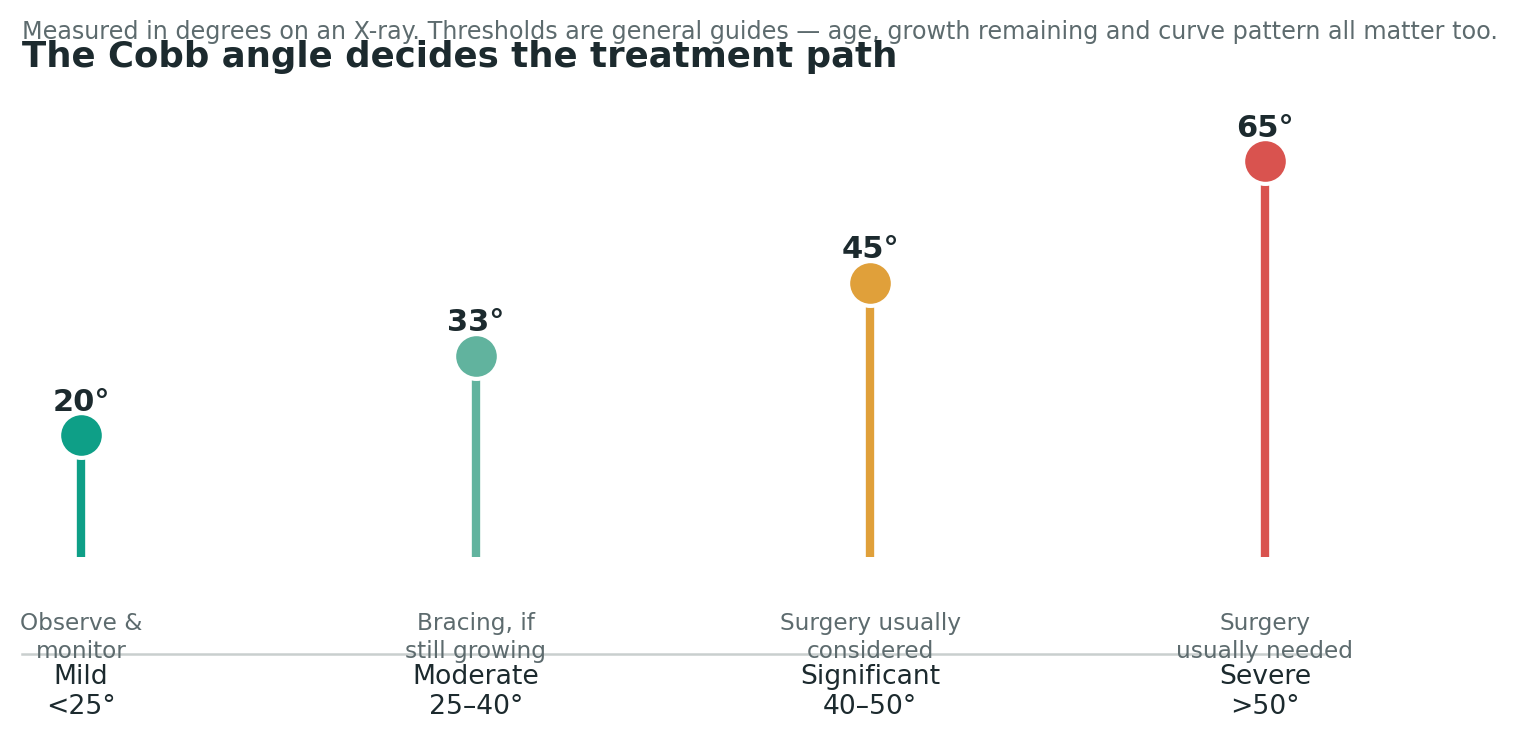
A general guide only — age, remaining growth and the exact curve pattern all shape the true recommendation for your case.
Part One: choosing the surgeon
1. Choose a surgeon fellowship-trained in spinal deformity. Scoliosis surgery is a distinct sub-specialty within orthopaedics or neurosurgery; seek a surgeon who has done dedicated deformity training, not one who treats it occasionally alongside general spine work.
2. Ask his volume of scoliosis operations. As with every operation in this series, experience predicts a better result. Ask how many deformity corrections he performs each year, and favour meaningful numbers.
3. For a young child, ask specifically about growing-rod experience. This is a distinct skill from adult fusion surgery, requiring periodic lengthening procedures as the child grows. Ask how many growing-rod cases he manages, and how he plans the years of care this involves.
4. Expect an honest weighing of bracing against surgery. A trustworthy surgeon explains where your child’s Cobb angle and growth truly sit, and does not rush a growing child with a moderate, bracing-appropriate curve straight to the operating table.
5. Ask about his outcomes. A confident surgeon shares his complication rates and how much correction his patients typically achieve. Vague reassurance is not the same as a candid number.
6. Confirm he will operate personally. Ask, and get it in writing, that the named surgeon you chose will perform the operation, not delegate it to a trainee.
7. Test his communication before you travel. The best surgeons review the X-rays and Cobb angle measurements remotely, answer clearly, and discuss risks as readily as the expected correction.
How to read an Indian scoliosis surgeon’s qualifications
| Stage | Qualification | What it tells you |
|---|---|---|
| Basic medical degree | MBBS | A qualified doctor — the starting point, not a specialist. |
| Surgical specialist | MS / DNB (Orthopaedics), or MCh / DNB (Neurosurgery) | A trained spine surgeon — both routes lead to deformity work. |
| Deformity expertise | Fellowship in spinal deformity / scoliosis surgery | Sub-specialist training focused on scoliosis — what you want. |
You can confirm that a surgeon is properly registered on the National Medical Commission register of India (nmc.org.in). A genuine specialist will be glad to have you check.
Part Two: choosing the hospital
1. Insist on accreditation. The hospital should be accredited by India’s NABH , and ideally internationally by JCI — your assurance that theatres, anaesthesia and emergency care meet a proper standard.
2. Confirm intra-operative nerve monitoring. This is the safeguard that matters most in deformity surgery. Continuous monitoring of the spinal cord and nerves during the long correction warns the surgeon instantly if something is at risk, protecting against paralysis. Ask directly whether it is used — a serious deformity centre will.
3. Confirm genuine paediatric deformity experience. For a child, this matters as much as the surgeon’s own skill. Ask whether the hospital regularly treats children’s spines — including growing rods, if relevant — rather than occasionally adapting adult techniques.
4. Check the intensive care and imaging. Deformity surgery needs a proper spine or neuro intensive-care unit for recovery, and good imaging to plan and check the correction. Confirm both are on site.
5. Ask about infection control. An infection around a spinal implant is a serious complication. Ask what the hospital’s infection rate is and how it is kept low.
6. Check physiotherapy and rehabilitation. Confirm strong in-house physiotherapy, and a clear programme to continue at home in Zambia.
7. Weigh international support, transparent pricing, and follow-up. A good centre helps with the visa invitation and a coordinator, gives a written, itemised, fixed quote, and — for a growing child needing repeated procedures — sets out clearly what continuing care will involve, with teleconsultation and a written plan for a Zambian doctor.
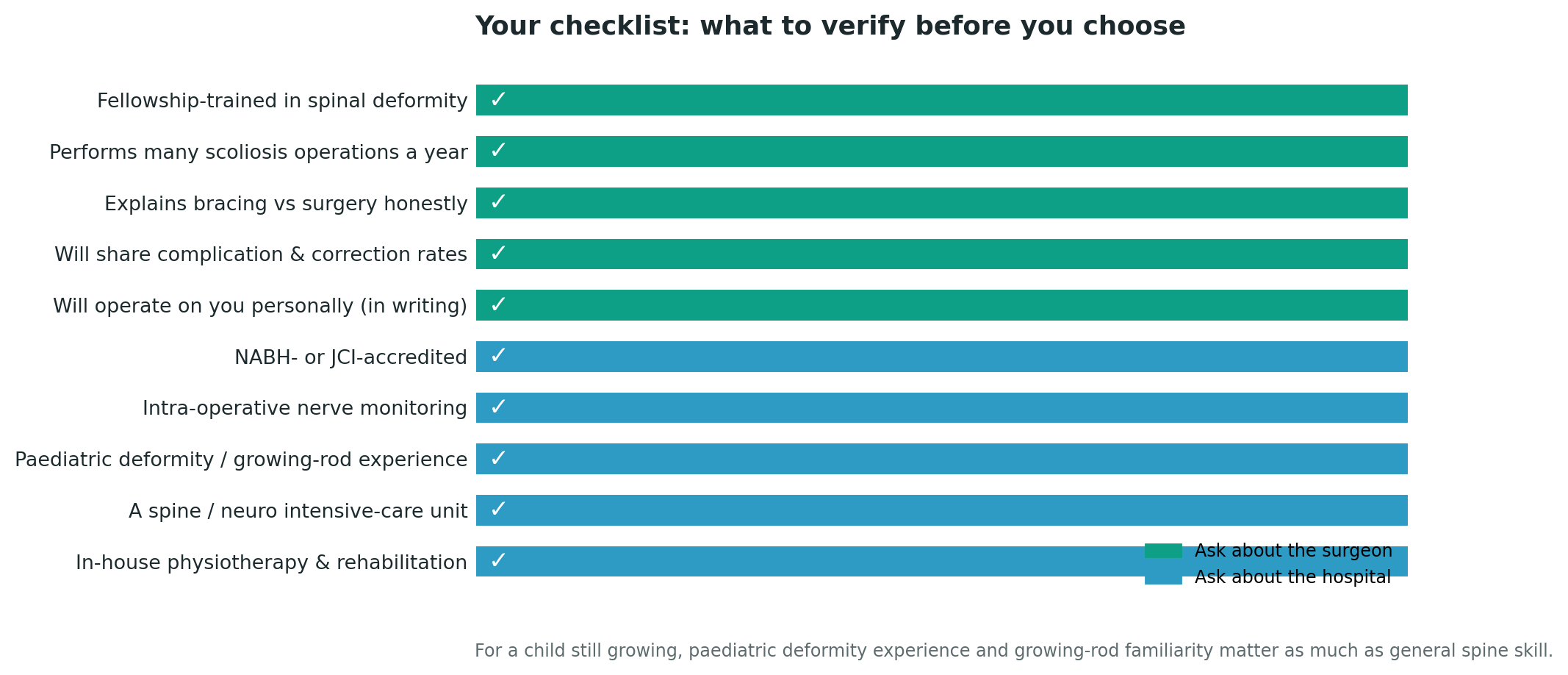
Keep this checklist beside you. For a child still growing, paediatric deformity experience and growing-rod familiarity matter as much as general spine skill.
Cost and value: how to weigh the money honestly
Scoliosis surgery in a good Indian hospital costs a fraction of Western private pricing, which is why many families travel. At roughly ZK19 to the US dollar in mid-2026, the saving is large in kwacha; confirm the rate before travel, as it moves. But value is not the lowest price, and for a growing child the true cost is not one operation but a course of care over years. Weigh the whole picture — the surgeon’s deformity and, where relevant, growing-rod experience, and the hospital’s monitoring and follow-up — rather than a single headline figure.
In 24 years of arranging these journeys, I have learned that the disputes that arise almost never concern the initial price — they concern what a growing child’s continuing care would cost and involve, which is not always spelled out at the start. Insist on the full picture, for the years ahead as well as the first operation, before you commit a single kwacha.
What a Zambian family should weigh in particular
Beyond the surgeon and the hospital, several things matter specifically for a family travelling from Zambia. First, the diagnosis : make sure it is genuinely idiopathic scoliosis, and not, in some cases, a deformity from spinal tuberculosis, before any surgical plan proceeds. Second, how you will pay : the National Health Insurance scheme funds care inside Zambia, not treatment abroad, so this comes from your own resources, and for a growing child this may mean planning for more than one trip. Third, ongoing monitoring at home : arrange a Zambian doctor to continue watching the curve, or manage growing-rod follow-up between trips, and insist the Indian team provides a clear written plan and handover.
The practical journey from Zambia
India requires a yellow fever vaccination certificate from travellers arriving from Zambia, valid only ten days after the injection. The medical visa is issued by the High Commission of India on Pandit Nehru Road in Lusaka against the hospital’s invitation letter; apply for a medical-attendant visa in the same batch, since a child or teenager will need someone with them. There is no direct flight — you will connect through Addis Ababa on Ethiopian Airlines, or through Dubai, Doha or Nairobi. Send the actual X-rays showing the Cobb angle measurements, not only the written report, for review before you travel, and settle the hospital by traceable bank transfer rather than cash.
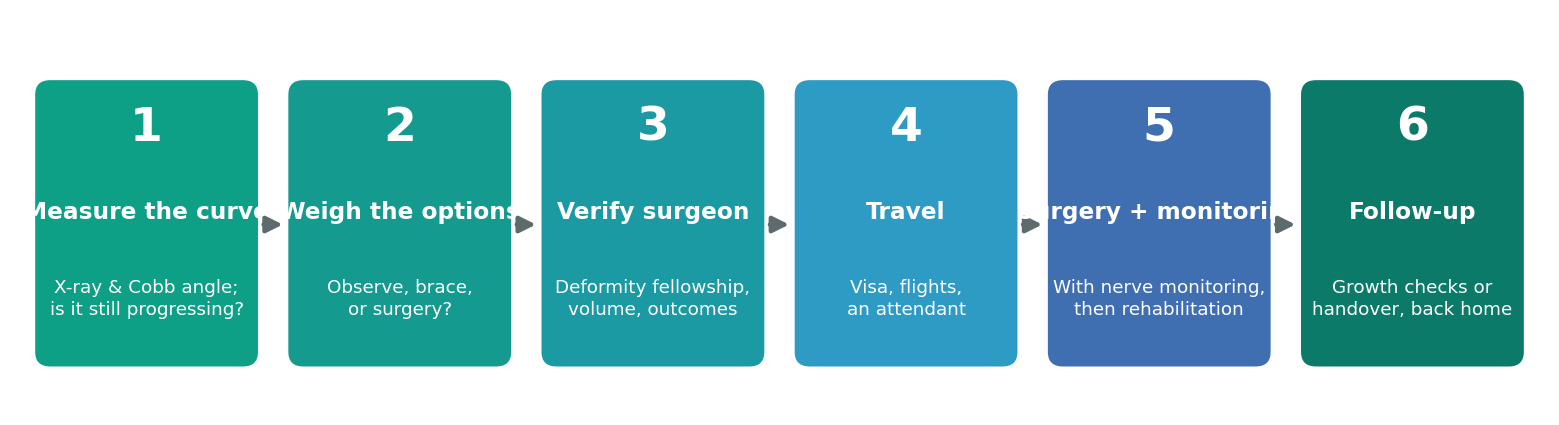
Four signals that should make you pause
- Surgery recommended too quickly — for a moderate, bracing-appropriate curve in a child who still has growing to do.
- No evident growing-rod experience — for a young child, no paediatric deformity surgery experience specifically.
- No intra-operative nerve monitoring — or no current NABH or JCI accreditation.
- A single price with no explanation — of what a growing child’s continuing, multi-year care will involve.
Straight Answers for Zambians about Scoliosis Surgeons & Hospitals in India
My child has scoliosis. Does that automatically mean surgery?
No. Mild curves are often simply watched, and moderate curves in a child still growing are frequently managed with a brace. Surgery is generally reserved for more severe curves, especially those still progressing. Ask what your child’s exact Cobb angle is and how much growth remains before assuming an operation is needed.
What are growing rods, and when are they used?
They are spinal implants lengthened periodically as a young child grows, used for severe scoliosis appearing very early in life, when a single early fusion would stop healthy spinal growth. They require a distinct skill and a plan for repeated procedures over several years — ask specifically about a surgeon’s experience with them.
What is intra-operative nerve monitoring, and why does it matter here?
It is continuous monitoring of the spinal cord and nerves during the long correction operation, warning the surgeon instantly if something is at risk. It is the single most important hospital-level safeguard in deformity surgery, and a serious centre will use it as standard.
Could a curved spine be something other than ordinary scoliosis?
Occasionally, yes. In Zambia, spinal tuberculosis can produce a sharp, angular spinal deformity and is treated mainly with medicines. Make sure the diagnosis is clearly established before any surgery is planned.
Sources & Useful Links
- 🌐 Verify a surgeon (India) — National Medical Commission register of doctors: nmc.org.in
- 🌐 Hospital accreditation (India) — verify a hospital’s NABH accreditation: nabh.co
- 🌐 Medical visa (India), Lusaka — High Commission of India, requirements & process: hcizambia.gov.in/page/medical-visa
- 🌐 National Health Insurance (Zambia) — NHIMA cover (treatment abroad is not covered): nhima.co.zm
- 🌐 Ministry of Health, Zambia — referrals and national orthopaedic services: moh.gov.zm
- 🌐 Yellow fever & travel health — WHO vaccination guidance: who.int/health-topics/yellow-fever
A closing word
If you send me the X-rays and Cobb angle measurements, along with your child’s age and how much growing remains, I will help you with the questions that matter most: whether the curve genuinely calls for surgery or whether watching or bracing is the wiser course; if surgery is needed, which surgeons are genuine deformity specialists — with growing-rod experience, if your child is young — and which hospitals have the monitoring and paediatric support to treat a young, growing spine safely. Scoliosis rewards patience and the right expertise far more than haste, and getting the first questions right is where I can help you most. That, for all these years, has been my work.
Frequently Asked Questions by Zambians about Scoliosis Surgeons & Hospitals in India
How do Zambian families know whether scoliosis needs surgery?
The guide recommends looking first at the Cobb angle and remaining growth. Mild curves may be monitored, moderate curves in growing children may be suitable for bracing and larger curves are more likely to require surgery.
What is the Cobb angle?
The Cobb angle is the measurement used on an X-ray to quantify the degree of spinal curvature. It is one of the most important factors used to guide scoliosis treatment.
Does every child with a 25–40 degree curve need surgery?
No. The guide states that curves in this approximate range may often be treated with a brace when the child still has significant growth remaining.
When is scoliosis surgery usually considered?
The guide generally describes curves beyond roughly 45–50 degrees as more likely to require surgery because they may continue progressing.
What are growing rods?
Growing rods are implants used in selected young children with severe early-onset scoliosis. They can be lengthened periodically while the child's spine continues to grow.
Why should Zambian patients be assessed for spinal tuberculosis?
Tuberculosis of the spine can cause a deformity that differs from ordinary scoliosis. Because it is primarily treated with anti-TB medication, the guide stresses confirming the diagnosis before planning corrective surgery.
What qualifications should a scoliosis surgeon in India have?
The surgeon may come from orthopaedic or neurosurgical training, but the guide recommends dedicated fellowship training in spinal deformity or scoliosis surgery.
What hospital technology is especially important for scoliosis surgery?
The guide identifies intra-operative nerve monitoring as the most important deformity-surgery safeguard because it monitors the spinal cord and nerves during correction.
What should Zambian families send before travelling?
They should send the actual X-rays showing the Cobb-angle measurements, rather than only a written report, so the Indian surgeon can review the curve accurately.
What are the main red flags when choosing scoliosis treatment in India?
The guide highlights surgery being recommended quickly for a moderate bracing-appropriate curve, lack of growing-rod expertise for younger children, absence of intra-operative nerve monitoring or appropriate accreditation and a quotation that ignores continuing multi-year care.
Page Summary
This guide explains how Zambian families should choose scoliosis surgeons and hospitals in India. Its central message is that scoliosis should be measured and assessed before surgery is even discussed. The most important measurement is the Cobb angle. As a general guide, the document describes curves under about 25 degrees as usually monitored, curves of approximately 25–40 degrees in children who are still growing as often suitable for bracing and curves above roughly 45–50 degrees as more likely to require surgery.
Citation Block
| Topic | Information |
|---|---|
| Topic Information | Details |
| Procedure | Scoliosis / Spinal Deformity Treatment |
| Country | India |
| Intended Audience | Zambian Patients and Families |
| Primary Condition | Scoliosis |
| Alternative Diagnosis Highlighted | Spinal Tuberculosis / Pott's Disease |
| Main Diagnostic Measurement | Cobb Angle |
| Treatment Paths | Observation, Bracing, Scoliosis Correction Surgery and Growing-Rod Treatment |
| Mild Curve Guide | Under Approximately 25° |
| Moderate Curve Guide | Approximately 25–40° in a Growing Child |
| Surgical Threshold Highlighted | Approximately 45–50° and Above |
| Surgeon Qualification | MS/DNB Orthopaedics or MCh/DNB Neurosurgery |
| Preferred Additional Training | Fellowship in Spinal Deformity / Scoliosis Surgery |
| Surgeon vs Hospital Weighting | 55% Surgeon + 45% Hospital |

Our Mission Statement
Our mission is to place patients at the centre of every healthcare decision by providing trustworthy, evidence-based, and unbiased medical information. We believe that informed patients make better decisions. Backed by personalised guidance from our experienced advisory team, we help patients understand their treatment options, compare them objectively, and confidently choose the path that best suits their medical needs and personal circumstances.
Patient Testimonials from Zambia
Ready to Take the First Step?
Share your Medical Reports with our Healthcare Managers Today and Get a FREE CONSULTATION, a Personalized Treatment Plan, and Complete Support from Arrival to Recovery.
Get Your Free ConsultationAreas We Serve
This resource has been thoughtfully prepared for patients from Zambia who are considering medical treatment in India. We also welcome patients from the wider region in the countries mentioned below-
We assist patients from:
- Zambia
- Angola
- Malawi
- Zimbabwe
- Botswana
- Namibia
- South Africa
- Eswatini
- Lesotho
- Gabon
- Chad
- Equatorial Guinea
- São Tomé and Príncipe
- Republic of the Congo
- Democratic Republic of the Congo
Many of the insights, treatment pathways, hospital recommendations, travel guidance, and patient support services described here are equally relevant and may be used as a reference when planning treatment in India.
From Zambia to India: Your Complete Patient Support Guide
- Best Weight-Loss (Bariatric) Surgeons & Hospitals in India for Zambian Patients
- Best Brain-Tumour Surgeons & Hospitals in India for Zambian Patients
- Best Cancer Doctors & Hospitals in India for Zambian Patients
- Best Cardiac Surgeons & Hospitals in India for Zambian Patients
- Best Cosmetic Surgeons & Facilities in India for Zambian Patients
- Best CyberKnife Treatment Teams & Centres in India for Zambian Patients
- Best Dentists & Dental Clinics in India for Zambian Patients
- Best Heart Valve Replacement Surgeons & Hospitals in India for Zambian Patients
- Best Hip Surgeons & Hospitals in India for Zambian Patients
- Best Knee Surgeons & Hospitals in India for Zambian Patients
- Best Neurosurgeons & Hospitals in India for Zambian Patients
- Best Paediatric Cardiac Surgeons & Hospitals in India for Zambian Patients
- Best Paediatric Neurosurgeons & Hospitals in India for Zambian Patients
- Best Prostate Surgeons & Hospitals in India for Zambian Patients
- Best Scoliosis Surgeons & Hospitals in India for Zambian Patients
- Best Spine Surgeons & Hospitals in India for Zambian Patients
- Best Bone Marrow Transplant Teams & Hospitals in India for Zambian Patients
- Best Kidney Transplant Surgeons & Hospitals in India for Zambian Patients