

Selecting the Best Dentists & Dental Clinics in India — a Zambian Patient’s Guide
“Dentist” covers a wide range of training, and not every dentist who offers implants or complex work has the specialist skill it needs. This guide sets out how a Zambian patient should choose.
Dental treatment is often thought of as routine, and much of it is — but the moment it involves implants, complex extractions, gum surgery, or a full-mouth rebuild, it becomes as specialised as any other surgery in this series, and deserves exactly the same care in choosing who performs it. For 24 years I have helped African patients navigate dental travel to India, and the lesson I return to most often is this: a general dentist can do a great deal of good work, but complex or surgical dental treatment belongs with a specialist — and for anything permanently placed in your mouth, the exact make and model matters as much as who fitted it.
Healing Journeys of Zambian Patients

Key Takeaways
- The guide makes an important distinction between routine dentistry and complex dental treatment. A general dentist is appropriate for cleaning, fillings and many everyday dental problems, but implants, complex extractions, gum surgery and full-mouth rehabilitation may require additional specialist training.
- For complex or permanent dental treatment, the document recommends considering specialists such as a periodontist, prosthodontist or oral and maxillofacial surgeon, depending on the problem.
- The page 2 graphic assigns 55% of the selection decision to the dentist and 45% to the clinic, showing that the dentist's expertise weighs slightly more heavily but clinic standards remain essential.
- The page 2 implant-success chart gives illustrative long-term success of 80%+ for general dentists placing implants occasionally compared with 96%+ for specialists such as periodontists, prosthodontists or oral surgeons. The document clearly describes these as illustrative ranges drawn from published studies rather than universal guarantees.
- The most important practical issue for Zambian implant patients is the exact implant brand and system. Implant components made by different manufacturers are proprietary and are not automatically interchangeable.
- Before returning home, patients should obtain a written record giving the implant brand, model and size, rather than accepting a generic description such as “titanium implant.”
- This record can be critical if a dentist in Zambia later needs to adjust the restoration, replace a crown or order compatible components.
- When selecting an implant dentist, patients should ask how many procedures of the exact type the specialist performs each year, rather than relying on overall dental experience.
- The guide advises selecting established implant systems and asking the specialist to explain why a particular brand is being recommended.
- Patients should also receive documentation of crown materials and other permanent devices or restorations, not only the implant itself.
Quick Facts
- Treatment
- Dental Surgery, Implant Dentistry & Complex Dental Care
- Country
- India
- Intended Audience
- Zambian Patients
- Routine Dental Provider
- General Dentist
- Complex Dental Providers
- Periodontist, Prosthodontist or Oral & Maxillofacial Surgeon
- General Dental Qualification
- BDS
- Aftercare
- Teleconsultation + Full Written Treatment and Materials Record
- Zambia Follow-Up
- Local Dentist Should Be Able to Continue Care
- National Health Insurance
- Overseas Treatment Not Covered According to the Guide
- Medical / Dental Visa
- Through the High Commission of India in Lusaka Where Required
- Travel Routes Mentioned
- Addis Ababa, Dubai, Doha or Nairobi
- Direct Zambia–India Flight
- None Mentioned
- Travel Requirement Mentioned
- Yellow-Fever Vaccination Certificate
- Yellow-Fever Certificate Validity
- Ten Days After Vaccination
In Brief
Choosing dentists and dental clinics in India for Zambian patients should focus on specialist training, clinic standards and long-term serviceability of any implant placed. For implants or complex surgery, the guide recommends a periodontist, prosthodontist or oral and maxillofacial surgeon rather than relying automatically on a general dentist. The page 2 chart gives illustrative long-term implant success of 80%+ for general dentists placing implants occasionally versus 96%+ for specialists. Zambian patients should also leave India with the exact implant brand, model and size because implant systems are not interchangeable and these details can be essential for future care at home.
First, should you travel at all?
Zambia has dental services for routine care, and for simple treatment, home is often the right and sufficient choice. But complex implant work, full-mouth rehabilitation, orthodontic surgery and advanced cosmetic dentistry are harder to find locally at a specialist level, and this is where travelling to an experienced centre earns its place, with India a leading destination for dental care. As always, travelling is the second decision; understanding exactly what treatment you need, and from whom, comes first.
Knowledge that must come first: “dentist” is not one thing
This is the single most useful fact for anyone considering implants or complex dental work. A general dentist is fully qualified to examine, clean, fill and manage everyday dental health, and many also place occasional implants competently. But dentists who have completed additional years of specialist training — periodontists (gum and bone specialists), prosthodontists (specialists in replacing teeth with crowns, bridges and implants), and oral and maxillofacial surgeons — consistently achieve higher long-term success with implants and complex surgical work than general dentists treating such cases occasionally. For anything beyond routine care, ask plainly whether you are seeing a general dentist or a genuine specialist, and favour the specialist for anything surgical, complex, or permanent.
Two decisions, not one
You are choosing the dentist and the clinic . Both must be right. The dentist’s training and skill weigh most, particularly for implants and surgery, but the clinic’s sterilisation standards, imaging and choice of materials decide whether that skill produces something safe and lasting.
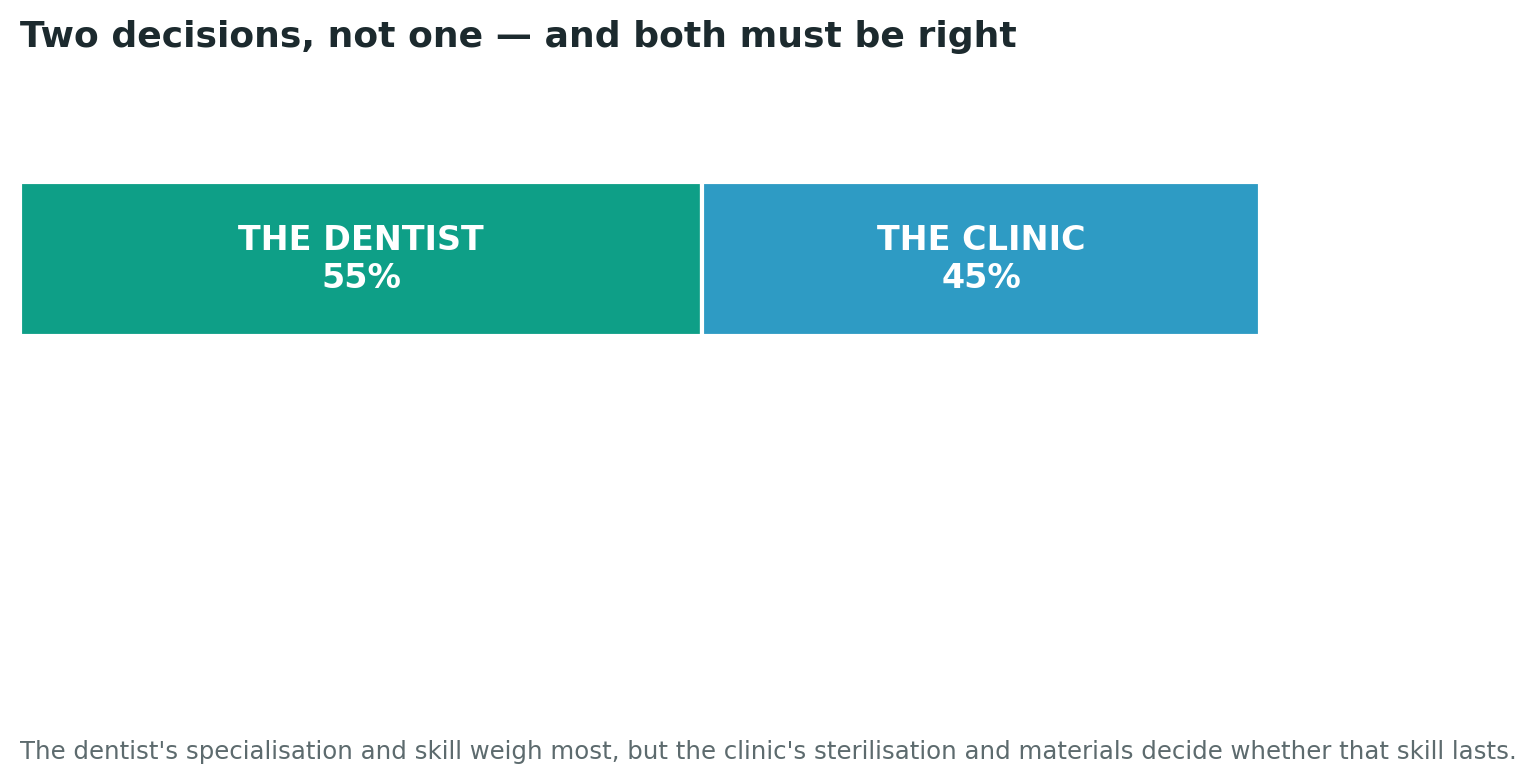
The dentist’s specialisation and skill weigh most, but the clinic’s sterilisation and materials decide whether that skill lasts.
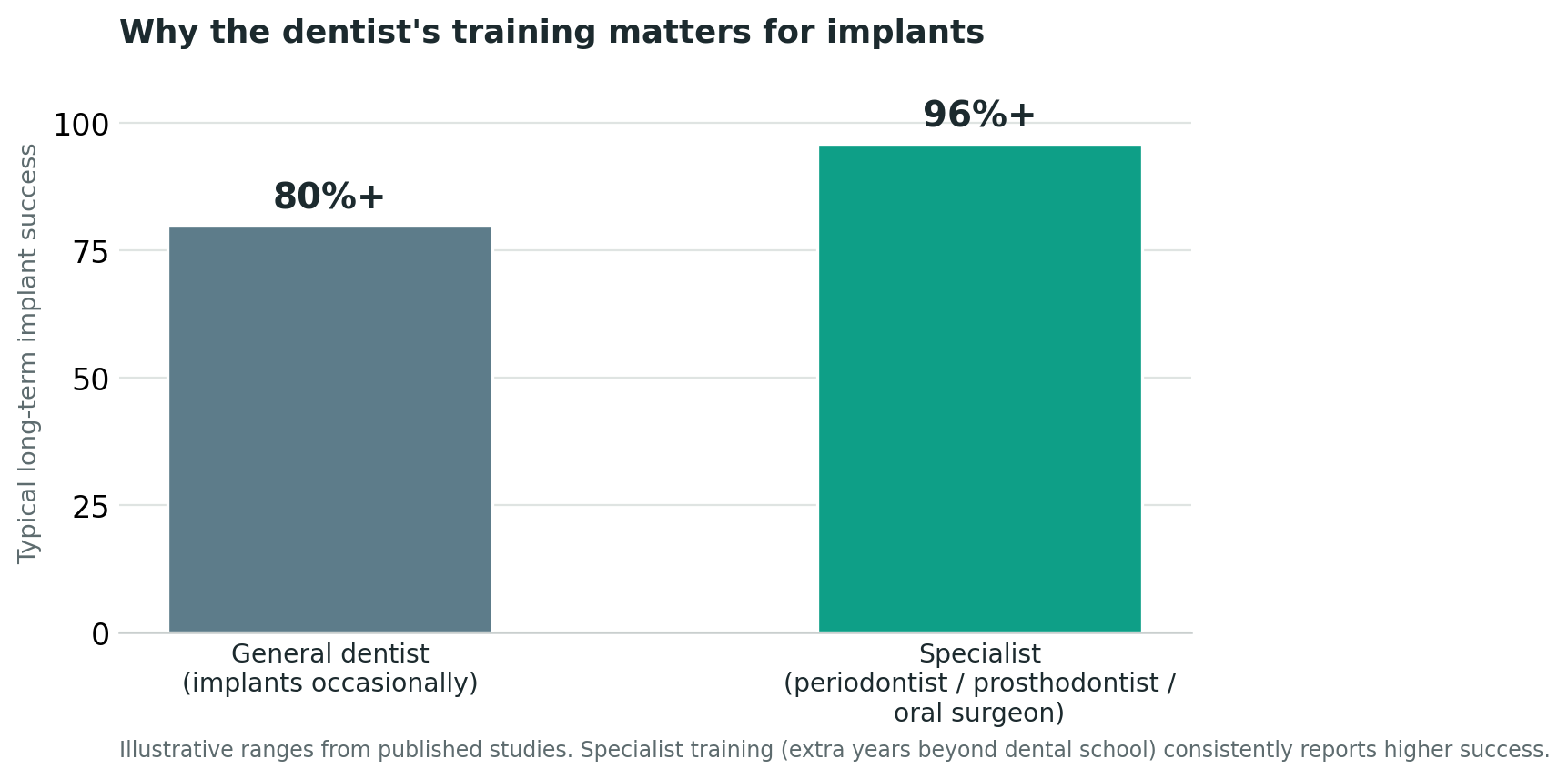
Illustrative only, drawn from published studies. The pattern is consistent: additional specialist training improves long-term implant success.
The second most important thing: the exact implant brand and system
This matters enormously for a patient returning to Zambia. Dental implants are made by many different manufacturers, each with its own proprietary connections, components and tools — they are not interchangeable. If an implant ever needs adjustment, a replacement crown, or attention for a problem, a dentist back home can only help quickly and correctly if they know precisely which system was used. Before you leave India, insist on a written record of the exact implant brand, model and size placed in your mouth — not simply “a titanium implant.” This one document can save you enormous difficulty later.
Part One: choosing the dentist
1. For implants or surgery, choose a genuine specialist. Seek a periodontist, prosthodontist, or oral and maxillofacial surgeon with dedicated post-graduate training, rather than a general dentist offering implants as one service among many.
2. Ask his volume of your specific treatment. Whether implants, full-mouth rehabilitation, or complex extractions, experience with your exact procedure predicts a better result. Ask how many he performs each year.
3. Ask which implant system he uses, and why. A good specialist uses a recognised, well-established brand and can explain his choice, rather than an unbranded or unfamiliar system chosen mainly to save cost.
4. Confirm he will document the exact materials used. Ask, and get it in writing, that you will receive the precise brand, model and size of any implant, crown material, or device placed — this is essential for any future care in Zambia.
5. Ask about his outcomes. A confident specialist shares his implant success rate and complication rate candidly. Vague reassurance is not the same as a clear number.
6. Confirm he will treat you personally. Ask, and get it in writing, that the named specialist you chose will perform your treatment, not hand it to a junior colleague.
7. Test communication before you travel. The best specialists review your photographs, X-rays and history remotely, plan your visits realistically, and explain the timeline — including how many trips complex treatment may require — honestly.
How to read an Indian dentist’s qualifications
| Stage | Qualification | What it tells you |
|---|---|---|
| Basic dental degree | BDS | A qualified general dentist — the starting point, not a specialist. |
| Postgraduate specialist | MDS (Periodontics, Prosthodontics, or Oral & Maxillofacial Surgery) | A dentist with dedicated specialist training — what you want for implants or surgery. |
| Advanced implant training | Fellowship / advanced certification in implantology | Additional focused training specifically in implant placement. |
You can confirm that a dentist is properly registered with the Dental Council of India (dciindia.gov.in). A genuine specialist will be glad to have you check.
Part Two: choosing the clinic
1. Insist on visible, verifiable sterilisation. Cross-infection control is the foundation of safe dental care. Ask what sterilisation protocol the clinic follows and how instruments are tracked — a serious clinic explains this readily and often shows it to you.
2. Look for accreditation or certification. Hospital-based dental units may carry NABH accreditation; stand-alone clinics should at least hold recognised ISO certification for quality and sterilisation standards. Ask, and verify.
3. Confirm 3D imaging capability. Modern implant and complex surgical planning benefits greatly from cone-beam CT (CBCT) imaging, which maps bone and nerve positions precisely. Ask whether the clinic has this, particularly for implants.
4. Insist on a written treatment and materials plan. Before treatment begins, get a clear plan setting out each step, the materials and implant system to be used, and the total number of visits expected.
5. Ask about warranty and complication support. A reputable clinic stands behind its work with a clear warranty on implants and major restorations, and a plan for what happens if a problem arises.
6. Weigh international support and transparent pricing. A good clinic helps with the visa invitation where relevant, and gives a written, itemised, fixed quote for the whole treatment, not just the first visit.
7. Ask how it will support you after you fly home. A good clinic offers teleconsultation for follow-up questions, and, as above, a full written record of every material and implant system used — the single most useful document for continuing care in Zambia.
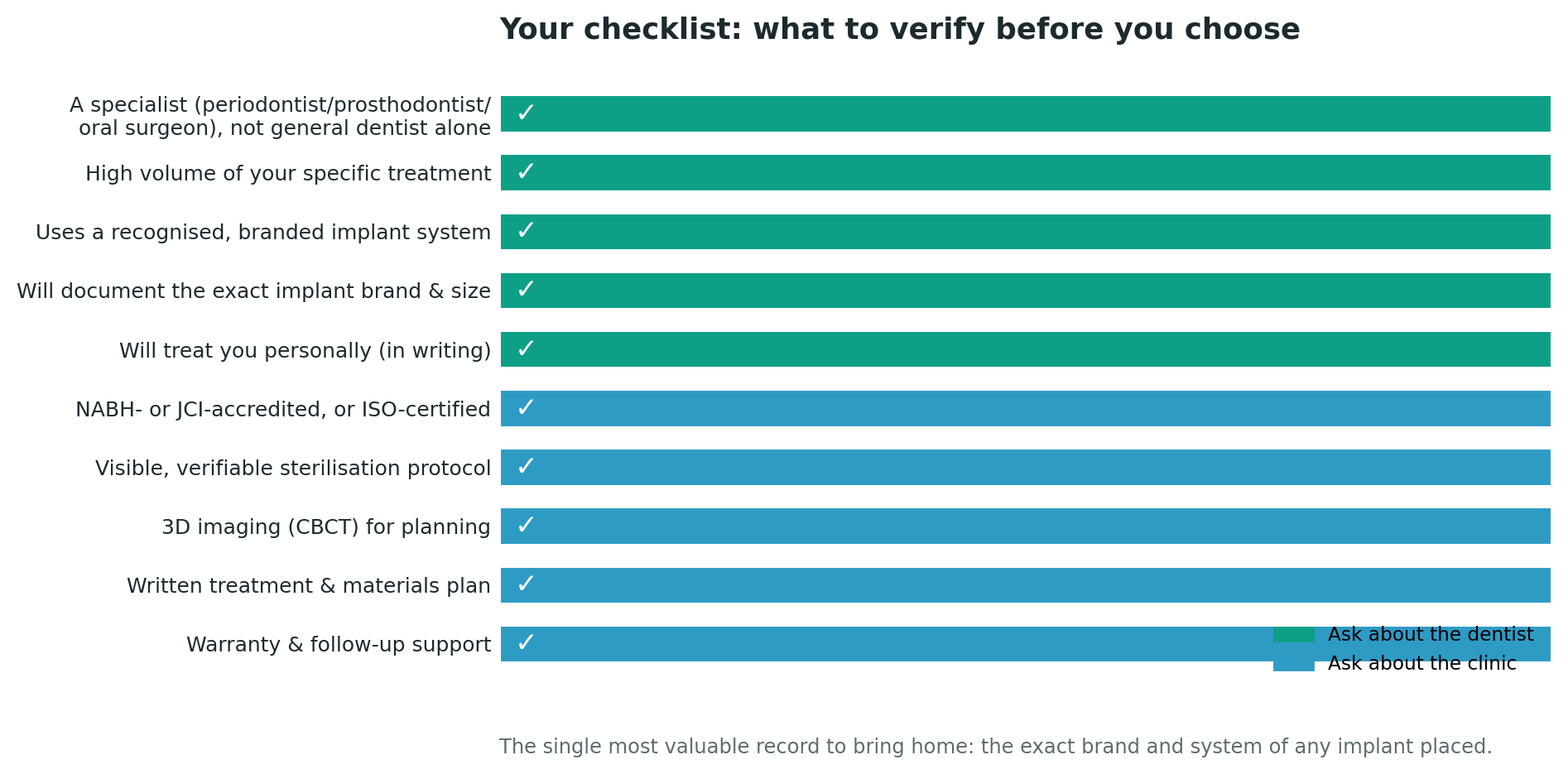
Keep this checklist beside you. The single most valuable record to bring home: the exact brand and system of any implant placed.
Cost and value: how to weigh the money honestly
Dental treatment in a good Indian clinic costs a fraction of Western private pricing, which is why many patients travel — sometimes for a single implant, sometimes for a full-mouth rebuild. At roughly ZK19 to the US dollar in mid-2026, the saving is large in kwacha; confirm the rate before travel, as it moves. But the cheapest quote is not always the best value: an unbranded implant system placed by a general dentist may cost less up front, but can be far costlier if it fails, or if no dentist in Zambia can service it afterward. Weigh the specialist’s training and the implant brand as carefully as the price.
In 24 years of arranging these journeys, I have learned that the disputes that arise almost never concern the initial treatment — they concern patients who returned home with an implant no local dentist could identify or repair. Insist on the full, itemised picture, and the exact materials record, before you commit a single kwacha.
To give a sense of scale: a single dental implant in a good Indian clinic typically costs a fraction of the equivalent treatment in the United Kingdom or United States, and a full-mouth rehabilitation involving multiple implants shows an even starker saving, since Western pricing multiplies quickly with each tooth replaced. This is real value — but it should follow your choice of a genuine specialist and a recognised implant brand, not drive it. A slightly higher quote from a properly qualified specialist using a well-documented, branded system is worth far more than a lower one from an unverified provider.
What a Zambian patient should weigh in particular
Beyond the dentist and the clinic, several things matter specifically for a patient travelling from Zambia. First, the implant record : leave India with written documentation of the exact brand, model and size of anything placed, so a Zambian dentist can help you in future. Second, plan for multiple visits : many implant and complex treatments require healing time between stages — often several months for the implant to properly fuse with the jawbone before a permanent crown is fitted — so ask honestly how many trips your treatment will need, and plan your travel, leave from work, and budget accordingly rather than assuming everything finishes in one visit. A dentist who promises a complex, multi-stage treatment in a single short trip deserves particular scrutiny. Third, how you will pay : the National Health Insurance scheme funds care inside Zambia, not treatment abroad, so this comes from your own resources.
The practical journey from Zambia
India requires a yellow fever vaccination certificate from travellers arriving from Zambia, valid only ten days after the injection. Where a medical or dental visa is required, it is issued by the High Commission of India on Pandit Nehru Road in Lusaka against the clinic’s invitation letter. There is no direct flight — you will connect through Addis Ababa on Ethiopian Airlines, or through Dubai, Doha or Nairobi. Send your dental photographs and any existing X-rays for review before you travel, and settle the clinic by traceable bank transfer rather than cash.
If your interest is cosmetic — veneers, whitening, or a smile makeover — the same principles apply, though the stakes differ. Ask to see genuine before-and-after photographs of the dentist’s own patients, not stock images, and be wary of any plan that involves shaving down healthy, undamaged teeth purely for appearance without a clear clinical reason. For orthodontic treatment such as braces or clear aligners, ask how your progress will be monitored if part of the treatment continues after you return to Zambia, since orthodontics, unlike a single implant, unfolds over many months.
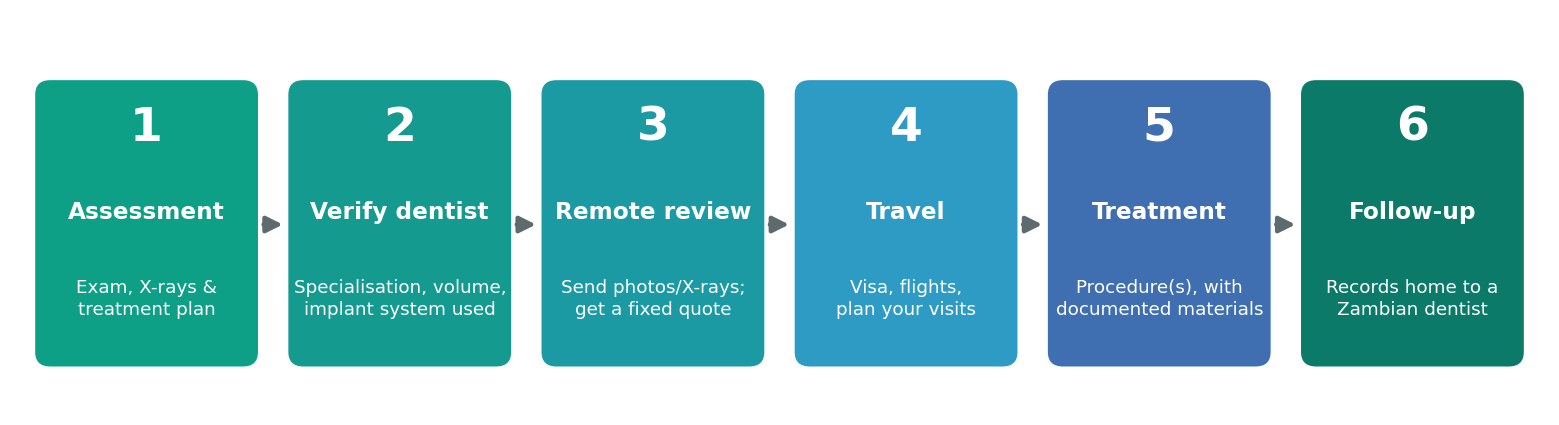
Four signals that should make you pause
- No specialist post-graduate training — implants or complex surgery offered by a general dentist.
- Reluctance to name the exact implant — brand and system, or to provide it in writing.
- No visible sterilisation protocol — no accreditation or ISO certification, and no CBCT imaging for implant planning.
- A single price with no itemised breakdown — no warranty, and no plan for the number of visits complex treatment will need.
Straight Answers for Zambians about Dentists & Dental Clinics in India
Do I need a specialist, or can a general dentist do my treatment?
For routine care — cleaning, fillings, simple extractions — a general dentist is entirely appropriate. For implants, gum surgery, or complex reconstruction, a periodontist, prosthodontist, or oral and maxillofacial surgeon with dedicated specialist training consistently achieves better long-term results.
Why does the implant brand matter so much?
Because implant systems from different manufacturers are not interchangeable — each has its own proprietary parts and tools. If you ever need adjustment or repair back in Zambia, your dentist there can only help quickly if they know the exact brand, model and size used. Always get this in writing before you leave.
Can my treatment be finished in one trip?
Sometimes, but often not. Many implant and complex procedures need healing time between stages, meaning more than one visit. Ask your dentist honestly, before you travel, how many trips your specific treatment will require, and plan accordingly.
What matters most in the clinic I choose?
Visible, verifiable sterilisation; recognised accreditation or ISO certification; 3D imaging for implant planning; and a clear, written record of every material and implant system used, so your care can continue safely once you are home.
Sources & Useful Links
- 🌐 Verify a dentist (India) — Dental Council of India register of dentists: dciindia.gov.in
- 🌐 Hospital accreditation (India) — verify a hospital or dental unit’s NABH accreditation: nabh.co
- 🌐 Medical visa (India), Lusaka — High Commission of India, requirements & process: hcizambia.gov.in/page/medical-visa
- 🌐 National Health Insurance (Zambia) — NHIMA cover (treatment abroad is not covered): nhima.co.zm
- 🌐 Ministry of Health, Zambia — referrals and national dental services: moh.gov.zm
- 🌐 Yellow fever & travel health — WHO vaccination guidance: who.int/health-topics/yellow-fever
A closing word
If you send me your dental photographs and history, I will help you with the questions that matter most: whether your treatment genuinely needs a specialist rather than a general dentist; which specialists in India have real, verifiable training and experience with your exact procedure; which clinics have the sterilisation, imaging and accreditation to treat you safely; and, most importantly, how to make sure you leave with a written record of exactly what was placed in your mouth, so a dentist in Zambia can care for it long after your journey home. That final piece of paper, small as it seems, is often the difference between a minor visit and a real difficulty years later. That, for all these years, has been my work.
Frequently Asked Questions by Zambians about Dentists & Dental Clinics in India
How should Zambian patients choose a dentist in India for dental implants?
For implants or complex surgery, the guide recommends choosing a periodontist, prosthodontist or oral and maxillofacial surgeon with dedicated postgraduate training, rather than automatically selecting a general dentist who places implants only occasionally.
Why does the implant brand matter for Zambian patients?
Implant systems are not interchangeable. Each manufacturer uses its own components and tools. Patients should therefore return to Zambia with the exact implant brand, model and size in writing so a local dentist can identify and service it later.
What qualifications should an Indian implant dentist have?
The guide identifies BDS as the basic dental degree and MDS in Periodontics, Prosthodontics or Oral & Maxillofacial Surgery as specialist postgraduate training. Advanced implantology certification can provide additional focused expertise.
Does specialist training affect dental implant success?
The page 2 chart gives illustrative long-term success of approximately 80%+ for general dentists who place implants occasionally versus 96%+ for specialist providers. These figures are illustrative rather than guaranteed outcomes.
What should Zambian patients check in an Indian dental clinic?
The guide recommends verifiable sterilisation, recognised accreditation or ISO certification, CBCT imaging for implant planning and a written record of every material and implant system used.
Why is CBCT important for dental implants?
CBCT creates a three-dimensional map of the jaw, helping the specialist assess bone quantity and the position of nerves before implant surgery.
Can Zambian patients complete dental implants in one trip to India?
Sometimes, but not always. Many implant procedures require several months of healing between stages, so complex treatment may need more than one journey. Patients should confirm the exact visit schedule before booking.
What should an Indian dental treatment quotation include?
It should be written and itemised, showing each treatment stage, materials and implant system, number of visits and the clinic's warranty or complication-support policy.
How should Zambian patients arrange dental follow-up after returning home?
They should keep all implant and materials records, arrange a local dentist in Zambia and ensure the Indian clinic provides teleconsultation and a clear warranty/aftercare plan.
What are the main red flags when choosing dental treatment in India?
The guide identifies four major warning signs: implants or complex surgery offered by a general dentist without specialist postgraduate training, refusal to name and document the implant system, no visible sterilisation/accreditation or CBCT imaging, and a single price without an itemised breakdown, warranty or realistic number-of-visits plan.
Page Summary
This guide explains how Zambian patients should select dentists and dental clinics in India, particularly when considering implants, surgical dentistry or full-mouth rehabilitation. The document begins by distinguishing routine dentistry from specialist dental treatment. A general dentist is appropriate for many everyday procedures, while implants, gum surgery and complex reconstruction may benefit from the additional
Citation Block
| Topic | Information |
|---|---|
| Topic Information | Details |
| Procedure | Dental Surgery, Implant Dentistry & Complex Dental Care |
| Country | India |
| Intended Audience | Zambian Patients |
| Routine Provider | General Dentist |
| Specialists | Periodontist, Prosthodontist and Oral & Maxillofacial Surgeon |
| Procedures Covered | Dental Implants, Gum Surgery, Complex Extractions, Full-Mouth Rehabilitation, Cosmetic Dentistry and Orthodontics |
| General Qualification | BDS |
| Specialist Qualification | MDS in Relevant Dental Specialty |
| Additional Implant Training | Fellowship / Advanced Certification in Implantology |
| Dentist vs Clinic Weighting | 55% Dentist + 45% Clinic |
| Illustrative General-Dentist Implant Success | 80%+ |
| Illustrative Specialist Implant Success | 96%+ |
| Important Implant Record | Exact Brand, Model and Size |


Our Mission Statement
Our mission is to place patients at the centre of every healthcare decision by providing trustworthy, evidence-based, and unbiased medical information. We believe that informed patients make better decisions. Backed by personalised guidance from our experienced advisory team, we help patients understand their treatment options, compare them objectively, and confidently choose the path that best suits their medical needs and personal circumstances.
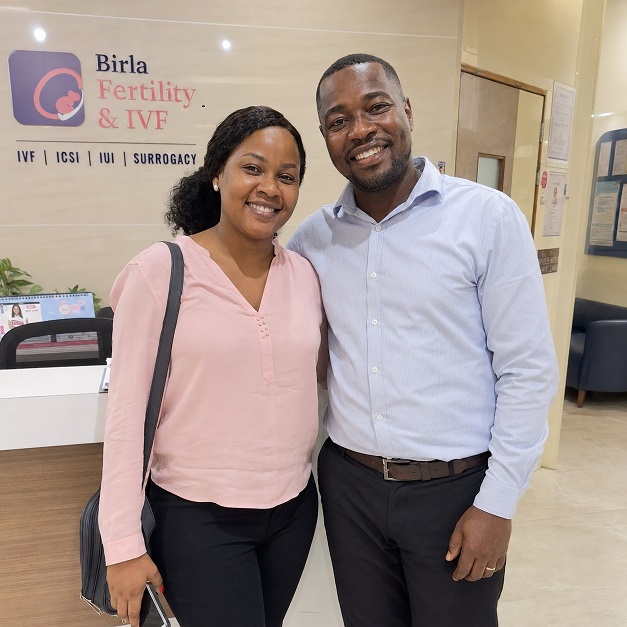
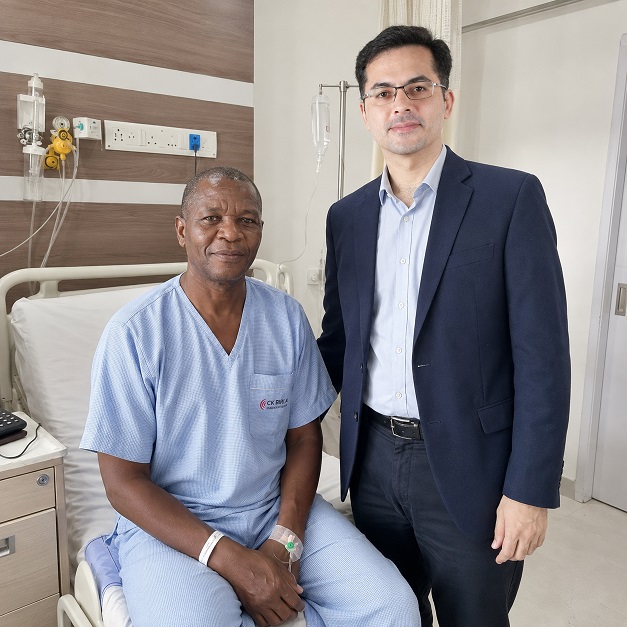
Patient Testimonials from Zambia

Ready to Take the First Step?
Share your Medical Reports with our Healthcare Managers Today and Get a FREE CONSULTATION, a Personalized Treatment Plan, and Complete Support from Arrival to Recovery.
Get Your Free ConsultationAreas We Serve
This resource has been thoughtfully prepared for patients from Zambia who are considering medical treatment in India. We also welcome patients from the wider region in the countries mentioned below-
We assist patients from:
- Zambia
- Angola
- Malawi
- Zimbabwe
- Botswana
- Namibia
- South Africa
- Eswatini
- Lesotho
- Gabon
- Chad
- Equatorial Guinea
- São Tomé and Príncipe
- Republic of the Congo
- Democratic Republic of the Congo
Many of the insights, treatment pathways, hospital recommendations, travel guidance, and patient support services described here are equally relevant and may be used as a reference when planning treatment in India.
From Zambia to India: Your Complete Patient Support Guide
- Best Weight-Loss (Bariatric) Surgeons & Hospitals in India for Zambian Patients
- Best Brain-Tumour Surgeons & Hospitals in India for Zambian Patients
- Best Cancer Doctors & Hospitals in India for Zambian Patients
- Best Cardiac Surgeons & Hospitals in India for Zambian Patients
- Best Cosmetic Surgeons & Facilities in India for Zambian Patients
- Best CyberKnife Treatment Teams & Centres in India for Zambian Patients
- Best Dentists & Dental Clinics in India for Zambian Patients
- Best Heart Valve Replacement Surgeons & Hospitals in India for Zambian Patients
- Best Hip Surgeons & Hospitals in India for Zambian Patients
- Best Knee Surgeons & Hospitals in India for Zambian Patients
- Best Neurosurgeons & Hospitals in India for Zambian Patients
- Best Paediatric Cardiac Surgeons & Hospitals in India for Zambian Patients
- Best Paediatric Neurosurgeons & Hospitals in India for Zambian Patients
- Best Prostate Surgeons & Hospitals in India for Zambian Patients
- Best Scoliosis Surgeons & Hospitals in India for Zambian Patients
- Best Spine Surgeons & Hospitals in India for Zambian Patients
- Best Bone Marrow Transplant Teams & Hospitals in India for Zambian Patients
- Best Kidney Transplant Surgeons & Hospitals in India for Zambian Patients