

Robotic Cancer Surgery in India for Zambian Patients
Robotic surgery is a genuine advance for many cancers — but for the single cancer that kills more Zambian women than any other, the best available evidence says the newer, robot-assisted approach can be the more dangerous choice.
Robotic surgery has changed cancer care for the better in many situations — smaller incisions, less blood loss, and faster recovery for operations that once required a large open wound. But it is not a blanket upgrade that makes every operation safer, and in at least one important cancer, the evidence points the other way entirely. In 24 years of guiding patients through cancer treatment abroad, I have learned that the question worth asking is never "is robotic surgery available," but "does the evidence support it for this specific cancer." This guide sets out where that answer is a confident yes, and where, just as importantly, it is not.
Healing Journeys of Zambian Patients




Key Takeaways
- The guide explains that robotic surgery is not automatically better than open surgery. Its benefits depend on the cancer being treated, with the strongest advantages generally involving smaller incisions, less blood loss and faster recovery when the technology provides meaningful surgical precision.
- A major exception is early-stage cervical cancer requiring radical hysterectomy. The guide highlights the LACC randomised trial, where minimally invasive surgery, including robotic surgery, was associated with worse survival than open surgery. The page 2 chart shows overall survival at 4.5 years of 90.6% with minimally invasive surgery versus 96.2% with open surgery.
- For prostate cancer, the evidence is much more favourable. The guide notes comparable cancer control and long-term outcomes to open surgery, with less blood loss, fewer transfusions and shorter hospital stays. The page 2 chart illustrates approximately 852 mL blood loss with open surgery versus 207 mL with robotic surgery in the cited cohort data.
- The guide also identifies kidney, rectal and endometrial cancers as situations where robotic surgery can be a well-supported option. Its page 3 table explains that robotic precision may help preserve healthy kidney tissue, improve visualisation in the narrow pelvis and support faster recovery while maintaining comparable cancer outcomes in appropriate patients.
- When choosing an Indian centre, patients should assess the surgeon's experience with their specific robotic operation, not simply whether the hospital owns a robotic system. The guide recommends asking about procedure volume, outcomes, multidisciplinary tumour-board review, NABH accreditation, ideally JCI, the robotic platform and the team's ability to convert safely to open surgery when required.
- The page 4 cost chart gives representative robotic cancer surgery costs of approximately US$12,000 in India, compared with US$45,000 in the UK and US$75,000 in the US. The guide cautions that surgery may be only one component of treatment and that chemotherapy, radiotherapy, hormone therapy and other expenses may need to be added.
Quick Facts
- Author
- Dr. Dheeraj Bojwani
- Experience
- 24+ Years of Experience
- Treatment
- Robotic Cancer Surgery
- Patients
- Zambian Cancer Patients
- Key Specialist
- Surgical Oncologist / Robotic Cancer Surgeon
- Main Assessment
- Cancer type, stage and suitability for robotic, laparoscopic or open surgery
- Strongly Supported
- Prostate, kidney, rectal and endometrial cancers
- Key Exception
- Open surgery is recommended for early-stage cervical cancer requiring radical hysterectomy
- Survival Finding
- 96.2% open vs 90.6% minimally invasive surgery at 4.5 years in the cited LACC trial
- Blood Loss
- Illustrative prostate data shows 207 mL robotic vs 852 mL open surgery
- Surgeon Check
- Experience and annual volume for the specific robotic procedure
- Hospital Check
- NABH accreditation, ideally JCI
- India Cost
- Approximately US$12,000
- Pre-Travel Records
- Scans, biopsy results, pathology reports and cancer staging
- Follow-Up
- Zambian oncologist or gynaecologist
- Key Safety Check
- Genuine multidisciplinary tumour-board review
- Warning Sign
- Robotic surgery recommended mainly because the technology is newer
- Decision Principle
- Select the surgical approach based on evidence for the specific cancer, not technology alone.
In Brief
For Zambian patients, the guide's main message is that the right surgical approach depends on the specific cancer, not on which technology sounds newest. Robotic surgery is well supported for several cancers, particularly prostate, kidney, rectal and endometrial cancers, while open surgery remains the recommended standard for early-stage cervical cancer requiring radical hysterectomy. The guide gives an indicative robotic cancer surgery cost of US$12,000 in India.
First, should you travel at all?
Zambia's surgical oncology capacity has grown, and conventional open and laparoscopic cancer surgery is available within the country and the wider region for many operations. For a great many cancers, a skilled surgeon operating with conventional technique achieves excellent results, and travel abroad specifically to access a robotic system may add cost without adding benefit. A good surgical oncologist should tell you plainly whether your particular operation is one where the surgical approach itself — robotic, laparoscopic, or open — meaningfully changes the outcome, or whether it mainly changes the experience of recovery.
Where travel becomes worth considering is when your cancer falls into a group where robotic surgery's precision offers a genuine, evidence-supported advantage, and where that specific expertise is not yet reliably available at home. India has built one of the largest robotic surgery programmes among medical travel destinations, with high-volume centres and surgeons trained on the same systems used in leading Western hospitals, at a fraction of the cost.
This is also why the conversation about surgical approach belongs with a surgical oncologist who treats your specific cancer regularly, rather than being decided by which technology a particular hospital happens to promote. A surgeon who operates on many patients with your type of cancer each year, and who can discuss both the robotic and open approaches candidly, is in a far better position to advise you than a general marketing description of what robotic surgery can do.
The cancer where the evidence points the other way
Zambia has the third-highest cervical cancer burden in the world, driven substantially by the country's high HIV prevalence, and it remains the leading cause of cancer death among Zambian women. It is precisely this cancer where a major international randomised trial produced a result that reshaped global practice: women having minimally invasive radical hysterectomy — including robotic surgery — for early-stage cervical cancer had a significantly higher rate of recurrence and a significantly lower rate of survival than women having open surgery. Since that trial, open radical hysterectomy has become the recommended standard of care for early-stage cervical cancer internationally. If you or a family member is facing this specific operation, this is one situation where asking for the newer, minimally invasive option is not the safer choice — asking for open surgery is.
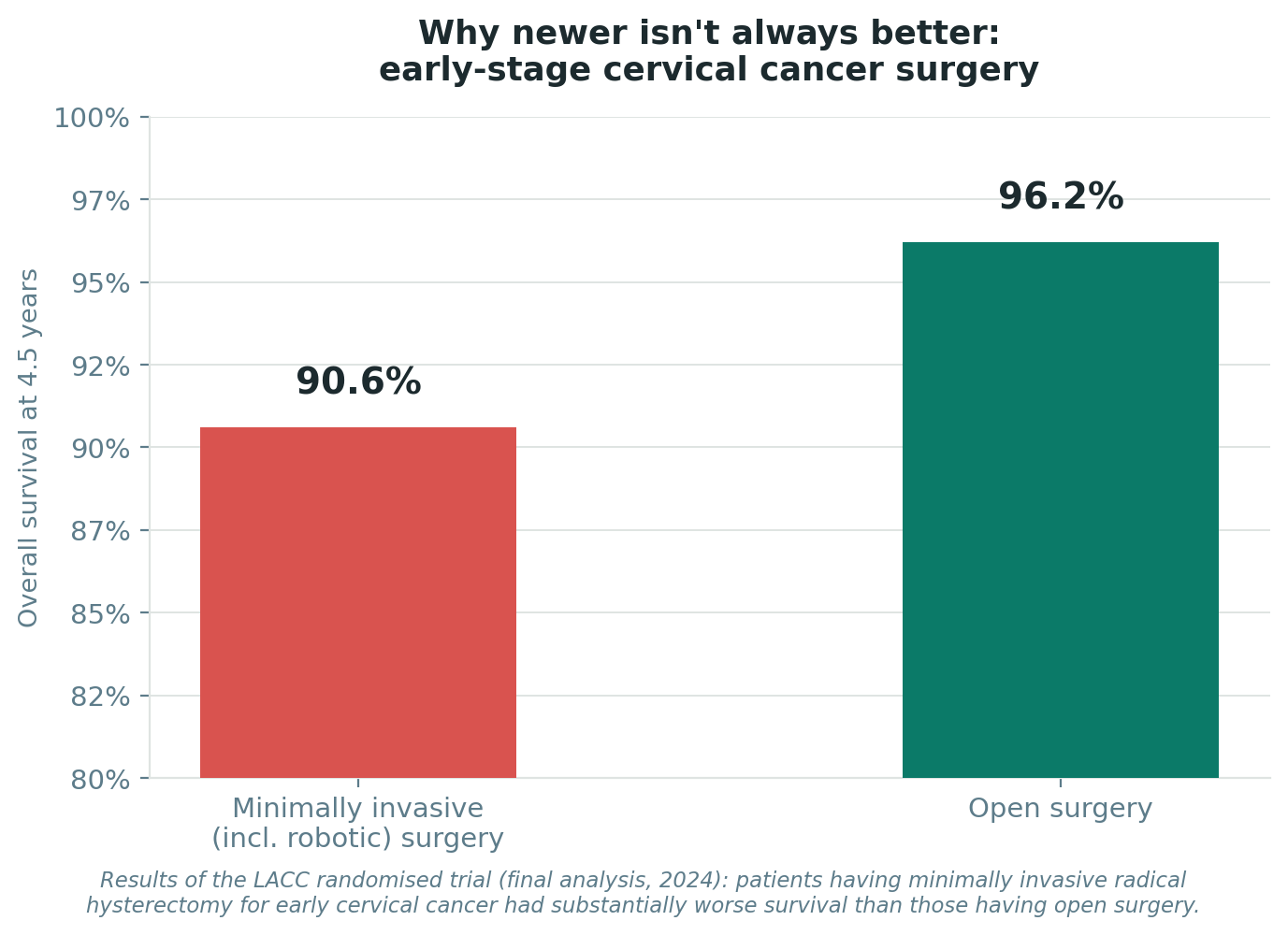
A rare and important case where a randomised trial found the newer surgical approach less safe, not more.
Where robotic surgery's advantage is real
The cervical cancer finding is important precisely because it is the exception, not the rule. For prostate cancer — a cancer that is both common and often diagnosed late in Zambian men, where screening remains limited — robotic surgery has a well-established evidence base showing meaningfully less blood loss, fewer blood transfusions, and shorter hospital stays than open surgery, with cancer control and long-term outcomes that are comparable between the two approaches. Similar perioperative advantages, without evidence of any survival disadvantage, have been shown for robotic surgery in kidney cancer, rectal cancer, and endometrial cancer, particularly in patients for whom a large abdominal incision carries higher risk.
The physical reason for this advantage is worth understanding, because it explains why the answer differs so much by cancer type. A robotic system gives the surgeon a magnified, three-dimensional view and wristed instruments that move with more precision than the human hand alone, particularly valuable in tight anatomical spaces such as the deep pelvis or around the kidney's blood vessels. Where that precision genuinely changes what the surgeon can safely achieve, robotic surgery tends to show real benefit. Where a cancer can already be removed with a wide, clear margin through a conventional incision, the extra precision matters less, and the deciding factors become cost, availability, and surgeon experience rather than the technology itself.
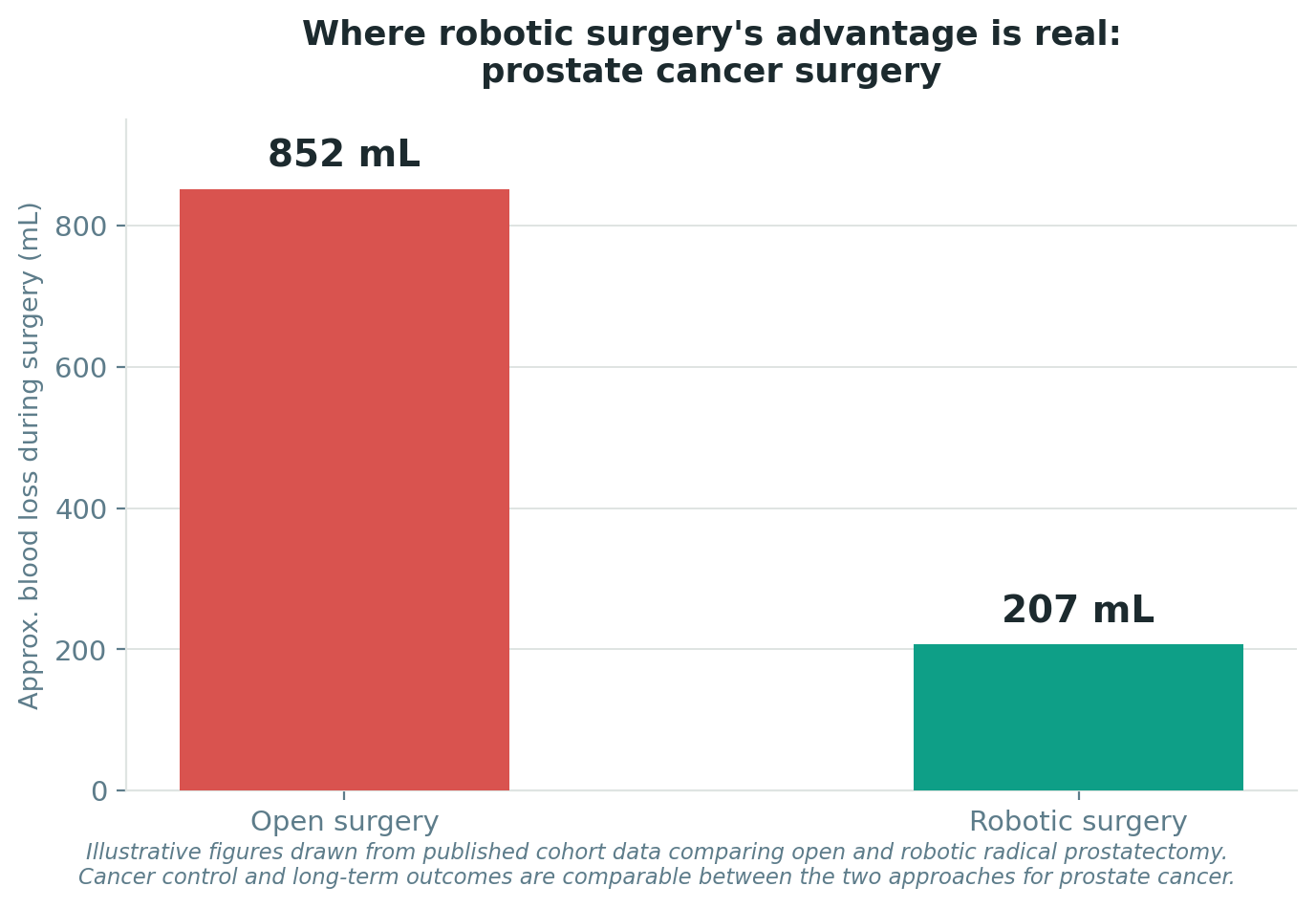
For prostate cancer specifically, the evidence for robotic surgery's perioperative benefit is strong and consistent.
| Your situation | Typical approach | What it involves |
|---|---|---|
| Localised prostate cancer requiring surgery | Robotic surgery well supported | Comparable cancer control to open surgery, with meaningfully less blood loss and a shorter hospital stay |
| Kidney tumour requiring partial or full removal | Robotic surgery often preferred | Precise dissection can help preserve healthy kidney tissue where the tumour allows |
| Rectal cancer requiring surgical removal | Robotic surgery a well-supported option | Enhanced visualisation in the narrow pelvis, particularly useful in men and in obese patients |
| Endometrial (womb) cancer requiring hysterectomy | Robotic or laparoscopic surgery well supported | Comparable cancer outcomes to open surgery with faster recovery, particularly relevant given this cancer's link to obesity |
| Early-stage cervical cancer requiring radical hysterectomy | Open surgery is the recommended standard | A major randomised trial found minimally invasive surgery, including robotic, associated with worse survival for this specific operation |
| Locally advanced or unusual tumours near major blood vessels or organs | Case-by-case decision with a multidisciplinary team | The evidence is less settled; a surgeon's individual experience and judgement matter more than the technology alone |
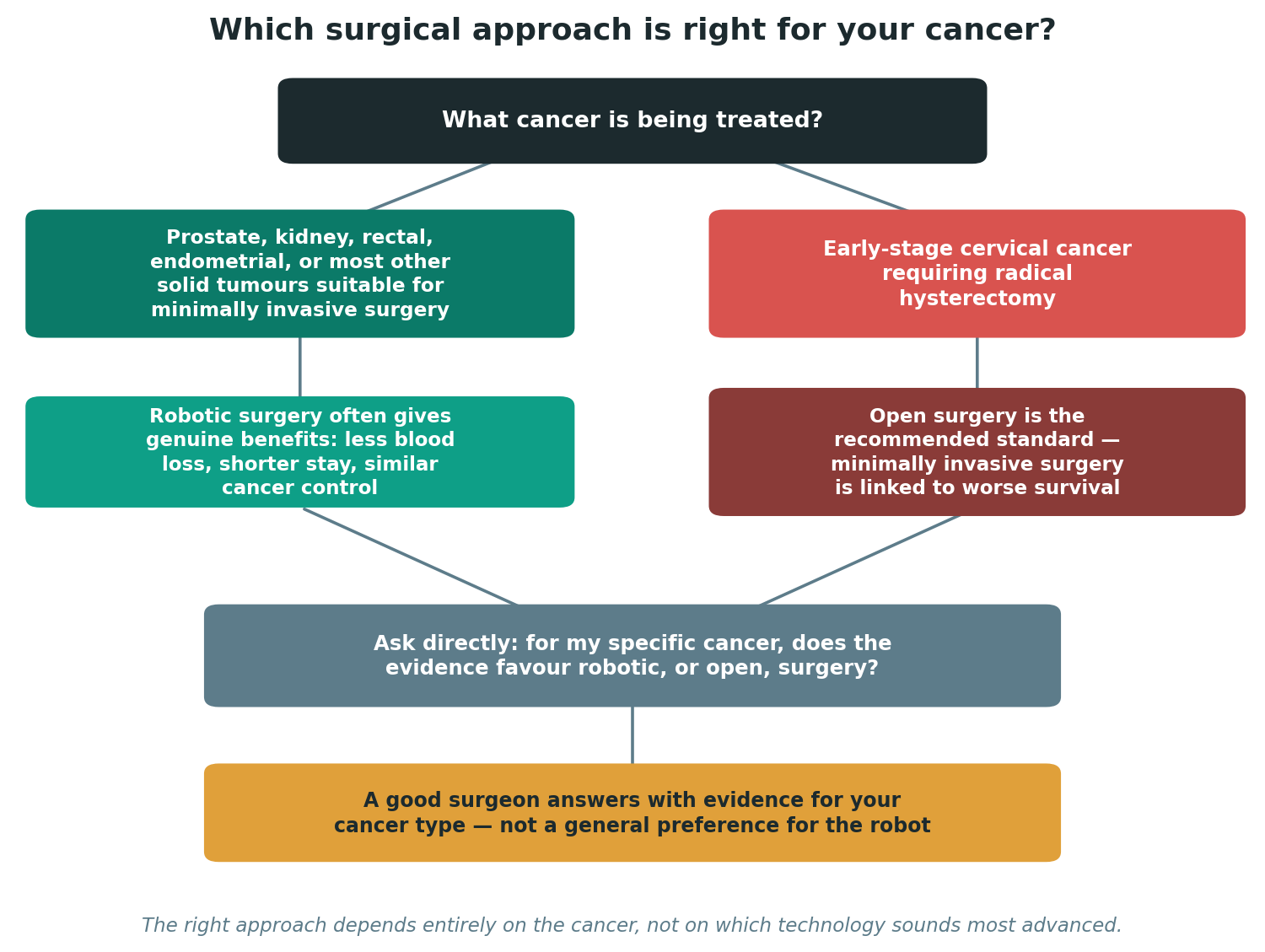
The right question is always cancer-specific — never a general preference for the newer technology.
Choosing the surgeon and the hospital
Because the right answer depends so heavily on the specific cancer, the most important question to ask any centre is not simply whether they have a robotic system, but how many operations of your specific type they perform robotically each year, and what their outcomes are. A surgeon's individual experience with a particular robotic operation matters enormously — the learning curve for robotic surgery is real, and outcomes improve significantly with volume. Ask how many years the surgeon has been performing robotic procedures, and how many of your specific operation they have done.
Confirm that your case is discussed by a genuine multidisciplinary tumour board before a surgical approach is recommended, since this is the best protection against a centre defaulting to robotic surgery out of habit or marketing rather than clinical reasoning. Check accreditation (NABH, ideally JCI), confirm which robotic platform is in use, and ask directly whether open surgery was considered and why it was or was not recommended for your case — a confident, specific answer is a good sign; a vague one is worth pausing on.
It is also worth asking what happens if the robotic approach needs to be converted to open surgery partway through the operation, since this occasionally happens for anatomical or safety reasons. A confident surgical team will be able to explain how often this occurs in their hands and how they handle it, and this conversation itself is a reasonable indicator of how honestly a centre discusses the limits of the technology rather than only its strengths.
Cost and value: how to weigh the money honestly
Robotic cancer surgery in a good Indian hospital costs a small fraction of the equivalent procedure in the West, and India's surgeons perform very high volumes of robotic operations, meaning genuine expertise is available at that lower price. But the value of the lower cost only holds if the approach itself is the right one for your cancer — a discounted price on the wrong operation is not a saving.
It is also worth remembering that surgery is rarely the only cost in a cancer treatment plan. Chemotherapy, radiotherapy or hormone therapy may be needed alongside surgery depending on your diagnosis and stage, and a hospital's surgical quote will not necessarily include these. Ask for the complete treatment plan and its full cost from the multidisciplinary team, not just the cost of the operation, so you are comparing the true total cost of your care in India against what would be involved at home.
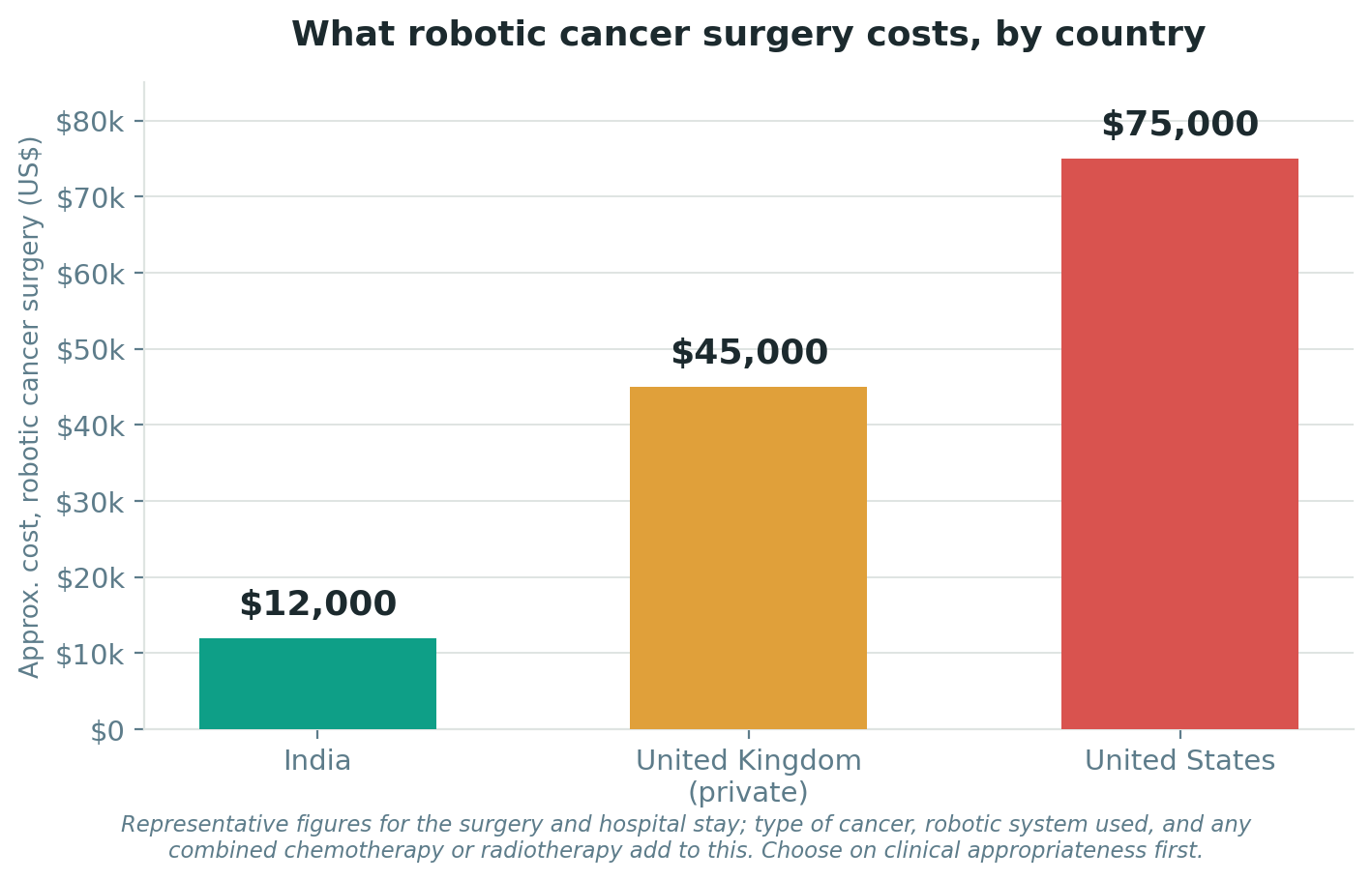
India's affordability is real — but confirm the surgical approach is right for your cancer first.
In 24 years of arranging these journeys, I have found that the patients who do best are the ones who ask their surgeon to justify the surgical approach in plain language before agreeing to it, rather than assuming that the most technologically advanced option is automatically the safest. Ask for a written explanation of the recommended approach for your specific cancer, request the complete itemised cost of surgery, hospital stay, and any additional therapy, and only then make your decision.
What a Zambian patient should weigh in particular
Beyond the surgical decision itself, several practical matters deserve attention. First, payment: NHIMA funds care at accredited facilities inside Zambia, not treatment abroad, so robotic cancer surgery in India comes from your own resources — another reason to be certain the surgical approach chosen is the right one before committing funds. Second, if your diagnosis is cervical cancer, raise the LACC trial findings directly with any surgeon who recommends a minimally invasive or robotic approach, and ask them to explain their reasoning against the current international guidance favouring open surgery. Third, aftercare: arrange with a Zambian oncologist or gynaecologist to take over your follow-up before you travel, and insist the Indian team provides a complete written operative report, since your local doctor will need the precise surgical details for any future care decisions.
Fourth, it is worth being realistic about the connection between HIV status and cervical cancer risk when planning care. Women living with HIV are diagnosed with cervical cancer at higher rates and often at a younger age, and disclosing HIV status and current antiretroviral treatment to the surgical and oncology team in India is important, since it can affect both the safety of major surgery and decisions about any additional chemotherapy or radiotherapy needed alongside it.
The practical journey from Zambia
India requires a yellow fever vaccination certificate from travellers arriving from Zambia, valid only from ten days after the injection. Your medical visa is issued by the High Commission of India on Pandit Nehru Road in Lusaka against the hospital's invitation letter. There is no direct flight from Zambia to India; you will connect through Addis Ababa on Ethiopian Airlines, or through Dubai, Doha or Nairobi. Send the patient's actual scans, biopsy results and pathology reports, not only summaries, for remote review before you travel, since the precise stage and type of your cancer is what determines whether robotic surgery is genuinely appropriate.
Signals that should make you pause
1. A recommendation for minimally invasive or robotic radical hysterectomy for early-stage cervical cancer without acknowledgement of the LACC trial findings and current guidance favouring open surgery.
2. Any recommendation for robotic surgery justified mainly by the technology's novelty rather than evidence specific to your cancer type.
3. Reluctance to share the surgeon's individual case volume and outcomes for your specific operation.
4. No offer of a genuine multidisciplinary opinion before a surgical approach is finalised.
Straight answers for Zambian Patients about Robotic Cancer Surgery in India
Is robotic surgery always better than open surgery?
No. For many cancers it offers genuine advantages in blood loss, recovery time and hospital stay with equivalent cancer control. For early-stage cervical cancer specifically, a major randomised trial found the opposite — worse survival with minimally invasive approaches — and open surgery is now the recommended standard for that operation.
I have been diagnosed with cervical cancer. Should I refuse robotic surgery if it's offered?
Raise the LACC trial findings directly with your surgeon and ask them to explain their reasoning if they recommend a minimally invasive approach for early-stage disease. Current international guidance favours open radical hysterectomy for this specific cancer, and a good surgeon will be able to discuss this evidence with you openly.
My husband has prostate cancer. Is robotic surgery a good option for him?
The evidence here points the other way from cervical cancer — robotic prostatectomy has a strong, consistent evidence base showing real perioperative benefits with cancer control comparable to open surgery, and it is a reasonable option to discuss with his surgical team.
How do I know if a surgeon is genuinely experienced with robotic surgery, not just equipped with it?
Ask directly how many years they have performed robotic surgery and how many procedures of your specific type they have done, and ask for their outcomes. Owning a robotic system is not the same as having deep individual experience using it for your particular cancer.
Does robotic surgery cost more because it's genuinely better, or just because it's newer?
Both factors play a role. The robotic systems themselves are extremely expensive for hospitals to buy and maintain, which is reflected in the price, and for the cancers where the evidence supports robotic surgery, the added cost often buys a real reduction in blood loss, pain and recovery time. For cancers where the evidence does not show a clear advantage, the higher price is not buying you a better outcome, only a different experience of surgery.
If open surgery is recommended for my cervical cancer, will I recover as well as I would with a minimally invasive approach?
Open surgery typically means a longer hospital stay and a slower initial recovery than a minimally invasive operation would offer. For early-stage cervical cancer, the current evidence indicates this trade-off is the safer one, since the survival difference found in the LACC trial was substantial. A good surgical team will help you understand and prepare for that recovery honestly.
Sources
- 🌐 Medical visa, Lusaka — High Commission of India, requirements & process: hcizambia.gov.in/page/medical-visa
- 🌐 Hospital accreditation (India) — Verify a hospital's NABH accreditation: nabh.co
- 🌐 National Health Insurance (Zambia) — NHIMA cover, treatment abroad is not covered: nhima.co.zm
- 🌐 Ministry of Health Zambia — National health services & guidance: moh.gov.zm
- 🌐 National Medical Commission (verify a surgeon) — Confirm a surgeon's registration in India: nmc.org.in
- 🌐 WHO yellow fever — Vaccination requirements before travel: who.int/health-topics/yellow-fever
A Closing Word
Of everything I help families weigh, robotic surgery is the clearest reminder that newer and better are not always the same thing. If you send me your diagnosis, staging, and any treatment plan you have been given, I will help you understand honestly whether the recommended surgical approach is well supported by evidence for your specific cancer, and which centres in India have the genuine, high-volume experience to treat you well — whichever approach turns out to be right for you.
Frequently Asked Questions by Zambian Patients about Robotic Cancer Surgery in India
Is robotic cancer surgery always better than open surgery?
No. Robotic surgery can reduce blood loss and recovery time for several cancers, but the appropriate approach depends on the specific cancer and evidence supporting that operation.
Is robotic surgery recommended for early-stage cervical cancer?
The guide states that open radical hysterectomy is the recommended standard for early-stage cervical cancer requiring this operation because minimally invasive surgery showed worse survival in the LACC trial.
Which cancers may benefit from robotic surgery?
The guide identifies prostate, kidney, rectal and endometrial cancers as areas where robotic surgery has a well-supported role in appropriate patients.
What are the main benefits of robotic prostate surgery?
The guide highlights less blood loss, fewer blood transfusions and shorter hospital stays, while cancer control remains comparable with open surgery.
How do I know whether a surgeon is genuinely experienced?
Ask how many years the surgeon has performed robotic surgery, how many procedures of your specific cancer type they have completed and what their outcomes are.
How much does robotic cancer surgery cost in India?
The guide gives an indicative cost of approximately US$12,000, compared with US$45,000 in the UK and US$75,000 in the US.
Does the surgical cost include chemotherapy or radiotherapy?
Not necessarily. Cancer treatment may also require chemotherapy, radiotherapy or hormone therapy, so patients should request the complete treatment plan and total estimated cost.
What should I ask if a surgeon recommends robotic surgery?
Ask why robotic surgery is preferable for your particular cancer, whether open surgery was considered and what evidence supports the recommended approach.
What should I send before travelling to India?
Send the patient's actual scans, biopsy results, pathology reports and staging information for remote review before travelling.
What should be arranged after returning to Zambia?
Arrange follow-up with a Zambian oncologist or gynaecologist and obtain a complete written operative report from the Indian hospital for future treatment decisions.
Page Summary
This five-page Zambia-to-India medical travel guide explains when robotic cancer surgery offers a genuine advantage and when open surgery may be safer. The page 2 charts highlight the cervical cancer survival difference of 90.6% versus 96.2% and the illustrative prostate surgery blood-loss difference of 852 mL versus 207 mL. The page 3 table compares robotic and open approaches across prostate, kidney, rectal, endometrial and cervical cancers. The page 4 cost chart gives representative costs of US$12,000 in India, US$45,000 in the UK and US$75,000 in the US.
Citation Block
| Topic | Information |
|---|---|
| Topic | Robotic Cancer Surgery in India for Zambian Patients |
| Treatment | Robotic Cancer Surgery |
| Patients | Zambian Cancer Patients |
| Specialist | Surgical Oncologist / Robotic Surgeon |
| Main Assessment | Cancer type, stage and surgical approach |
| Supported Cancers | Prostate, kidney, rectal and endometrial cancers |
| Cervical Cancer | Open surgery recommended for early-stage radical hysterectomy |
| LACC Finding | 90.6% vs 96.2% survival at 4.5 years |
| Prostate Blood Loss | 207 mL robotic vs 852 mL open in cited data |
| Surgeon Check | Specific procedure volume and outcomes |
| Hospital Check | NABH, ideally JCI |
| Team Requirement | Multidisciplinary tumour board |
| India Cost | Approximately US$12,000 |
| UK Cost | Approximately US$45,000 |
| US Cost | Approximately US$75,000 |
| Pre-Travel Records | Scans, biopsy, pathology and staging |
| Follow-Up | Zambian oncology/gynaecology team |
| Key Warning | Technology-based recommendation without cancer-specific evidence |
| Patient Pathway | Diagnosis/staging → surgical approach assessment → tumour-board review → surgery → follow-up |
| Decision Principle | Cancer-specific evidence should determine robotic versus open surgery |


Our Mission Statement
Our mission is to place patients at the centre of every healthcare decision by providing trustworthy, evidence-based, and unbiased medical information. We believe that informed patients make better decisions. Backed by personalised guidance from our experienced advisory team, we help patients understand their treatment options, compare them objectively, and confidently choose the path that best suits their medical needs and personal circumstances.
Patient Testimonials from Zambia


Ready to Take the First Step?
Share your Medical Reports with our Healthcare Managers Today and Get a FREE CONSULTATION, a Personalized Treatment Plan, and Complete Support from Arrival to Recovery.
Get Your Free ConsultationAreas We Serve
This resource has been thoughtfully prepared for patients from Zambia who are considering medical treatment in India. We also welcome patients from the wider region in the countries mentioned below-
We assist patients from:
- Zambia
- Angola
- Malawi
- Zimbabwe
- Botswana
- Namibia
- South Africa
- Eswatini
- Lesotho
- Gabon
- Chad
- Equatorial Guinea
- São Tomé and Príncipe
- Republic of the Congo
- Democratic Republic of the Congo
Many of the insights, treatment pathways, hospital recommendations, travel guidance, and patient support services described here are equally relevant and may be used as a reference when planning treatment in India.
From Zambia to India: Your Complete Patient Support Guide
- Best Weight-Loss (Bariatric) Surgeons & Hospitals in India for Zambian Patients
- Best Brain-Tumour Surgeons & Hospitals in India for Zambian Patients
- Best Cancer Doctors & Hospitals in India for Zambian Patients
- Best Cardiac Surgeons & Hospitals in India for Zambian Patients
- Best Cosmetic Surgeons & Facilities in India for Zambian Patients
- Best CyberKnife Treatment Teams & Centres in India for Zambian Patients
- Best Dentists & Dental Clinics in India for Zambian Patients
- Best Heart Valve Replacement Surgeons & Hospitals in India for Zambian Patients
- Best Hip Surgeons & Hospitals in India for Zambian Patients
- Best Knee Surgeons & Hospitals in India for Zambian Patients
- Best Neurosurgeons & Hospitals in India for Zambian Patients
- Best Paediatric Cardiac Surgeons & Hospitals in India for Zambian Patients
- Best Paediatric Neurosurgeons & Hospitals in India for Zambian Patients
- Best Prostate Surgeons & Hospitals in India for Zambian Patients
- Best Scoliosis Surgeons & Hospitals in India for Zambian Patients
- Best Spine Surgeons & Hospitals in India for Zambian Patients
- Best Bone Marrow Transplant Teams & Hospitals in India for Zambian Patients
- Best Kidney Transplant Surgeons & Hospitals in India for Zambian Patients