

Plastic and Reconstructive Surgery in India for Zambian Patients
A published study found the average age at first cleft surgery in an African cohort was around nine years old — against a global recommendation of three to six months — a gap measured in years, not weeks.
Reconstructive plastic surgery restores form and function after injury, infection, or a condition present from birth — distinct from purely cosmetic surgery, which this series covers separately. Two conditions dominate the reconstructive need here: burns, overwhelmingly affecting young children and often leaving contractures that restrict movement for life, and cleft lip and palate, one of the most common and most treatable birth defects, yet one that too often goes uncorrected for years. In 24 years of guiding families through surgical care abroad, I have found that timing is the thread running through both of these conditions, though in different ways.
Healing Journeys of Zambian Patients
Key Takeaways
- The guide focuses on two major reconstructive needs in children: burn injuries and cleft lip and palate. It explains that burns can leave contractures that permanently restrict movement, while cleft conditions are highly treatable but may be repaired much later than the recommended age in some African settings.
- Burns are particularly common in young children, with the page 1 chart showing approximately 33% of published burn injuries occurring in children under five compared with about 67% in other age groups. The guide stresses that burns crossing joints such as the elbow, hand, neck or armpit need careful early management to reduce the risk of contracture.
- The guide emphasises that early burn rehabilitation can be as important as later reconstructive surgery. Splinting, positioning, pressure garments and physiotherapy during healing can help preserve movement. Once a contracture has formed, surgical release may be required, followed by a skin graft or flap and structured physiotherapy.
- For cleft lip and palate, timing is a central issue. The page 3 chart compares the recommended 3–6 month window for cleft lip repair with an average age of around nine years at first surgery in the cited African cohort. The guide explains that delayed palate repair can increase the risk of persistent speech difficulties, although treatment can still meaningfully improve function and appearance at an older age.
- When selecting an Indian hospital, families should look beyond the operation itself. For burns, they should ask about contracture-release experience and rehabilitation support. For cleft conditions, they should confirm experience with the child's specific cleft and access to a multidisciplinary team that includes speech-therapy input. NABH accreditation, ideally JCI, should also be checked.
- The page 4 cost chart gives representative reconstructive-surgery costs of approximately US$3,000 in India, compared with US$12,000 in the UK and US$20,000 in the US. The guide stresses that families should request an itemised quotation covering the complete treatment plan and arrange ongoing speech therapy or burn rehabilitation in Zambia before returning home.
Quick Facts
- Author
- Dr. Dheeraj Bojwani
- Experience
- 24+ Years of Experience
- Treatment
- Plastic & Reconstructive Surgery
- Patients
- Zambian Children and Families
- Key Specialist
- Plastic & Reconstructive Surgeon
- Main Conditions
- Burns, burn contractures, cleft lip and cleft palate
- Burn Priority
- Early splinting, positioning and physiotherapy
- Contracture Treatment
- Surgical release with skin graft or flap when required
- Cleft Lip Timing
- Ideally around 3–6 months
- Cleft Palate Timing
- Ideally around 12–18 months
- Key Team
- Reconstructive surgeon with multidisciplinary and speech-therapy support
- India Cost
- Approximately US$3,000
- Hospital Check
- NABH accreditation, ideally JCI
- Pre-Travel Records
- Photographs, imaging and medical history
- Follow-Up
- Speech therapy for cleft palate; scar management and physiotherapy for burns
- Key Decision
- Match treatment timing and reconstructive approach to the child's condition.
In Brief
For Zambian families, the guide's main message is that timing differs according to the condition: cleft lip repair should ideally be planned around 3–6 months, while a fresh burn over a joint needs early splinting, positioning and physiotherapy to prevent contracture. Established burn contractures may require surgical release and reconstruction. The guide gives an indicative reconstructive-surgery cost of US$3,000 in India.
Burns: overwhelmingly a young child's injury
Across published African studies, burns are disproportionately an injury of early childhood, closely tied to how many households cook — open fires, and paraffin or kerosene stoves, often at ground or low level, in the same space where young children live and play. A spilled pot of boiling water or a stumble near an open flame can cause a serious burn in seconds.
Most of these injuries are scalds from hot liquids rather than direct flame burns, and infants and toddlers, who are unsteady on their feet and often at exactly the height of a stove or cooking pot, are at particular risk. This pattern is well documented across multiple African settings and reflects genuine, structural aspects of how many households cook, rather than any lack of care or attentiveness from parents.
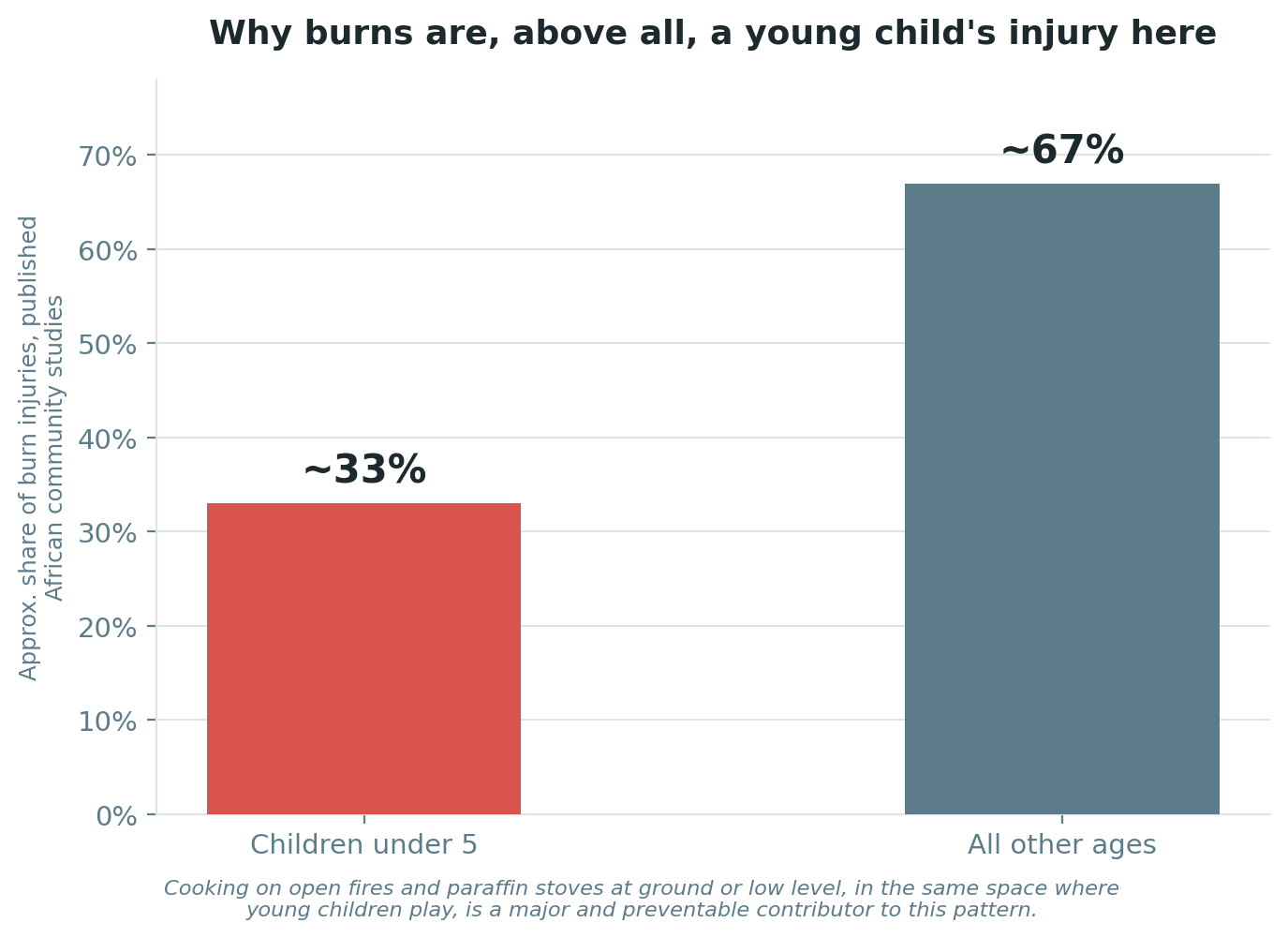
This pattern reflects household cooking arrangements more than anything else, and is genuinely preventable in many cases.
When a burn crosses a joint — the elbow, the hand, the neck, the armpit — the way it heals in the following weeks determines whether a child regains full movement or develops a contracture, where tightened scar tissue permanently restricts the joint's range of motion.
Why the first weeks after a burn matter as much as any later surgery
A significant proportion of the contractures that eventually reach a reconstructive surgeon were, in principle, preventable. Structured early burn care — splinting the joint in a stretched position, pressure garments to control scarring, and consistent physiotherapy through the healing period — substantially reduces the risk of a contracture forming in the first place. This is not always available, since burn rehabilitation infrastructure remains genuinely underdeveloped across much of the region, and this is not a reflection on any family's care for their child. But if your child has a significant burn, particularly over a joint, asking specifically about splinting, positioning and physiotherapy from the first week — not just wound dressing — is one of the most protective things you can do.
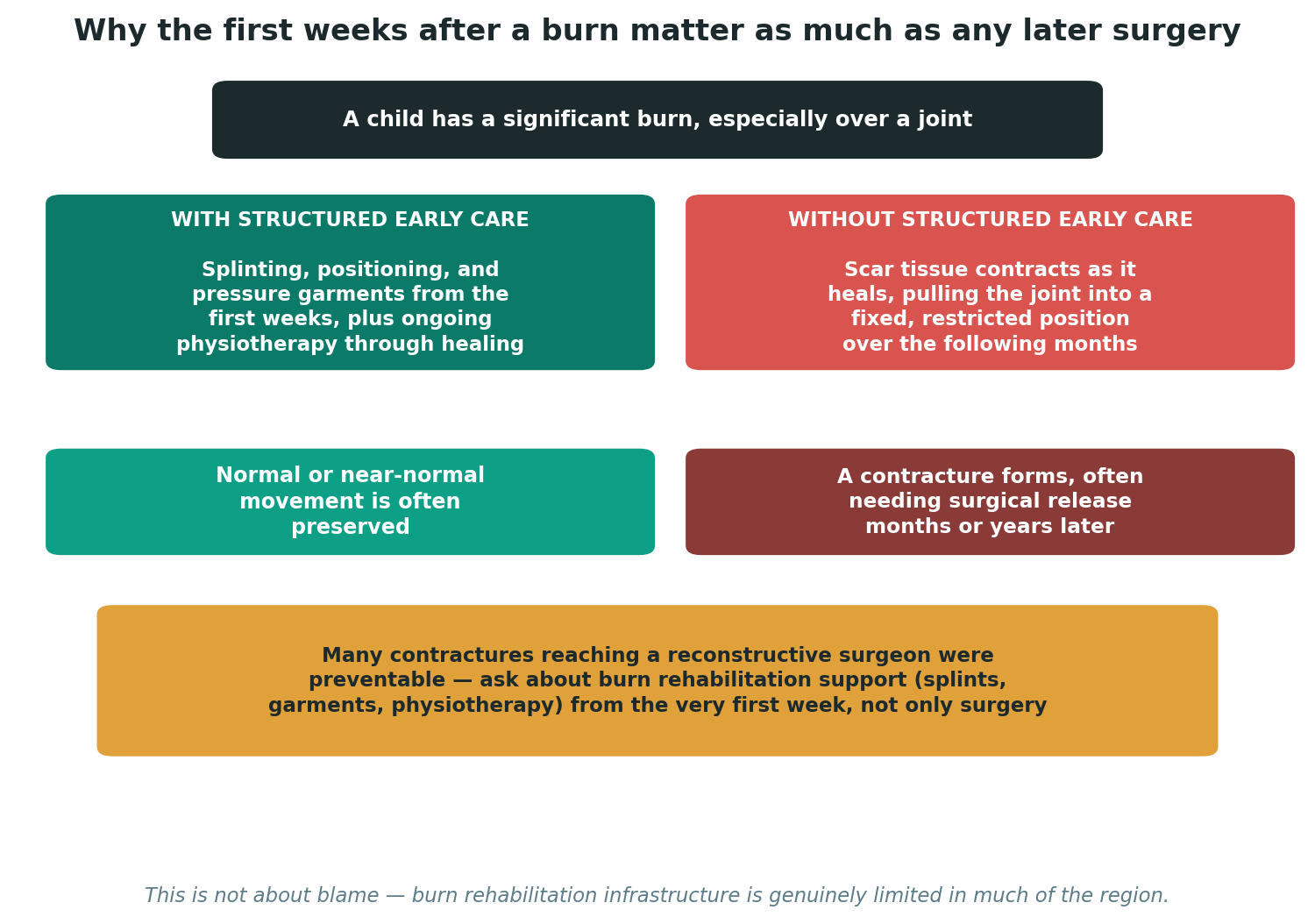
Once a contracture has fully formed, surgical release becomes the main option — prevention is far simpler than correction.
| Your situation | Typical approach | What it involves |
|---|---|---|
| Fresh significant burn, especially over a joint | Structured early care, not surgery | Splinting, positioning, pressure garments and physiotherapy to prevent a contracture forming |
| An established contracture restricting movement | Surgical release | The tightened scar tissue is surgically released and the defect covered with a skin graft or flap |
| Cleft lip, noticed at birth | Surgical repair, ideally at 3-6 months | A single procedure to close the lip, timed for the best cosmetic and feeding outcome |
| Cleft palate, with or without cleft lip | Surgical repair, ideally by 12-18 months | Closure of the roof of the mouth, timed to support normal speech development |
Cleft lip and palate: a highly treatable condition, if timing is respected
Cleft lip and palate is one of the most common congenital conditions worldwide, affecting roughly one in every 700 to 1,000 births, and it is also one of the most reliably treatable with surgery. International guidelines recommend repairing the lip at around three to six months of age and the palate by twelve to eighteen months, timing chosen specifically to support feeding, appearance, hearing and — critically — normal speech development, since the palate plays a direct role in how a child learns to form sounds.
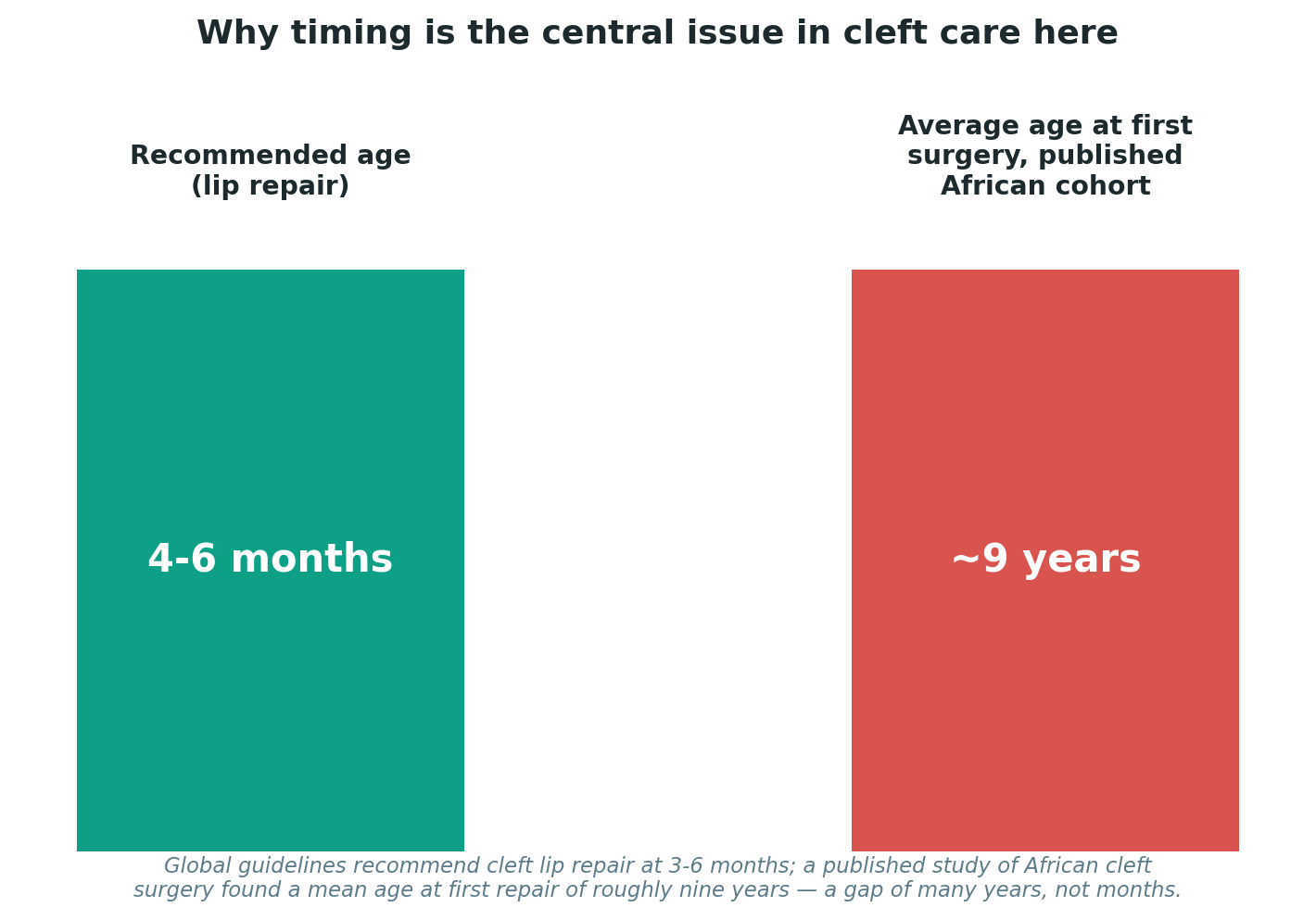
A delay of years, not months, means a child may enter school having already missed the window that best supports normal speech.
Delayed palate repair specifically is associated with a greater need for speech therapy later and more persistent speech difficulties, since a child's early years are when the foundations of speech are laid. This is a condition where the surgery itself is often straightforward and highly successful — the greater challenge, in this setting, is ensuring a child is identified and treated within the window that gives them the best possible start.
It is worth understanding why this particular delay happens so often, since none of the usual explanations are about a family not caring. Distance to a centre with genuine paediatric cleft expertise, the cost of travel and time away from work, and in some communities a simple lack of awareness that effective treatment exists at all, all play a role. None of these reasons reflect on a family, and none of them make a later repair pointless — they simply mean that reaching treatment earlier, wherever possible, protects a child's best possible outcome.
Choosing the surgeon and the hospital
For burns, ask specifically what rehabilitation support — splinting, pressure garments, physiotherapy — is available both during treatment and after you return home, not only what surgical options exist. For cleft lip and palate, ask about the surgeon's experience specifically with the type and severity of cleft your child has, and confirm that a genuine multidisciplinary team, including speech therapy input, is involved in the overall care plan, not just the surgery itself.
Check accreditation (NABH, ideally JCI), and for any condition requiring multiple staged procedures, ask for a complete overview of the whole treatment plan and timeline from the outset, not just the next scheduled operation.
It is also worth asking, for burn reconstruction specifically, how many similar contracture releases the surgeon performs each year, since results depend heavily on the surgical technique chosen — skin grafts, local tissue flaps, or more advanced options — being genuinely matched to your child's specific scar and the joint involved, rather than a single default approach applied to every case.
Cost and value: how to weigh the money honestly
Reconstructive surgery in a good Indian hospital costs a small fraction of the equivalent treatment in the West, and India performs very high volumes of both cleft repair and burn reconstruction, including through dedicated charitable surgical programmes in some cases. The saving is real, and for cleft lip and palate specifically, the procedure itself is relatively affordable — the greater cost of delay is measured in a child's speech and development, not only money.
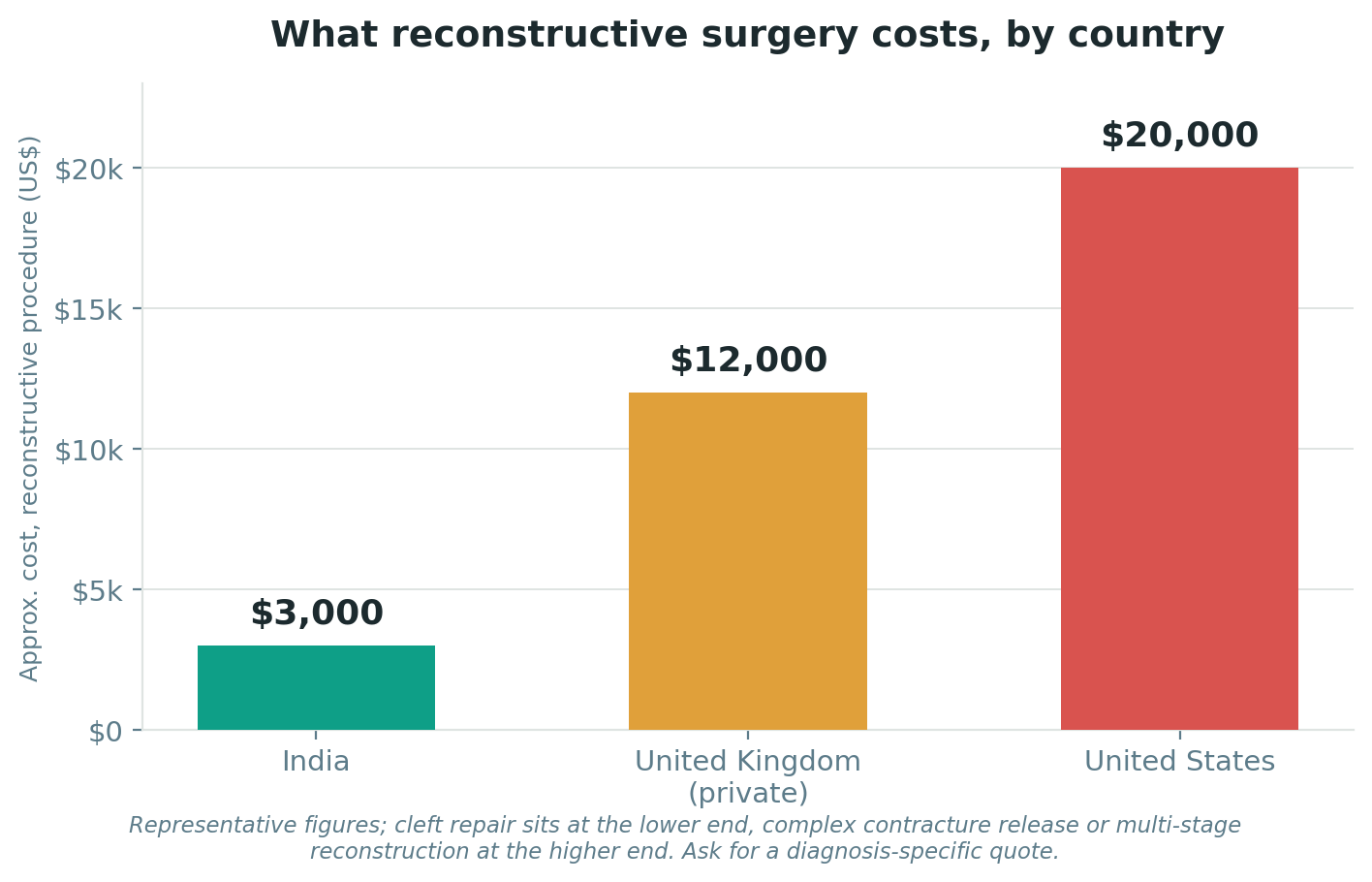
India's affordability is genuine — and for cleft repair, acting within the recommended window costs nothing extra.
In 24 years of arranging these journeys, I have found that families who understand the specific timing that matters for their child's condition tend to get significantly better outcomes than those who treat all surgery as equally urgent, or equally able to wait. Ask for a written, itemised quote covering the complete treatment plan for your child's specific diagnosis.
What a Zambian family should weigh in particular
Beyond the treatment decision itself, several practical matters deserve attention. First, payment: NHIMA funds care at accredited facilities inside Zambia, not treatment abroad, so this comes from your own resources — another reason acting within the recommended window for cleft repair, where delay adds no cost benefit at all, is worth prioritising. Second, if your child has a fresh burn, ask your Zambian medical team directly about splinting and positioning from the very first week, even before any conversation about travel begins. Third, aftercare: both conditions often need ongoing follow-up — speech therapy for cleft palate, scar management for burns — so arrange this with a Zambian team before you travel.
Fourth, keep clear photographs of your child's condition over time, particularly for burns, since this helps any doctor assess how a wound or scar is progressing, including during a remote consultation before you travel. For cleft lip and palate, keeping a simple record of feeding, weight gain and any early sounds or words your child makes is similarly useful for the team planning their care.
The practical journey from Zambia
India requires a yellow fever vaccination certificate from travellers arriving from Zambia, valid only from ten days after the injection. Your medical visa is issued by the High Commission of India on Pandit Nehru Road in Lusaka against the hospital's invitation letter, with medical-attendant visas for accompanying parents. There is no direct flight from Zambia to India; you will connect through Addis Ababa on Ethiopian Airlines, or through Dubai, Doha or Nairobi. Send your child's photographs, any imaging, and a clear description of the condition and its history for remote review before you travel, so the hospital's team can advise honestly on timing and the treatment plan.
Straight answers for Zambian Patients about Plastic and Reconstructive Surgery in India
My baby was just born with a cleft lip. When should we plan to travel?
As early as realistically possible, aiming for repair by around three to six months of age. Contact a cleft team promptly to begin planning, since earlier surgery within this window supports the best outcomes for feeding, appearance and future speech.
My child has an older, untreated cleft. Is it too late to help?
No — cleft repair still meaningfully improves appearance, feeding and function at any age, though the speech outcomes may be more limited than if repair had happened earlier. Surgery remains genuinely worthwhile, and speech therapy afterward can still help considerably.
My child was recently burned. What should we be doing right now, before thinking about surgery?
Ask your medical team about splinting the affected area in a stretched position and beginning physiotherapy as soon as the wound allows, particularly if the burn crosses a joint. This early care matters as much as any surgery that may follow.
My child already has a burn contracture. What does treatment involve?
Surgical release of the tightened scar tissue, with the resulting defect covered by a skin graft or flap, followed by a structured physiotherapy programme to maintain the improved movement. This may need to be combined with ongoing splinting during growth.
Sources
- 🌐 Medical visa, Lusaka — High Commission of India, requirements & process: hcizambia.gov.in/page/medical-visa
- 🌐 Hospital accreditation (India) — Verify a hospital's NABH accreditation: nabh.co
- 🌐 National Health Insurance (Zambia) — NHIMA cover, treatment abroad is not covered: nhima.co.zm
- 🌐 Ministry of Health Zambia — National health services & guidance: moh.gov.zm
- 🌐 National Medical Commission (verify a surgeon) — Confirm a surgeon's registration in India: nmc.org.in
- 🌐 WHO yellow fever — Vaccination requirements before travel: who.int/health-topics/yellow-fever
A Closing Word
Of everything I help families with, this is where a simple truth applies to two very different conditions: for a cleft, act within the window that supports the best speech and development outcomes; for a burn, protect the joint from the very first week, not only once healing is complete. If you send me a description of your child's condition and any photographs or records you have, I will help you understand honestly what timing matters most for your situation, and which centres in India have the genuine paediatric reconstructive experience to treat your child well.
Frequently Asked Questions by Zambian Patients about Plastic and Reconstructive Surgery in India
What conditions does reconstructive surgery address in this guide?
The guide focuses mainly on burn injuries and contractures, cleft lip and cleft palate, particularly in children.
What should be done after a fresh burn over a joint?
Early care should include splinting, correct positioning and physiotherapy when the wound permits, rather than waiting until a contracture develops.
What happens if a burn contracture has already formed?
The tightened scar tissue may require surgical release, with the resulting area covered using a skin graft or flap, followed by rehabilitation.
When should cleft lip surgery ideally be performed?
The guide states that cleft lip repair is ideally performed at around 3–6 months of age to support feeding, appearance and future development.
When should cleft palate surgery be performed?
The guide gives an ideal window of approximately 12–18 months, particularly because palate repair plays an important role in normal speech development.
Is it too late to treat an older child with an untreated cleft?
No. The guide explains that repair can still improve appearance, feeding and function, although speech outcomes may be more limited after significant delay.
How much does reconstructive surgery cost in India?
The guide gives a representative figure of approximately US$3,000, although complex contracture releases and staged reconstruction may cost more.
What should I check when choosing a surgeon?
Ask about experience with the specific type of cleft or burn contracture, the number of similar procedures performed and the complete treatment plan, including rehabilitation.
Why is speech therapy important after cleft surgery?
The palate plays a direct role in speech development. Children with delayed palate repair may require additional speech therapy, so this should be included in the long-term care plan.
What should we send before travelling to India?
Send clear photographs, imaging where available, medical records and a description of the condition and its history so the Indian team can assess the case and advise on appropriate timing before travel.
Page Summary
This five-page Zambia-to-India medical travel guide explains plastic and reconstructive surgery for burns, burn contractures and cleft lip and palate. The page 1 chart shows that approximately 33% of published African burn injuries occurred in children under five. The page 2 treatment table distinguishes early burn rehabilitation from surgical contracture release and gives recommended timing for cleft lip and palate repair. The page 3 chart highlights the contrast between the recommended cleft-lip repair window of 3–6 months and an average first-surgery age of around nine years in the cited African cohort. The page 4 cost chart gives representative costs of US$3,000 in India, US$12,000 in the UK and US$20,000 in the US.
Citation Block
| Topic | Information |
|---|---|
| Topic | Plastic & Reconstructive Surgery in India for Zambian Patients |
| Treatment | Reconstructive Plastic Surgery |
| Patients | Zambian Children and Families |
| Specialist | Plastic & Reconstructive Surgeon |
| Main Conditions | Burns, contractures, cleft lip and palate |
| Burn Priority | Early splinting, positioning and physiotherapy |
| Contracture Treatment | Surgical release with graft or flap |
| Cleft Lip Timing | Ideally 3–6 months |
| Cleft Palate Timing | Ideally 12–18 months |
| Team Requirement | Multidisciplinary cleft and rehabilitation support |
| Hospital Check | NABH, ideally JCI |
| India Cost | Approximately US$3,000 |
| UK Cost | Approximately US$12,000 |
| US Cost | Approximately US$20,000 |
| Pre-Travel Records | Photographs, imaging and medical history |
| Follow-Up | Speech therapy, scar management and physiotherapy |
| Key Statistic | ~33% of published African burn injuries involved children under five |
| Cleft Timing Gap | Recommended repair at 3–6 months vs ~9 years average first surgery in cited African cohort |
| Travel Check | Yellow fever certificate and medical/attendant visa requirements |
| Key Warning | Do not delay early rehabilitation for a fresh burn crossing a joint |
| Patient Pathway | Assessment → treatment timing → reconstructive procedure → rehabilitation → Zambia follow-up |
| Decision Principle | Early intervention and condition-specific specialist expertise are central to outcome |

Our Mission Statement
Our mission is to place patients at the centre of every healthcare decision by providing trustworthy, evidence-based, and unbiased medical information. We believe that informed patients make better decisions. Backed by personalised guidance from our experienced advisory team, we help patients understand their treatment options, compare them objectively, and confidently choose the path that best suits their medical needs and personal circumstances.
Patient Testimonials from Zambia
Ready to Take the First Step?
Share your Medical Reports with our Healthcare Managers Today and Get a FREE CONSULTATION, a Personalized Treatment Plan, and Complete Support from Arrival to Recovery.
Get Your Free ConsultationAreas We Serve
This resource has been thoughtfully prepared for patients from Zambia who are considering medical treatment in India. We also welcome patients from the wider region in the countries mentioned below-
We assist patients from:
- Zambia
- Angola
- Malawi
- Zimbabwe
- Botswana
- Namibia
- South Africa
- Eswatini
- Lesotho
- Gabon
- Chad
- Equatorial Guinea
- São Tomé and Príncipe
- Republic of the Congo
- Democratic Republic of the Congo
Many of the insights, treatment pathways, hospital recommendations, travel guidance, and patient support services described here are equally relevant and may be used as a reference when planning treatment in India.
From Zambia to India: Your Complete Patient Support Guide
- Best Weight-Loss (Bariatric) Surgeons & Hospitals in India for Zambian Patients
- Best Brain-Tumour Surgeons & Hospitals in India for Zambian Patients
- Best Cancer Doctors & Hospitals in India for Zambian Patients
- Best Cardiac Surgeons & Hospitals in India for Zambian Patients
- Best Cosmetic Surgeons & Facilities in India for Zambian Patients
- Best CyberKnife Treatment Teams & Centres in India for Zambian Patients
- Best Dentists & Dental Clinics in India for Zambian Patients
- Best Heart Valve Replacement Surgeons & Hospitals in India for Zambian Patients
- Best Hip Surgeons & Hospitals in India for Zambian Patients
- Best Knee Surgeons & Hospitals in India for Zambian Patients
- Best Neurosurgeons & Hospitals in India for Zambian Patients
- Best Paediatric Cardiac Surgeons & Hospitals in India for Zambian Patients
- Best Paediatric Neurosurgeons & Hospitals in India for Zambian Patients
- Best Prostate Surgeons & Hospitals in India for Zambian Patients
- Best Scoliosis Surgeons & Hospitals in India for Zambian Patients
- Best Spine Surgeons & Hospitals in India for Zambian Patients
- Best Bone Marrow Transplant Teams & Hospitals in India for Zambian Patients
- Best Kidney Transplant Surgeons & Hospitals in India for Zambian Patients