

Paediatric Orthopaedic Surgery in India for Zambian Patients
A foot turned inward at birth and a hot, swollen joint with fever look nothing alike, and they shouldn't be treated with the same sense of urgency — one calls for a calm, unhurried plan, the other for same-day emergency care.
Children's bones, joints and growth plates behave differently from adults', and the conditions that affect them span an unusually wide range of urgency — from a congenital foot deformity that can be gently corrected over weeks without surgery, to a joint infection that can cause permanent damage within days if missed. In 24 years of guiding families through paediatric care abroad, I have found that the single most useful thing a parent can know is which of these two very different situations they are facing, since that changes everything about how quickly to act.
Healing Journeys of Zambian Patients
Key Takeaways
- The guide emphasises that children's bones, joints and growth plates require different assessment from adults, and that urgency varies greatly between conditions. A congenital clubfoot generally allows planned treatment, while a hot, swollen joint accompanied by fever can require same-day emergency care.
- For clubfoot, the guide strongly supports the Ponseti method as first-line treatment, involving gentle weekly plaster casting, often followed by a minor Achilles tendon procedure and prolonged bracing. The page 1 chart shows approximately 93% successful non-surgical correction when treatment starts in the first weeks of life, compared with about 63% when treatment begins later after walking age.
- The guide identifies septic arthritis as a genuine paediatric orthopaedic emergency, particularly when the hip is involved. Fever, a hot or swollen joint and refusal to bear weight require same-day assessment because infection-related pressure can compromise the blood supply to the femoral head and cause permanent damage. The page 2 chart illustrates approximately 10% risk of hip damage when treated within 24–48 hours versus about 55% when diagnosis or treatment is delayed beyond 4–5 days.
- Children with sickle cell disease require particular diagnostic care because a painful vaso-occlusive bone crisis can resemble a bone or joint infection. The guide recommends prompt assessment using blood tests, imaging and, when necessary, joint sampling, because infection requires urgent antibiotics and drainage while a straightforward crisis is managed differently.
- The page 3 decision pathway shows how parents can respond to different symptoms: a foot turned inward at birth should lead to prompt paediatric orthopaedic assessment for Ponseti casting; fever with refusal to bear weight and a hot swollen joint requires same-day emergency care; and a painless-fever-free limp in a child with sickle cell disease requires prompt assessment to distinguish crisis from infection. Hospital selection should include Ponseti experience, emergency drainage capability, NABH accreditation and, ideally, JCI accreditation.
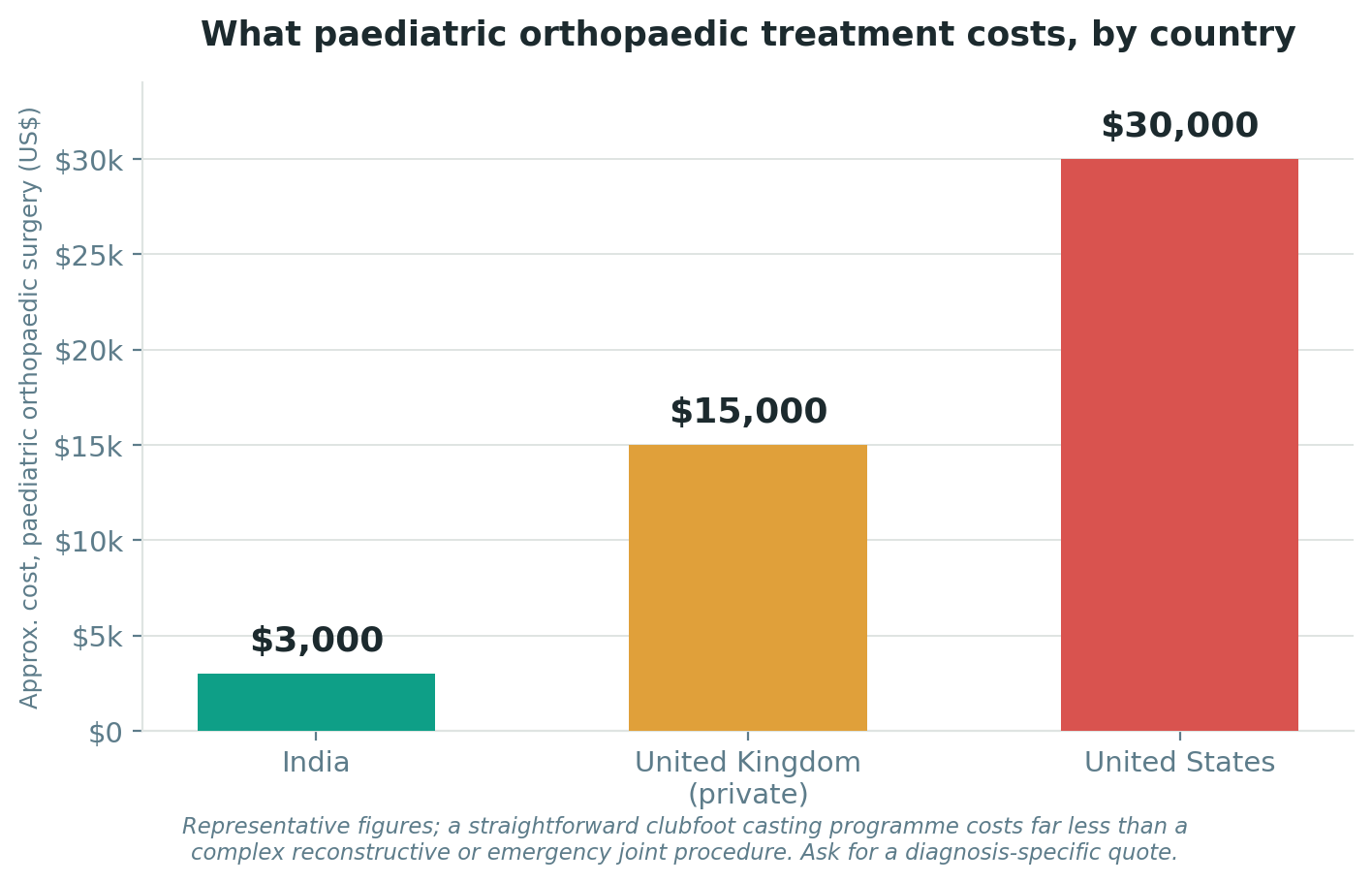
- The page 4 cost chart gives an indicative paediatric orthopaedic treatment cost of approximately US$3,000 in India, compared with US$15,000 in the UK and US$30,000 in the US. The guide stresses that families should request a written, itemised quotation based on the child's specific diagnosis and arrange follow-up in Zambia, particularly because clubfoot bracing continues for years after initial correction.
Quick Facts
- Author
- Dr. Dheeraj Bojwani
- Experience
- 24+ Years of Experience
- Treatment
- Paediatric Orthopaedic Surgery
- Patients
- Zambian Children
- Key Specialist
- Paediatric Orthopaedic Surgeon
- Main Conditions
- Clubfoot, septic arthritis and sickle cell-related orthopaedic problems
- Key Treatment
- Ponseti method for clubfoot
- Emergency Sign
- Fever with a hot, swollen joint and refusal to bear weight
- India Cost
- Approximately US$3,000
- Pre-Travel Records
- Actual imaging and clinical notes
- Follow-Up
- Paediatric team in Zambia
- Key Warning Sign
- Delaying assessment of a suspected joint infection
- Decision Principle
- Match the urgency and treatment to the child's specific condition
In Brief
For Zambian families, the guide's central message is to identify the urgency of the child's condition before planning travel. Early clubfoot can usually be treated with Ponseti casting rather than major surgery, while fever with a hot, swollen joint and refusal to walk requires same-day emergency assessment. The guide gives an indicative paediatric orthopaedic treatment cost of US$3,000 in India.
Clubfoot: a deformity best treated without surgery at all
Clubfoot, or congenital talipes equinovarus, is one of the most common congenital conditions affecting children worldwide, in which one or both feet are turned inward and downward at birth. It looks alarming to new parents, but the modern approach to treating it, called the Ponseti method, is gentle, non- surgical, and highly effective: a series of weekly plaster casts gradually and painlessly reposition the foot, usually followed by a minor procedure to lengthen the Achilles tendon and then a bracing period to prevent the deformity returning.
Published studies from across Africa consistently confirm that the Ponseti method works well in this setting specifically, with success rates comparable to those reported in high-income countries. This matters because it means Zambian families do not need to think of clubfoot as a condition requiring major, complex surgery by default — for the great majority of children treated appropriately and promptly, a straightforward, non-surgical casting programme is genuinely all that is needed.
The single most important factor in how well this works is timing. A newborn's tissues are remarkably flexible, and casting started in the first weeks of life corrects the vast majority of cases without ever needing surgery. The same deformity, left until a child is already walking, is considerably harder to correct fully with casting alone, and more often requires surgical intervention.
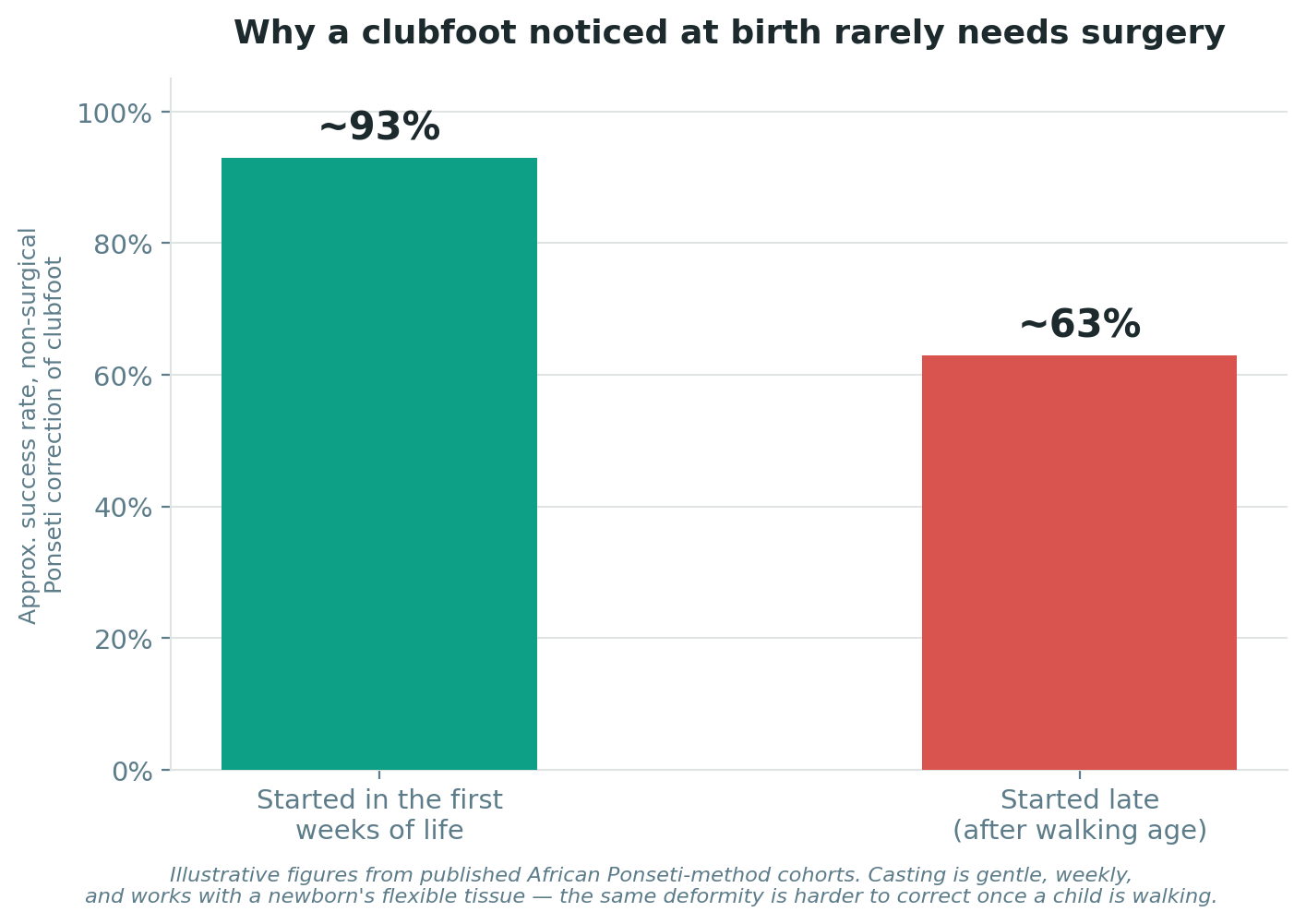
This is one of the clearest examples in children's orthopaedics of how much timing changes the treatment needed.
| Your situation | Typical approach | What it involves |
|---|---|---|
| Clubfoot noticed at birth | Ponseti casting, started as early as possible | Weekly gentle casting over several weeks, often followed by a minor tendon procedure and then long-term bracing |
| Clubfoot in an older child, not previously treated | Still treatable, but more likely to need surgery | A combination of casting and surgical correction, tailored to the specific deformity |
| Fever, refusal to bear weight, and a hot, swollen joint | Emergency assessment the same day | Urgent evaluation for septic arthritis, particularly of the hip, discussed in detail below |
| A limp without fever, in a child with sickle cell disease | Prompt but not panicked assessment | Distinguishing a painful bone crisis from a joint infection, since the two require very different treatment |
Why a hot, swollen joint with fever is a genuine emergency
Septic arthritis — a bacterial infection inside a joint — is considered a true orthopaedic emergency in children, and the hip is the joint of greatest concern. Because the hip joint capsule is tight and relatively inelastic, infection inside it causes pressure to build rapidly, and that pressure can cut off the blood supply to the head of the femur, the ball at the top of the thigh bone. Once that blood supply is lost, the bone itself can be permanently damaged — a condition called avascular necrosis — leading to long-term joint problems that follow a child for life. This is why fever combined with a swollen joint and reluctance to bear weight needs same-day medical attention, not a wait-and-see approach.
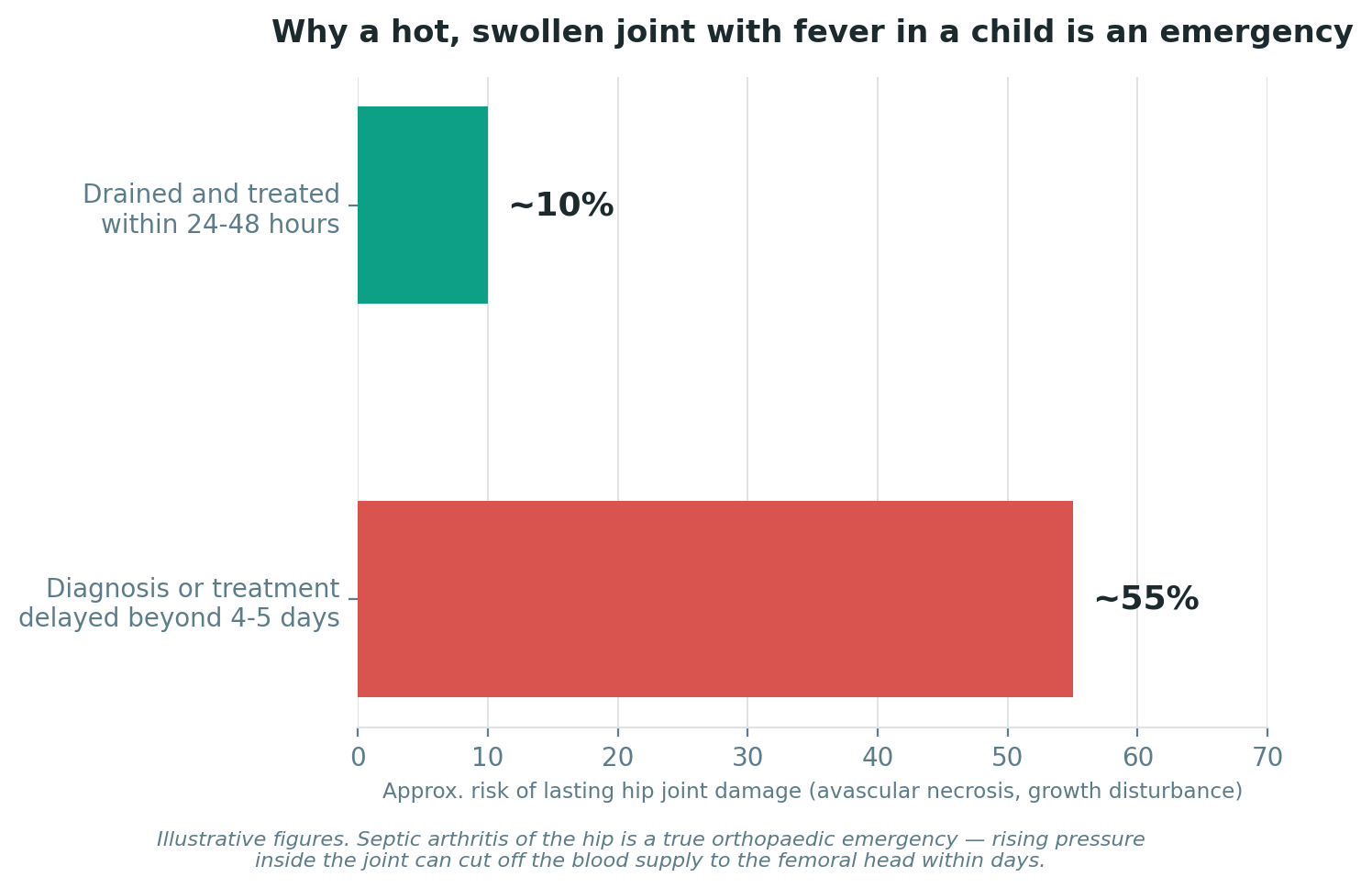
The window to protect the joint's blood supply is measured in days, not weeks.
A distinct complication in children with sickle cell disease
Children with sickle cell disease face a particular diagnostic challenge that deserves specific attention. They are more prone to bone and joint infections than other children, but they also experience painful vaso-occlusive crises — episodes where sickled blood cells block small blood vessels in the bone, causing severe pain that can look remarkably similar to a joint infection on the surface. Telling the two apart matters enormously, since a bone crisis is managed with pain relief and hydration, while a joint infection needs urgent surgical drainage and antibiotics. If your child has sickle cell disease and develops a new limp or bone pain, prompt assessment by a team experienced in this specific distinction is essential.
In practice, this often means a combination of blood tests, imaging, and sometimes a sample taken from the joint itself to determine whether infection is present, since neither a parent nor even an experienced doctor can reliably distinguish the two by symptoms alone. Being open with the medical team about your child's sickle cell diagnosis, and about the pattern of any previous crises, helps them interpret the findings accurately and avoid both under- treating a genuine infection and over-treating a straightforward crisis with an unnecessary procedure.
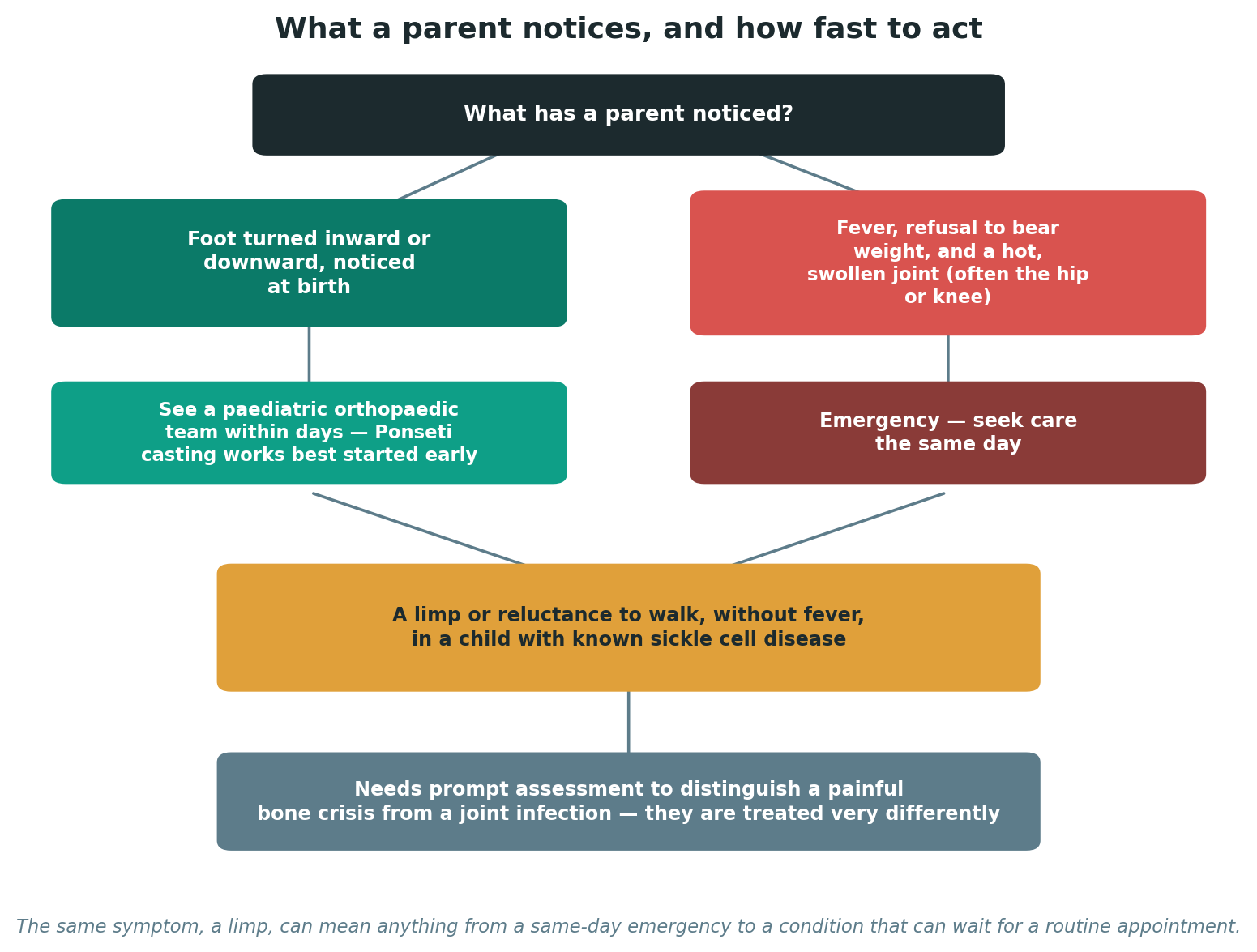
The same symptom can mean very different things — knowing which situation you are in changes how fast to act.
Choosing the centre
For clubfoot, ask specifically whether the centre uses the Ponseti method as first-line treatment, and how many cases their team manages each year, since consistent, correctly-applied casting technique makes a real difference to outcomes. For suspected joint infections, ask about the hospital's capacity for urgent paediatric orthopaedic assessment and same-day surgical drainage if needed, since this is not something that should wait for a scheduled appointment.
Check accreditation (NABH, ideally JCI), and for any condition connected to sickle cell disease, confirm the team has genuine experience distinguishing bone crisis from infection in this specific patient group, since getting this diagnosis right shapes the entire treatment path.
It is also worth asking, for clubfoot specifically, how the centre supports bracing compliance after casting is complete, since relapse is more likely when the bracing period is not followed consistently. A good programme will explain this clearly and provide ongoing guidance, not just the initial correction.
Cost and value: how to weigh the money honestly
Paediatric orthopaedic treatment in a good Indian hospital costs a small fraction of the equivalent care in the West, and India has extensive experience with both routine conditions like clubfoot and more complex paediatric orthopaedic emergencies. The saving is real, and for clubfoot specifically, acting early is not just clinically better — it is also far less costly than the more extensive surgical correction a delayed presentation often requires.
Acting early on a congenital deformity is both the better outcome and the more affordable path.
In 24 years of arranging these journeys, I have found that the families who do best are the ones who understand which situation they are in — a condition that benefits from careful, early planning, or one that cannot wait. Ask for a written, itemised quote that reflects your child's specific diagnosis, since the cost of a straightforward casting programme and a complex reconstructive procedure differ considerably.
What a Zambian family should weigh in particular
Beyond the treatment decision itself, several practical matters deserve attention. First, payment: NHIMA funds care at accredited facilities inside Zambia, not treatment abroad, so this comes from your own resources — another reason acting early on conditions like clubfoot, where delay adds cost as well as complexity, is worth prioritising. Second, if your child has sickle cell disease, discuss with your Zambian doctor now how to recognise the difference between a bone crisis and a possible joint infection, so you are prepared before an emergency happens. Third, aftercare: clubfoot bracing continues for years after initial correction, so arrange follow-up with a Zambian paediatric team before you travel, and insist the Indian team provides a complete written plan for the bracing schedule ahead.
Fourth, keep a simple written or photographic record of your child's condition over time — how a foot looked before treatment, or how a limp has changed — since this kind of practical documentation can be genuinely useful to any doctor assessing your child, in Zambia or India, particularly if you need to describe a change in symptoms during a phone consultation before travel.
The practical journey from Zambia
India requires a yellow fever vaccination certificate from travellers arriving from Zambia, valid only from ten days after the injection — for a genuine emergency, discuss timing with the hospital directly, since urgent care may need to proceed regardless. Your medical visa is issued by the High Commission of India on Pandit Nehru Road in Lusaka against the hospital's invitation letter, with medical-attendant visas for accompanying parents. There is no direct flight from Zambia to India; you will connect through Addis Ababa on Ethiopian Airlines, or through Dubai, Doha or Nairobi. Send your child's actual imaging and clinical notes, not only a summary, for remote review before you travel, so the hospital's team can advise honestly on urgency.
Straight answers for Zambian Patients about Paediatric Orthopaedic Surgery in India
My newborn has a clubfoot. Do we need to travel immediately?
Not necessarily as an emergency, but earlier is better — Ponseti casting works best when started in the first weeks of life. Contact a paediatric orthopaedic team promptly to begin the assessment and treatment process.
My child has a fever and won't put weight on one leg. How worried should I be?
This combination needs same-day medical assessment. It can indicate a joint infection, particularly of the hip, which is a genuine emergency requiring prompt treatment to protect the joint.
My child has sickle cell disease and is limping without fever. Is this an emergency?
It needs prompt assessment, though not necessarily the same urgency as a fever with a hot joint. A doctor experienced with sickle cell disease can help distinguish a painful bone crisis from a possible infection, and this distinction matters for treatment.
Will my child need surgery for their clubfoot?
Many children treated early with the Ponseti method avoid major surgery entirely, though a minor tendon procedure is often part of the standard process. Older children presenting later are more likely to need a more significant surgical component.
Sources
- 🌐 Medical visa, Lusaka — High Commission of India, requirements & process: hcizambia.gov.in/page/medical-visa
- 🌐 Hospital accreditation (India) — Verify a hospital's NABH accreditation: nabh.co
- 🌐 National Health Insurance (Zambia) — NHIMA cover, treatment abroad is not covered: nhima.co.zm
- 🌐 Ministry of Health Zambia — National health services & guidance: moh.gov.zm
- 🌐 National Medical Commission (verify a surgeon) — Confirm a surgeon's registration in India: nmc.org.in
- 🌐 WHO yellow fever — Vaccination requirements before travel: who.int/health-topics/yellow-fever
A Closing Word
Of everything I help families with, this is where knowing which situation you are facing changes everything about how to act. If you send me a note on what you have noticed and any imaging or clinical records you have, I will help you understand honestly how urgent your child's situation is, and which centres in India have the genuine paediatric orthopaedic experience to treat your child well.
Frequently Asked Questions by Zambian Patients about Paediatric Orthopaedic Surgery in India
Does every child with clubfoot need surgery?
No. The guide states that most children treated early with the Ponseti method can avoid major surgery. A minor Achilles tendon procedure may still be part of the standard treatment.
When should Ponseti treatment begin?
It should begin as early as possible, ideally within the first weeks of life, because the newborn's tissues are more flexible and correction is generally easier.
Is a hot, swollen joint with fever an emergency?
Yes. Fever combined with a hot, swollen joint and refusal to bear weight requires same-day medical assessment, particularly when the hip may be involved.
Why is septic arthritis dangerous?
Infection inside the hip can increase pressure within the joint and compromise blood supply to the femoral head, potentially causing permanent bone and joint damage.
What if my child has sickle cell disease and develops a limp?
The child needs prompt assessment. A painful sickle cell crisis can resemble infection, but the two conditions require different treatment.
How much does paediatric orthopaedic treatment cost in India?
The guide gives an indicative cost of approximately US$3,000, although the final cost depends on the diagnosis and complexity of treatment.
What should I ask an Indian hospital about clubfoot?
Ask whether the centre uses the Ponseti method as first-line treatment, how many cases the team manages and how it supports long-term bracing after casting.
What should I send before travelling?
Send the child's actual imaging and clinical notes, rather than only a summary. This allows the Indian team to assess the diagnosis and urgency before travel.
What happens after clubfoot treatment?
Bracing continues for an extended period after correction to reduce relapse. The guide recommends arranging follow-up with a Zambian paediatric team before travelling.
What should families check before travelling from Zambia?
The guide highlights the need to check yellow fever vaccination requirements, medical and attendant visas, travel connections and hospital arrangements before departure.
Page Summary
This five-page Zambia-to-India medical travel guide explains paediatric orthopaedic conditions and treatment, with particular emphasis on early clubfoot care, emergency recognition of septic arthritis and the diagnostic challenge presented by sickle cell disease. The page 1 chart shows approximately 93% non-surgical correction when Ponseti casting starts in the first weeks of life versus 63% when started later. The page 2 chart highlights the potential increase in hip damage when septic arthritis treatment is delayed, while the page 3 flowchart explains how parents should respond to clubfoot, fever with a swollen joint and sickle cell-related limping. The page 4 cost chart gives an indicative cost of US$3,000 in India, compared with US$15,000 in the UK and US$30,000 in the US.
Citation Block
| Topic | Information |
|---|---|
| Topic | Paediatric Orthopaedic Surgery in India for Zambian Patients |
| Treatment | Paediatric Orthopaedic Care |
| Patients | Zambian Children |
| Specialist | Paediatric Orthopaedic Surgeon |
| Main Conditions | Clubfoot, septic arthritis, sickle cell-related problems |
| Key Treatment | Ponseti casting |
| Clubfoot Advantage | Early treatment can avoid major surgery |
| Emergency Sign | Fever + hot swollen joint + refusal to bear weight |
| Sickle Cell Check | Distinguish bone crisis from infection |
| Hospital Check | Ponseti experience and emergency drainage capability |
| Accreditation | NABH, ideally JCI |
| India Cost | Approximately US$3,000 |
| UK Cost | Approximately US$15,000 |
| US Cost | Approximately US$30,000 |
| Pre-Travel Records | Actual imaging and clinical notes |
| Follow-Up | Zambian paediatric team |
| Key Statistic | ~93% vs ~63% non-surgical clubfoot correction depending on treatment timing |
| Emergency Statistic | ~10% vs ~55% illustrative hip-damage risk depending on septic-arthritis treatment delay |
| Travel Check | Yellow fever certificate and medical visa requirements |
| Warning Sign | Delayed assessment of fever with a swollen joint |
| Patient Pathway | Symptoms → urgency assessment → specialist evaluation → treatment → follow-up in Zambia |
| Decision Principle | Early planned care for clubfoot; immediate care for suspected joint infection |


Our Mission Statement
Our mission is to place patients at the centre of every healthcare decision by providing trustworthy, evidence-based, and unbiased medical information. We believe that informed patients make better decisions. Backed by personalised guidance from our experienced advisory team, we help patients understand their treatment options, compare them objectively, and confidently choose the path that best suits their medical needs and personal circumstances.
Patient Testimonials from Zambia
Ready to Take the First Step?
Share your Medical Reports with our Healthcare Managers Today and Get a FREE CONSULTATION, a Personalized Treatment Plan, and Complete Support from Arrival to Recovery.
Get Your Free ConsultationAreas We Serve
This resource has been thoughtfully prepared for patients from Zambia who are considering medical treatment in India. We also welcome patients from the wider region in the countries mentioned below-
We assist patients from:
- Zambia
- Angola
- Malawi
- Zimbabwe
- Botswana
- Namibia
- South Africa
- Eswatini
- Lesotho
- Gabon
- Chad
- Equatorial Guinea
- São Tomé and Príncipe
- Republic of the Congo
- Democratic Republic of the Congo
Many of the insights, treatment pathways, hospital recommendations, travel guidance, and patient support services described here are equally relevant and may be used as a reference when planning treatment in India.
From Zambia to India: Your Complete Patient Support Guide
- Best Weight-Loss (Bariatric) Surgeons & Hospitals in India for Zambian Patients
- Best Brain-Tumour Surgeons & Hospitals in India for Zambian Patients
- Best Cancer Doctors & Hospitals in India for Zambian Patients
- Best Cardiac Surgeons & Hospitals in India for Zambian Patients
- Best Cosmetic Surgeons & Facilities in India for Zambian Patients
- Best CyberKnife Treatment Teams & Centres in India for Zambian Patients
- Best Dentists & Dental Clinics in India for Zambian Patients
- Best Heart Valve Replacement Surgeons & Hospitals in India for Zambian Patients
- Best Hip Surgeons & Hospitals in India for Zambian Patients
- Best Knee Surgeons & Hospitals in India for Zambian Patients
- Best Neurosurgeons & Hospitals in India for Zambian Patients
- Best Paediatric Cardiac Surgeons & Hospitals in India for Zambian Patients
- Best Paediatric Neurosurgeons & Hospitals in India for Zambian Patients
- Best Prostate Surgeons & Hospitals in India for Zambian Patients
- Best Scoliosis Surgeons & Hospitals in India for Zambian Patients
- Best Spine Surgeons & Hospitals in India for Zambian Patients
- Best Bone Marrow Transplant Teams & Hospitals in India for Zambian Patients
- Best Kidney Transplant Surgeons & Hospitals in India for Zambian Patients