

Laparoscopic and Robotic Myomectomy in India for Zambian Patients
Fibroids affect Zambian women earlier, more often, and more severely than most of the world — which makes myomectomy, the operation that removes fibroids while preserving the womb, one of the most common and most consequential decisions in this whole guide series.
A myomectomy is, on the surface, a simple idea: remove the fibroids, keep the womb. In practice, it is one of the more technically demanding operations in gynaecology, because the surgeon must not only remove the growths but rebuild the uterine wall well enough to carry a future pregnancy safely. In 24 years of guiding women through this decision, I have found that two questions matter more than any other: is the surgical approach right for the size and number of your fibroids, and — a question too many women are never asked — how will the tissue actually be removed from your body once it is free. This guide explains both.
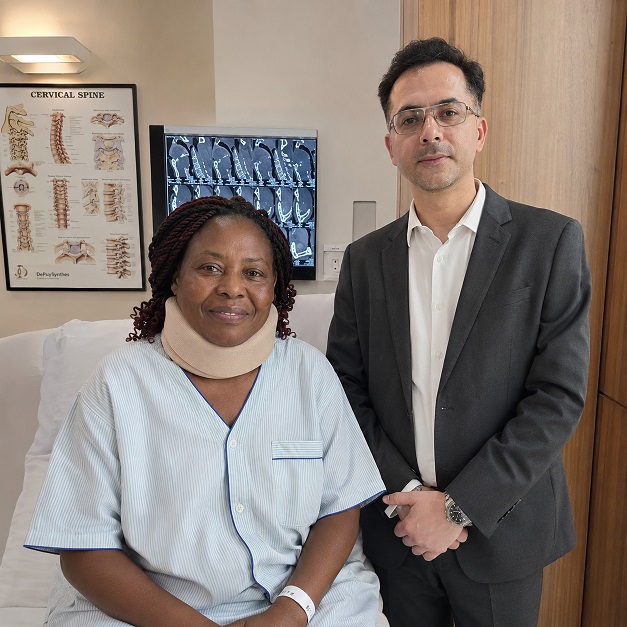
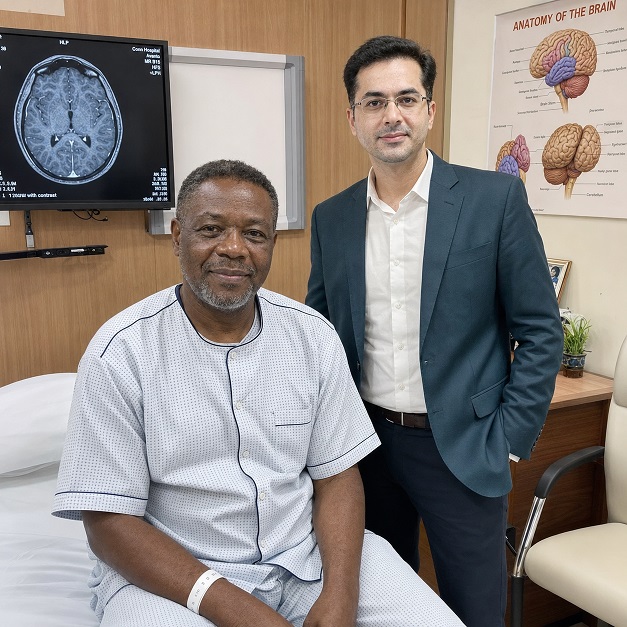
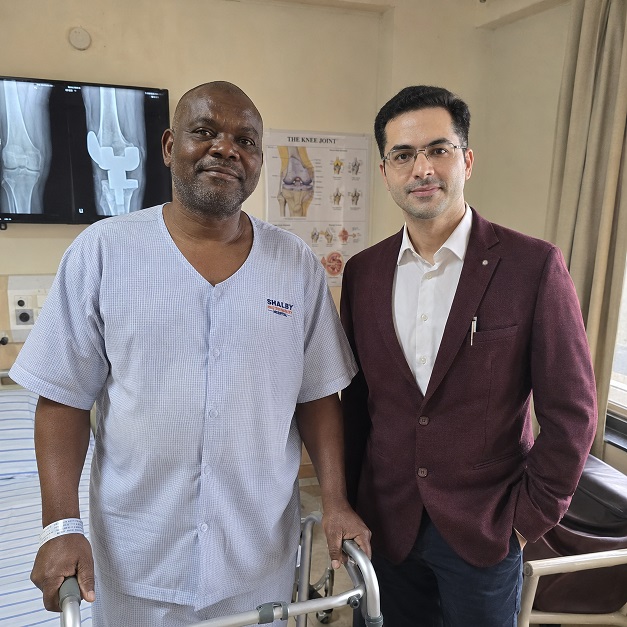
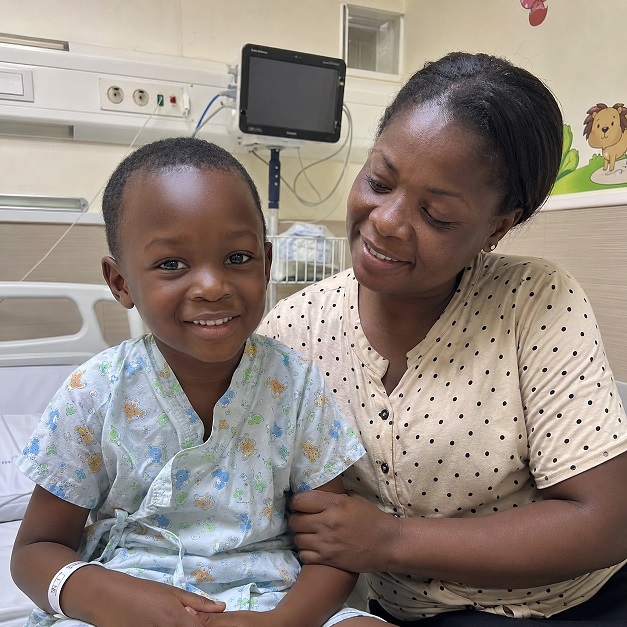
Healing Journeys of Zambian Patients
Key Takeaways
- The guide explains that myomectomy removes uterine fibroids while preserving the uterus, making it particularly important for women who want to maintain fertility. Laparoscopic and robotic approaches may offer less blood loss, shorter hospital stays and faster recovery for appropriately selected fibroids, while open surgery may remain preferable for very large or numerous fibroids.
- The page 2 chart highlights the higher cumulative incidence of fibroids presented for Black and African-ancestry women, showing approximately 80% by age 50 compared with 70% in other populations. The guide notes that fibroids may appear earlier, be larger and be more numerous, making fertility-preserving treatment an important consideration.
- A major focus of the guide is how fibroid tissue is removed after minimally invasive surgery. Because a fibroid and rare uterine sarcoma can appear similar on imaging and cannot always be reliably distinguished before surgery, uncontained morcellation can potentially spread malignant tissue. The guide therefore stresses contained in-bag morcellation, mini-laparotomy extraction or vaginal extraction where appropriate.
- The page 3 infographic presents an illustrative 1-in-350 risk of unsuspected uterine sarcoma among women undergoing surgery for presumed fibroids. It also provides a practical table matching fibroid characteristics with the appropriate surgical approach, including laparoscopic/robotic surgery for selected cases, open surgery for multiple large fibroids and hysteroscopic treatment for suitable cavity-distorting fibroids.
- The guide recommends assessing a surgeon's annual laparoscopic and robotic myomectomy volume, conversion-to-open rate and tissue-extraction technique. Patients should also confirm that all removed tissue will undergo pathology examination and, where future fertility matters, ask how the uterine wall will be repaired because this can influence future pregnancy and delivery planning.
- The guide also discusses uterine artery embolisation as a non-surgical alternative that can reduce fibroid symptoms. However, it notes that evidence regarding future fertility is less certain than with myomectomy, so the choice should be based on the woman's reproductive goals and individual circumstances.
- The page 5 cost chart gives an indicative cost of approximately US$4,000 for laparoscopic or robotic myomectomy in India, compared with US$20,000 in the UK and US$42,000 in the US. The guide stresses that women should obtain an itemised quotation covering surgery, hospital stay, pathology and follow-up, while prioritising safe tissue extraction and appropriate surgical expertise over the lowest price.
Quick Facts
- Author
- Dr. Dheeraj Bojwani
- Experience
- 24+ Years of Experience
- Treatment
- Laparoscopic & Robotic Myomectomy
- Patients
- Zambian Women with Fibroids
- Key Specialist
- Gynaecological Surgeon
- Main Assessment
- Size, number and position of fibroids
- Key Priority
- Choose the safest surgical approach
- Fertility Goal
- Preserve the uterus where appropriate
- Key Safety Check
- Safe tissue-extraction method
- Key Alternatives
- Open or hysteroscopic myomectomy where appropriate
- India Cost
- Approximately US$4,000
- UK Cost
- Approximately US$20,000
- US Cost
- Approximately US$42,000
- Pre-Travel Records
- Actual ultrasound/MRI images
- Pathology
- All removed tissue should be examined
- Follow-Up
- Written operative and pathology report for Zambian gynaecologist
- Key Warning Sign
- Uncontained power morcellation
- Decision Principle
- Match the surgical approach and extraction method to the individual fibroid case
In Brief
For Zambian women considering myomectomy in India, the key decision is not simply whether surgery is laparoscopic or robotic, but whether that approach is appropriate for the size, number and location of the fibroids and whether the tissue can be removed safely. The guide gives an indicative cost of US$4,000 in India and emphasises fertility preservation, pathology review and safe contained tissue extraction.
First, should you travel at all?
Open (abdominal) myomectomy is available in Zambia, and for many women, particularly those with a single large fibroid or a straightforward case, it remains a safe and appropriate option performed well within the country. Laparoscopic and robotic myomectomy — performed through small incisions rather than one large one — are not yet widely available, and this is where travel becomes worth considering: for smaller or fewer fibroids, a minimally invasive approach can mean less blood loss, a shorter hospital stay, and a faster return to normal life, without giving up the fertility-preserving goal of the operation.
Whether minimally invasive surgery is right for you depends heavily on the size, number and position of your fibroids, which is why a proper ultrasound or MRI assessment, reviewed by a gynaecologist experienced in fibroid surgery specifically, should come before any decision about where to have the operation.
It is also worth being clear about what myomectomy cannot always promise. Even the most skilled surgeon may not be able to find and remove every small fibroid, particularly ones too small to feel or see clearly during surgery, and new fibroids can develop over time, especially in women who still have many reproductive years ahead. This does not make the operation any less worthwhile for most women, but it is a realistic conversation to have beforehand rather than an unwelcome surprise afterward.
Why this operation matters so much here
Uterine fibroids are dramatically more common in Black and African-ancestry women than in most other populations, appearing earlier in life, growing larger, and occurring in greater numbers. Reliable data specific to Zambia is limited, but the pattern seen across women of African ancestry worldwide — heavier bleeding, earlier onset, and a much greater likelihood of needing surgery during the childbearing years — is consistent with what gynaecologists across the region report seeing in practice. Because fibroids are so often diagnosed in women who are still building their families, the fertility-preserving nature of myomectomy, as opposed to hysterectomy, matters enormously here — and Black women are far more likely to choose and be offered myomectomy specifically for this reason.
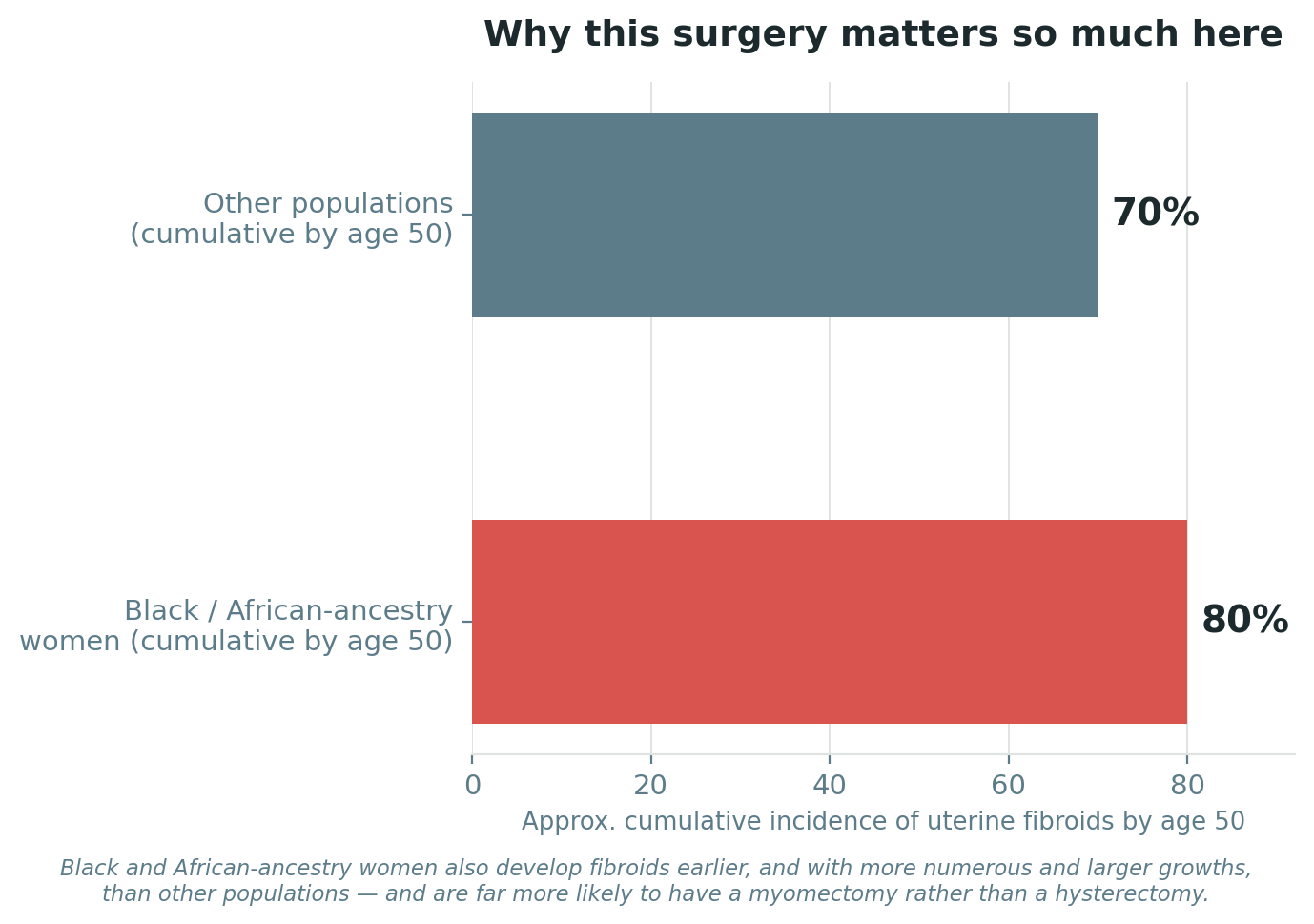
Earlier onset, larger and more numerous fibroids are a consistent finding in Black and African-ancestry women.
The question most women are never asked
Once fibroids are freed from the uterus during laparoscopic or robotic surgery, they are often too large to remove through the same small incisions used to operate — so they need to be cut into smaller pieces inside the abdomen, a process called morcellation, before they can be taken out. This is where an important and under-discussed safety issue comes in.
It is worth understanding why this issue exists at all. Before surgery, a fibroid and a rare cancer called a leiomyosarcoma can look identical on ultrasound or even MRI, and there is no blood test or biopsy that reliably tells the two apart beforehand. The diagnosis is usually only made after the tissue has already been removed and examined under a microscope by a pathologist. This is precisely why the method of extraction matters so much: it has to be safe on the assumption that, in a small number of cases, the tissue could turn out to be something more serious than it first appeared.
The risk that changes how tissue should be removed
What looks and feels like an ordinary fibroid on a scan is, in a small number of cases, an unsuspected cancer called a uterine sarcoma — and there is no reliable way to be completely certain which is which before surgery. If tissue that turns out to be malignant is cut into pieces freely within the abdomen using an open power morcellator, cancer cells can scatter throughout the pelvis and abdomen, potentially converting an early, curable cancer into an advanced, much harder to treat one. Since 2014, health regulators including the US FDA have discouraged open power morcellation for this reason, and now recommend that any morcellation be done inside a sealed containment bag, or that tissue be removed through a small incision (mini-laparotomy) or the vagina instead.
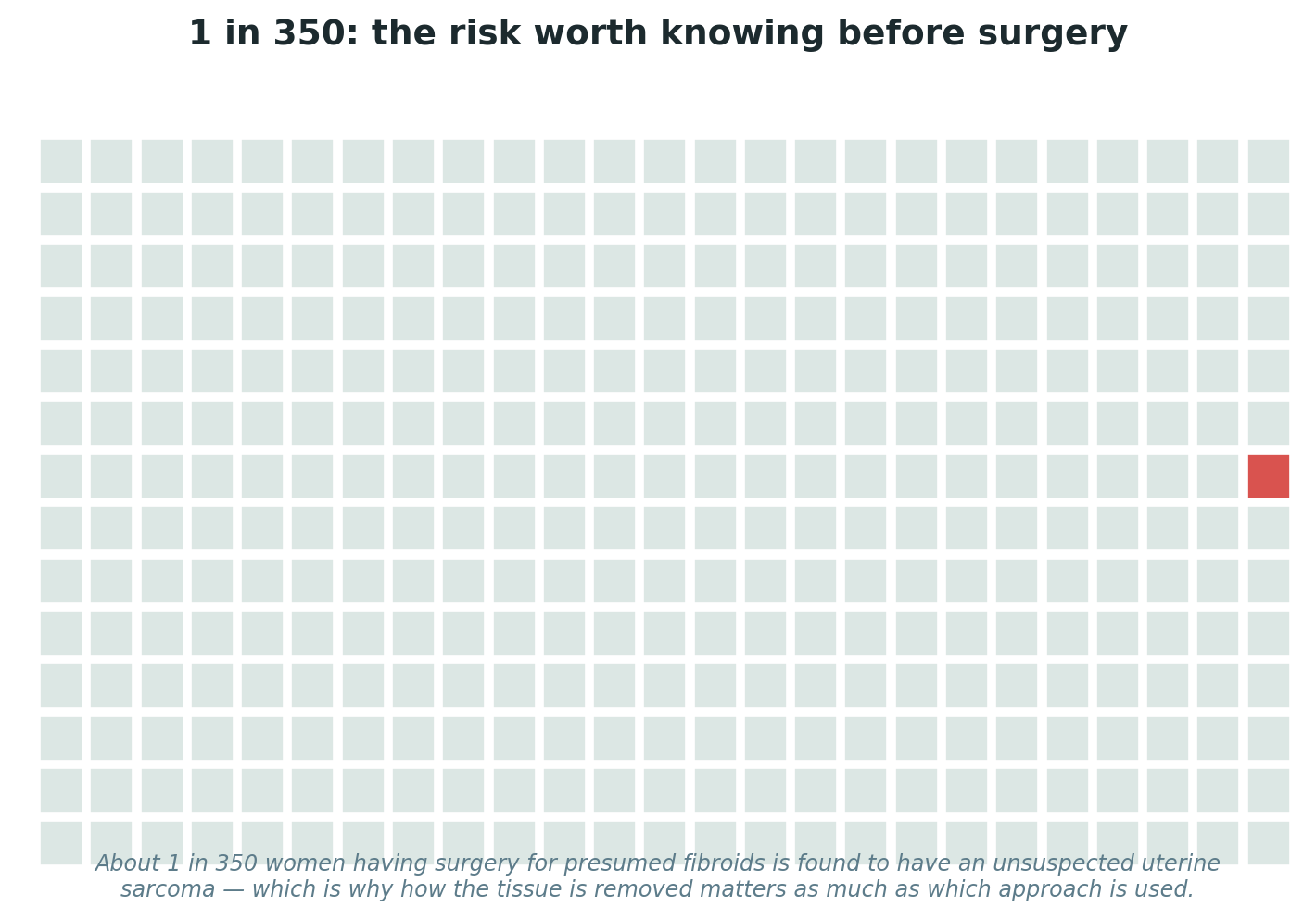
A small but real risk — and one that changes how, not whether, minimally invasive surgery should be done.
| Your situation | Typical approach | What it involves |
|---|---|---|
| Single or few fibroids, moderate size, cavity not badly distorted | Laparoscopic or robotic myomectomy well suited | Small incisions, contained tissue extraction, generally faster recovery than open surgery |
| Multiple large fibroids, or a very enlarged uterus | Open (abdominal) myomectomy often preferred | Allows the surgeon to feel and address fibroids that may not be visible on imaging, without morcellation |
| Fibroids distorting the uterine cavity, affecting fertility | Hysteroscopic myomectomy may be an option for some | Fibroids removed through the vagina and cervix; no abdominal incisions at all for suitable cases |
| Any minimally invasive myomectomy where tissue must be morcellated | Contained (in-bag) morcellation, or mini-laparotomy extraction | Keeps any unexpectedly malignant tissue from spreading, in line with current safety guidance |
| Strong desire for future pregnancy, deep or cavity-entering fibroids | Discuss delivery planning at the time of surgery | Depending on how the uterine wall was repaired, a planned caesarean section is often recommended for any future birth |
| Heavy bleeding causing significant anaemia | Correct anaemia before elective surgery where possible | Iron therapy or, where needed, a short course of medication to shrink fibroids and reduce bleeding before the operation |
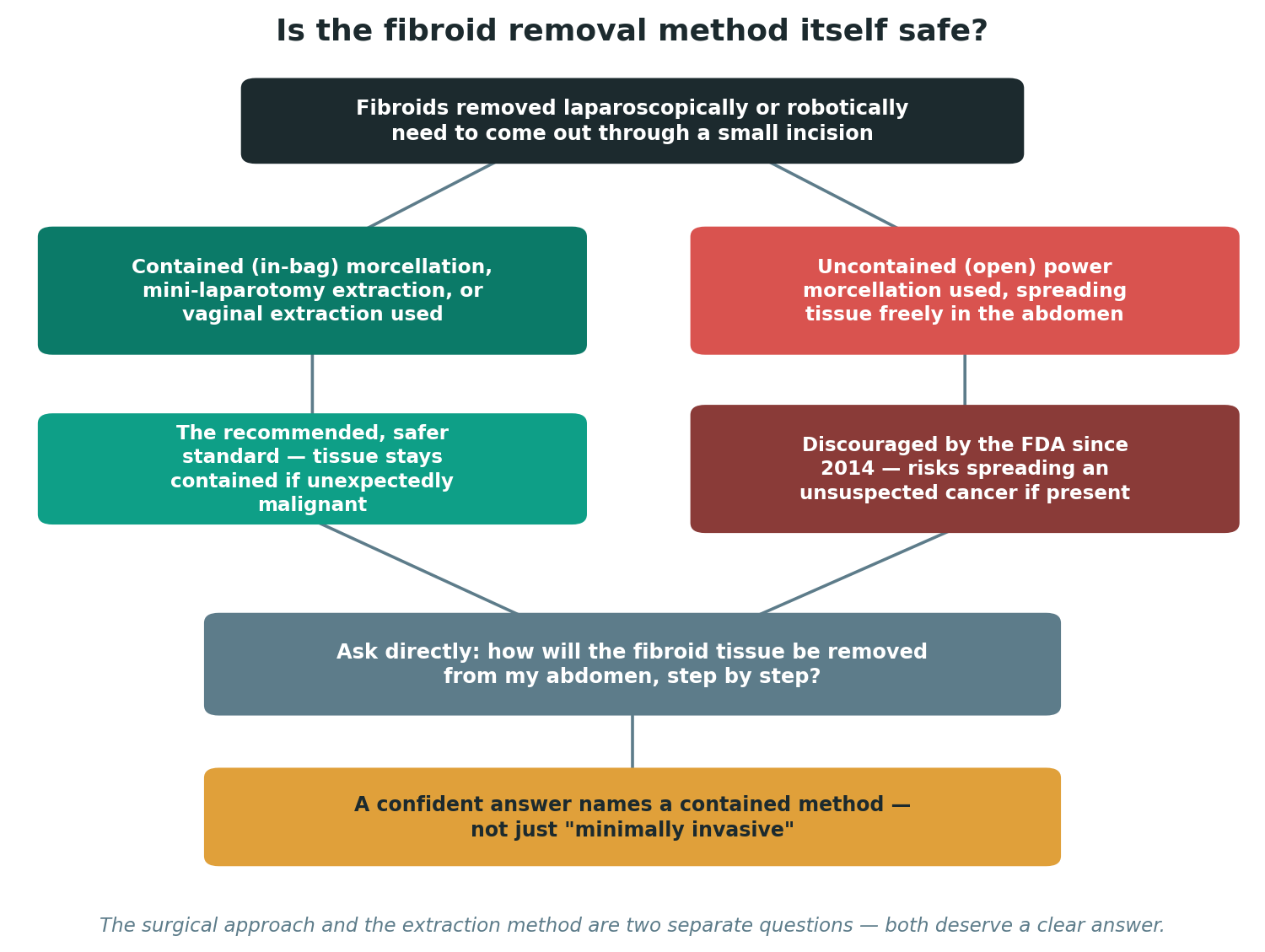
Ask specifically how tissue will be removed — "minimally invasive" alone does not answer this question.
Choosing the surgeon and the hospital
Ask directly how many laparoscopic and robotic myomectomies the surgeon performs each year, and how they routinely handle tissue extraction — a confident, specific answer naming a contained method is a strong sign. Ask, too, about their conversion rate to open surgery, since a fibroid that turns out to be larger, more numerous, or more deeply embedded than expected on imaging sometimes requires switching approach mid-operation, and an honest surgeon will discuss this possibility with you beforehand rather than treating it as a failure to disclose afterward.
Confirm that a pathologist will examine all removed tissue, and ask how any incidental finding of a suspected sarcoma would be communicated and managed. Check accreditation (NABH, ideally JCI), and if fertility preservation is a priority for you, ask specifically about the surgeon's approach to closing the uterine wall in layers, since the quality of this repair affects the safety of any future pregnancy and delivery.
It is also reasonable to ask whether the hospital offers uterine artery embolisation as an alternative to surgery, and to understand why it was or was not recommended for you. This non-surgical procedure blocks the blood supply to fibroids and can be effective at reducing symptoms, but the evidence for its effect on future fertility is less certain than for myomectomy, so it tends to suit women who have completed their families more than those still hoping to conceive.
Cost and value: how to weigh the money honestly
Laparoscopic and robotic myomectomy in a good Indian hospital costs a small fraction of the equivalent surgery in the West, and India performs very high volumes of these operations, meaning genuine expertise is available at that lower price. The saving is real, but it should never come at the cost of asking the extraction-safety questions above — a lower price does not offset an unsafe tissue-removal method.
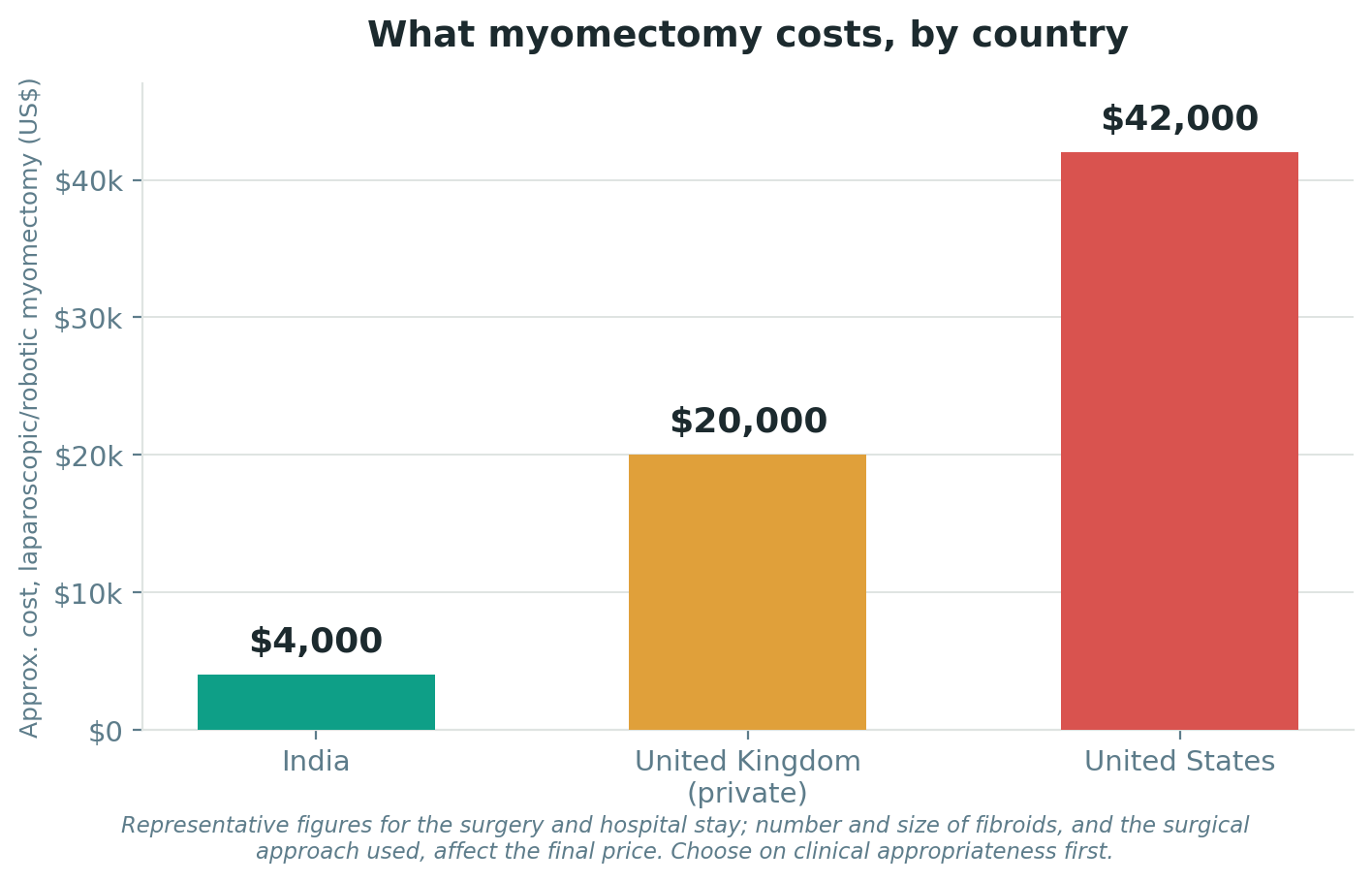
India's affordability is real — but confirm the extraction method is safe before you travel.
In 24 years of arranging these journeys, I have found that women who ask specific, informed questions before surgery — about the surgical approach, the extraction method, and future fertility plans — tend to have both safer surgery and a clearer sense of what recovery and any future pregnancy will look like. Ask for a written, itemised quote covering the surgery, hospital stay, pathology review of all removed tissue, and any follow-up scans, before you commit.
What a Zambian patient should weigh in particular
Beyond the surgical decision itself, several practical matters deserve attention. First, payment: NHIMA funds care at accredited facilities inside Zambia, not treatment abroad, so myomectomy in India comes from your own resources — another reason to be confident in the plan before committing funds. Second, if you hope to have children in future, discuss this explicitly with the surgical team before the operation, not after, since it can affect both the surgical approach chosen and how the uterine wall is repaired. Third, aftercare: arrange with a Zambian gynaecologist to take over your follow-up before you travel, and insist the Indian team provides a complete written operative report, including the pathology result on all removed tissue and any recommendations for future pregnancy and delivery.
Fourth, if heavy menstrual bleeding from fibroids has left you significantly anaemic, raise this with your team as early as possible. Severe anaemia increases the risks of any major surgery, and correcting it beforehand, whether with iron therapy or a short course of medication to reduce bleeding and shrink fibroids, is often possible and worth the delay of a few weeks if it makes your operation meaningfully safer.
The practical journey from Zambia
India requires a yellow fever vaccination certificate from travellers arriving from Zambia, valid only from ten days after the injection. Your medical visa is issued by the High Commission of India on Pandit Nehru Road in Lusaka against the hospital's invitation letter. There is no direct flight from Zambia to India; you will connect through Addis Ababa on Ethiopian Airlines, or through Dubai, Doha or Nairobi. Send your actual ultrasound or MRI images, not only written reports, for remote review before you travel, since the precise size, number and position of your fibroids is what determines which surgical approach is genuinely appropriate.
Signals that should make you pause
1. A hospital that cannot describe, specifically, how fibroid tissue will be removed from your abdomen once it is free.
2. Any mention of open, uncontained power morcellation without a containment bag or alternative extraction method.
3. No plan for pathology examination of all removed tissue, or vagueness about how an unexpected finding would be handled.
4. Reluctance to discuss the surgeon's individual case volume, complication rate, or conversion-to-open-surgery rate.
Straight answers for Zambian Patients about Laparoscopic and Robotic Myomectomy in India
Will a myomectomy affect my ability to have children?
Myomectomy is specifically intended to preserve the uterus and fertility, unlike a hysterectomy. Many women go on to have successful pregnancies afterward, though depending on how the uterine wall was repaired, a planned caesarean section is often recommended rather than a vaginal delivery.
What is morcellation, and why does it matter so much?
It is the process of cutting fibroid tissue into smaller pieces so it can be removed through small incisions. It matters because a small proportion of tissue that looks like an ordinary fibroid turns out to be an unsuspected cancer, and cutting that tissue up without containing it can spread cancer cells through the abdomen. Contained, in-bag morcellation or alternative extraction methods avoid this risk.
How do I know if my surgeon uses a safe extraction method?
Ask directly, before surgery, exactly how tissue will be removed from your abdomen. A confident answer will name a specific method — a containment bag, a mini-laparotomy incision, or vaginal extraction — rather than a general reassurance that the surgery is "minimally invasive."
Sources
- 🌐 Medical visa, Lusaka — High Commission of India, requirements & process: hcizambia.gov.in/page/medical-visa
- 🌐 Hospital accreditation (India) — Verify a hospital's NABH accreditation: nabh.co
- 🌐 National Health Insurance (Zambia) — NHIMA cover, treatment abroad is not covered: nhima.co.zm
- 🌐 Ministry of Health Zambia — National health services & guidance: moh.gov.zm
- 🌐 National Medical Commission (verify a surgeon) — Confirm a surgeon's registration in India: nmc.org.in
- 🌐 WHO yellow fever — Vaccination requirements before travel: who.int/health-topics/yellow-fever
A Closing Word
Myomectomy is one of the operations I am asked about most often, because fibroids touch so many Zambian women's lives, often at exactly the moment they are building their families. If you send me your scans and a note on your fertility goals, I will help you think through whether a minimally invasive approach is right for your specific fibroids, what questions to ask about how tissue will be removed, and which centres in India have the genuine experience — surgical and pathological — to treat you safely and help you protect the future you want.
Frequently Asked Questions by Zambian Patients about Laparoscopic and Robotic Myomectomy in India
What is a myomectomy?
Myomectomy is surgery to remove uterine fibroids while preserving the uterus. It is commonly considered when fertility preservation is important.
Is laparoscopic or robotic myomectomy always better than open surgery?
Not for every case. It offers real advantages in blood loss, scarring and recovery time for suitable fibroids, but for very large, numerous, or deeply embedded fibroids, open surgery may allow a more thorough and safer removal. The right approach depends on your specific fibroids, assessed on imaging beforehand.
What is morcellation?
Morcellation means cutting fibroid tissue into smaller pieces so it can be removed through small incisions. The guide stresses that the method must prevent possible spread of unexpectedly malignant tissue.
Why is contained morcellation important?
A fibroid can rarely prove to be an unsuspected uterine sarcoma. Contained, in-bag morcellation or alternative extraction methods are recommended in the guide to reduce the risk of spreading malignant tissue.
Can myomectomy preserve fertility?
Yes. Myomectomy is specifically intended to preserve the uterus, unlike hysterectomy. Future delivery planning depends partly on how deeply the uterine wall was repaired.
How much does myomectomy cost in India?
The guide gives an indicative cost of approximately US$4,000 for laparoscopic or robotic myomectomy in India. The final cost varies according to fibroid size, number and surgical complexity.
What should I ask my surgeon before surgery?
Ask about annual case volume, conversion-to-open rate, tissue-extraction method, pathology examination and uterine-wall repair, particularly if future pregnancy is important.
Can fibroids come back after myomectomy?
Yes, new fibroids can develop over time, particularly in younger women with many reproductive years remaining, and very small fibroids present at the time of surgery are sometimes missed. This is a realistic part of the conversation with your surgeon beforehand, and it does not mean the operation has failed if it happens.
Is uterine artery embolisation an alternative?
It can reduce fibroid symptoms and may be an option for some women. However, the guide notes that its effect on future fertility is less certain than that of myomectomy.
What should I send before travelling to India?
Send the actual ultrasound or MRI images, not just written reports. The size, number and location of the fibroids help the Indian surgical team determine the most appropriate approach.
Page Summary
This six-page Zambia-to-India medical travel guide explains laparoscopic and robotic myomectomy, focusing on fertility preservation, selection of the surgical approach and the safety of fibroid tissue extraction. The page 2 chart shows an illustrative cumulative fibroid incidence of 80% among Black/African-ancestry women versus 70% in other populations by age 50. The page 3 infographic highlights an illustrative 1-in-350 risk of unsuspected uterine sarcoma and provides a table matching fibroid characteristics with appropriate surgical approaches. The page 4 diagram explains the difference between contained and uncontained tissue extraction. The page 5 cost chart gives an indicative myomectomy cost of US$4,000 in India, compared with US$20,000 in the UK and US$42,000 in the US.
Citation Block
| Topic | Information |
|---|---|
| Topic | Laparoscopic & Robotic Myomectomy in India for Zambian Patients |
| Treatment | Laparoscopic / Robotic Myomectomy |
| Patients | Zambian Women with Fibroids |
| Specialist | Gynaecological Surgeon |
| Main Assessment | Fibroid size, number and position |
| Key Priority | Appropriate surgical approach |
| Fertility Goal | Preserve uterus and future fertility |
| Minimally Invasive Option | Laparoscopic or robotic myomectomy |
| Large Fibroids | Open myomectomy may be preferred |
| Cavity Fibroids | Hysteroscopic myomectomy may suit selected cases |
| Safety Check | Contained tissue extraction |
| Morcellation | In-bag containment or alternative extraction |
| Pathology | Examination of all removed tissue |
| Surgeon Check | Annual case volume and conversion rate |
| India Cost | Approximately US$4,000 |
| UK Cost | Approximately US$20,000 |
| US Cost | Approximately US$42,000 |
| Pre-Travel Records | Actual ultrasound/MRI images |
| Follow-Up | Operative report, pathology and fertility guidance |
| Key Statistic | Illustrative 1-in-350 unsuspected sarcoma risk |
| Fibroid Incidence Chart | Approx. 80% vs 70% cumulative incidence by age 50 |
| Alternative Treatment | Uterine artery embolisation |
| Warning Sign | Uncontained power morcellation |
| Patient Pathway | Imaging → surgical assessment → approach selection → safe extraction → pathology → recovery/fertility follow-up |
| Decision Principle | Surgical approach and tissue extraction must be individually assessed |

Our Mission Statement
Our mission is to place patients at the centre of every healthcare decision by providing trustworthy, evidence-based, and unbiased medical information. We believe that informed patients make better decisions. Backed by personalised guidance from our experienced advisory team, we help patients understand their treatment options, compare them objectively, and confidently choose the path that best suits their medical needs and personal circumstances.
Patient Testimonials from Zambia
Ready to Take the First Step?
Share your Medical Reports with our Healthcare Managers Today and Get a FREE CONSULTATION, a Personalized Treatment Plan, and Complete Support from Arrival to Recovery.
Get Your Free ConsultationAreas We Serve
This resource has been thoughtfully prepared for patients from Zambia who are considering medical treatment in India. We also welcome patients from the wider region in the countries mentioned below-
We assist patients from:
- Zambia
- Angola
- Malawi
- Zimbabwe
- Botswana
- Namibia
- South Africa
- Eswatini
- Lesotho
- Gabon
- Chad
- Equatorial Guinea
- São Tomé and Príncipe
- Republic of the Congo
- Democratic Republic of the Congo
Many of the insights, treatment pathways, hospital recommendations, travel guidance, and patient support services described here are equally relevant and may be used as a reference when planning treatment in India.
From Zambia to India: Your Complete Patient Support Guide
- Best Weight-Loss (Bariatric) Surgeons & Hospitals in India for Zambian Patients
- Best Brain-Tumour Surgeons & Hospitals in India for Zambian Patients
- Best Cancer Doctors & Hospitals in India for Zambian Patients
- Best Cardiac Surgeons & Hospitals in India for Zambian Patients
- Best Cosmetic Surgeons & Facilities in India for Zambian Patients
- Best CyberKnife Treatment Teams & Centres in India for Zambian Patients
- Best Dentists & Dental Clinics in India for Zambian Patients
- Best Heart Valve Replacement Surgeons & Hospitals in India for Zambian Patients
- Best Hip Surgeons & Hospitals in India for Zambian Patients
- Best Knee Surgeons & Hospitals in India for Zambian Patients
- Best Neurosurgeons & Hospitals in India for Zambian Patients
- Best Paediatric Cardiac Surgeons & Hospitals in India for Zambian Patients
- Best Paediatric Neurosurgeons & Hospitals in India for Zambian Patients
- Best Prostate Surgeons & Hospitals in India for Zambian Patients
- Best Scoliosis Surgeons & Hospitals in India for Zambian Patients
- Best Spine Surgeons & Hospitals in India for Zambian Patients
- Best Bone Marrow Transplant Teams & Hospitals in India for Zambian Patients
- Best Kidney Transplant Surgeons & Hospitals in India for Zambian Patients