

Kidney Transplant in India for Zambian Patients
Of everyone in Africa who needs a kidney transplant or dialysis to stay alive, only a small fraction ever receive it — which makes the timing of this decision, not just the choice of hospital, one of the most consequential a Zambian family will make.
Kidney failure is unusual among the conditions I am asked about, because the single biggest driver of a good outcome is not which surgeon holds the scalpel — it is how early the decision to transplant is made, and how quickly a suitable donor is found. Wait too long on dialysis, and the odds shift, sometimes quietly, against the patient. In 24 years of guiding African families through this process, the single regret I hear most often is not about the hospital chosen, but about time lost earlier — searching for a donor, or hoping dialysis alone would be enough, when the more decisive path was transplant itself. This guide sets out what a Zambian patient and family should understand, and when, to give a transplant the best chance of succeeding.
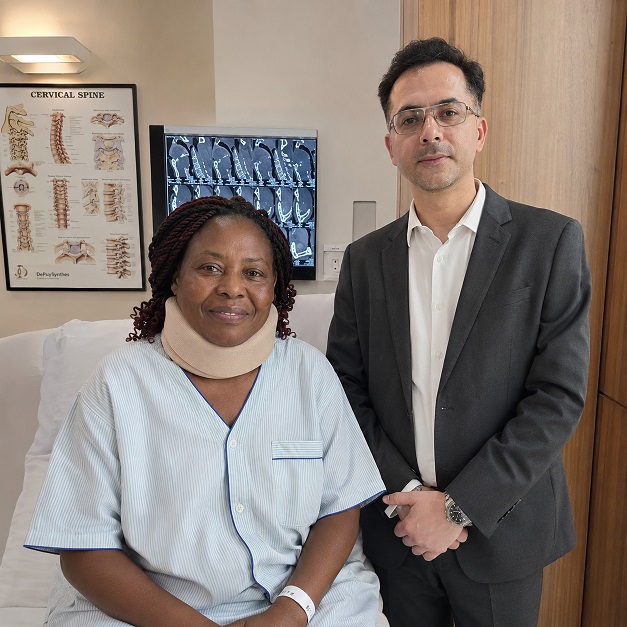
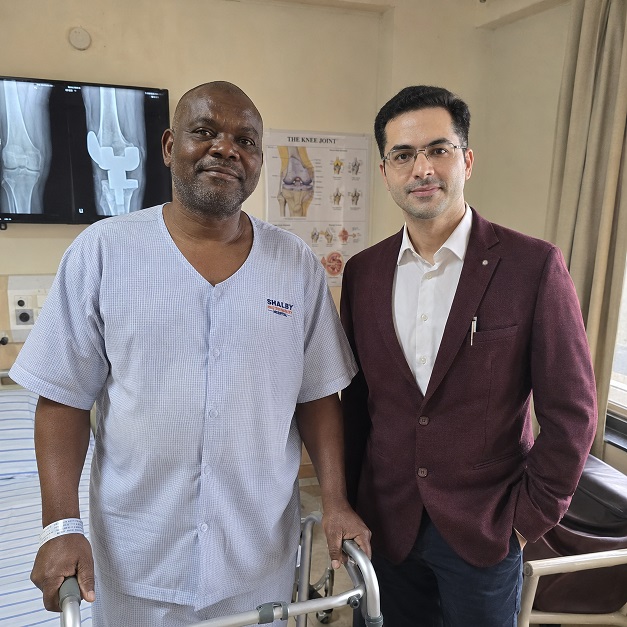
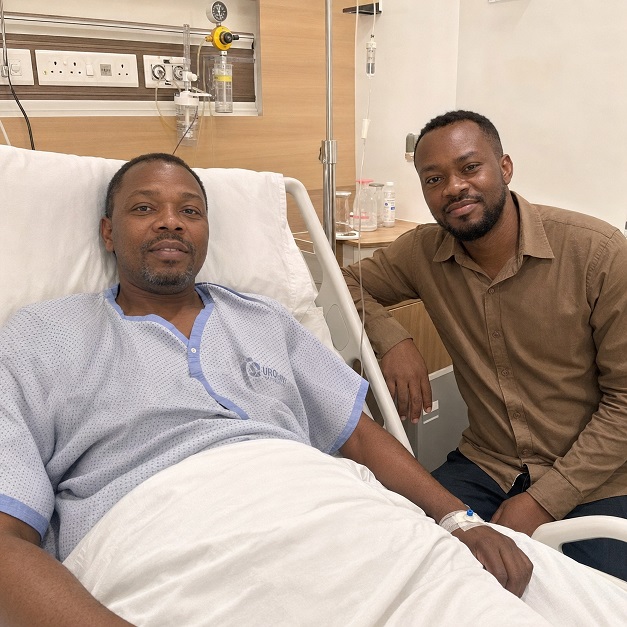
Healing Journeys of Zambian Patients






Key Takeaways
- The guide emphasises that timing can be as important as hospital selection in kidney transplantation. Patients with progressive kidney failure should begin transplant planning early, ideally before dialysis becomes necessary, while those with early or stable kidney disease may still benefit from medical management and monitoring in Zambia rather than immediate travel.
- The page 2 chart highlights the different causes of kidney failure described in sub-Saharan African cohorts, with hypertension at 25–40%, HIV-associated nephropathy/HIV-related kidney disease at 15–28%, diabetes at 14–20% and chronic glomerulonephritis at 12–20%. The guide therefore recommends considering HIV history, blood-pressure control and family history during the transplant work-up.
- The guide strongly favours early transplant evaluation and preemptive transplantation where appropriate. Its page 2 survival chart presents illustrative five-year survival of approximately 82% after kidney transplant versus about 45% with long-term dialysis without transplant, while noting that these figures are general and not guarantees for an individual patient.
- For foreign patients, the guide identifies a living donor from the patient's family as the most realistic pathway. It explains that a willing near-relative may donate subject to Indian legal and Authorization Committee requirements. If blood group or tissue compatibility is a problem, paired exchange or an ABO-incompatible transplant may still make transplantation possible.
- The page 3 donor-matching diagram clearly shows the possible pathways: a compatible near-relative can proceed to a direct living-donor transplant, while a mismatch may lead to paired exchange or ABO-incompatible transplantation. Without a willing or eligible near-relative, the deceased-donor route is presented as having long odds for a foreign patient.
- When choosing an Indian transplant centre, the guide recommends checking annual kidney-transplant volume, graft and patient survival results, multidisciplinary transplant expertise, ICU capability and donor evaluation standards. It also recommends asking whether laparoscopic or robotic donor nephrectomy is available and whether the named surgeon will personally lead the recipient's operation.
- The page 4 cost chart gives an indicative kidney-transplant admission cost of approximately US$15,000 in India, compared with US$100,000 in the UK and US$300,000 in the US. However, the guide stresses that the transplant admission is only the beginning: lifelong immunosuppressive medicines, blood tests and follow-up must be included in financial planning.
Quick Facts
- Author
- Dr. Dheeraj Bojwani
- Experience
- 24+ Years of Experience
- Treatment
- Kidney Transplant
- Patients
- Zambian Kidney Patients
- Key Specialist
- Transplant Nephrologist / Kidney Transplant Surgeon
- Main Assessment
- Kidney function, transplant suitability and donor pathway
- Key Priority
- Early transplant evaluation
- Preferred Donor
- Eligible living family donor
- Matching Options
- Direct transplant, paired exchange or ABO-incompatible transplant
- India Cost
- Approximately US$15,000
- UK Cost
- Approximately US$100,000
- US Cost
- Approximately US$300,000
- Pre-Travel Records
- Actual scans, blood tests and transplant records
- Follow-Up
- Lifelong transplant monitoring and immunosuppressive medication
- Key Warning Sign
- Anyone offering a kidney for payment or arranging a donor for a fee
- Decision Principle
- Confirm the donor pathway and transplant team's experience before travelling
In Brief
For Zambian patients with progressive kidney failure, the guide recommends starting transplant evaluation early rather than waiting until prolonged dialysis. A living family donor is generally the most realistic pathway for a foreign patient, and a blood-group mismatch does not necessarily end the possibility because paired exchange and ABO-incompatible transplantation may be available. The guide gives an indicative transplant admission cost of US$15,000 in India.
First, should you travel at all?
Zambia can and does provide dialysis, and a great many patients live stable, active lives on it for years, treated at referral hospitals within the country. For a patient newly diagnosed with reduced kidney function, or one whose kidney disease is at an early stage, the right course is very often careful management at home — control of blood pressure, treatment of the underlying cause, and monitoring — not immediate travel for transplant. A good nephrologist should tell you plainly if this describes your situation.
What is far harder to access within Zambia, and across most of the region, is transplantation itself. Across sub-Saharan Africa, only a small fraction of the people whose kidneys have failed completely ever receive a transplant or even reliable long-term dialysis — access to renal replacement therapy of any kind remains one of the great unmet needs in African healthcare. This is precisely why, once kidney failure is confirmed and progressing, the conversation about transplant should start early rather than being delayed until dialysis is the only remaining option. India performs more kidney transplants for international patients than almost any other country, with an experienced, high-volume living-donor programme that a Zambian family can realistically access.
This is also why the first specialist conversation matters so much, and why it should happen with a nephrologist rather than being left to a general physician alone. Someone who has tracked your kidney function over months, understands the underlying cause, and can say honestly how quickly things are likely to progress is in the best position to tell you when the conversation should shift from "manage" to "plan for transplant." That conversation, started early, is worth more at this stage than any hospital's marketing material.
Why kidneys fail differently here
In Western teaching, diabetes and age-related hypertension are usually presented as the leading causes of kidney failure. Across Southern and Eastern Africa the picture includes a further, distinct driver: HIV itself, both through a direct kidney injury called HIV-associated nephropathy and through the long-term effects of certain antiretroviral medicines, is responsible for a substantial share of kidney failure in the region, alongside severe, often late-detected hypertension. This matters practically. It means HIV status and treatment history belong at the centre of the pre- transplant work-up, not as an incidental detail; it means blood pressure control started early can meaningfully change the trajectory of kidney disease; and it means a family history of unexplained kidney failure is worth mentioning to your team, since a genetic susceptibility more common in people of African ancestry can also play a role.
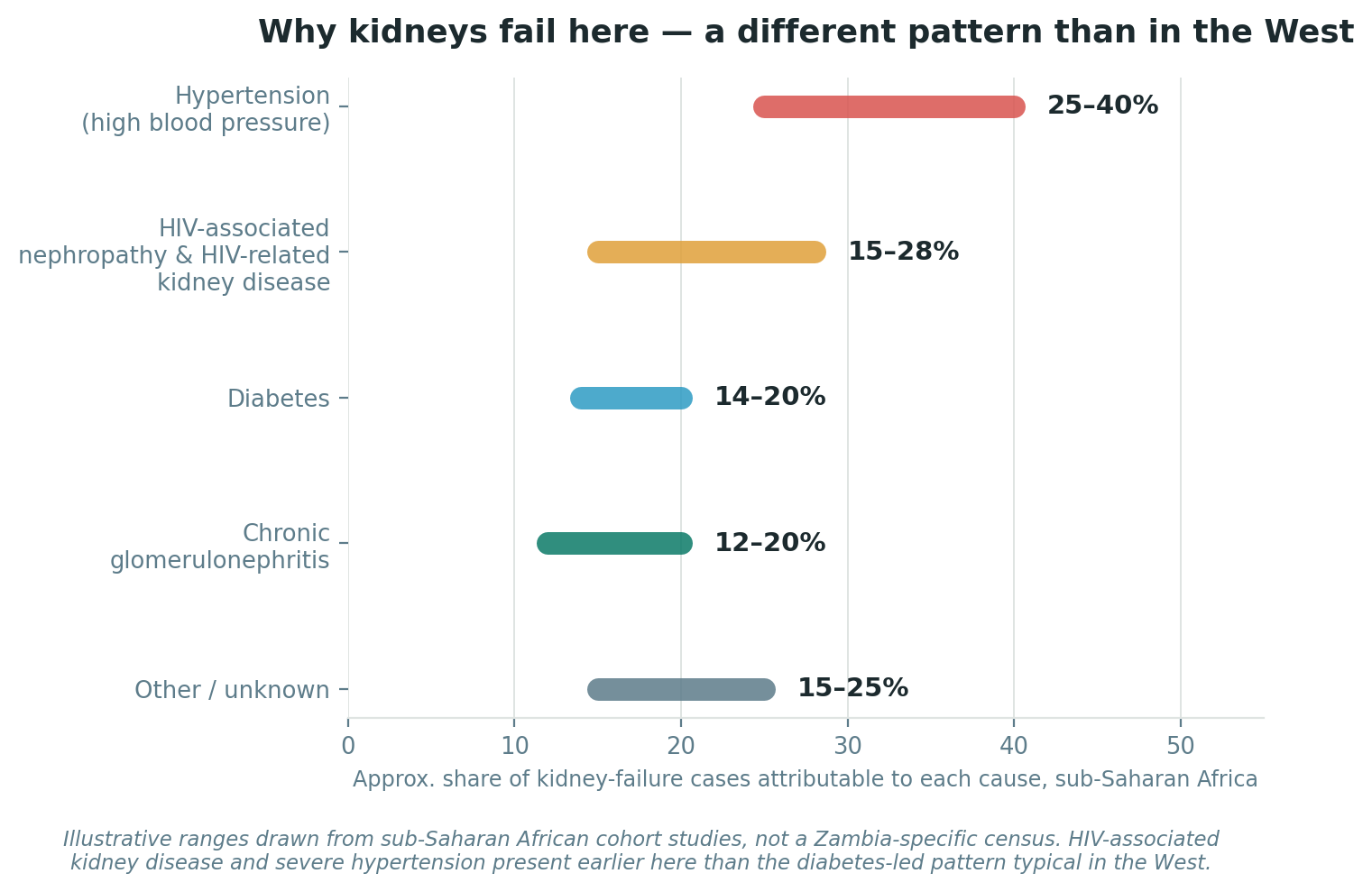
HIV-related kidney disease and severe hypertension feature far more heavily here than in typical Western case-mix.
Why timing matters as much as the hospital
Every study of kidney failure finds the same basic pattern: patients who receive a transplant before starting dialysis, or after only a short time on it, tend to do considerably better than those who spend years on dialysis first. Dialysis keeps patients alive, but it is hard on the body — it raises the risk of heart disease and infection over time, and the longer someone remains on it, the more those risks accumulate, sometimes to the point where a person is no longer considered a safe candidate for transplant at all. This is why, in good kidney care, the question "should we start planning for transplant" is asked as soon as kidney failure is confirmed as progressive, not deferred until dialysis has already begun.
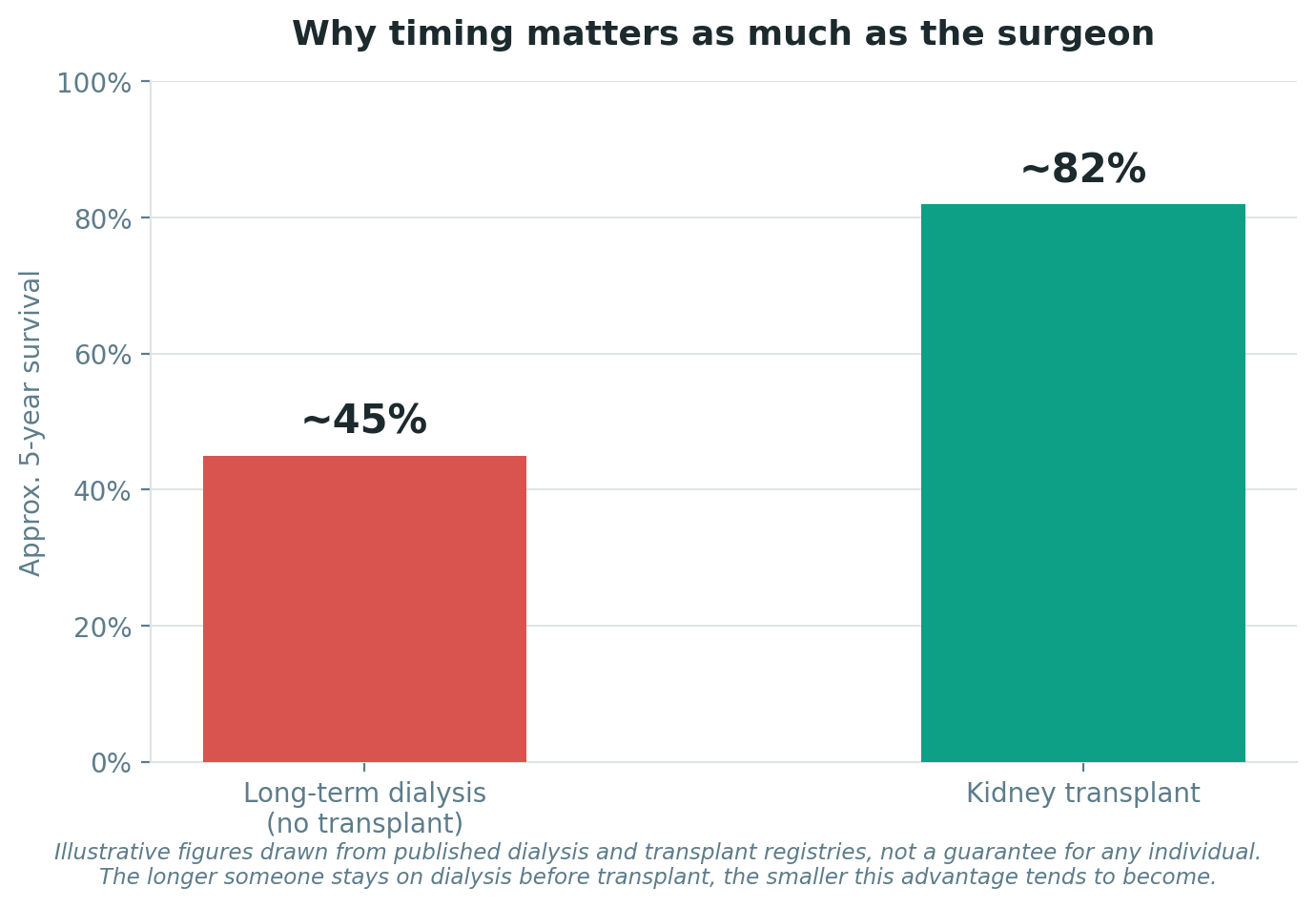
Illustrative figures only — the gap narrows the earlier a well-matched transplant happens.
| Your situation | Typical approach | What it involves |
|---|---|---|
| Early or moderate reduced kidney function, stable | Medical management and monitoring | Blood pressure and diabetes control, treatment of the underlying cause, regular blood tests to track the trend |
| Kidney function declining toward failure, no dialysis yet | Begin transplant work-up now — a preemptive transplant | Recipient evaluation, identification of a potential family donor, and blood-group/tissue typing, ideally completed before dialysis becomes necessary |
| Already on dialysis, otherwise reasonably well | Transplant evaluation without delay | The same work-up as above, pursued as a priority rather than something to revisit "later" |
| Willing family donor, fully compatible | Direct living-donor transplant | The most straightforward path — donor and recipient surgery scheduled together at the chosen centre |
| Willing family donor, blood group or tissue mismatch | Paired exchange or ABO-incompatible transplant | Discussed in full below — a mismatch does not have to end the plan |
| No willing or eligible family donor | Deceased-donor registration, or reconsider the plan | A realistic conversation about long odds for a foreign patient, covered below |
The donor question: whose kidney, and what if it doesn't match?
As with other organ transplants, Indian law allows an Indian citizen to donate a kidney to a foreign national only if the donor is a near relative — spouse, parent, child, sibling, or grandparent — and a case involving a foreign national requires Authorization Committee approval and certification of the relationship through the Indian High Commission. Deceased-donor kidneys exist in India through the national NOTTO registry, but foreign nationals are considered only after every suitable Indian patient has been, and realistic waiting times even for eligible candidates commonly run into years. A Zambian family should plan on the basis that a living donor from within the family is the realistic route, not the deceased-donor list.
What surprises many families is what happens next if their willing donor turns out not to match. In the past, an incompatible blood group between patient and donor often ended the conversation. It no longer has to. Indian transplant centres increasingly offer paired exchange, sometimes called a kidney swap, in which your incompatible donor gives a kidney to another family's matching recipient, while that family's donor gives a kidney to your relative in return — both patients are transplanted, neither donor gives to their own family member directly. Where a suitable swap partner cannot be found, some centres also offer ABO-incompatible transplantation, using medication before surgery to prepare the recipient's immune system to safely accept a mismatched kidney. Ask about both options directly and early; assuming a mismatch rules your donor out is one of the more common and avoidable planning mistakes I see.
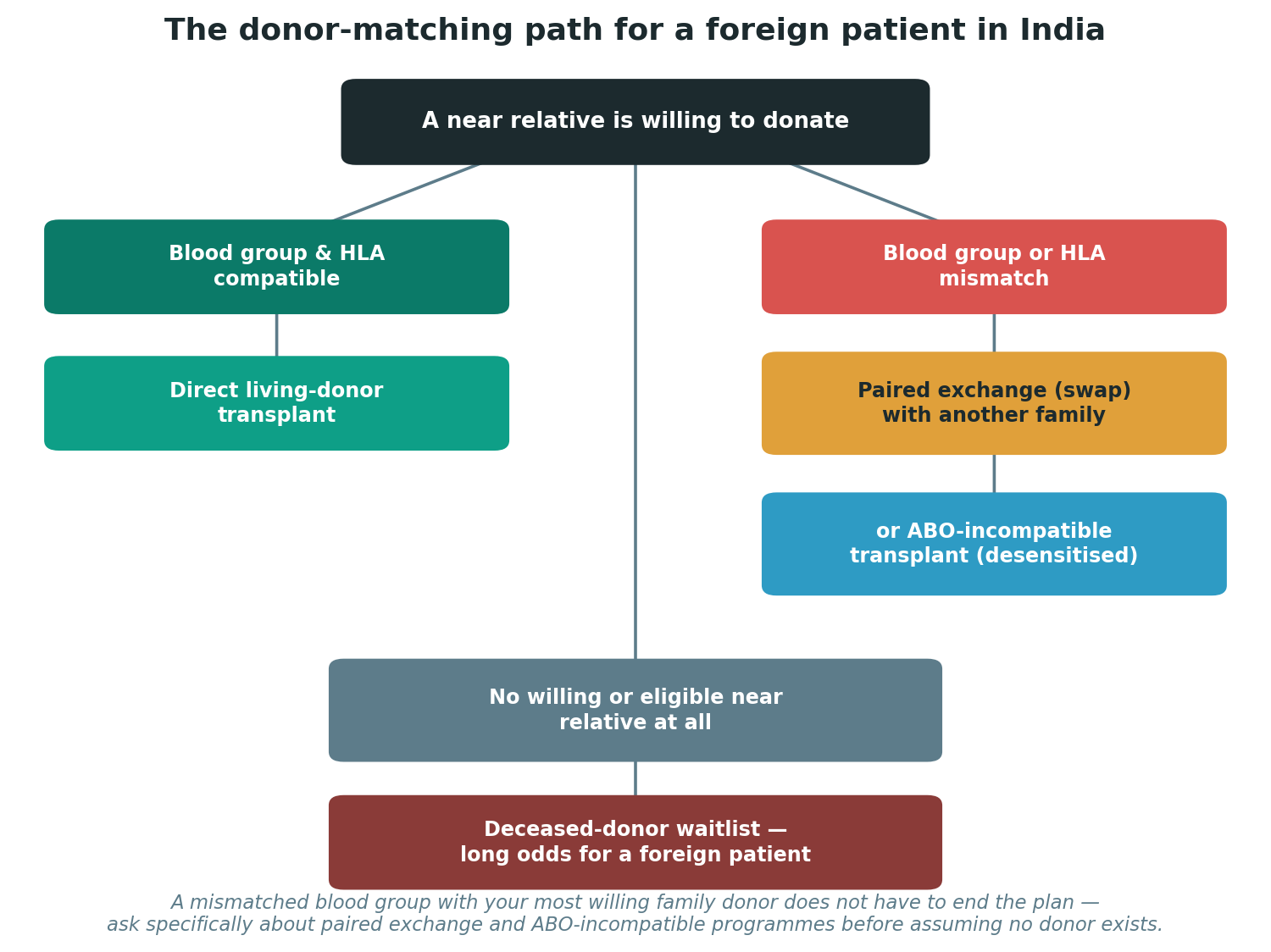
A mismatched donor is a detour, not a dead end — but it should be raised with the hospital before you travel.
Choosing the surgeon and the hospital
Once you know your likely donor pathway, the questions to ask a centre are much the same as for any major transplant: how many kidney transplants, including paired-exchange and ABO-incompatible cases if relevant to you, does this team perform each year, and what are their graft and patient survival results? A serious centre will have a dedicated transplant nephrology and urology team, a transplant-experienced intensive-care unit, and — because your donor is a healthy person undergoing surgery purely to help you — a thorough, independent medical and psychological evaluation of the donor, separate from the recipient's own care pathway. Ask whether laparoscopic or robotic donor nephrectomy is available, since it generally means a smaller incision, less pain, and a faster return to normal life for the person giving up a kidney for you.
Confirm that your case, particularly if a mismatch is involved, is discussed by a genuine multidisciplinary transplant team rather than decided by one surgeon's judgement alone. Check accreditation (NABH, ideally JCI), confirm the named surgeon will personally lead your operation, and insist on a complete written quote covering both the recipient's and the donor's surgery and hospital stay, along with a realistic estimate of the immunosuppressive medicines you will need for the rest of your life — a cost that continues long after you have returned home.
Ask, too, how a centre handles a donor who changes their mind. A trustworthy programme builds in private, judgement-free opportunities for a donor to withdraw at any point before surgery, without having to justify that decision to the recipient's family. If a hospital or coordinator seems to treat the donor's consent as a formality rather than something to be protected throughout the process, that is worth taking seriously as a sign of how the rest of your care may be handled.
Cost and value: how to weigh the money honestly
Kidney transplant surgery in a good Indian hospital costs a small fraction of the equivalent care in the West, and India's pharmaceutical industry also means the immunosuppressive medicines you will need for life are considerably cheaper to source there and continue afterward than their Western equivalents. But the admission itself is only the beginning of an ongoing relationship with medicine — regular blood tests, clinic visits, and daily medication continue indefinitely, and their cost belongs in your planning from day one.
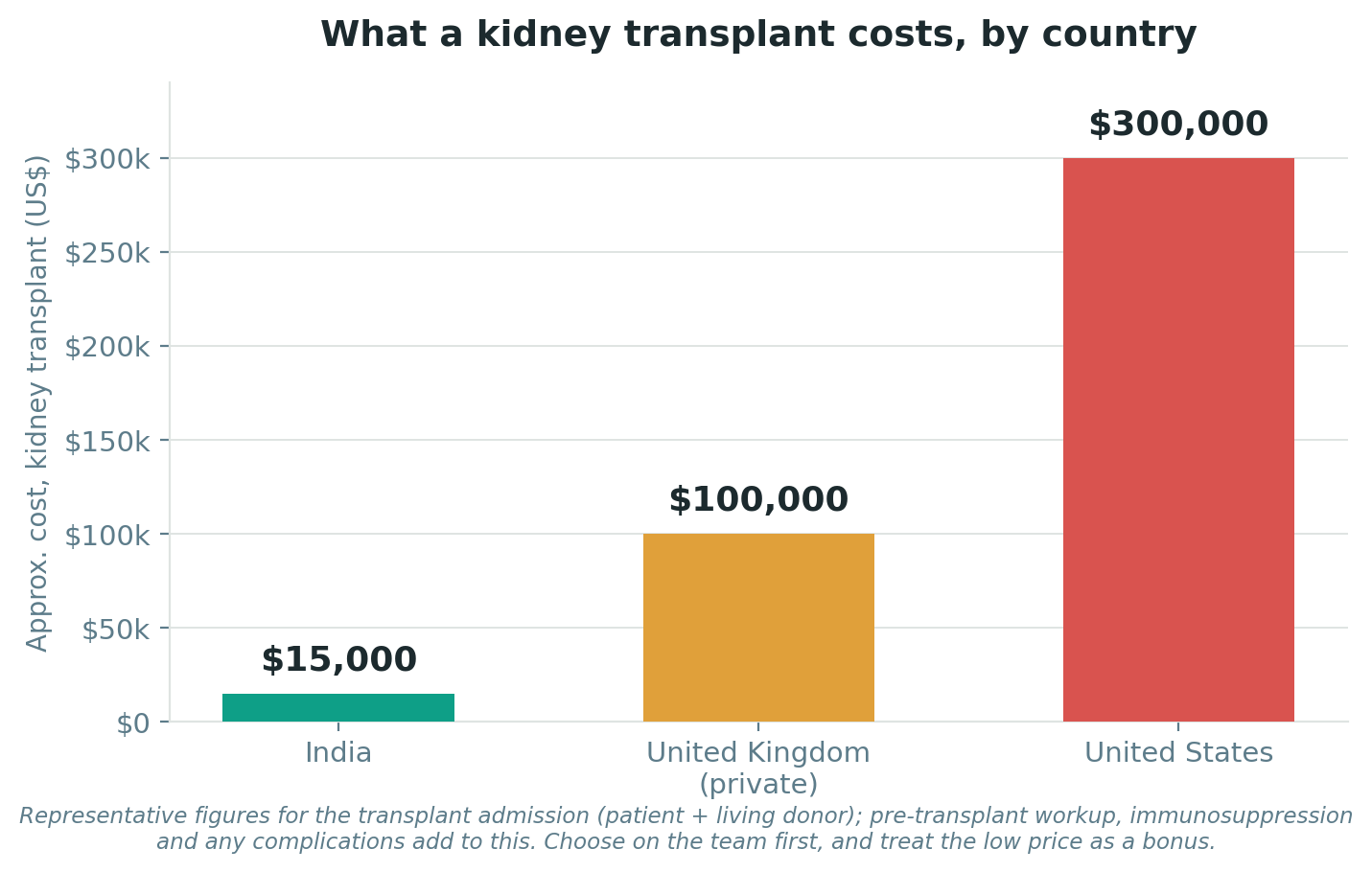
India's affordability is genuine — but choose the team and confirm the donor pathway first.
In 24 years of arranging these journeys, I have found that the disputes that arise almost never concern the headline transplant price. They concern the items left off it — the donor's own hospital stay, additional dialysis sessions if the wait for a matched donor runs longer than expected, or the true ongoing monthly cost of immunosuppressants once you are home. Ask for the complete, itemised picture, including a realistic ongoing medication estimate, before you commit a single kwacha.
What a Zambian patient should weigh in particular
Beyond the medical decision and the donor question, several practical matters deserve early attention. First, payment: NHIMA funds care at accredited facilities inside Zambia, not treatment abroad, so kidney transplant surgery in India comes from your own resources — another reason to have the complete plan, including lifelong medication costs, in writing before you travel. Second, your donor's welfare deserves the same seriousness as your own; living kidney donation is major surgery undergone for someone else's benefit, and a responsible hospital will insist on independent evaluation and the donor's genuine, pressure-free consent, however urgent the family's situation feels. Third, aftercare: immunosuppressive medicines must never be missed or interrupted, so arrange with a Zambian physician, ideally one with experience monitoring transplant patients, to take over your long-term follow-up before you travel, and insist the Indian team provides a complete written handover, drug regimen, and the schedule of blood tests you will need indefinitely.
The practical journey from Zambia
India requires a yellow fever vaccination certificate from travellers arriving from Zambia, valid only from ten days after the injection. Your medical visa is issued by the High Commission of India on Pandit Nehru Road in Lusaka against the hospital's invitation letter; if a family donor is travelling with you, both patient and donor will need medical and medical-attendant visas, and the donor relationship will need formal certification through the High Commission. There is no direct flight from Zambia to India; you will connect through Addis Ababa on Ethiopian Airlines, or through Dubai, Doha or Nairobi. Send the patient's actual scans and blood work, not only written reports, for remote review before you travel, and if the family donor's blood group has not yet been checked, arrange this in Zambia beforehand so the hospital's international team can begin planning realistically from your first contact with them.
Signals that need urgent, not routine, attention
1. A sharp drop in urine output, or swelling of the face, hands or legs that is new or rapidly worsening.
2. Breathlessness or chest pain in a patient with known kidney disease — fluid overload affecting the heart and lungs is a medical emergency.
3. Missed dialysis sessions due to cost or access — flag this to your care team immediately rather than waiting, since interruptions are a leading cause of avoidable deterioration.
4. Any suggestion of paying a stranger for a kidney, or of an "agent" who can arrange a donor for a fee — this is illegal under Indian law and a serious warning sign of an unsafe, unregulated arrangement.
Straight answers for Zambian Patients about Kidney Transplant in India
Should I wait until I am on dialysis before thinking about transplant?
No — the evidence consistently favours starting the transplant conversation and work-up as early as possible, ideally before dialysis becomes necessary at all. If dialysis has already started, that does not rule out a good outcome, but it makes moving forward without further delay more important, not less.
My relative wants to donate but has a different blood group from me. Does that end the plan?
Not necessarily. Paired exchange and ABO-incompatible transplant programmes exist specifically for this situation, and experienced Indian centres offer both. Raise it directly with the hospital's transplant team rather than assuming a mismatch means no donor is available.
Is a deceased-donor kidney a realistic option for a Zambian patient?
In practice, rarely. Foreign nationals may register on India's deceased-donor waitlist, but the organ is offered to them only once every suitable Indian patient has been considered, and realistic waits even for eligible candidates commonly run into years. Plan around a living donor from your own family.
Can a friend, not a blood relative, donate a kidney to me?
It is possible in principle through India's Authorization Committee process for donation out of genuine affection, but it is slower, requires substantially more documentation, and should not be assumed to move quickly. A near relative remains the far more straightforward path for a foreign patient.
How long does a kidney donor take to recover?
Most donors recover well, particularly with laparoscopic donor surgery, and go on to live full, healthy lives with one kidney. It remains major surgery with real, if low, risks, and a responsible centre will discuss those risks honestly rather than minimising them, and will support the donor's own recovery as carefully as the recipient's.
Sources
- 🌐 Medical visa, Lusaka — High Commission of India, requirements & process: hcizambia.gov.in/page/medical-visa
- 🌐 Hospital accreditation (India) — Verify a hospital's NABH accreditation: nabh.co
- 🌐 National Health Insurance (Zambia) — NHIMA cover, treatment abroad is not covered: nhima.co.zm
- 🌐 Ministry of Health Zambia — National health services & guidance: moh.gov.zm
- 🌐 National Medical Commission (verify a surgeon) — Confirm a surgeon's registration in India: nmc.org.in
- 🌐 WHO yellow fever — Vaccination requirements before travel: who.int/health-topics/yellow-fever
A Closing Word
Of everything I help families with, kidney transplant is the journey where the calendar matters most — not because there is no time to think carefully, but because early, careful thinking is itself what protects the outcome. If you send me a note on your situation — how your kidney function is trending, whether dialysis has started, and an honest picture of who in the family might be able to donate — I will help you think through the timing, the realistic donor pathway including paired exchange if a mismatch is involved, and which centres in India have the transplant team and track record to treat your family well. The earlier that conversation happens, the more options remain open.
Frequently Asked Questions by Zambian Patients about Kidney Transplant in India
Should I wait until dialysis starts before considering a kidney transplant?
No. The guide recommends beginning transplant evaluation as early as possible, ideally before dialysis becomes necessary when clinically appropriate.
Who can donate a kidney to a Zambian patient in India?
The guide identifies a near relative such as a spouse, parent, child, sibling or grandparent as the most straightforward living-donor pathway, subject to Indian legal requirements and approval.
What if my donor has a different blood group?
A blood-group mismatch does not necessarily end the plan. Paired exchange and ABO-incompatible transplantation may be considered at experienced centres.
Is a deceased-donor kidney a realistic option?
The guide describes this as rarely realistic for a foreign patient, because eligible Indian recipients are considered first and waiting periods can extend for years.
How much does kidney transplant cost in India?
The guide gives an indicative transplant admission cost of approximately US$15,000. Lifelong medicines, tests and follow-up are additional and should be included in financial planning.
What should I check before choosing a transplant hospital?
Ask about annual transplant volume, graft and patient survival results, multidisciplinary expertise, ICU facilities and donor evaluation procedures.
What happens if my family donor changes their mind?
A responsible transplant programme should provide the donor with a private and pressure-free opportunity to withdraw before surgery without having to justify the decision to the recipient's family.
How long will the donor take to recover?
The guide notes that most donors recover well, particularly after laparoscopic donor surgery, but kidney donation remains major surgery and its risks and recovery should be explained independently to the donor.
What happens after I return to Zambia?
You will require lifelong immunosuppressive medication, regular blood tests and transplant follow-up. The Indian team should provide a written handover and medication/testing schedule for the Zambian doctor.
What should I send before travelling to India?
Send the patient's actual scans and blood-work results, rather than only written reports. If a family donor is being considered, arrange blood-group and compatibility testing as early as possible.
Page Summary
This six-page Zambia-to-India medical travel guide explains kidney transplantation, focusing on early transplant planning, living-donor options, donor matching, Indian legal requirements, hospital selection, costs and lifelong follow-up. The page 2 charts compare major kidney-failure causes in sub-Saharan African cohorts and show illustrative five-year survival of approximately 82% after transplant versus 45% with long-term dialysis without transplant. The page 3 donor-matching diagram presents direct living donation, paired exchange and ABO-incompatible transplantation as possible pathways when a family donor is available. The page 4 cost chart gives an indicative transplant admission cost of US$15,000 in India, compared with US$100,000 in the UK and US$300,000 in the US.
Citation Block
| Topic | Information |
|---|---|
| Topic | Kidney Transplant in India for Zambian Patients |
| Treatment | Kidney Transplantation |
| Patients | Zambian Kidney Patients |
| Specialist | Transplant Nephrologist / Kidney Transplant Surgeon |
| Main Assessment | Kidney function and transplant suitability |
| Key Priority | Early transplant planning |
| Preferred Donor | Eligible living family donor |
| Direct Option | Compatible living-donor transplant |
| Mismatch Option | Paired exchange or ABO-incompatible transplant |
| Deceased Donor | Long odds for foreign patients |
| Legal Check | Authorization Committee approval where required |
| Hospital Check | Kidney transplant volume and outcomes |
| Team Requirement | Transplant nephrology, urology and experienced ICU |
| Donor Check | Independent medical and psychological evaluation |
| Donor Surgery | Laparoscopic/robotic nephrectomy where available |
| India Cost | Approximately US$15,000 |
| UK Cost | Approximately US$100,000 |
| US Cost | Approximately US$300,000 |
| Quote Check | Recipient + donor surgery, admission and ongoing medication estimate |
| Pre-Travel Records | Actual scans and blood work |
| Follow-Up | Lifelong medication and blood-test monitoring |
| Key Statistic | Approx. 82% vs 45% illustrative five-year survival |
| Key Cause Range | Hypertension 25–40%; HIV-related disease 15–28% |
| Patient Pathway | Kidney assessment → transplant work-up → donor matching → legal approval → transplant → lifelong follow-up |
| Decision Principle | Timing and donor pathway are central to transplant planning |


Our Mission Statement
Our mission is to place patients at the centre of every healthcare decision by providing trustworthy, evidence-based, and unbiased medical information. We believe that informed patients make better decisions. Backed by personalised guidance from our experienced advisory team, we help patients understand their treatment options, compare them objectively, and confidently choose the path that best suits their medical needs and personal circumstances.
Patient Testimonials from Zambia


Ready to Take the First Step?
Share your Medical Reports with our Healthcare Managers Today and Get a FREE CONSULTATION, a Personalized Treatment Plan, and Complete Support from Arrival to Recovery.
Get Your Free ConsultationAreas We Serve
This resource has been thoughtfully prepared for patients from Zambia who are considering medical treatment in India. We also welcome patients from the wider region in the countries mentioned below-
We assist patients from:
- Zambia
- Angola
- Malawi
- Zimbabwe
- Botswana
- Namibia
- South Africa
- Eswatini
- Lesotho
- Gabon
- Chad
- Equatorial Guinea
- São Tomé and Príncipe
- Republic of the Congo
- Democratic Republic of the Congo
Many of the insights, treatment pathways, hospital recommendations, travel guidance, and patient support services described here are equally relevant and may be used as a reference when planning treatment in India.
From Zambia to India: Your Complete Patient Support Guide
- Best Weight-Loss (Bariatric) Surgeons & Hospitals in India for Zambian Patients
- Best Brain-Tumour Surgeons & Hospitals in India for Zambian Patients
- Best Cancer Doctors & Hospitals in India for Zambian Patients
- Best Cardiac Surgeons & Hospitals in India for Zambian Patients
- Best Cosmetic Surgeons & Facilities in India for Zambian Patients
- Best CyberKnife Treatment Teams & Centres in India for Zambian Patients
- Best Dentists & Dental Clinics in India for Zambian Patients
- Best Heart Valve Replacement Surgeons & Hospitals in India for Zambian Patients
- Best Hip Surgeons & Hospitals in India for Zambian Patients
- Best Knee Surgeons & Hospitals in India for Zambian Patients
- Best Neurosurgeons & Hospitals in India for Zambian Patients
- Best Paediatric Cardiac Surgeons & Hospitals in India for Zambian Patients
- Best Paediatric Neurosurgeons & Hospitals in India for Zambian Patients
- Best Prostate Surgeons & Hospitals in India for Zambian Patients
- Best Scoliosis Surgeons & Hospitals in India for Zambian Patients
- Best Spine Surgeons & Hospitals in India for Zambian Patients
- Best Bone Marrow Transplant Teams & Hospitals in India for Zambian Patients
- Best Kidney Transplant Surgeons & Hospitals in India for Zambian Patients