

Heart Valve Replacement in India for Zambian Patients
Before you agree to replace a heart valve, two questions matter more than price: can the valve be saved instead, and — if it must be replaced — which valve fits the whole of your life? This guide answers both.
A leaking or narrowed heart valve steals a life quietly — the breath that shortens on a gentle hill, the tiredness that no rest cures, the heart that flutters at night. In Zambia this is most often the late echo of a childhood illness, rheumatic fever, and it tends to strike the young. For 24 years I have helped African patients face the decision that follows, and I want to begin by unsettling the very phrase “valve replacement,” because the first and best question is often whether the valve needs replacing at all. Get that question right, and the one after it — which valve, for which life — and you protect not just your heart but your future.
Healing Journeys of Zambian Patients




Key Takeaways
- Heart valve replacement is not always the first or only option for Zambian patients. The guide emphasises that patients should first establish whether the damaged valve can be repaired or treated with balloon valvuloplasty before proceeding to replacement.
- Rheumatic heart disease is particularly important in Zambia because it often affects younger patients. The mitral valve is the most commonly affected valve, followed by the aortic valve.
- The page 2 chart shows the distribution of rheumatic valve disease as approximately 66% mitral valve, 32% aortic valve and 2% other/tricuspid valve.
- Some diseased valves can be repaired while preserving the patient's natural tissue. For suitable younger patients with rheumatic mitral narrowing that has not become severely stiff or calcified, balloon valvuloplasty may open the valve without open-heart surgery or an artificial valve.
- When replacement is necessary, patients generally choose between a mechanical valve and a tissue/biological valve.
- Mechanical valves offer greater durability but require lifelong warfarin and regular INR blood tests. The patient's ability to reliably access INR testing after returning to Zambia is therefore a major part of the decision.
- Tissue valves do not require the same long-term warfarin treatment but wear out sooner, particularly in younger patients. The document states that they may require replacement in approximately 10–15 years.
- Before travelling, Zambian patients should send their echocardiogram and medical reports so the cardiac team can determine whether the valve can be repaired, opened with a balloon or requires replacement.
- Four warning signs are identified: replacement recommended without considering repair or balloon treatment, a mechanical valve recommended without discussing INR access, no pregnancy discussion for women of childbearing age, and no dental clearance or Zambia follow-up/INR plan.
Quick Facts
- Treatment
- Heart Valve Repair, Balloon Valvuloplasty & Replacement
- Country
- India
- Intended Audience
- Zambian Patients
- Primary Condition Highlighted
- Rheumatic Heart Disease
- Most Commonly Affected Valve
- Mitral Valve
- Mitral Valve Share in Page 2 Chart
- Approximately 66%
- Aortic Valve Share in Page 2 Chart
- Approximately 32%
- Other / Tricuspid Share in Page 2 Chart
- Approximately 2%
- First Treatment Question
- Can the Valve Be Saved?
- Important Lifestyle Consideration
- Reliable Access to INR Testing
- Pregnancy Consideration
- Warfarin Can Harm an Unborn Baby
- Pre-Surgery Requirement
- Dental Check and Treatment of Dental Infection
- Long-Term Valve Risk
- Infective Endocarditis
- Important Patient Record
- Valve Type and Implantation Date
In Brief
Heart valve replacement in India for Zambian patients should begin with one important question: can the natural valve be saved? Rheumatic disease most commonly affects the mitral valve, and suitable patients may be candidates for valve repair or balloon valvuloplasty instead of replacement. If replacement is required, mechanical valves offer greater durability but need lifelong warfarin and INR monitoring, while tissue valves avoid long-term warfarin but may require earlier replacement. The page 4 chart gives a representative valve replacement cost of approximately US$7,000 in India.
First, should you travel at all?
Zambia’s cardiac services are growing, centred on the University Teaching Hospital in Lusaka, and visiting surgical teams have treated a rising number of patients. But open-heart valve surgery is highly specialised: it needs a full team, a heart- lung bypass machine and dedicated intensive care, and it is performed in only small numbers locally, so many valve patients — adults and children alike — are referred abroad. For valve work above all, the volume and experience of the surgeon translate directly into survival and into the finer skill of repairing a valve rather than simply replacing it. That is the honest case for a high-volume centre — not any shortage of care at home.
Knowledge first: which valve — and can it be saved?
Rheumatic disease does not damage the heart at random. It attacks the mitral valve most of all, and the aortic valve next; the mitral valve alone accounts for roughly two in three cases. Knowing which valve is affected, and how, shapes everything that follows.
And here is the knowledge that too many patients never hear: replacement is not the only answer. A diseased valve can sometimes be repaired — keeping your own tissue, avoiding a prosthesis, and sparing you lifelong medication. Better still, for a young person whose mitral valve has narrowed but is not yet stiff and calcified, a balloon valvuloplasty can open it through a thin tube passed from a vein in the leg — no open surgery, no cut to the chest, no artificial valve at all. For suitable rheumatic mitral narrowing this is the first-choice treatment worldwide, not a second-best. Any good centre will look hard for a way to save your valve before it reaches for a replacement.
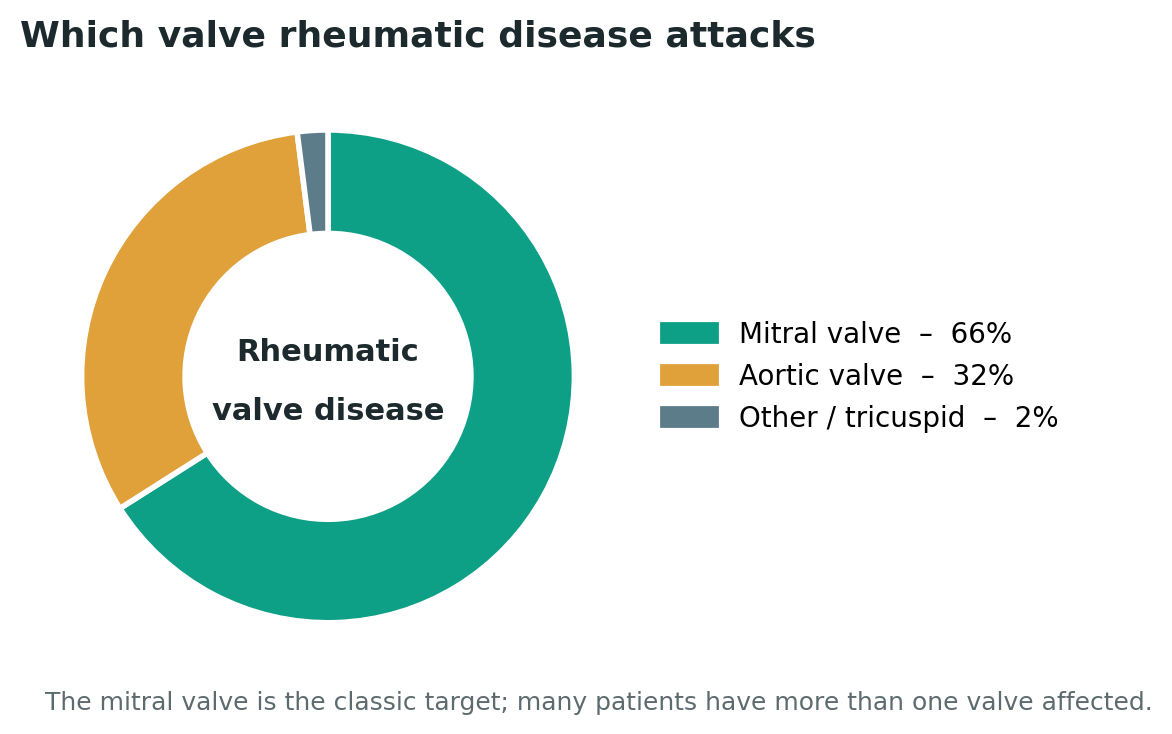
Rheumatic disease targets the mitral valve above all — the very valve that can most often be repaired or opened with a balloon rather than replaced.
If it must be replaced: which valve fits your life?
When a valve truly cannot be saved, you face a choice between two kinds of replacement, and it is one of the most consequential decisions in all of medicine. A mechanical valve , made of durable materials, can last a lifetime — but it demands lifelong treatment with the blood-thinner warfarin, whose level must be checked regularly with an INR blood test. A tissue valve , made from animal tissue, needs no long-term blood-thinner but wears out faster, especially in the young, and may need replacing in ten to fifteen years. There is no single right answer — only the answer that fits your life.
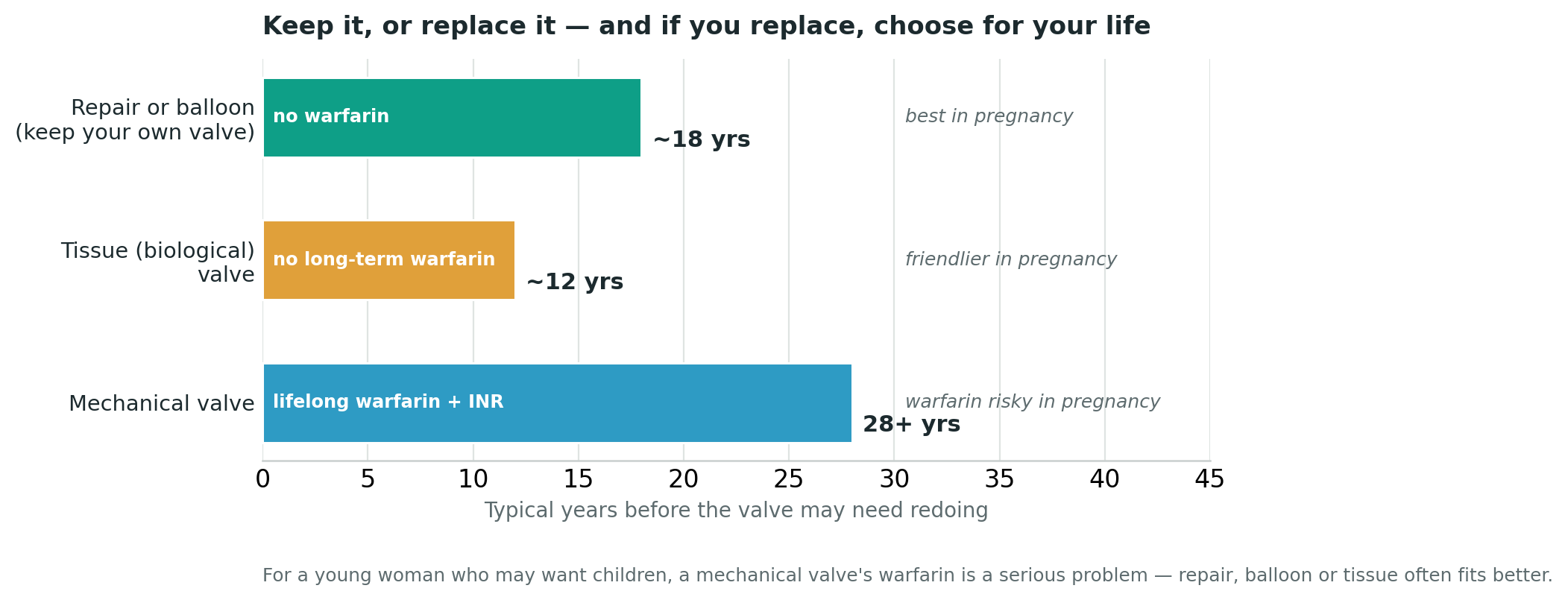
Durability is only part of the choice. Whether you can monitor warfarin — and whether you may become pregnant — can matter more than the years on the label.
Two practical questions decide it more than age does. The first is whether you can reliably reach a laboratory for the regular INR blood tests a mechanical valve’s warfarin requires; if you live far from a dependable lab, or the tests are hard to obtain, a mechanical valve can become dangerous, and a repair or a tissue valve may be far safer. The second question is the one below, and for many Zambian patients it is the most important of all.
The question no young woman should skip: pregnancy
Rheumatic heart disease falls heavily on young women, which makes one question essential and too often forgotten: might you want to have children? It matters because warfarin — the very drug a mechanical valve depends on — is dangerous to an unborn baby , causing malformations, especially early in pregnancy. A young woman given a mechanical valve without this conversation may find herself, years later, forced to choose between her own safety and her baby’s. That is why, for a woman who may wish to become pregnant, keeping her own valve through repair or balloon, or accepting a tissue valve that needs no long-term warfarin, is frequently the wiser path — even knowing a tissue valve may need redoing sooner. And because severe rheumatic valve disease is itself very dangerous in pregnancy, any young woman with a known valve problem should seek advice before she conceives, not during. Insist that your team discusses pregnancy openly with you before any valve is chosen; it is your future, and the choice is partly yours to make.
Newer, gentler ways to fix a valve
It is worth knowing that valve treatment is no longer only the large open operation of the past. Beyond the balloon procedure for a narrowed mitral valve, a worn aortic valve can in suitable patients be replaced through a catheter threaded from a vessel in the leg — a technique called TAVI — without opening the chest or stopping the heart, and it is increasingly available in India’s major centres. Where open surgery is still needed, many hospitals now offer keyhole or minimally invasive approaches through a small incision rather than fully dividing the breastbone, easing recovery. Not every patient is suited to these gentler options — your anatomy and the exact valve problem decide — but it is always worth asking whether one of them fits you, because the less the body is disturbed, the smoother the recovery tends to be.
Protect the valve you are given: teeth and lifelong care
Whatever valve you end up with, two duties protect it. First, your teeth : bacteria from infected or decayed teeth can settle on a heart valve and destroy it, an infection called endocarditis, so dental problems must be treated before valve surgery and dental health guarded carefully afterwards. Second, a replaced valve is a lifelong relationship — regular review with a cardiologist, faithful medication, and, if you have a mechanical valve, disciplined INR monitoring. A valve operation is not an ending but the start of a partnership with your own care.
One small, practical habit protects that partnership: carry a card or note recording exactly which valve you were given and the date, and show it to every doctor and dentist you see. It tells them at a glance what medication you need and what precautions to take, and it can prevent dangerous mistakes years later, far from where the operation was done.
The cost, in plain terms
Heart valve surgery is among the most expensive care in the wealthy world, which is why the gap is so wide. In a good Indian hospital, valve repair or replacement costs a fraction of United Kingdom private pricing and a small fraction of United States pricing; a balloon procedure, where suitable, costs less again. At roughly ZK19 to the US dollar in mid-2026, the saving is large in kwacha; confirm the rate before travel, as it moves.
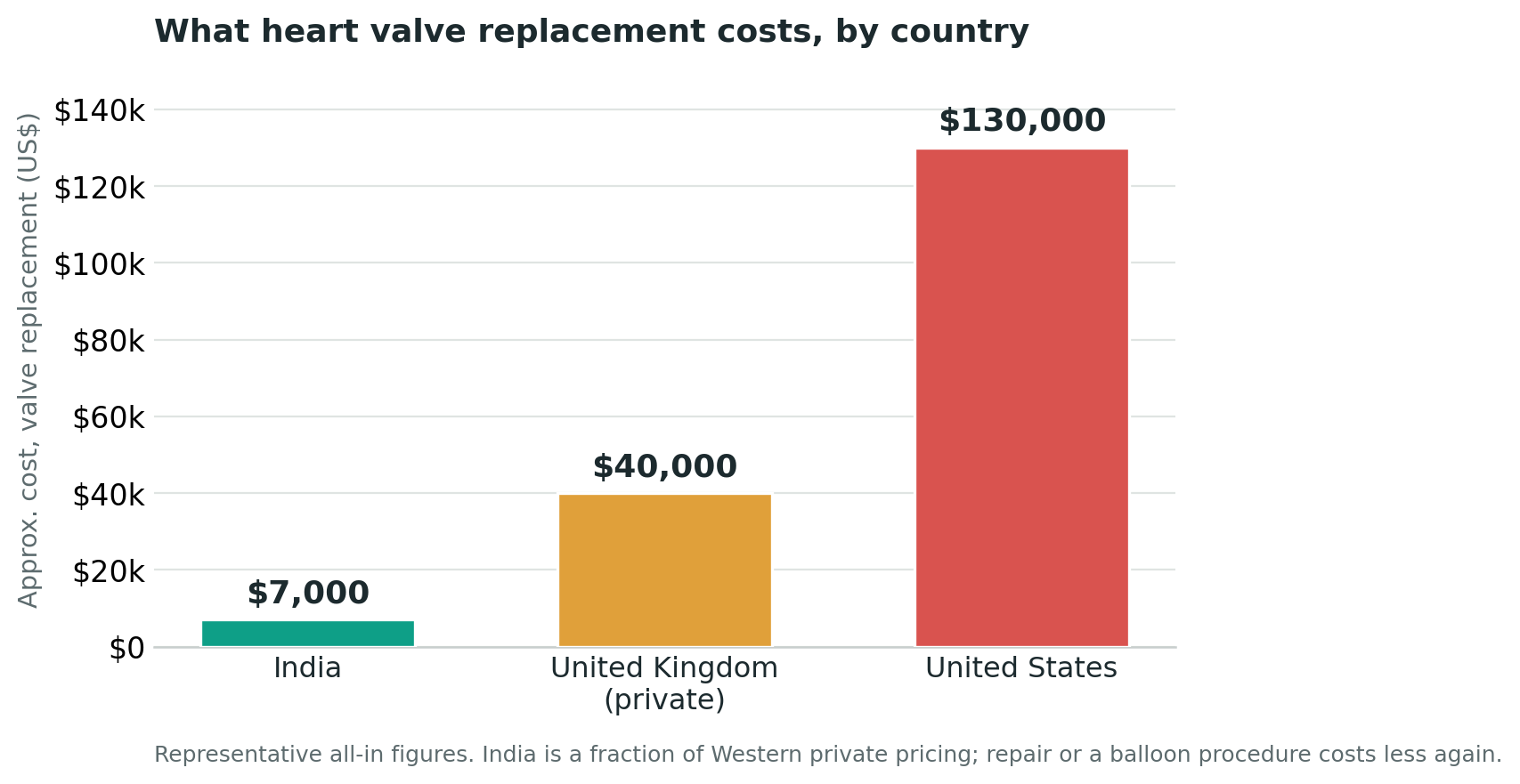
Representative figures for valve surgery. Repairing a valve, or opening it with a balloon, is usually less costly than a full replacement.
In 24 years of arranging these journeys, I have learned that disputes almost never concern the headline price — they concern what it left out: the type of valve, the intensive-care days, the medicines, the echocardiograms afterward. Insist on an itemised quote that names the valve to be used, and ask what happens to the cost if you need longer in intensive care, as valve patients sometimes do.
Why India for a heart valve
India performs an enormous volume of valve surgery, and its leading heart hospitals — accredited internationally by JCI and within India by NABH — carry exactly the depth a valve patient needs: surgeons who repair valves routinely rather than only replacing them, cardiologists skilled in balloon valvuloplasty, both mechanical and tissue valves on the shelf, dedicated paediatric cardiac teams for children, and experience managing valve disease in pregnancy. There are no waiting lists for a theatre date, and English, Zambia’s official language, is the working language of care. Insist that your surgeon records exactly which valve was used, gives you a clear plan for INR monitoring if it is mechanical, and hands your ongoing care back to a Zambian cardiologist.
Recovery, and when you can fly home
Open valve surgery asks a good deal of the body. Expect several days in hospital including intensive care, and a total of around three to four weeks in India before you are cleared to fly, so the breastbone begins to heal and your team is confident your rhythm and recovery are stable. A balloon procedure is far gentler, with a much shorter stay. Either way, let your surgeon’s clearance, not a fixed ticket, decide when you travel home.
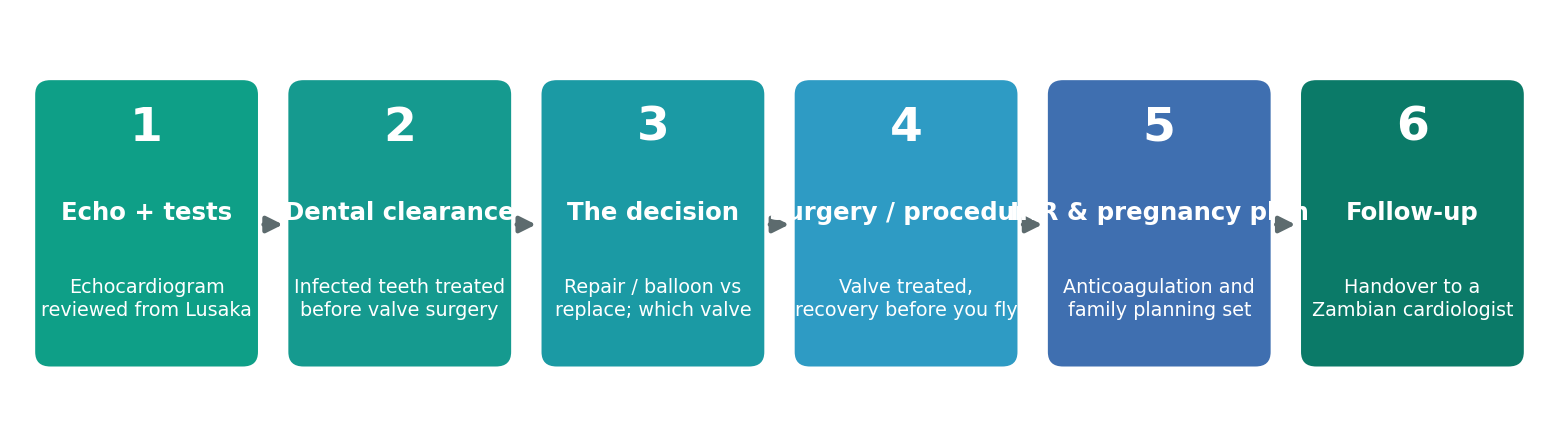
What the journey looks like
Notice that the decision — repair or balloon versus replace, and which valve — comes before any operation, and that the dental check comes first. Send your echocardiogram and reports for review from Lusaka, and a good centre will tell you honestly whether your valve can be saved, and return a plan and a fixed quote, before you commit a single kwacha.
Practicalities for travelling from Zambia
India requires a yellow fever vaccination certificate from travellers arriving from Zambia, valid only ten days after the injection — do not leave it late. Your medical visa is issued by the High Commission of India on Pandit Nehru Road in Lusaka against the hospital’s invitation letter; apply for a medical-attendant visa in the same batch, which matters greatly for a heart patient and is essential for a child. There is no direct flight — you will connect through Addis Ababa on Ethiopian Airlines, or through Dubai, Doha or Nairobi, a door-to-door journey of roughly fourteen to twenty hours. Book a changeable return ticket, carry your echocardiogram and any records rather than only the reports, and settle the hospital by traceable bank transfer rather than cash.
On paying for it. Zambia’s National Health Insurance scheme funds care at accredited facilities inside the country, not elective surgery abroad, so valve surgery in India will usually come from your own resources. I would rather you knew that from the first line than discovered it later. For children, charitable heart-surgery programmes sometimes assist — ask your cardiologist — and if you hold any private or employer policy, ask the insurer in writing whether an overseas benefit exists.
Four signals that should make you pause
- Replacement urged without discussing repair — or opening the valve with a balloon instead.
- A mechanical valve without INR discussion — recommended without asking whether you can reach a lab for lifelong testing.
- No pregnancy conversation for a woman — of childbearing age, a valve chosen without discussing warfarin.
- No dental check before surgery — or no follow-up and INR plan arranged for your return to Zambia.
Straight answers for Zambian Patients about Heart Valve Replacement in India
Does a diseased valve always have to be replaced?
No. Many valves can be repaired, and a narrowed young mitral valve can often be opened with a balloon through a vein in the leg — no open surgery and no artificial valve. Keeping your own valve, where possible, is usually the best outcome. A good centre looks for that first.
Mechanical or tissue — which should I choose?
It depends on your life more than your age. A mechanical valve lasts longest but needs lifelong warfarin and regular INR tests; if you cannot reach a lab reliably, or you may become pregnant, a repair or a tissue valve is often safer. Insist your team weighs this honestly with you.
I am a young woman and may want children. Why does that change the valve?
Because warfarin, which a mechanical valve requires, can harm an unborn baby. For a woman who may become pregnant, keeping your own valve or choosing a tissue valve — neither needing long-term warfarin — is often wiser. Seek advice before you conceive, as valve disease is itself risky in pregnancy.
Can my child’s valve be treated in India?
Yes, and India has deep experience with children’s heart and valve surgery. Confirm the hospital has a dedicated paediatric cardiac team, and ask your Zambian cardiologist whether a charitable programme can help with the cost.
Sources & Useful Links
- 🌐 Medical visa (India), Lusaka — High Commission of India, requirements & process: hcizambia.gov.in/page/medical-visa
- 🌐 National Health Insurance (Zambia) — NHIMA cover and accredited facilities: nhima.co.zm
- 🌐 Ministry of Health, Zambia — referrals and national health services: moh.gov.zm
- 🌐 University Teaching Hospitals, Lusaka — Zambia’s largest public referral centre: uth.gov.zm
- 🌐 Hospital accreditation (India) — verify a hospital’s NABH accreditation: nabh.co
- 🌐 Yellow fever & travel health — WHO vaccination guidance: who.int/health-topics/yellow-fever
A closing word
If you send me your echocardiogram and a note on your history — and, if it applies, whether you hope one day to have children — I will help you reach the questions that matter most: can your valve be repaired or opened rather than replaced, and if it must be replaced, which valve truly fits the life you intend to live. A heart valve chosen well can give you back the breath and the years the disease was taking; chosen without these conversations, it can shape your life in ways no one warned you of. My work has always been to make sure the choice fits not just your heart, but your whole future.
Frequently Asked Questions by Zambian Patients about Heart Valve Replacement in India
Does every Zambian patient with a diseased heart valve need valve replacement in India?
No. The guide emphasises that some valves can be repaired, while suitable rheumatic mitral stenosis may be treated with balloon valvuloplasty without open-heart surgery or an artificial valve.
How much does heart valve replacement in India cost for Zambian patients?
The page 4 chart gives a representative all-in cost of approximately US$7,000 in India. The actual cost depends on valve type, surgical complexity, intensive-care needs and recovery.
Which heart valve is most commonly affected by rheumatic disease in Zambian patients?
The page 2 chart identifies the mitral valve at approximately 66%, followed by the aortic valve at 32% and other/tricuspid valves at 2%.
What is balloon valvuloplasty, and can Zambian patients have it in India?
Balloon valvuloplasty uses a catheter passed through a blood vessel to open a suitable narrowed mitral valve. It may avoid open surgery and artificial valve replacement in appropriately selected patients.
Should Zambian patients choose a mechanical or tissue heart valve?
The choice depends on more than age. Mechanical valves provide greater durability but require lifelong warfarin and regular INR tests. Tissue valves avoid long-term warfarin but generally require replacement sooner.
Why is INR testing important after mechanical valve replacement?
Mechanical valves require lifelong warfarin. Regular INR blood testing helps ensure the medication remains within a safe therapeutic range. Reliable access to testing after returning to Zambia is therefore essential.
Why should pregnancy be discussed before heart valve replacement?
The guide highlights that warfarin can harm an unborn baby, particularly early in pregnancy. Women who may want children should discuss pregnancy plans with their cardiac team before a valve is selected.
Are minimally invasive valve treatments available for Zambian patients in India?
The guide discusses TAVI for selected aortic valve patients, balloon valvuloplasty for suitable mitral stenosis and minimally invasive/keyhole surgery as alternatives to conventional open surgery in appropriate cases.
How long should Zambian patients stay in India after valve replacement?
After open valve surgery, the guide recommends approximately three to four weeks in India before flying home, including several days of hospital and intensive-care recovery. Balloon procedures generally require a shorter stay.
What are the main red flags when choosing heart valve treatment in India?
The guide highlights four warning signs: replacement recommended without considering repair or balloon treatment, a mechanical valve chosen without discussing INR access, no pregnancy discussion for a woman of childbearing age, and no dental clearance or follow-up/INR plan for the patient's return to Zambia.
Page Summary
This guide explains heart valve replacement in India for Zambian patients, with particular attention to whether replacement can be avoided and how the correct replacement valve should be chosen when it cannot. Rheumatic heart disease is central to the discussion because it frequently affects younger patients. The page 2 chart shows that approximately 66% of rheumatic valve disease involves the mitral valve, 32% the aortic valve and 2% other/tricuspid valves.
Citation Block
| Topic | Information |
|---|---|
| Topic Information | Details |
| Procedure | Heart Valve Repair, Balloon Valvuloplasty & Replacement |
| Country | India |
| Intended Audience | Zambian Patients |
| Primary Condition | Rheumatic Heart Disease |
| Primary Valve | Mitral Valve |
| Valve Distribution | Mitral 66%, Aortic 32%, Other/Tricuspid 2% |
| Valve-Saving Procedures | Valve Repair and Balloon Valvuloplasty |
| Replacement Options | Mechanical Valve and Tissue/Biological Valve |
| Mechanical Valve Requirement | Lifelong Warfarin + Regular INR Testing |
| Tissue Valve Lifespan | Approximately 10–15 Years Mentioned in Text |
| Pre-Travel Requirement | Echocardiogram and Medical Reports |
| Treatment Pathway | Echo + Tests → Dental Clearance → The Decision → Surgery / Procedure → INR & Pregnancy Plan → Follow-Up |
| Follow-Up | Zambian Cardiologist + INR Monitoring Where Required |


Our Mission Statement
Our mission is to place patients at the centre of every healthcare decision by providing trustworthy, evidence-based, and unbiased medical information. We believe that informed patients make better decisions. Backed by personalised guidance from our experienced advisory team, we help patients understand their treatment options, compare them objectively, and confidently choose the path that best suits their medical needs and personal circumstances.
Patient Testimonials from Zambia

Ready to Take the First Step?
Share your Medical Reports with our Healthcare Managers Today and Get a FREE CONSULTATION, a Personalized Treatment Plan, and Complete Support from Arrival to Recovery.
Get Your Free ConsultationAreas We Serve
This resource has been thoughtfully prepared for patients from Zambia who are considering medical treatment in India. We also welcome patients from the wider region in the countries mentioned below-
We assist patients from:
- Zambia
- Angola
- Malawi
- Zimbabwe
- Botswana
- Namibia
- South Africa
- Eswatini
- Lesotho
- Gabon
- Chad
- Equatorial Guinea
- São Tomé and Príncipe
- Republic of the Congo
- Democratic Republic of the Congo
Many of the insights, treatment pathways, hospital recommendations, travel guidance, and patient support services described here are equally relevant and may be used as a reference when planning treatment in India.
From Zambia to India: Your Complete Patient Support Guide
- Best Weight-Loss (Bariatric) Surgeons & Hospitals in India for Zambian Patients
- Best Brain-Tumour Surgeons & Hospitals in India for Zambian Patients
- Best Cancer Doctors & Hospitals in India for Zambian Patients
- Best Cardiac Surgeons & Hospitals in India for Zambian Patients
- Best Cosmetic Surgeons & Facilities in India for Zambian Patients
- Best CyberKnife Treatment Teams & Centres in India for Zambian Patients
- Best Dentists & Dental Clinics in India for Zambian Patients
- Best Heart Valve Replacement Surgeons & Hospitals in India for Zambian Patients
- Best Hip Surgeons & Hospitals in India for Zambian Patients
- Best Knee Surgeons & Hospitals in India for Zambian Patients
- Best Neurosurgeons & Hospitals in India for Zambian Patients
- Best Paediatric Cardiac Surgeons & Hospitals in India for Zambian Patients
- Best Paediatric Neurosurgeons & Hospitals in India for Zambian Patients
- Best Prostate Surgeons & Hospitals in India for Zambian Patients
- Best Scoliosis Surgeons & Hospitals in India for Zambian Patients
- Best Spine Surgeons & Hospitals in India for Zambian Patients
- Best Bone Marrow Transplant Teams & Hospitals in India for Zambian Patients
- Best Kidney Transplant Surgeons & Hospitals in India for Zambian Patients