

Heart Surgery in India for Zambian Patients
In Zambia, a failing heart valve is often a young person’s problem, not an old one — and that single fact should change how the whole decision is made. This guide explains why, and how to choose surgery in India that fits a lifetime.
There is a breathlessness I have come to know well — the young mother who cannot climb a hill without stopping, the schoolboy who tires while his friends run on, the trader whose ankles swell by evening. In the wealthy world these are the complaints of the elderly; in Zambia they arrive in people in their twenties and thirties, and the reason is a disease the West has all but forgotten. For 24 years I have helped African patients understand what is happening to their hearts, and with heart surgery above all, the right knowledge does not just save money — it can save the muscle itself. So let this guide arm you before any decision is made.
Healing Journeys of Zambian Patients



Key Takeaways
- Heart-valve disease in Zambia often affects children and young adults rather than primarily elderly patients. The guide identifies rheumatic heart disease as an important reason for this difference and explains why the patient's expected lifetime should influence valve decisions.
- Rheumatic heart disease can begin after untreated group A streptococcal throat infection triggers rheumatic fever. The resulting inflammation can scar the heart valves, particularly the mitral valve.
- The page 2 chart illustrates the age difference clearly: a typical Zambian rheumatic heart disease valve patient is shown at approximately 30 years, compared with approximately 72 years for a typical Western patient with degenerative valve disease.
- For a young Zambian patient, the guide describes three main approaches: repair the natural valve, replace it with a mechanical valve, or replace it with a tissue/biological valve.
- Valve repair may be particularly valuable when technically possible because it preserves the patient's natural valve and may avoid lifelong anticoagulation.
- If regular laboratory access is difficult, a mechanical valve may create additional risk. Too little warfarin can allow a clot to form on the valve, while too much can increase bleeding risk.
- A tissue valve does not require the same lifelong warfarin treatment but has a shorter lifespan, particularly in younger patients. The text states that it may require replacement after approximately 10–15 years.
Quick Facts
- Treatment
- Heart Valve Repair & Replacement Surgery
- Country
- India
- Intended Audience
- Zambian Patients
- Primary Condition Highlighted
- Rheumatic Heart Disease
- Primary Valve Highlighted
- Mitral Valve
- Underlying Cause Highlighted
- Rheumatic Fever Following Group A Streptococcal Infection
- Typical Zambian Rheumatic Valve Patient in Page 2 Chart
- Approximately 30 Years
- Typical Western Degenerative Valve Patient in Page 2 Chart
- Approximately 72 Years
- Main Treatment Decision
- Valve Repair vs Mechanical Valve vs Tissue Valve
- Valve Repair
- Preserves the Patient's Natural Valve Where Technically Possible
- Representative United States Cost
- Approximately US$120,000
- Cost Variables
- Complexity, Intensive-Care Needs, Valve Type, Medicines and Follow-Up
- Hospital Stay
- Several Days Including Intensive Care
- Typical Stay in India
- Approximately 3–4 Weeks Before Flying Home
In Brief
Heart surgery in India for Zambian patients often involves decisions about rheumatic heart disease and valve repair or replacement in relatively young patients. Where possible, repairing the natural valve may be considered, while mechanical valves offer long durability but require lifelong warfarin and regular INR monitoring. Tissue valves avoid long-term anticoagulation but may require replacement sooner. The page 4 chart gives a representative all-in cost of approximately US$7,000 for heart valve repair or replacement in India.
First, should you travel at all?
Zambia’s cardiac services are growing but remain limited. The University Teaching Hospital in Lusaka is the main centre, and dedicated cardiac programmes and visiting surgical teams have treated a rising number of patients, including children. But open-heart surgery — the kind that repairs or replaces a valve — is highly specialised, demands a full team and intensive-care support, and is performed in only small numbers locally; for years many Zambian patients, especially children, have been referred abroad for it. For simpler cardiac care, staying home is right. But when a valve must be repaired or replaced, or a child needs heart surgery, the case for a high-volume centre with deep experience becomes compelling — because in heart surgery, volume and experience are measured directly in survival.
Knowledge first: why Zambian heart disease strikes the young
The single most important thing to understand about heart-valve disease in Zambia is that it usually begins with a sore throat in childhood. Untreated infection with a common bacterium — group A streptococcus, the cause of “strep throat” — can trigger rheumatic fever , and in some children that fever inflames and scars the heart valves. The result, years later, is rheumatic heart disease : valves, most often the mitral valve, that no longer open or close properly. It has been almost eradicated in Europe and North America, but across sub-Saharan Africa it remains the leading cause of acquired heart disease in children and young adults. In hospital studies across the region, the typical valve patient is around thirty years old — not seventy.
Why does this change everything? Because a valve fitted into a seventy-year-old only needs to serve a comfortable retirement, but a valve fitted into a person of thirty may need to work for forty or fifty more years — through pregnancy, through hard physical work, through a whole adult life. The Western playbook does not simply transfer. The decisions below are the ones that matter, and they are decisions a young Zambian patient must make with clear eyes.
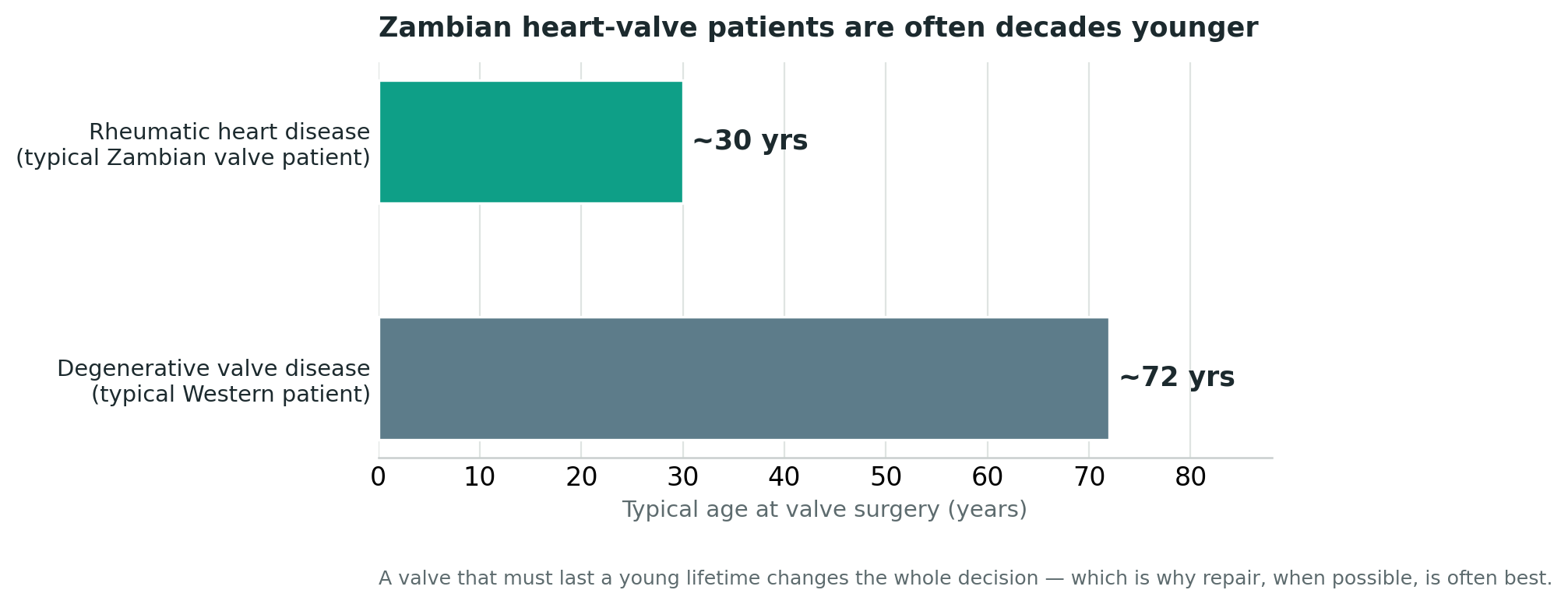
In the West, valve surgery is mostly an operation of old age; in Zambia it is often an operation of youth — which reshapes every choice that follows.
The decision that defines your future: repair, mechanical, or tissue
When a valve is failing, there are three broad paths, and choosing well is the heart of this guide. The first, and often the best for a young patient, is to repair your own valve rather than replace it — keeping the natural valve, avoiding lifelong medication, and preserving the heart’s own design. Repair is not always possible, and it demands a genuinely expert, high- volume surgeon; but where it can be done, it is frequently the finest option for a young African patient. The second path is a mechanical valve , made of durable materials that can last a lifetime — but it requires lifelong treatment with the blood- thinner warfarin, and warfarin only works safely if its level is checked regularly with an INR blood test. The third is a tissue valve , which needs no long-term blood-thinner but wears out faster, especially in the young, and may need replacing in ten to fifteen years.
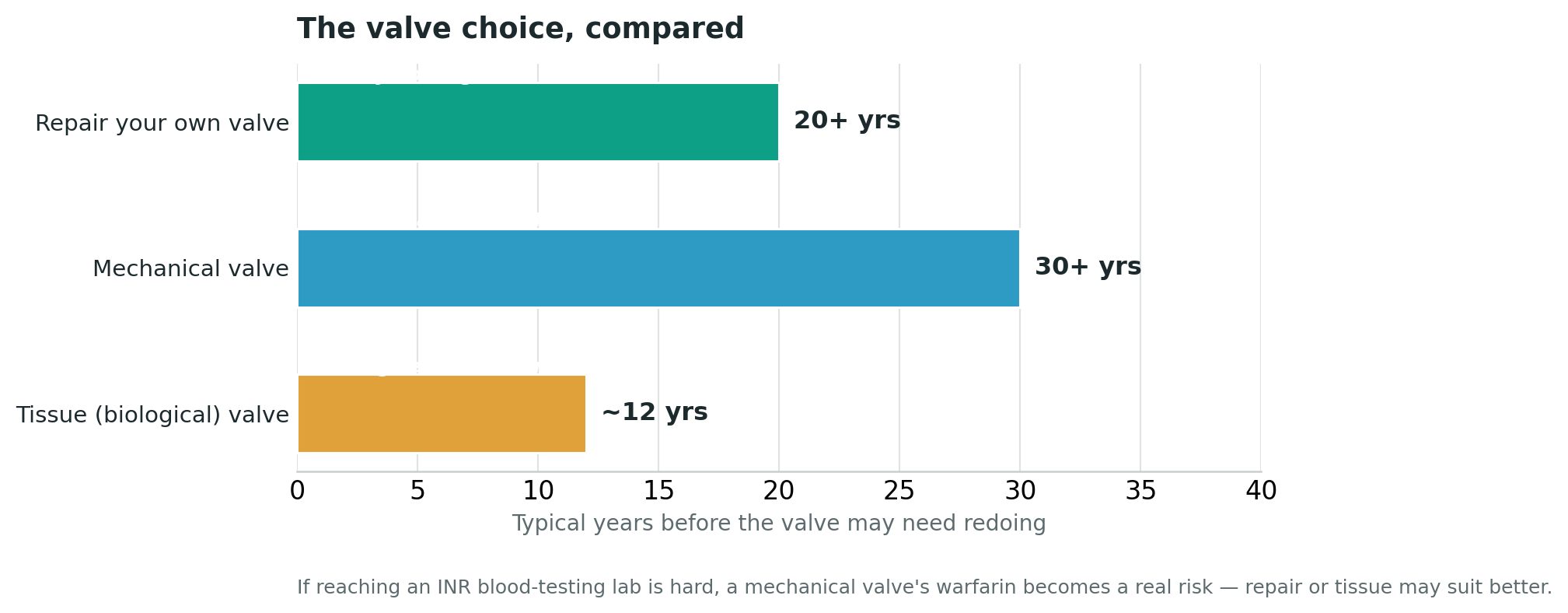
Durability is only half the story. For many Zambian patients the deciding question is not age, but whether warfarin can be monitored safely.
The question the textbooks miss: can you reach a blood-testing lab?
Here is the knowledge that a surgeon in London may never think to ask, but that can decide your survival. A mechanical valve is wonderfully durable — but it is only as safe as your ability to take warfarin every day and to have your INR blood level checked, often monthly, for the rest of your life. If you live far from a reliable laboratory, if the tests are costly or the reagents run short, or if travel to the clinic is difficult, then a mechanical valve can become dangerous: too little warfarin and a clot can jam the valve; too much and you can bleed. For a patient who genuinely cannot guarantee that lifelong monitoring, a valve repair or a tissue valve — neither of which needs long- term warfarin — may be far safer, even knowing the tissue valve may need redoing later. This is not a decision about your age alone; it is a decision about your life as you actually live it. Insist that your surgeon discusses it in exactly those terms.
Two things not to overlook: your teeth, and your children
Two further points carry real weight. First, your teeth : infected or decayed teeth can send bacteria into the bloodstream that settle on a heart valve and destroy it — a catastrophe called endocarditis. Any dental problems should be treated before valve surgery, not after, and good centres insist on a dental check first. Second, children : many Zambian children need heart surgery, whether for rheumatic disease or for a defect present from birth. Children are not small adults; they need a dedicated paediatric cardiac team — surgeon, anaesthetist and intensive-care nurses trained specifically in children’s hearts. If you are seeking care for a child, confirm that such a team exists at the hospital before anything else.
Timing: protect the muscle, not just the valve
The heart is a muscle, and a valve left leaking or blocked for too long forces that muscle to strain until it weakens permanently. Operate in time and the heart recovers well; wait too long and even a perfect new valve cannot undo the damage. This is why breathlessness, palpitations, swelling ankles or fainting should never be dismissed as ordinary tiredness — they deserve an echocardiogram, the simple ultrasound scan that shows exactly what the valves are doing. Getting that scan reviewed early is the most powerful step you can take.
And a word on prevention, because it can spare a family this journey altogether. Because rheumatic heart disease begins with strep throat, a sore throat in a child that is properly treated with antibiotics can stop the whole chain before it starts. More than that: a child or young adult who has already had rheumatic fever can often be protected from further valve damage by regular penicillin, usually a simple injection every few weeks — cheap, safe and available in Zambia. If someone in your family has had rheumatic fever, ask your clinic about this secondary prevention. It is the least glamorous medicine in this guide, and quite possibly the most valuable.
The cost, in plain terms
Heart surgery is among the most expensive care in the Western world, which is exactly why the gap is so wide. A valve repair or replacement in a good Indian hospital, all in, typically runs a fraction of United Kingdom private pricing and a small fraction of United States pricing. At roughly ZK19 to the US dollar in mid-2026, that difference is large in kwacha; confirm the rate before you travel, as it moves.
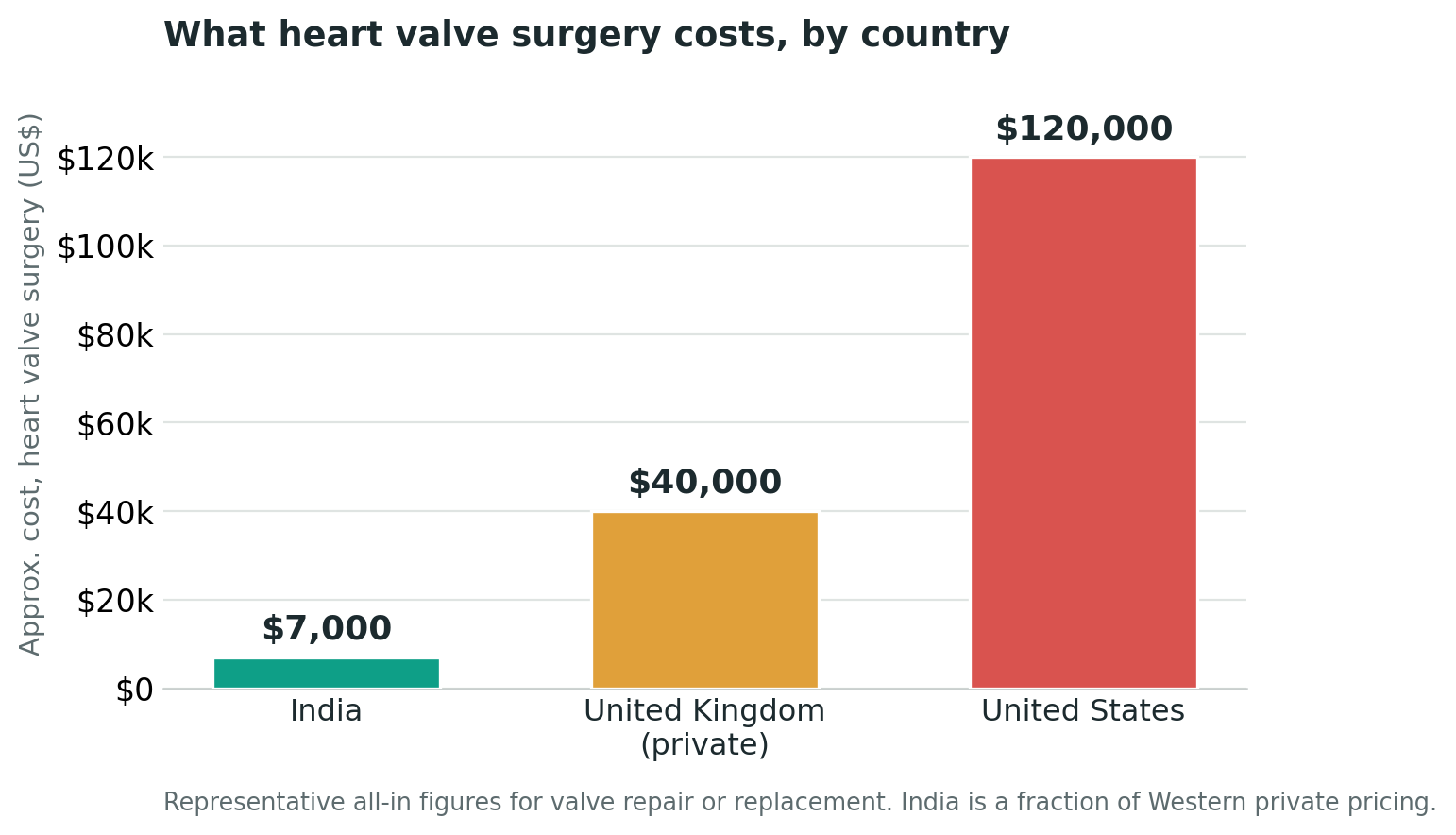
Representative figures for valve surgery. Costs rise with complexity, intensive-care needs and the type of valve used.
In 24 years of arranging these journeys, I have learned that disputes almost never concern the headline price — they concern what it left out: the intensive-care days, the valve itself, the medicines, the echocardiograms afterward. Insist on an itemised quote, and ask specifically what happens to the cost if you need longer in intensive care, as heart patients sometimes do.
Why India for the heart
India performs an enormous volume of cardiac surgery, and its leading heart hospitals — accredited internationally by JCI and within India by NABH — carry exactly the depth a young valve patient needs: surgeons who repair valves routinely rather than only replacing them, dedicated paediatric cardiac units for children, and modern intensive care. There are no waiting lists for a theatre date, and English, Zambia’s official language, is the working language of care. Insist, as always, that your surgeon records precisely what was done, gives you a clear plan for warfarin and INR monitoring if you receive a mechanical valve, and hands your ongoing care back to a Zambian cardiologist.
Recovery, and when you can fly home
Open-heart surgery asks more of the body than most operations. Expect several days in hospital including intensive care, and a total of around three to four weeks in India before you are cleared to fly, so the breastbone can begin to heal and your team can be sure your rhythm and recovery are stable. Do not let a fixed return ticket rush you onto a plane; a heart that is pushed home too soon is a heart at risk.
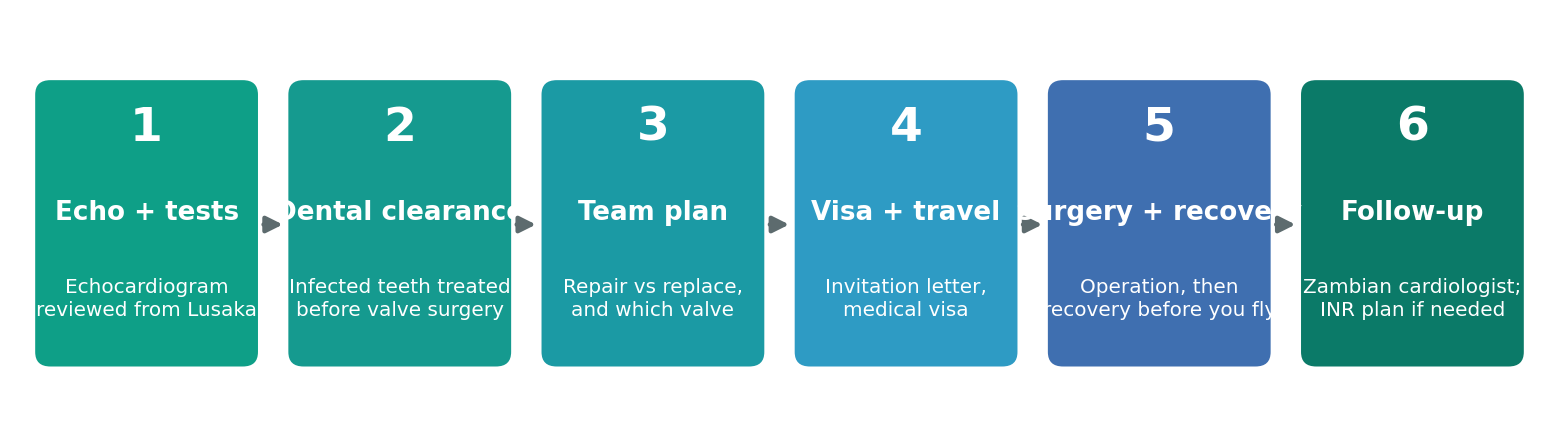
What the journey looks like
Notice that surgery is not step one, and that the dental check comes before the theatre. Send your echocardiogram and reports for review from Lusaka, and a good centre will return a plan — repair or replace, and which valve — and a fixed quote before you commit a single kwacha.
Practicalities for travelling from Zambia
India requires a yellow fever vaccination certificate from travellers arriving from Zambia, valid only ten days after the injection — do not leave it late. Your medical visa is issued by the High Commission of India on Pandit Nehru Road in Lusaka against the hospital’s invitation letter; apply for a medical-attendant visa in the same batch, which matters greatly for heart patients and is essential for a child. There is no direct flight — you will connect through Addis Ababa on Ethiopian Airlines, or through Dubai, Doha or Nairobi, a door-to-door journey of roughly fourteen to twenty hours. Book a changeable return ticket, carry your echocardiogram and any HIV or other records, and settle the hospital by traceable bank transfer rather than cash.
On paying for it. Zambia’s National Health Insurance scheme funds care at accredited facilities inside the country, not elective surgery abroad, so heart surgery in India will usually come from your own resources. I would rather you knew that from the first line than discovered it later. For children, charitable heart-surgery programmes sometimes assist — ask your cardiologist — and if you hold any private or employer policy, ask the insurer in writing whether an overseas benefit exists.
Four signals that should make you pause
- A mechanical valve without INR discussion — no discussion of whether you can reach a lab for lifelong testing.
- A surgeon who only ever replaces valves — never repairs them, offered to a young patient.
- No dental check before valve surgery — or no dedicated paediatric team for a child.
- A fixed price before echocardiogram review — or no follow-up plan for Zambia.
Straight answers for Zambian Patients about Heart Surgery in India
Should I choose a mechanical or a tissue valve?
It depends less on your age than on your life. A mechanical valve lasts longest but needs lifelong warfarin and regular INR blood tests; if you cannot reliably reach a lab, a repair or a tissue valve may be safer even though a tissue valve may need redoing later. Insist your surgeon weighs this honestly with you.
Can my child’s heart be operated on in India?
Yes, and India has extensive experience with children’s heart surgery. Confirm the hospital has a dedicated paediatric cardiac team — not just adult heart surgeons — and ask your Zambian cardiologist whether any charitable programme can help with cost.
Why must my teeth be checked before heart surgery?
Because bacteria from infected teeth can travel to a heart valve and destroy it. Treating dental problems first is a simple, essential step that protects your new or repaired valve.
How urgent is valve surgery?
Often there is time to plan — but not unlimited time, because a strained heart muscle can weaken permanently. Sudden severe breathlessness, chest pain or fainting is an emergency; otherwise, get an echocardiogram reviewed promptly so you operate before the muscle is harmed.
Sources & Useful Links
- 🌐 Medical visa (India), Lusaka — High Commission of India, requirements & process: hcizambia.gov.in/page/medical-visa
- 🌐 National Health Insurance (Zambia) — NHIMA cover and accredited facilities: nhima.co.zm
- 🌐 Ministry of Health, Zambia — referrals and national health services: moh.gov.zm
- 🌐 University Teaching Hospitals, Lusaka — Zambia’s largest public referral centre: uth.gov.zm
- 🌐 Hospital accreditation (India) — verify a hospital’s NABH accreditation: nabh.co
- 🌐 Yellow fever & travel health — WHO vaccination guidance: who.int/health-topics/yellow-fever
A closing word
If you send me your echocardiogram and a note on your history — or your child’s — I will help you get to the questions that matter: can the valve be repaired rather than replaced, which valve truly suits the life you live, and whether the heart should be operated on now or can safely wait. In heart surgery, the wrong valve chosen for the wrong reasons can cost far more than money over a lifetime. My work has always been to make sure the choice fits not just your diagnosis, but your life.
Frequently Asked Questions by Zambian Patients about Heart Surgery in India
Why do Zambian patients travel to India for heart valve surgery?
The guide explains that complex open-heart surgery remains limited locally. India offers high-volume cardiac centres with valve-repair expertise, intensive-care support and dedicated paediatric cardiac services.
How much does heart valve surgery in India cost for Zambian patients?
The page 4 chart gives a representative all-in cost of approximately US$7,000 for valve repair or replacement in India. Actual costs vary with surgical complexity, valve type and intensive-care requirements.
Why is rheumatic heart disease important for Zambian heart patients?
Rheumatic heart disease can begin after rheumatic fever damages the heart valves following a streptococcal throat infection. It commonly affects younger people and often involves the mitral valve.
Should a young Zambian patient choose valve repair or replacement?
The guide encourages considering repair of the natural valve where technically possible, particularly for younger patients. However, suitability depends on the valve damage and the surgeon's expertise.
Is a mechanical valve suitable for Zambian patients?
It can be, but a mechanical valve requires lifelong warfarin and regular INR blood testing. Reliable access to INR monitoring should therefore be considered before selecting this option.
How long does a tissue heart valve last?
The guide states that tissue valves may need replacement after approximately 10–15 years, while the page 3 comparison chart illustrates a typical figure of about 12 years.
Why do Zambian patients need a dental check before valve surgery?
Infected or decayed teeth can allow bacteria to enter the bloodstream and infect a repaired or replacement heart valve, potentially causing endocarditis. Dental problems should therefore be addressed before surgery.
Can Zambian children undergo heart surgery in India?
Yes. The guide advises families to choose a hospital with a dedicated paediatric cardiac surgeon, paediatric anaesthesia and intensive-care team rather than relying only on adult cardiac services.
How long should Zambian patients stay in India after open-heart surgery?
The guide recommends planning approximately three to four weeks in India before being cleared to fly home, allowing time for hospital care, early breastbone healing and assessment of heart rhythm and recovery.
What are the red flags when choosing heart surgery in India?
The guide identifies four warning signs: a mechanical valve recommended without discussing lifelong INR access, a surgeon who only replaces valves without considering repair in a young patient, no dental clearance or dedicated paediatric team where appropriate, and a fixed price before echocardiogram review or without a clear follow-up plan in Zambia.
Page Summary
This guide explains heart surgery in India for Zambian patients, with particular attention to rheumatic heart disease and the lifelong implications of valve selection in younger patients. Unlike degenerative valve disease commonly seen in older Western patients, rheumatic heart disease can affect Zambians much earlier in life. It can develop after rheumatic fever damages the heart valves, particularly the mitral valve.
Citation Block
| Topic | Information |
|---|---|
| Topic Information | Details |
| Procedure | Heart Valve Repair & Replacement Surgery |
| Country | India |
| Intended Audience | Zambian Patients |
| Primary Condition | Rheumatic Heart Disease |
| Primary Valve Highlighted | Mitral Valve |
| Treatment Options | Valve Repair, Mechanical Valve and Tissue/Biological Valve |
| Valve Repair Durability | 20+ Years in Page 3 Chart |
| Mechanical Valve Durability | 30+ Years in Page 3 Chart |
| Mechanical Valve Requirement | Lifelong Warfarin + Regular INR Testing |
| Tissue Valve Durability | Approximately 12 Years in Page 3 Chart; 10–15 Years Mentioned in Text |
| Diagnostic Test | Echocardiogram |
| Pre-Surgery Requirement | Dental Clearance |
| Typical Hospital Stay | Several Days Including Intensive Care |


Our Mission Statement
Our mission is to place patients at the centre of every healthcare decision by providing trustworthy, evidence-based, and unbiased medical information. We believe that informed patients make better decisions. Backed by personalised guidance from our experienced advisory team, we help patients understand their treatment options, compare them objectively, and confidently choose the path that best suits their medical needs and personal circumstances.
Patient Testimonials from Zambia

Ready to Take the First Step?
Share your Medical Reports with our Healthcare Managers Today and Get a FREE CONSULTATION, a Personalized Treatment Plan, and Complete Support from Arrival to Recovery.
Get Your Free ConsultationAreas We Serve
This resource has been thoughtfully prepared for patients from Zambia who are considering medical treatment in India. We also welcome patients from the wider region in the countries mentioned below-
We assist patients from:
- Zambia
- Angola
- Malawi
- Zimbabwe
- Botswana
- Namibia
- South Africa
- Eswatini
- Lesotho
- Gabon
- Chad
- Equatorial Guinea
- São Tomé and Príncipe
- Republic of the Congo
- Democratic Republic of the Congo
Many of the insights, treatment pathways, hospital recommendations, travel guidance, and patient support services described here are equally relevant and may be used as a reference when planning treatment in India.
From Zambia to India: Your Complete Patient Support Guide
- Best Weight-Loss (Bariatric) Surgeons & Hospitals in India for Zambian Patients
- Best Brain-Tumour Surgeons & Hospitals in India for Zambian Patients
- Best Cancer Doctors & Hospitals in India for Zambian Patients
- Best Cardiac Surgeons & Hospitals in India for Zambian Patients
- Best Cosmetic Surgeons & Facilities in India for Zambian Patients
- Best CyberKnife Treatment Teams & Centres in India for Zambian Patients
- Best Dentists & Dental Clinics in India for Zambian Patients
- Best Heart Valve Replacement Surgeons & Hospitals in India for Zambian Patients
- Best Hip Surgeons & Hospitals in India for Zambian Patients
- Best Knee Surgeons & Hospitals in India for Zambian Patients
- Best Neurosurgeons & Hospitals in India for Zambian Patients
- Best Paediatric Cardiac Surgeons & Hospitals in India for Zambian Patients
- Best Paediatric Neurosurgeons & Hospitals in India for Zambian Patients
- Best Prostate Surgeons & Hospitals in India for Zambian Patients
- Best Scoliosis Surgeons & Hospitals in India for Zambian Patients
- Best Spine Surgeons & Hospitals in India for Zambian Patients
- Best Bone Marrow Transplant Teams & Hospitals in India for Zambian Patients
- Best Kidney Transplant Surgeons & Hospitals in India for Zambian Patients