

CyberKnife Treatment in India for Zambian Patients
Despite its name, the CyberKnife does not cut — it is pinpoint radiation, delivered by a robot, with no incision at all. This guide explains what it really is, when it is the right choice, and when it is not.
The word “knife” frightens people, and understandably so — but it is, in this case, quite misleading. The CyberKnife is not a knife, and it does not cut. It is a machine that delivers radiation with extraordinary precision, and it has helped many patients with tumours that were difficult, dangerous or impossible to reach with an ordinary operation. For 24 years I have helped African patients understand their options, and few are as widely misunderstood as this one. So let me clear away the confusion first, explain honestly what the CyberKnife can and cannot do, and show you how a Zambian patient might reach it — and, just as importantly, how to know whether it is truly the right choice for you.
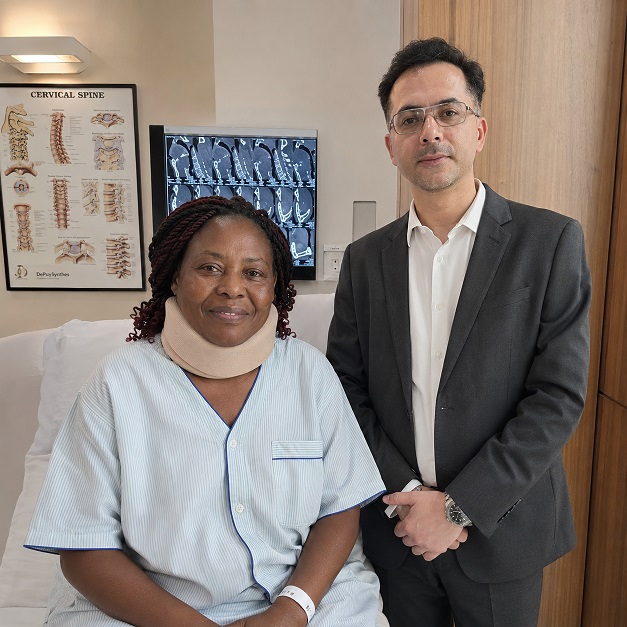
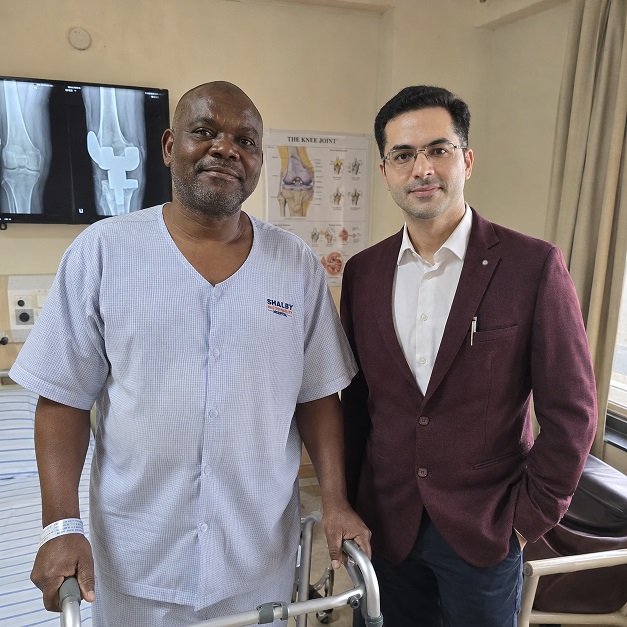
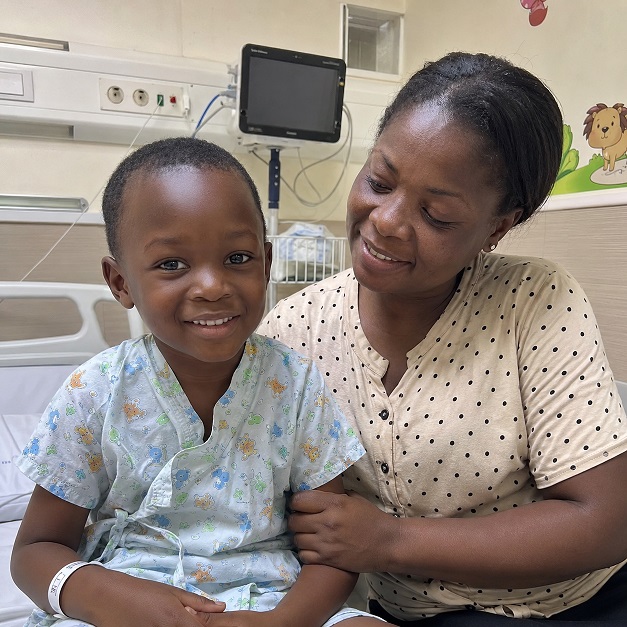
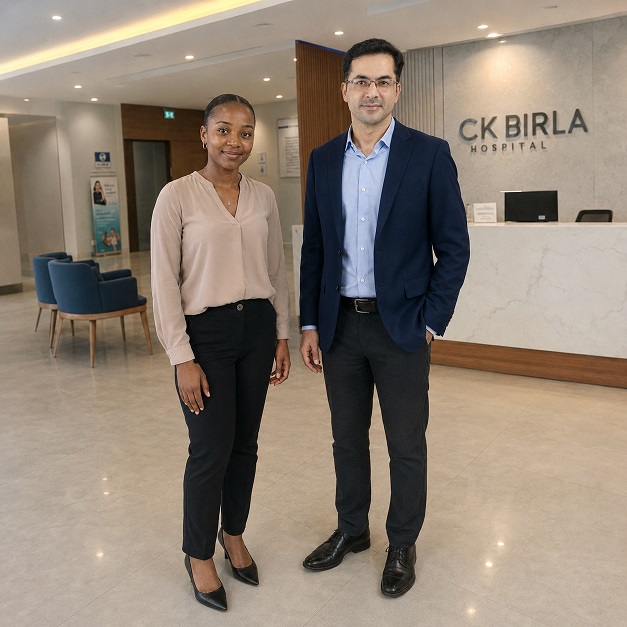
Healing Journeys of Zambian Patients


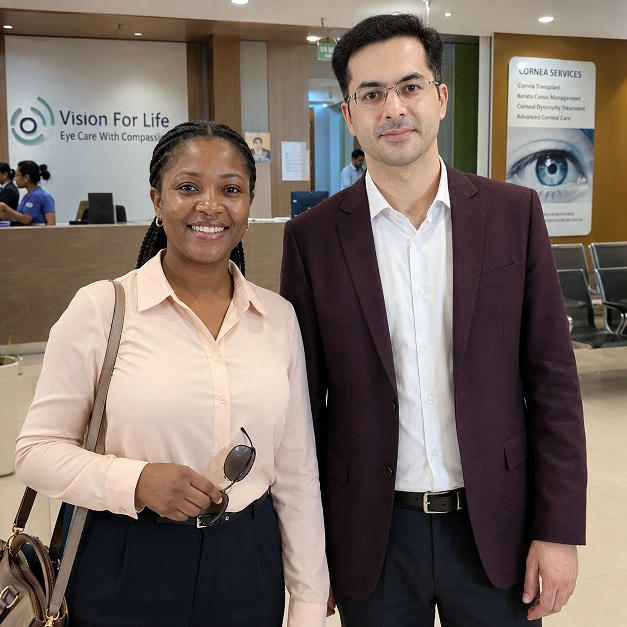
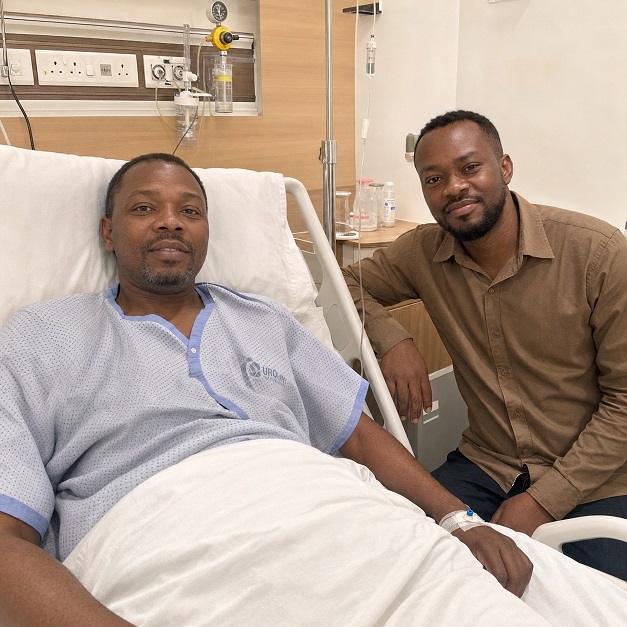

Key Takeaways
- Despite its name, the CyberKnife is not a surgical knife and does not make an incision. It is a robotic stereotactic radiosurgery system that delivers highly precise radiation beams to a defined tumour target.
- During treatment, a robotic arm moves around the patient and directs radiation from many different angles. The individual beams converge on the tumour, allowing a strong treatment dose to reach the target while limiting radiation exposure to surrounding healthy tissue.
- CyberKnife treatment is generally non-invasive and outpatient-based. The guide states that there is no incision, no blood, usually no anaesthetic and generally no hospital stay. Most patients return to normal activity within a day or two.
- The page 2 chart shows the broad range of targets that CyberKnife may treat, including the brain and skull base, spine, prostate, head and neck, lung, liver, pancreas and kidney, as well as selected benign conditions such as trigeminal neuralgia.
- A major advantage of CyberKnife is its ability to track tumours that move with breathing. The chart specifically identifies lung, liver, pancreas and kidney targets as moving targets that can be tracked in real time.
- CyberKnife is most appropriate for selected small and well-defined tumours, difficult or inoperable lesions, tumours close to critical structures, patients who may be too frail for conventional surgery and selected limited metastatic deposits.
- The guide is equally clear that CyberKnife is not suitable for every cancer. Large or widespread cancers and cases better treated with surgery, conventional radiotherapy or systemic drug treatment may not benefit from CyberKnife.
Quick Facts
- Treatment
- CyberKnife Robotic Radiosurgery
- Country
- India
- Intended Audience
- Zambian Patients
- Treatment Type
- Stereotactic Radiosurgery / Precision Radiation
- Surgical Incision
- None
- Anaesthesia
- Usually Not Required
- Hospitalisation
- Usually Not Required
- Treatment Setting
- Outpatient
- Technology
- Robotic Radiation Delivery
- Primary Advantage
- Highly Precise Radiation Delivery
- Conventional Radiotherapy Sessions
- Approximately 20–35 Sessions
- CyberKnife Treatment Duration
- Usually Over Several Days
- Normal Activity
- Often Within 1–2 Days
- Typical Stay in India
- Approximately 1–2 Weeks Including Planning and Treatment
In Brief
CyberKnife treatment in India for Zambian patients is a non-invasive form of robotic stereotactic radiosurgery, not conventional surgery. It can treat selected tumours in areas including the brain, spine, lung, liver, pancreas, prostate and kidney, with a particular advantage in tracking targets that move with breathing. Treatment typically requires 1–5 outpatient sessions, compared with approximately 20–35 sessions for conventional radiotherapy. The guide's page 4 chart gives a representative full-course CyberKnife cost of approximately US$7,000 in India.
First, should you travel at all?
Advanced stereotactic radiosurgery of this kind is not available in Zambia. Radiotherapy itself is limited — the Cancer Diseases Hospital in Lusaka is the country’s main radiotherapy centre, and demand outstrips it, so waits can be long. For a patient whose cancer genuinely calls for the pinpoint precision of a CyberKnife, that treatment means travelling. India is a natural destination: it has many CyberKnife and stereotactic-radiosurgery centres in accredited hospitals, with experienced radiation oncologists and no waiting lists. But — and this matters — the CyberKnife is a specialist tool for particular situations, not a treatment to seek simply because it is advanced. Whether it is right for you is a medical decision, and this guide will help you ask the right questions.
Knowledge first: it is not a knife — it is precision radiation
Here is what actually happens. You lie comfortably on a couch — for a brain target, wearing a soft mesh mask rather than the rigid metal frame older methods required — and a robotic arm moves quietly around you, aiming from hundreds of different angles. From each angle it sends a thin beam of radiation, each one too weak to harm the tissue it passes through, but all of them meeting at a single point: the tumour. Where they converge, the dose is powerful enough to destroy the target’s cells; everywhere else, the surrounding healthy tissue is largely spared. There is no incision, no blood, usually no anaesthetic, and no hospital stay — it is an outpatient treatment, and most people are back to normal activity within a day or two. That, in essence, is the whole idea: the effect of surgery on the tumour, without the cutting.
What it can treat — and its signature strength
Unlike some radiosurgery systems that treat only the brain, the CyberKnife can reach targets throughout the body — the brain and skull base, the spine, the lung, liver, pancreas, prostate, kidney and head and neck — as well as some benign, non-cancerous conditions such as certain nerve disorders. Its signature strength, the thing that sets it apart, is that it can track a tumour that moves . Tumours in the lung, liver and pancreas shift with every breath, and where a fixed machine would have to irradiate a wide margin to be sure of hitting them, the CyberKnife follows the movement in real time and keeps the beam locked on the target. That precision means less damage to healthy tissue and fewer side effects.
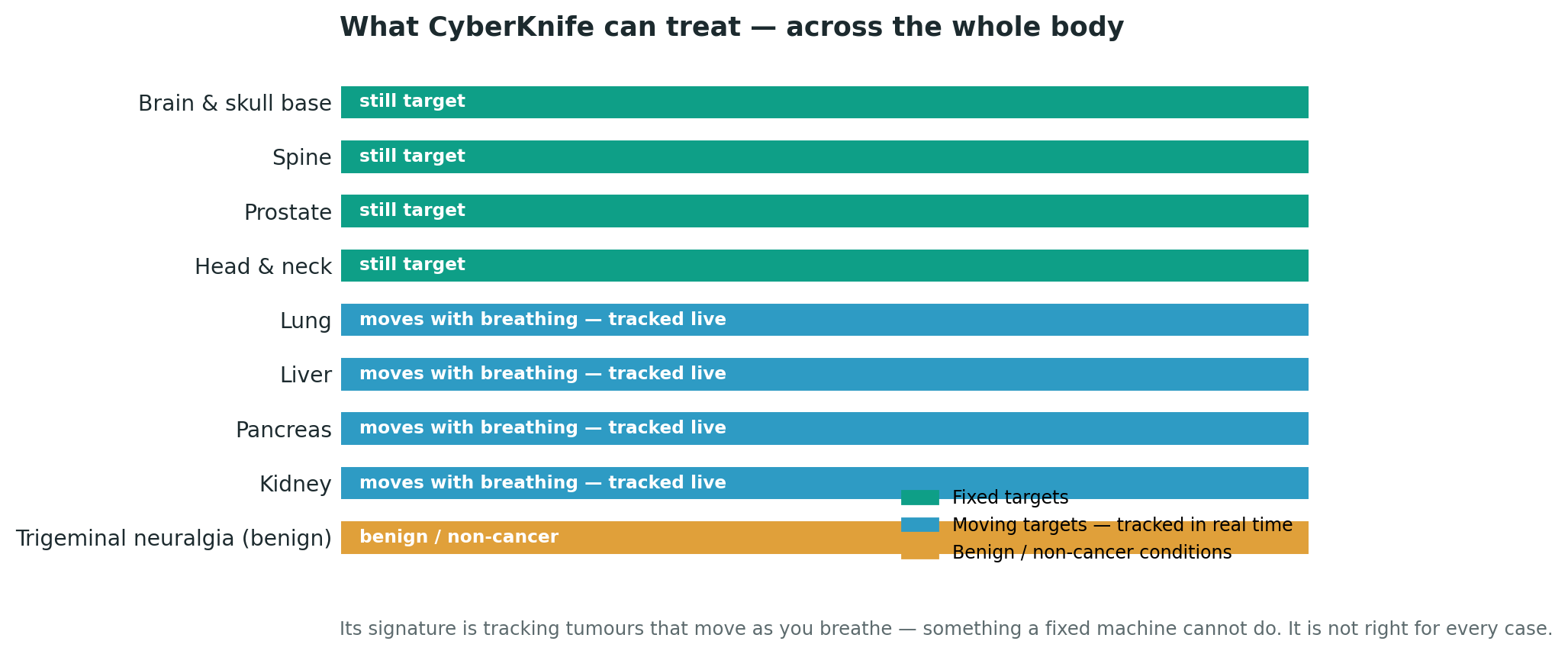
Its reach across the whole body, and its ability to track tumours that move as you breathe, are what distinguish the CyberKnife — though it is not the right tool for every case.
The honest part: when it is the right tool, and when it is not
This is where clear thinking matters most, because newer does not always mean better for your situation. The CyberKnife is at its best for tumours that are relatively small and well-defined; for growths that are inoperable, deep, or wrapped around critical structures where a surgeon’s knife would be dangerous; for patients too frail for an operation; and for treating a limited number of secondary spots. It is not a cure-all. For large or widespread cancers, for many cases where straightforward surgery would serve better, or where chemotherapy is the mainstay, it may not be the right answer at all. That is why the choice should never be made from a brochure. It should be made by a tumour board — a team including a radiation oncologist, a surgeon and a medical oncologist — weighing the CyberKnife against surgery, conventional radiotherapy and drug treatment for your particular cancer. Be wary of any clinic that offers the technology before it has established that you actually need it.
CyberKnife, Gamma Knife, or ordinary radiotherapy?
These names cause much confusion, so here is the plain difference. The Gamma Knife is also radiosurgery, but it treats only the brain and the very top of the spine, and traditionally fixes a rigid frame to the head. The CyberKnife is frameless and can treat the whole body, and it tracks movement — so which of the two suits you is decided purely by where your tumour is, not by preference. Conventional radiotherapy , by contrast, spreads a gentler dose over many sessions — often twenty to thirty-five visits across several weeks — and remains the right choice for many cancers. The CyberKnife’s advantage is that its precision lets it deliver a strong dose in just one to five sessions, which is a real benefit when you have travelled far for care.
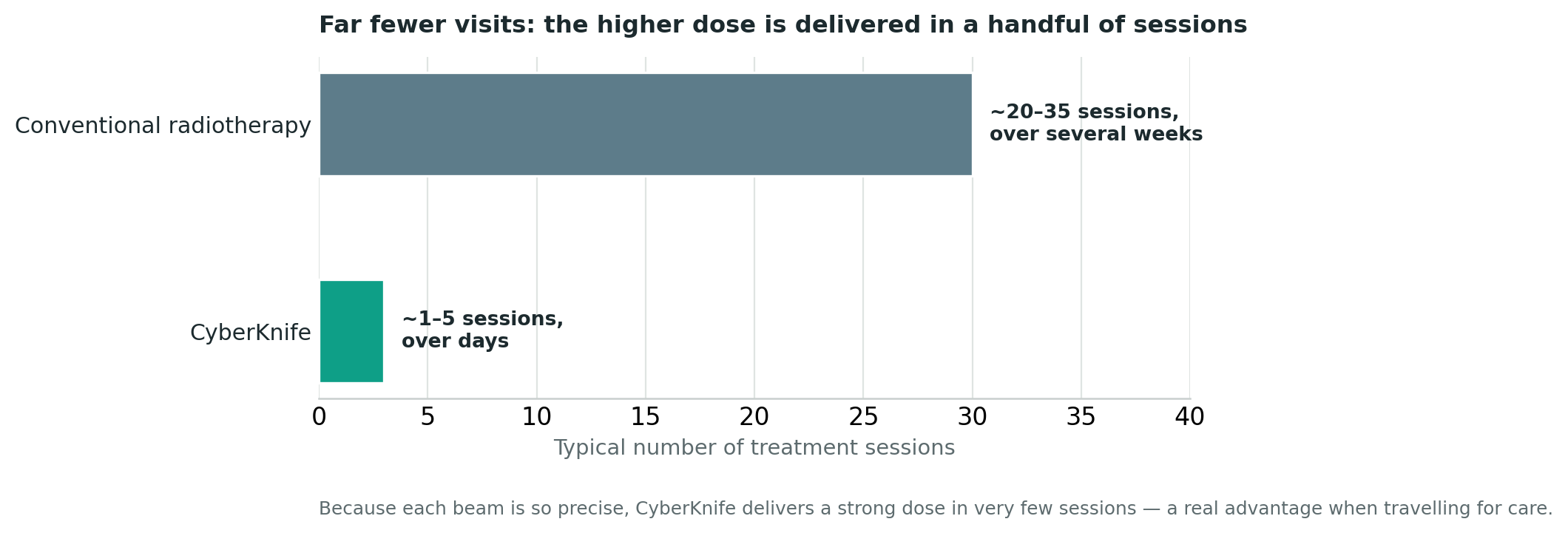
Far fewer visits: because each beam is so precise, a full dose can be given in a handful of sessions rather than weeks of daily treatment.
Often part of a bigger plan, not a standalone answer
It is worth understanding that the CyberKnife is frequently used alongside other treatments rather than instead of them. It may be used after an operation to treat a small amount of tumour a surgeon could not safely remove; to deal with a cancer that has come back in one spot after earlier treatment; to treat a few secondary deposits while drug treatment handles the rest; or to relieve symptoms when a cure is not possible. Seen this way, it is one instrument in a whole orchestra of cancer care — powerful in its place, but working best in concert with the others. This is exactly why the decision belongs with a team that sees the whole picture, not with a single machine or a single clinic.
Honestly, what to expect — and its limits
Because it is radiation, the CyberKnife is not entirely without effect. The most common is tiredness in the days afterward; there may be mild, short-lived nausea or headache for brain targets, or some skin irritation at body sites that settles within a couple of weeks. Serious effects are uncommon but possible, depending on the area treated. And it is honest to say that no treatment guarantees a cure: how well it works depends on the type and stage of the tumour, and results are followed carefully with scans — usually an MRI at around six weeks and three months — to see how the target has responded. A good doctor will give you realistic expectations for your specific case, not a promise.
The cost, in plain terms
A course of CyberKnife treatment in India costs a fraction of what it does in the West, where the same technology can be extremely expensive. At roughly ZK19 to the US dollar in mid-2026, the saving is substantial; confirm the rate before travel, as it moves. The exact figure depends on the site treated and the number of sessions, so ask for it in full.
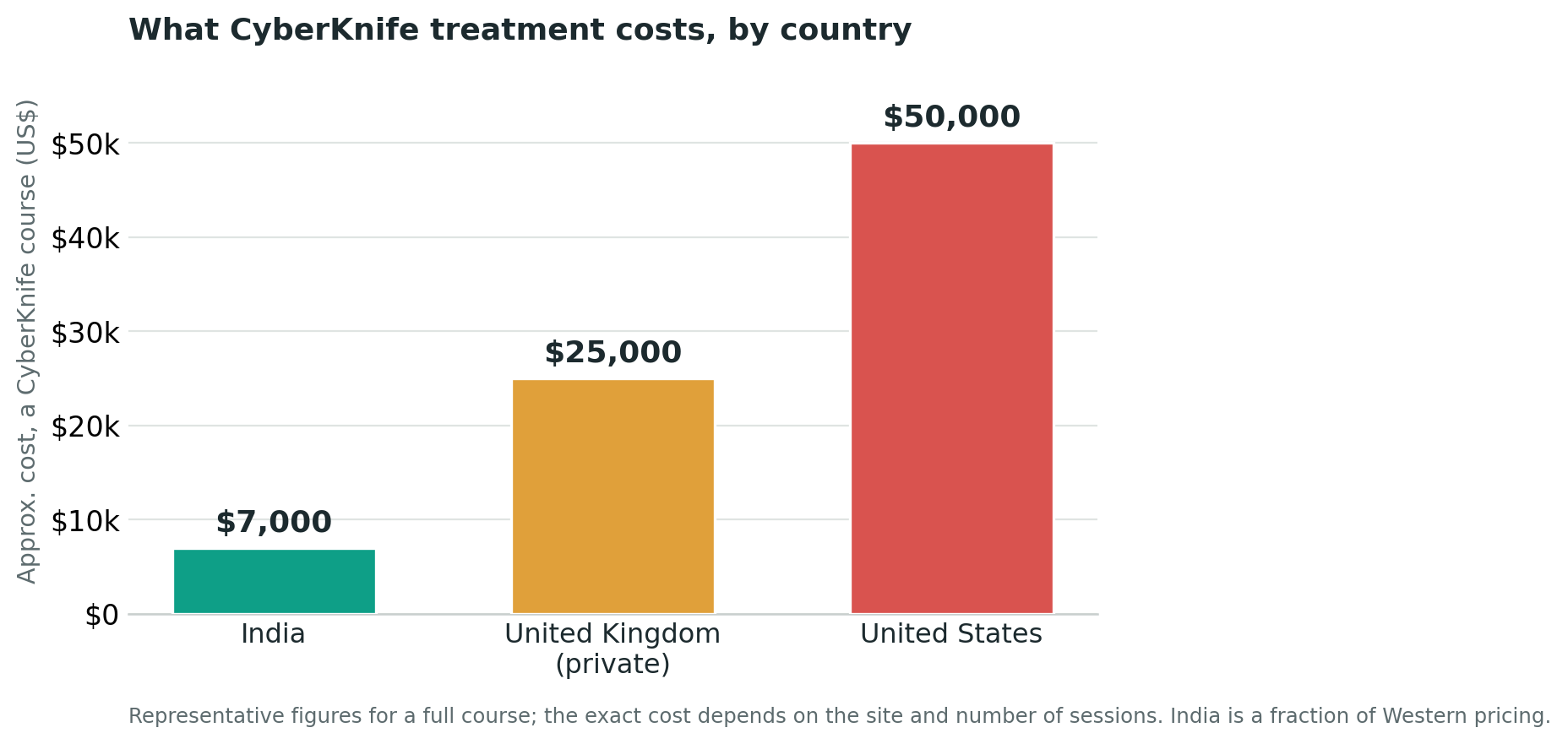
Representative figures for a full course. India’s pricing, with no waiting list, is why many patients travel for stereotactic radiosurgery.
In 24 years of arranging these journeys, I have learned that disputes almost never concern the headline price — they concern what it left out: the planning scans, the number of sessions, the follow-up imaging. Insist on an itemised quote that states how many sessions are included and what the follow-up covers.
Why India for the CyberKnife
India’s leading cancer centres — accredited internationally by JCI and within India by NABH — run CyberKnife and other stereotactic systems with experienced radiation oncologists and physicists, backed by the tumour boards that decide whether it is the right choice. There are no waiting lists for planning or treatment, and English, Zambia’s official language, is the working language of care. As always, insist that the team reviews your case honestly, tells you if another treatment would serve you better, and hands your follow-up back to a doctor in Zambia.
Recovery, and travelling home
This is one of the gentler journeys. Because the treatment is non-invasive and outpatient, there is no surgical recovery to wait through. Allow a few days at the start for planning — the scans, the fitting of a mask, and the careful mapping of your treatment — and then a short course of one to five sessions, so that most patients complete everything within one to two weeks in India. You can usually fly home soon after the final session; your team will confirm when. It is a far lighter undertaking than an operation.
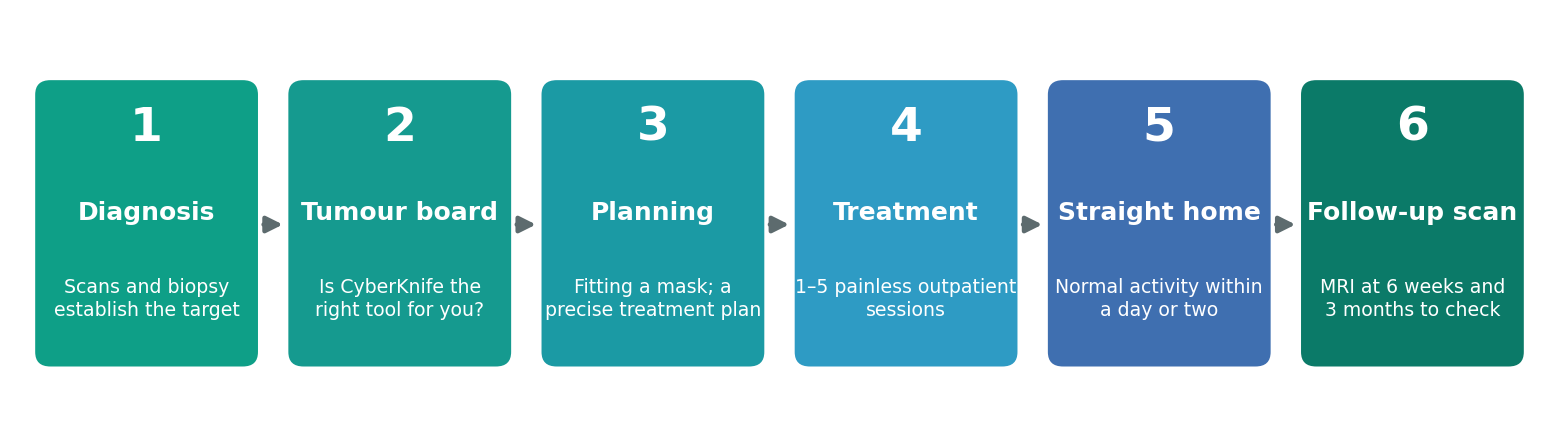
What the journey looks like
Notice that treatment comes only after a tumour board has confirmed the CyberKnife is right for you. Send your scans and reports for review from Lusaka, and a good centre will tell you honestly whether this is the best tool for your case — and, if it is, return a plan and a fixed quote — before you commit a single kwacha.
Practicalities for travelling from Zambia
India requires a yellow fever vaccination certificate for travellers arriving from Zambia, valid only ten days after the injection. Your medical visa is issued by the High Commission of India on Pandit Nehru Road in Lusaka against the hospital’s invitation letter; apply for a medical-attendant visa in the same batch so a family member can accompany you. There is no direct flight — you will connect through Addis Ababa on Ethiopian Airlines, or through Dubai, Doha or Nairobi. Carry your actual scan files, not only the reports, along with your biopsy and treatment records, and settle the hospital by traceable bank transfer rather than cash.
On paying for it. Zambia’s National Health Insurance scheme funds care at accredited facilities inside the country, not elective treatment abroad, so CyberKnife treatment in India will usually come from your own resources. I would rather you knew that from the first line than discovered it later. Ask for a quote that covers the whole course and the follow-up scans, and if you hold any private or employer policy, ask the insurer in writing whether an overseas cancer-treatment benefit exists.
Four signals that should make you pause
- No tumour board confirmation — a clinic offering CyberKnife before a tumour board confirms it is the right treatment.
- Promises of a guaranteed cure — or no honest discussion of side effects and the need for follow-up scans.
- No comparison with other treatments — surgery, conventional radiotherapy or drug treatment, where those might serve you better.
- A price with no session count — or no plan for your follow-up back in Zambia.
Straight answers for Zambian Patients about CyberKnife Treatment in India
Is the CyberKnife surgery? Will I be cut?
No. Despite the name, there is no cutting, no incision and usually no anaesthetic. A robot delivers many precise beams of radiation that meet at the tumour. It is an outpatient treatment, and most people return to normal activity within a day or two.
Is it better than an operation?
For the right tumour, it can be an excellent alternative — especially where surgery would be dangerous or impossible, or you are unfit for it. But it is not better for every case; sometimes surgery, chemotherapy or ordinary radiotherapy is the wiser choice. A tumour board should weigh the options for your specific cancer.
How many visits will I need, and how long in India?
Usually one to five sessions, after a few days of planning — so most patients complete everything within one to two weeks. Because it is non-invasive, you can generally fly home soon after the final session, once your team confirms it is safe.
Will it cure my cancer?
It can control or destroy suitable tumours very effectively, but no treatment guarantees a cure, and much depends on the type and stage of your cancer. Results are checked with follow-up scans. Expect an honest, realistic answer for your own situation rather than a promise.
Sources & Useful Links
- 🌐 Medical visa (India), Lusaka — High Commission of India, requirements & process: hcizambia.gov.in/page/medical-visa
- 🌐 National Health Insurance (Zambia) — NHIMA cover and accredited facilities: nhima.co.zm
- 🌐 Ministry of Health, Zambia — referrals and national health services: moh.gov.zm
- 🌐 University Teaching Hospitals, Lusaka — Zambia’s largest public referral centre: uth.gov.zm
- 🌐 Hospital accreditation (India) — verify a hospital’s NABH accreditation: nabh.co
- 🌐 Yellow fever & travel health — WHO vaccination guidance: who.int/health-topics/yellow-fever
A closing word
If you send me your scans, biopsy details and history, I will help you get to the question that matters most: is the CyberKnife genuinely the right tool for your cancer, or would surgery, chemotherapy or ordinary radiotherapy serve you better? Used for the right tumour, this technology can achieve something remarkable — the destruction of a growth that no surgeon could safely reach, with no incision and barely an interruption to daily life. Used for the wrong one, it is simply an expensive detour. My work has always been to make sure you understand the difference, so that whatever you choose is chosen for the right reasons. That, for all these years, has been my work.
Frequently Asked Questions by Zambian Patients about CyberKnife Treatment in India
Why do Zambian patients travel to India for CyberKnife treatment?
The guide states that advanced CyberKnife stereotactic radiosurgery is not available in Zambia. India offers CyberKnife and other stereotactic systems in accredited cancer centres with experienced radiation oncology teams.
Is CyberKnife actually surgery, and will Zambian patients be cut?
No. Despite its name, CyberKnife does not involve a knife or surgical incision. A robotic system delivers multiple highly focused radiation beams to the tumour.
How much does CyberKnife treatment in India cost for Zambian patients?
The page 4 chart gives a representative full-course cost of approximately US$7,000 in India. Actual costs depend on the tumour location, number of sessions, planning and follow-up imaging.
Which tumours can be treated with CyberKnife in India?
The guide discusses selected tumours involving the brain and skull base, spine, lung, liver, pancreas, prostate, kidney and head and neck. Suitability depends on tumour size, location, stage and other clinical factors.
Can CyberKnife treat lung and liver tumours in Zambian patients?
For suitable cases, yes. A particular advantage of CyberKnife is its ability to track selected tumours that move with breathing, including targets in the lung and liver.
How many CyberKnife sessions will Zambian patients need in India?
CyberKnife treatment generally requires approximately 1–5 sessions over several days. The exact number depends on the tumour and the treatment plan.
How long should Zambian patients stay in India for CyberKnife treatment?
The guide states that most patients complete planning and treatment within approximately one to two weeks, including planning scans, mask fitting and one to five treatment sessions.
Is CyberKnife better than surgery or conventional radiotherapy?
Not in every case. CyberKnife may be valuable for selected small, difficult or inoperable tumours, but some patients are better treated with surgery, conventional radiotherapy or systemic treatment. A tumour board should compare the options.
What follow-up is required after CyberKnife treatment?
Treatment response is checked with follow-up imaging. The guide mentions an MRI at around six weeks and three months, although the actual schedule depends on the tumour and treating team.
What are the red flags when choosing CyberKnife treatment in India?
The guide highlights four warning signs: CyberKnife offered before tumour-board review, promises of a guaranteed cure, failure to compare CyberKnife with surgery or other treatments, and a quotation that does not clearly state the number of sessions or the follow-up plan in Zambia.
Page Summary
This guide explains CyberKnife treatment in India for Zambian patients and begins by correcting a common misunderstanding: CyberKnife is not surgery with a knife. It is a robotic system that delivers highly focused radiation without an incision. CyberKnife directs multiple radiation beams toward a defined tumour target while minimising exposure to surrounding healthy tissue. Treatment is generally outpatient, usually requires no anaesthetic and allows most patients to resume normal activity within a day or two.
Citation Block
| Topic | Information |
|---|---|
| Topic Information | Details |
| Procedure | CyberKnife Robotic Radiosurgery |
| Country | India |
| Intended Audience | Zambian Patients |
| Treatment Type | Stereotactic Radiosurgery / Precision Radiation |
| Conditions / Targets Covered | Brain, Skull Base, Spine, Lung, Liver, Pancreas, Prostate, Kidney, Head & Neck and Selected Benign Conditions |
| Incision | None |
| Anaesthesia | Usually Not Required |
| Treatment Setting | Outpatient |
| Treatment Sessions | Approximately 1–5 Sessions |
| Conventional Radiotherapy Comparison | Approximately 20–35 Sessions |
| Typical Stay | Approximately 1–2 Weeks Including Planning and Treatment |
| Hospital Stay | Usually None |
| Recovery | Normal Activity Often Within 1–2 Days |


Our Mission Statement
Our mission is to place patients at the centre of every healthcare decision by providing trustworthy, evidence-based, and unbiased medical information. We believe that informed patients make better decisions. Backed by personalised guidance from our experienced advisory team, we help patients understand their treatment options, compare them objectively, and confidently choose the path that best suits their medical needs and personal circumstances.
Patient Testimonials from Zambia

Ready to Take the First Step?
Share your Medical Reports with our Healthcare Managers Today and Get a FREE CONSULTATION, a Personalized Treatment Plan, and Complete Support from Arrival to Recovery.
Get Your Free ConsultationAreas We Serve
This resource has been thoughtfully prepared for patients from Zambia who are considering medical treatment in India. We also welcome patients from the wider region in the countries mentioned below-
We assist patients from:
- Zambia
- Angola
- Malawi
- Zimbabwe
- Botswana
- Namibia
- South Africa
- Eswatini
- Lesotho
- Gabon
- Chad
- Equatorial Guinea
- São Tomé and Príncipe
- Republic of the Congo
- Democratic Republic of the Congo
Many of the insights, treatment pathways, hospital recommendations, travel guidance, and patient support services described here are equally relevant and may be used as a reference when planning treatment in India.
From Zambia to India: Your Complete Patient Support Guide
- Best Weight-Loss (Bariatric) Surgeons & Hospitals in India for Zambian Patients
- Best Brain-Tumour Surgeons & Hospitals in India for Zambian Patients
- Best Cancer Doctors & Hospitals in India for Zambian Patients
- Best Cardiac Surgeons & Hospitals in India for Zambian Patients
- Best Cosmetic Surgeons & Facilities in India for Zambian Patients
- Best CyberKnife Treatment Teams & Centres in India for Zambian Patients
- Best Dentists & Dental Clinics in India for Zambian Patients
- Best Heart Valve Replacement Surgeons & Hospitals in India for Zambian Patients
- Best Hip Surgeons & Hospitals in India for Zambian Patients
- Best Knee Surgeons & Hospitals in India for Zambian Patients
- Best Neurosurgeons & Hospitals in India for Zambian Patients
- Best Paediatric Cardiac Surgeons & Hospitals in India for Zambian Patients
- Best Paediatric Neurosurgeons & Hospitals in India for Zambian Patients
- Best Prostate Surgeons & Hospitals in India for Zambian Patients
- Best Scoliosis Surgeons & Hospitals in India for Zambian Patients
- Best Spine Surgeons & Hospitals in India for Zambian Patients
- Best Bone Marrow Transplant Teams & Hospitals in India for Zambian Patients
- Best Kidney Transplant Surgeons & Hospitals in India for Zambian Patients