

Cornea Transplant and Advanced Eye Surgery in India for Zambian Patients
Unlike a kidney or a liver, a cornea can be donated by anyone after death, with no living relative required — which makes it all the more striking that most of sub-Saharan Africa still cannot offer this operation, simply because the infrastructure to collect and store donated corneas has never been built.
The cornea is the clear, dome-shaped window at the front of the eye, and when it becomes scarred, thinned or clouded — from infection, injury, or a progressive condition called keratoconus — vision can be permanently affected. A corneal transplant, replacing the damaged tissue with healthy donor cornea, is one of the most successful transplant operations in all of medicine. But its success depends entirely on something few people think about until they need it: a functioning system for collecting, testing and storing donated corneal tissue. In 24 years of guiding patients through eye care abroad, I have found that understanding this donor-tissue reality, and the value of catching problems early, changes how a family should think about this journey.
Healing Journeys of Zambian Patients



Key Takeaways
- The guide explains that corneal transplantation depends not only on surgical expertise but also on a functioning eye-banking system capable of collecting, testing and storing donor corneal tissue. India has a large established eye-banking network, while access remains limited across much of sub-Saharan Africa.
- The page 1 chart highlights this infrastructure difference, showing 740+ registered eye banks/donation centres in the Eye Bank Association of India network compared with approximately 4 across the entire Sub-Saharan African region in the guide's cited figures.
- The guide distinguishes between several conditions and treatments. Advanced corneal scarring or severe keratoconus may require a corneal transplant, while early progressive keratoconus may be treated with corneal cross-linking (CXL) to strengthen the cornea and halt progression. Trachomatous trichiasis may require eyelid surgery before corneal damage becomes severe.
- Keratoconus is presented as a condition where early diagnosis can significantly change the treatment pathway. The page 2 chart shows a cited relative risk of significant visual impairment at first presentation of approximately 2.25× in Black patients compared with 1.0× in White patients, with the guide interpreting later diagnosis rather than faster disease progression as the likely explanation.
- The page 3 pathway shows that early keratoconus may lead to cross-linking without dependence on donor tissue, whereas advanced thinning and scarring may make transplantation the remaining option. Patients should therefore obtain proper corneal imaging rather than relying only on standard glasses prescriptions.
- When selecting an Indian eye hospital, the guide recommends asking about the source, quality and freshness of donor corneal tissue, the surgeon's experience with the specific transplant technique, NABH accreditation and ideally JCI accreditation. Patients should also ask how the hospital handles early graft rejection and educates patients about warning signs.
- The page 4 cost chart gives an indicative corneal transplant cost of approximately US$3,000 in India, compared with US$15,000 in the UK and US$25,000 in the US. The guide stresses that patients should request an itemised quotation covering assessment, surgery/procedure and follow-up, and should confirm whether cross-linking could be a less invasive and lower-cost option where clinically appropriate.
Quick Facts
- Author
- Dr. Dheeraj Bojwani
- Experience
- 24+ Years of Experience
- Treatment
- Cornea Transplant & Advanced Eye Surgery
- Patients
- Zambian Eye Patients
- Key Specialist
- Corneal Specialist / Ophthalmologist
- Main Assessment
- Corneal condition and disease stage
- Key Priority
- Early diagnosis and correct procedure selection
- Key Treatments
- Corneal transplant, cross-linking and eyelid surgery
- Key Selection Factor
- Experience with the required corneal technique
- Donor Tissue
- Established eye-bank sourcing
- India Cost
- Approximately US$3,000
- UK Cost
- Approximately US$15,000
- US Cost
- Approximately US$25,000
- Pre-Travel Records
- Eye examination and corneal topography
- Follow-Up
- Regular ophthalmic monitoring in Zambia
- Key Warning Signs
- Vision deterioration, eye pain, redness or possible graft rejection
- Decision Principle
- Choose the least invasive effective treatment appropriate for the corneal condition
In Brief
For Zambian patients with corneal disease, the guide recommends confirming whether the condition requires cross-linking, partial transplantation or full corneal transplantation before travelling. Early keratoconus may be treated with cross-linking and avoid donor tissue altogether, while advanced thinning or scarring may require a transplant. The guide gives an indicative corneal transplant cost of US$3,000 in India.
Why India specifically has solved a problem much of Africa has not
Corneal donation is, in one important sense, far simpler than donating a kidney or a liver: it does not require a living relative, a major operation on the donor, or complex matching. Anyone can potentially donate their corneas after death, and the tissue can help restore sight to someone entirely unrelated to them. And yet across most of sub-Saharan Africa, this simple act of generosity has nowhere to go, because the eye banks needed to collect, test and store donated corneal tissue simply do not exist in most countries. India, by contrast, has built one of the largest eye-banking networks in the world.
The reasons for this gap are not simply about willingness to donate. Building an eye bank requires trained staff who can retrieve corneal tissue within hours of death, cold-chain storage and testing facilities to ensure the tissue is safe, and a legal and administrative framework for consent and allocation. Several African countries have begun building this infrastructure in recent years, and a small number of functioning eye banks now exist, but coverage across the continent remains sparse, and many countries still have no domestic eye bank at all.
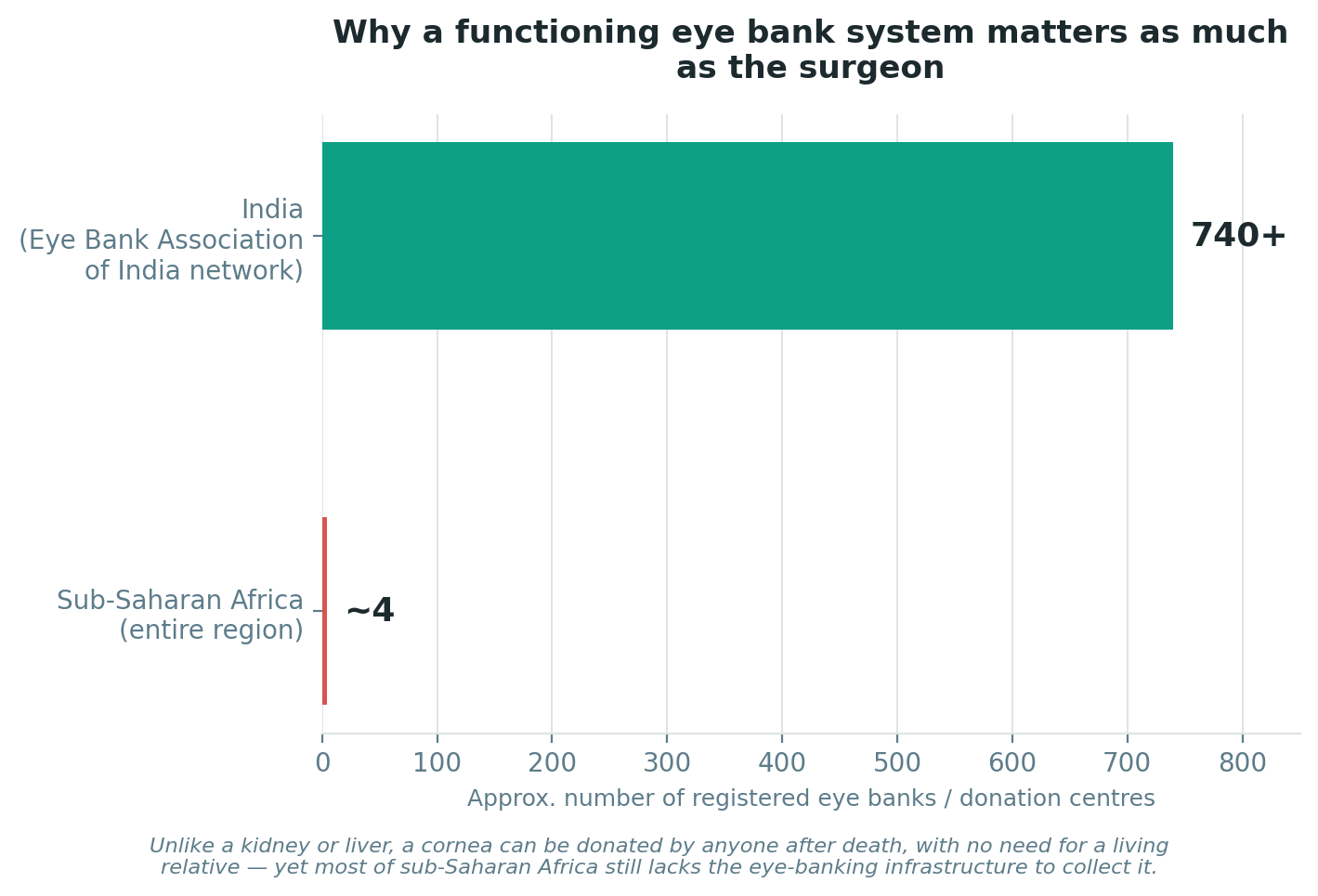
This is an infrastructure gap, not a legal one — the same generosity that exists everywhere simply has nowhere to go in most of the region.
This matters enormously for a Zambian patient, because it means that when you travel to India for a corneal transplant, you are not competing for an artificially scarce resource the way you might for other organs — you are accessing a system that has been deliberately built, over decades, specifically to meet this need reliably.
| Your situation | Typical approach | What it involves |
|---|---|---|
| Corneal scarring from infection, injury, or advanced keratoconus | Corneal transplant (keratoplasty) | Full or partial-thickness replacement of the damaged cornea with healthy donor tissue |
| Early, progressive keratoconus, not yet severely scarred | Corneal cross-linking (CXL) | A single outpatient procedure using UV light and vitamin drops to strengthen the cornea and halt progression |
| Trachomatous trichiasis (in-turned eyelashes from trachoma) | Eyelid surgery, ideally before corneal damage occurs | A relatively simple procedure that prevents the ongoing corneal scarring caused by lashes rubbing the eye |
| Cataracts alongside other eye conditions | Often addressed as part of a combined surgical plan | Discuss with your surgeon whether combining procedures makes sense for your specific situation |
A regional condition still active here
Trachoma, an infection that leads over years to scarred eyelids and in-turned eyelashes that scrape and damage the cornea, remains a public health problem in parts of Zambia, particularly Western Province, despite significant progress through national elimination efforts. It disproportionately affects women, who in many communities care for young children most exposed to the infection. Left untreated, the constant irritation from in- turned lashes can scar the cornea badly enough to eventually require a transplant — a late-stage outcome that eyelid surgery, performed earlier, can often prevent entirely.
Keratoconus: a condition where timing changes everything
Keratoconus is a progressive thinning and bulging of the cornea that typically begins in the teenage years or twenties, causing gradually worsening, distorted vision. It is more common, and tends to be diagnosed at a more advanced stage, in patients of African ancestry than in white populations — likely reflecting later diagnosis rather than a fundamentally different disease course.
The condition often begins subtly, sometimes mistaken for simply needing a stronger pair of glasses, and eye rubbing — a common habit, particularly in people with allergies — is a known factor that can worsen its progression. This combination of a subtle onset and a plausible, everyday explanation is exactly why keratoconus can go unrecognised for years, particularly where routine, detailed eye examinations including corneal imaging are not widely accessible.
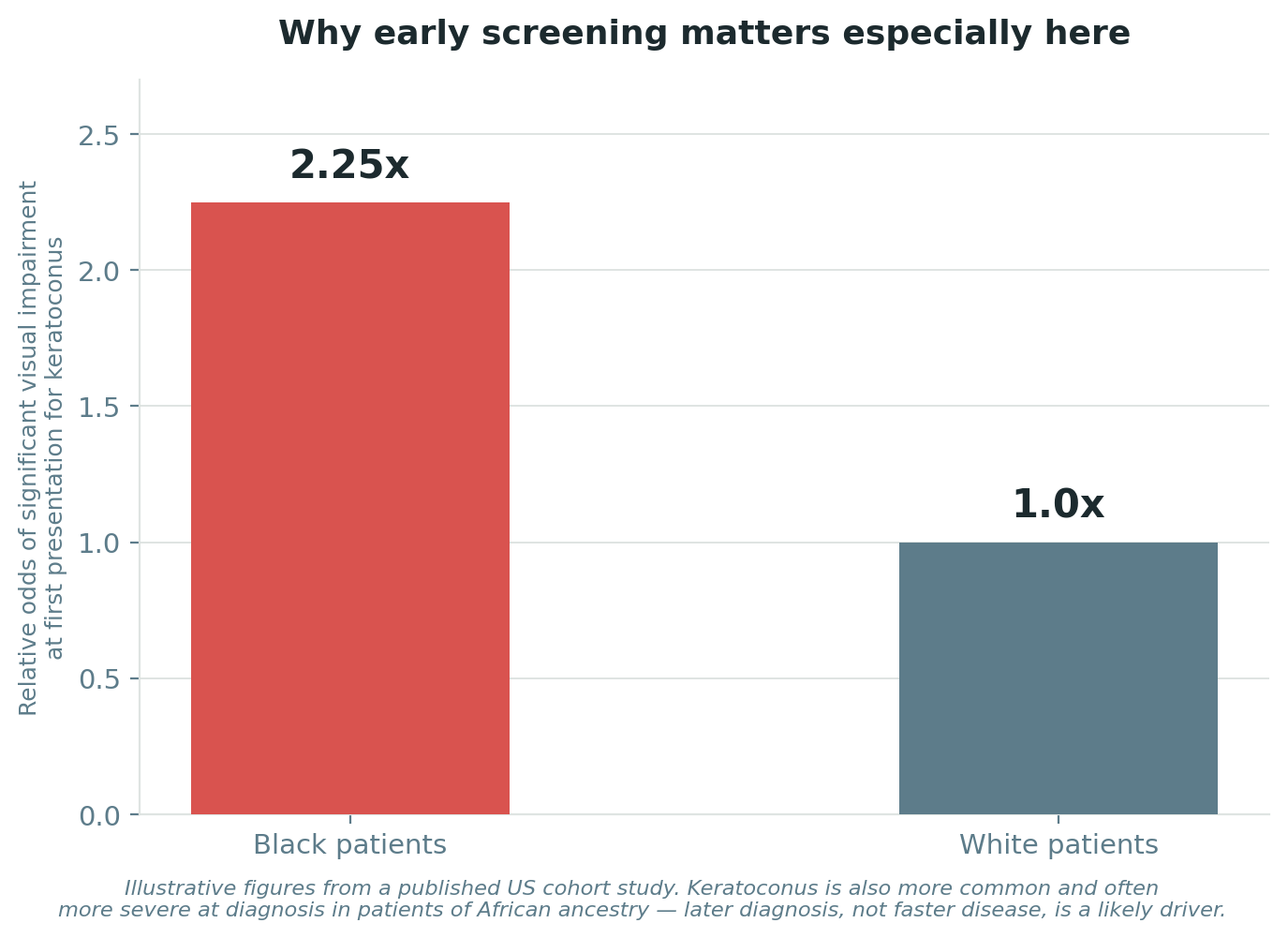
Later diagnosis, not faster disease, is the likely explanation — which makes early assessment genuinely protective.
This matters because the treatment options for keratoconus differ dramatically depending on how early it is caught. Corneal cross-linking, performed while the cornea is still relatively healthy, is a single outpatient procedure that can halt the condition's progression before serious damage occurs. Once the cornea has become significantly thinned and scarred, cross-linking is no longer enough, and a transplant — dependent on donor tissue — becomes the only remaining option.
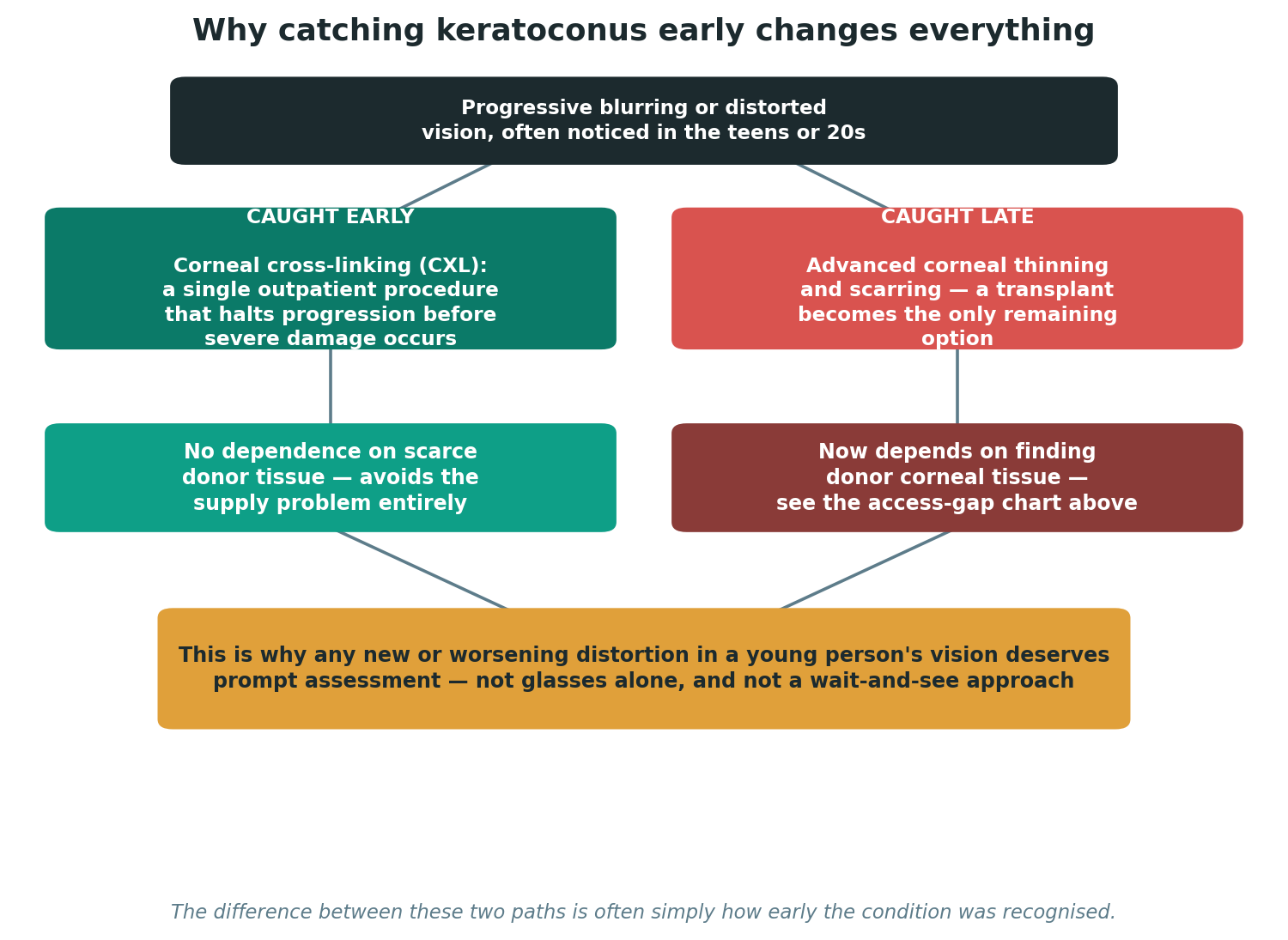
The difference between these two paths is often simply how early the condition was recognised.
Choosing the surgeon and the hospital
Ask directly where the centre's donor corneal tissue comes from, and how they ensure its quality and freshness — a reputable Indian eye hospital will be able to explain their sourcing through the established Eye Bank Association of India network without hesitation. Ask about the surgeon's experience with the specific technique your condition requires, since corneal transplantation includes several distinct approaches, from full-thickness replacement to more selective partial-thickness techniques that preserve more of your own healthy tissue where possible.
Check accreditation (NABH, ideally JCI), and if keratoconus is your diagnosis, ask specifically whether you are actually a candidate for cross-linking rather than a transplant — this is a meaningful clinical judgement that depends on exactly how advanced your condition is, not a decision to make based on cost alone.
It is also worth asking what happens if your transplant shows early signs of rejection, since this is a recognised risk with any corneal graft. A responsible centre will explain how they educate patients to recognise warning signs, since prompt treatment can often reverse early rejection, while a delayed response can result in losing the graft.
Cost and value: how to weigh the money honestly
Corneal transplant surgery in a good Indian hospital costs a small fraction of the equivalent procedure in the West, and India's mature eye-banking system means donor tissue is genuinely available, not merely promised. The saving is real, and for this specific condition, it is paired with something rarer in medical travel: access to an infrastructure problem that has actually been solved.
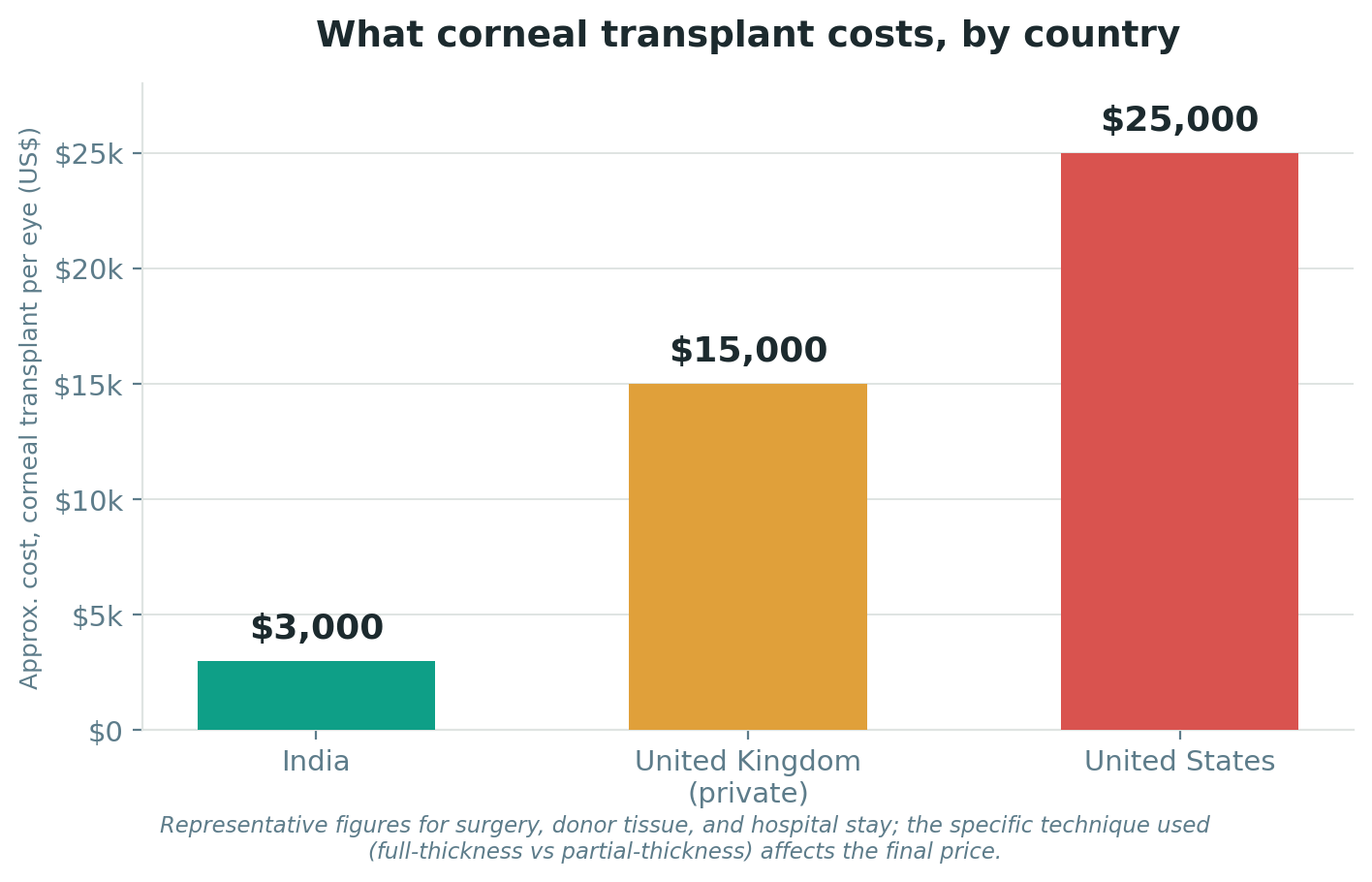
India's affordability is genuine — and here, it comes with a donor-tissue system that actually works.
In 24 years of arranging these journeys, I have found that eye care is one of the areas where acting early saves the most, both financially and in terms of vision preserved. Ask for a written, itemised quote covering the assessment, surgery or procedure, and follow-up visits, and ask specifically whether cross- linking might be a lower-cost, less invasive option for your situation before assuming a transplant is necessary.
What a Zambian patient should weigh in particular
Beyond the treatment decision itself, several practical matters deserve attention. First, payment: NHIMA funds care at accredited facilities inside Zambia, not treatment abroad, so this comes from your own resources — another reason to ask specifically whether the less invasive, less costly cross-linking option applies to you before committing to a transplant. Second, if your family has a history of keratoconus, or if a teenager's vision seems to be worsening despite updated glasses, seek an eye assessment specifically for this condition rather than assuming stronger lenses are the only answer. Third, aftercare: corneal transplants require regular follow-up to monitor for graft rejection, particularly in the first year, so arrange this with a Zambian ophthalmologist before you travel.
Fourth, protect the operated eye carefully in the weeks after surgery, following your surgeon's specific instructions about avoiding dust, rubbing, and strenuous activity, since the cornea heals slowly and remains vulnerable to injury for some time. This is a period where following instructions precisely matters as much as the surgery itself.
The practical journey from Zambia
India requires a yellow fever vaccination certificate from travellers arriving from Zambia, valid only from ten days after the injection. Your medical visa is issued by the High Commission of India on Pandit Nehru Road in Lusaka against the hospital's invitation letter. There is no direct flight from Zambia to India; you will connect through Addis Ababa on Ethiopian Airlines, or through Dubai, Doha or Nairobi. Send your eye examination records and any corneal imaging (topography), not only a summary, for remote review before you travel, since this determines whether cross-linking, a partial transplant, or a full transplant is appropriate for your specific eye.
Signals that deserve prompt eye assessment
1. Progressively worsening or distorted vision in a teenager or young adult, especially if glasses need frequent changes.
2. Eyelashes that seem to turn inward and rub against the eye, or persistent eye irritation and redness.
3. Sudden vision loss, severe eye pain, or a white or cloudy appearance to the cornea after any eye injury.
4. A family history of keratoconus, which is a reasonable prompt to have your own eyes checked specifically for it.
Straight answers for Zambian Patients about Cornea Transplant and Advanced Eye Surgery in India
If I need a corneal transplant, will donor tissue actually be available when I arrive in India?
India's eye-banking network is large and well-established, and reputable hospitals will be able to explain their tissue sourcing clearly. This is a reasonable question to ask directly before you travel, so you know realistically what to expect.
My teenager's vision keeps getting worse even with new glasses. Could this be keratoconus?
It is worth asking specifically, since keratoconus often begins in the teenage years and can be missed if only standard vision tests are used. A proper corneal assessment can identify it, and catching it early opens up cross-linking as a much simpler option than a future transplant.
What is corneal cross-linking, and is it better than a transplant?
It is a non-transplant procedure that strengthens the cornea and halts the progression of keratoconus when performed early enough. It is not "better" in every case — it is only effective before the cornea becomes too thin or scarred — but where it applies, it is far less invasive than a transplant and avoids any dependence on donor tissue.
I've heard about trachoma. Is this still a problem in Zambia?
Yes, in parts of the country, though significant progress has been made. If you or a family member has in-turned eyelashes or persistent eye irritation, particularly in rural areas, seek assessment — treating this early can prevent the corneal damage that would otherwise require more serious treatment later.
Sources
- 🌐 Medical visa, Lusaka — High Commission of India, requirements & process: hcizambia.gov.in/page/medical-visa
- 🌐 Hospital accreditation (India) — Verify a hospital's NABH accreditation: nabh.co
- 🌐 National Health Insurance (Zambia) — NHIMA cover, treatment abroad is not covered: nhima.co.zm
- 🌐 Ministry of Health Zambia — National health services & guidance: moh.gov.zm
- 🌐 National Medical Commission (verify a doctor) — Confirm a doctor's registration in India: nmc.org.in
- 🌐 WHO yellow fever — Vaccination requirements before travel: who.int/health-topics/yellow-fever
A Closing Word
Of everything I help patients navigate, eye care is where early action protects the most — both vision and money. If you send me your eye examination records and any imaging you have, I will help you understand honestly whether cross-linking, a partial transplant, or a full transplant is right for your situation, and which centres in India have the genuine eye-banking access and surgical experience to treat you well.
Frequently Asked Questions by Zambian Patients about Cornea Transplant and Advanced Eye Surgery in India
When is a corneal transplant needed?
A transplant may be required when the cornea has become significantly scarred, thinned or damaged, including advanced keratoconus or damage caused by infection or injury.
Can keratoconus be treated without a transplant?
Yes, when diagnosed early enough. Corneal cross-linking (CXL) can strengthen the cornea and halt progression before severe thinning or scarring develops.
Is cross-linking better than a corneal transplant?
They are used at different stages. Cross-linking is much less invasive but is effective only when the cornea remains suitable for it; advanced scarring may require transplantation.
Why is India's eye-banking system important?
A corneal transplant requires suitable donor tissue. The guide highlights India's established eye-banking infrastructure as an important advantage for patients requiring donor corneas.
Can trachoma cause corneal damage?
Yes. Trachomatous trichiasis can cause eyelashes to turn inward and repeatedly rub against the cornea. Early eyelid surgery may prevent progressive corneal scarring.
What should I ask the Indian eye hospital about donor tissue?
Ask where the donor cornea comes from and how it is collected, tested, stored and allocated. A reputable centre should be able to explain its eye-bank sourcing clearly.
How much does a corneal transplant cost in India?
The guide gives an indicative cost of approximately US$3,000, although the final price varies according to the transplant technique, hospital and individual case.
What records should I send before travelling?
Send your eye examination records and corneal imaging/topography, rather than only a written summary. These help determine whether cross-linking, partial transplantation or full transplantation is appropriate.
What should I know about transplant rejection?
Rejection is a recognised risk after corneal transplantation. Patients should understand the warning signs and have a clear plan for prompt assessment and treatment, particularly during the early follow-up period.
When should a teenager be assessed for keratoconus?
Progressively worsening or distorted vision, frequent changes in glasses prescription or a family history of keratoconus should prompt a specific corneal assessment, rather than simply prescribing stronger glasses.
Page Summary
This five-page Zambia-to-India medical travel guide explains corneal transplantation and advanced eye surgery, focusing on India's established donor-tissue infrastructure, early detection of keratoconus and appropriate selection between cross-linking and transplantation. The page 1 chart compares the eye-banking network, while the page 2 chart highlights the cited difference in visual-impairment presentation associated with later diagnosis of keratoconus. The page 3 pathway shows early keratoconus → cross-linking, while advanced thinning/scarring may lead to transplantation. The page 4 cost chart gives an indicative corneal transplant cost of US$3,000 in India, compared with US$15,000 in the UK and US$25,000 in the US.
Citation Block
| Topic | Information |
|---|---|
| Topic | Cornea Transplant & Advanced Eye Surgery in India for Zambian Patients |
| Treatment | Corneal Transplant, Cross-Linking & Advanced Eye Surgery |
| Patients | Zambian Eye Patients |
| Specialist | Corneal Specialist / Ophthalmologist |
| Main Assessment | Corneal condition and stage |
| Key Priority | Early diagnosis and correct treatment selection |
| Corneal Transplant | For advanced scarring/thinning where indicated |
| Cross-Linking | For early progressive keratoconus |
| Eyelid Surgery | For trachomatous trichiasis before corneal damage |
| Donor Tissue Check | Source, quality and freshness |
| Hospital Check | Eye-bank access and corneal surgical expertise |
| India Cost | Approximately US$3,000 |
| UK Cost | Approximately US$15,000 |
| US Cost | Approximately US$25,000 |
| Quote Check | Assessment, procedure/surgery and follow-up |
| Pre-Travel Records | Eye examination and corneal topography |
| Follow-Up | Zambian ophthalmologist |
| Quality Check | NABH, ideally JCI |
| Rejection Check | Warning signs and emergency response plan |
| Key Statistic | 740+ Indian eye banks/donation centres vs approximately 4 in Sub-Saharan Africa in the guide's chart |
| Keratoconus Figure | 2.25× vs 1.0× relative visual-impairment risk shown in the cited comparison |
| Patient Pathway | Eye assessment → corneal imaging → cross-linking/transplant decision → procedure → follow-up |
| Decision Principle | Treat early where possible and avoid transplantation when an effective earlier option applies |


Our Mission Statement
Our mission is to place patients at the centre of every healthcare decision by providing trustworthy, evidence-based, and unbiased medical information. We believe that informed patients make better decisions. Backed by personalised guidance from our experienced advisory team, we help patients understand their treatment options, compare them objectively, and confidently choose the path that best suits their medical needs and personal circumstances.
Patient Testimonials from Zambia


Ready to Take the First Step?
Share your Medical Reports with our Healthcare Managers Today and Get a FREE CONSULTATION, a Personalized Treatment Plan, and Complete Support from Arrival to Recovery.
Get Your Free ConsultationAreas We Serve
This resource has been thoughtfully prepared for patients from Zambia who are considering medical treatment in India. We also welcome patients from the wider region in the countries mentioned below-
We assist patients from:
- Zambia
- Angola
- Malawi
- Zimbabwe
- Botswana
- Namibia
- South Africa
- Eswatini
- Lesotho
- Gabon
- Chad
- Equatorial Guinea
- São Tomé and Príncipe
- Republic of the Congo
- Democratic Republic of the Congo
Many of the insights, treatment pathways, hospital recommendations, travel guidance, and patient support services described here are equally relevant and may be used as a reference when planning treatment in India.
From Zambia to India: Your Complete Patient Support Guide
- Best Weight-Loss (Bariatric) Surgeons & Hospitals in India for Zambian Patients
- Best Brain-Tumour Surgeons & Hospitals in India for Zambian Patients
- Best Cancer Doctors & Hospitals in India for Zambian Patients
- Best Cardiac Surgeons & Hospitals in India for Zambian Patients
- Best Cosmetic Surgeons & Facilities in India for Zambian Patients
- Best CyberKnife Treatment Teams & Centres in India for Zambian Patients
- Best Dentists & Dental Clinics in India for Zambian Patients
- Best Heart Valve Replacement Surgeons & Hospitals in India for Zambian Patients
- Best Hip Surgeons & Hospitals in India for Zambian Patients
- Best Knee Surgeons & Hospitals in India for Zambian Patients
- Best Neurosurgeons & Hospitals in India for Zambian Patients
- Best Paediatric Cardiac Surgeons & Hospitals in India for Zambian Patients
- Best Paediatric Neurosurgeons & Hospitals in India for Zambian Patients
- Best Prostate Surgeons & Hospitals in India for Zambian Patients
- Best Scoliosis Surgeons & Hospitals in India for Zambian Patients
- Best Spine Surgeons & Hospitals in India for Zambian Patients
- Best Bone Marrow Transplant Teams & Hospitals in India for Zambian Patients
- Best Kidney Transplant Surgeons & Hospitals in India for Zambian Patients