

Colorectal Cancer Treatment and Surgery in India for Zambian Patients
A published study of Zambian patients found colorectal cancer arriving both younger and later than in the West — a combination that means the disease is too often dismissed in the young and discovered too late in everyone.
Colorectal cancer is often spoken of as a single disease, but it behaves, and is treated, quite differently depending on where exactly it sits — in the colon or in the rectum — and how early it is caught. In much of the West, colorectal cancer is thought of as an older person's disease, caught early through routine screening colonoscopy. Neither of those assumptions holds well in Zambia. In 24 years of guiding cancer patients through treatment abroad, I have found that understanding both of these realities — the age at which this cancer strikes here, and the very different treatment paths for colon versus rectal disease — changes how a family should approach the whole journey.
Healing Journeys of Zambian Patients
Key Takeaways
- The guide highlights that colorectal cancer in Zambia can be diagnosed at a younger age and at a later stage than in high-income countries. Persistent symptoms such as rectal bleeding, bowel-habit changes, unexplained weight loss or abdominal pain should therefore not be dismissed because of the patient's age.
- The page 1 chart compares an approximate median diagnosis age of 45 years in published Sub-Saharan African cohorts versus about 66 years in the United States, reinforcing the guide's message that age alone should not rule out colorectal cancer.
- A central message is that colon and rectal cancer do not necessarily follow the same treatment sequence. Colon cancer is usually treated with surgery first, while many locally advanced rectal cancers receive chemoradiation before surgery. Rectal surgery may also involve total mesorectal excision to improve local cancer control and support appropriate bowel-function preservation.
- The page 3 treatment table explains that very low rectal tumours require a specific discussion about sphincter preservation, while cancer that has spread to the liver, lungs or peritoneum may require multidisciplinary treatment combining surgery, chemotherapy and, in selected peritoneal cases, HIPEC.
- The guide also addresses the fear of a permanent colostomy. A temporary stoma is common after some rectal operations and may later be reversed, although whether a stoma is required and whether it can be reversed depends on the tumour's location, extent and treatment response.
- Hospital selection should include a genuine multidisciplinary tumour board, experience with total mesorectal excision and sphincter-preserving surgery, stoma-care support and appropriate minimally invasive options. The guide recommends checking NABH accreditation, ideally JCI, but stresses that accreditation should be combined with cancer-specific surgical expertise.
- The page 3 cost chart gives an indicative colorectal cancer surgery cost of approximately US$6,000 in India, compared with US$30,000 in the UK and US$75,000 in the US. The guide recommends requesting a complete, itemised quotation covering the full treatment sequence rather than surgery alone, because chemotherapy and radiotherapy may also be required.
Quick Facts
- Author
- Dr. Dheeraj Bojwani
- Experience
- 24+ Years of Experience
- Treatment
- Colorectal Cancer Treatment & Surgery
- Patients
- Zambian Cancer Patients
- Key Specialist
- Colorectal Surgeon / Oncologist
- Main Assessment
- Tumour location, stage and treatment sequence
- Key Priority
- Distinguish colon from rectal cancer
- Key Technique
- Total Mesorectal Excision for appropriate rectal cancers
- Key Selection Factor
- Cancer-specific surgical experience
- Hospital Requirement
- Multidisciplinary colorectal cancer programme
- India Cost
- Approximately US$6,000
- UK Cost
- Approximately US$30,000
- US Cost
- Approximately US$75,000
- Pre-Travel Records
- Colonoscopy, biopsy and imaging
- Follow-Up
- Surveillance and stoma care in Zambia
- Key Warning Signs
- Persistent rectal bleeding, bowel-habit changes or unexplained weight loss
- Decision Principle
- Choose treatment according to tumour location, stage and multidisciplinary assessment
In Brief
For Zambian patients with suspected or confirmed colorectal cancer, the guide recommends determining whether the tumour is in the colon or rectum and establishing its stage before deciding on treatment. Rectal cancer may require chemoradiation before surgery, while colon cancer is commonly treated with surgery first. The guide gives an indicative colorectal cancer surgery cost of US$6,000 in India.
Why this cancer looks different here
A study specifically examining colorectal cancer in Zambian patients found it was diagnosed at both a younger age and a later stage than is typical in high- income countries. This is not a coincidence of two unrelated facts — the two are connected. Because colorectal cancer is still widely thought of as a disease of older age, symptoms in a younger person — a change in bowel habit, rectal bleeding, unexplained weight loss, persistent abdominal pain — are too often attributed to less serious causes, delaying the colonoscopy that would catch the disease early.
This is not unique to Zambia; researchers across sub-Saharan Africa have documented the same pattern, and some have suggested that screening guidelines built around Western life expectancy and disease patterns may simply not fit the African context well, since colorectal cancer here often develops a decade or more earlier than the age at which Western screening programmes typically begin. Until formal screening becomes more widely available, the practical response is individual vigilance: taking new bowel symptoms seriously regardless of age, rather than waiting for them to fit an expected profile.
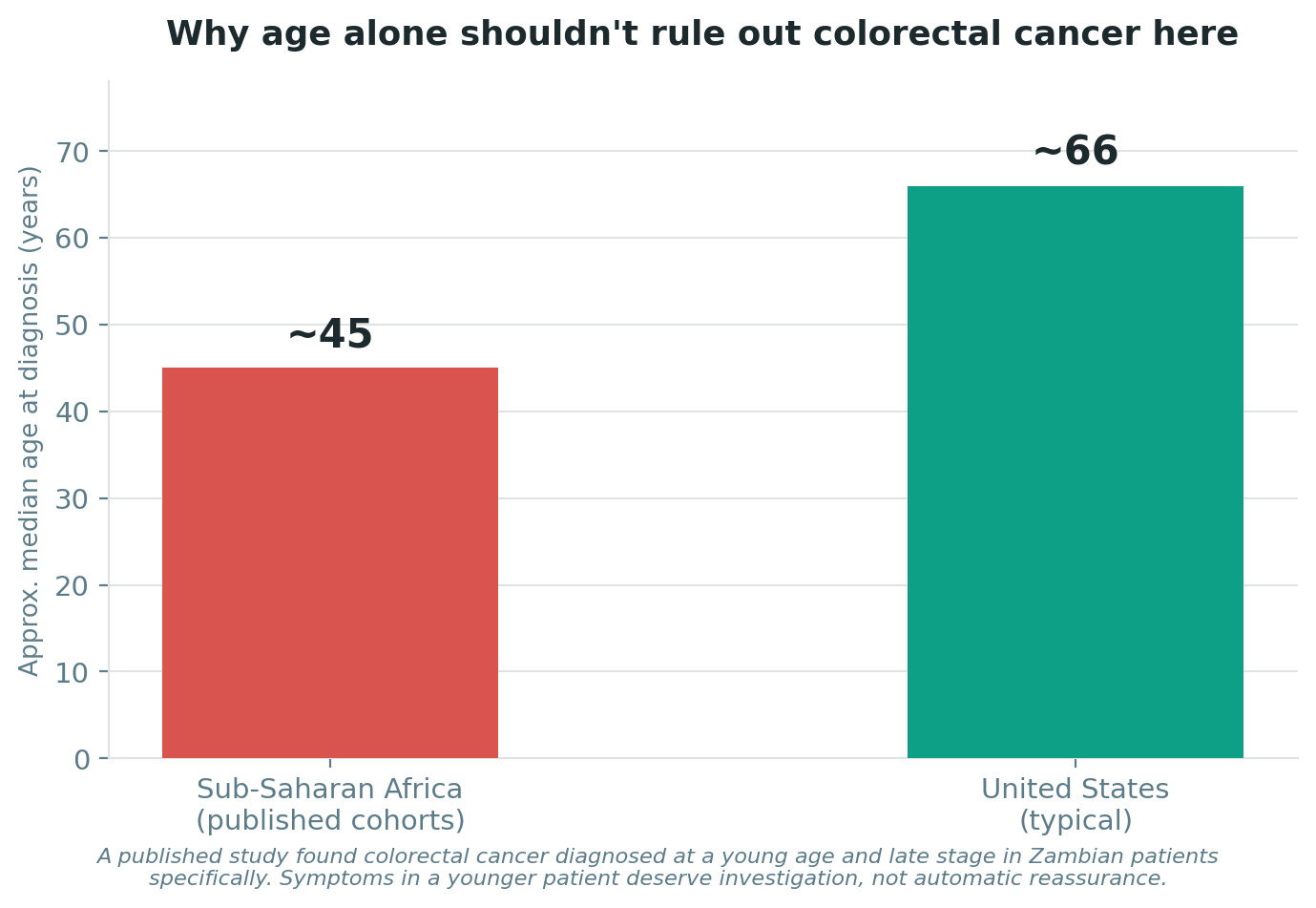
The age at which this cancer typically strikes here does not match the assumptions many people carry about who gets it.
The consequence of this delay shows up clearly in how advanced the disease is by the time it is found. Sub-Saharan African cohorts, including Zambian data, consistently report a much higher proportion of patients presenting with stage IV disease — cancer that has already spread — than is typical in settings with established screening.
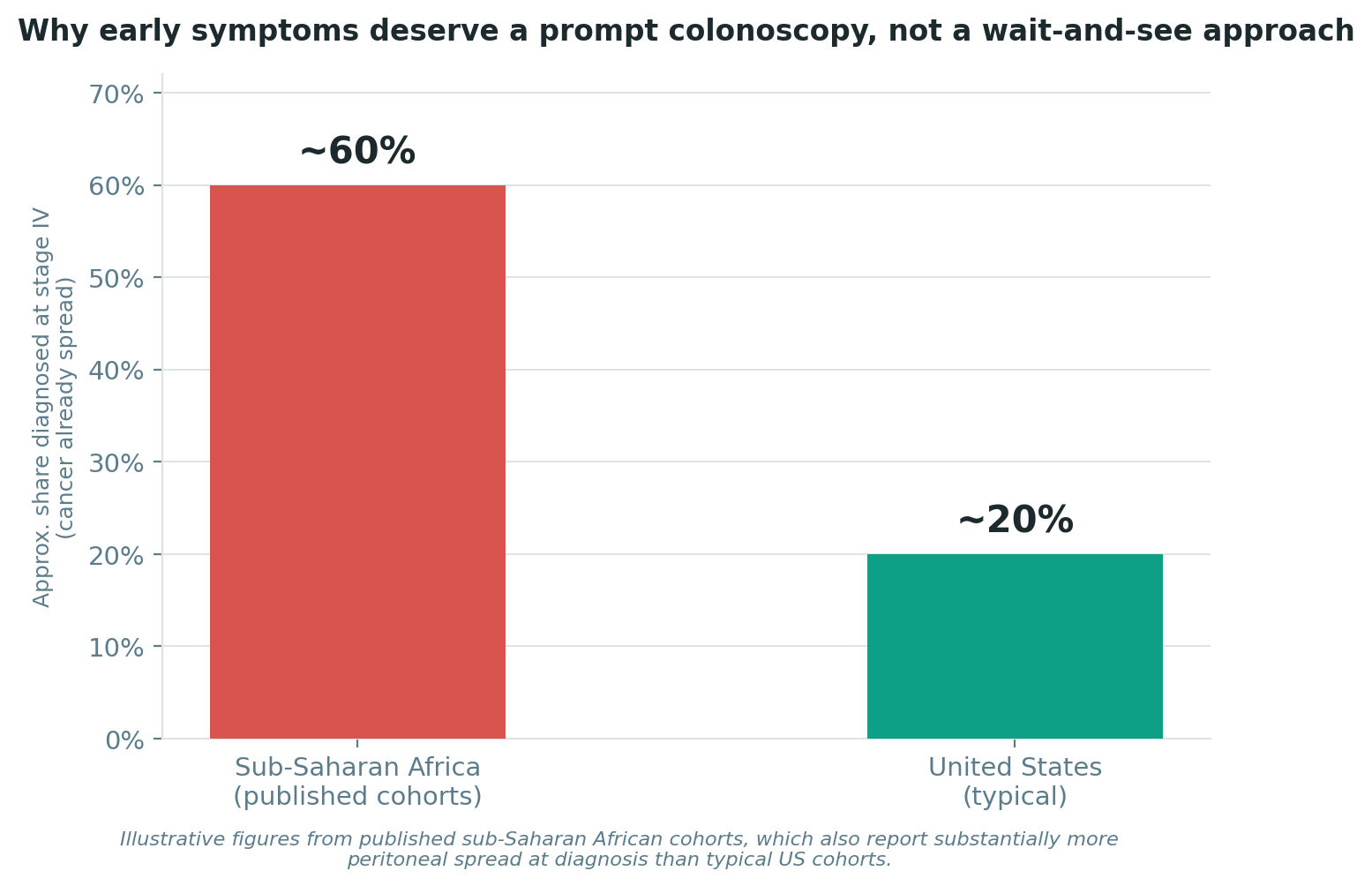
This gap reflects delayed recognition and limited screening access, not a more aggressive form of the disease.
Colon and rectal cancer are not treated the same way
This is the single most important thing to understand once colorectal cancer is diagnosed, and it is widely misunderstood. Cancer in the colon is usually treated with surgery first, sometimes followed by chemotherapy if needed. Cancer in the rectum — the final few centimetres of the large bowel, close to the anal sphincter — is often treated in the opposite order: chemotherapy combined with radiotherapy first, to shrink the tumour, followed by surgery afterward. This sequence exists because rectal cancer sits in a tight, delicate space close to the muscles that control bowel continence, and shrinking the tumour first gives the surgeon a better chance of removing it completely while preserving normal bowel function.
The surgical technique used for rectal cancer also differs meaningfully from colon surgery. A careful, complete removal of the mesorectum — the fatty tissue and lymph nodes surrounding the rectum — using a technique called total mesorectal excision, has been shown to reduce the chance of the cancer coming back locally more than older surgical approaches. Ask specifically whether this technique will be used for your rectal surgery, since it has become the accepted standard of care internationally.
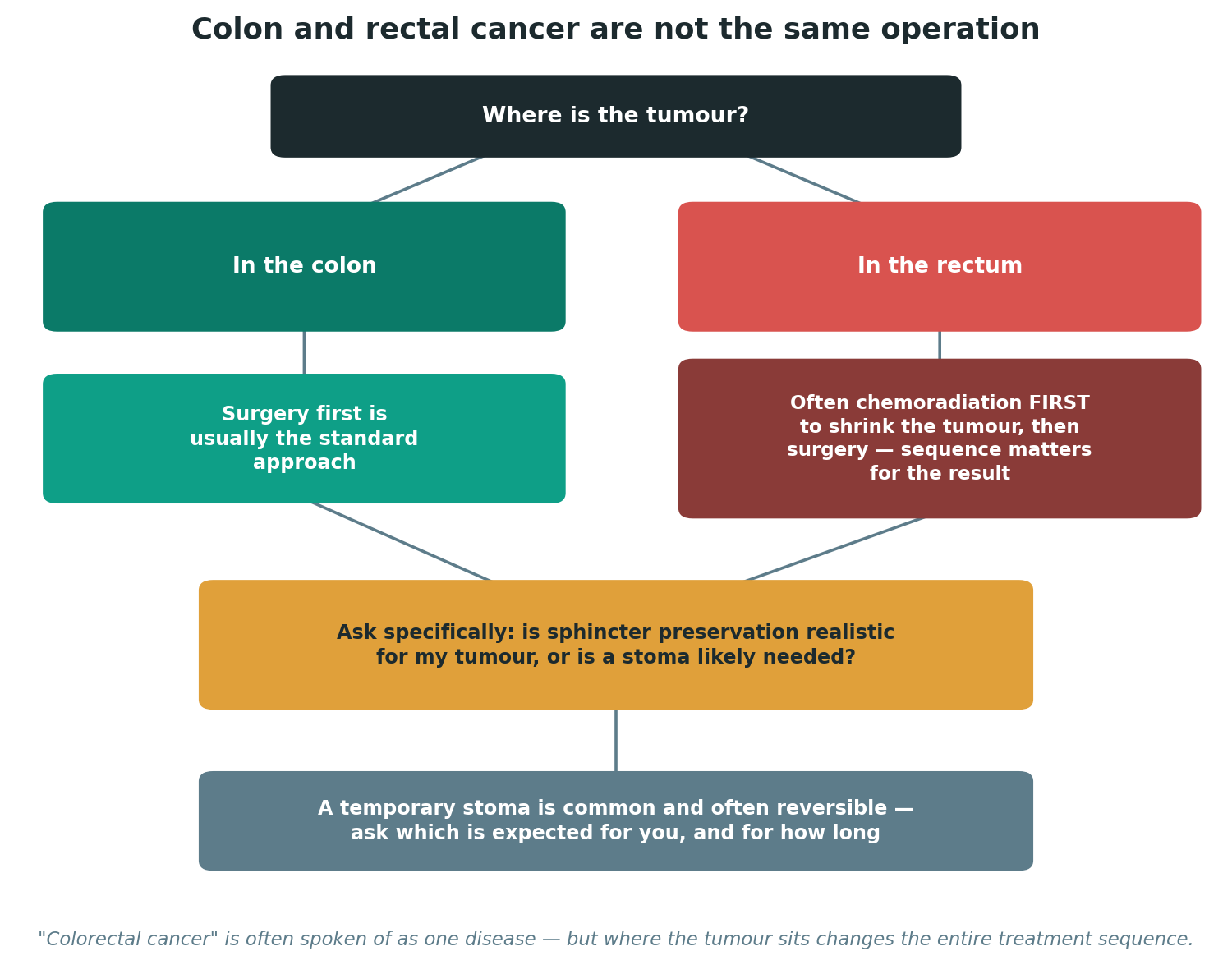
The location of the tumour, not simply the word "colorectal," determines the treatment sequence.
| Your situation | Typical approach | What it involves |
|---|---|---|
| Cancer confined to the colon, no spread | Surgery first, usually | Removal of the affected section of colon; chemotherapy afterward if the pathology suggests it is needed |
| Cancer in the rectum, locally advanced | Chemoradiation first, then surgery | Shrinks the tumour before the operation, using a technique called total mesorectal excision to remove it with the best chance of preserving normal bowel function |
| Very low rectal tumour, close to the anal sphincter | Careful, specific discussion about sphincter preservation | Whether the sphincter can realistically be preserved depends on the exact tumour position and response to chemoradiation |
| Cancer that has spread to the liver, lungs, or peritoneum | Multidisciplinary discussion of combined treatment | Depending on the extent of spread, this may include surgery to the original tumour and secondary sites, chemotherapy, or in some cases HIPEC for peritoneal spread |
Why a stoma is often temporary, not permanent
Many patients and families understandably fear that any colorectal cancer surgery will end in a permanent colostomy bag. In reality, a temporary stoma — a surgically created opening that allows the bowel to heal after surgery, reversed in a second, smaller operation some weeks or months later — is common, particularly after rectal surgery, and is not the same as a permanent one. Whether a stoma is needed at all, and whether it is likely to be temporary or permanent, depends on the exact location and extent of your tumour. This is a specific, answerable question to ask your surgical team before your operation, not something to assume the worst about in advance.
Choosing the surgeon and the hospital
Ask directly whether your case will be reviewed by a genuine multidisciplinary tumour board — a colorectal surgeon, medical oncologist, radiation oncologist and pathologist together — before a treatment sequence is finalised, since this is what ensures a rectal tumour is correctly identified as needing chemoradiation first rather than being rushed to surgery. For rectal cancer specifically, ask about the surgeon's experience with total mesorectal excision and their personal rate of sphincter preservation for tumours similar to yours.
Check accreditation (NABH, ideally JCI), and ask specifically how the centre supports patients who do need a stoma, including access to a stoma care nurse and practical training before you travel home, since living well with a stoma, even a temporary one, depends heavily on this kind of practical support.
It is also worth asking about the centre's approach to minimally invasive surgery — laparoscopic or robotic techniques are now well established for many colon and rectal cancers, generally offering a faster recovery than open surgery with equivalent cancer outcomes when performed by an experienced team. Ask whether this is an option for your specific tumour, and if not, why an open approach is recommended instead.
Cost and value: how to weigh the money honestly
Colorectal cancer surgery in a good Indian hospital costs a small fraction of the equivalent treatment in the West, and India has extensive experience with both colon and rectal cancer surgery, including complex sphincter-preserving techniques. The saving is real, but the complete treatment plan — surgery, and often chemotherapy or radiotherapy alongside it — should be priced and understood as a whole.
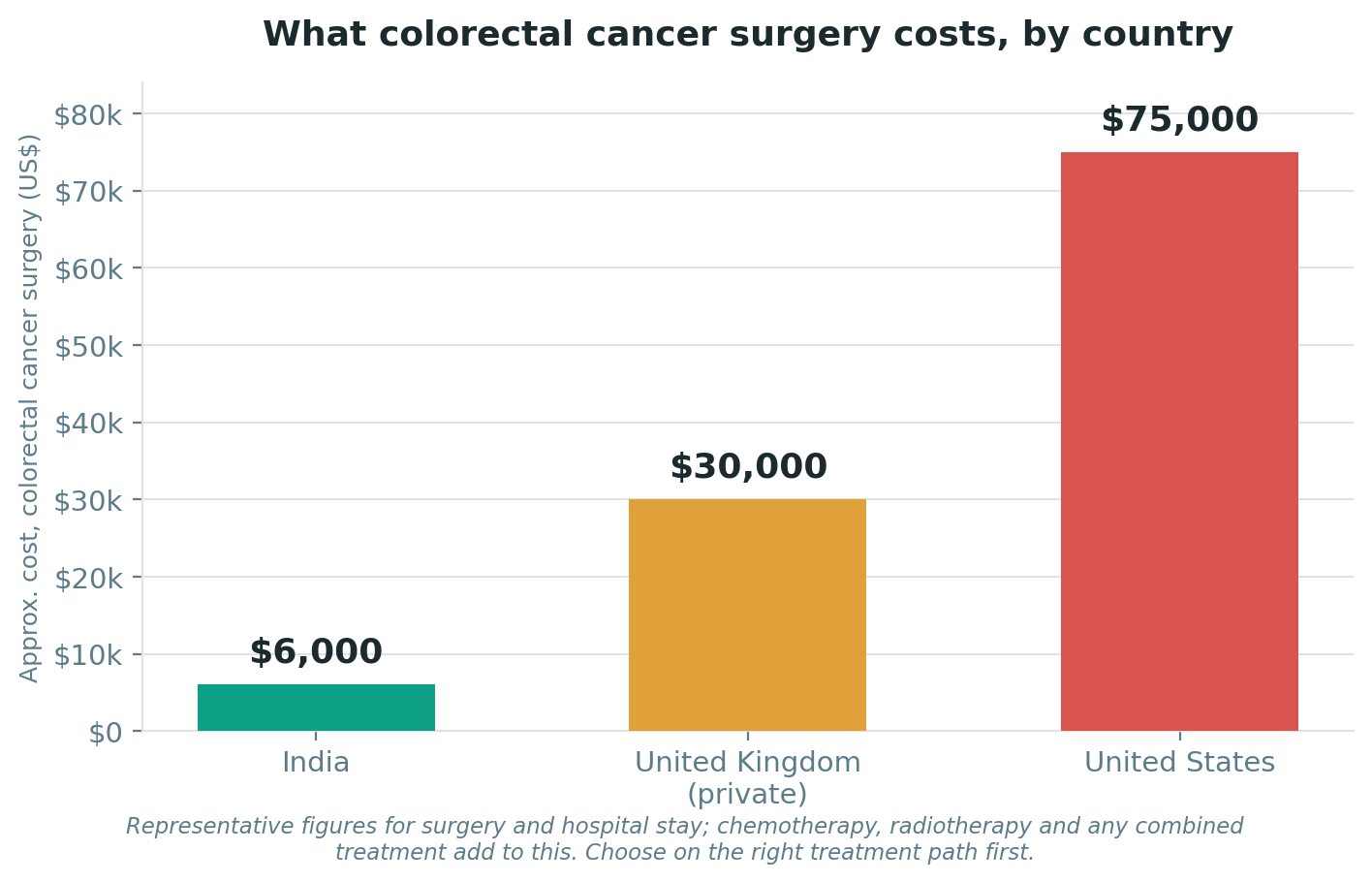
India's affordability is genuine — but confirm the correct treatment sequence for your tumour's location first.
In 24 years of arranging these journeys, I have found that patients who understand the distinction between colon and rectal cancer before they travel are better prepared for what their treatment will actually involve, rather than being surprised by a chemoradiation course they did not expect. Ask for a written, itemised quote covering the complete treatment sequence, not just the surgery.
What a Zambian patient should weigh in particular
Beyond the treatment decision itself, several practical matters deserve attention. First, payment: NHIMA funds care at accredited facilities inside Zambia, not treatment abroad, so this comes from your own resources — another reason to understand the complete treatment plan before committing funds. Second, if you are under 50 and experiencing symptoms such as rectal bleeding, a persistent change in bowel habit, or unexplained weight loss, insist on a colonoscopy rather than accepting reassurance based on age alone. Third, aftercare: arrange with a Zambian doctor to take over your surveillance colonoscopies and any needed stoma care, and insist the Indian team provides a complete written operative report before you leave.
Fourth, if a temporary stoma is part of your plan, ask early about the timeline for its reversal and what needs to happen medically before that second operation can take place, so you can plan realistically for two hospital stays rather than being caught off guard by the second one.
The practical journey from Zambia
India requires a yellow fever vaccination certificate from travellers arriving from Zambia, valid only from ten days after the injection. Your medical visa is issued by the High Commission of India on Pandit Nehru Road in Lusaka against the hospital's invitation letter; if chemoradiation is part of your plan, arrange for an extended-stay medical visa since this adds several weeks to your time in India. There is no direct flight from Zambia to India; you will connect through Addis Ababa on Ethiopian Airlines, or through Dubai, Doha or Nairobi. Send your colonoscopy report, biopsy results and imaging, not only a summary, for remote review before you travel, since the exact location and stage of your tumour determines the correct treatment sequence.
Signals that deserve prompt investigation, at any age
1. Rectal bleeding or blood in the stool that is new or persistent.
2. A persistent change in bowel habit — new constipation, diarrhoea, or a feeling of incomplete emptying — lasting more than a few weeks.
3. Unexplained weight loss, fatigue, or abdominal pain without a clear cause.
4. A family history of colorectal cancer or polyps, which may mean earlier and more frequent screening is appropriate for you.
Straight answers for Zambian Patients about Colorectal Cancer Treatment and Surgery in India
I'm only in my 30s. Could I really have colorectal cancer?
Yes — colorectal cancer diagnosed at a young age is a well-documented pattern in this region, and age alone should not be used to dismiss persistent symptoms. If you have rectal bleeding, a change in bowel habit, or unexplained weight loss, ask directly for a colonoscopy.
Will I definitely need a colostomy bag?
Not necessarily, and if you do, it is often temporary rather than permanent. Whether a stoma is needed, and for how long, depends on the exact location of your tumour — ask your surgical team this specific question rather than assuming the worst.
Why would I need radiotherapy before surgery instead of after?
This is standard for many rectal cancers specifically, not colon cancers, because shrinking the tumour first gives the surgeon the best chance of removing it completely while preserving normal bowel function. Ask your oncology team to explain why this sequence, or a different one, is right for your specific tumour.
My cancer has spread to the lining of my abdomen. What does that mean for treatment?
This pattern of spread, called peritoneal carcinomatosis, is treated differently from cancer that has spread to organs like the liver, and in select patients may be a candidate for a specialised combined surgery and heated chemotherapy treatment called HIPEC. This series includes a separate, dedicated guide on HIPEC with more detail.
Sources
- 🌐 Medical visa, Lusaka — High Commission of India, requirements & process: hcizambia.gov.in/page/medical-visa
- 🌐 Hospital accreditation (India) — Verify a hospital's NABH accreditation: nabh.co
- 🌐 National Health Insurance (Zambia) — NHIMA cover, treatment abroad is not covered: nhima.co.zm
- 🌐 Ministry of Health Zambia — National health services & guidance: moh.gov.zm
- 🌐 National Medical Commission (verify a surgeon) — Confirm a surgeon's registration in India: nmc.org.in
- 🌐 WHO yellow fever — Vaccination requirements before travel: who.int/health-topics/yellow-fever
A Closing Word
Of everything I help families understand, colorectal cancer is where clearing up a simple misconception — that colon and rectal cancer are treated identically, and that this is only an older person's disease — often matters as much as any decision about where to travel. If you send me your colonoscopy report, biopsy results and imaging, I will help you understand honestly what treatment sequence is right for your specific tumour, what to realistically expect regarding a stoma, and which centres in India have the genuine experience to treat you well.
Frequently Asked Questions by Zambian Patients about Colorectal Cancer Treatment and Surgery in India
Can colorectal cancer occur in younger Zambian patients?
Yes. The guide highlights that colorectal cancer in published Zambian/Sub-Saharan African data is diagnosed at a younger age than is typical in the United States. Persistent symptoms should therefore be investigated regardless of age.
What symptoms should prompt investigation?
Persistent rectal bleeding, changes in bowel habits, unexplained weight loss, fatigue or abdominal pain should be assessed rather than automatically attributed to less serious conditions.
Are colon and rectal cancer treated the same way?
No. Colon cancer is usually treated with surgery first, while many locally advanced rectal cancers receive chemoradiation before surgery.
What is total mesorectal excision?
It is a surgical technique that removes the rectum together with the surrounding mesorectal tissue and lymph nodes. The guide identifies it as an important standard technique for rectal cancer surgery.
Will I definitely need a colostomy?
No. A stoma may not be necessary, and when one is required it can often be temporary, particularly in some rectal cancer operations. The decision depends on the tumour's location and extent.
Can the anal sphincter be preserved?
Sometimes. For very low rectal tumours, preservation depends on the exact tumour position and response to pre-operative treatment. The surgeon should discuss this specifically before surgery.
How much does colorectal cancer surgery cost in India?
The guide gives an indicative cost of approximately US$6,000 for colorectal cancer surgery in India. The complete treatment may cost more if chemotherapy, radiotherapy or other treatments are required.
What should I ask the Indian hospital?
Ask whether your case will be reviewed by a multidisciplinary tumour board, whether the surgeon has experience with your specific tumour and whether minimally invasive surgery is appropriate.
What records should I send before travelling?
Send the colonoscopy report, biopsy results and imaging, rather than only a summary, because tumour location and stage determine the treatment sequence.
What happens if the cancer has spread?
Treatment depends on where and how extensively it has spread. The guide notes that selected patients with liver, lung or peritoneal spread may be considered for combined approaches, including surgery, chemotherapy and, in selected peritoneal cases, HIPEC.
Page Summary
This five-page Zambia-to-India medical travel guide explains colorectal cancer treatment and surgery, with emphasis on younger presentation, later-stage diagnosis and the critical distinction between colon and rectal cancer. It covers surgery-first treatment for many colon cancers, chemoradiation followed by surgery for many locally advanced rectal cancers, total mesorectal excision, sphincter preservation, temporary stomas, multidisciplinary tumour boards and minimally invasive surgery. The page 1 chart compares approximate diagnosis ages, while the page 2 chart highlights the higher proportion of stage IV disease in published Sub-Saharan African cohorts. The page 3 treatment table outlines approaches by tumour location and spread, and the cost chart gives an indicative surgical cost of US$6,000 in India, compared with US$30,000 in the UK and US$75,000 in the US.
Citation Block
| Topic | Information |
|---|---|
| Topic | Colorectal Cancer Treatment & Surgery in India for Zambian Patients |
| Treatment | Colorectal Cancer Surgery & Multimodality Treatment |
| Patients | Zambian Cancer Patients |
| Specialist | Colorectal Surgeon / Oncologist |
| Main Assessment | Tumour location and stage |
| Key Priority | Distinguish colon from rectal cancer |
| Colon Approach | Surgery first, chemotherapy if indicated |
| Rectal Approach | Often chemoradiation first, then surgery |
| Key Technique | Total Mesorectal Excision |
| Sphincter Check | Preservation based on tumour location and response |
| Advanced Disease | Multidisciplinary treatment; HIPEC in selected cases |
| Stoma | May be temporary or permanent depending on case |
| Hospital Check | Multidisciplinary tumour board |
| India Cost | Approximately US$6,000 |
| UK Cost | Approximately US$30,000 |
| US Cost | Approximately US$75,000 |
| Quote Check | Complete treatment sequence, not surgery alone |
| Pre-Travel Records | Colonoscopy, biopsy and imaging |
| Follow-Up | Surveillance and stoma care in Zambia |
| Quality Check | NABH, ideally JCI |
| Warning Signs | Persistent bleeding, bowel changes, weight loss or abdominal pain |
| Key Statistic | Approx. median diagnosis age 45 vs 66 years in cited comparison |
| Patient Pathway | Colonoscopy/biopsy → staging → tumour-board plan → treatment → surgery → follow-up |
| Decision Principle | Treatment sequence depends on tumour location and stage |


Our Mission Statement
Our mission is to place patients at the centre of every healthcare decision by providing trustworthy, evidence-based, and unbiased medical information. We believe that informed patients make better decisions. Backed by personalised guidance from our experienced advisory team, we help patients understand their treatment options, compare them objectively, and confidently choose the path that best suits their medical needs and personal circumstances.
Patient Testimonials from Zambia
Ready to Take the First Step?
Share your Medical Reports with our Healthcare Managers Today and Get a FREE CONSULTATION, a Personalized Treatment Plan, and Complete Support from Arrival to Recovery.
Get Your Free ConsultationAreas We Serve
This resource has been thoughtfully prepared for patients from Zambia who are considering medical treatment in India. We also welcome patients from the wider region in the countries mentioned below-
We assist patients from:
- Zambia
- Angola
- Malawi
- Zimbabwe
- Botswana
- Namibia
- South Africa
- Eswatini
- Lesotho
- Gabon
- Chad
- Equatorial Guinea
- São Tomé and Príncipe
- Republic of the Congo
- Democratic Republic of the Congo
Many of the insights, treatment pathways, hospital recommendations, travel guidance, and patient support services described here are equally relevant and may be used as a reference when planning treatment in India.
From Zambia to India: Your Complete Patient Support Guide
- Best Weight-Loss (Bariatric) Surgeons & Hospitals in India for Zambian Patients
- Best Brain-Tumour Surgeons & Hospitals in India for Zambian Patients
- Best Cancer Doctors & Hospitals in India for Zambian Patients
- Best Cardiac Surgeons & Hospitals in India for Zambian Patients
- Best Cosmetic Surgeons & Facilities in India for Zambian Patients
- Best CyberKnife Treatment Teams & Centres in India for Zambian Patients
- Best Dentists & Dental Clinics in India for Zambian Patients
- Best Heart Valve Replacement Surgeons & Hospitals in India for Zambian Patients
- Best Hip Surgeons & Hospitals in India for Zambian Patients
- Best Knee Surgeons & Hospitals in India for Zambian Patients
- Best Neurosurgeons & Hospitals in India for Zambian Patients
- Best Paediatric Cardiac Surgeons & Hospitals in India for Zambian Patients
- Best Paediatric Neurosurgeons & Hospitals in India for Zambian Patients
- Best Prostate Surgeons & Hospitals in India for Zambian Patients
- Best Scoliosis Surgeons & Hospitals in India for Zambian Patients
- Best Spine Surgeons & Hospitals in India for Zambian Patients
- Best Bone Marrow Transplant Teams & Hospitals in India for Zambian Patients
- Best Kidney Transplant Surgeons & Hospitals in India for Zambian Patients