

Cervical and Lumbar Disc Replacement Surgery in India for Zambian Patients
Not every worn-out disc can be replaced — and the same imaging that decides whether you are a candidate also tells an honest surgeon whether years of heavy manual work have already ruled it out.
Disc replacement is one of the more exciting developments in spine surgery, because unlike a fusion, which locks a segment of the spine permanently in place, a replacement preserves motion at that level. But it is not simply a newer, better version of fusion available to anyone with a worn disc. Candidacy depends on strict, specific findings on imaging — healthy joints, adequate bone density, no instability — and a great many of the patients I meet, particularly those whose neck and back pain comes from years of heavy physical work, do not meet those criteria. In 24 years of guiding patients through spine surgery abroad, I have found that understanding this distinction, before travelling, saves both money and disappointment.
Healing Journeys of Zambian Patients




Key Takeaways
- The guide explains that disc replacement is not suitable for every worn or degenerated disc. Candidacy depends on specific imaging findings, including healthy facet joints, adequate bone density, preserved disc characteristics and absence of spinal instability.
- It also stresses that many patients with neck or back pain—particularly those whose symptoms have developed after years of heavy physical work—may be better served by non-surgical treatment or fusion rather than disc replacement. A survey of 357 mineworkers at Kalumbila Mine found 77% reported musculoskeletal pain, with lower-back pain at 51.5% and neck pain at 24.9%.
- The main purpose of disc replacement is motion preservation. Unlike fusion, which permanently joins the affected vertebrae, an artificial disc maintains movement at that level and aims to reduce additional stress on neighbouring segments. The guide notes that the evidence for this benefit is strongest and longest-established for cervical disc replacement.
- The guide gives strict situations where fusion is generally more appropriate, including facet-joint arthritis, reduced bone density, spinal instability and disease affecting more than two levels. For lumbar replacement, candidacy is even stricter because the surgery uses an anterior abdominal approach close to major blood vessels and carries additional procedure-specific risks.
- The page 3 decision pathway shows that imaging is central to the treatment choice. Healthy facet joints, good bone density and one or two affected levels may support discussion of disc replacement, while arthritis, poor bone density, instability or multiple affected levels generally point toward fusion. The guide also stresses that heavy manual workers should receive realistic advice about returning to physically demanding jobs.
- The page 4 cost chart gives an indicative cost of approximately US$8,000 in India for disc replacement, compared with US$40,000 in the UK and US$75,000 in the US. The guide recommends obtaining an itemised quotation covering the surgery, implant, hospital stay and physiotherapy.
Quick Facts
- Author
- Dr. Dheeraj Bojwani
- Experience
- 24+ Years of Experience
- Treatment
- Cervical & Lumbar Disc Replacement
- Patients
- Zambian Spine Patients
- Key Specialist
- Spine Surgeon
- Main Assessment
- MRI/CT findings and clinical symptoms
- Key Priority
- Confirm genuine disc-replacement candidacy
- Main Benefit
- Motion preservation
- Key Selection Factor
- Imaging-based patient selection
- Lumbar Requirement
- Experienced anterior-access surgical team
- India Cost
- Approximately US$8,000
- UK Cost
- Approximately US$40,000
- US Cost
- Approximately US$75,000
- Pre-Travel Records
- Actual MRI and CT images
- Follow-Up
- Physiotherapy and spine care in Zambia
- Key Warning Signs
- Replacement offered without clear imaging-based justification
- Decision Principle
- Choose the procedure based on candidacy, not preference
In Brief
For Zambian patients considering cervical or lumbar disc replacement in India, the most important step is to confirm candidacy from the actual MRI and CT findings before travelling. Disc replacement may preserve motion in carefully selected patients, but fusion remains more appropriate when there is facet arthritis, reduced bone density, instability or multi-level disease. The guide gives an indicative Indian cost of US$8,000.
First, should you travel at all?
As with any spine surgery, the great majority of neck and back pain, including pain from a degenerated disc, improves with time, physiotherapy and medication, without any operation at all. Zambia has surgeons capable of straightforward fusion surgery, and for many patients, appropriate non-surgical treatment at home is the right course. Travel becomes worth considering specifically when conservative treatment over several months has failed, imaging confirms a disc problem consistent with your symptoms, and — for disc replacement specifically — your imaging shows you are a genuine candidate for a motion-preserving approach rather than a standard fusion.
This last point matters more here than for most other spine operations in this guide series, because disc replacement is a technically demanding, implant- dependent procedure with a narrower range of appropriate use than fusion. A centre that offers it to everyone who asks, rather than assessing candidacy honestly, is not doing you a favour.
It is also worth being clear about what disc replacement is not. It does not reverse arthritis in the small facet joints at the back of the spine, correct a spine that has already become unstable, or rebuild bone that has thinned with osteoporosis. Where any of these are present, replacing the disc alone would leave the true source of ongoing pain untreated, which is exactly why imaging findings, not patient preference, decide candidacy.
Why this matters so much here
Neck and lower back pain from heavy, repetitive physical work is extremely common across Zambia's mining, agricultural and construction sectors. A recent survey of mineworkers at Kalumbila Mine found that more than three-quarters reported musculoskeletal pain in the past year, with the lower back and neck among the most affected sites — a pattern consistent with mining and heavy manual labour elsewhere in the world. This matters for disc replacement specifically because the kind of degeneration that develops from years of heavy loading and repetitive strain often affects the facet joints and more than one level at once — precisely the findings that tend to rule a patient out of disc replacement and point toward fusion instead, regardless of how physically demanding their work has been.
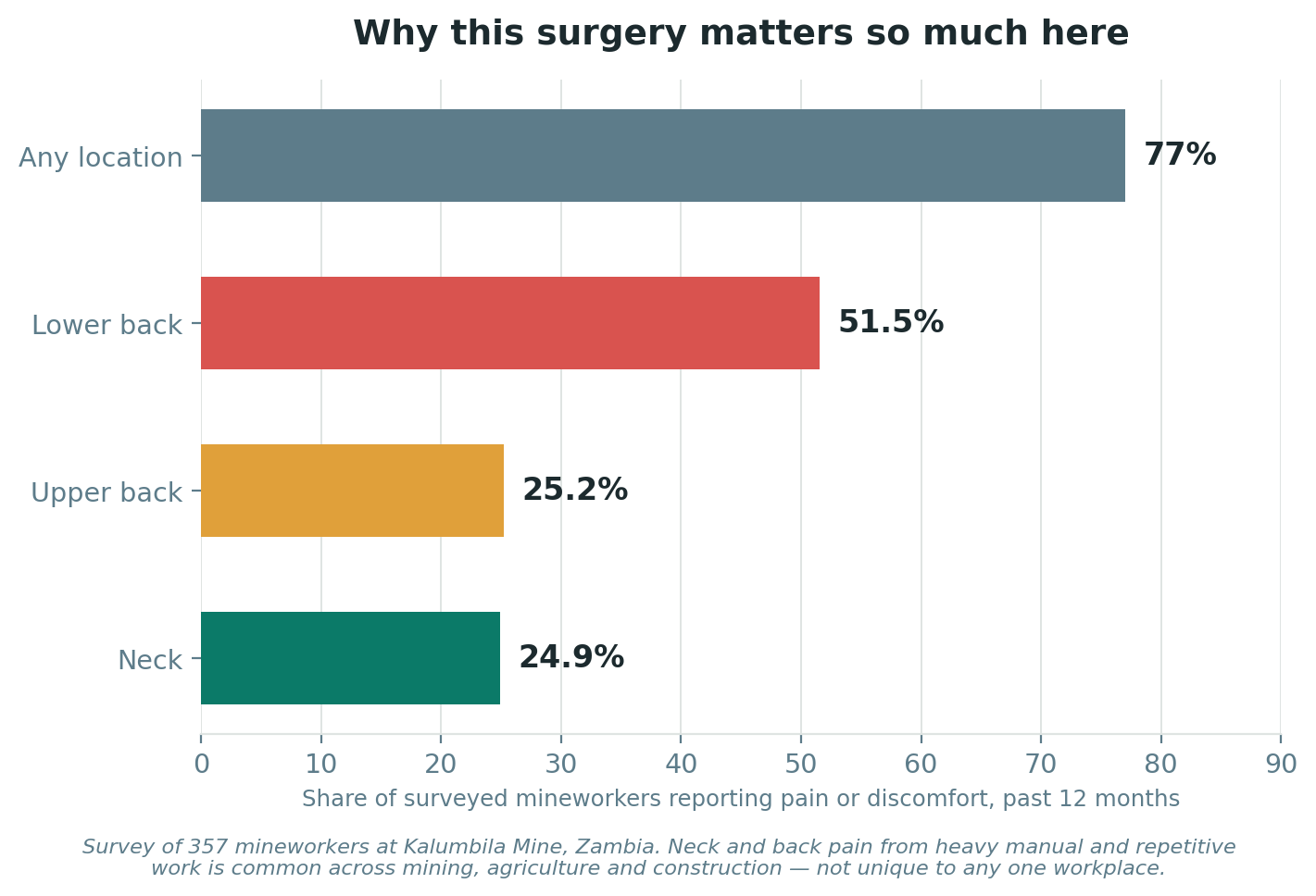
Heavy manual work is a major, well-documented driver of neck and back pain in this region.
Why motion preservation was developed
A spinal fusion permanently joins two vertebrae together, eliminating movement at that level to stop the pain coming from a worn disc. This works well, but the segments above and below a fusion take on extra movement and stress over the following years, and in a meaningful proportion of patients, this leads to new degeneration and symptoms at that next level — a well-documented complication called adjacent segment disease. Disc replacement was developed specifically to address this: by preserving natural movement at the treated level, it aims to reduce the extra strain placed on the segments next to it.
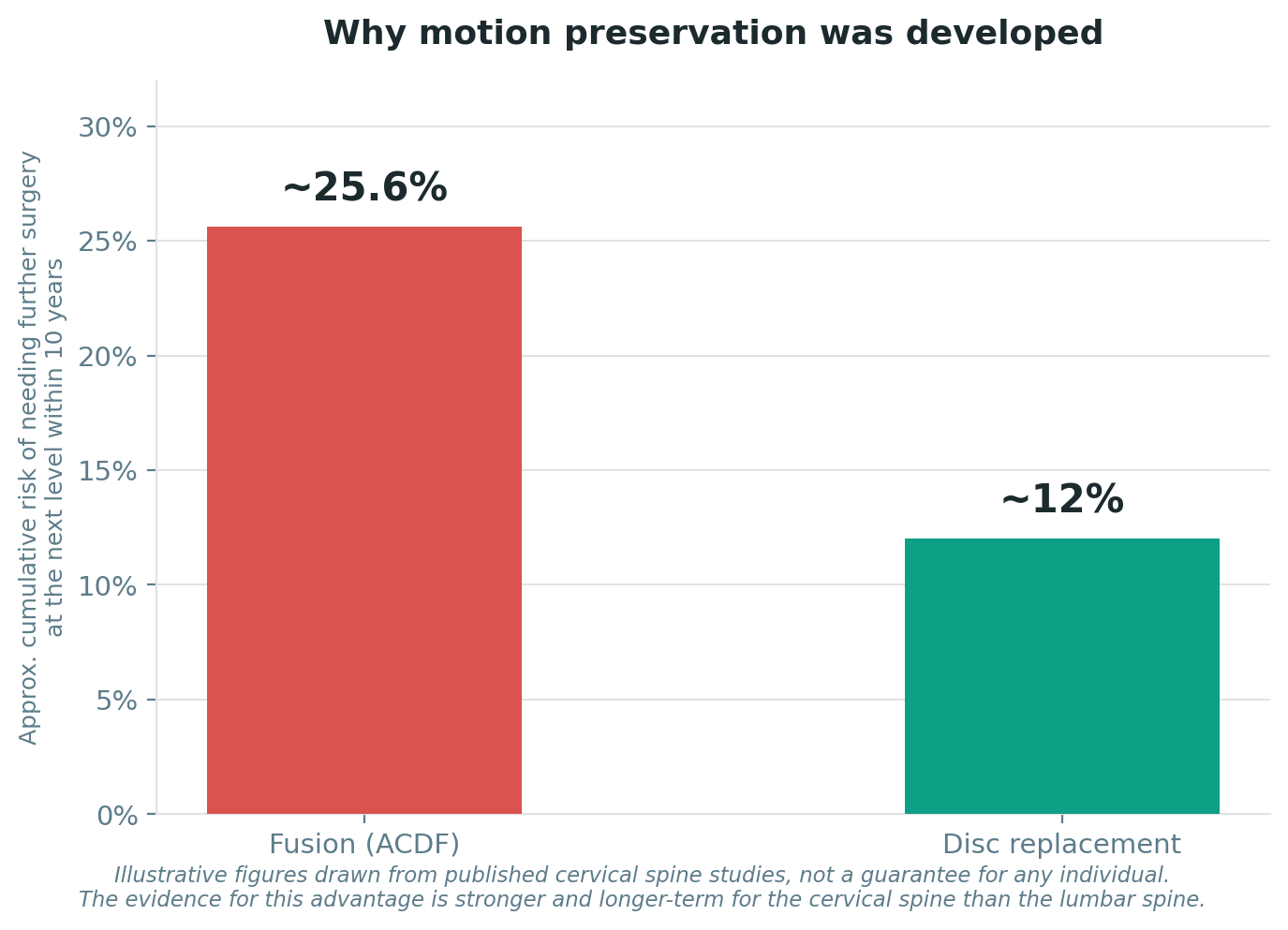
The evidence for this benefit is strongest and longest-followed in the neck; lumbar evidence is more limited.
| Your situation | Typical approach | What it involves |
|---|---|---|
| Single or two-level disc degeneration, healthy facet joints, good bone density, no instability | Disc replacement is a reasonable option | An artificial disc is placed at the affected level, preserving movement there |
| Facet joint arthritis, reduced bone density, spinal instability, or more than two levels affected | Fusion is usually the safer, more appropriate choice | The affected level is permanently joined; disc replacement cannot correct these underlying problems |
| Lumbar disc disease specifically, with any of the above findings | Candidacy assessed even more strictly than in the neck | The anterior approach used for lumbar replacement carries its own risks, discussed below |
| Neck or back pain without a clear structural cause on imaging, or pain that is mainly from the facet joints themselves | Neither fusion nor replacement is likely to help | Further assessment, possibly including diagnostic injections, to identify the true source of pain |
| Physically demanding job involving heavy lifting or repetitive strain | Discuss realistic expectations for return to work explicitly | Neither operation guarantees an unrestricted return to heavy manual labour |
Cervical versus lumbar: two different levels of evidence
Cervical disc replacement, in the neck, has been studied for considerably longer than lumbar disc replacement, with multiple large randomised trials now following patients for a decade or more. The evidence consistently favours it, for the right candidate, over fusion in terms of avoiding further surgery at adjacent levels. Lumbar disc replacement, in the lower back, is a different proposition. It requires an anterior approach through the abdomen, working around the major blood vessels that sit in front of the spine, and carries specific risks that a cervical procedure does not, including injury to those vessels and a small risk of retrograde ejaculation in men, caused by disturbance to nearby nerves during the approach. Candidacy criteria for lumbar replacement are correspondingly stricter, and the evidence for its long-term advantage over fusion is less mature than in the neck.
None of this means lumbar disc replacement is unsafe when performed on a well-selected patient by an experienced team — the underlying operation has been performed and refined for over two decades, and outcomes at good centres are good. It means the margin for getting patient selection right is narrower, and the consequences of getting it wrong, particularly around the blood vessels, are more serious than in the neck. This is precisely why the strength of the surgical team, not just the surgeon alone, matters so much for this specific operation.
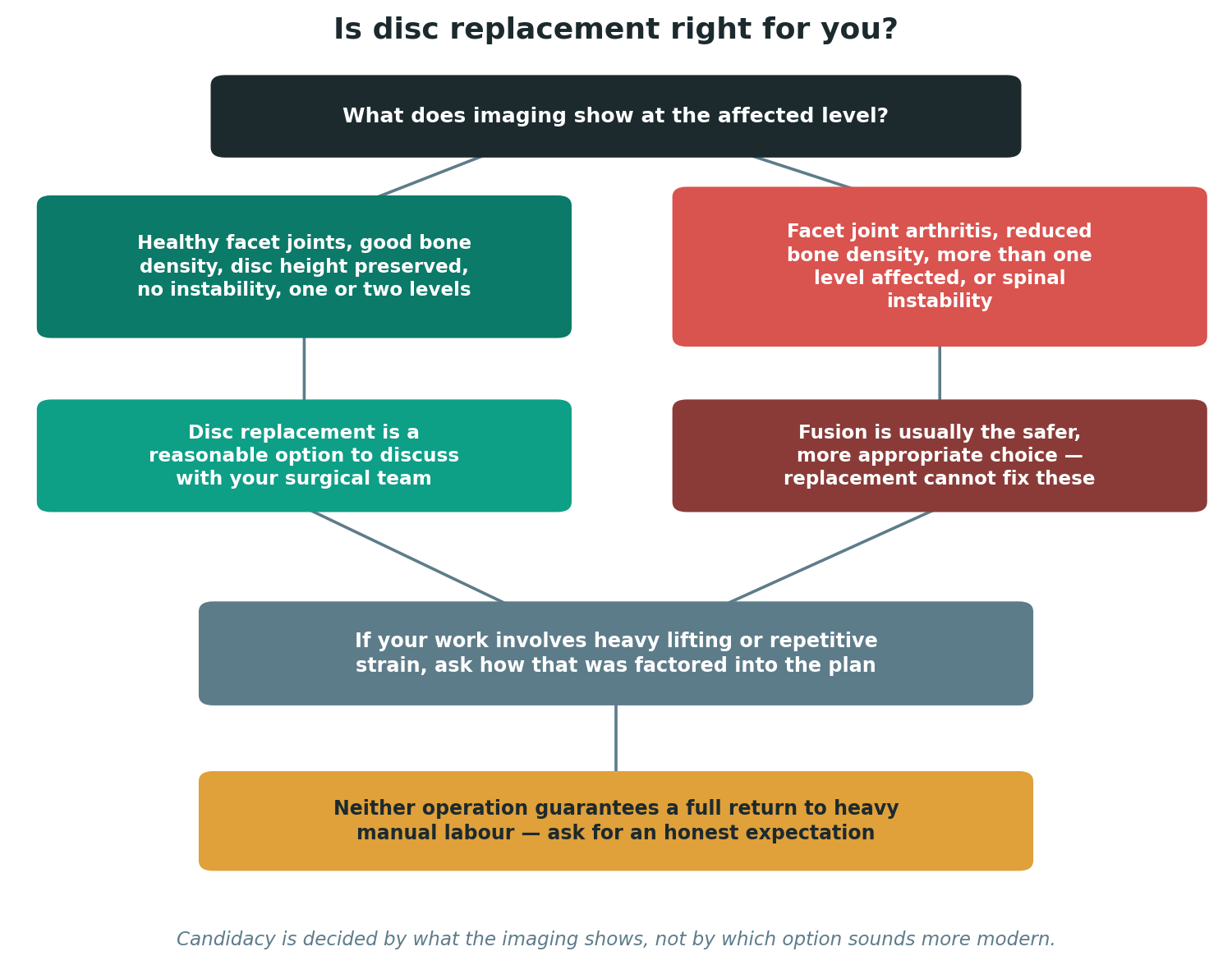
Candidacy is a clinical finding, not a preference — ask specifically what your imaging showed.
Choosing the surgeon and the hospital
Ask directly what proportion of patients referred for disc replacement are ultimately assessed as candidates, and what happens to those who are not — a centre that offers replacement to nearly everyone who asks is a warning sign, not a selling point. Confirm that your case has been reviewed against specific imaging findings, not simply your preference for a "modern" operation, and ask the surgeon to explain, in plain terms, why replacement or fusion is right for your particular disc and joints.
For lumbar surgery specifically, ask whether an access surgeon, typically a vascular or general surgeon experienced in the anterior retroperitoneal approach, is part of the team, since this shared-care model is standard at experienced centres and meaningfully reduces the risk of vascular injury. Check accreditation (NABH, ideally JCI), and ask about the specific implant being used and its track record, since not all artificial discs have the same long-term evidence behind them.
It is also reasonable to ask how the team handles a finding, sometimes only confirmed once surgery has begun, that a disc is not suitable for replacement after all — for example, because the facet joints look worse in person than on imaging. A confident surgical team will be able to describe converting to fusion during the same operation if needed, rather than treating this as an unexpected failure.
Cost and value: how to weigh the money honestly
Disc replacement surgery in a good Indian hospital costs a small fraction of the equivalent procedure in the West, and India has genuine, high-volume experience with both cervical and lumbar cases. The saving is real, but it should never be the reason a patient who is not a genuine candidate is offered replacement over a more appropriate fusion.
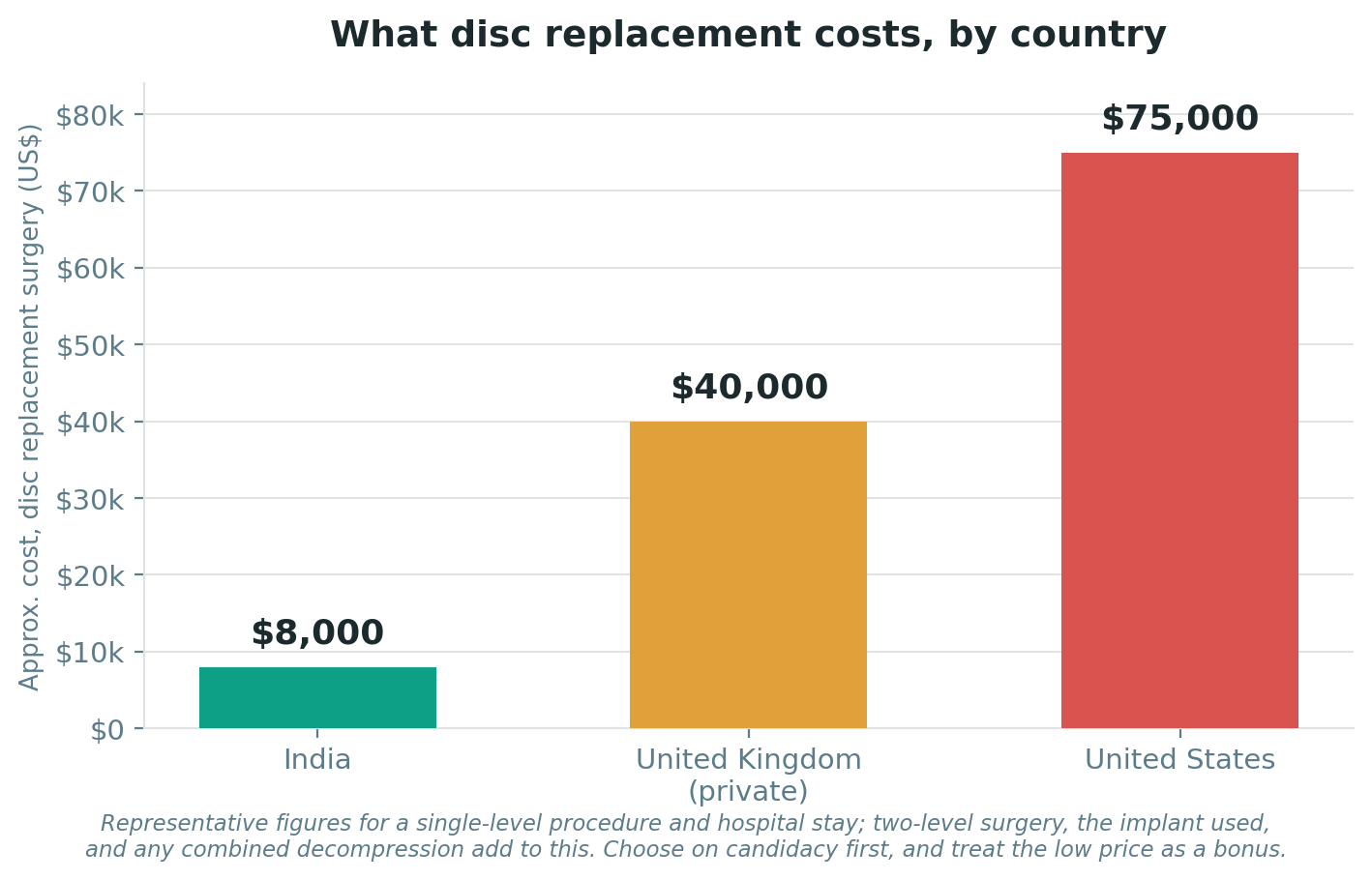
India's affordability is genuine — but confirm candidacy on imaging first.
In 24 years of arranging these journeys, I have found that the patients who do best are the ones who ask their surgeon to justify the choice between fusion and replacement in specific, imaging-based terms before agreeing to either. Ask for a written, itemised quote covering the surgery, the implant, hospital stay, and physiotherapy, and clarify early what a realistic return to your particular job might look like.
What a Zambian patient should weigh in particular
Beyond the surgical decision itself, several practical matters deserve attention. First, payment: NHIMA funds care at accredited facilities inside Zambia, not treatment abroad, so this comes from your own resources — another reason to be confident in the plan, including realistic work expectations, before committing funds. Second, if your pain is work-related, discuss your specific job's physical demands honestly with the surgical team, since this should shape both the choice of procedure and the rehabilitation plan that follows it. Third, aftercare: arrange with a Zambian doctor, ideally one experienced in post-operative spine care, to take over your physiotherapy and follow-up, and insist the Indian team provides a complete written operative report and a realistic timeline for returning to work.
Fourth, be realistic about the recovery period itself. Even a successful operation is followed by weeks of restricted activity and a structured physiotherapy programme before any return to physical work, and rushing this can undermine an otherwise good result. Plan your finances and, where possible, your employer's expectations around this reality rather than the shortest timeline you have read about.
The practical journey from Zambia
India requires a yellow fever vaccination certificate from travellers arriving from Zambia, valid only from ten days after the injection. Your medical visa is issued by the High Commission of India on Pandit Nehru Road in Lusaka against the hospital's invitation letter. There is no direct flight from Zambia to India; you will connect through Addis Ababa on Ethiopian Airlines, or through Dubai, Doha or Nairobi. Send your actual MRI and CT images, not only written reports, for remote review before you travel, since the precise condition of your facet joints, bone density and disc height is what determines whether replacement is genuinely appropriate for you.
Signals that should make you pause
1. A recommendation for disc replacement without a clear explanation of your facet joint condition and bone density findings.
2. Any suggestion that disc replacement is offered to nearly all patients who ask for it, regardless of imaging findings.
3. For lumbar surgery, no mention of a dedicated access surgeon experienced in the anterior approach.
4. No honest conversation about realistic return-to-work expectations if your job involves heavy lifting or repetitive strain.
Straight answers for Zambian Patients about Cervical and Lumbar Disc Replacement Surgery in India
Is disc replacement always better than fusion?
No. It offers a genuine advantage for the right candidate, particularly in the neck, but strict imaging criteria decide who that is. For patients with facet joint arthritis, reduced bone density, spinal instability, or disease at more than two levels, fusion remains the safer and more appropriate choice.
My work involves heavy lifting. Will surgery let me go back to it?
Possibly, but neither fusion nor disc replacement guarantees an unrestricted return to heavy manual labour, and this should be discussed honestly before surgery rather than assumed. Ask your surgical team for a realistic expectation specific to your job and your findings.
Why is lumbar disc replacement held to a stricter standard than cervical?
The lumbar procedure requires an anterior approach through the abdomen, working near major blood vessels, and carries risks — including vascular injury and a small risk of retrograde ejaculation in men — that the cervical procedure does not. The evidence supporting its long-term advantage over fusion is also less mature than in the neck.
What if I'm not a candidate for disc replacement — have I wasted my trip?
No. Fusion remains a well-established, effective operation for the many patients who are not suited to replacement, and a centre that reviews your imaging honestly and recommends fusion where appropriate is doing right by you, even if it is not the operation you first asked about.
Sources
- 🌐 Medical visa, Lusaka — High Commission of India, requirements & process: hcizambia.gov.in/page/medical-visa
- 🌐 Hospital accreditation (India) — Verify a hospital's NABH accreditation: nabh.co
- 🌐 National Health Insurance (Zambia) — NHIMA cover, treatment abroad is not covered: nhima.co.zm
- 🌐 Ministry of Health Zambia — National health services & guidance: moh.gov.zm
- 🌐 National Medical Commission (verify a surgeon) — Confirm a surgeon's registration in India: nmc.org.in
- 🌐 WHO yellow fever — Vaccination requirements before travel: who.int/health-topics/yellow-fever
A Closing Word
Of everything I help patients weigh, disc replacement is the clearest example of a good operation being the wrong one for the wrong patient. If you send me your scans and a note on your work and daily life, I will help you understand honestly whether replacement is genuinely available to you, or whether fusion — no less a legitimate operation — is the right and safer path, and which centres in India have the specific experience to treat you well, whichever it turns out to be.
Frequently Asked Questions by Zambian Patients about Cervical and Lumbar Disc Replacement Surgery in India
Is disc replacement better than spinal fusion?
Not automatically. Disc replacement can offer a genuine advantage for carefully selected patients, particularly in the cervical spine, but fusion remains more appropriate for several common conditions.
Who may be a candidate for disc replacement?
Patients with limited-level disc degeneration, healthy facet joints, adequate bone density and no spinal instability may be considered. The final decision depends on clinical and imaging assessment.
When is fusion usually preferred?
Fusion is generally more appropriate when there is facet-joint arthritis, reduced bone density, spinal instability or disease affecting more than two levels.
Why is lumbar disc replacement more strictly selected?
Lumbar replacement uses an anterior approach through the abdomen near major blood vessels. It also carries specific risks, including vascular injury and a small risk of retrograde ejaculation in men.
Is the evidence the same for cervical and lumbar replacement?
No. The guide states that cervical disc replacement has been studied for considerably longer, with stronger long-term evidence. Lumbar evidence is less mature.
Does heavy manual work affect candidacy?
It can influence both the underlying degeneration and expectations after surgery. Patients who perform heavy lifting or repetitive work should discuss realistic return-to-work expectations before choosing either procedure.
What should I send before travelling to India?
Send the actual MRI and CT images, not only written reports. The guide emphasises that facet-joint condition, bone density and disc characteristics are central to determining candidacy.
How much does disc replacement cost in India?
The guide gives an indicative cost of approximately US$8,000 for a single-level procedure and hospital stay, although the final cost varies according to the implant and complexity.
What should I ask a lumbar disc replacement centre?
Ask whether an access surgeon experienced in the anterior retroperitoneal approach is part of the surgical team and how the team manages potential vascular complications.
What if I am not suitable for disc replacement?
You have not necessarily wasted the journey. Fusion remains an established treatment for patients who are not appropriate candidates for disc replacement, and an honest centre should recommend fusion when the imaging supports it.
Page Summary
This five-page Zambia-to-India medical travel guide explains cervical and lumbar disc replacement surgery, focusing on strict patient selection, imaging-based candidacy and the difference between motion preservation and fusion. It highlights the high prevalence of musculoskeletal pain among surveyed mineworkers, the stronger long-term evidence for cervical replacement, stricter criteria and additional risks for lumbar replacement, and the importance of realistic return-to-work expectations for heavy manual workers. The page 3 decision diagram shows how imaging findings guide the choice between replacement and fusion, while the page 4 cost chart gives an indicative cost of US$8,000 in India, compared with US$40,000 in the UK and US$75,000 in the US.
Citation Block
| Topic | Information |
|---|---|
| Topic | Cervical & Lumbar Disc Replacement in India for Zambian Patients |
| Treatment | Cervical/Lumbar Disc Replacement |
| Patients | Zambian Spine Patients |
| Specialist | Spine Surgeon |
| Main Assessment | MRI/CT findings and symptoms |
| Key Priority | Confirm genuine candidacy |
| Main Benefit | Motion preservation |
| Candidacy | Healthy facets, good bone density, no instability, limited levels |
| Fusion Preference | Facet arthritis, poor bone density, instability or multi-level disease |
| Cervical Evidence | Stronger and longer-term evidence |
| Lumbar Check | Strict selection and anterior-access expertise |
| India Cost | Approximately US$8,000 |
| UK Cost | Approximately US$40,000 |
| US Cost | Approximately US$75,000 |
| Quote Check | Surgery, implant, hospital stay and physiotherapy |
| Pre-Travel Records | Actual MRI and CT images |
| Follow-Up | Zambian spine doctor and physiotherapy |
| Quality Check | NABH, ideally JCI |
| Warning Signs | Replacement recommended without clear imaging findings |
| Kenya/Zambia Work Issue | Heavy lifting may affect recovery and return-to-work expectations |
| Key Statistic | 77% of surveyed Kalumbila mineworkers reported musculoskeletal pain |
| Patient Pathway | Imaging → candidacy assessment → replacement/fusion decision → surgery → rehabilitation → Zambia follow-up |
| Decision Principle | Imaging determines candidacy, not preference for a newer procedure |


Our Mission Statement
Our mission is to place patients at the centre of every healthcare decision by providing trustworthy, evidence-based, and unbiased medical information. We believe that informed patients make better decisions. Backed by personalised guidance from our experienced advisory team, we help patients understand their treatment options, compare them objectively, and confidently choose the path that best suits their medical needs and personal circumstances.
Patient Testimonials from Zambia

Ready to Take the First Step?
Share your Medical Reports with our Healthcare Managers Today and Get a FREE CONSULTATION, a Personalized Treatment Plan, and Complete Support from Arrival to Recovery.
Get Your Free ConsultationAreas We Serve
This resource has been thoughtfully prepared for patients from Zambia who are considering medical treatment in India. We also welcome patients from the wider region in the countries mentioned below-
We assist patients from:
- Zambia
- Angola
- Malawi
- Zimbabwe
- Botswana
- Namibia
- South Africa
- Eswatini
- Lesotho
- Gabon
- Chad
- Equatorial Guinea
- São Tomé and Príncipe
- Republic of the Congo
- Democratic Republic of the Congo
Many of the insights, treatment pathways, hospital recommendations, travel guidance, and patient support services described here are equally relevant and may be used as a reference when planning treatment in India.
From Zambia to India: Your Complete Patient Support Guide
- Best Weight-Loss (Bariatric) Surgeons & Hospitals in India for Zambian Patients
- Best Brain-Tumour Surgeons & Hospitals in India for Zambian Patients
- Best Cancer Doctors & Hospitals in India for Zambian Patients
- Best Cardiac Surgeons & Hospitals in India for Zambian Patients
- Best Cosmetic Surgeons & Facilities in India for Zambian Patients
- Best CyberKnife Treatment Teams & Centres in India for Zambian Patients
- Best Dentists & Dental Clinics in India for Zambian Patients
- Best Heart Valve Replacement Surgeons & Hospitals in India for Zambian Patients
- Best Hip Surgeons & Hospitals in India for Zambian Patients
- Best Knee Surgeons & Hospitals in India for Zambian Patients
- Best Neurosurgeons & Hospitals in India for Zambian Patients
- Best Paediatric Cardiac Surgeons & Hospitals in India for Zambian Patients
- Best Paediatric Neurosurgeons & Hospitals in India for Zambian Patients
- Best Prostate Surgeons & Hospitals in India for Zambian Patients
- Best Scoliosis Surgeons & Hospitals in India for Zambian Patients
- Best Spine Surgeons & Hospitals in India for Zambian Patients
- Best Bone Marrow Transplant Teams & Hospitals in India for Zambian Patients
- Best Kidney Transplant Surgeons & Hospitals in India for Zambian Patients