

Brain Tumour Treatment in India for Zambian Patients
A shadow on a brain scan is one of the most frightening things a family can face — and in Zambia, it is often not what it first appears. This guide explains what a brain mass can really be, and how to be sure before anyone opens the skull.
Few words land as heavily as “there is a mass on your brain scan.” In that moment the family hears a death sentence and the mind races to surgery. For 24 years I have walked African patients through exactly this fear, and the most important thing I have learned is also the most reassuring: in Zambia, a shadow on a brain scan very often turns out not to be a cancer, and sometimes not a tumour at all. Getting to the truth of what it actually is — calmly, correctly, and before any knife is lifted — is the whole task of this guide, and it can be the difference between a simple course of tablets and an unnecessary, dangerous operation.
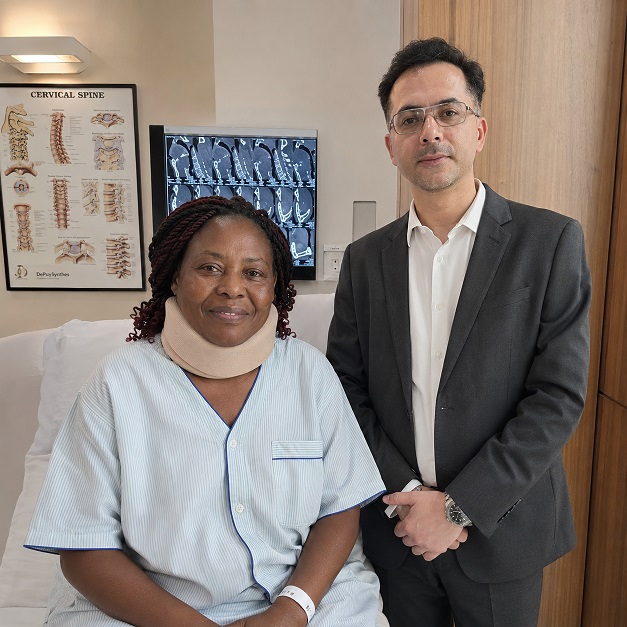
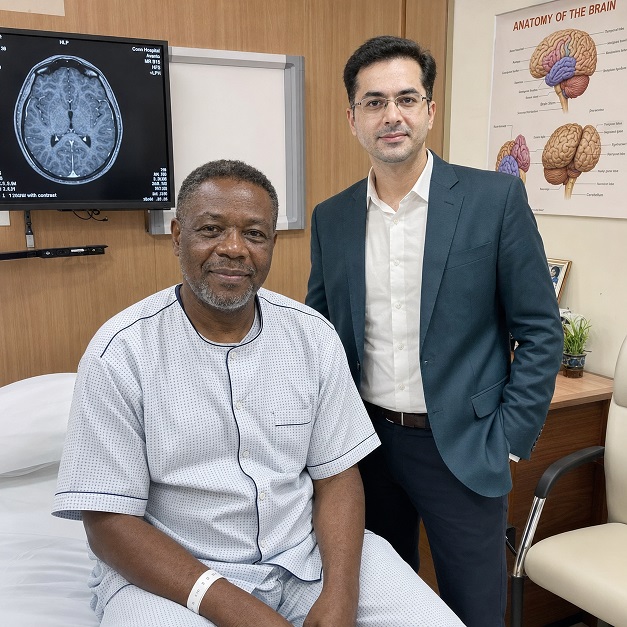
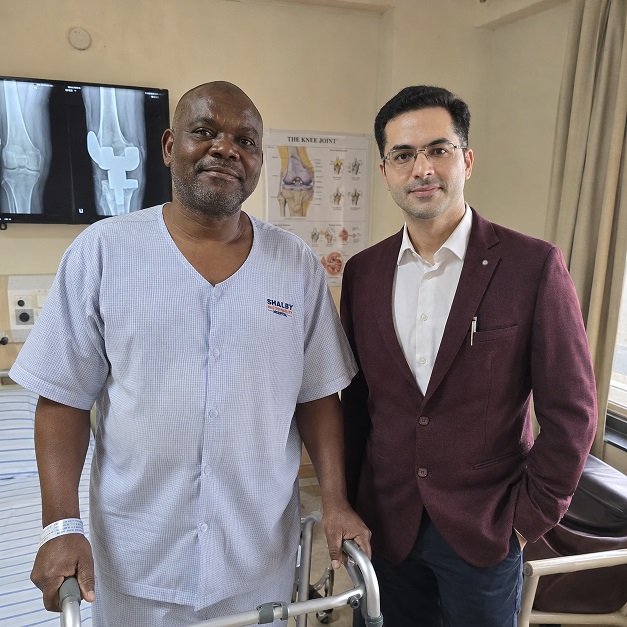
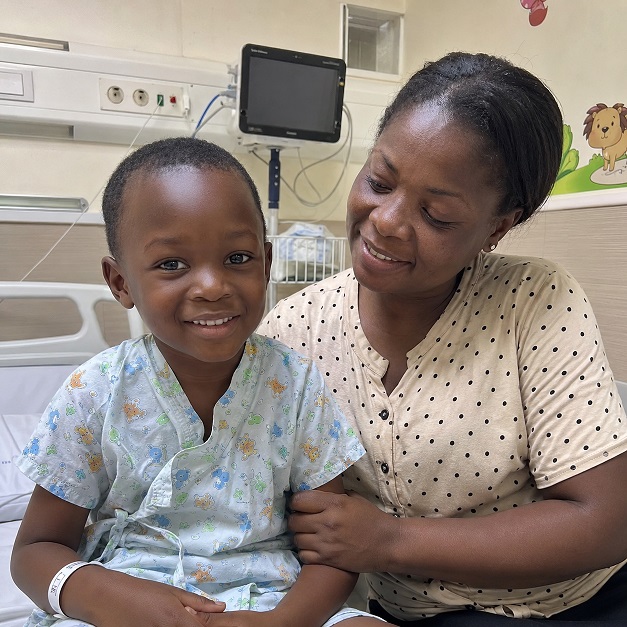
Healing Journeys of Zambian Patients
Key Takeaways
- A brain mass seen on a scan does not automatically mean a brain tumour or brain cancer. The guide places particular emphasis on establishing the correct diagnosis before surgery because several infections can produce brain lesions that resemble tumours.
- For Zambian patients, important tumour look-alikes discussed in the guide include cerebral toxoplasmosis, tuberculoma, neurocysticercosis, fungal lesions and bacterial brain abscesses.
- The page 2 chart compares these conditions with a true brain tumour. A true tumour is shown as usually requiring surgery, while cerebral toxoplasmosis, tuberculoma, neurocysticercosis and fungal lesions are generally treated medically. A bacterial brain abscess may require drainage together with antibiotics.
- The guide stresses that the correct sequence should be scan → investigate → decide, rather than proceeding directly from a scan to surgery.
- Diagnostic evaluation may include a contrast-enhanced MRI, HIV testing, CD4 count, tuberculosis evaluation and careful assessment of the number, shape and location of the brain lesions.
- When infection is suspected, the document explains that a short course of appropriate medicine followed by a repeat scan may help establish the diagnosis. If uncertainty remains, a precise needle biopsy may be considered before a larger operation.
- Even when a brain mass is confirmed as a true tumour, it is not necessarily cancerous. The guide notes that benign tumours such as meningiomas may sometimes be completely removed and potentially cured.
Quick Facts
- Treatment
- Brain Tumour Diagnosis & Treatment
- Country
- India
- Intended Audience
- Zambian Patients
- Primary Concern
- Intracranial / Brain Mass
- Important First Step
- Confirm Whether the Mass Is Actually a Tumour
- Important Tumour Mimics
- Cerebral Toxoplasmosis, Tuberculoma, Neurocysticercosis, Fungal Lesion and Brain Abscess
- Diagnostic Imaging
- MRI with Contrast
- Additional Assessment
- HIV Testing, CD4 Count and Tuberculosis Evaluation
- Treatment Options
- Biopsy, Craniotomy, Stereotactic Radiosurgery, Radiotherapy and Chemotherapy
- Brain Surgery
- Craniotomy for Suitable Accessible Tumours
- Advanced Surgical Techniques
- Image-Guided Navigation and Awake Surgery
- Hospital Accreditation
- NABH or JCI
- Representative Brain Tumour Surgery Cost in India
- Approximately US$8,000
- Representative UK Private Cost
- Approximately US$35,000
In Brief
Brain tumour treatment in India for Zambian patients should begin with accurate diagnosis rather than immediate surgery. Cerebral toxoplasmosis, tuberculoma, neurocysticercosis, fungal lesions and brain abscesses can resemble tumours on brain imaging but may require very different treatment. Once a true tumour is confirmed, options can include biopsy, craniotomy, stereotactic radiosurgery, radiotherapy and chemotherapy depending on its type and location. The guide's page 4 chart gives a representative brain tumour surgery cost of approximately US$8,000 in India, while highlighting neuro-intensive-care requirements as an important cost variable.
First, should you travel at all?
Zambia has neurosurgical services, chiefly at the University Teaching Hospital in Lusaka, and simpler cases can and should be managed at home. But brain surgery is among the most demanding of all specialties: it needs high-volume neurosurgeons, modern imaging and image-guided navigation, and a dedicated neuro-intensive-care unit for the days after the operation. That full combination is available in only a few places, and complex or delicate tumours — those near speech, movement or vision, deep in the brain, or in children — are often referred abroad. When the diagnosis is uncertain or the surgery is difficult, the depth of a high-volume centre matters enormously; in the brain, experience is measured in outcomes you cannot undo.
Knowledge first: a mass on the scan is not always a tumour
This is the single most important thing a Zambian patient can know, and it can save a life. A scan showing a lump in the brain — often a ring-shaped bright spot — instantly suggests a tumour. But in a country with a high burden of HIV and tuberculosis, several other conditions produce almost identical pictures, and they are cured not with surgery but with medicine.
The most common of these is cerebral toxoplasmosis , an infection that in people living with HIV is in fact the most frequent cause of these ring-shaped brain lesions worldwide — and it melts away with anti-parasitic tablets. Next is a tuberculoma , a lump of tuberculosis in the brain; Zambia’s heavy TB burden makes this a real and treatable possibility, and it resolves on anti-TB drugs, not the operating table. A parasitic cyst from the pork tapeworm (neurocysticercosis) and a fungal lesion round out the look-alikes, and a bacterial abscess is drained and treated with antibiotics rather than removed as a tumour would be. Operating on any of these as though it were a cancer is a catastrophe — and, just as importantly, treating a true tumour as though it were an infection wastes the time that a cure depends on. Telling them apart is everything.
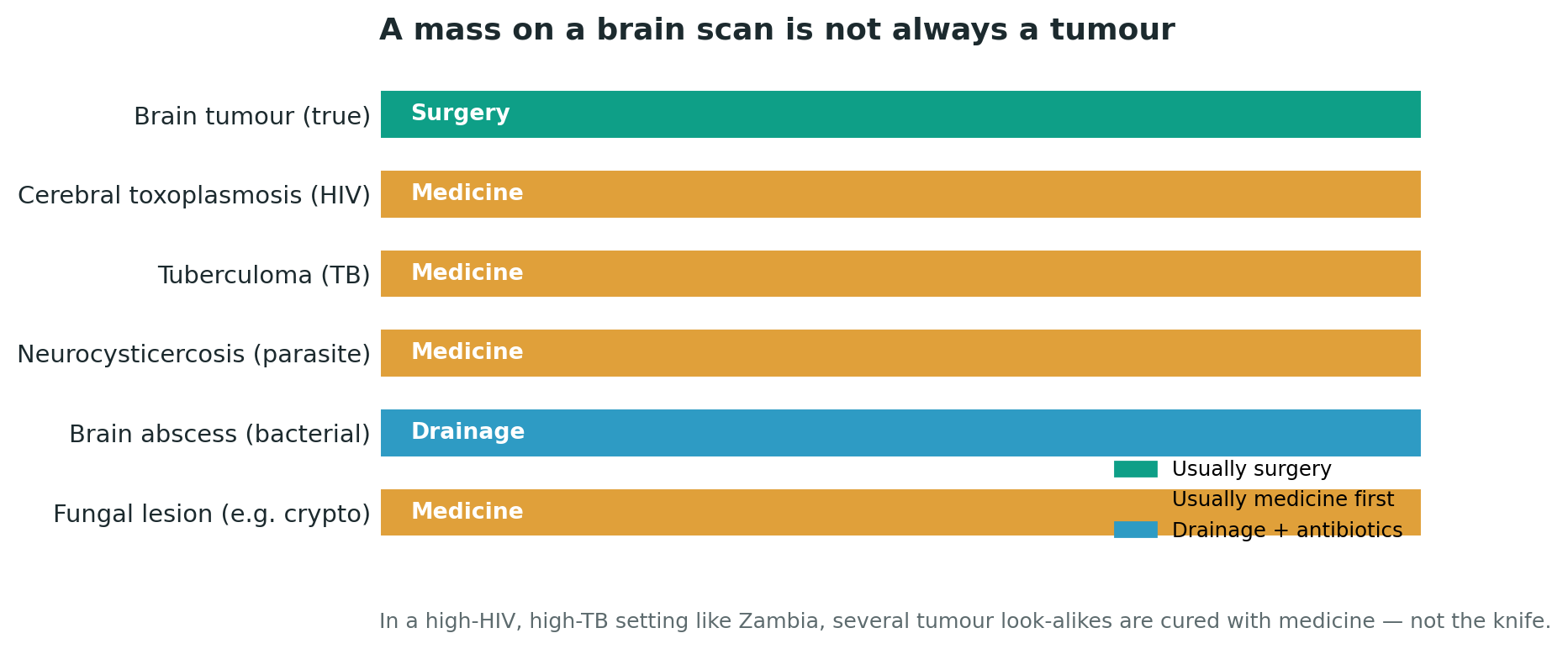
Several conditions mimic a brain tumour on a scan. In a high-HIV, high-TB setting, many are cured with medicine — which is why the diagnosis must come before the knife.
Get the diagnosis right before the skull is opened
Because of these look-alikes, the correct order is never “scan, then operate.” It is scan, then investigate , then decide. A good neuro team will take a detailed MRI with contrast, test for HIV and check the CD4 count, look for tuberculosis, and study the exact pattern of the lesion — because its shape, number and position give powerful clues. Where an infection is likely, a short trial of the right medicine with a repeat scan a few weeks later can confirm the answer without any surgery at all: if it shrinks, it was never a tumour. Where doubt remains, a small, precise needle biopsy can take a tiny sample to establish the diagnosis before any larger operation is contemplated. None of this is delay for its own sake; it is the difference between the right treatment and the wrong one.
And if it truly is a tumour — it is not automatically cancer
Here is the second reassurance. Even when the mass is a genuine brain tumour, it is not necessarily cancer. Many brain tumours are benign — a meningioma growing from the brain’s lining, for example — and can often be removed completely, with an excellent chance of cure and a normal life afterwards. Others are cancerous and need surgery followed by radiotherapy and sometimes chemotherapy. What decides everything is the tumour’s type and its location : a small tumour deep in a critical area may be treated more safely with focused radiation than with a scalpel, while an accessible one may be best simply removed. This is why the plan should come from a team — a neurosurgeon, a neuro-oncologist and a neuroradiologist together — rather than from any single opinion. “Brain tumour” is a frightening phrase, but for a great many patients it is not the end of the story.
The main treatment approaches, compared
When treatment is needed, there is more than one tool. A biopsy comes first when the diagnosis is unclear, taking a small sample to be certain before anything larger. A craniotomy — opening the skull to remove the tumour — is the answer for many accessible growths, and modern navigation and, where needed, awake surgery let the surgeon protect speech and movement. Stereotactic radiosurgery , such as the Gamma Knife, delivers a precise dose of radiation to a small or deep tumour with no incision at all. And for cancerous tumours, radiotherapy and chemotherapy follow surgery to treat what remains. The skill lies in choosing the least harmful path that controls the tumour — not simply the biggest operation.
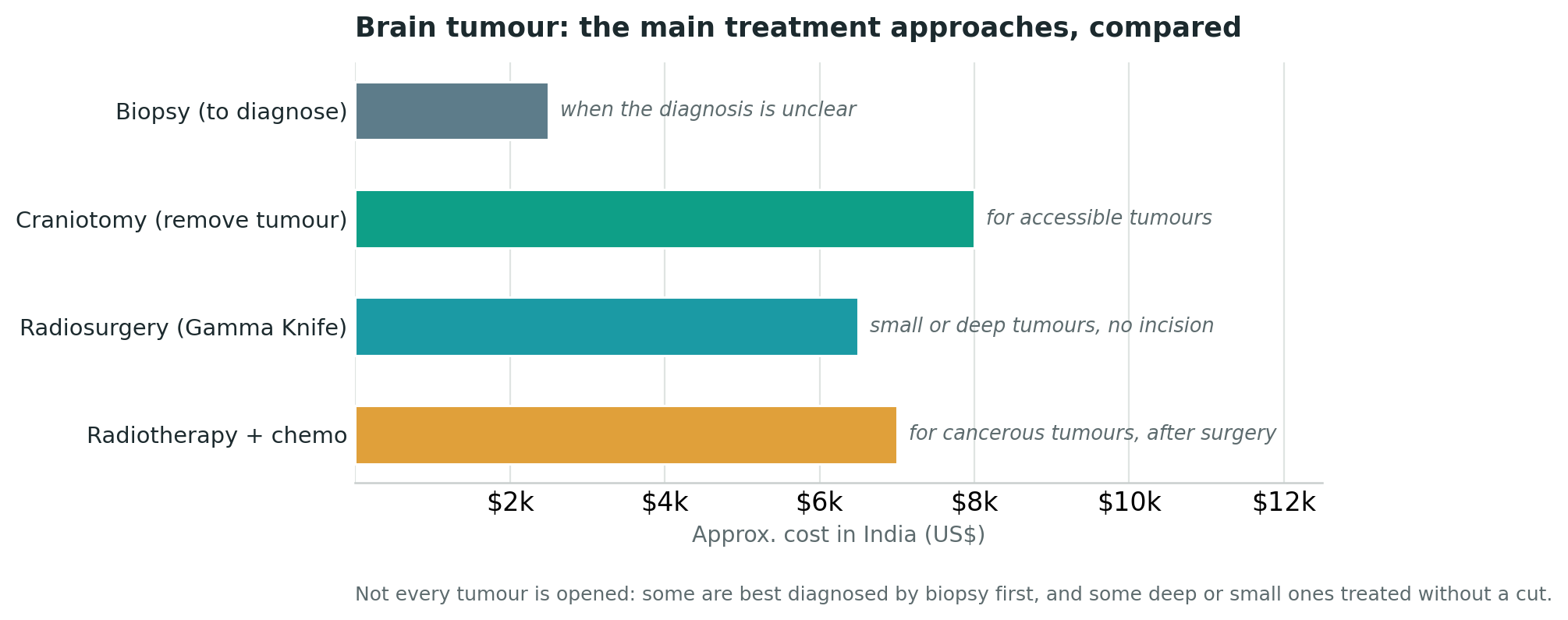
Not every tumour is opened. Some are best diagnosed by biopsy first, and some small or deep ones treated without a single cut.
Warning signs, and what is urgent
Some brain symptoms deserve prompt attention rather than watchful waiting. A new headache that is persistent and worsening — especially one worse in the early morning, or brought on by coughing or bending — a first-ever seizure in an adult, progressive weakness or numbness on one side, new problems with vision, speech or balance, or a marked change in personality or memory all warrant urgent medical assessment and a scan. A rapid decline in consciousness, relentless vomiting or a sudden severe headache is an emergency: go to hospital at once, because pressure inside the skull can rise dangerously. For most people, though, there is time to plan carefully — which is exactly what this guide urges you to do.
The cost, in plain terms
Brain tumour surgery in a good Indian hospital typically costs a fraction of Western private pricing. One honest point specific to the brain: the biggest driver of the final bill is often not the operation itself but the days in neuro-intensive care afterwards, which vary from patient to patient. At roughly ZK19 to the US dollar in mid-2026, the saving against Western care is large in kwacha; confirm the rate before travel, as it moves.
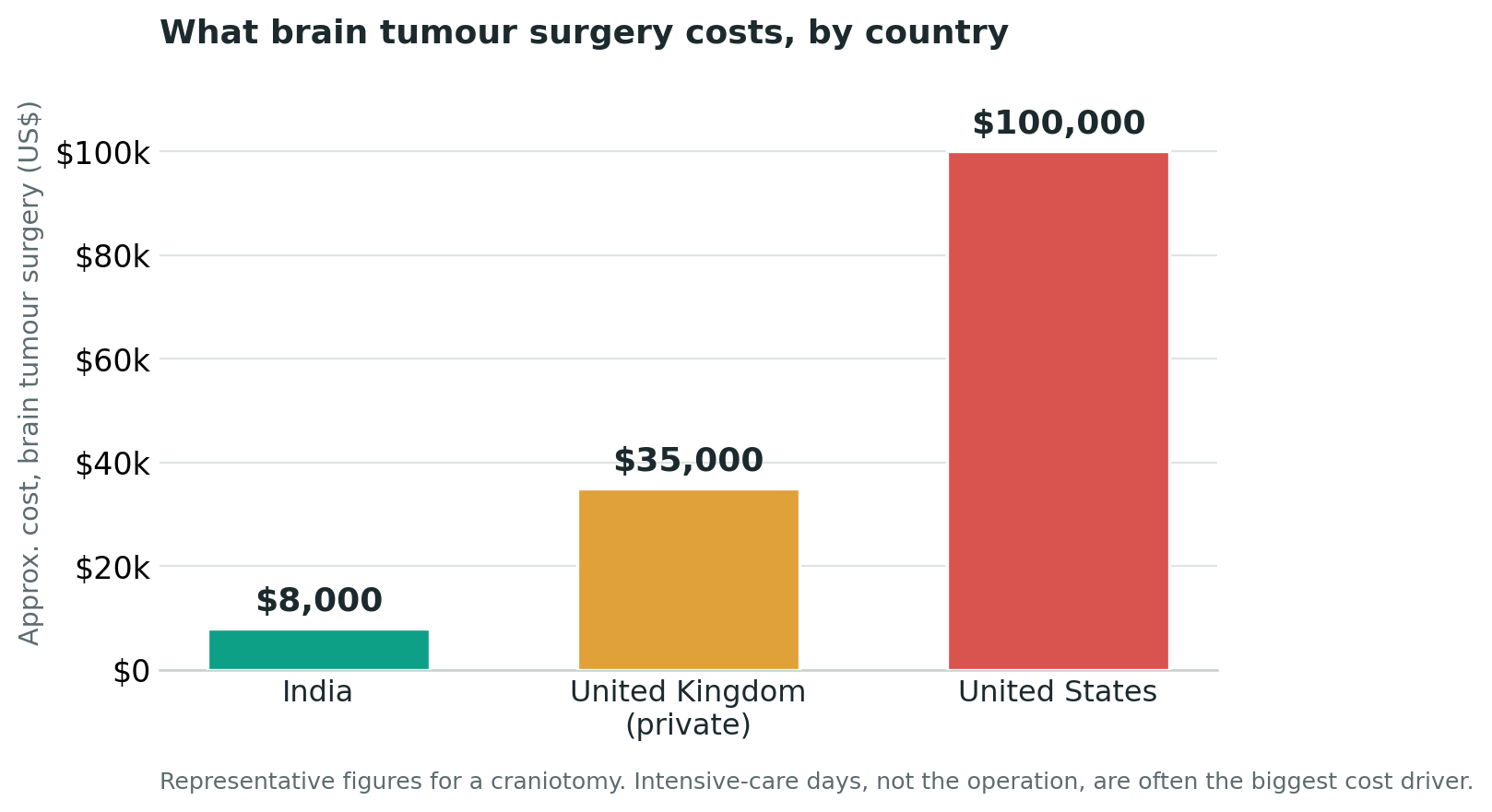
Representative figures for a craniotomy. Ask specifically how intensive-care days are charged, as they are often the largest variable.
In 24 years of arranging these journeys, I have learned that disputes almost never concern the headline price — they concern what it left out: the intensive-care days, the imaging, the radiotherapy, the medicines. Insist on an itemised quote, and ask directly what happens to the cost if you need longer in intensive care, as brain patients sometimes do.
Why India for the brain
India performs a very large volume of neurosurgery, and its leading centres — accredited internationally by JCI and within India by NABH — carry the full range: high-volume neurosurgeons, image-guided and awake surgery, Gamma Knife and CyberKnife radiosurgery, dedicated paediatric neurosurgery for children, and the neuro-intensive care that brain surgery demands. Critically for a Zambian patient, these centres see the tumour look-alikes — tuberculoma, toxoplasmosis, cysticercosis — routinely, because India too knows HIV and TB well, so they are less likely to mistake an infection for a cancer. There are no waiting lists, and English, Zambia’s official language, is the working language of care.
Recovery, and when you can fly home
Recovery from brain surgery is highly individual. Expect several days in hospital, including intensive care, and a total of around three to four weeks in India before you are cleared to fly, so pressure inside the head settles and your team is confident you are stable. Air travel too soon after brain surgery carries real risk, so never let a fixed ticket rush the journey home; your surgeon’s clearance, not the calendar, decides when you fly.
What the journey looks like
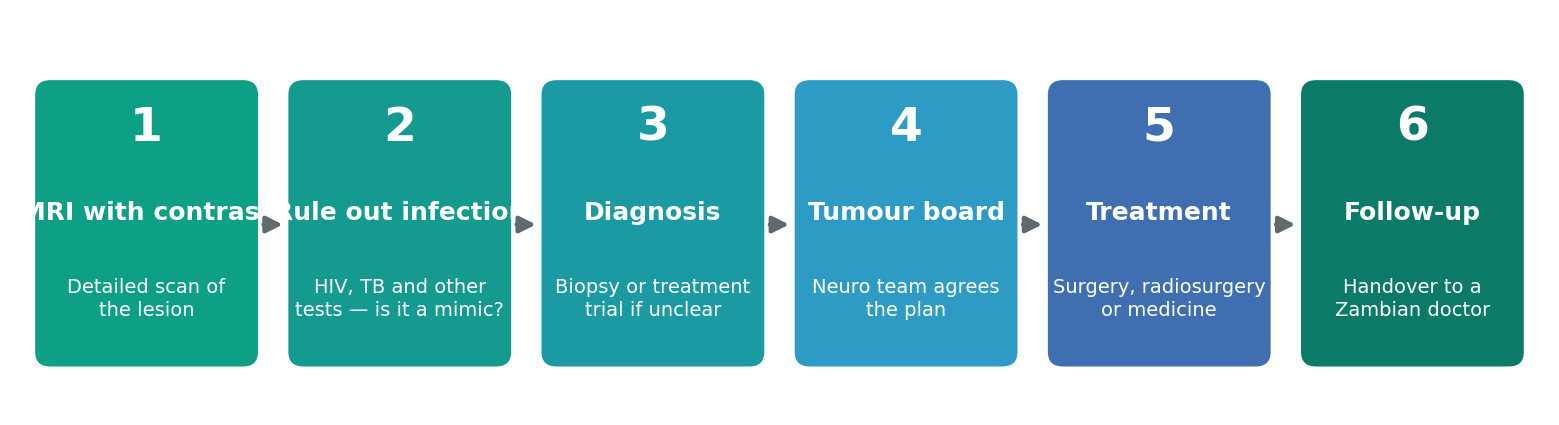
Notice that ruling out infection comes before any thought of surgery, and treatment is the last step. Send your MRI and reports for review from Lusaka, along with your HIV and TB status, and a good centre will tell you honestly what the mass is likely to be — and return a plan and a fixed quote — before you commit a single kwacha.
Much of this first, decisive step can happen before you leave home. A specialist neuroradiologist can review your MRI remotely and often say a great deal from the images alone — whether the mass has the look of an infection or of a tumour, whether a trial of medicine is worth trying first, or whether a biopsy is the sensible next move. Ask for that remote reading, and share your HIV and TB results with it. It costs little, it may spare you a journey you do not need, and if you do travel, you arrive with the hardest question already half-answered rather than starting from a blank page.
Practicalities for travelling from Zambia
India requires a yellow fever vaccination certificate from travellers arriving from Zambia, valid only ten days after the injection — do not leave it late. Your medical visa is issued by the High Commission of India on Pandit Nehru Road in Lusaka against the hospital’s invitation letter; apply for a medical-attendant visa in the same batch, which is essential for a brain patient and for any child. There is no direct flight — you will connect through Addis Ababa on Ethiopian Airlines, or through Dubai, Doha or Nairobi, a door-to-door journey of roughly fourteen to twenty hours. Book a changeable return ticket, carry your actual MRI files and any HIV or TB records rather than only the reports, and settle the hospital by traceable bank transfer rather than cash.
On paying for it. Zambia’s National Health Insurance scheme funds care at accredited facilities inside the country, not elective surgery abroad, so brain treatment in India will usually come from your own resources. I would rather you knew that from the first line than discovered it later. Because intensive-care needs can vary, budget with some room above the opening quote; for children, ask your doctor whether any charitable neurosurgery programme can help, and if you hold any private or employer policy, ask the insurer in writing whether an overseas benefit exists.
Four signals that should make you pause
- Rushing to surgery — without HIV, TB and infection look-alikes first being excluded.
- A fixed price or surgery date — offered before the diagnosis is actually established.
- A single surgeon’s plan — with no mention of a neuro tumour board, a biopsy, or radiosurgery as an alternative.
- No dedicated neuro-intensive care — or paediatric neurosurgery team for a child, and no follow-up plan for Zambia.
Straight answers for Zambian Patients about Brain Tumour Treatment in India
The scan shows a mass. Does that mean I have brain cancer?
Not necessarily. In Zambia, infections such as toxoplasmosis or a tuberculoma can look just like a tumour on a scan and are cured with medicine. Even a true tumour is often benign and curable. The first job is to find out exactly what it is — before any surgery.
Can a brain mass really be treated without an operation?
Yes, quite often. If it is an infection, the right tablets can make it disappear, confirmed by a repeat scan. Even some true tumours, if small or deep, are treated with focused radiation rather than open surgery. Surgery is one tool among several.
I am living with HIV. Does that change things?
It makes the infection look-alikes more likely, so it is vital your team knows your HIV status and CD4 count. Bring your results, keep taking your antiretrovirals, and share everything openly — it directly shapes the correct diagnosis and can spare you an unnecessary operation.
How urgent is it?
Often there is time to investigate properly. But a rapidly worsening headache with vomiting, a decline in consciousness, or a sudden severe headache is an emergency — go to hospital immediately rather than waiting to arrange travel.
Sources & Useful Links
- 🌐 Medical visa (India), Lusaka — High Commission of India, requirements & process: hcizambia.gov.in/page/medical-visa
- 🌐 National Health Insurance (Zambia) — NHIMA cover and accredited facilities: nhima.co.zm
- 🌐 Ministry of Health, Zambia — referrals and national health services: moh.gov.zm
- 🌐 University Teaching Hospitals, Lusaka — Zambia’s largest public referral centre: uth.gov.zm
- 🌐 Hospital accreditation (India) — verify a hospital’s NABH accreditation: nabh.co
- 🌐 Yellow fever & travel health — WHO vaccination guidance: who.int/health-topics/yellow-fever
A closing word
If you send me your MRI and a note on your history — including your HIV and TB status — I will help you get to the question that matters most first: what is this mass, really? So often the frightening shadow turns out to be an infection that tablets will cure, or a benign tumour that surgery will remove for good. And where it is something more serious, the right team, the right tests and the right order of steps give you the best chance there is. In the brain above all, the wrong operation cannot be undone — so be sure before you act. That, for all these years, has been my work.
Frequently Asked Questions by Zambian Patients about Brain Tumour Treatment in India
Why should Zambian patients confirm the diagnosis before travelling to India for brain tumour surgery?
Because a mass seen on a brain scan may not actually be a tumour. The guide explains that infections such as cerebral toxoplasmosis and tuberculoma can resemble brain tumours but may be treated with medicines instead of surgery.
How much does brain tumour surgery in India cost for Zambian patients?
The page 4 chart gives a representative craniotomy cost of approximately US$8,000 in India. The final amount may be higher depending on neuro-intensive-care requirements, imaging, medicines and additional treatment.
Can a brain mass in a Zambian patient be treated without surgery?
Yes. If the mass is caused by an infection, medicines may be appropriate. Some small or deep true tumours may also be treated with focused stereotactic radiosurgery rather than open surgery.
Which infections can look like brain tumours on scans?
The guide discusses cerebral toxoplasmosis, tuberculoma, neurocysticercosis, fungal lesions and bacterial brain abscesses as important tumour mimics.
What tests should Zambian patients undergo before brain tumour surgery?
The guide recommends contrast-enhanced MRI, HIV testing, CD4 count, tuberculosis assessment and detailed review of the brain lesion. A biopsy may be required if the diagnosis remains uncertain.
What brain tumour treatments are available in India for Zambian patients?
Depending on the diagnosis, options discussed include biopsy, craniotomy, image-guided surgery, awake surgery, Gamma Knife or other stereotactic radiosurgery, radiotherapy and chemotherapy.
Can Zambian patients get Gamma Knife or CyberKnife treatment in India?
Yes. The guide notes that leading Indian neurosurgical centres provide Gamma Knife and CyberKnife radiosurgery. Focused radiosurgery may be considered for selected small or deep tumours.
How long should a Zambian patient stay in India after brain tumour surgery?
The guide recommends planning for approximately three to four weeks in India before being cleared to fly, although recovery varies between patients.
What should Zambian patients send to an Indian brain tumour specialist before travelling?
They should send their actual MRI files, medical reports and relevant HIV and TB information. A specialist neuroradiologist may review the imaging remotely before travel.
What are the red flags when choosing brain tumour treatment in India?
The guide warns against rushing into surgery before infections are excluded, receiving a surgery date or fixed price before the diagnosis is established, relying on a single surgeon without discussing tumour-board review or alternative treatments, and choosing a centre without appropriate neuro-intensive-care or follow-up arrangements.
Page Summary
This guide explains brain tumour treatment in India for Zambian patients with a strong emphasis on establishing the correct diagnosis before considering brain surgery. A mass on an MRI does not necessarily mean cancer—or even a true tumour.
Citation Block
| Topic | Information |
|---|---|
| Topic Information | Details |
| Procedure | Brain Tumour Diagnosis & Treatment |
| Country | India |
| Intended Audience | Zambian Patients |
| Conditions Covered | True Brain Tumours, Cerebral Toxoplasmosis, Tuberculoma, Neurocysticercosis, Fungal Lesions and Brain Abscess |
| Diagnostic Imaging | MRI with Contrast |
| Additional Tests | HIV Status, CD4 Count and Tuberculosis Assessment |
| Diagnostic Procedure | Needle Biopsy When Required |
| Procedures | Biopsy, Craniotomy, Stereotactic Radiosurgery, Radiotherapy and Chemotherapy |
| Radiosurgery | Gamma Knife and CyberKnife Mentioned |
| Multidisciplinary Specialists | Neurosurgeon, Neuro-Oncologist and Neuroradiologist |
| Hospital Stay | Several Days; Neuro-ICU May Be Required |
| Typical Stay in India | Approximately 3–4 Weeks After Brain Surgery Before Flight Clearance |
| Recovery | Individual; Flying Home Requires Surgeon Clearance |

Our Mission Statement
Our mission is to place patients at the centre of every healthcare decision by providing trustworthy, evidence-based, and unbiased medical information. We believe that informed patients make better decisions. Backed by personalised guidance from our experienced advisory team, we help patients understand their treatment options, compare them objectively, and confidently choose the path that best suits their medical needs and personal circumstances.
Patient Testimonials from Zambia
Ready to Take the First Step?
Share your Medical Reports with our Healthcare Managers Today and Get a FREE CONSULTATION, a Personalized Treatment Plan, and Complete Support from Arrival to Recovery.
Get Your Free ConsultationAreas We Serve
This resource has been thoughtfully prepared for patients from Zambia who are considering medical treatment in India. We also welcome patients from the wider region in the countries mentioned below-
We assist patients from:
- Zambia
- Angola
- Malawi
- Zimbabwe
- Botswana
- Namibia
- South Africa
- Eswatini
- Lesotho
- Gabon
- Chad
- Equatorial Guinea
- São Tomé and Príncipe
- Republic of the Congo
- Democratic Republic of the Congo
Many of the insights, treatment pathways, hospital recommendations, travel guidance, and patient support services described here are equally relevant and may be used as a reference when planning treatment in India.
From Zambia to India: Your Complete Patient Support Guide
- Best Weight-Loss (Bariatric) Surgeons & Hospitals in India for Zambian Patients
- Best Brain-Tumour Surgeons & Hospitals in India for Zambian Patients
- Best Cancer Doctors & Hospitals in India for Zambian Patients
- Best Cardiac Surgeons & Hospitals in India for Zambian Patients
- Best Cosmetic Surgeons & Facilities in India for Zambian Patients
- Best CyberKnife Treatment Teams & Centres in India for Zambian Patients
- Best Dentists & Dental Clinics in India for Zambian Patients
- Best Heart Valve Replacement Surgeons & Hospitals in India for Zambian Patients
- Best Hip Surgeons & Hospitals in India for Zambian Patients
- Best Knee Surgeons & Hospitals in India for Zambian Patients
- Best Neurosurgeons & Hospitals in India for Zambian Patients
- Best Paediatric Cardiac Surgeons & Hospitals in India for Zambian Patients
- Best Paediatric Neurosurgeons & Hospitals in India for Zambian Patients
- Best Prostate Surgeons & Hospitals in India for Zambian Patients
- Best Scoliosis Surgeons & Hospitals in India for Zambian Patients
- Best Spine Surgeons & Hospitals in India for Zambian Patients
- Best Bone Marrow Transplant Teams & Hospitals in India for Zambian Patients
- Best Kidney Transplant Surgeons & Hospitals in India for Zambian Patients