

Bone Marrow Transplant in India for Zambian Patients
A bone marrow transplant can cure conditions that nothing else can — including sickle cell disease. It is also one of the most serious treatments in medicine. This guide gives you both truths, plainly and with care, so you can decide well.
Some decisions in medicine are small, and this is not one of them. A bone marrow transplant offers something rare and precious — the possibility of a true cure for diseases that would otherwise last a lifetime — but it asks a great deal in return, and it carries real risk. For 24 years I have walked families through decisions of this weight, and I have learned that they are best made slowly, with clear information and without pressure. So I will not sell you anything on this page. I will tell you honestly what a transplant is, when it can cure, what it costs in effort and in risk, and how a Zambian family might reach it — so that whatever you decide, you decide with open eyes.
Healing Journeys of Zambian Patients
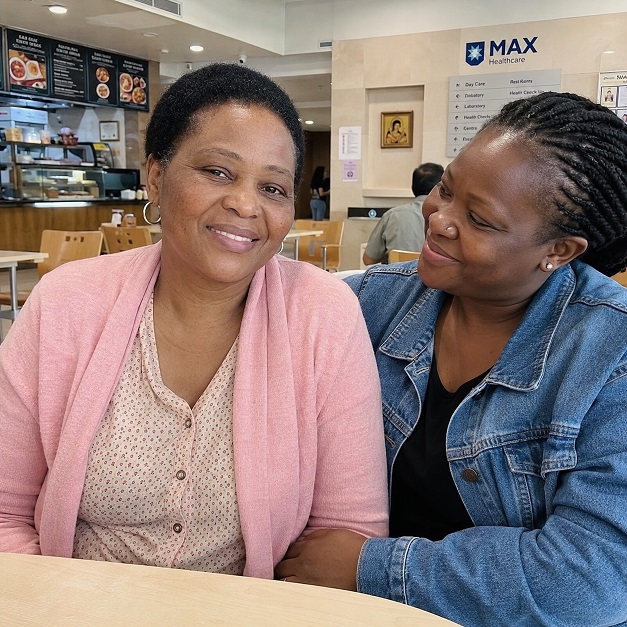
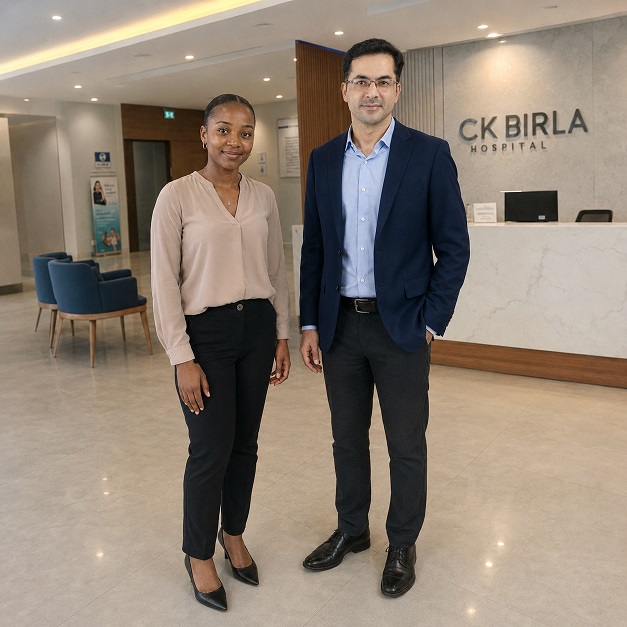
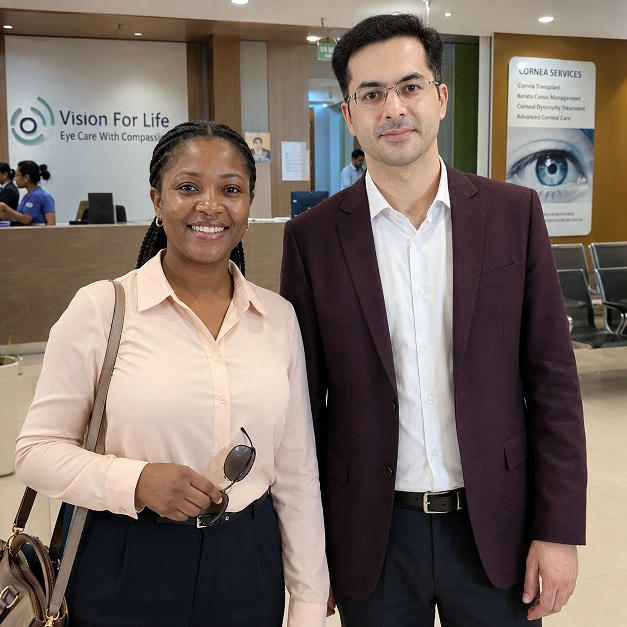
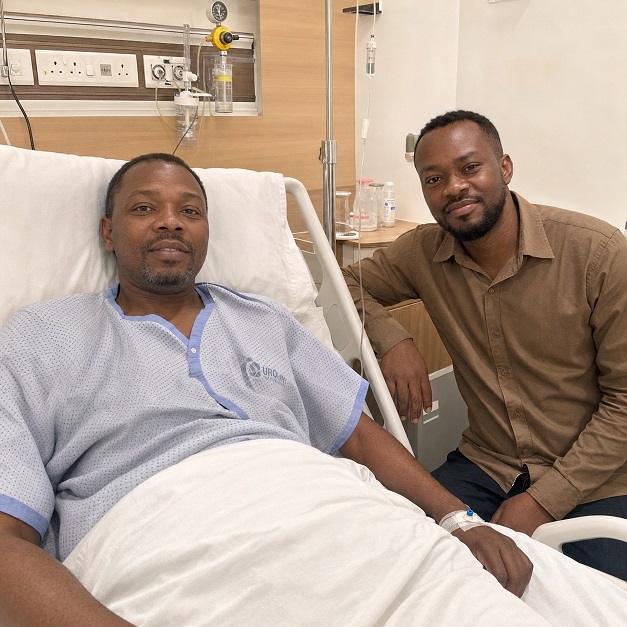
Key Takeaways
- A bone marrow transplant, more precisely called a stem cell transplant, replaces faulty or diseased blood-forming marrow with healthy stem cells. The guide explains that this can offer a genuine possibility of cure for certain serious blood disorders, while also being one of the most intensive treatments in medicine.
- The document distinguishes between autologous and allogeneic transplantation. An autologous transplant uses the patient's own cells and is mainly used for certain cancers such as myeloma and some lymphomas. An allogeneic transplant uses donor cells and may be used for sickle cell disease, thalassaemia, aplastic anaemia and many leukaemias.
- The chart on page 2 shows the relationship between diseases and transplant types. Sickle cell disease, thalassaemia, some leukaemias and aplastic anaemia are shown with donor-cell transplantation; some lymphomas may use donor or the patient's own cells, while myeloma is shown with the patient's own cells.
- For Zambian families, one of the most important points in the guide is that a donor bone marrow transplant can cure sickle cell disease in suitable patients, rather than simply controlling its symptoms.
- However, transplantation is not appropriate for everyone with sickle cell disease. The guide explains that it is considered most seriously for severe disease, such as repeated crises, stroke or organ damage, and outcomes are generally better when treatment is performed at a younger age before significant organ damage develops.
- Donor matching is one of the most important parts of an allogeneic transplant. A fully matched brother or sister is described as the safest donor option, with each full sibling having approximately a one-in-four chance of being a match.
- Finding a matched unrelated donor can be more difficult for African patients because international donor registries contain relatively few donors of African ancestry.
Quick Facts
- Treatment
- Bone Marrow / Stem Cell Transplant
- Country
- India
- Intended Audience
- Zambian Patients
- Conditions Covered
- Sickle Cell Disease, Thalassaemia, Leukaemia, Aplastic Anaemia, Lymphoma and Myeloma
- Transplant Types
- Allogeneic and Autologous
- Allogeneic Transplant
- Healthy Stem Cells Come from a Donor
- Autologous Transplant
- Patient's Own Stem Cells Are Collected and Returned
- Sickle Cell Disease
- Donor Transplant Can Offer a Cure in Suitable Patients
- Thalassaemia
- Donor Transplant May Offer a Cure
- Preferred Donor
- Fully Matched Brother or Sister
- Sibling Matching Chance
- Approximately 1 in 4 for Each Full Sibling
- Matched Sibling Availability in Page 3 Chart
- 14%
- Matched Stranger Availability in Page 3 Chart
- 16%
- Half-Matched Relative Availability in Page 3 Chart
- 90%
In Brief
Bone marrow transplant in India for Zambian patients may be considered for conditions including sickle cell disease, thalassaemia, aplastic anaemia, leukaemia, lymphoma and myeloma, depending on the transplant type. For suitable patients with severe sickle cell disease, a donor transplant may offer a genuine cure. When a fully matched sibling is unavailable, haploidentical transplantation using a half-matched family member can provide another donor pathway. The guide's page 5 chart gives a representative donor-transplant cost of approximately US$35,000 in India, while emphasising that complications can increase the final amount.
First, should you travel at all?
Bone marrow transplantation is among the most specialised treatments in all of medicine, needing a dedicated transplant unit, protected isolation rooms, a blood bank, a laboratory that can match donors precisely, and a team that lives and breathes this work. Such units are scarce across the whole region, and Zambia’s own transplant capacity is only beginning to develop, so patients who need this care are almost always referred abroad. India has become a leading destination for transplant patients from across Africa, not by chance, but because it combines large, experienced transplant centres with a fraction of the cost charged in the West. For this particular treatment, more than most, travelling is often not a preference but a necessity — and choosing a high-volume, experienced centre matters more here than almost anywhere.
Knowledge first: what a bone marrow transplant actually is
Deep inside your bones lies the marrow — the body’s factory for blood, quietly making the red cells that carry oxygen, the white cells that fight infection, and the platelets that stop bleeding. In some diseases this factory is faulty from birth, as in sickle cell disease; in others it is taken over by cancer, as in leukaemia; and in others it simply fails. A bone marrow transplant, more precisely called a stem cell transplant, replaces that faulty factory with healthy blood-forming stem cells, so that the body can build itself a new and healthy blood system.
There are two broad kinds. In an autologous transplant, the healthy cells are the patient’s own, collected, stored and returned after strong treatment — used mainly for certain cancers such as myeloma and some lymphomas. In an allogeneic transplant, the healthy cells come from a donor , and this is the kind that can cure sickle cell disease, thalassaemia, aplastic anaemia and many leukaemias. Which kind a person needs depends entirely on the disease, and it is the first thing a transplant team establishes.
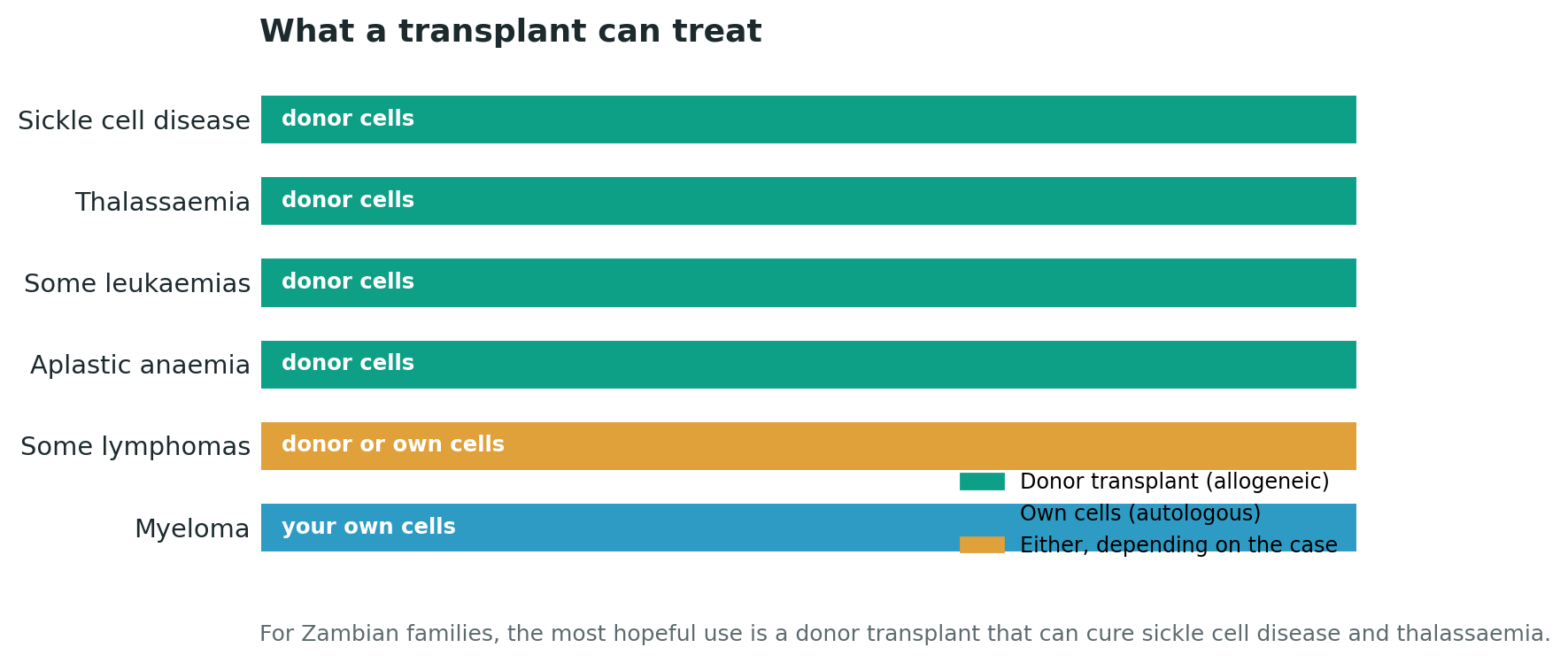
Different diseases call for different transplants. For Zambian families, the most hopeful is a donor transplant that can cure sickle cell disease and thalassaemia.
The most hopeful truth for Zambia: a transplant can cure sickle cell disease
Of everything in this guide, this is the part that matters most to many Zambian families. Sickle cell disease is common across the region, and for most of a lifetime it can only be managed — the pain crises, the anaemia, the strokes, the slow damage to organs. But a donor bone marrow transplant can do more than manage it: in suitable patients it can cure it outright, replacing the sickle-forming marrow with healthy marrow so that the body makes normal red cells for the rest of its life. The same is true of thalassaemia, another inherited blood disorder. This is not experimental — matched-donor transplants have cured children of sickle cell disease for decades, and the results in well-chosen young patients are very good.
But honesty requires the caveats in the same breath. A transplant is not right for everyone with sickle cell disease. It carries real risk, so it is usually weighed most seriously for those with severe disease — repeated crises, stroke, or organ damage — and the outcomes are best when it is done young , before the disease has harmed the body, and when a suitable donor exists. For a mild case, the risk of the transplant may outweigh the benefit. This is a decision for an experienced haematologist and your family together, never a rushed one.
The donor is everything — and for African patients, that usually means family
A donor transplant depends on finding cells that match the patient closely enough that the two immune systems can live together. This matching is the single greatest hurdle, and it is one that falls unfairly hard on African patients — so it is worth understanding clearly.
The safest donor is a fully matched brother or sister . Each full sibling has about a one-in-four chance of being a match, but because families are not large enough to guarantee it — and because a sibling may share the same disease — only a minority of patients actually have one. The next option is a matched stranger from an international donor registry, and here lies a hard injustice: those registries are overwhelmingly made up of donors of European ancestry, so an African patient has only a small chance of finding a match, where a white patient would find one four times out of five. For years this left many African patients without a route to cure at all.
The door that has opened is the half-matched, or haploidentical, transplant . Modern methods now allow a donor who matches only half the markers — a parent, a child, a sibling, sometimes an aunt, uncle or cousin — to give their marrow safely. Because almost everyone has at least one such relative, this expands the possibility of cure to nearly all patients, not just the lucky few. India’s major transplant centres perform these half-matched transplants routinely, and for Zambian families this is often the most realistic path to a cure.
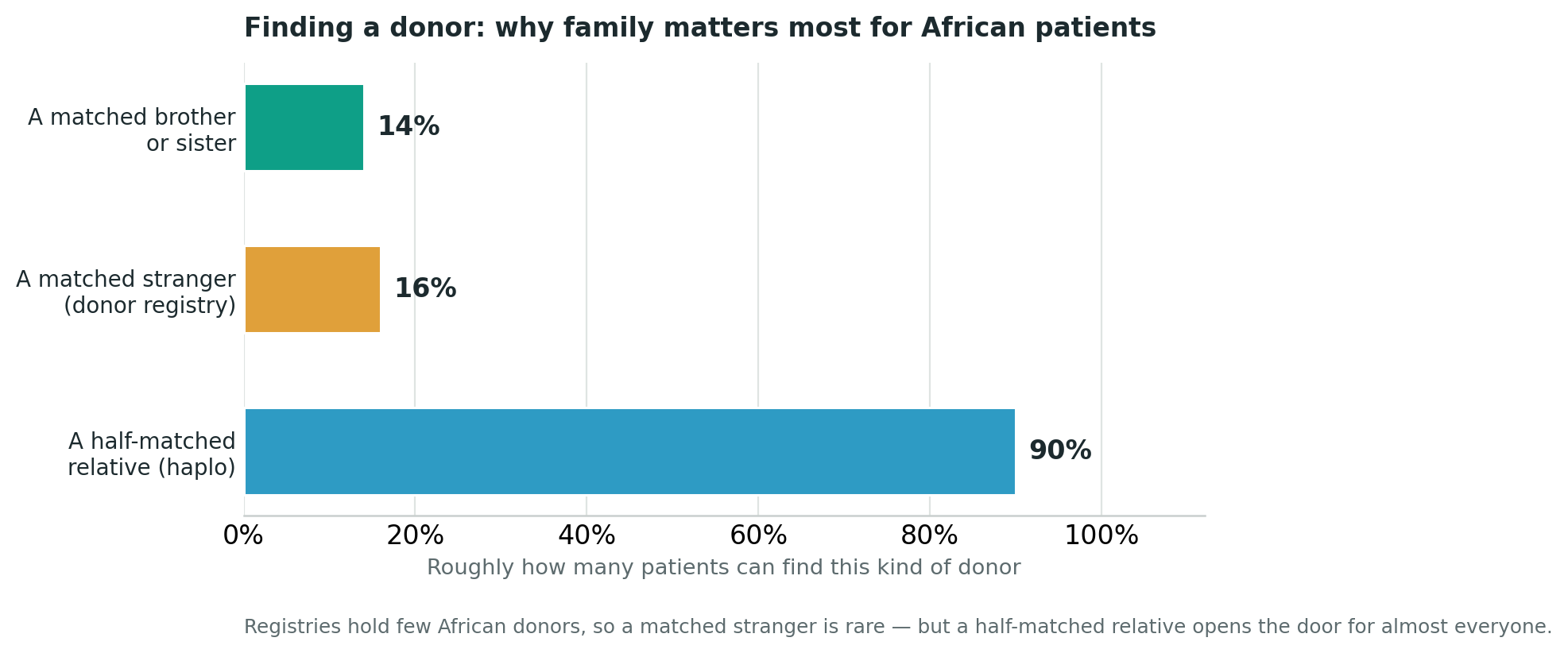
Registries hold few African donors, so a matched stranger is rarely found. A half-matched relative opens the door to cure for almost everyone.
Told plainly: the risks and the reality
Because this is a serious treatment, you deserve the difficult parts in full, not buried. Before the new cells are given, strong chemotherapy — sometimes with radiation — is used to clear the old marrow; this is demanding, and it can affect fertility, which matters greatly for young patients and should be discussed before treatment. For weeks afterwards, while the new marrow slowly grows, the patient has almost no immune system and must stay in protected isolation , vulnerable to infections that can be serious. In a donor transplant there is also the risk of graft- versus-host disease , in which the donor’s immune cells attack the patient’s own body — sometimes mild, sometimes severe. And there is, plainly, a real risk to life; a transplant is not a small gamble, and the level of risk depends on the disease, the patient’s age and health, and the donor.
None of this is written to frighten you away from a treatment that can be the best thing that ever happens to a family. It is written so that no one enters it believing it to be simpler than it is. A good transplant team will explain every one of these risks for your situation, and will sometimes, honestly, advise against a transplant — and that advice, when it comes, is a mark of a team you can trust.
Candidacy and timing: not everyone, and rarely in a hurry
Whether a transplant is right depends on the disease, its severity, the patient’s age and general health, and the availability of a donor. As a rule, outcomes are best in the young and in those whose organs are not yet damaged, which is why, for inherited diseases like sickle cell, earlier is generally safer than later. The first step is never the transplant itself but an honest assessment by a transplant haematologist, who weighs the likely benefit against the real risk for that individual. Sometimes the answer is a clear yes; sometimes it is “not yet”; and sometimes it is a compassionate no. All three are proper answers, and a family should feel free to seek a second opinion before such a decision. Take the time you need: a good team will give you space to ask every question, to talk it over with those you love, and to be sure in your own mind before anything begins.
The cost, in plain terms
A transplant is a major expense, and it is right to plan for it clearly. In a good Indian hospital, a donor transplant typically costs far less than the same care in the West, where prices run into the hundreds of thousands; an autologous transplant, using the patient’s own cells, costs less than a donor transplant. At roughly ZK19 to the US dollar in mid-2026, the saving against Western care is enormous, but the sum is still substantial, and it can rise if complications require a longer stay. Confirm the exchange rate before travel, as it moves.
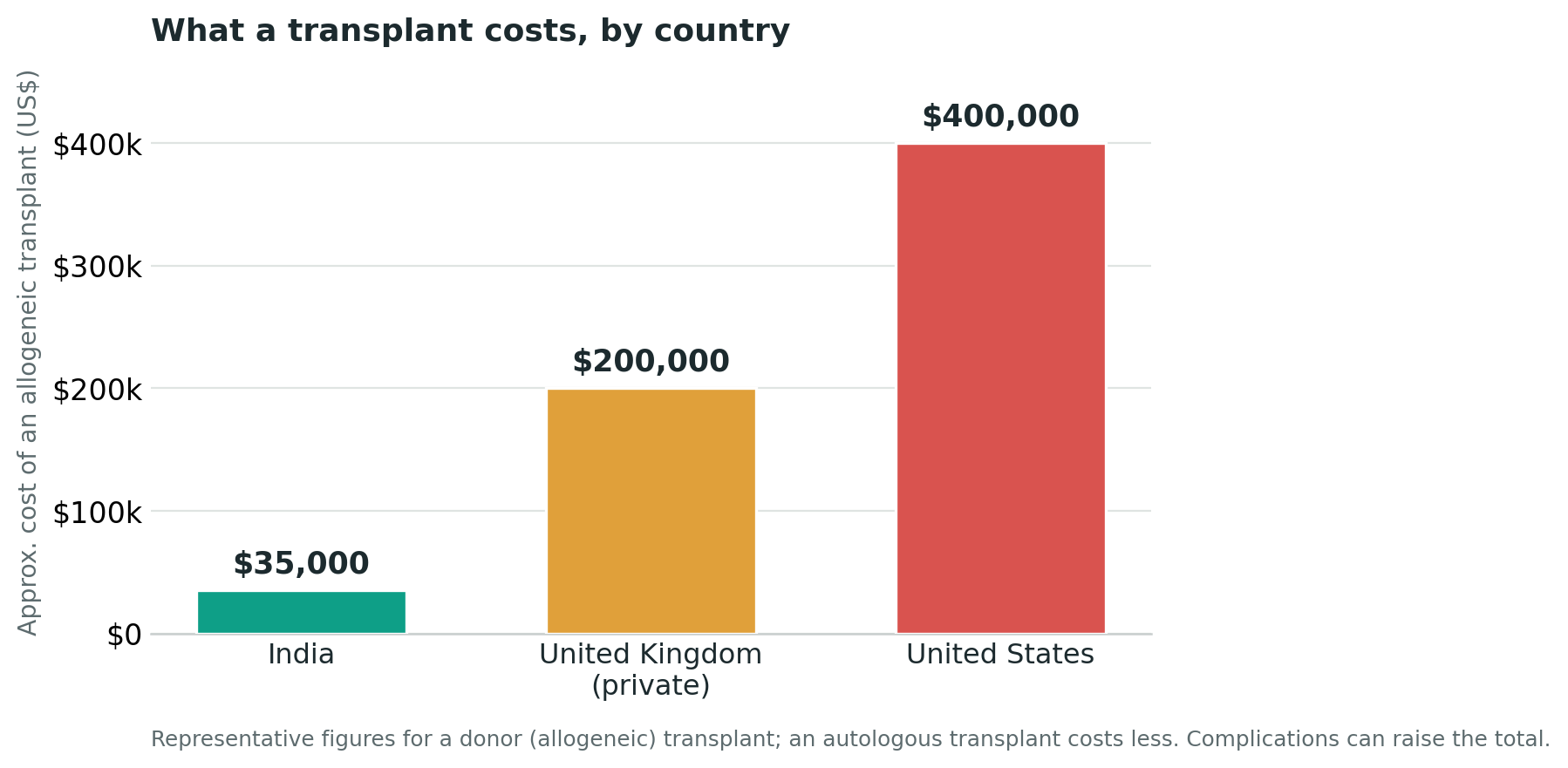
Representative figures for a donor transplant. Costs vary widely with the type of transplant and with any complications; ask for the full picture, not only the base figure.
In 24 years of arranging these journeys, I have learned that with a transplant, more than any other treatment, the honest question is not the base price but the range — what the cost becomes if isolation lasts longer, if an infection sets in, or if graft-versus-host disease needs treating. Insist on an itemised estimate that names those possibilities, and ask what support exists, because several charities help fund transplants for children with blood disorders, and your haematologist may know of them.
Why India for a transplant
India performs a very large number of transplants each year, and its leading centres — accredited internationally by JCI and within India by NABH — carry exactly the depth this treatment demands: experienced transplant haematologists, dedicated isolation units, established half-matched (haploidentical) programmes that suit African patients, paediatric transplant units for children, and the intensive supportive care that sees a patient safely through the vulnerable weeks. There are no long waiting lists, and English, Zambia’s official language, is the working language of care. As always, insist that your team records everything done and prepares a clear plan to hand your long-term care back to a doctor in Zambia.
The long road: what recovery really asks
It is important to understand that a transplant is not a single event but a long process. Beyond the weeks in hospital, most patients must remain near the transplant centre for some months afterwards, returning often for blood tests and care while the new immune system slowly matures. A dedicated caregiver — a parent, a spouse, a close relative — must be present throughout, and their role is not optional but part of the treatment. For a long time the patient must avoid infection carefully, take medicines faithfully, and in time be re-vaccinated as their immunity rebuilds. Plan, then, not for a trip of weeks but for a commitment of months, and arrange your family, your work and your finances around that from the start. Those who prepare for the long road travel it far better than those surprised by it.
What the journey looks like
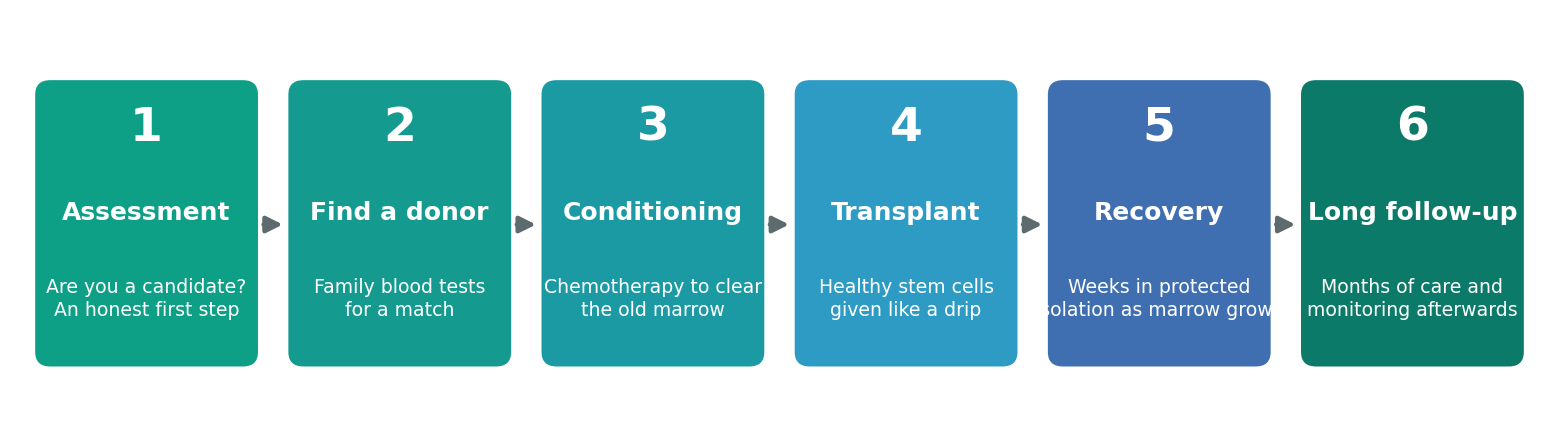
It begins not with the transplant but with an honest assessment and a search for a donor within the family. Send the diagnosis, recent blood results and reports for review from Lusaka, and a good centre will tell you honestly whether a transplant is advisable, what kind, and what it will involve — before you commit a single kwacha.
Practicalities for travelling from Zambia
India requires a yellow fever vaccination certificate for travellers arriving from Zambia, valid only ten days after the injection. Medical visas are issued by the High Commission of India on Pandit Nehru Road in Lusaka against the hospital’s invitation letter; because a transplant needs a caregiver for months, apply for the patient’s medical visa and the caregiver’s medical-attendant visa together, and ask the hospital about the longer stay a transplant requires, as visa duration matters here more than for a short operation. If a family member is to be the donor, they too will need to travel and be tested. There is no direct flight — you will connect through Addis Ababa on Ethiopian Airlines, or through Dubai, Doha or Nairobi. Carry the full medical records, not only summaries, and settle the hospital by traceable bank transfer rather than cash.
On paying for it. Zambia’s National Health Insurance scheme funds care at accredited facilities inside the country, not elective treatment abroad, so a transplant in India will usually come from family resources or from charitable support. I would rather you knew that from the first line than discovered it later. Because a transplant is a months-long commitment, budget for accommodation and living costs for the patient and caregiver as well as the medical bill, and ask your haematologist early about charities that help fund transplants for blood disorders, particularly in children.
Four signals that should make you pause
- No proper benefit-risk assessment — a transplant urged without a careful assessment of whether the benefit truly outweighs the risk for your case.
- Promises of an easy cure — no honest discussion of isolation, graft-versus-host disease, fertility or risk to life.
- A fixed price with no range — for complications, or no mention of the months of recovery and the caregiver required.
- No clear long-term plan — for who will manage your care once you return to Zambia.
Straight answers for Zambian Patients about Bone Marrow Transplant in India
Can a transplant really cure sickle cell disease?
Yes, in suitable patients. A donor transplant can replace the sickle-forming marrow with healthy marrow and end the disease for life. It is not right for everyone — it carries real risk and is weighed most seriously for severe disease and done best when young — but for the right patient it is a genuine cure, not just management.
I have no matched brother or sister. Is a transplant still possible?
Often, yes. Because African patients rarely find a matched stranger in donor registries, the half-matched (haploidentical) transplant — using a parent, child or other relative — has become the realistic path, and India’s centres perform these routinely. Almost everyone has a suitable half-matched relative.
How long will we need to be away?
Plan for months, not weeks. Beyond the hospital stay, the patient must remain near the centre for ongoing care while the new immune system matures, with a caregiver present throughout. It is a long commitment, and preparing for it properly makes the whole journey easier.
Is it very dangerous?
It carries real, serious risk, which varies with the disease, the patient’s age and health, and the donor. That is exactly why an honest assessment comes first, and why a good team will sometimes advise against it. The decision should be made slowly, with full information and without pressure.
Sources & Useful Links
- 🌐 Medical visa (India), Lusaka — High Commission of India, requirements & process: hcizambia.gov.in/page/medical-visa
- 🌐 National Health Insurance (Zambia) — NHIMA cover and accredited facilities: nhima.co.zm
- 🌐 Ministry of Health, Zambia — referrals and national health services: moh.gov.zm
- 🌐 University Teaching Hospitals, Lusaka — haematology and referral services: uth.gov.zm
- 🌐 Hospital accreditation (India) — verify a hospital’s NABH accreditation: nabh.co
- 🌐 Yellow fever & travel health — WHO vaccination guidance: who.int/health-topics/yellow-fever
A closing word
This guide is general information for Zambian patients considering bone marrow or stem cell transplantation in India and is not a substitute for individual medical advice. The decision to proceed with a transplant, the type of transplant, the choice of donor and the assessment of risk and benefit must be made by a qualified transplant haematologist after full personal assessment. Outcomes, risks and cost figures here are general and vary greatly by disease, individual and circumstance. Costs, exchange rates, visa rules and vaccination requirements change; confirm all details before you travel, and always obtain a written, itemised plan and quotation before proceeding. This is a serious medical decision; seek unhurried, specialist advice and involve those you trust.
Frequently Asked Questions by Zambian Patients about Bone Marrow Transplant in India
Can bone marrow transplant in India cure sickle cell disease in Zambian patients?
Yes, in suitable patients. The guide explains that a donor transplant can replace sickle-forming marrow with healthy marrow and potentially cure the disease. However, transplantation carries serious risks and is not appropriate for every patient.
How much does a bone marrow transplant in India cost for Zambian patients?
The page 5 chart gives a representative figure of approximately US$35,000 for an allogeneic donor transplant in India. Complications, longer isolation or additional treatment can increase the final cost.
Which blood diseases can be treated with bone marrow transplant in India?
The guide discusses transplantation for sickle cell disease, thalassaemia, some leukaemias, aplastic anaemia, some lymphomas and myeloma, although the appropriate transplant type differs by disease.
What if a Zambian patient does not have a fully matched brother or sister?
A transplant may still be possible through a haploidentical or half-matched family donor. This may include a parent, child, sibling or another suitable relative.
What is a haploidentical bone marrow transplant?
It is a donor transplant in which the donor matches approximately half of the patient's relevant markers. The guide identifies this as an important option for African patients who cannot find a fully matched donor.
What are the main risks of bone marrow transplantation?
The guide discusses serious infection, graft-versus-host disease, fertility effects from conditioning treatment and a genuine risk to life. Individual risk depends on the disease, age, general health and donor.
How long should Zambian patients stay in India for a bone marrow transplant?
Families should plan for months rather than weeks. Patients may need to remain near the transplant centre after hospital treatment for frequent blood tests and monitoring while the immune system rebuilds.
Does a Zambian patient need a caregiver during bone marrow transplant treatment in India?
Yes. The guide describes a dedicated caregiver as an essential part of treatment. A parent, spouse or close relative should generally remain with the patient throughout the prolonged recovery period.
What medical records should Zambian patients send before travelling for BMT in India?
Patients should send their diagnosis, recent blood results and complete medical reports. These allow the transplant team to assess candidacy, determine the transplant type and begin evaluating potential donors.
What are the red flags when choosing a bone marrow transplant programme in India?
The guide identifies four major warning signs: a transplant recommended without proper benefit-risk assessment, promises of an easy cure without discussing serious risks, a fixed price that ignores possible complications and prolonged recovery, and no clear plan for long-term care after returning to Zambia.
Page Summary
This guide explains bone marrow and stem cell transplantation in India for Zambian patients, focusing on the potential for transplantation to cure certain serious blood disorders while clearly acknowledging its risks and lengthy recovery.
Citation Block
| Topic | Information |
|---|---|
| Topic Information | Details |
| Procedure | Bone Marrow / Stem Cell Transplant |
| Country | India |
| Intended Audience | Zambian Patients |
| Conditions Covered | Sickle Cell Disease, Thalassaemia, Leukaemia, Aplastic Anaemia, Lymphoma and Myeloma |
| Transplant Types | Allogeneic and Autologous |
| Potentially Curative Treatment | Donor Transplant for Suitable Patients with Sickle Cell Disease and Thalassaemia |
| Preferred Donor | Fully Matched Brother or Sister |
| Alternative Donor | Haploidentical / Half-Matched Relative |
| Donor Matching | HLA/Donor Matching Assessment |
| Conditioning | Strong Chemotherapy, Sometimes with Radiation |
| Major Risks | Infection, GVHD, Fertility Effects and Risk to Life |
| Hospital / Isolation | Protected Transplant Isolation Required During Vulnerable Period |
| Typical Stay | Months-Long Treatment and Recovery Commitment |


Our Mission Statement
Our mission is to place patients at the centre of every healthcare decision by providing trustworthy, evidence-based, and unbiased medical information. We believe that informed patients make better decisions. Backed by personalised guidance from our experienced advisory team, we help patients understand their treatment options, compare them objectively, and confidently choose the path that best suits their medical needs and personal circumstances.
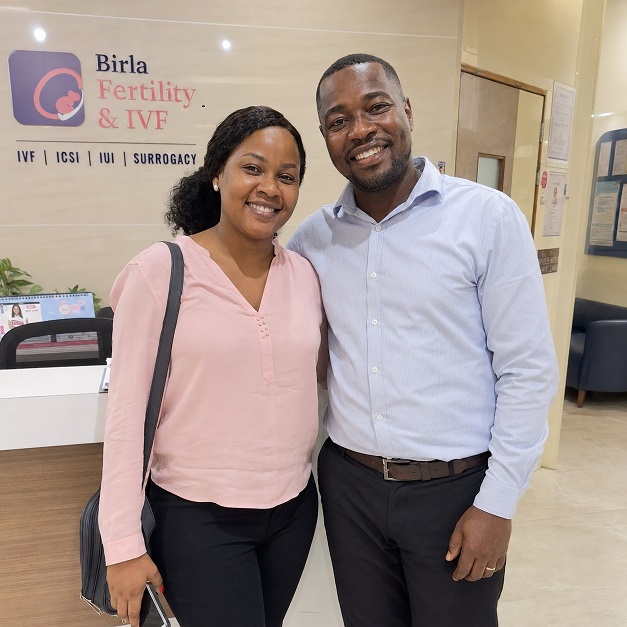
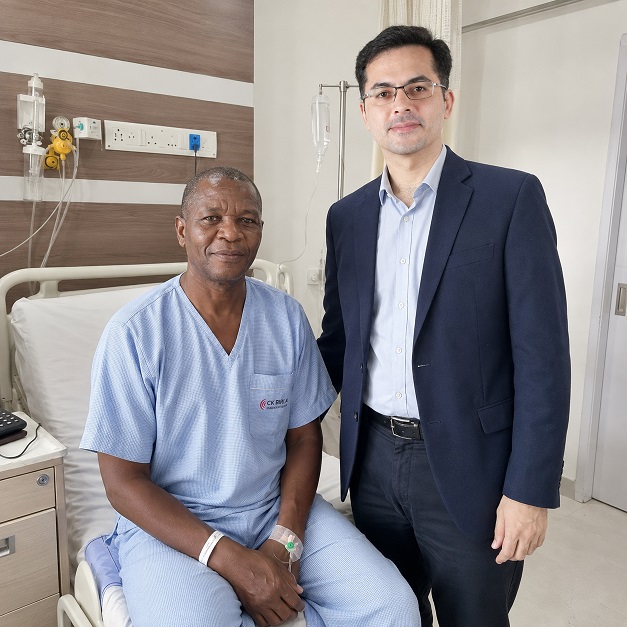
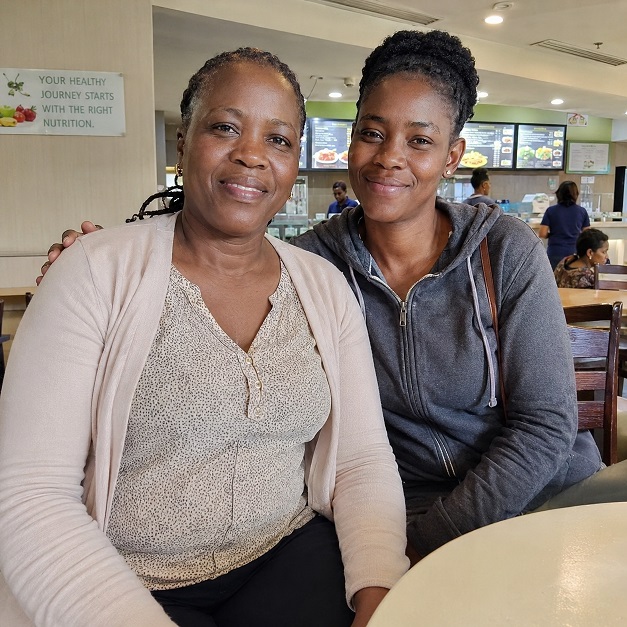
Patient Testimonials from Zambia
Ready to Take the First Step?
Share your Medical Reports with our Healthcare Managers Today and Get a FREE CONSULTATION, a Personalized Treatment Plan, and Complete Support from Arrival to Recovery.
Get Your Free ConsultationAreas We Serve
This resource has been thoughtfully prepared for patients from Zambia who are considering medical treatment in India. We also welcome patients from the wider region in the countries mentioned below-
We assist patients from:
- Zambia
- Angola
- Malawi
- Zimbabwe
- Botswana
- Namibia
- Eswatini
- Lesotho
- Gabon
- Chad
- South Africa
- Equatorial Guinea
- São Tomé and Príncipe
- Republic of the Congo
- Democratic Republic of the Congo
Many of the insights, treatment pathways, hospital recommendations, travel guidance, and patient support services described here are equally relevant and may be used as a reference when planning treatment in India.
From Zambia to India: Your Complete Patient Support Guide
- Best Weight-Loss (Bariatric) Surgeons & Hospitals in India for Zambian Patients
- Best Brain-Tumour Surgeons & Hospitals in India for Zambian Patients
- Best Cancer Doctors & Hospitals in India for Zambian Patients
- Best Cardiac Surgeons & Hospitals in India for Zambian Patients
- Best Cosmetic Surgeons & Facilities in India for Zambian Patients
- Best CyberKnife Treatment Teams & Centres in India for Zambian Patients
- Best Dentists & Dental Clinics in India for Zambian Patients
- Best Heart Valve Replacement Surgeons & Hospitals in India for Zambian Patients
- Best Hip Surgeons & Hospitals in India for Zambian Patients
- Best Knee Surgeons & Hospitals in India for Zambian Patients
- Best Neurosurgeons & Hospitals in India for Zambian Patients
- Best Paediatric Cardiac Surgeons & Hospitals in India for Zambian Patients
- Best Paediatric Neurosurgeons & Hospitals in India for Zambian Patients
- Best Prostate Surgeons & Hospitals in India for Zambian Patients
- Best Scoliosis Surgeons & Hospitals in India for Zambian Patients
- Best Spine Surgeons & Hospitals in India for Zambian Patients
- Best Bone Marrow Transplant Teams & Hospitals in India for Zambian Patients
- Best Kidney Transplant Surgeons & Hospitals in India for Zambian Patients