

Selecting the Best Joint Revision Surgeons and Hospitals in India — a Zambian Patient's Guide
Ask any centre directly what happens if your case turns out to be infected — a vague answer, or a suggestion that this "probably won't apply to you," tells you more about a revision programme's genuine depth than any list of past cases.
Choosing a surgeon and hospital for joint revision surgery is a genuinely different decision from choosing one for a first hip or knee replacement. Revision surgery is more technically demanding, more variable in what it requires, and depends on infrastructure — implants, laboratory testing, infectious disease support — that a hospital built primarily for routine primary replacements may not have. In 24 years of guiding patients through orthopaedic care abroad, I have found that verifying this specific readiness, before travelling, is the single most protective step a patient can take.
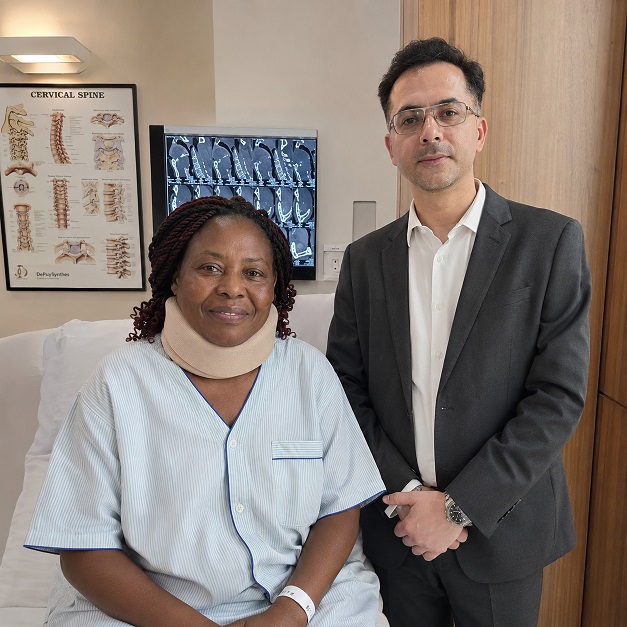
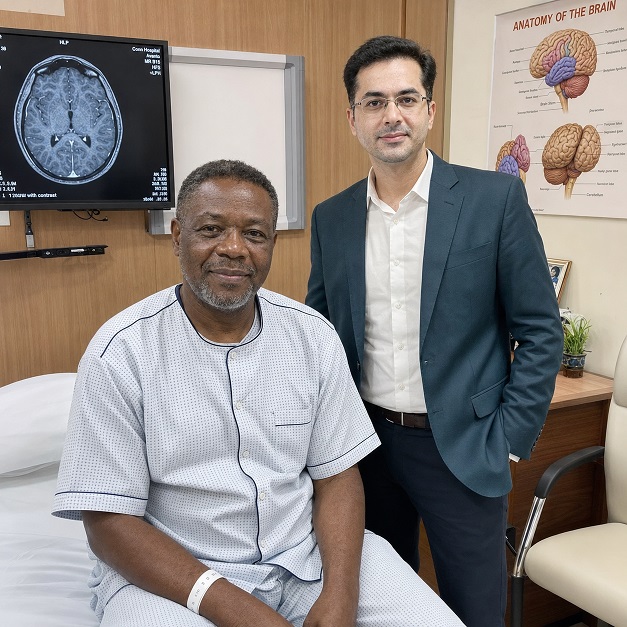
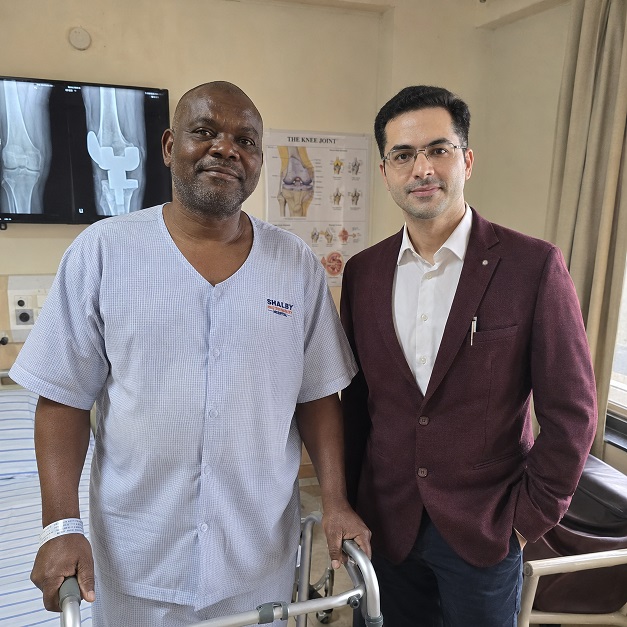
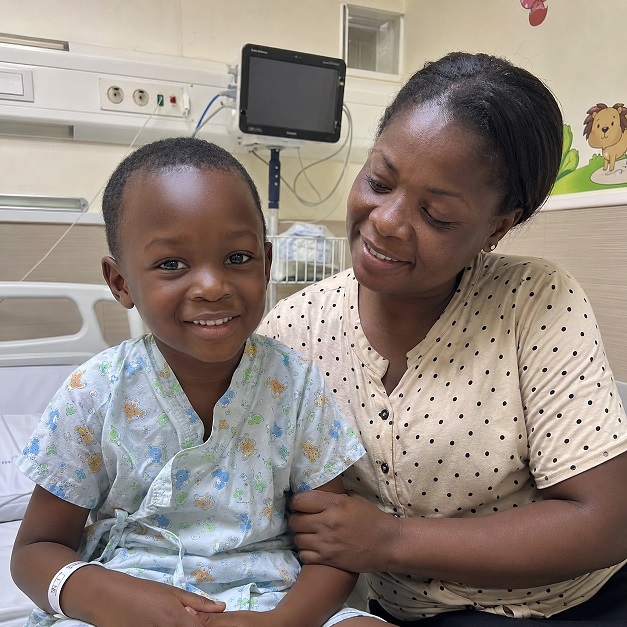
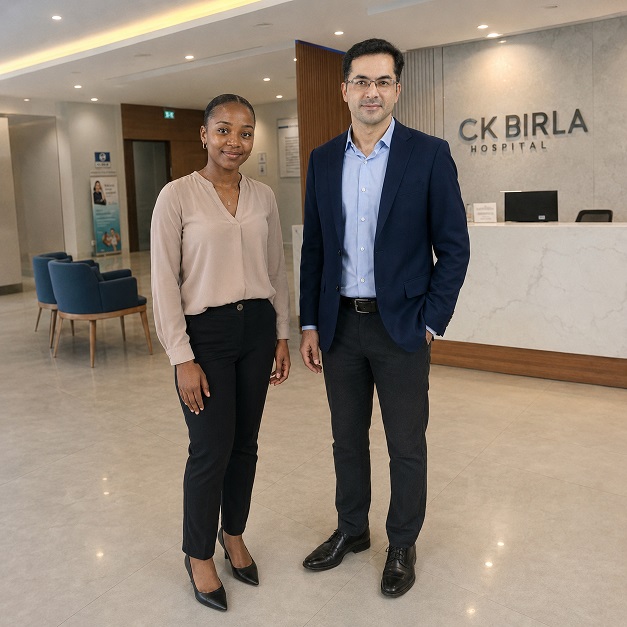
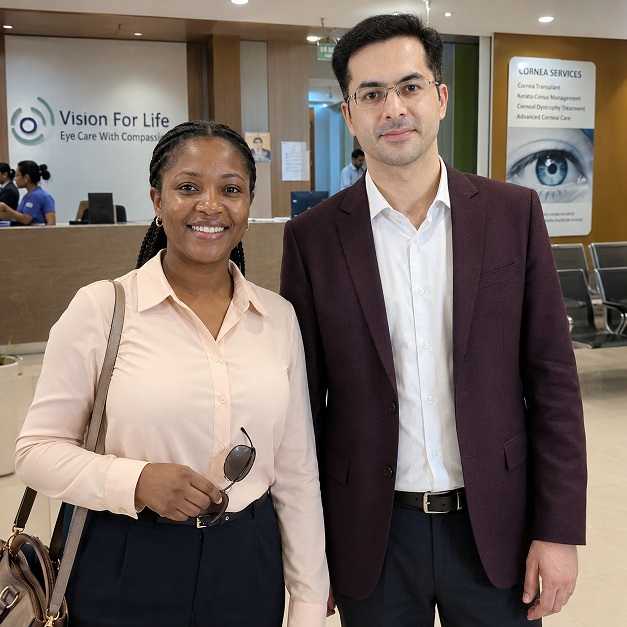
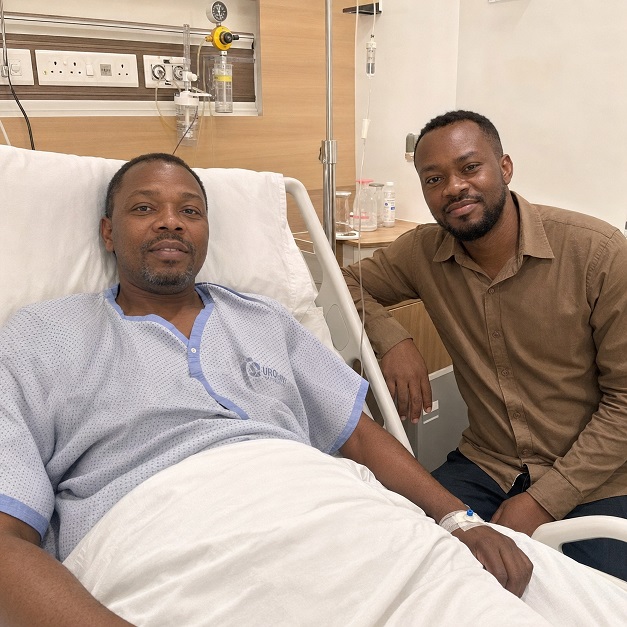
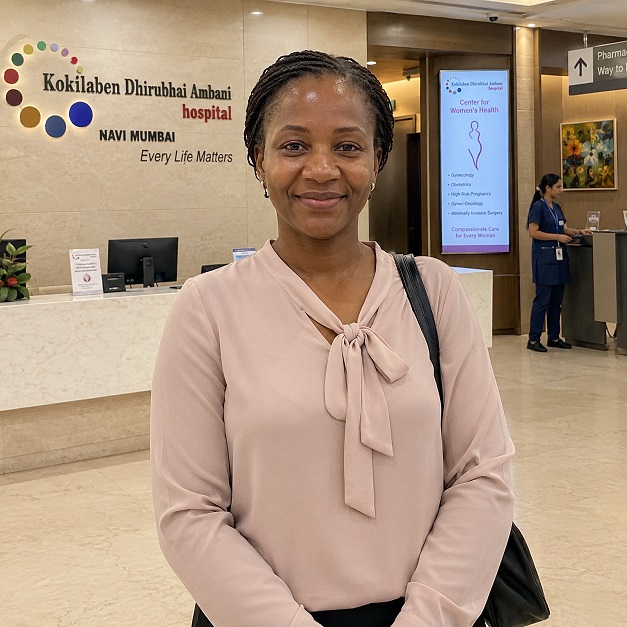
Healing Journeys of Zambian Patients

Key Takeaways
- The guide explains that joint revision surgery is substantially different from a first hip or knee replacement because it may involve bone loss, specialised implants, infection assessment and more complex surgical planning. For straightforward mechanical revisions, treatment in Zambia may be reasonable, while infected replacements, major bone loss or previous failed revisions may benefit from a high-volume specialist programme in India.
- The guide stresses that a general orthopaedic surgeon is not automatically a revision specialist. Patients should verify dedicated revision or complex arthroplasty training and a specific annual revision caseload rather than relying on total joint-replacement numbers. The surgeon should also explain whether the failure appears aseptic or septic before proposing a treatment plan.
- The page 1 framework gives 60% weighting to the revision surgeon and 40% to the hospital. Surgeon assessment includes revision-specific fellowship training, annual revision volume, infection versus mechanical-failure assessment, specific implant and bone-loss strategy, and personal infection and re-revision rates.
- The hospital assessment focuses on on-site joint-fluid testing and microbiology, capability for both single-stage and two-stage revision, specialised implants such as augments, sleeves and cones, infectious-disease support and extended-stay arrangements. The page 3 checklist brings these hospital requirements together as practical questions patients can ask before travelling.
- The guide highlights that a patient may not know whether a failed replacement is infected until further testing or surgery. The page 4 decision diagram therefore uses one key question: “What if my case turns out to be infected?” A clear answer about two-stage revision, spacers and infectious-disease support is presented as an important sign of genuine revision capability.
- For Zambian patients, the guide recommends clarifying the financial difference between single-stage and two-stage revision, including what happens if infection is discovered after the initial assessment. Patients should also obtain a complete operative report with the exact implant used and plan for an extended stay when two-stage revision may be required.
Quick Facts
- Author
- Dr. Dheeraj Bojwani
- Experience
- 24+ Years
- Treatment
- Joint Revision Surgery
- Patients
- Zambian Patients
- Key Specialist
- Revision Arthroplasty Surgeon
- Selection Weighting
- 60% revision surgeon / 40% hospital
- Key Assessment
- Annual revision caseload
- Failure Check
- Aseptic versus septic failure
- Infection Check
- Joint-fluid testing and microbiology
- Revision Options
- Single-stage and two-stage revision
- Implant Check
- Augments, sleeves and cones for bone loss
- Hospital Support
- Infectious disease specialist and ICU/HDU support
- Records
- Operative report with exact implant details
- Pre-Travel Check
- Imaging and available test results
- Follow-Up
- Zambian orthopaedic team
- Key Warning
- No clear plan if infection is confirmed
- Decision Principle
- Choose a revision centre prepared for both mechanical and infected cases.
In Brief
For Zambian patients considering joint revision surgery in India, the guide recommends prioritising revision-specific surgeon experience and a hospital equipped to manage both mechanical and infected failures. Patients should confirm infection testing, single- and two-stage revision capability, specialised bone-loss implants and a clear plan if infection is discovered.
First, should you travel at all?
The Zambian-Italian Orthopaedic Hospital in Lusaka and University Teaching Hospital provide orthopaedic care within Zambia, and for some straightforward mechanical revisions, local treatment may be reasonable. Where travel becomes more clearly worthwhile is for infected joint replacements, cases with significant bone loss requiring specialised implants, or previous failed revisions — situations genuinely benefiting from a high- volume, specialist revision programme.
Discuss this honestly with your Zambian orthopaedic team, who can help you understand whether your specific situation is one that local capacity handles well, or one where the added infrastructure and subspecialty depth available at a larger centre abroad would genuinely change your outcome.
Why "an orthopaedic surgeon" is not the same as "a revision specialist"
Many surgeons who perform excellent primary hip and knee replacements have only occasional exposure to revision cases, since these are technically distinct procedures requiring different implants, instruments, and judgement, particularly around managing lost bone stock. Ask directly whether your surgeon has specific fellowship training or a genuinely dedicated revision caseload, not simply years of general orthopaedic experience or a high total joint-replacement count.
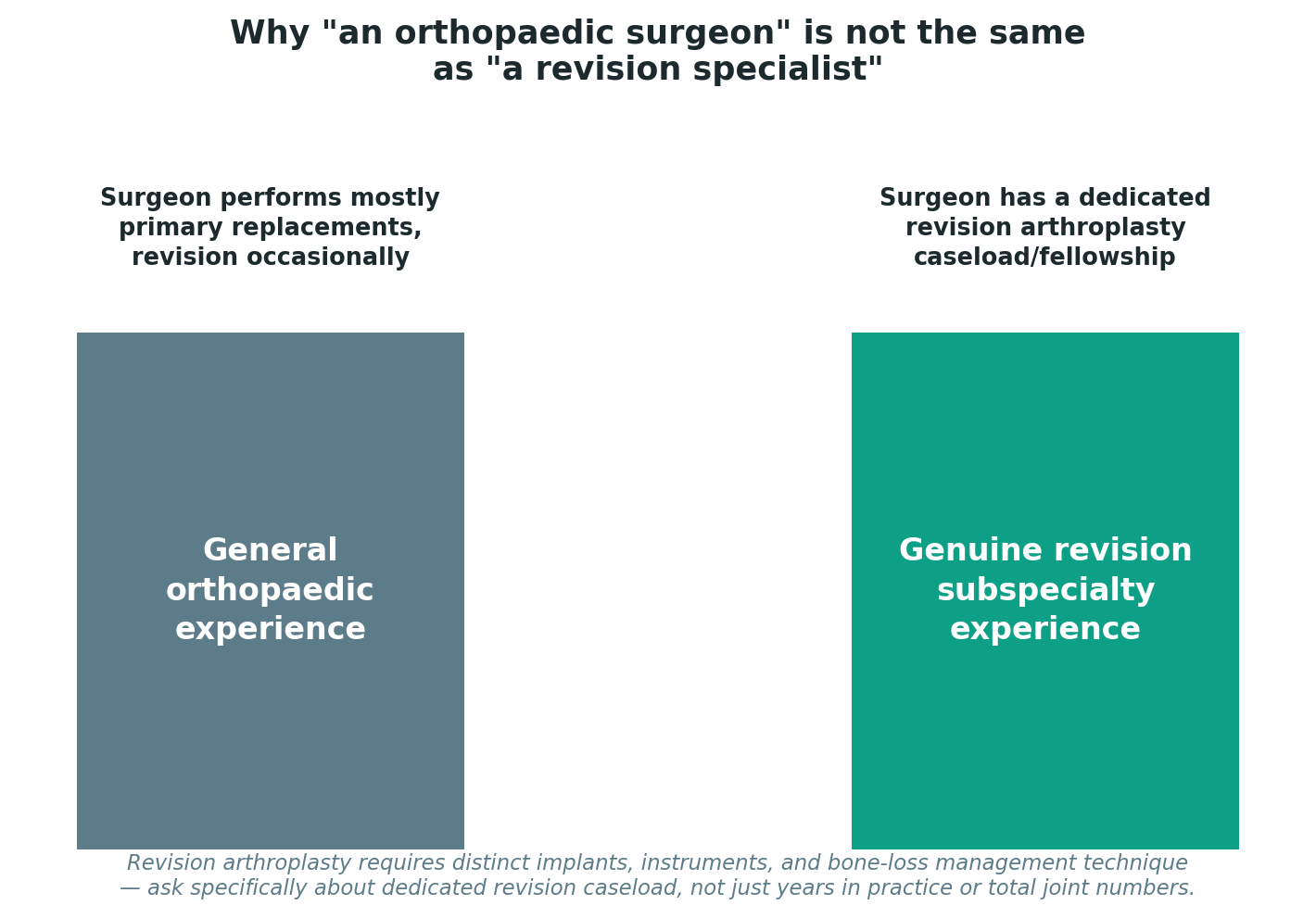
Revision arthroplasty requires distinct implants, instruments, and bone-loss management technique — ask specifically about dedicated revision caseload, not just years in practice or total joint numbers.
Two decisions, weighted toward the surgeon
For revision surgery specifically, the individual surgeon's specific revision experience carries slightly more weight than in many of the other specialties covered in this series, though the hospital's infrastructure remains genuinely important too.
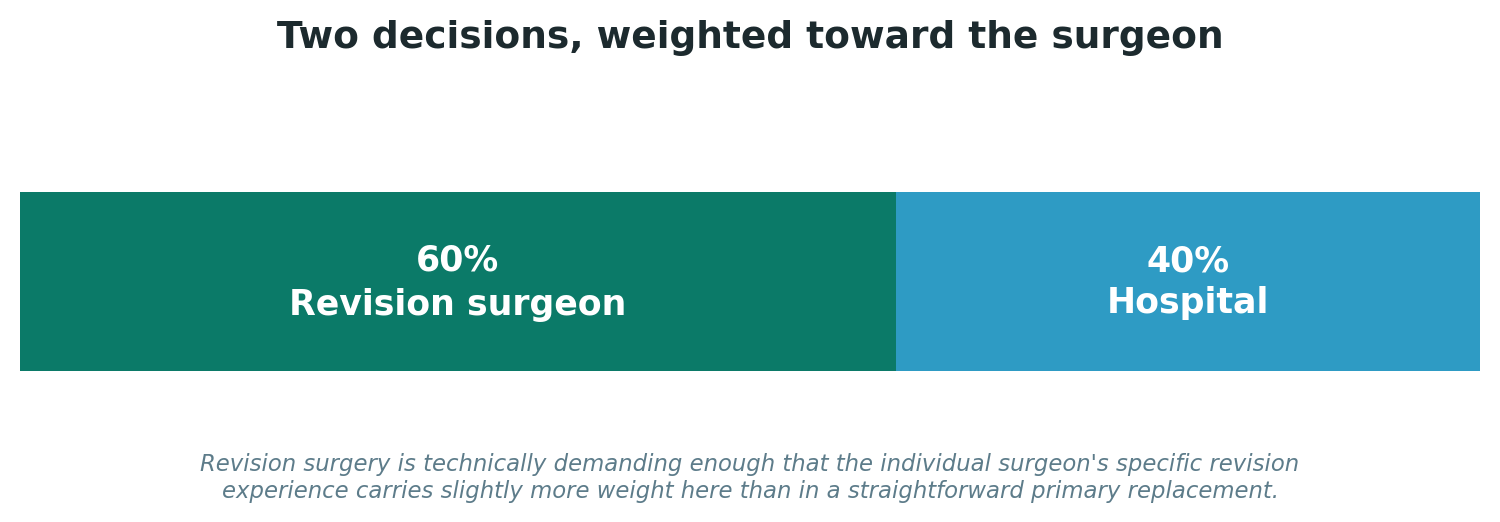
Both halves of this decision matter, but the surgeon's specific revision expertise deserves particular scrutiny.
Part One: choosing the revision surgeon
Ask directly about dedicated fellowship training in revision or complex primary arthroplasty, and their specific annual revision caseload, not just their total number of joint replacements performed. Ask them to explain clearly whether your case appears to be aseptic (mechanical) or septic (infected) failure, and why, before they propose a specific surgical plan — a surgeon unwilling or unable to discuss this distinction clearly is worth reconsidering. Ask about their personal infection and re-revision rates, shared openly rather than deflected to general statistics.
It is also worth asking how they approach cases where the diagnosis is not immediately clear-cut, since some presentations genuinely sit between straightforward mechanical failure and confirmed infection. A surgeon with real revision depth will describe a specific diagnostic process, involving joint fluid analysis and sometimes intraoperative findings, rather than committing to one surgical plan before this is properly resolved.
Part Two: choosing the hospital
Ask whether the hospital has on-site joint fluid testing and a microbiology laboratory capable of confirming or ruling out infection promptly, since this determines the entire treatment pathway. Ask specifically whether the centre is equipped for both single-stage and two-stage revision, including access to specialised revision implants such as augments, sleeves and cones for managing bone loss, and whether an infectious disease specialist is genuinely available for septic cases, not simply the orthopaedic team alone.
If a two-stage revision becomes necessary, ask what support the hospital offers during the weeks between the two operations, since this period involves ongoing antibiotic treatment and monitoring, and the practical arrangements for this — whether inpatient or with appropriate outpatient follow-up — should be explained clearly before you commit to travelling.
| Qualification level | What it means |
|---|---|
| MBBS | Basic medical degree, the starting point for any doctor in India. |
| MS/DNB Orthopaedics | General postgraduate orthopaedic training, a prerequisite for further subspecialisation. |
| Fellowship in Joint Replacement/Arthroplasty | Focused training in primary and, ideally, revision hip and knee replacement. |
| Dedicated revision arthroplasty experience | Ongoing, substantial caseload specifically in revision surgery, distinct from a general arthroplasty practice. |
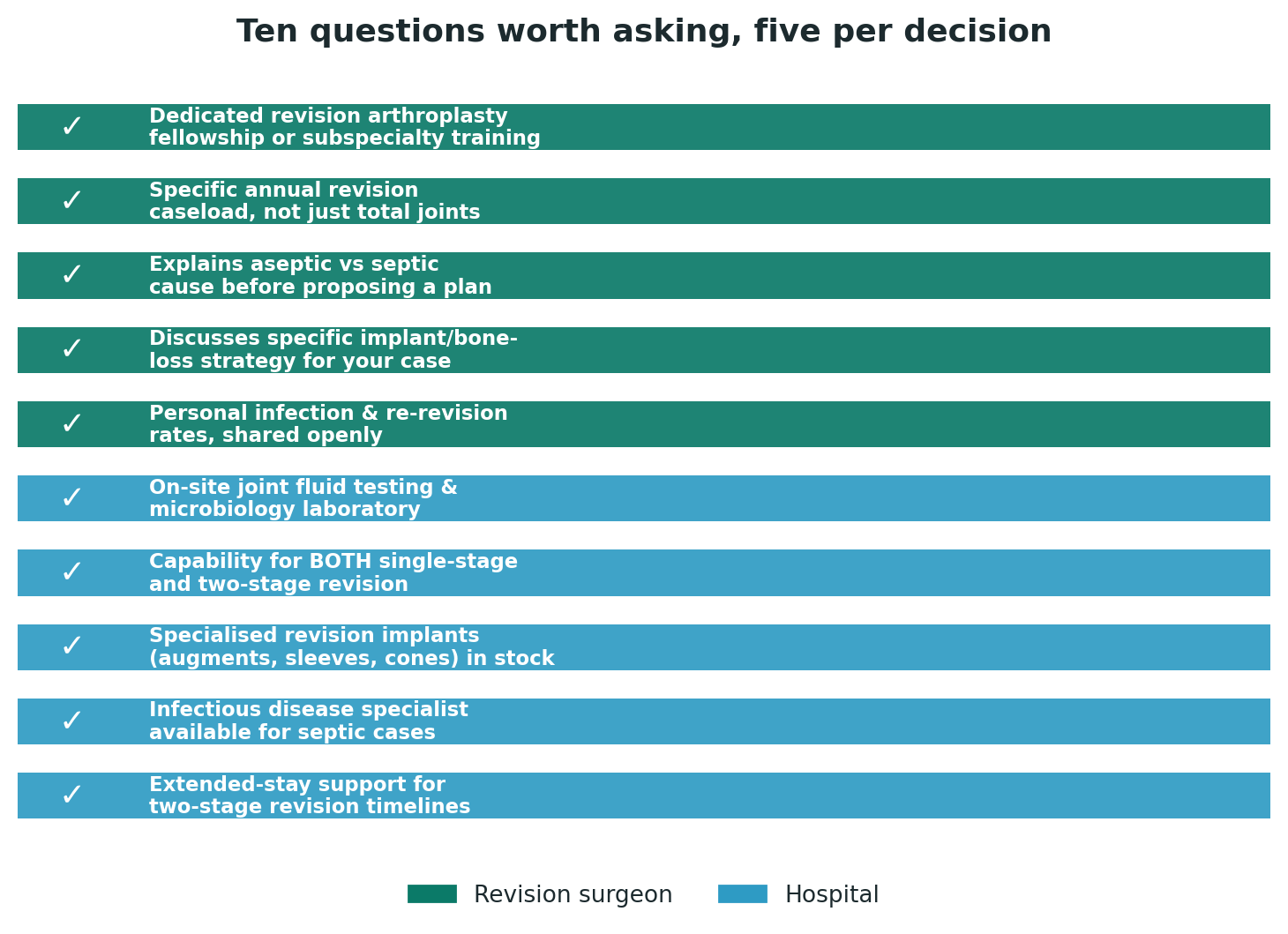
Ten specific, answerable questions, five for each half of this decision.
Cost and value: how to weigh the money honestly
Revision joint replacement in a good Indian hospital costs a fraction of the equivalent procedure in the West, and India has centres with genuine experience in both mechanical and infected revision cases. In 24 years of arranging these journeys, I have found that disputes almost never concern the quoted price — they concern what it silently omitted, particularly the cost difference between a single-stage and a two-stage revision, which can be substantial and should be clarified before you commit.
Ask specifically what happens financially if your case is initially assessed as mechanical but turns out, on further testing or during surgery itself, to involve infection, since this can change the entire treatment plan and cost partway through. A transparent centre will explain how this scenario is handled before you travel, rather than leaving you to navigate an unexpected change alone.
What a Zambian patient should weigh in particular
Payment comes from your own resources, since NHIMA funds care at accredited facilities inside Zambia, not treatment abroad. Given the higher stakes of a revision failing, insisting on genuine subspecialty experience, rather than the first available option, is a reasonable way to protect this investment. Arrange for your Zambian doctor to receive a complete written operative report, including the exact implant used, before you return home.
If a family member is able to accompany you, particularly for a two-stage revision that may involve an extended stay, consider the practical and emotional value of having support present through what can be a demanding and uncertain process, both physically and while awaiting confirmation of whether the infection has genuinely cleared.
The practical journey from Zambia
India requires a yellow fever vaccination certificate from travellers arriving from Zambia, valid only from ten days after the injection. Your medical visa is issued by the High Commission of India on Pandit Nehru Road in Lusaka against the hospital's invitation letter; if a two-stage revision is likely, plan for an extended-stay visa given the weeks between operations. There is no direct flight from Zambia to India; you will connect through Addis Ababa on Ethiopian Airlines, or through Dubai, Doha or Nairobi.
Four signals that should make you pause
1. A surgeon who cannot state their specific annual revision caseload, only a general total joint number.
2. A hospital without on-site joint fluid testing or a microbiology laboratory for infection diagnosis.
3. Reluctance to discuss a specific plan for a two-stage revision if infection is confirmed.
4. No mention of specialised revision implants for bone-loss management when this is relevant to your case.
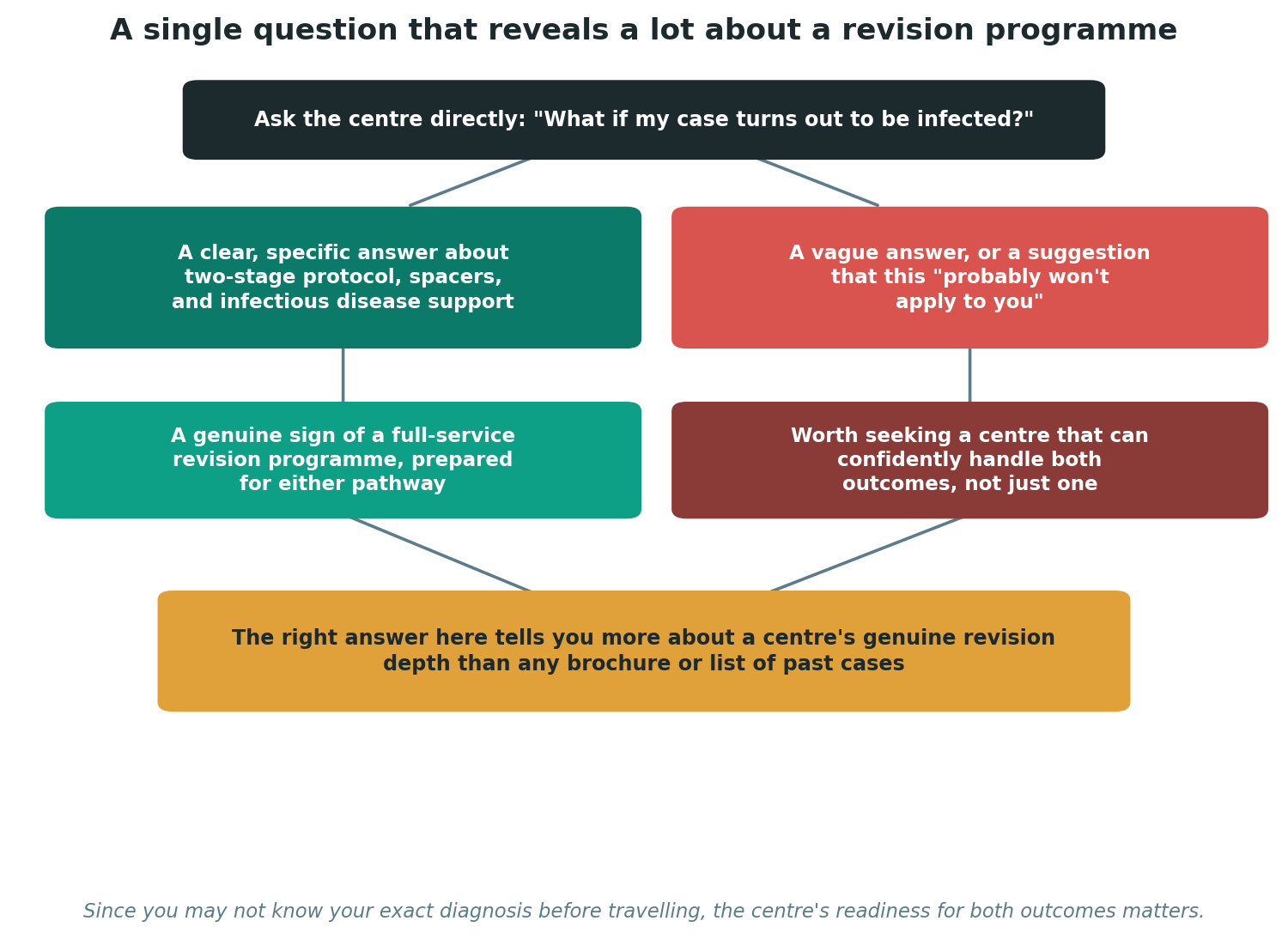
Since you may not know your exact diagnosis before travelling, a centre's readiness for both outcomes matters.
Straight Answers for Zambians about Joint Revision Surgeons and Hospitals in India
Is any orthopaedic surgeon qualified to perform my revision surgery?
Not necessarily — revision arthroplasty requires distinct skills and experience beyond primary replacement. Ask specifically about dedicated revision fellowship training and caseload, not just general orthopaedic experience.
Why does it matter if the hospital can do both single-stage and two-stage revision?
You may not know your exact diagnosis, infected or purely mechanical, until you are assessed at the centre. A hospital genuinely equipped for both pathways can respond appropriately whichever situation you turn out to have.
Should I be worried if my case is more complex than initially expected?
A genuinely experienced revision centre will explain this honestly and adjust the plan accordingly, rather than being caught off guard. This is precisely why choosing a centre with broad revision capability, not just a narrow specific plan, matters from the outset.
How do I verify a surgeon's revision-specific experience before I travel?
Ask directly for their annual revision caseload and personal complication rates, and request this in writing if possible. A genuinely experienced revision surgeon will share this information readily and specifically.
Sources
- 🌐 Medical visa, Lusaka — High Commission of India, requirements & process: hcizambia.gov.in/page/medical-visa
- 🌐 Hospital accreditation (India) — Verify a hospital's NABH accreditation: nabh.co
- 🌐 National Health Insurance (Zambia) — NHIMA cover, treatment abroad is not covered: nhima.co.zm
- 🌐 Ministry of Health Zambia — National health services & guidance: moh.gov.zm
- 🌐 National Medical Commission (verify a surgeon) — Confirm a surgeon's registration in India: nmc.org.in
- 🌐 WHO yellow fever — Vaccination requirements before travel: who.int/health-topics/yellow-fever
A Closing Word
Of everything I help patients verify, a centre's genuine readiness for both a straightforward mechanical revision and a more complex infected one is among the most important. If you send me your imaging and any available test results, I will help you understand honestly what your case may involve, and which centres in India have the genuine revision-specific depth to give you the best possible outcome.
This guide is general information to help Zambian patients select joint revision surgeons and hospitals in India and is not a substitute for individual medical advice. The diagnosis of joint replacement failure and the appropriate treatment must be determined by qualified orthopaedic surgeons after full clinical assessment. Cost figures here are general and vary by individual, hospital and case complexity. Costs, exchange rates, visa rules and vaccination requirements change; confirm all details before you travel, verify qualifications and accreditation independently, and always obtain a written, itemised quotation before proceeding.
Frequently Asked Questions by Zambians about Joint Revision Surgeons and Hospitals in India
Should every Zambian patient travel to India for joint revision?
No. The guide notes that some straightforward mechanical revisions may be managed in Zambia. India may be more relevant for infected replacements, significant bone loss or previous failed revisions.
Is every orthopaedic surgeon a revision specialist?
No. Revision arthroplasty requires different implants, instruments and bone-loss management techniques. Patients should verify dedicated revision training and caseload.
How should I check a surgeon's revision experience?
Ask for the surgeon's specific annual revision caseload, rather than their total number of hip and knee replacements, and ask about their personal infection and re-revision rates.
Why is infection testing so important?
An infected and mechanically failed joint can require completely different treatment pathways. The guide recommends on-site joint-fluid testing and microbiology so infection can be assessed promptly.
What is the difference between single-stage and two-stage revision?
The appropriate approach depends on the diagnosis, particularly whether infection is present. The guide recommends choosing a centre capable of managing both pathways rather than one that offers only a single approach.
What specialised implants should the hospital have?
The guide specifically mentions augments, sleeves and cones for managing significant bone loss during complex revision surgery.
What should I ask if infection is discovered?
Ask exactly what the centre would do if the case turns out to be infected, including its two-stage revision protocol, spacer use and infectious-disease support.
Can the cost change after I arrive?
Yes. The guide warns that costs can change substantially if a case initially considered mechanical is found to involve infection. Patients should clarify this scenario and obtain a written quotation before travelling.
What records should I take back to Zambia?
Obtain a complete written operative report including the exact implant used and provide it to your Zambian orthopaedic team.
What are the main warning signs?
Be cautious if the surgeon cannot provide a specific revision caseload, the hospital lacks infection-testing capability, there is no clear two-stage revision plan or specialised revision implants are unavailable when required.
Page Summary
This guide helps Zambian patients compare joint revision surgeons and hospitals in India, focusing on revision-specific experience, infection diagnosis, bone-loss management, specialised implants and the ability to perform both single-stage and two-stage revision. The page 1 framework gives 60% weight to the surgeon and 40% to the hospital, while the page 4 diagram highlights the key question: what happens if the case turns out to be infected?
Citation Block
| Topic | Information |
|---|---|
| Topic | Selecting the Best Joint Revision Surgeons & Hospitals in India for Zambian Patients |
| Treatment | Joint Revision Surgery |
| Patients | Zambian Patients |
| Key Specialist | Revision Arthroplasty Surgeon |
| Selection Weighting | 60% surgeon / 40% hospital |
| Key Training | Revision arthroplasty fellowship / dedicated revision experience |
| Experience Check | Specific annual revision caseload |
| Failure Assessment | Aseptic versus septic failure |
| Infection Testing | Joint-fluid analysis and microbiology |
| Revision Options | Single-stage and two-stage revision |
| Bone-Loss Management | Augments, sleeves and cones |
| Infectious Disease | Specialist support for septic cases |
| Hospital Support | ICU/HDU and extended-stay arrangements |
| Cost Check | Clarify single-stage versus two-stage costs |
| Records | Operative report with exact implant |
| Pre-Travel Review | Imaging and available test results |
| Follow-Up | Zambian orthopaedic team |
| Warning Signs | No infection testing, no two-stage plan, vague revision volume or no specialised implants |
| Travel Requirements | Yellow-fever certificate and Indian Medical Visa |
| Key Decision | Choose a centre prepared for both mechanical and infected revision pathways |


Our Mission Statement
Our mission is to place patients at the centre of every healthcare decision by providing trustworthy, evidence-based, and unbiased medical information. We believe that informed patients make better decisions. Backed by personalised guidance from our experienced advisory team, we help patients understand their treatment options, compare them objectively, and confidently choose the path that best suits their medical needs and personal circumstances.
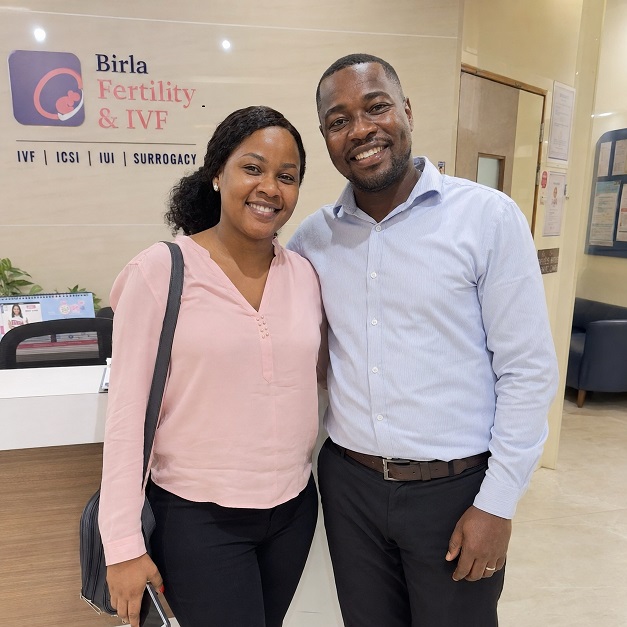
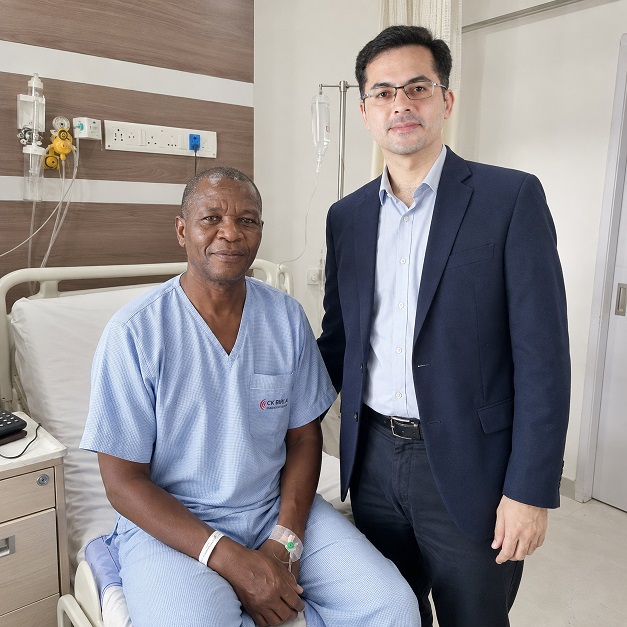
Patient Testimonials from Zambia

Ready to Take the First Step?
Share your Medical Reports with our Healthcare Managers Today and Get a FREE CONSULTATION, a Personalized Treatment Plan, and Complete Support from Arrival to Recovery.
Get Your Free ConsultationAreas We Serve
This resource has been thoughtfully prepared for patients from Zambia who are considering medical treatment in India. We also welcome patients from the wider region in the countries mentioned below-
We assist patients from:
- Zambia
- Angola
- Malawi
- Zimbabwe
- Botswana
- Namibia
- South Africa
- Eswatini
- Lesotho
- Gabon
- Chad
- Equatorial Guinea
- São Tomé and Príncipe
- Republic of the Congo
- Democratic Republic of the Congo
Many of the insights, treatment pathways, hospital recommendations, travel guidance, and patient support services described here are equally relevant and may be used as a reference when planning treatment in India.
From Zambia to India: Your Complete Patient Support Guide
- Best Weight-Loss (Bariatric) Surgeons & Hospitals in India for Zambian Patients
- Best Brain-Tumour Surgeons & Hospitals in India for Zambian Patients
- Best Cancer Doctors & Hospitals in India for Zambian Patients
- Best Cardiac Surgeons & Hospitals in India for Zambian Patients
- Best Cosmetic Surgeons & Facilities in India for Zambian Patients
- Best CyberKnife Treatment Teams & Centres in India for Zambian Patients
- Best Dentists & Dental Clinics in India for Zambian Patients
- Best Heart Valve Replacement Surgeons & Hospitals in India for Zambian Patients
- Best Hip Surgeons & Hospitals in India for Zambian Patients
- Best Knee Surgeons & Hospitals in India for Zambian Patients
- Best Neurosurgeons & Hospitals in India for Zambian Patients
- Best Paediatric Cardiac Surgeons & Hospitals in India for Zambian Patients
- Best Paediatric Neurosurgeons & Hospitals in India for Zambian Patients
- Best Prostate Surgeons & Hospitals in India for Zambian Patients
- Best Scoliosis Surgeons & Hospitals in India for Zambian Patients
- Best Spine Surgeons & Hospitals in India for Zambian Patients
- Best Bone Marrow Transplant Teams & Hospitals in India for Zambian Patients
- Best Kidney Transplant Surgeons & Hospitals in India for Zambian Patients