

Selecting the Best Urosurgery and Reconstructive Urology Specialists in India for Nigerian Patients
The simpler procedure gets performed far more often. Published data suggests that is not because it works better.
For a urethral stricture, two genuinely different treatment philosophies exist. Dilation and internal urethrotomy are quick, minimally invasive procedures that widen the narrowed urethra, often repeated when the stricture recurs. Urethroplasty is definitive reconstructive surgery, rebuilding the affected segment using tissue grafts, typically performed once. A large national registry found the simpler procedure performed roughly forty times more often than definitive reconstruction, despite reconstruction's substantially higher long-term success rate. Understanding why this gap exists is the necessary first step before evaluating any specific specialist. This guide sets out that specific gap in detail, and what it means practically for choosing a specialist genuinely equipped to perform definitive reconstruction, rather than defaulting to whichever provider or procedure happens to be most immediately accessible.
Should you even be reading this guide? If a urethral stricture or comparable reconstructive urological need has genuinely been diagnosed, this guide will help you evaluate the specific specialist and hospital. This series' main Urosurgery guide covers the broader diagnostic and treatment landscape.
Healing Journeys of Nigerian Patients









Key Takeaways
- The guide's central message is that the simpler procedure is not necessarily the more effective long-term option for recurrent urethral stricture.
- Dilation and internal urethrotomy are quicker and less invasive, but their success can decline substantially after repeated procedures.
- The page 2 chart shows dilation success falling from 41% after the first dilation to 14.9% after multiple previous dilations.
- The page 3 comparison, based on national registry data, shows that internal urethrotomy represented 82% of procedures, while definitive urethroplasty accounted for only 2%, despite urethroplasty having a reported 82–93% long-term success rate.
- The guide explains that this large difference in procedure use reflects access and referral patterns, rather than evidence that repeated dilation is more effective.
- Urethroplasty requires specialised reconstructive training, longer operating time and, in many cases, tissue-grafting expertise. Therefore, specific reconstructive experience matters more than general urology reputation.
- The guide cites a comparison between a high-volume tertiary centre performing approximately 500 urethroplasties annually and a regional specialist centre performing approximately 50 annually, illustrating substantial variation even between legitimate specialist programmes.
- The page 4 evaluation gives 60% weight to the reconstructive urologist's technique-specific case volume and 40% to the hospital's graft-harvesting and post-operative catheter care.
- Nigerian patients who have already experienced one or more failed dilations should specifically ask whether definitive urethroplasty is now more appropriate than repeating dilation.
- Four warning signs include another dilation being recommended without discussing reconstruction, inability to provide specific urethroplasty volume, no explanation of the appropriate reconstructive technique and no structured catheter-care or follow-up plan.
Quick Facts
- Treatment
- Urosurgery and Reconstructive Urology
- Country
- India
- Patients
- Patients from Nigeria
- Key Specialist
- Reconstructive Urologist / Urethroplasty Specialist
- Main Condition
- Urethral Stricture
- Initial Options
- Dilation or Internal Urethrotomy
- Definitive Option
- Urethroplasty
- First-Dilation Success
- Approximately 41%
- After Multiple Dilations
- Approximately 14.9% Success
- Urethrotomy Usage
- 82% of Procedures in the Cited National Registry
- Urethroplasty Usage
- 2% of Procedures
- Urethroplasty Long-Term Success
- 82–93%
- Evaluation Weighting
- 60% Surgeon; 40% Hospital
- Surgeon Check
- Specific Annual Urethroplasty Volume and Technique Experience
- Technique Check
- Match Reconstruction Technique to Stricture Length and Location
- Hospital Check
- Graft Harvesting and Post-Operative Catheter Care
- Outcome Check
- Ask for the Surgeon's Personal Success Rate
- Nigeria-Specific Check
- Coordinated Follow-Up With a Nigerian Urologist
- Important Warning
- Repeated Dilation Without Discussion of Definitive Reconstruction
- Pre-Travel
- Confirm Stricture Length, Location and Treatment Strategy
- Follow-Up
- Structured Catheter Care and Nigerian Urologist Follow-Up
- Author
- Dr. Dheeraj Bojwani
- Experience
- 24+ Years
In Brief
For Nigerian patients with urethral stricture, particularly those who have already experienced failed dilation, the guide recommends seeking a dedicated reconstructive urologist with specific, tracked urethroplasty experience. Patients should ask whether definitive reconstruction is appropriate, which technique fits the length and location of their stricture, the surgeon's annual urethroplasty volume and personal success rate, and how graft harvesting, catheter care and follow-up will be managed.
START HERE
The quick fix gets less effective every time it's repeated
Understanding this pattern reframes what "trying something simpler first" genuinely means for this specific condition.
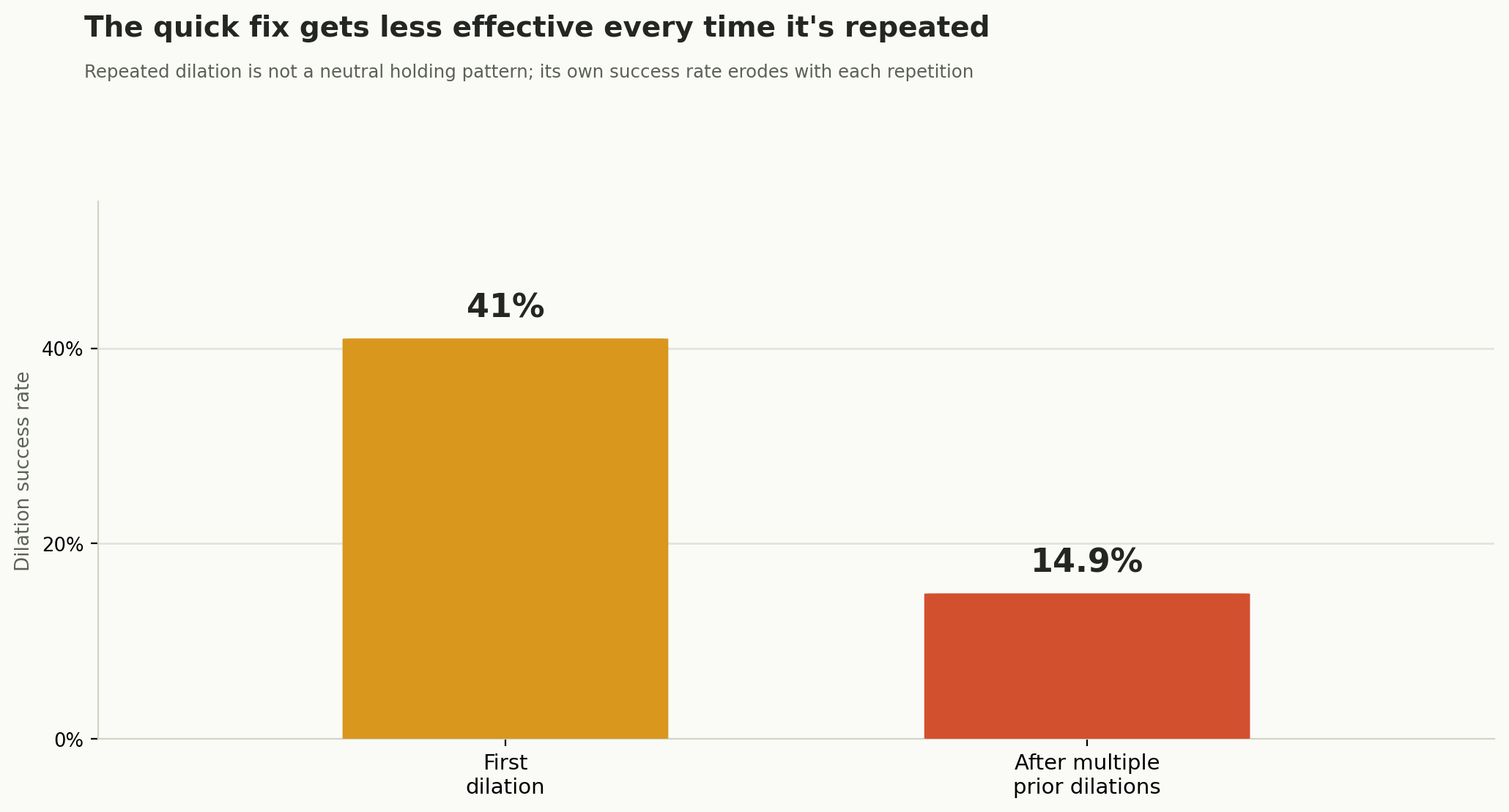
Repeated dilation is not a neutral holding pattern; its own success rate erodes with each repetition.
This is a genuinely important distinction from many other "try the simpler option first" situations covered elsewhere in this series. Repeating dilation after it has already failed is not a low-risk, cost-free way to buy time; each subsequent attempt carries diminishing odds of success, and a patient who has already been through several failed dilations deserves a serious conversation about definitive reconstruction, not another round of the same approach.
Patients themselves often understandably prefer dilation initially, since it is quicker, less invasive, and requires less recovery time than reconstructive surgery. That preference is entirely reasonable for a first attempt. What deserves scrutiny is a pattern of repeated dilation continuing indefinitely, cycle after cycle, without a genuine, direct conversation about whether reconstruction has become the more appropriate path forward.
A Real, Documented Access Gap
The more effective option is the one used least often
This pattern is not a matter of impression; it is directly documented in large-scale national procedure data.
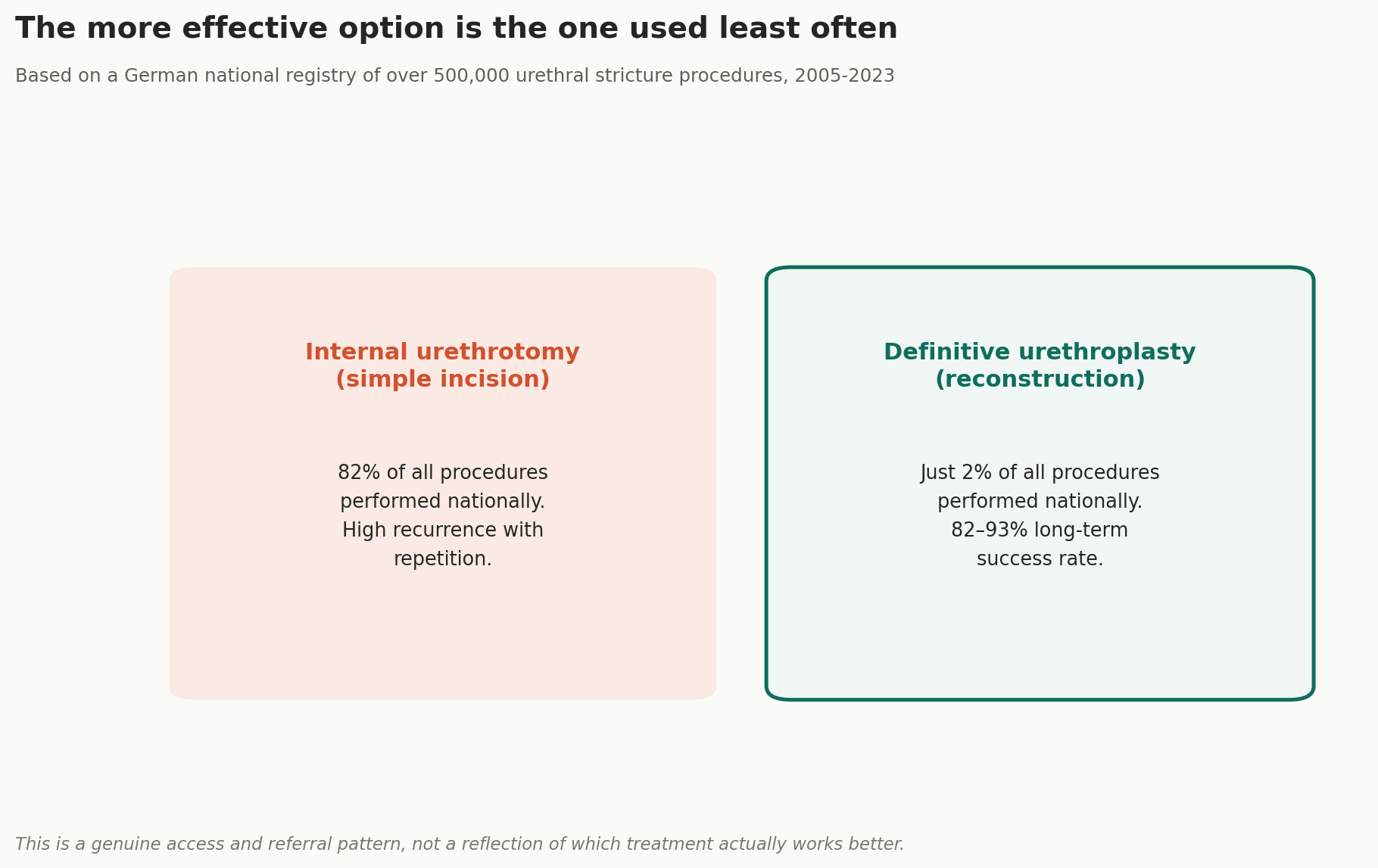
This is a genuine access and referral pattern, not a reflection of which treatment actually works better.
This gap likely reflects genuine practical realities, urethroplasty requires more specialised surgical training, longer operating time, and often tissue grafting technique, rather than any evidence that repeated dilation is the medically preferred approach. A patient facing a recurring stricture deserves to know that a more definitive, more effective option genuinely exists, even if it is used less often in general practice.
This is worth framing carefully: it is not a criticism of clinicians offering dilation as a first step, which remains a reasonable initial approach for many patients. It is a call to ensure the conversation continues beyond that first step, so that a patient does not simply cycle through repeat dilations by default, without ever being offered the more definitive alternative that published evidence supports.
A note on why surgeon-specific volume matters unusually much here. One published study compared a high-volume tertiary centre performing around 500 urethroplasties annually against a regional centre performing around 50 annually, both staffed by fellowship-trained specialists. This is a genuinely large volume difference even between two legitimate specialist programmes, underscoring how much technique-specific experience varies even among qualified providers.
THE BALANCE
A dedicated reconstructive specialist, not a general urologist
Given how specialised definitive reconstruction genuinely is, this evaluation weights meaningfully toward the individual surgeon's specific experience.
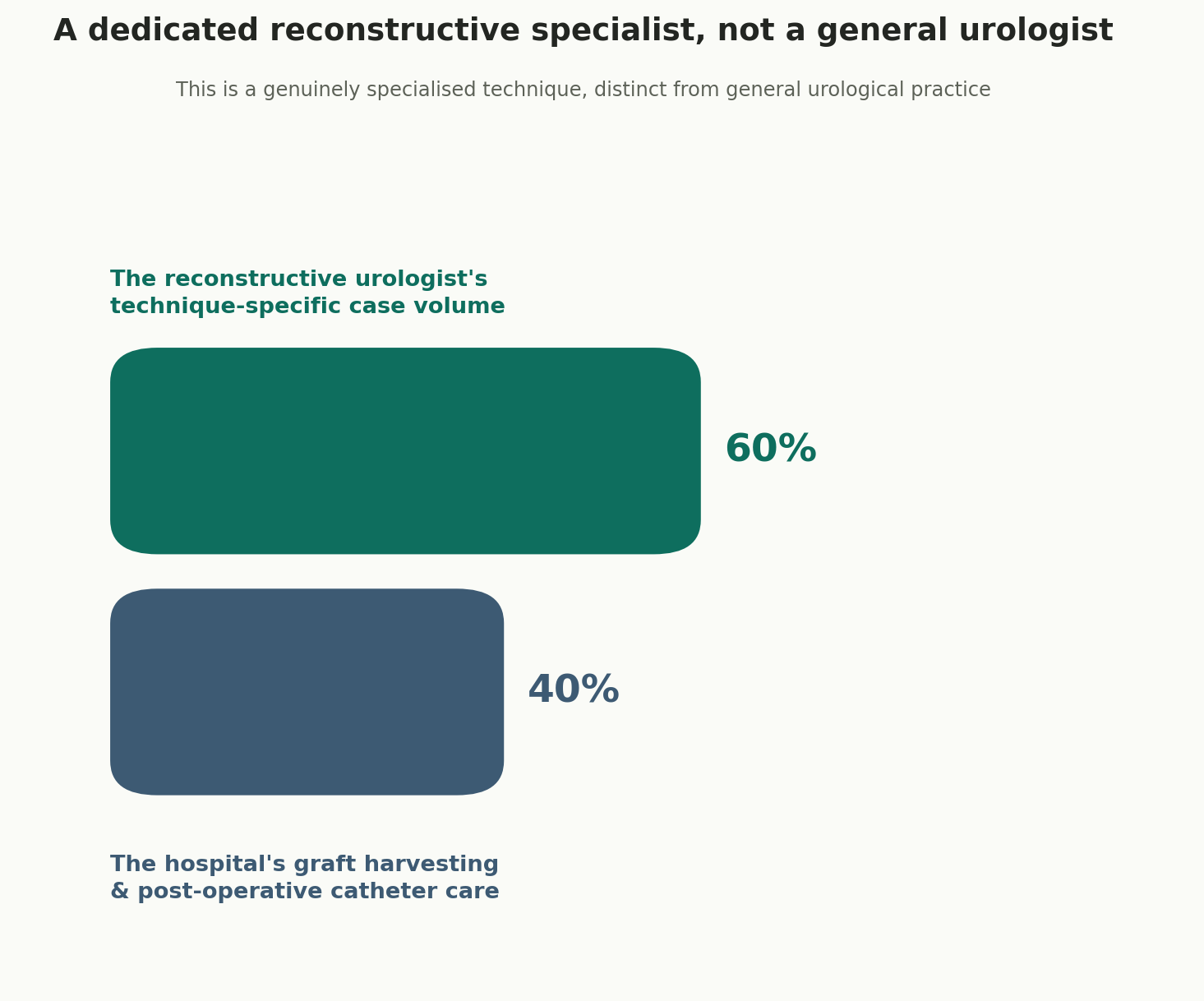
This is a genuinely specialised technique, distinct from general urological practice.
The hospital's role remains genuinely important: proper graft harvesting technique and careful post-operative catheter management both shape recovery and long-term success. But urethroplasty is a distinctly specialised reconstructive skill, not a routine part of general urological training, and a surgeon's specific, tracked experience with this exact procedure carries the larger relative share of this evaluation. This weighting reflects a broader pattern in this series: procedures demanding genuinely specialised, technique- specific training tend to lean more heavily toward the individual practitioner than toward the surrounding facility.
THE VETTING CONVERSATION
What to actually ask
Questions for the specialist
- Given my history, is definitive reconstruction more appropriate than another dilation? This should be a direct, honest answer, especially after prior failed dilations.
- What is your specific, annual urethroplasty case volume? A confident, specific number is reasonable to expect.
- Which specific reconstructive technique do you recommend for my stricture, and why? This should reflect your specific stricture length and location.
- What is your personal success rate for this specific technique? A specific, tracked answer suggests genuine expertise.
Questions for the hospital
- What is the hospital's experience with graft harvesting for this procedure? This is a specific, technical skill worth confirming.
- What is the post-operative catheter care and follow-up protocol? This should be a clear, structured plan.
- What is the hospital's own outcome data for urethroplasty specifically? Specific, tracked figures matter more than general reputation.
- What is the plan for follow-up once I return to Nigeria? This should be coordinated before you travel.
Nigeria-specific Considerations
Why asking about reconstruction specifically matters here
Given how much more accessible simpler dilation and urethrotomy procedures tend to be relative to definitive reconstructive surgery, discussed in detail in this series' main Urosurgery guide, a Nigerian patient who has already been through one or more failed dilation procedures should actively ask whether definitive urethroplasty is a genuinely appropriate next step, rather than assuming another round of the same approach is the only available option.
Four warning signs worth taking seriously
- Another dilation recommended without discussing definitive reconstruction after prior failures. This should be raised directly.
- Inability to state a specific urethroplasty case volume. A confident, specific number reflects genuine specialisation.
- No clear explanation of which specific reconstructive technique suits your stricture. This should be tailored to your specific case.
- No structured post-operative catheter care and follow-up plan. This should be clear and specific.
A practical order of operations
- Get a confirmed diagnosis and full assessment of stricture length and location.
- If dilation has already failed once or more, ask directly about definitive reconstruction.
- Ask the specialist-side and hospital-side questions above before committing to treatment.
- Confirm the specific reconstructive technique planned, and why it suits your case.
- Travel, surgery, and a structured catheter care and recovery period.
- Establish a coordinated follow-up relationship with a Nigerian urologist.
Straight Answers for Nigerian Patients about Urosurgery and Reconstructive Urology in India
Is repeated dilation a safe, neutral long-term approach?
No. Its own success rate declines with repetition, from around 41 percent initially to roughly 15 percent after multiple prior attempts.
How effective is definitive urethroplasty compared to dilation?
Published studies report 82 to 93 percent long-term success, substantially higher than repeat dilation, especially after prior dilations have already failed.
Why is reconstruction performed so much less often?
A national registry found urethrotomy made up 82 percent of procedures versus just 2 percent for urethroplasty, reflecting access and referral patterns, not effectiveness.
Why does the surgeon's specific volume matter so much here?
Urethroplasty is a specialised reconstructive skill, distinct from general urology, and specific, tracked experience shapes outcomes more directly than general reputation.
What is a realistic red flag when choosing a provider?
Another dilation recommended without discussing reconstruction after prior failures, or inability to state a specific case volume, are genuine warning signs.
A closing word
The most commonly performed treatment is not always the most effective one, and urethral stricture management is a genuinely clear example of this gap. A patient who has already been through a failed dilation deserves to know that a more definitive, considerably more effective option exists, even if it requires seeking out a genuinely specialised reconstructive surgeon rather than returning to a familiar, simpler procedure. In twenty-four years of this work, the patients who navigate this best ask directly whether reconstruction is appropriate once dilation has already failed, seek out a surgeon's specific technique-relevant case volume, and treat repeated dilation as a diminishing-returns approach rather than a safe default. The definitive procedure takes longer to arrange. It is considerably more likely to actually work.
Sources
- 🌐 Perioperative Outcomes and Trends of Surgical Correction of Male Urethral Strictures: Results from the GRAND Study
- 🌐 Female urethral stricture: A multi-centre experience and lessons learnt. BJUI Compass, 2025
- 🌐 Long term outcomes of one-stage augmentation anterior urethroplasty: a systematic review and meta-analysis. PMC
- 🌐 American Urological Association — Urethral stricture disease, patient guidance
- 🌐 High Commission of India, Abuja — Medical and Medical Attendant Visa requirements
Frequently Asked Questions by Nigerians about Urosurgery and Reconstructive Urology in India
Is repeated dilation an effective long-term solution for urethral stricture?
Its effectiveness can decline with repetition. The guide reports success falling from about 41% after the first dilation to approximately 14.9% after multiple previous dilations.
When should Nigerian patients ask about urethroplasty?
Patients who have already experienced one or more failed dilations should directly ask whether definitive urethroplasty is now more appropriate rather than simply repeating the same procedure.
How successful is definitive urethroplasty?
The guide cites published studies reporting 82–93% long-term success, substantially higher than the reported success of repeated dilation.
Why is urethroplasty performed much less often than urethrotomy?
The cited national registry showed 82% of procedures were internal urethrotomies compared with only 2% urethroplasties. The guide explains that this reflects access and referral patterns rather than superior effectiveness of urethrotomy.
Why does the surgeon's specific urethroplasty experience matter?
Urethroplasty is a specialised reconstructive technique distinct from general urology. The guide therefore gives greater weight to the surgeon's technique-specific experience and tracked case volume.
What should Nigerian patients ask about the reconstructive technique?
They should ask which specific technique is recommended for their stricture and why, with the answer based on the stricture's length and location.
What should Nigerian patients ask about the surgeon's experience?
They should ask for the surgeon's specific annual urethroplasty volume and personal success rate for the proposed technique, rather than relying only on general urology credentials.
What should the hospital provide after urethroplasty?
The guide highlights proper graft-harvesting capability and structured post-operative catheter care and follow-up as important hospital responsibilities.
Should follow-up in Nigeria be arranged before travelling?
Yes. The guide recommends establishing a coordinated follow-up relationship with a Nigerian urologist before returning home.
What are the main warning signs when choosing a reconstructive urology provider?
Warning signs include another dilation being recommended after previous failures without discussing reconstruction, inability to state specific urethroplasty volume, no tailored technique explanation and no structured catheter-care or follow-up plan.
Page Summary
This guide explains how Nigerian patients can select urosurgery and reconstructive urology specialists in India, focusing particularly on urethral stricture and the difference between repeated dilation and definitive urethroplasty. The page 2 chart shows dilation success declining from 41% after the first procedure to 14.9% after multiple prior dilations. The page 3 comparison shows that internal urethrotomy represented 82% of procedures in the cited national registry, compared with only 2% for urethroplasty, despite reported 82–93% long-term success for definitive urethroplasty. The page 4 evaluation gives 60% weight to the reconstructive urologist's technique-specific case volume and 40% to the hospital's graft harvesting and post-operative catheter care. The guide stresses that Nigerian patients with recurrent or previously failed strictures should directly discuss definitive reconstruction with a dedicated specialist.
Citation Block
| Topic | Information |
|---|---|
| Topic Information | Selecting the Best Urosurgery and Reconstructive Urology Specialists in India for Nigerian Patients for Patients from Nigeria |
| Treatment | Urosurgery and Reconstructive Urology |
| Intended Audience | Patients from Nigeria |
| Key Specialist | Reconstructive Urologist / Urethroplasty Specialist |
| Main Condition | Urethral Stricture |
| Initial Treatment Options | Dilation and Internal Urethrotomy |
| Definitive Treatment | Urethroplasty |
| First-Dilation Success | Approximately 41% |
| Success After Multiple Dilations | Approximately 14.9% |
| National Procedure Pattern | Internal Urethrotomy 82%; Urethroplasty 2% |
| Urethroplasty Long-Term Success | 82–93% |
| Specialist Volume Example | Approximately 500 Urethroplasties Annually at a High-Volume Tertiary Centre vs Approximately 50 at a Regional Centre |
| Evaluation Weighting | 60% Surgeon; 40% Hospital |
| Surgeon Check | Specific Annual Urethroplasty Case Volume |
| Technique Check | Confirm the Reconstruction Technique Suits Stricture Length and Location |
| Outcome Check | Ask for the Surgeon's Personal Success Rate for the Specific Technique |
| Hospital Check | Confirm Graft-Harvesting Experience |
| Catheter Care Check | Verify a Structured Post-Operative Catheter Management Protocol |
| Nigeria-Specific Check | Arrange Follow-Up With a Nigerian Urologist Before Returning Home |
| Important Warning | Another Dilation Recommended Without Discussing Definitive Reconstruction After Prior Failures |
| Pre-Travel Requirement | Confirm Stricture Length, Location and Appropriate Treatment Strategy |
| Patient Journey | Diagnosis → stricture assessment → reconstruction discussion → specialist/hospital evaluation → technique selection → surgery → catheter care/recovery → Nigerian follow-up |
| Follow-Up | Structured Catheter Care and Coordinated Urological Follow-Up in Nigeria |


Our Mission Statement
Our mission is to place patients at the centre of every healthcare decision by providing trustworthy, evidence-based, and unbiased medical information. We believe that informed patients make better decisions. Backed by personalised guidance from our experienced advisory team, we help patients understand their treatment options, compare them objectively, and confidently choose the path that best suits their medical needs and personal circumstances.
Patient Testimonials from Nigeria















Ready to Take the First Step?
Share your Medical Reports with our Healthcare Managers Today and Get a FREE CONSULTATION, a Personalized Treatment Plan, and Complete Support from Arrival to Recovery.
Get Your Free ConsultationAreas We Serve
This resource has been thoughtfully prepared for patients from Nigeria who are considering medical treatment in India. We also welcome patients from the wider region in the countries mentioned below-
We assist patients from:
- Benin
- Niger
- Chad
- Cameroon
- Algeria
- Egypt
- Libya
- Morocco
- Sudan
- Tunisia
- Gambia
- Ghana
- Burkina Faso
- Cabo Verde
- Côte d'Ivoire
- Equatorial Guinea
- São Tomé and Príncipe
Many of the insights, treatment pathways, hospital recommendations, travel guidance, and patient support services described here are equally relevant and may be used as a reference when planning treatment in India.
From Nigeria to India: Your Complete Patient Support Guide
- Artificial Disc Replacement in India for Nigerian Patients
- Weight Loss and Bariatric Surgery in India for Nigerian Patients
- Bone Marrow Transplant in India for Nigerian Patients
- Brain Tumour Surgery in India for Nigerian Patients
- Breast Cancer Treatment and Surgery in India for Nigerian Patients
- Cancer Treatment and Surgery in India for Nigerian Patients
- Cardiac Arrhythmia and Heart Pacemaker Treatment in India for Nigerian Patients
- Cardiac Surgery in India for Nigerian Patients
- Colorectal Cancer Treatment and Surgery in India for Nigerian Patients
- Complex Orthopaedic and Joint Revision Surgery in India for Nigerian Patients
- Cornea Transplant and Advanced Eye Surgery in India for Nigerian Patients
- CyberKnife Treatment in India for Nigerian Patients
- Gamma Knife Treatment in India for Nigerian Patients
- Heart Failure Treatment and Surgery in India for Nigerian Patients
- Hip Surgery in India for Nigerian Patients
- HIPEC Cancer Surgery in India for Nigerian Patients
- IVF and Fertility Treatment in India for Nigerian Patients
- Joint Arthroscopy and Sports Medicine in India for Nigerian Patients