

Selecting the Best Shoulder Surgeons and Hospitals in India for Nigerian Patients
The natural instinct is to ask "how many of these has this surgeon done?" Published research suggests a different, more specific question matters more.
Most patients evaluating a surgeon default to a simple, intuitive question: how many procedures have they performed? For shoulder surgery specifically, a large 2024 nationwide analysis of 1,489 surgeons found this instinct to be less reliable than expected. Fellowship-specific training in sports medicine or shoulder and elbow surgery predicted measurably better outcomes, while raw case volume alone did not, and was even associated with a slightly higher reoperation risk in that particular dataset. This genuinely changes what the right question to ask actually is. This guide sets out that more specific question, alongside the honest role tear severity plays independent of surgeon choice, and why hospital-side rehabilitation support carries unusually significant weight for this particular procedure compared to several others in this series.
Should you even be reading this guide? If shoulder surgery has genuinely been recommended and discussed as appropriate for your specific case, this guide will help you evaluate the surgeon and hospital. This series' main Shoulder Surgery guide covers when physical therapy should be tried first.
Healing Journeys of Nigerian Patients









Key Takeaways
- The guide's central message is that fellowship-specific shoulder training may be more useful than raw surgical volume alone when evaluating a shoulder surgeon.
- A 2024 nationwide analysis of 1,489 surgeons performing rotator cuff repair found that fellowship-specific training in sports medicine or shoulder and elbow surgery predicted better outcomes, while high case volume alone did not.
- The page 2 chart shows a 7% lower 90-day emergency-department visit rate and 5% lower two-year reoperation risk associated with fellowship-trained surgeons in the cited analysis, while high volume alone showed a 6% higher two-year reoperation risk.
- The guide stresses that the tear itself independently affects the chance of repair failure. More than two tendons involved and tears larger than 25 mm each were associated with roughly three times higher failure odds.
- The page 3 chart also shows that patients aged 75+ with significant muscle degeneration had more than 11 times higher odds of failure in the cited analysis.
- Fellowship training means a dedicated year or more of additional training in sports medicine or shoulder and elbow surgery after orthopaedic residency.
- The page 4 evaluation gives 52% weight to the surgeon's fellowship training and specific procedure experience and 48% to the hospital's rehabilitation coordination and post-operative support.
- The guide emphasises that shoulder surgery success depends heavily on months of structured physiotherapy, progressive strengthening and monitoring, not only the operation itself.
- Nigerian patients should arrange continuing physiotherapy with a Nigerian provider before travelling, because inconsistent rehabilitation after returning home can undermine an otherwise technically successful repair.
- Four warning signs include emphasis on case volume without fellowship-specific training, no honest discussion of tear severity, no structured rehabilitation plan and no coordination for physiotherapy after returning to Nigeria.
Quick Facts
- Treatment
- Shoulder Surgery / Rotator Cuff Repair
- Country
- India
- Patients
- Patients from Nigeria
- Key Specialist
- Shoulder and Elbow / Sports Medicine Orthopaedic Surgeon
- Primary Training Check
- Dedicated Shoulder and Elbow or Sports Medicine Fellowship
- Study Size
- 1,489 Surgeons
- Study Year
- 2024
- 90-Day Finding
- 7% Lower Emergency-Department Visit Rate With Fellowship Training
- Two-Year Finding
- 5% Lower Reoperation Risk With Fellowship Training
- Tear Risk
- More Than 2 Tendons Affected — 2.8× Higher Failure Odds
- Tear Size
- Larger Than 25 mm — 2.9× Higher Failure Odds
- Age/Degeneration
- Age 75+ With Significant Degeneration — 11.2× Higher Failure Odds
- Evaluation Weighting
- 52% Surgeon; 48% Hospital
- Surgeon Check
- Fellowship Training and Specific Procedure Experience
- Prognosis Check
- Tear Size, Location, Tendon Involvement and Muscle Degeneration
- Hospital Check
- Structured Physiotherapy and Post-Operative Support
- Rehabilitation Check
- Continuing Physiotherapy in Nigeria
- Important Warning
- Do Not Rely on Raw Case Volume Alone
- Pre-Travel
- Confirm Surgery Is Appropriate and Understand Tear-Related Risks
- Follow-Up
- Nigerian Orthopaedic Surgeon and Physiotherapist
- Author
- Dr. Dheeraj Bojwani
- Experience
- 24+ Years
In Brief
For Nigerian patients considering shoulder surgery in India, the guide recommends looking beyond the surgeon's total case volume and asking specifically about fellowship training in sports medicine or shoulder and elbow surgery. Patients should also receive an honest assessment of how their tear size, location, tendon involvement and muscle degeneration affect prognosis. Because recovery depends heavily on months of structured rehabilitation, the guide recommends arranging physiotherapy in Nigeria before travelling and confirming a coordinated follow-up plan.
Start Here
Fellowship training predicted better outcomes; raw volume alone did not
This is a genuinely counterintuitive finding worth understanding before evaluating any specific surgeon.
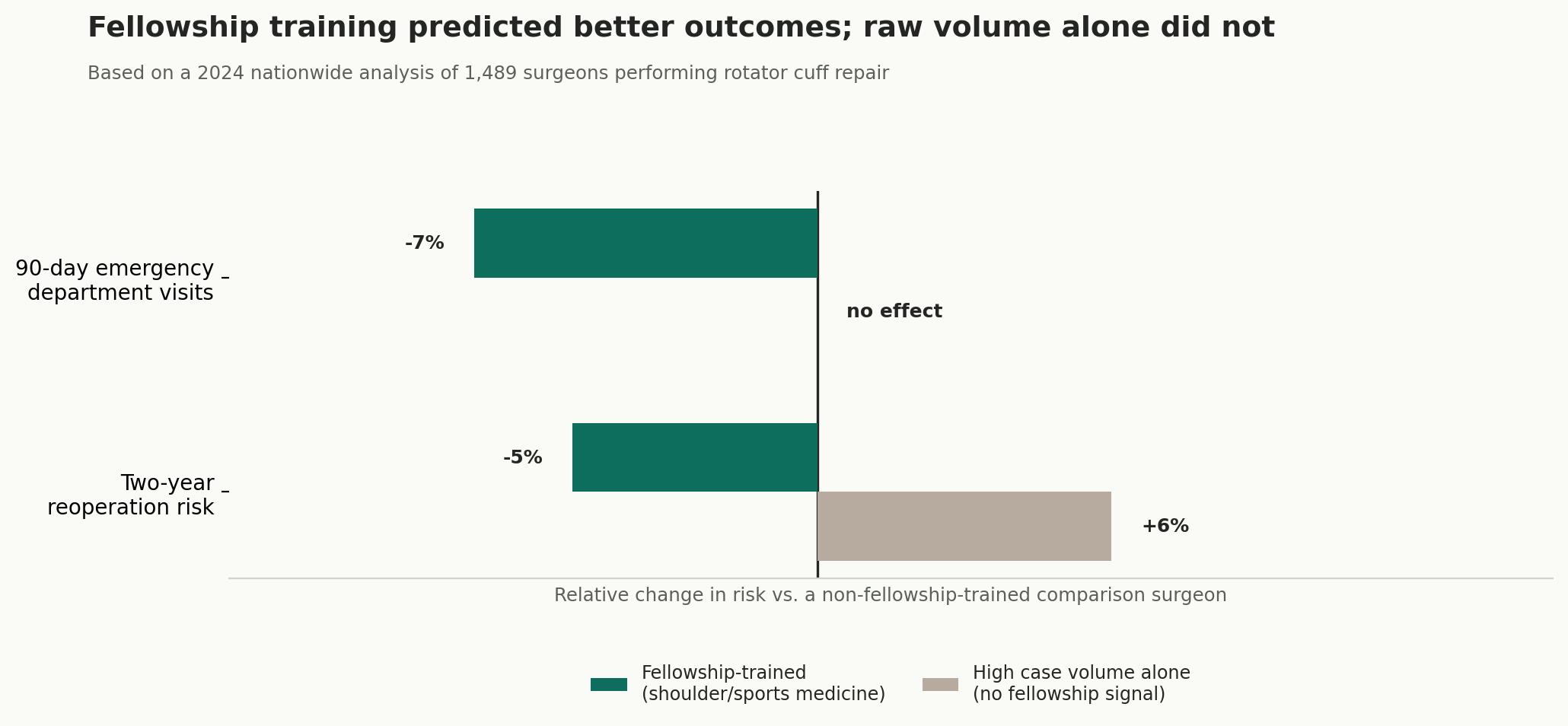
Based on a 2024 nationwide analysis of 1,489 surgeons performing rotator cuff repair.
These effects are genuinely modest in size, not dramatic, and should not be read as proof that any individual high-volume, non-fellowship-trained surgeon is a poor choice. The broader, more useful lesson is that fellowship-specific training in this exact specialty is a more reliable, better-documented signal than case count alone, and deserves to be asked about directly and specifically.
This finding is worth sitting with for a moment, since it runs against a natural assumption many patients bring into this decision. A surgeon who has performed an enormous number of procedures has genuinely valuable experience, but that experience does not automatically substitute for the specific, structured training a dedicated fellowship provides in recognising and managing the particular complexities of shoulder pathology.
Setting Honest Expectations
Some of this outcome is decided before the surgeon is even chosen
Alongside surgeon-specific factors, the tear itself independently shapes the realistic likelihood of success.
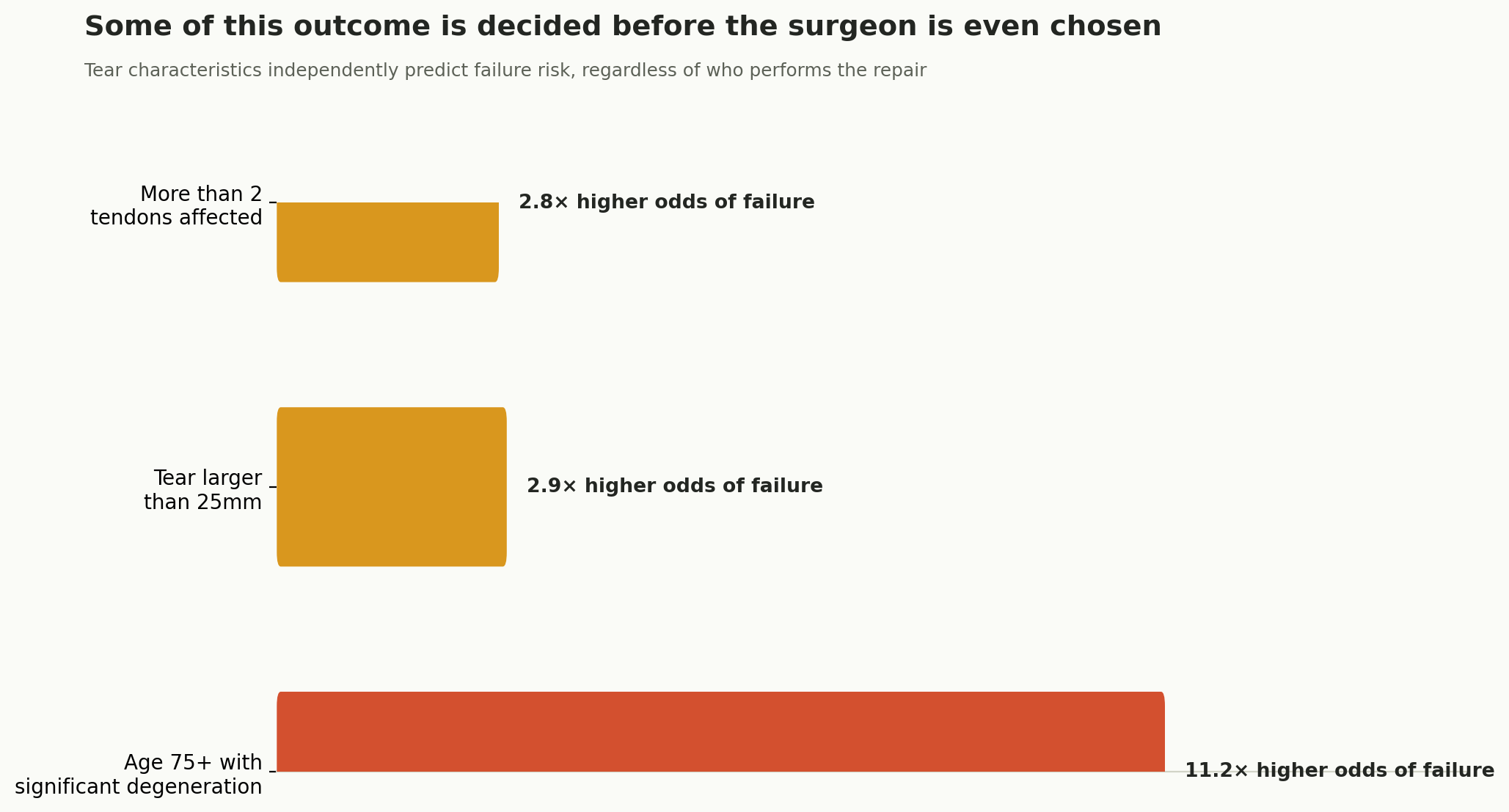
Tear characteristics independently predict failure risk, regardless of who performs the repair.
A skilled, well-trained surgeon cannot change the underlying biology of a large, multi-tendon tear in an older patient with significant muscle degeneration. Understanding this honestly, before surgery, protects against unrealistic expectations, and a surgeon willing to discuss these specific risk factors openly, rather than offering blanket reassurance, is demonstrating genuine, useful honesty.
This is genuinely useful information for a family weighing whether to travel for treatment at all. A patient whose tear falls into a higher-risk category deserves a frank conversation about realistic odds before committing to the cost and disruption of international travel, not a uniformly optimistic sales pitch regardless of the underlying anatomy.
A note on what "fellowship training" specifically means, since the term itself deserves clarification.
This refers to a dedicated year or more of additional training focused specifically on sports medicine or shoulder and elbow surgery, completed after general orthopaedic residency. It is a specific, verifiable credential, not a general description of experience, and is worth asking about by name.
THE BALANCE
A near-even balance, tipped slightly by training
Given how much recovery from shoulder surgery depends on sustained rehabilitation, not just the operation itself, this evaluation weights close to evenly between surgeon and hospital.
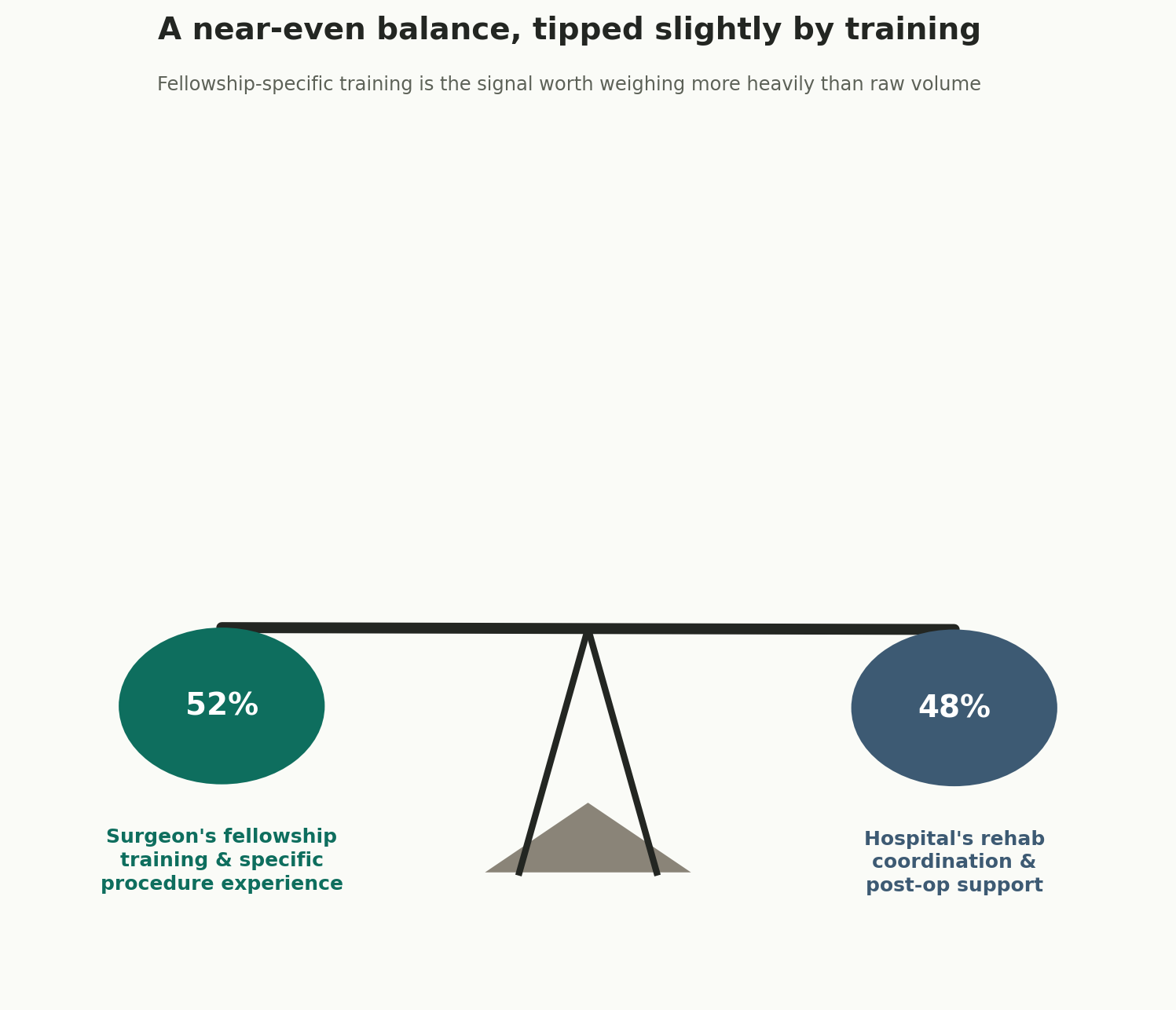
Fellowship-specific training is the signal worth weighing more heavily than raw volume.
Unlike several other procedures in this series where a single operation largely determines the outcome, shoulder surgery success depends heavily on what happens over the following months: structured physiotherapy, progressive strengthening, and close monitoring for early signs of a failing repair. A hospital with genuinely strong rehabilitation coordination is not a secondary consideration here; it is close to as important as the surgeon's own technical skill. This is a genuinely different balance than the more surgeon- weighted procedures elsewhere in this series, reflecting how much this specific recovery process depends on sustained, ongoing care.
THE VETTING CONVERSATION
What to actually ask
Questions for the surgeon
- Did you complete a dedicated sports medicine or shoulder and elbow fellowship? Ask specifically, by name, not just general orthopaedic training.
- How does my specific tear size, location, and tendon involvement affect my realistic prognosis? A specific, honest answer is worth more than general reassurance.
- What is your approach for tears with these specific risk factors? This should be a thoughtful, case- specific answer.
- What does your own reoperation rate look like for cases similar to mine? A confident, specific answer suggests genuine, tracked experience.
Questions for the hospital
- What structured physiotherapy programme is in place after surgery? This should be a specific, coordinated plan, not a general referral.
- How is progress monitored over the following months? Regular, planned follow-up matters for catching problems early.
- What support exists for continuing rehabilitation once I return to Nigeria? This should be planned before you travel.
- What is the hospital's own outcome data for this specific procedure? Specific, tracked figures matter more than general reputation.
Nigeria-specific Considerations
Why the rehabilitation question matters most here
Given how much shoulder surgery recovery depends on months of structured physiotherapy, discussed in detail in this series' main Shoulder Surgery guide, arranging genuine continuing rehabilitation with a Nigerian physiotherapist before travelling is one of the most practically important steps a patient can take. A technically excellent operation, followed by inconsistent or absent rehabilitation once home, can genuinely undermine an otherwise successful surgery.
Four warning signs worth taking seriously
- A surgeon emphasising overall case volume without confirming specific fellowship training. Ask directly, by name.
- No honest discussion of how your specific tear characteristics affect realistic outcomes. This should be addressed directly.
- No structured, specific rehabilitation plan in place before surgery. This should be planned in advance, not improvised afterward.
- No coordination for continuing physiotherapy once you return home. This should be arranged before you travel.
A practical order of operations
- Confirm surgery is genuinely indicated using this series' main Shoulder Surgery guide first.
- Ask directly about specific fellowship training, by name, not general orthopaedic experience.
- Ask honestly how your specific tear characteristics affect realistic expectations.
- Ask the surgeon-side and hospital-side questions above before committing to a programme.
- Arrange continuing physiotherapy with a Nigerian provider before you travel.
- Establish a coordinated follow-up relationship with a Nigerian orthopaedic surgeon.
Straight Answers for Nigerian Patients about Shoulder Surgery in India
Is the highest-volume surgeon automatically the best choice?
Not necessarily. A 2024 nationwide study found fellowship-specific training predicted better outcomes, while high volume alone was not protective and was even linked to slightly higher reoperation risk.
What predicts repair failure beyond who performs it?
Tear characteristics independently predict outcomes: more than two tendons affected and tears over 25mm each carry roughly three times higher failure odds; age 75+ with significant degeneration carries over eleven times higher odds.
What should I ask about fellowship training specifically?
Ask directly whether they completed a dedicated sports medicine or shoulder and elbow fellowship, a specific, verifiable credential distinct from general orthopaedic training.
Why is this weighted almost evenly between surgeon and hospital?
Outcomes depend heavily on both precise technique and a genuinely coordinated rehabilitation process afterward, giving the hospital's support system a larger relative role than in some other procedures.
What is a realistic red flag when choosing a provider?
Emphasis on case volume without confirming fellowship training, no honest tear-severity discussion, or no structured rehabilitation plan, are genuine warning signs.
A closing word
The intuitive question, how many of these has this surgeon done, is not wrong, but published research suggests it is not the most useful question either. Fellowship-specific training, honest engagement with tear severity, and a genuinely coordinated rehabilitation process together predict outcomes considerably better than volume alone. In twenty-four years of this work, the patients who navigate this best ask for a specific fellowship credential by name, expect an honest conversation about their own tear's realistic prognosis, and treat the months of rehabilitation afterward as seriously as the surgery itself. The operation is a single afternoon. What follows it, for months, is what actually determines whether it succeeds.
Sources
- 🌐 Sadjadi R, Nosrat C, Su F, et al. Impact of surgeon volume, experience, and training on outcomes after arthroscopic rotator cuff repair
- 🌐 Critical Predictors of the Outcomes of Rotator Cuff Arthroscopic Repair. PMC, 2025
- 🌐 American Academy of Orthopaedic Surgeons — Rotator cuff repair, patient information
- 🌐 American Shoulder and Elbow Surgeons — Choosing a shoulder specialist, patient guidance
- 🌐 High Commission of India, Abuja — Medical and Medical Attendant Visa requirements
Frequently Asked Questions by Nigerians about Shoulder Surgery in India
Is the highest-volume shoulder surgeon automatically the best choice?
Not necessarily. The guide cites a 2024 nationwide analysis showing that fellowship-specific training predicted better outcomes, while raw case volume alone was not protective.
What type of fellowship should Nigerian patients ask about?
Patients should specifically ask whether the surgeon completed a dedicated sports medicine or shoulder and elbow fellowship after orthopaedic residency.
How much did fellowship training affect outcomes in the cited study?
The page 2 chart shows a 7% lower 90-day emergency-department visit rate and 5% lower two-year reoperation risk associated with fellowship training.
Does the severity of the rotator cuff tear affect the outcome?
Yes. The guide states that tear characteristics independently predict failure risk. More than two tendons affected and tears larger than 25 mm each carried roughly three times higher failure odds.
Does age and muscle degeneration affect repair success?
Yes. The page 3 chart reports 11.2 times higher odds of failure for patients aged 75+ with significant muscle degeneration in the cited analysis.
What should Nigerian patients ask the shoulder surgeon?
They should ask about fellowship training, their specific tear size and location, tendon involvement, realistic prognosis and their reoperation rate for similar cases.
Why is rehabilitation so important after shoulder surgery?
The guide explains that recovery depends heavily on structured physiotherapy, progressive strengthening and monitoring over several months, not only on the surgical procedure.
Should physiotherapy in Nigeria be arranged before surgery in India?
Yes. The guide considers this one of the most important practical steps because inconsistent rehabilitation after returning home can undermine an otherwise successful repair.
What should Nigerian patients ask the hospital about rehabilitation?
They should ask what structured physiotherapy programme is provided, how progress is monitored and how rehabilitation will continue after returning to Nigeria.
What are the main warning signs when choosing a shoulder surgery provider?
Warning signs include emphasis on raw case volume without fellowship-specific training, no honest discussion of tear characteristics, no structured rehabilitation plan and no coordination for physiotherapy after returning home.
Page Summary
This guide explains how Nigerian patients can select shoulder surgeons and hospitals in India, focusing on fellowship-specific training, realistic assessment of tear characteristics and rehabilitation support. The page 2 chart, based on a 2024 analysis of 1,489 rotator cuff surgeons, shows that fellowship training predicted better outcomes while raw case volume alone did not. The page 3 chart highlights how tear characteristics independently affect failure risk, including 2.8× higher odds with more than two tendons affected, 2.9× higher odds with tears larger than 25 mm and 11.2× higher odds for patients aged 75+ with significant degeneration. The page 4 evaluation gives 52% weight to surgeon fellowship training and specific experience and 48% to hospital rehabilitation coordination and post-operative support. The guide also places strong emphasis on arranging continuing physiotherapy in Nigeria before travelling.
Citation Block
| Topic | Information |
|---|---|
| Topic Information | Selecting the Best Shoulder Surgeons and Hospitals in India for Nigerian Patients for Patients from Nigeria |
| Treatment | Shoulder Surgery / Rotator Cuff Repair |
| Intended Audience | Patients from Nigeria |
| Key Specialist | Shoulder and Elbow / Sports Medicine Orthopaedic Surgeon |
| Primary Training Check | Dedicated Sports Medicine or Shoulder and Elbow Fellowship |
| Study Reference | 2024 Nationwide Analysis of 1,489 Rotator Cuff Surgeons |
| Fellowship Finding | Better Outcomes Compared With Non-Fellowship-Trained Surgeons |
| 90-Day Finding | 7% Lower Emergency-Department Visit Rate |
| Two-Year Finding | 5% Lower Reoperation Risk |
| Tear Risk | More Than 2 Tendons: 2.8× Higher Failure Odds |
| Tear Size Risk | Larger Than 25 mm: 2.9× Higher Failure Odds |
| Age/Degeneration Risk | Age 75+ With Significant Degeneration: 11.2× Higher Failure Odds |
| Evaluation Weighting | 52% Surgeon; 48% Hospital |
| Surgeon Check | Confirm Fellowship Training and Specific Procedure Experience |
| Prognosis Check | Discuss Tear Size, Location, Tendon Involvement and Muscle Degeneration |
| Reoperation Check | Ask for the Surgeon's Reoperation Rate for Similar Cases |
| Hospital Check | Verify Structured Physiotherapy and Post-Operative Monitoring |
| Nigeria-Specific Check | Arrange Continuing Physiotherapy With a Nigerian Provider Before Travel |
| Important Warning | No Honest Discussion of Tear Severity or Rehabilitation Requirements |
| Pre-Travel Requirement | Confirm Surgery Is Appropriate and Understand Realistic Prognosis |
| Patient Journey | Diagnosis → tear assessment → fellowship/surgeon verification → hospital rehabilitation review → travel/surgery → rehabilitation → Nigerian follow-up |
| Follow-Up | Coordinated Orthopaedic and Physiotherapy Care in Nigeria |


Our Mission Statement
Our mission is to place patients at the centre of every healthcare decision by providing trustworthy, evidence-based, and unbiased medical information. We believe that informed patients make better decisions. Backed by personalised guidance from our experienced advisory team, we help patients understand their treatment options, compare them objectively, and confidently choose the path that best suits their medical needs and personal circumstances.
Patient Testimonials from Nigeria















Ready to Take the First Step?
Share your Medical Reports with our Healthcare Managers Today and Get a FREE CONSULTATION, a Personalized Treatment Plan, and Complete Support from Arrival to Recovery.
Get Your Free ConsultationAreas We Serve
This resource has been thoughtfully prepared for patients from Nigeria who are considering medical treatment in India. We also welcome patients from the wider region in the countries mentioned below-
We assist patients from:
- Benin
- Niger
- Chad
- Cameroon
- Algeria
- Egypt
- Libya
- Morocco
- Sudan
- Tunisia
- Gambia
- Ghana
- Burkina Faso
- Cabo Verde
- Côte d'Ivoire
- Equatorial Guinea
- São Tomé and Príncipe
Many of the insights, treatment pathways, hospital recommendations, travel guidance, and patient support services described here are equally relevant and may be used as a reference when planning treatment in India.
From Nigeria to India: Your Complete Patient Support Guide
- Artificial Disc Replacement in India for Nigerian Patients
- Weight Loss and Bariatric Surgery in India for Nigerian Patients
- Bone Marrow Transplant in India for Nigerian Patients
- Brain Tumour Surgery in India for Nigerian Patients
- Breast Cancer Treatment and Surgery in India for Nigerian Patients
- Cancer Treatment and Surgery in India for Nigerian Patients
- Cardiac Arrhythmia and Heart Pacemaker Treatment in India for Nigerian Patients
- Cardiac Surgery in India for Nigerian Patients
- Colorectal Cancer Treatment and Surgery in India for Nigerian Patients
- Complex Orthopaedic and Joint Revision Surgery in India for Nigerian Patients
- Cornea Transplant and Advanced Eye Surgery in India for Nigerian Patients
- CyberKnife Treatment in India for Nigerian Patients
- Gamma Knife Treatment in India for Nigerian Patients
- Heart Failure Treatment and Surgery in India for Nigerian Patients
- Hip Surgery in India for Nigerian Patients
- HIPEC Cancer Surgery in India for Nigerian Patients
- IVF and Fertility Treatment in India for Nigerian Patients
- Joint Arthroscopy and Sports Medicine in India for Nigerian Patients