

Selecting the Best Robotic Cancer Surgeons and Hospitals in India for Nigerian Patients
The robot has never made a single independent decision. Every outcome traces back to the person sitting at the console.
A common, understandable misconception treats robotic surgery as though the machine itself performs the operation, with the surgeon supervising from a distance. The reality is the opposite: the surgeon controls every single movement in real time from the console, and the robotic system translates that movement with precision, making no autonomous decisions whatsoever. This means the single most important factor in choosing a robotic surgery provider is not the equipment's reputation, but the specific, individual experience of the surgeon whose hands are actually controlling it. This guide sets out the specific, practical questions that follow from that reality: how to evaluate a surgeon's genuine, platform-specific experience, what a conversion-to-open rate actually reveals, and why the balance of this decision tilts more heavily toward the individual than several other procedures covered elsewhere in this series.
Should you even be reading this guide? If robotic surgery has genuinely been recommended and confirmed as appropriate for your specific diagnosis, this guide will help you evaluate the treating surgeon and hospital. This series' main Robotic Cancer Surgery guide covers whether robotic surgery is genuinely indicated in the first place.
Healing Journeys of Nigerian Patients









Key Takeaways
- The guide's central message is that the surgeon, not the robot, makes every surgical decision. The robotic system translates the surgeon's hand movements in real time and makes no autonomous decisions.
- The page 2 chart shows that a surgeon's earliest cases on a specific robotic platform carry higher complication risk, with proficiency improving as experience accumulates.
- This learning curve is platform- and procedure-specific. Extensive robotic experience on another system or another operation does not automatically establish equivalent experience for the proposed procedure.
- The guide recommends asking for the surgeon's exact case volume on the specific robotic platform and for the specific procedure, rather than relying on general robotic-surgery credentials.
- A conversion-to-open rate is identified as an important trackable measure. It shows how often a planned robotic procedure needs to be changed to open surgery because of technical difficulty or an unexpected complication.
- The page 3 diagram emphasises that the robot translates the surgeon's movements and makes zero autonomous decisions, making individual surgeon experience particularly important.
- The page 4 evaluation gives 58% weight to the surgeon's console-specific case volume and experience and 42% to the hospital's robotic platform and surgical team.
- Nigerian patients should also verify the hospital's collective robotic-surgery experience, procedure-specific outcomes and backup protocol if conversion to open surgery becomes necessary.
- The guide notes that robotic surgery capacity in Nigeria is only beginning to develop, making direct verification of internationally established programmes particularly important for patients considering treatment abroad.
- Four warning signs include inability to state specific platform case volume, reluctance to discuss conversion rates, marketing that implies the robot performs the surgery and no clear open-surgery backup plan.
Quick Facts
- Treatment
- Robotic Cancer Surgery
- Country
- India
- Patients
- Patients from Nigeria
- Key Specialist
- Surgical Oncologist / Robotic Cancer Surgeon
- Main Technology
- Robotic Surgical Platform
- Primary Factor
- Surgeon-Specific Platform and Procedure Experience
- Learning Curve
- Specific to the Robotic Platform and Procedure
- Key Metric
- Conversion-to-Open Rate
- Evaluation Weighting
- 58% Surgeon; 42% Hospital
- Surgeon Check
- Exact Platform and Procedure Case Volume
- Experience Check
- Compare Robotic Experience With Laparoscopic/Open Experience
- Hospital Check
- Robotic Platform, Surgical Team and Procedure-Specific Outcomes
- Backup Check
- Clear Protocol for Conversion to Open Surgery
- Complication Check
- Ask How Previous Complications Were Managed
- Nigeria-Specific Point
- Robotic Surgery Capacity in Nigeria Is Only Beginning to Develop
- Important Warning
- Do Not Assume New Equipment Means Greater Surgeon Experience
- Pre-Travel
- Confirm Robotic Surgery Is Appropriate for the Diagnosis
- Visa
- Indian Medical Visa and Medical Attendant Visa
- Follow-Up
- Nigerian Oncologist and Long-Term Cancer Care
- Author
- Dr. Dheeraj Bojwani
- Experience
- 24+ Years
In Brief
For Nigerian patients considering robotic cancer surgery in India, the guide recommends evaluating the individual surgeon's experience on the exact robotic platform and procedure, rather than choosing a hospital simply because it owns advanced robotic equipment. Patients should ask for specific case volume and conversion-to-open rates, understand how complications have been managed and verify the hospital's wider robotic team and backup arrangements. Before travelling, robotic surgery should first be confirmed as appropriate for the patient's diagnosis, followed by a coordinated follow-up plan with a Nigerian oncologist.
START HERE
The learning curve is real, and well documented
Understanding this pattern is the necessary first step before evaluating any specific surgeon's robotic experience.
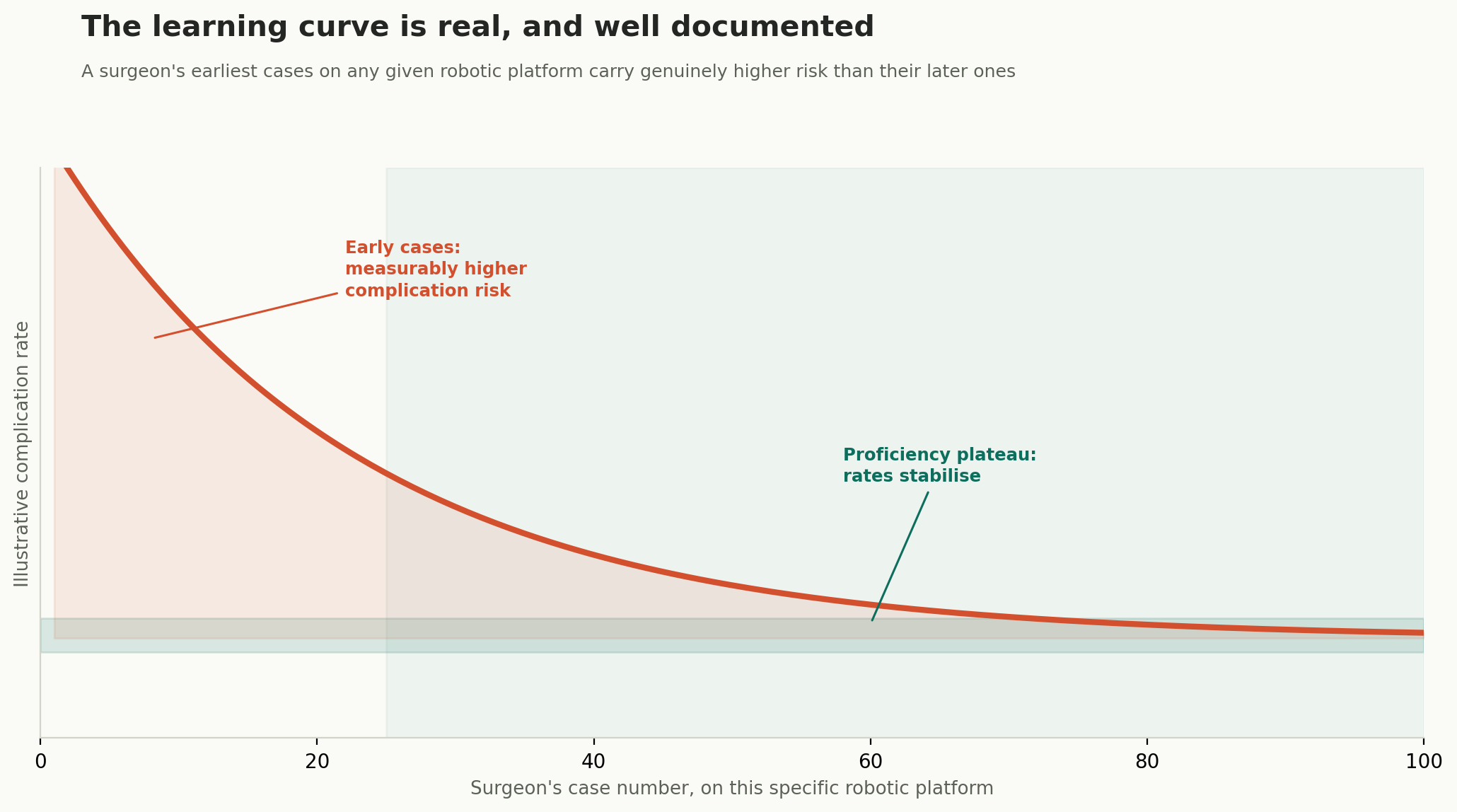
A surgeon's earliest cases on any given robotic platform carry genuinely higher risk than their later ones.
This learning curve is specific to each robotic platform and procedure, not a general skill that transfers automatically from one system or operation to another. A surgeon with genuine, extensive experience on one robotic platform, or with a different procedure entirely, may still be relatively early in their personal learning curve for the specific platform and operation being proposed for your case. Asking directly about this specific, relevant experience matters more than general robotic surgery credentials.
This is not a reason to distrust every early-career robotic surgeon; every surgeon, however skilled they eventually become, necessarily passes through this same early period at some point. It is a reason to ask the question directly and honestly, rather than assuming a hospital's overall reputation, or the newness of its equipment, tells you where a specific surgeon sits on their own individual curve.
A Common Misconception, Corrected
The robot has never made a single decision
Understanding what the robotic system actually does, and does not do, reframes the entire evaluation process.
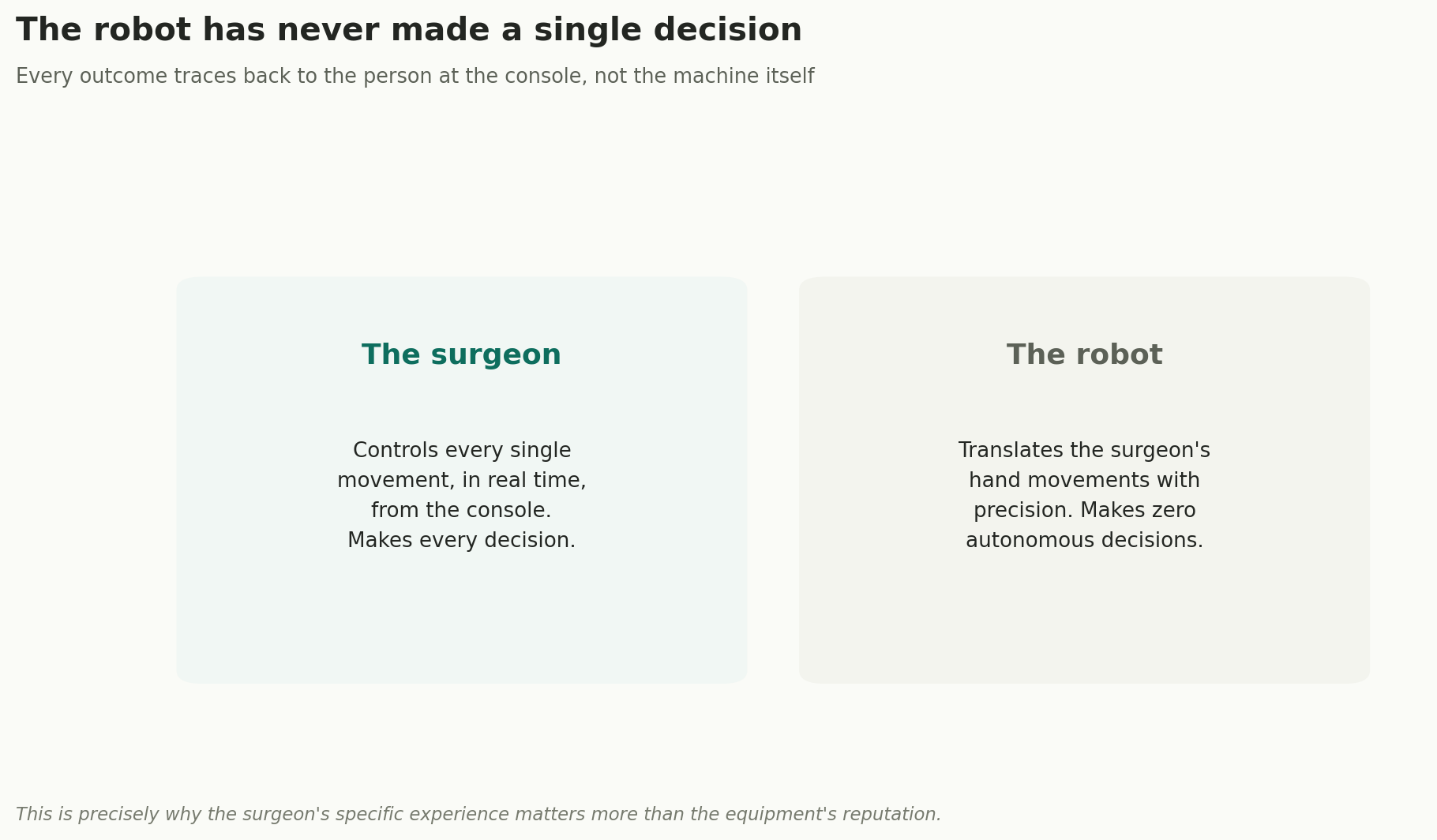
This is precisely why the surgeon's specific experience matters more than the equipment's reputation.
A hospital's investment in the newest robotic platform is a genuinely relevant, positive factor, but it does not, on its own, determine the quality of a specific operation. That determination rests with the individual surgeon's skill, judgement, and specific experience with that exact system, which is why this guide places such deliberate emphasis on verifying the person, not just the equipment.
This distinction is worth explaining clearly to family members supporting a patient through this decision, since marketing materials for robotic surgery programmes understandably emphasise the technology's precision and capability. That precision is real, but it is a description of what the tool can achieve in skilled hands, not a promise about the specific hands that will actually be used.
A note on conversion-to-open rates, since this is a genuinely useful, trackable metric. A conversion-to- open rate describes how often a planned robotic procedure needs to switch to open surgery mid-operation, usually due to technical difficulty or an unexpected complication. A surgeon's specific, tracked conversion rate for your exact procedure is a genuinely informative question, and a confident, experienced surgeon will typically know this figure and discuss it honestly.
THE BALANCE
The hands on the console decide most of this
Given how directly every surgical movement originates from the individual surgeon, this evaluation weights meaningfully toward the practitioner.
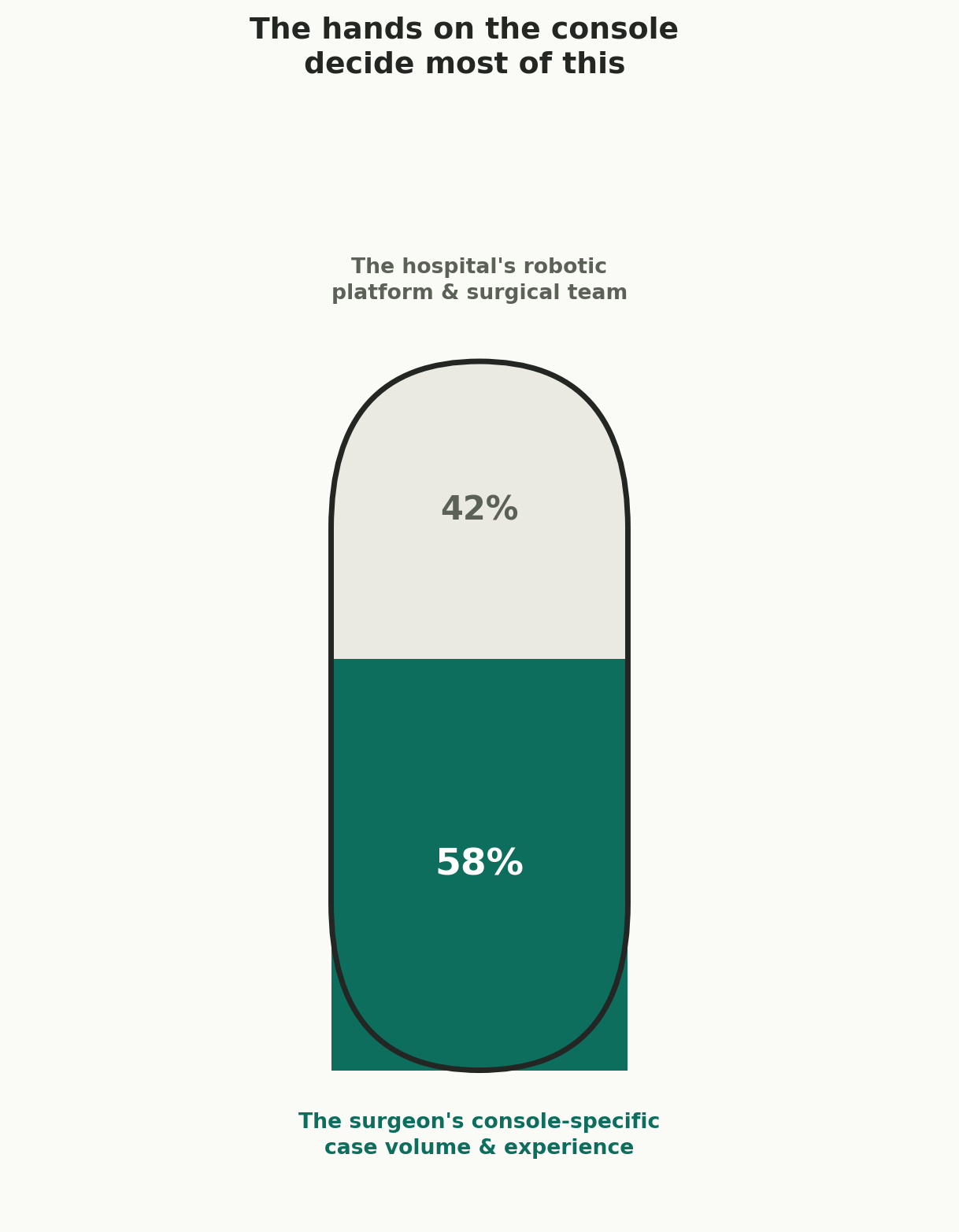
Every outcome traces back to the person at the console, not the machine itself.
The hospital's role remains genuinely important: a well-maintained, genuine robotic platform and an experienced surrounding surgical team both matter. But because the robotic system itself contributes no independent judgement, the surgeon's specific, platform-relevant skill and experience carry the larger relative share of what actually determines a successful outcome. This weighting sits close to the credential- heavy balance used elsewhere in this series for procedures where an individual practitioner's specific, verifiable training shapes outcomes more than the surrounding facility.
THE VETTING CONVERSATION
What to actually ask
Questions for the surgeon
- How many cases have you personally performed on this specific robotic platform, for this specific procedure? A specific, confident number is reasonable to expect.
- What is your conversion-to-open rate for this specific procedure? An honest, specific answer suggests genuine, tracked experience.
- How does your experience with this platform compare to your experience with laparoscopic or open approaches? This helps contextualise their overall skill profile.
- What complications have you personally encountered, and how were they managed? A thoughtful, honest answer is a genuinely good sign.
Questions for the hospital
- Which specific robotic platform and model is installed, and how long has it been in use? This should be a clear, specific answer.
- What is the surgical team's collective experience supporting robotic procedures? The wider team matters, not the surgeon alone.
- What is the hospital's own outcome and conversion data for this specific procedure? Specific, tracked figures matter more than general reputation.
- What backup plan exists if conversion to open surgery becomes necessary? This should be a clear, rehearsed protocol.
Nigeria-specific Considerations
Why this verification matters even more right now
With robotic surgery capacity in Nigeria only just beginning, discussed in detail in this series' main Robotic Cancer Surgery guide, most Nigerian patients considering this treatment are evaluating international programmes with well-established platforms and surgical teams. This makes the specific, individual verification questions in this guide particularly worthwhile: an internationally established programme is likely to have surgeons considerably further along their own learning curves than would be realistic to expect from a newly launched domestic programme, but this should still be confirmed directly, not assumed.
Four warning signs worth taking seriously
- Inability or reluctance to state a specific case volume on the exact platform proposed. This should be a confident, specific answer.
- No willingness to discuss conversion-to-open rates honestly. This is genuinely useful, trackable information.
- Marketing language suggesting the robot itself performs the surgery. This misrepresents how the technology actually works.
- No clear backup protocol for converting to open surgery if needed. This should be a rehearsed, confident plan.
A practical order of operations
- Confirm robotic surgery is genuinely indicated using this series' main Robotic Cancer Surgery guide first.
- Ask directly for the surgeon's specific case volume on the exact platform and procedure.
- Ask about conversion-to-open rates and how complications have been managed previously.
- Ask the surgeon-side and hospital-side questions above before committing to a programme.
- Travel, surgery, and a recovery period appropriate to the specific procedure performed.
- Establish a coordinated follow-up relationship with a Nigerian oncologist before returning home.
Straight Answers for Nigerian Patients about Robotic Cancer Surgery in India
Does the robot make any of its own decisions?
No. It translates the surgeon's own hand movements in real time, making no autonomous decisions. Every outcome traces back to the person at the console.
Is general robotic experience enough, or does the specific platform matter?
The specific platform and procedure matter. A surgeon's earliest cases on any given system carry measurably higher risk than their later cases, even with extensive experience elsewhere.
What is a conversion-to-open rate?
How often a planned robotic procedure switches to open surgery mid-operation. A lower rate for a specific surgeon and procedure is a genuine indicator of proficiency.
Why does the surgeon matter more than the hospital here?
Since the robotic system has no autonomous capability, every movement originates from the surgeon, giving their specific experience a larger relative share of the outcome.
What is a realistic red flag when choosing a provider?
Inability to state a specific case volume, reluctance to discuss conversion rates, or marketing suggesting the robot performs the surgery, are genuine warning signs.
A closing word
Robotic surgery marketing often centres the machine, its precision, its magnification, its advanced engineering. All of this is genuinely real, and none of it changes the fact that a human being, with a specific, individual amount of experience on that exact system, is making every single decision during the operation. In twenty-four years of this work, the patients who navigate this best ask for a specific, platform-relevant case number, request an honest conversion-to-open rate, and evaluate the surgeon with the same seriousness most patients reserve for evaluating the equipment. The robot is a remarkable tool. It has never once decided anything on its own.
Sources
- 🌐 Society of American Gastrointestinal and Endoscopic Surgeons — Robotic surgery learning curve, published guidance
- 🌐 American Cancer Society — Robotic surgery for cancer, patient information
- 🌐 American Urological Association — Robotic-assisted surgery, patient resources
- 🌐 NHS (UK) — Robotic surgery: overview – nhs.uk
- 🌐 High Commission of India, Abuja — Medical and Medical Attendant Visa requirements
Frequently Asked Questions by Nigerians about Robotic Cancer Surgery in India
Does the robotic system perform the cancer surgery by itself?
No. The guide clearly explains that the surgeon controls every movement from the console. The robot translates those movements with precision and makes no independent decisions.
Is general robotic surgery experience enough when choosing a surgeon?
No. The guide stresses that the learning curve is specific to the exact robotic platform and procedure. Experience on another system or operation does not automatically transfer.
Why does the surgeon's case volume matter?
A surgeon's earliest cases on a specific robotic platform generally carry higher complication risk, with proficiency increasing as experience accumulates. Specific case numbers are therefore useful when evaluating expertise.
What is a conversion-to-open rate?
It is the percentage of planned robotic procedures that need to be converted to open surgery during the operation, usually because of technical difficulty or an unexpected complication.
Why should Nigerian patients ask about conversion-to-open rates?
A specific, tracked rate can provide useful information about a surgeon's experience with the exact procedure, particularly when discussed alongside the reasons for previous conversions.
Does having the newest robotic platform guarantee better surgery?
No. The guide states that advanced equipment is valuable, but the surgeon's skill, judgement and platform-specific experience remain central to the outcome.
What should Nigerian patients ask the hospital about its robotic programme?
They should ask which robotic platform and model is installed, how long it has been used, the surgical team's collective experience and the hospital's procedure-specific outcomes.
What happens if robotic surgery has to be converted to open surgery?
The hospital should have a clear and rehearsed backup protocol for conversion to open surgery. Patients should ask about this before committing to treatment.
Why is specific verification important for Nigerian patients?
The guide notes that robotic surgery capacity in Nigeria is only beginning to develop, so patients evaluating international programmes should verify the individual surgeon's experience rather than assuming an established hospital automatically means an experienced surgeon.
What are the main warning signs when choosing a robotic cancer surgeon?
Warning signs include no specific platform case volume, reluctance to discuss conversion rates, marketing that suggests the robot performs the operation and no clear open-surgery backup plan.
Page Summary
This guide explains how Nigerian patients can select robotic cancer surgeons and hospitals in India, with its central focus on the surgeon's specific experience rather than the reputation or sophistication of the robotic equipment alone. The page 2 chart illustrates the real learning curve, showing that early cases on a specific robotic platform carry higher complication risk before rates stabilise with experience. The page 3 diagram explains that the surgeon controls every movement while the robot makes no autonomous decisions, and introduces conversion-to-open rate as a useful surgeon-specific metric. The page 4 evaluation gives 58% weight to the surgeon's console-specific case volume and experience and 42% to the hospital's robotic platform and surgical team. The guide also emphasises procedure-specific outcome data, open-surgery backup and coordinated follow-up in Nigeria.
Citation Block
| Topic | Information |
|---|---|
| Topic Information | Selecting the Best Robotic Cancer Surgeons and Hospitals in India for Nigerian Patients for Patients from Nigeria |
| Treatment | Robotic Cancer Surgery |
| Intended Audience | Patients from Nigeria |
| Key Specialist | Surgical Oncologist / Robotic Cancer Surgeon |
| Main Technology | Robotic Surgical Platform |
| Primary Evaluation Factor | Surgeon-Specific Platform and Procedure Experience |
| Learning Curve | Specific to Each Robotic Platform and Procedure |
| Key Metric | Procedure-Specific Conversion-to-Open Rate |
| Evaluation Weighting | 58% Surgeon; 42% Hospital |
| Surgeon Check | Confirm Exact Platform and Procedure Case Volume |
| Experience Check | Ask About Relevant Robotic, Laparoscopic and Open-Surgery Experience |
| Outcome Check | Request Specific Outcome and Conversion Data for the Procedure |
| Hospital Check | Verify Platform Model, Length of Use and Surgical Team Experience |
| Backup Check | Confirm a Clear Protocol for Conversion to Open Surgery |
| Complication Check | Ask How Previous Robotic Complications Were Managed |
| Nigeria-Specific Check | Establish Follow-Up With a Nigerian Oncologist Before Returning Home |
| Important Warning | Marketing That Suggests the Robot Performs the Surgery |
| Pre-Travel Requirement | Confirm Robotic Surgery Is Appropriate for the Specific Diagnosis |
| Patient Journey | Confirm indication → surgeon/platform evaluation → hospital assessment → travel/surgery → recovery → Nigerian follow-up |
| Follow-Up | Coordinated Oncology Care After Returning to Nigeria |


Our Mission Statement
Our mission is to place patients at the centre of every healthcare decision by providing trustworthy, evidence-based, and unbiased medical information. We believe that informed patients make better decisions. Backed by personalised guidance from our experienced advisory team, we help patients understand their treatment options, compare them objectively, and confidently choose the path that best suits their medical needs and personal circumstances.
Patient Testimonials from Nigeria















Ready to Take the First Step?
Share your Medical Reports with our Healthcare Managers Today and Get a FREE CONSULTATION, a Personalized Treatment Plan, and Complete Support from Arrival to Recovery.
Get Your Free ConsultationAreas We Serve
This resource has been thoughtfully prepared for patients from Nigeria who are considering medical treatment in India. We also welcome patients from the wider region in the countries mentioned below-
We assist patients from:
- Benin
- Niger
- Chad
- Cameroon
- Algeria
- Egypt
- Libya
- Morocco
- Sudan
- Tunisia
- Gambia
- Ghana
- Burkina Faso
- Cabo Verde
- Côte d'Ivoire
- Equatorial Guinea
- São Tomé and Príncipe
Many of the insights, treatment pathways, hospital recommendations, travel guidance, and patient support services described here are equally relevant and may be used as a reference when planning treatment in India.
From Nigeria to India: Your Complete Patient Support Guide
- Artificial Disc Replacement in India for Nigerian Patients
- Weight Loss and Bariatric Surgery in India for Nigerian Patients
- Bone Marrow Transplant in India for Nigerian Patients
- Brain Tumour Surgery in India for Nigerian Patients
- Breast Cancer Treatment and Surgery in India for Nigerian Patients
- Cancer Treatment and Surgery in India for Nigerian Patients
- Cardiac Arrhythmia and Heart Pacemaker Treatment in India for Nigerian Patients
- Cardiac Surgery in India for Nigerian Patients
- Colorectal Cancer Treatment and Surgery in India for Nigerian Patients
- Complex Orthopaedic and Joint Revision Surgery in India for Nigerian Patients
- Cornea Transplant and Advanced Eye Surgery in India for Nigerian Patients
- CyberKnife Treatment in India for Nigerian Patients
- Gamma Knife Treatment in India for Nigerian Patients
- Heart Failure Treatment and Surgery in India for Nigerian Patients
- Hip Surgery in India for Nigerian Patients
- HIPEC Cancer Surgery in India for Nigerian Patients
- IVF and Fertility Treatment in India for Nigerian Patients
- Joint Arthroscopy and Sports Medicine in India for Nigerian Patients