

Selecting the Best Radiotherapy and Modern Cancer Treatment Centres in India for Nigerian Patients
The word "radiotherapy" covers technology spanning decades. Which specific generation your treatment uses matters as much as who is planning it.
More than half of all cancer patients will need radiotherapy as part of their treatment at some point, yet the word itself covers a genuinely wide range of technology. A cobalt-60 machine, still in active use in parts of Africa, delivers a broader, less precise beam than a modern linear accelerator, which in turn falls short of the real-time image guidance and beam shaping available through techniques like IMRT and IGRT. Two hospitals both offering "radiotherapy" may be offering treatments separated by decades of precision, and that difference shapes both how effectively the cancer is treated and how much healthy tissue around it is spared. This guide, like this series' blood cancer guide, departs from the surgeon-centred structure used elsewhere, for a different but related reason: the defining factor here is not a proceduralist's hands but a machine's capability, operated and calibrated by a specialised team. Understanding this distinction changes what questions are actually worth asking.
Should you even be reading this guide? If radiotherapy has genuinely been recommended as part of your cancer treatment plan, this guide will help you evaluate the specific equipment, radiation oncologist, and hospital involved. If a full cancer diagnosis and treatment plan are not yet complete, that multidisciplinary planning process is the appropriate starting point.
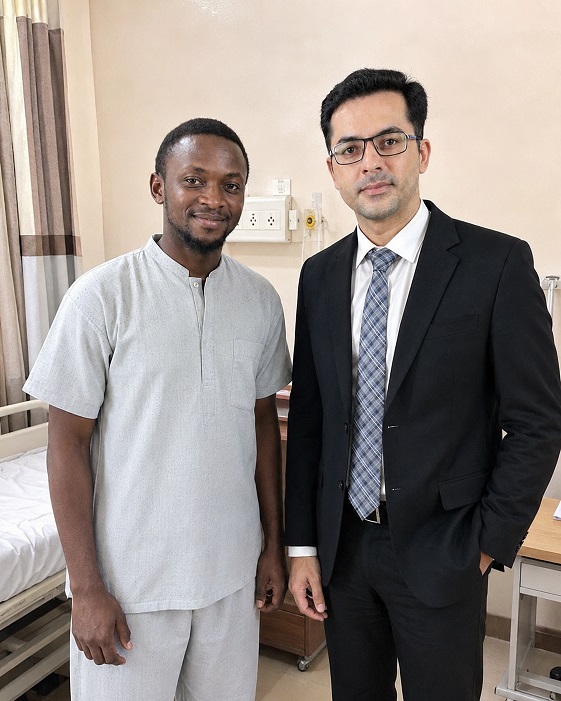
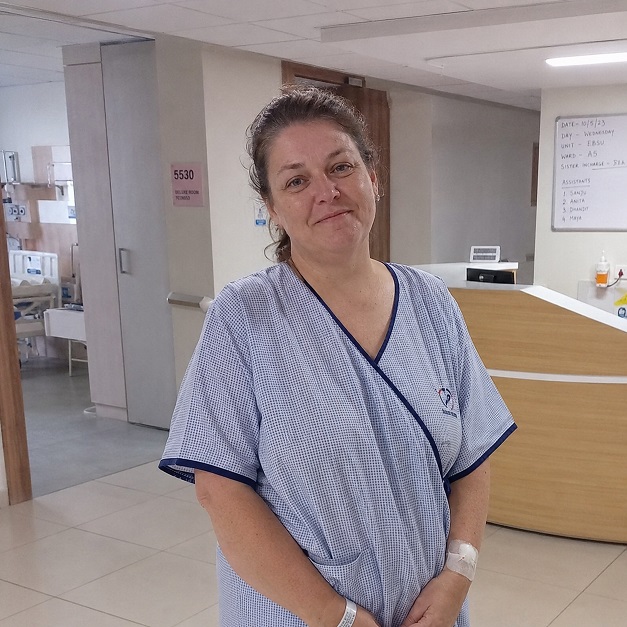
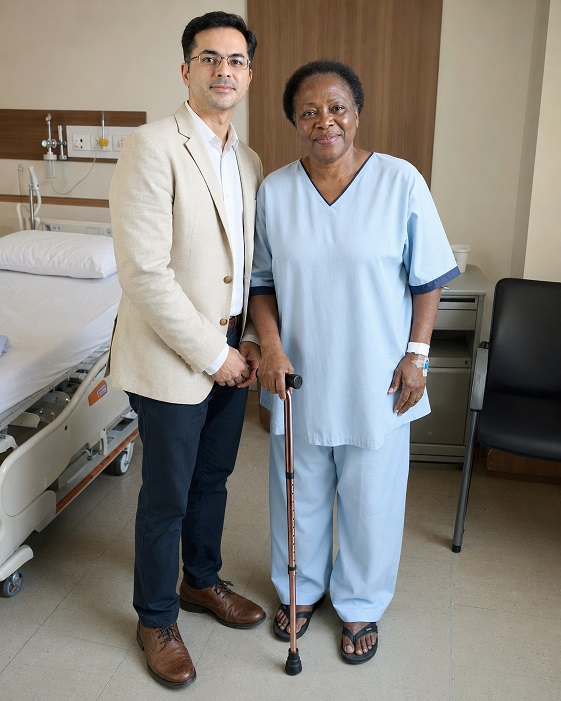
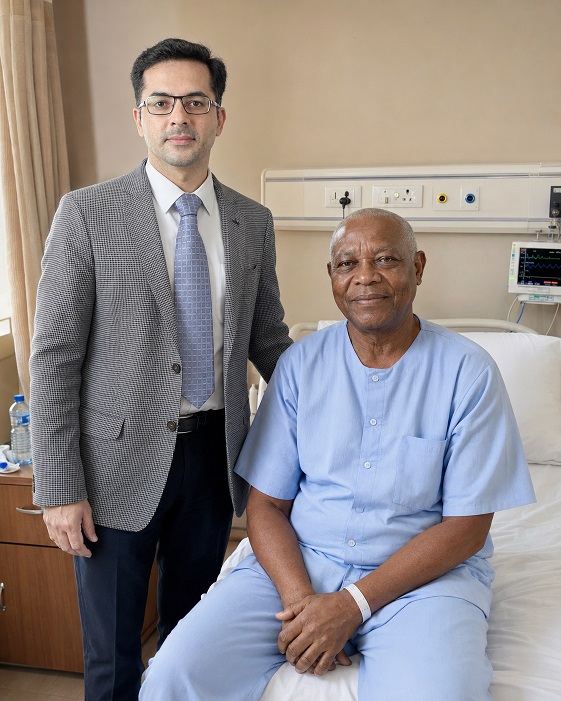
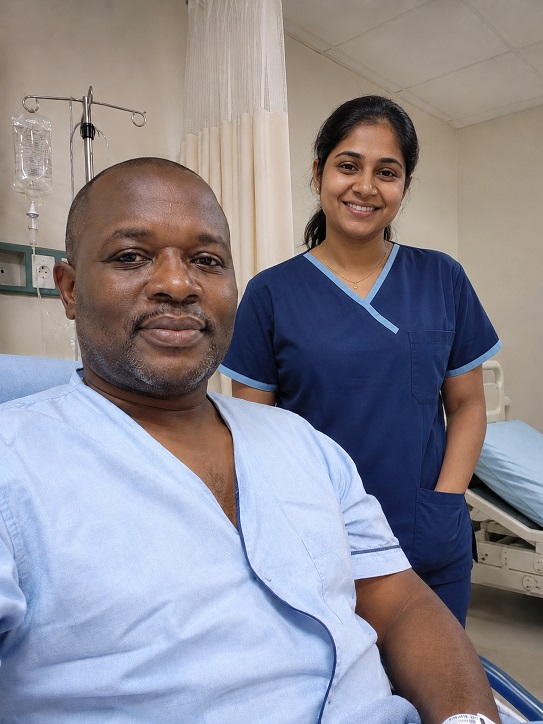
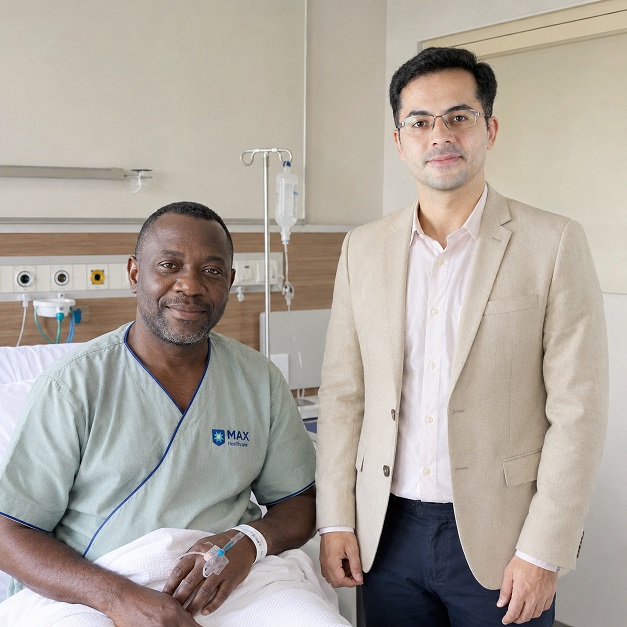
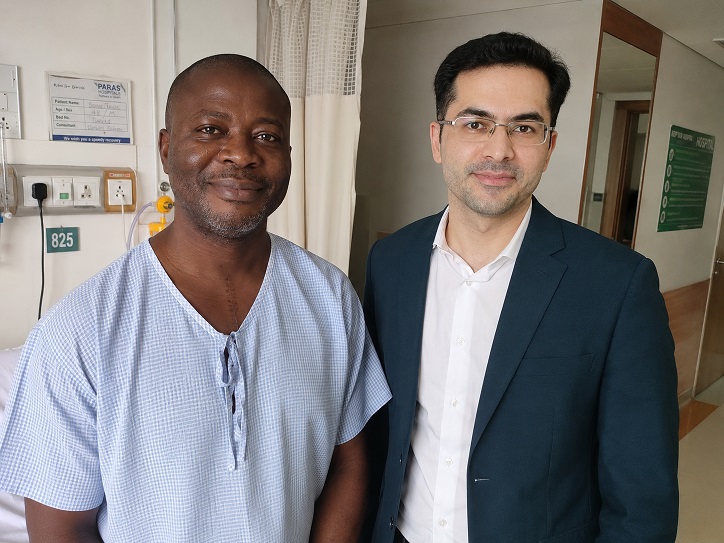
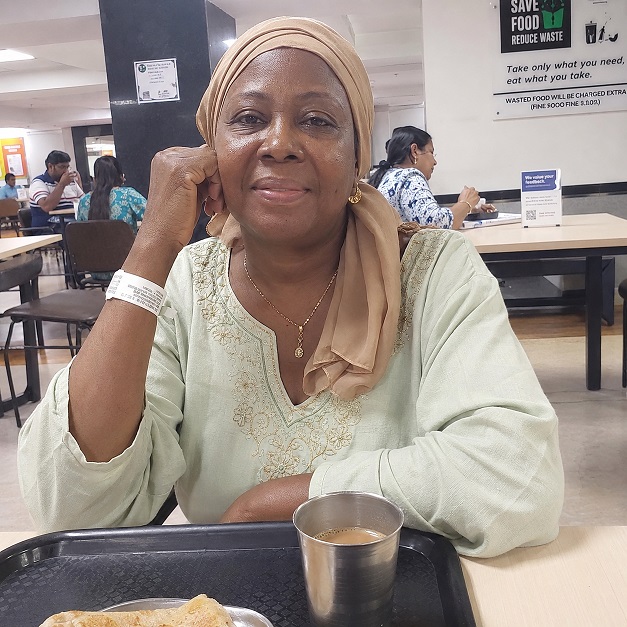
Healing Journeys of Nigerian Patients





Key Takeaways
- The term “radiotherapy” can describe technologies separated by decades of precision. A centre using an older cobalt-60 machine is not offering the same technical capability as a modern linear accelerator equipped for IMRT or IGRT.
- The guide therefore advises Nigerian patients to ask which exact machine and treatment technique will be used, rather than simply confirming that a hospital offers radiotherapy.
- Older cobalt-60 systems deliver broader, less precisely shaped radiation. Modern linear accelerators allow more sophisticated beam control, while techniques such as IMRT and IGRT provide substantially greater precision.
- IMRT—intensity-modulated radiotherapy—uses multiple beam segments with different intensities to shape the radiation dose more closely around the tumour while reducing exposure to nearby healthy structures.
- IGRT—image-guided radiotherapy—adds imaging immediately before or during treatment so the team can confirm the tumour's position and correct for daily anatomical changes.
- This matters clinically because greater precision can allow more effective tumour targeting while reducing radiation exposure to healthy tissues.
- The page 2 technology comparison makes this distinction central to the entire decision: patients should identify whether they are being offered older cobalt-based treatment, a standard linear accelerator, or modern image-guided treatment rather than accepting “radiotherapy” as a sufficiently specific description.
- Nigeria's radiotherapy access gap is described as severe and structural.
- However, the guide does not state that every Nigerian patient must travel. Where a domestic centre has a reliably functioning machine, proper imaging support and an appropriate treatment plan, local radiotherapy can still be a reasonable option.
- The recommended order is to confirm that radiotherapy is part of a coordinated multidisciplinary cancer plan, establish the exact machine and technique, confirm the number of fractions and duration, assess equipment reliability, plan for the entire multi-week stay and coordinate ongoing follow-up with a Nigerian oncologist.
Quick Facts
- Topic
- Selecting Radiotherapy and Modern Cancer Treatment Centres
- Country
- India
- Intended Audience
- Nigerian Cancer Patients and Families
- Primary Specialty
- Radiation Oncology
- Primary Treatment
- Radiotherapy
- Modern Core Equipment
- Linear Accelerator
- Nigeria Linear Accelerator Access Mentioned
- Approximately 1 Per 25.7 Million People
- Nigeria Capacity Trend
- More Than Halved Between 2012 and 2020
- Modern Planning Gap
- Limited CT / MRI Simulation Support
- Major Consequence of Machine Failure
- Treatment Delay or Interruption
- Hospital Role
- Equipment, Physics, Simulation and Schedule Reliability
- Main Decision Principle
- Choose the Machine, Physics Team and Reliable Treatment System—not merely a hospital that says it offers radiotherapy
- Author/Advisor
- Dr. Dheeraj Bojwani
- Experience
- 24 Years
In Brief
Selecting a radiotherapy centre in India requires Nigerian patients to evaluate technology and hospital infrastructure as carefully as the radiation oncologist. The term radiotherapy covers older cobalt-60 systems, standard linear accelerators and modern techniques such as IMRT and IGRT, which differ substantially in precision and healthy-tissue sparing. The guide cites a severe Nigerian access gap of approximately one linear accelerator per 25.7 million people versus roughly one per 250,000 in high-income countries. Because treatment is commonly delivered over several weeks, machine uptime, CT or MRI simulation, image guidance and medical-physics support directly affect whether a course can be completed accurately and without interruption. For this reason, the hospital's equipment and systems carry greater relative weight than the individual physician alone.
START HERE
"Radiotherapy" can mean genuinely different things
Understanding this range of technology is the necessary first step before evaluating any specific hospital or physician.
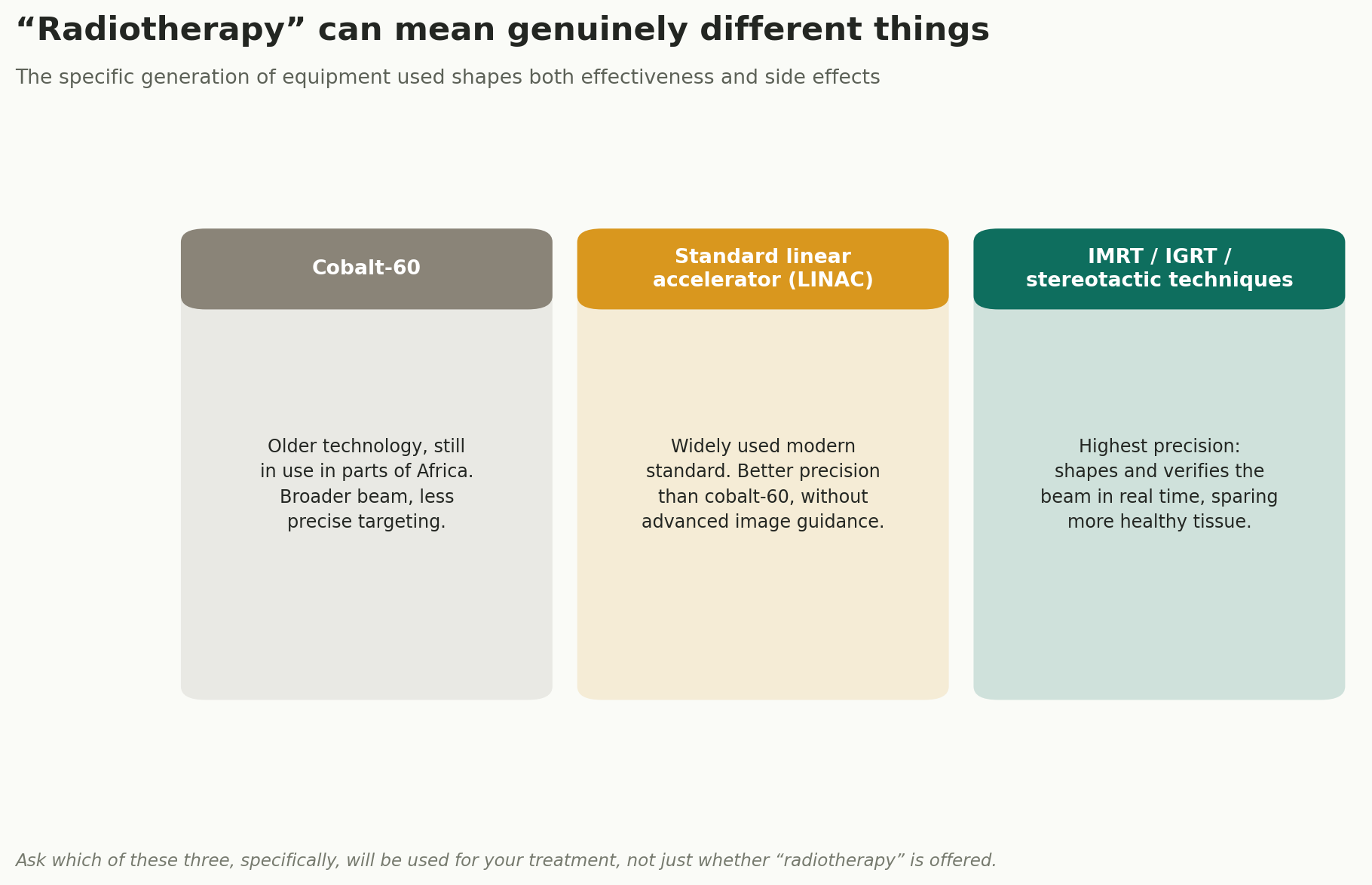
Ask which of these three, specifically, will be used for your treatment, not just whether "radiotherapy" is offered.
This is not a purely academic distinction. More precise techniques generally allow a higher, more effective dose to be delivered directly to the tumour while sparing more of the surrounding healthy tissue, which can meaningfully reduce side effects. A programme should be able to state clearly, and specifically, which of these three broad categories applies to your treatment, and why. A vague or evasive answer to this specific question is often more informative than any other single response a programme can give.
THE SCALE OF THE GAP
A hundredfold gap, not a rounding error
This technology gap is not evenly distributed globally, and Nigeria's specific position within it is worth understanding clearly.
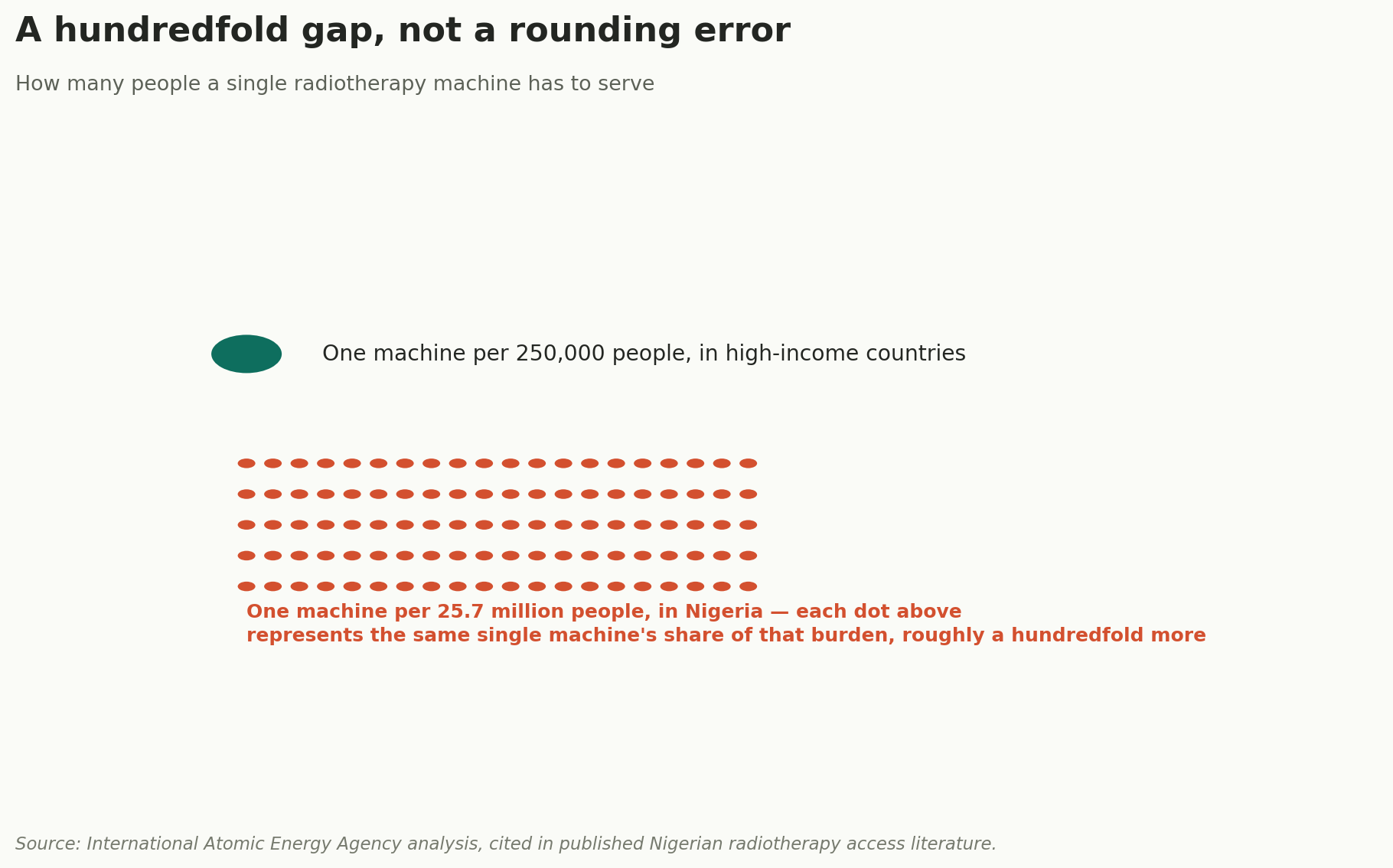
This gap has real, documented consequences beyond the raw numbers: frequent equipment breakdowns, limited maintenance capacity, and long waiting times that allow disease to progress during delay. Understanding the scale of this gap is what makes seeking treatment with reliable access to modern equipment, wherever that treatment ultimately happens, a genuinely serious consideration rather than an abstract preference. A delay measured in weeks or months, while waiting for a functioning machine, is not a minor inconvenience in cancer treatment; it can meaningfully affect the outcome itself.
A note on fractionation, since this is rarely a single appointment. Most radiotherapy is delivered across multiple sessions, or fractions, typically on weekdays over several weeks, rather than as a single treatment. This requires genuine logistical planning, accommodation, daily attendance, and the practical and emotional stamina for a sustained treatment course, not just the day of a single procedure. A missed or delayed session during this course can meaningfully affect treatment effectiveness, which is precisely why realistic logistics planning deserves the same seriousness as the medical decision itself.
THE BALANCE
The machine sets the ceiling
Because the specific generation of equipment available fundamentally limits what precision is even physically achievable, the hospital carries unusual weight in this specific decision.
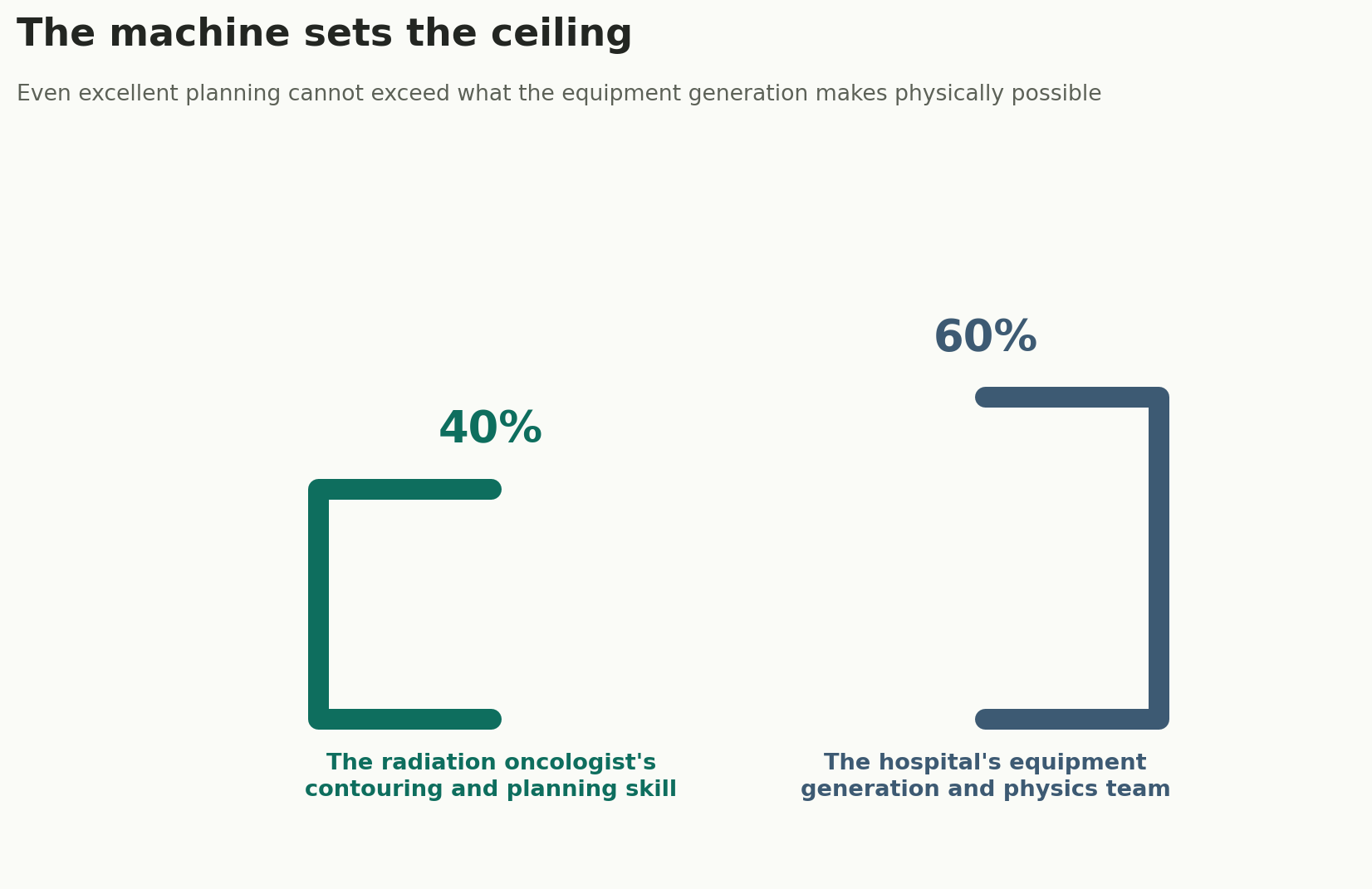
Even excellent planning cannot exceed what the equipment generation makes physically possible.
A brilliant radiation oncologist working with an older cobalt-60 machine cannot deliver the same precision as a competent one working with a modern IGRT-capable linear accelerator; the equipment itself sets a hard physical ceiling. This does not make the treating physician's skill in contouring the tumour and planning the dose irrelevant, it remains genuinely important, but it means the hospital's specific equipment and physics team deserve at least as much scrutiny as the individual physician's reputation. This is a genuinely different balance than surgeon-weighted procedures elsewhere in this series; here, the institution's physical infrastructure caps what even the most skilled individual can achieve.
THE VETTING CONVERSATION What to actually ask
Questions for the radiation oncologist
- Which specific technique will be used for my treatment, and why? A specific, confident answer, not a general reassurance, suggests real, current expertise.
- How many total sessions are planned, and over what timeframe? This should be a specific, individualised number.
- What are the realistic side effects for this specific technique and treatment site? A thorough, honest answer reflects genuine, case-specific experience.
- Is a medical physicist and dosimetrist directly involved in planning my treatment? This dedicated team role matters for precision and safety.
Questions for the hospital
- What specific equipment, and generation, will be used for my treatment? Ask directly whether it includes image guidance capability.
- What is the hospital's equipment maintenance and downtime history? Reliability affects whether a planned schedule is actually kept.
- Is CT or MRI simulation available for treatment planning? This directly affects planning accuracy.
- What logistical support exists for a multi-week treatment course as an international patient? This should be planned in advance, not improvised.
NIGERIA-SPECIFIC CONSIDERATIONS
A documented, severe, and specific gap
Published research places Nigeria's radiotherapy access gap among the most severe globally, and the country's total radiotherapy capacity has been documented as having more than halved between 2012 and 2020, even as cancer incidence rose. Of Nigeria's government-funded radiotherapy centres, only a minority report consistently functional linear accelerators, and most rely on older two-dimensional planning techniques without CT or MRI simulation support.
This context matters directly for how a Nigerian family should evaluate treatment abroad: the comparison is not between a modest domestic option and an excellent international one, but frequently between a genuinely limited, unreliable domestic option and access to consistently functional, modern equipment. This is a case where seeking treatment abroad reflects a documented, structural gap, not simply a preference for something unfamiliar. Where a curative window exists, the reliability of the equipment and schedule genuinely available can matter as much as the underlying medical decision itself.
Four warning signs worth taking seriously
- Vague answers about which specific equipment generation will be used. This should be a specific, confident answer.
- No mention of image guidance or advanced planning for a case where it would genuinely help. This should be raised proactively where relevant.
- An unclear total number of planned sessions or overall treatment timeframe. This should be specific from the outset.
- No discussion of the hospital's equipment reliability or maintenance history. A confident, experienced programme can speak to this directly.
A practical order of operations
- Confirm radiotherapy is part of a coordinated, multidisciplinary cancer treatment plan.
- Ask directly which specific equipment generation and technique will be used.
- Confirm the total number of sessions and realistic overall timeframe in advance.
- Ask the physician-side and hospital-side questions above, particularly around equipment reliability.
- Plan logistics for the full multi-week course, not just the first appointment.
- Coordinate follow-up care with a Nigerian oncologist for ongoing monitoring after treatment completes.
A closing word
Radiotherapy asks a family to evaluate something less visible than a surgeon's hands: a machine, a physics team, and weeks of sustained, precisely calibrated treatment. The equipment generation genuinely limits what is achievable before a single session even begins, making it a legitimate, central part of this evaluation, not a technical detail to leave unexamined. In twenty-four years of this work, the families who navigate this best ask specifically which equipment generation and technique will be used, confirm the full treatment schedule before travel, and take Nigeria's documented, severe access gap seriously as a genuine reason to look elsewhere, not a reason for discouragement. The sessions themselves are often brief. Getting the machine, the plan, and the weeks of consistency right is what this treatment actually depends on, and understanding that clearly is itself a genuine form of protection for anyone navigating this decision.
Sources
- 🌐 Infrastructural Challenges Lead to Delay of Curative Radiotherapy in Nigeria. JCO Global Oncology
- 🌐 Radiotherapy Resources in Africa: An International Atomic Energy Agency Update and Analysis of Projected Needs. Lancet Oncology
- 🌐 Status of Government-Funded Radiotherapy Services in Nigeria. JCO Global Oncology, 2022
- 🌐 American Society for Radiation Oncology — Patient information on radiotherapy techniques
- 🌐 High Commission of India, Abuja — Medical and Medical Attendant Visa requirements
Frequently Asked Questions by Nigerians about Radiotherapy and Modern Cancer Treatment in India
Is all radiotherapy essentially the same?
No. The guide distinguishes older cobalt-60 systems, standard linear accelerators and modern techniques such as IMRT and IGRT. The specific technology affects tumour targeting and how much healthy tissue is exposed.
How severe is Nigeria's radiotherapy access gap?
Nigeria has approximately one linear accelerator per 25.7 million people, compared to roughly one per 250,000 in high-income countries, a hundredfold gap, and total capacity has more than halved since 2012.
What is IMRT?
IMRT varies the intensity of multiple radiation beam segments so the dose can be shaped more precisely around an irregular tumour while reducing exposure to nearby healthy tissues.
What is IGRT?
IGRT uses imaging around the time of treatment to confirm the tumour's position and correct for daily movement or anatomical changes, improving targeting accuracy.
Why does the hospital matter more than the radiation oncologist in this guide?
The oncologist's planning skill matters, but the equipment generation sets a physical limit on achievable precision. A modern machine, strong physics team and reliable scheduling system therefore carry unusually high weight.
What should Nigerian patients ask the radiation oncologist?
Ask which exact technique will be used and why, the total number of sessions, expected site-specific side effects, and whether a medical physicist and dosimetrist are directly involved in planning.
What should patients ask the hospital?
Ask which machine and generation will deliver treatment, its maintenance and downtime history, whether CT or MRI simulation is available and what logistical support exists for the full multi-week course.
Why is equipment reliability so important in radiotherapy?
Most radiotherapy is delivered over multiple weekday sessions across several weeks. Significant interruptions can reduce treatment effectiveness, making machine uptime and schedule reliability clinically important.
Should every Nigerian patient travel to India for radiotherapy?
No. If a Nigerian centre has a reliably functioning machine, appropriate imaging support and a clear treatment schedule, local treatment may be reasonable. Travel becomes more relevant when access or modern precision cannot be reliably provided.
What are the main warning signs when choosing a radiotherapy centre?
Major warning signs include vague answers about equipment generation, no image-guidance discussion where appropriate, an unclear number of sessions or timeframe, and no willingness to discuss equipment maintenance or downtime.
Is all radiotherapy the same?
No. It spans older cobalt-60 machines to modern linear accelerators to advanced IMRT and IGRT techniques. The specific generation shapes both how effectively the tumour is targeted and how much healthy tissue is spared.
How long does a typical course of radiotherapy take?
Most radiotherapy is delivered across multiple sessions over several weeks, typically on weekdays, requiring genuine logistical planning for accommodation and attendance.
Why does the hospital carry more weight than the physician here?
The equipment generation sets a physical ceiling on achievable precision regardless of planning skill, giving the hospital's infrastructure a larger relative share of the outcome.
What is a realistic red flag when choosing a programme?
Vague answers about equipment generation, no discussion of image guidance where relevant, or an unclear treatment schedule, are genuine warning signs.
Page Summary
This guide explains how Nigerian patients should evaluate radiotherapy centres in India, starting with a point that is easy to miss: "radiotherapy" is not one technology. An older cobalt-60 unit, a standard linear accelerator and modern IMRT or IGRT differ greatly in how precisely radiation can be shaped around a tumour. That matters because Nigeria has roughly one linear accelerator per 25.7 million people against about one per 250,000 in high-income countries, and breakdowns create long waits. Treatment is delivered in fractions across weeks, so interruptions can cost a curative window — which is why the hospital's equipment outweighs the individual oncologist. Ask which machine, which generation, which technique, who plans the dose and what the downtime history looks like, and plan accommodation for the whole course rather than the first appointment.
Citation Block
| Topic | Information |
|---|---|
| Topic Information | Details |
| Topic | Selecting the Best Radiotherapy and Modern Cancer Treatment Centres in India for Nigerian Patients |
| Treatment | Radiotherapy |
| Country | India |
| Intended Audience | Nigerian Cancer Patients |
| Primary Specialty | Radiation Oncology |
| Technology Range | Cobalt-60 to Modern Linear Accelerator Systems |
| Advanced Techniques | IMRT and IGRT |
| Primary Selection Priority | Equipment Capability and Reliability |
| Treatment Planning | CT / MRI-Based Simulation Where Appropriate |
| Core Team | Radiation Oncologist, Medical Physicist and Dosimetrist |
| Main Decision Principle | Machine Capability and Course Reliability Set the Ceiling for Treatment Quality |


Our Mission Statement
Our mission is to place patients at the centre of every healthcare decision by providing trustworthy, evidence-based, and unbiased medical information. We believe that informed patients make better decisions. Backed by personalised guidance from our experienced advisory team, we help patients understand their treatment options, compare them objectively, and confidently choose the path that best suits their medical needs and personal circumstances.
Patient Testimonials from Nigeria


Ready to Take the First Step?
Share your Medical Reports with our Healthcare Managers Today and Get a FREE CONSULTATION, a Personalized Treatment Plan, and Complete Support from Arrival to Recovery.
Get Your Free ConsultationAreas We Serve
This resource has been thoughtfully prepared for patients from Nigeria who are considering medical treatment in India. We also welcome patients from the wider region in the countries mentioned below-
We assist patients from:
- Benin
- Niger
- Chad
- Cameroon
- Algeria
- Egypt
- Libya
- Morocco
- Sudan
- Tunisia
- Burkina Faso
- Cabo Verde
- Côte d'Ivoire
- Gambia
- Ghana
- Equatorial Guinea
- São Tomé and Príncipe
Many of the insights, treatment pathways, hospital recommendations, travel guidance, and patient support services described here are equally relevant and may be used as a reference when planning treatment in India.
From Nigeria to India: Your Complete Patient Support Guide
- Artificial Disc Replacement in India for Nigerian Patients
- Weight Loss and Bariatric Surgery in India for Nigerian Patients
- Bone Marrow Transplant in India for Nigerian Patients
- Brain Tumour Surgery in India for Nigerian Patients
- Breast Cancer Treatment and Surgery in India for Nigerian Patients
- Cancer Treatment and Surgery in India for Nigerian Patients
- Cardiac Arrhythmia and Heart Pacemaker Treatment in India for Nigerian Patients
- Cardiac Surgery in India for Nigerian Patients
- Colorectal Cancer Treatment and Surgery in India for Nigerian Patients
- Complex Orthopaedic and Joint Revision Surgery in India for Nigerian Patients
- Cornea Transplant and Advanced Eye Surgery in India for Nigerian Patients
- CyberKnife Treatment in India for Nigerian Patients
- Gamma Knife Treatment in India for Nigerian Patients
- Heart Failure Treatment and Surgery in India for Nigerian Patients
- Hip Surgery in India for Nigerian Patients
- HIPEC Cancer Surgery in India for Nigerian Patients
- IVF and Fertility Treatment in India for Nigerian Patients
- Joint Arthroscopy and Sports Medicine in India for Nigerian Patients